Last close As at 05/08/2026
SEK1.39
▲ −0.01 (−0.43%)
Market capitalisation
SEK197m
Research: Healthcare
IRLAB continued to progress its pipeline in Q224 and met key milestones, such as the clinical entry of IRL757 with non-dilutive backing from the Michael J Fox Foundation (MJFF) and the McQuade Center for Strategic Research and Development (MSRD). These partnerships provide external validation and de-risk the development plan (to proof of concept). After a supportive review from the independent data and safety monitoring board (DSMB), the pirepemat trial is on track to complete patient recruitment in Q324 (top-line results due in Q125) and mesdopetam may enter Phase III trials in Q424/Q125, pending successful partnership discussions. Cash of SEK98.3m at end Q224, supported by the US$3m (c SEK32m) MSRD upfront payment and the SEK25m debt facility drawdown, should provide an operational runway into Q125. Our valuation remains largely unchanged at SEK4.47bn or SEK86.2/share (from SEK4.56bn or SEK87.9/share).
Written by
IRLAB Therapeutics |
Anticipation builds as inflection points approach |
Q224 results |
Pharma and biotech |
11 July 2024 |
Share price performance
Business description
Next events
Analysts
IRLAB Therapeutics is a research client of Edison Investment Research Limited |
|||||||||||||||||||||||||||||||||||||||||||||||||||||||
IRLAB continued to progress its pipeline in Q224 and met key milestones, such as the clinical entry of IRL757 with non-dilutive backing from the Michael J Fox Foundation (MJFF) and the McQuade Center for Strategic Research and Development (MSRD). These partnerships provide external validation and de-risk the development plan (to proof of concept). After a supportive review from the independent data and safety monitoring board (DSMB), the pirepemat trial is on track to complete patient recruitment in Q324 (top-line results due in Q125) and mesdopetam may enter Phase III trials in Q424/Q125, pending successful partnership discussions. Cash of SEK98.3m at end Q224, supported by the US$3m (c SEK32m) MSRD upfront payment and the SEK25m debt facility drawdown, should provide an operational runway into Q125. Our valuation remains largely unchanged at SEK4.47bn or SEK86.2/share (from SEK4.56bn or SEK87.9/share).
Year end |
Revenue (SEKm) |
PBT* |
EPS* |
DPS |
P/E |
Yield |
12/22 |
61.3 |
(113.1) |
(2.18) |
0.0 |
N/A |
N/A |
12/23 |
5.7 |
(177.8) |
(3.43) |
0.0 |
N/A |
N/A |
12/24e |
75.6 |
(154.8) |
(2.98) |
0.0 |
N/A |
N/A |
12/25e |
27.5 |
(180.9) |
(3.49) |
0.0 |
N/A |
N/A |
Note: *PBT and EPS are normalised, excluding amortisation of acquired intangibles, exceptional items and share-based payments.
Q224: A constructive period for the pipeline
We see IRL757’s clinical entry as an endorsement of IRLAB’s pipeline strength (third asset to enter the clinic), with funding support from the MJFF and the MSRD providing external validation, de-risking the development path and freeing resources to invest in other key assets. This includes pirepemat, a potential treatment to improve balance and reduce falls in Parkinson’s disease patients (PD-Falls), which received its second and final approval from the DSMB, paving the way for enrolment completion in Q324 and top-line readout in Q125. We also expect the appointment of Kristina Torfgård as CEO (effective 1 August 2024), with her experience in the neurodegenerative space, to support IRLAB’s development objectives as it approaches key inflection points in H224 and H125.
All eyes on securing a partner for mesdopetam
We expect investor interest to be focused on obtaining a collaboration/out-licensing partner for mesdopetam in H224, prior to the anticipated launch of twin Phase III trials in Q424 and Q125 (three-month studies recruiting c 250 patients in total). We view this as a crucial event that is likely to influence the future development course for pirepemat (self-development vs partnership) and the pace of development of IRLAB’s preclinical pipeline.
Valuation: SEK4.47bn or SEK86.2 per share
We update our estimates for the Q224 results but keep our long-term assumptions mostly unchanged (see previous note). Our valuation adjusts modestly to SEK4.47bn or SEK86.2/share (from SEK4.56bn or SEK87.9/share), with roll-forward benefits offset by the strengthening of the Swedish krona. The gross cash position of SEK98.3m at end-Q224 provides headroom to Q125, past key upcoming events (pirepemat Phase IIb trial completion; partner for mesdopetam).
Pipeline set to span all stages of clinical development
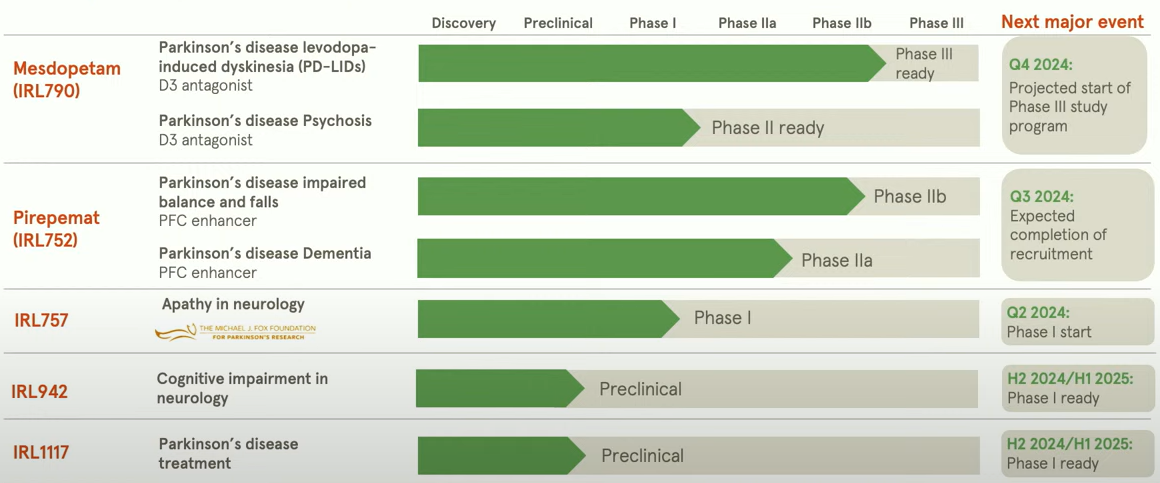
Mesdopetam (PD-LIDs; Phase III-ready)
During its Q224 results presentation, IRLAB re-affirmed that mesdopetam remains a top strategic priority, as it is a candidate that has shown promise to address levodopa-induced dyskinesias (PD-LIDs). After a successful end-of-Phase II meeting, management is aligned with the FDA for the proposed Phase III programme design. The Unified Dyskinesia Rating Scale (UDysRS) is the planned primary endpoint measure (endpoint met with statistical significance in the prior Phase IIb trial), with secondary endpoints based on sub-sections of the UDysRS, the MDS Unified PD Rating Scale and 24-hour patient motor diaries. This will involve c 250 patients in total, with a treatment duration of 12 weeks at a dosage of 7.5mg BID, running across two separate studies in parallel. IRLAB will also undertake an open label extension study, offered to participants from the Phase III studies and aimed at generating longer-term data (at least one year) from at least 100 patients, to support its registrational plans with the regulators. During the last quarter, management has been preparing for discussions with European regulatory authorities to ensure the planned design of the Phase III programme is also appropriate in this region. We understand that a partnership is required to finance these late stages of development and discussions with potential partners continues to be a significant focus. In our view, the next key inflection point for IRLAB will be the signing of a potential partner, which we believe is required prior to the start of Phase III trials.
We highlight that, if successful with regulatory approval for PD-LIDs, mesdopetam’s profile may offer differentiation over Adamas Pharmaceuticals’ GOCOVRI (sales of US$119.6m in 2023). While GOCOVRI has been approved by the FDA for PD-LIDs, it is associated with a multitude of side effects, which include symptoms of psychosis (such as hallucinations). While IRLAB is primarily focused on the development of mesdopetam for PD-LIDs, it has previously shown potential as a treatment for PD-Psychosis and, as such, management has communicated that this may represent an opportunity for first label expansion. However, we note that the strategy for this additional indication may be determined by the selected partner for the asset.
Pirepemat (PD-Falls; Phase IIb trial ongoing)
Another strategic priority for IRLAB is to complete patient recruitment for the ongoing React PD trial, which is assessing pirepemat’s ability to improve balance and reduce falls in PD patients. In July 2024, the company announced that the DSMB had completed its final pre-specified review and unanimously recommended that the trial should continue according to the approved protocol without modification. In February 2024, IRLAB reported that the baseline data showed subjects were two-to-three times more likely to experience falls than anticipated, which, according to management, provided higher probability of observing treatment-dependent effects. More patients than expected had chosen to complete the study, reflecting a lower-than-anticipated drop-out rate. These observations led to management requesting to reduce the number of participants required to complete the trial, while expecting to retain the pre-agreed statistical power. In its Q224 report, IRLAB confirmed that regulatory authorities in France, Poland, the Netherlands, Spain, Sweden and Germany (38 sites in total across which the trial is being conducted) have accepted and provided support to accommodate these amendments to the study size and planned analyses. As a result, patient recruitment remains on track to be complete within Q324, consistent with previous guided timelines, and we expect top-line results to be shared in Q125, after the three-month treatment period, follow-up visits and data analyses. As pirepemat is IRLAB’s second most advanced asset, we believe the Phase IIb results could represent an inflection point.
IRL757 (apathy; Phase I safety study commenced)
As discussed, this programme recently commenced Phase I studies, following a swift turnaround from regulatory green light (announced on 6 May 2024) to first patient dosing (announced on 22 May 2024). IRL757 has been designed as a potential treatment for apathy, a common symptom that impairs the quality of life for numerous patients suffering from neurological conditions. The Phase I trial aims to evaluate the safety, tolerability and pharmacokinetics of IRL757 in healthy volunteers, and will include single and multiple ascending dose parts, along with a food-effect analysis. We expect top-line results to be reported in Q125. Encouragingly, IRLAB has received support from both the MJFF and the MSRD for this programme, with the Phase I study financed by the MJFF via a US$2m (c SEK22m) grant. The MSRD is set to fund subsequent R&D efforts until proof-of-concept (in return for low single-digit royalties), with the possibility of an extension, contingent on deal negotiation. The MSRD has also made an upfront payment of US$3m to IRLAB with a potential additional US$5.5m in development milestones. Management has indicated that trial costs to proof-of-concept for similar programmes can go up to US$25m, indicating MSRD’s funding commitment.
In our view, the validation from these external groups highlights the potential of the programme to address the unmet medical need. While precise prevalence rates of apathy can vary (as they are often complicated with co-symptoms, such as depression and anxiety due to variations in assessment tools and protocols), it is estimated that apathy affects 20–70% of PD patients and 20–90% of Alzheimer’s disease patients. As there are no approved treatments for apathy, we believe this could translate to a sizeable opportunity for IRLAB.
Preclinical programmes
IRLAB has two active preclinical programmes, which management remains committed to driving development activities through to Phase I readiness.
IRL942 has been designed to address cognitive impairment in patients with neurological conditions. Throughout Q224, IRLAB has continued to advance the development of this asset in preclinical studies and has started Good Manufacturing Practice manufacturing of drug substance on a larger scale in preparation for Investigational New Drug-enabling (IND-enabling) studies, focused on toxicology and safety. Management has communicated that the programme is progressing as anticipated. Subject to delays, IRL942 could be Phase I-ready by end-2024, or in H125, depending on scheduling with the designated contract research organisation.
IRL1117 is being developed as a potential once-daily treatment for PD, either as a monotherapy or as an adjuvant to the current mainstay for PD treatment, levodopa. Preclinical studies suggest that IRL1117 could have a full anti-parkinsonian effect, without the complications associated with levodopa. Manufacturing efforts for IND-enabling studies are ongoing and, as with IRL942, this programme is also on track to be Phase I-ready by end-2024 or in H125.
|
Exhibit 1: IRLAB’s development portfolio |
|
|
Source: IRLAB Q224 results presentation |
Valuation
We recently published our updated valuation (June 2024) to reflect the potential contribution from IRL757, following the commencement of Phase I studies, and our underlying long-term assumptions and drivers remain unchanged following the Q224 results. Our valuation adjusts to SEK4.47bn or SEK86.2 per share (from SEK4.56bn or SEK87.9/share), with the benefits from our model roll-forward offset by the strengthening of the Swedish krona against the US dollar (0.095$/SEK vs 0.092$/SEK at the time of the last update). Exhibit 2 presents a breakdown of our risk-adjusted net present value (rNPV) valuation for IRLAB.
Exhibit 2: IRLAB Therapeutics rNPV valuation
Product |
Indication |
Launch |
Peak |
Peak sales |
Value |
Probability |
rNPV |
rNPV/share (SEK) |
|
Mesdopetam |
PD-LIDs |
2028 |
2034 |
1,268.5 |
4,965.3 |
40% |
1,994.0 |
38.4 |
|
Mesdopetam |
PD-Psychosis |
2032 |
2038 |
726.5 |
1,215.9 |
20% |
219.8 |
4.2 |
|
Pirepemat |
PD-Falls (postural hypotension) |
2029 |
2035 |
1,057.2 |
6,440.8 |
30% |
1,897.4 |
36.6 |
|
IRL757 |
Apathy (PD and AD) |
2031 |
2037 |
2,305.7 |
4,190.6 |
7.5% |
314.3 |
6.1 |
|
Net cash at 30 June 2024 |
|
|
|
43.3 |
100% |
43.3 |
0.8 |
||
Valuation |
|
|
|
16,855.9 |
4,468.8 |
86.2 |
|||
Source: Edison Investment Research
Financials
IRLAB’s Q224 results were broadly in line with our expectations, with the top-line growth and cash flows benefiting from the US$3m (c SEK32m) upfront payment from the MSRD. Reported revenues for the quarter were SEK42.8m (vs SEK6.9m in Q223) and included payment of c SEK10m in invoiced costs to the MSRD, related to pre-Phase I development work (such as chemistry, manufacturing, and controls work, and toxicology) for IRL757. Management has indicated that it invoiced the MSRD a total of US$5.1m (c SEK55m) in development costs in Q224, which will be reflected in the financial statements over the next 12 months.
Operating expenses for the quarter were reported at SEK53.2m, over 40% higher than Q124’s figure of SEK37.6m, although broadly in line with the SEK51.7m recorded in Q223. This upward trend was mainly due to higher R&D expenses (SEK49.1m vs SEK28.9m in Q124) for IRL757, as it entered the clinic in May 2024. However, given that the IRL757 development programme costs will be footed by the MJFF and the MSRD through to proof-of-concept (invoiced as revenues as reflected above, offsetting the increase in costs), the net impact on operating margin from this treatment was negligible. Overall operating loss for Q224 was SEK5.1m (Q124: SEK37.6m). Interest expenses during the period was SEK2.5m and we expect this figure to increase with the drawdown of the remaining SEK25m from the original SEK55m loan facility with Fenja Capital (formerly Formue Nord). Net loss for Q224 was SEK7.1m (vs SEK44.9m in Q223 and SEK39.0m in Q124).
Based on the Q224 results and to reflect IRLAB’s recognition of revenues and costs related to the development of IRL757, we have made certain adjustments to our short-term estimates. For FY24, we have increased our revenue estimate from SEK32.6m to SEK75.6m, reflecting the Q224 revenue contribution, as well as potential further sales recognition from the costs already invoiced to the MSRD. We assume SEK27.5m of the SEK55m invoiced costs will be recognised as revenue in H224, with the remainder due in FY25. This results in revenues of SEK27.5m in FY25e versus zero previously. We make similar adjustments to our expense estimates (raising the costs by the amounts invoiced), with the net impact leading to minor changes to our operating loss estimates. For FY24, our revised operating loss estimate is SEK151.6m (vs SEK157.6m previously), with the difference stemming from the SEK5.3m in other operating income recognised in the quarter. For FY25, our operating loss estimate stands broadly unchanged at SEK174.1m (from SEK174.8m previously). Note that our estimates do not account for the incremental contribution from the US$5.5m in potential activity-based milestone payments under the MSRD collaboration deal.
IRLAB had an end-Q224 gross cash position of SEK98.3m (net cash of SEK43.3m accounting for SEK55.0m in debt outstanding), reflecting the c SEK32m upfront payment from the MSRD and the SEK25m from the final tranche drawdown of the Fenja Capital loan. Based on our projections, we estimate the gross funds at hand to be sufficient to fund operations into Q125, past completion of patient recruitment in the Phase IIb React PD trial (expected in Q324), and potentially a licensing deal for mesdopetam (expected in H224). In the absence of a licensing deal for mesdopetam, we estimate the need to raise SEK550m before becoming self-sufficient in 2028, following the expected launch of mesdopetam. We account for this capital requirement as illustrative debt in our model, assuming a SEK75m raise in H2/Q424, SEK250m in FY25 and SEK225m in FY26. Alternatively, if these funds were to be raised through an equity issue, IRLAB would have to issue 36.9m shares, which, assuming the current trading price of SEK14.9, would result in our per-share valuation decreasing to SEK56.6, from SEK86.2 currently (the number of shares outstanding would increase from 51.9m to 88.8m).
Exhibit 3: Financial summary
Accounts: IFRS, year-end: 31 December, SEK’000s |
|
|
2021 |
2022 |
2023 |
2024e |
2025e |
PROFIT & LOSS |
|
|
|
|
|
|
|
Total revenues |
|
|
207,906 |
61,277 |
5,720 |
75,597 |
27,500 |
Cost of sales |
|
|
0 |
0 |
0 |
0 |
0 |
Gross profit |
|
|
207,906 |
61,277 |
5,720 |
75,597 |
27,500 |
Total operating expenses |
|
|
(155,330) |
(174,386) |
(186,486) |
(227,220) |
(201,576) |
Research and development expenses |
|
|
(129,748) |
(146,178) |
(151,312) |
(181,776) |
(160,000) |
EBITDA (reported) |
|
|
56,050 |
(108,330) |
(176,450) |
(146,958) |
(172,929) |
Operating income (reported) |
|
|
52,576 |
(113,109) |
(180,766) |
(151,623) |
(174,076) |
Operating margin % |
|
|
N/A |
N/A |
N/A |
N/A |
N/A |
Finance income/(expense) |
|
|
(795) |
(297) |
2,927 |
(3,148) |
(6,870) |
Exceptionals and adjustments |
|
|
0 |
0 |
0 |
0 |
0 |
Profit before tax (reported) |
|
|
51,781 |
(113,406) |
(177,839) |
(154,771) |
(180,946) |
Profit before tax (normalised) |
|
|
91,131 |
(113,147) |
(177,839) |
(154,771) |
(180,946) |
Income tax expense (includes exceptionals) |
|
|
0 |
0 |
0 |
0 |
0 |
Net income (reported) |
|
|
51,781 |
(113,406) |
(177,839) |
(154,771) |
(180,946) |
Net income (normalised) |
|
|
91,131 |
(113,147) |
(177,839) |
(154,771) |
(180,946) |
Basic average number of shares, m |
|
|
51.7 |
51.8 |
51.9 |
51.9 |
51.9 |
Basic EPS (SEK) |
|
|
1.00 |
(2.19) |
(3.43) |
(2.98) |
(3.49) |
Adjusted EPS (SEK) |
|
|
1.76 |
(2.18) |
(3.43) |
(2.98) |
(3.49) |
Dividend per share (SEK) |
|
|
0.00 |
0.00 |
0.00 |
0.00 |
0.00 |
BALANCE SHEET |
|
|
|
|
|
|
|
Tangible assets |
|
|
8,348 |
8,009 |
6,671 |
2,306 |
1,459 |
Intangible assets |
|
|
42,661 |
46,862 |
46,862 |
46,862 |
46,862 |
Other non-current assets |
|
|
0 |
0 |
0 |
0 |
0 |
Total non-current assets |
|
|
51,009 |
54,871 |
53,533 |
49,168 |
48,321 |
Cash and equivalents |
|
|
401,897 |
252,776 |
111,309 |
30,015 |
69,916 |
Inventories |
|
|
0 |
0 |
0 |
0 |
0 |
Trade and other receivables |
|
|
19,543 |
15,908 |
12,278 |
40,110 |
15,110 |
Other current assets |
|
|
0 |
0 |
0 |
0 |
0 |
Total current assets |
|
|
421,440 |
268,684 |
123,587 |
70,125 |
85,026 |
Non-current loans and borrowings |
|
|
0 |
0 |
24,511 |
73,033 |
319,511 |
Non-current lease liabilities |
|
|
3,566 |
381 |
115 |
0 |
0 |
Other non-current liabilities |
|
|
0 |
0 |
0 |
0 |
0 |
Total non-current liabilities |
|
|
3,566 |
381 |
24,626 |
73,033 |
319,511 |
Accounts payable |
|
|
4,634 |
0 |
0 |
0 |
0 |
Current loans and borrowings |
|
|
0 |
0 |
0 |
51,478 |
0 |
Current lease liabilities |
|
|
3,034 |
3,595 |
2,940 |
0 |
0 |
Deferred Income |
|
|
42,576 |
0 |
0 |
0 |
0 |
Other current liabilities |
|
|
19,158 |
28,748 |
33,792 |
33,792 |
33,792 |
Total current liabilities |
|
|
69,402 |
32,343 |
36,732 |
85,270 |
33,792 |
Equity attributable to company |
|
|
399,481 |
290,830 |
115,764 |
(39,007) |
(219,954) |
CASH FLOW STATEMENT |
|
|
|
|
|
|
|
Operating income |
|
|
52,576 |
(113,109) |
(180,766) |
(151,623) |
(174,076) |
Depreciation and amortisation |
|
|
3,474 |
4,779 |
4,316 |
4,665 |
1,147 |
Share based payments |
|
|
0 |
0 |
0 |
0 |
0 |
Other adjustments |
|
|
38,295 |
(297) |
2,927 |
(3,148) |
(6,870) |
Movements in working capital |
|
|
34,296 |
(33,985) |
8,673 |
(27,832) |
25,000 |
Cash from operations (CFO) |
|
|
128,641 |
(142,612) |
(164,850) |
(177,939) |
(154,800) |
Capex |
|
|
(708) |
(2,876) |
(293) |
(300) |
(300) |
Acquisitions & disposals net |
|
|
0 |
(500) |
0 |
0 |
0 |
Other investing activities |
|
|
0 |
0 |
0 |
0 |
0 |
Cash used in investing activities (CFIA) |
|
|
(708) |
(3,376) |
(293) |
(300) |
(300) |
Net proceeds from issue of shares |
|
|
(180) |
0 |
0 |
0 |
0 |
Movements in debt |
|
|
(2,865) |
(3,134) |
20,905 |
96,945 |
195,000 |
Other financing activities |
|
|
0 |
0 |
2,771 |
0 |
0 |
Cash from financing activities (CFF) |
|
|
(3,045) |
(3,134) |
23,676 |
96,945 |
195,000 |
Cash and equivalents at beginning of period |
|
|
277,009 |
401,897 |
252,776 |
111,309 |
30,015 |
Increase/(decrease) in cash and equivalents |
|
|
124,888 |
(149,122) |
(141,467) |
(81,294) |
39,900 |
Effect of FX on cash and equivalents |
|
|
0 |
1 |
0 |
0 |
0 |
Cash and equivalents at end of period |
|
|
401,897 |
252,776 |
111,309 |
30,015 |
69,916 |
Net (debt)/cash |
|
|
401,897 |
252,776 |
86,798 |
(94,496) |
(249,595) |
Source: Company reports. Edison Investment Research
|
|
Research: Real Estate
Custodian Property Income REIT’s (CREI’s) confidence in its organic growth outlook is reflected in accelerated, fully covered DPS growth. Reversionary income potential is strong and, with the occupier market remaining robust, average rental values have continued to increase, providing ongoing support for the company’s enhanced income strategy. The prospective dividend yield is 7.8% and the expected decline in interest rates should benefit earnings and support property valuations and NAV.