Last close As at 05/08/2026
EUR21.35
▲ 0.05 (0.23%)
Market capitalisation
EUR376m
Research: Investment Companies
Deutsche Beteiligungs (DBAG) reported an eighth consecutive quarter of positive underlying NAV progress in Q318, taking its dividend-adjusted NAV return for the first nine months of FY18 to 6.8%. This contrasts with the significant de-rating of DBAG’s shares during the period, which saw its share price premium to NAV decline from over 70% to below 20%. A change in accounting policy to bring forward the recognition of carried interest provision had a small negative impact on NAV and also on management’s earnings guidance for FY18, but arguably this has increased future upside. DBAG had a busy third quarter, agreeing three new investments alongside DBAG Fund VII and DBAG ECF I and II for a total €39.2m, with expressions of interest from potential buyers received for two portfolio companies.
Written by
Deutsche Beteiligungs |
Positive underlying NAV progress continues |
Investment companies |
10 August 2018 |
Share price/premium performance
Three-year performance vs index
Gearing
Analysts
|
|||||||||||||||||||||||||||||||||||||||||||||||||||||||||||||||||||||||||||||||||||||||
Deutsche Beteiligungs (DBAG) reported an eighth consecutive quarter of positive underlying NAV progress in Q318, taking its dividend-adjusted NAV return for the first nine months of FY18 to 6.8%. This contrasts with the significant de-rating of DBAG’s shares during the period, which saw its share price premium to NAV decline from over 70% to below 20%. A change in accounting policy to bring forward the recognition of carried interest provision had a small negative impact on NAV and also on management’s earnings guidance for FY18, but arguably this has increased future upside. DBAG had a busy third quarter, agreeing three new investments alongside DBAG Fund VII and DBAG ECF I and II for a total €39.2m, with expressions of interest from potential buyers received for two portfolio companies.
12 months ending |
Share price |
NAV** |
LPX Europe (%) |
LPX Europe NAV (%) |
SDAX |
FTSE All-Share (%) |
31/07/14 |
28.2 |
17.5 |
12.0 |
16.3 |
17.8 |
16.7 |
31/07/15 |
40.6 |
10.2 |
32.5 |
15.6 |
27.3 |
18.0 |
30/06/16* |
(6.5) |
8.5 |
(8.3) |
(1.8) |
(2.0) |
(15.0) |
30/06/17 |
51.3 |
27.1 |
29.9 |
17.0 |
23.5 |
11.8 |
30/06/18 |
(9.0) |
10.2 |
9.3 |
10.8 |
10.2 |
8.2 |
Source: Thomson Datastream, Bloomberg. Note: *11-month period due to change in financial year end. **Reflects restated quarterly NAV figures from 31 Dec 2016 to 31 March 2018. Discrete rolling 12-month total return performance in euros up to last reported NAV.
Upward underlying NAV progress continued in Q318
DBAG reported €11.1m net income for Q318, taking net income for the first nine months of FY18 to €28.9m (taking into account the change in accounting policy). A rise in market earnings valuation multiples made the greatest contribution to valuation gains in the quarter, while improved earnings expectations for portfolio companies made the greatest contribution over nine months. The private equity investments and fund investment services businesses both made positive contributions over three and nine months. NAV per share increased from a restated €28.81 at end-March 2018 to €29.50 at end-June 2018.
Accounting change lowers FY18 earnings guidance
Following a regulatory review, DBAG has changed its accounting methodology to bring forward the timing of recognition of carried interest provisions, in compliance with IFRS accounting standards. As a result, management has lowered FY18 earnings guidance for a second time, now expecting full-year net income of €29m to €34m (€34m to €39m previously). There is no change to medium-term guidance as a carried interest provision had already been incorporated into the forecasts.
Valuation: Premium to NAV has recovered
DBAG’s share price premium to NAV narrowed from 75.8% in January 2018 to 13.7% in June 2018, but has recovered to 31.4% currently. After an exceptionally strong FY17, DBAG’s slower NAV progress in FY18 appears to have substantially lowered market expectations for its future growth. Our analysis suggests that the market may now be applying a c 5% underlying discount to the NAV of DBAG’s private equity investments, compared to a c 40% premium previously (see page 5).
Exhibit 1: Company at a glance
Investment objective and fund background |
Recent developments |
||||||
DBAG is a Germany-based and listed private equity investment and fund management company that invests in mid-sized companies in Germany and neighbouring German-speaking countries via MBO transactions and growth capital financings. There is a focus on growth-driven profitable businesses valued between €50m and €250m. DBAG’s core objective is to sustainably increase net asset value. |
■ 7 August 2018: Q318 results – NAV TR +2.4% vs LPX Europe NAV TR +7.0%. ■ 7 August 2018: Change in accounting recognition of carried interest provision, resulting in small downward adjustment to current year earnings guidance. ■ 26 June 2018: DBAG invests up to €4.8m in MBO of BTV braun teleCom group, a cable network equipment and service provider, alongside DBAG ECF II. ■ 12 June 2018: DBAG invests up to €22.7m in MBO of Karl Eugen Fischer, a manufacturer of cutting machines for the tyre industry, alongside DBAG Fund VII. ■ 5 June 2018: DBAG invests up to €11.8m in the MBO of von Poll Immobilien, an estate agency covering the DACH region, alongside DBAG ECF I. |
||||||
Forthcoming |
Capital structure |
Fund details |
|||||
AGM |
February 2019 |
FY17 net expense ratio* |
0.4% (0.8% unadjusted) |
Group |
Deutsche Beteiligungs |
||
Final results |
30 November 2018 |
Net cash |
21.3%** |
Manager |
Team managed |
||
Year end |
30 September |
Annual mgmt fee |
N/A (self-managed) |
Address |
Boersenstrasse 1 60313 Frankfurt am Main, Germany |
||
Dividend paid |
February 2019 |
Performance fee |
N/A (self-managed) |
||||
Launch date |
December 1985 |
Company life |
Unlimited |
Phone |
+49 69 95787-01 |
||
Continuation vote |
N/A |
Loan facilities |
€50m |
Website |
|||
Dividend policy and history (financial years) |
Share buyback policy and history (financial years) |
||||||
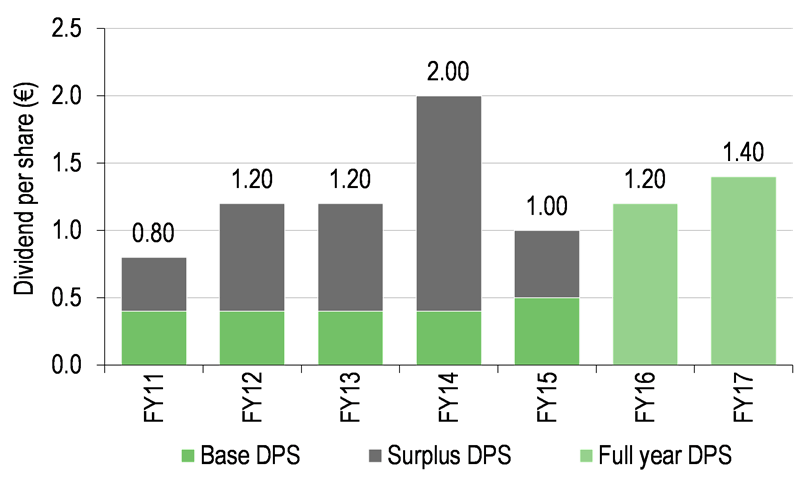
DBAG’s policy is to pay a stable or rising annual dividend. Prior to FY16, a base dividend was paid, supplemented by a surplus dividend based on realised gains. |
Share buybacks and capital increases are used to manage longer-term capital requirements. In FY16, €38.6m was raised through a 10% capital increase. |
||||||
|
|
||||||
Concentration of portfolio value by size (as at 30 June 2018)*** |
Portfolio exposure by sector (as at 30 June 2018)*** |
||||||
|
|
||||||
Shareholder base (as at 9 August 2018) |
Portfolio companies’ revenues by region (latest available data) |
||||||
|
|
||||||
Source: DBAG, Edison Investment Research, Bloomberg, Thomson Reuters. Note: *Based on expenses net of fee income; adjusted for non-recurring items. **Including €50.1m of securities classified as long-term assets. ***Does not include co-investment funds.
Q318 performance highlights
DBAG reported €11.1m net income for Q318, taking net income for the first nine months of FY18 to €28.9m, with a 6.8% dividend-adjusted NAV return, after incorporating the effects of a change in accounting policy (effective at end-June 2018 and applied retrospectively to end-September 2017 – see below). A €7.0m increase in valuations to reflect expressions of interest from potential buyers for two portfolio companies formed part of the €24.3m gain from a rise in market valuation multiples, which made the greatest contribution to valuation gains in the third quarter. Over the first nine months of FY18, improved earnings expectations for 14 of the 25 portfolio companies made the greatest contribution to valuation gains. Pre-tax earnings were positive for both business lines for the nine months, with private equity investments generating €24.3m and fund investment services contributing €4.7m. NAV per share increased from a restated €29.01 at end-September 2017 to €29.50 at end-June 2018, after payment of the €1.40 per share FY17 dividend (see Exhibit 2).
New investments
Investment activity remained brisk in the third quarter of FY18, with DBAG agreeing two new investments alongside DBAG ECF and one new investment alongside DBAG Fund VII. DBAG ECF completed its first new investment period (DBAG ECF I), with c 80% of its commitments called after only 12 months following a management buyout (MBO) investment in von Poll Immobilien. DBAG ECF started its second new investment period (DBAG ECF II), scheduled to run to December 2020, with an MBO investment in BTV braun teleCom. A new MBO investment in Karl Eugen Fischer was agreed and completed by DBAG Fund VII, which has called around one-third of its commitments.
von Poll Immobilien
Alongside the DBAG ECF fund, DBAG has invested €11.8m to take a c 36% stake in von Poll Immobilien, with the previous shareholders retaining significant stakes. Founded in 2000 and headquartered in Frankfurt, von Poll Immobilen has a network of 280 offices across Germany and nine other European countries, the majority of which are operated by independent sales partners. A range of services are offered related to the sale and letting of residential and commercial properties, and advising on new-build projects and property valuations. The company has c 120 employees and generated revenues of over €70m in its 2017 financial year.
Increasing demand for high-quality residential property provides the opportunity for von Poll Immobilen to continue to grow through opening new offices. Management also sees potential for it to increase its share of a fragmented market and expand its market position outside the DACH region, targeting markets such as France, Italy, Spain, the UK and Poland. DBAG’s investment will support the company’s plans to expand its network, invest in digitisation and strengthen its brand, with the medium-term objective of taking the company public.
Karl Eugen Fischer
DBAG Fund VII has acquired a majority stake in Karl Eugen Fischer (KEF) from Equistone Partners Europe, with DBAG investing €22.7m to take a c 22% interest and the company’s management holding a minority stake. This is the fourth MBO investment by DBAG Fund VII, which is around one-third invested following this transaction. Since development of the first steel cord cutting plant in 1970, KEF has become the global leading developer and manufacturer of precision cutting systems for the tyre industry. Nine of the world’s 10 most successful tyre manufacturers rely on machines produced by KEF, which has a global market share of c 70%. Manufacturing operations are located at KEF’s headquarters in Burgkunstadt, Upper Franconia, Germany, where more than 500 of the company’s 545 employees are based, while distribution and service subsidiaries operate in the US and China. The company generated revenues of €83m in 2017.
KEF is expected to benefit from the rising global demand for tyres and the expected increase in production facilities to meet this demand, which will require investment at its own production facility in Germany. Mechanical and plant engineering and automotive suppliers are two of DBAG’s four core sectors, where it has invested in 10 companies over the last decade. DBAG’s investment will support KEF’s planned growth, with further potential seen for the expansion of its service business.
BTV braun teleCom
DBAG has invested €4.8m, alongside DBAG ECF, to acquire a c 38% stake in BTV braun teleCom, in the MBO of four operating companies in the BTV group from founder Thomas Braun, who continues to manage the business, with other senior managers also holding shares in the business. Established in 1986 in Hanover, Germany, BTV is one of a small number of full-service providers for cable and fibre-optic network infrastructure operators, with its product business supported by a growing service business. BTV has grown rapidly, almost doubling revenues to c €30m in the last three years. It has c 40 employees, with a research and development team, sales and support operations in Hamburg and Wismar in Germany, and offices in the Netherlands and Taiwan.
Rising demand for faster internet connections is requiring existing networks to be upgraded or rebuilt, with a trend towards higher-performing fibre-optic networks, and the growing level of complexity is driving demand for BTV’s products and services. BTV is the fifth broadband communications company in which DBAG has invested since 2013, and DBAG’s investment will support BTV’s organic growth and the expansion of its range of products and services.
Change in accounting policy for carried interest provisions
As flagged by management at the February 2017 AGM, and in DBAG’s FY17 Annual Report and subsequent quarterly statements, the German Federal Financial Supervisory Authority (BaFin) has reviewed DBAG’s accounting for carried interest provisions, following a routine audit of its FY15 financial statements. In July 2018, BaFin communicated its decision that DBAG’s accounting treatment of carried interest provisions did not comply with IFRS accounting standards in terms of the timing of recognition. Consequently, DBAG has changed its accounting methodology for carried interest provisions, effective 30 June 2018, which has reduced NAV by €10.5m (2.3%) at this date compared with the previous methodology. DBAG has restated its prior year accounts on a comparable basis, with an €8.4m (1.9%) reduction in year-end (30 September 2017) NAV. The accounting change has lowered net income by €2.1m in the first nine months of FY18, compared with a €7.2m reduction in net income in the equivalent previous year period. For clarification, the accounting change merely brings forward the timing of the provision, with no change in the underlying carried interest amount or the performance hurdle that has to be met before any payment is made. Exhibit 2 shows the restated and historically reported NAV per share figures.
|
Exhibit 2: Comparison of reported and restated historical NAV per share data |
|
|
Source: DBAG, Edison Investment Research. Note: March 2017 and March 2018 NAV per share figures reflect €1.20 and €1.40 per share dividend payments respectively. |
Commitments and financial resources
At 30 June 2018, DBAG had €222.7m in undrawn capital commitments to the DBAG ECF and DBAG Fund VII funds. While capital calls totalling €52.6m were met during the first nine months of FY18, this was largely offset by the €39.7m commitment to DBAG ECF’s second new investment period (DBAG ECF II). Based on these two funds’ expected investment programmes, DBAG’s management continues to anticipate an average annual investment run rate of c €70m. While outstanding commitments exceed its current financial resources, DBAG has sufficient funds to meet its expected financial commitments over the next 12 months. In addition, any portfolio realisations should supplement financial resources. DBAG also has a €50m credit facility, with its maturity now extended to 2023, on which it can draw to manage short-term cash flow timing differences.
During 9M18, DBAG’s financial resources (including fixed-income funds and fixed-rate securities, which are held as cash investments but classified as long-term assets) declined from €161.6m to €94.4m. Cash outflows of €52.6m to meet capital calls for new and follow-on investments were largely covered by €46.5m of cash inflows from disposals and refinancing of investments. €32.8m of short-term loans were granted in connection with the structuring of the investment in Karl Eugen Fischer and the follow-on investment in duagon, while the €21.1m FY17 dividend was also paid and net operating cash outflows were €7.2m.
Lowered FY18 earnings guidance
In April 2018, DBAG indicated that it expected net income for the year to 30 September 2018 to be moderately (10% to 20%) lower than the €43.0m average of the last five financial years (the reference level for management’s earnings guidance). Previous guidance had been for a significant (more than 20%) increase in net income, and the forecast revision was principally due to the market decline in the first quarter of the year, which led to lower valuation multiples being used to value portfolio companies at end-March 2018.
Following the change in accounting policy for carried interest provisions (see above) in June 2018, management lowered FY18 earnings guidance again, now expecting FY18 net income to be considerably (more than 20%) lower than the €43.0m reference level. However, management has confirmed that it expects positive earnings in the final quarter of FY18, which suggests that FY18 net income will be between €29m and €34m, compared with €34m to €39m previously, noting that the change had a negative €2.1m effect in the first nine months of FY18. No change has been made to management’s guidance for a moderate 10-20% rise in FY19 and FY20 net income, as a carried interest provision had been incorporated into these medium-term forecasts. Arguably, future returns should be higher as the new methodology simply brings forward the timing of the provision.
Valuation: Premium to NAV appears to have stabilised
As we have highlighted in our previous research, DBAG’s reported NAV does not reflect the fair value of its fund services business, which has c €1.5bn of third-party assets under management and generates substantial recurring fee income. In contrast, DBAG’s share price reflects the value of this business as well as DBAG’s private equity investments. We see the value attributed by the market to DBAG’s fund services business as the principal reason for its shares trading at a premium to NAV for nearly all of the last three years, as illustrated in Exhibit 3.
In our view, two factors contribute to the premium. These are the underlying premium or discount being applied by the market to the NAV of DBAG’s private equity investment portfolio, and the value ascribed by the market to DBAG’s fund services business. Our previous analysis (in our August 2017 note) suggested the market was attributing a valuation of up to c €160m to DBAG’s fund services business (giving a market-implied valuation multiple of between 23x and 40x earnings).
|
Exhibit 3: Share price premium/discount to NAV* over three years (%) |
|
|
Source: Thomson Datastream, Edison Investment Research. Note: *Premium/discount data reflect restated quarterly NAV figures from 31 Dec 2016 to 31 March 2018. |
DBAG’s shares are trading at a c €140m or 31.4% premium to NAV, having narrowed to a 13.7% premium in June 2018 (the narrowest level since July 2016). If we assume that the fund services business outlook has not altered materially since our August 2017 analysis, DBAG’s current share price suggests the market is applying an underlying c €20m or c 5% discount to the NAV of its private equity investments. This compares to the implied c €180m or c 40% underlying premium to NAV in January 2018 when DBAG’s headline premium to NAV was 75.8%. After an exceptionally strong FY17 performance, DBAG’s slower NAV progress in FY18 to date seems to have markedly reduced market expectations for its future growth prospects, leading to the significant share price decline and resultant sharp narrowing of DBAG’s share price premium to NAV (see Exhibit 3).
Peer group comparison
Exhibit 4 shows a comparison of DBAG with selected listed private equity investment companies that are primarily focused on Europe. DBAG is the only company in the peer group that specialises in mid-sized companies in German-speaking countries. DBAG also manages third-party funds, which differentiates it from all of the peers other than 3i in the UK. As noted above, we see the value of DBAG’s fund service business as the primary reason for its shares trading at a premium to its reported NAV. This contrasts with its peers that do not manage third-party funds, some of which are trading at a wide discount to NAV. DBAG’s 3.6% yield is among the highest in the peer group.
Exhibit 4: Listed private equity investment companies peer group as at 9 August 2018*
% unless stated |
Region |
Market cap £m |
NAV TR 1 year |
NAV TR 3 years |
NAV TR 5 years |
NAV TR 10 years |
Price TR 1 year |
Price TR 3 years |
Price TR 5 years |
Price TR 10 years |
Premium/(discount) |
Dividend yield |
Deutsche Beteiligungs |
Europe |
521.5 |
9.1 |
93.3 |
104.5 |
154.1 |
(8.3) |
67.2 |
136.9 |
279.7 |
31.4 |
3.6 |
3i |
Global |
9,254.2 |
26.4 |
126.3 |
205.0 |
40.0 |
2.9 |
94.0 |
225.4 |
87.4 |
24.1 |
3.2 |
Electra Private Equity |
UK |
346.8 |
0.5 |
67.3 |
121.3 |
197.8 |
4.6 |
88.5 |
173.3 |
301.8 |
(16.4) |
0.0 |
HgCapital Trust |
UK |
699.8 |
14.7 |
67.0 |
96.7 |
146.6 |
17.6 |
92.5 |
102.0 |
201.0 |
(6.7) |
2.5 |
ICG Enterprise Trust |
UK |
597.7 |
15.2 |
49.2 |
71.1 |
116.2 |
18.6 |
58.5 |
101.5 |
144.5 |
(12.5) |
2.4 |
Oakley Capital Investments |
Europe |
397.3 |
12.9 |
46.3 |
36.6 |
163.7 |
9.8 |
21.0 |
28.3 |
109.4 |
(24.2) |
2.3 |
Princess Private Equity |
Global |
616.3 |
8.9 |
77.5 |
84.2 |
105.7 |
6.9 |
95.1 |
120.9 |
163.4 |
(10.7) |
5.6 |
Standard Life Private Equity |
Europe |
512.0 |
4.3 |
54.2 |
79.1 |
73.1 |
1.4 |
66.2 |
108.2 |
99.6 |
(16.5) |
3.7 |
Average |
1,618.2 |
11.5 |
72.6 |
99.8 |
124.6 |
6.7 |
72.9 |
124.6 |
173.4 |
(3.9) |
2.9 |
|
Rank in peer group |
5 |
5 |
2 |
3 |
3 |
8 |
5 |
3 |
2 |
1 |
3 |
Source: Morningstar, Edison Investment Research. Note: *Performance data to end-June 2018. TR = total return. Net gearing is total assets less cash and equivalents as a percentage of net assets (100 = ungeared).
DBAG’s NAV total return in sterling terms to 30 June 2018 is ahead of the peer group average over three, five and 10 years, ranking second or third out of eight in each period, but modestly below the average over one year. DBAG’s share price total return has outperformed its NAV total return over five and 10 years to end-June 2018, despite having underperformed over one and three years, reflecting the share price decline and significant contraction of the premium to NAV in 2018.
|
|
Research: Real Estate
Target is making good progress in the deployment of its available capital resources, including the £94m (gross) proceeds of February’s equity issue and extended, but unutilised, debt facilities. A significant pipeline of investment opportunities remains, on terms that management believes are consistent with dividend cover on a fully invested basis. We continue to forecast full investment in the current financial year and dividend cover in FY20. The 5.7% dividend yield is backed by very long-dated, RPI-linked leases, and supported by careful asset and operator selection.