Last close As at 05/08/2026
—
— 0.00 (0.00%)
Market capitalisation
—
Research: Healthcare
ReNeuron has refocussed onto its human retinal progenitor cell (hRPC) as shown in the last business update and in the FY20 results. hRPC, now the lead project, show a consistent and robust sustained averaged response at the one million cell dose. The next dose level, two million cells in nine patients, could start this autumn. A pivotal study could be initiated in 2022. ReNeuron is starting to create multiple partnering opportunities from its core technologies. We have revised our valuation to £170m from £107m.
Written by
ReNeuron Group |
Exploiting the potential of cell therapy |
Strategic update |
Pharma & biotech |
26 August 2020 |
Share price performance
Business description
Next events
Analyst
|
||||||||||||||||||||||||||||||||||||||||||||||||
ReNeuron has refocussed onto its human retinal progenitor cell (hRPC) as shown in the last business update and in the FY20 results. hRPC, now the lead project, show a consistent and robust sustained averaged response at the one million cell dose. The next dose level, two million cells in nine patients, could start this autumn. A pivotal study could be initiated in 2022. ReNeuron is starting to create multiple partnering opportunities from its core technologies. We have revised our valuation to £170m from £107m.
Year end |
Revenue (£m) |
PBT* |
EPS* |
DPS |
P/E |
Yield |
03/19 |
2.7 |
(17.2) |
(45.3) |
0.0 |
N/A |
N/A |
03/20 |
6.2 |
(13.9) |
(35.9) |
0.0 |
N/A |
N/A |
03/21e |
1.1 |
(13.1) |
(36.0) |
0.0 |
N/A |
N/A |
03/22e |
1.1 |
(13.6) |
(37.0) |
0.0 |
N/A |
N/A |
Note: *PBT and EPS are normalised, excluding amortisation of acquired intangibles, exceptional items and share-based payments.
hRPC in a strong competitive position
ReNeuron’s portfolio is now refocused on the hRPC therapy for retinitis pigmentosa (RP), an inherited, degenerative eye disease caused by one of over 100 different gene mutations. What is impressive, in our view, is that hRPC, on average, appears to give a clear benefit quickly then appears stable. hRPC therapy could potentially treat any RP patient, giving a big potential commercial advantage; competing gene therapies only treat a small number of specific X-linked mutations. There is only one cell-based competitor at a similar development stage targeting the wider market. As data from the hRPC extension study, due to start in autumn 2020, accumulates, ReNeuron should be in a good position to start a pivotal study in 2022 and to look at possible partnering. The Chinese partner, Fosun, continues to develop the stroke and RP indications.
Preclinical portfolio creates partnering opportunities
With the CTX stroke project on hold and awaiting partnering, ReNeuron has freed up resources to progress a portfolio of promising preclinical exosome projects. In our view, these should generate a number of partnering deals once solid preclinical data are available, probably as a series of releases, later in 2020. There are also earlier stem cell projects (in immunotherapy and diabetes) which could generate preclinical data in 2020 and offer further deal potential from 2021-22.
Valuation: Revised to £170m
Our former indicative value of £107m was based on a prior model of the potential hRPC market. We have used updated information to reassess the project and build a more complex market model. With other adjustments, this takes the indicative value to £170m. We note current high deal values in the gene and cell retinal therapy area, with one totalling $250m plus royalties in June. Exosome evaluation projects to deliver RNA drugs are promising but are preclinical. Many deals in this area have been at high values. Cash on 31 March 2020 was £12.6m. We envisage a further funding need in FY21 of £20m.
ReNeuron portfolio
The main project uses human Retinal Progenitor Cells (hRPC) (see Exhibit 1) to treat the degenerative eye condition retinitis pigmentosa (RP). The CTX project in stroke disability is on hold and will not restart (following the COVID-19 attributed suspension) until one or more partners are found.
The exosome set of projects are for the delivery of high-value pharmaceuticals, probably genetic therapies like siRNA, to the brain, but also have considerable potential as vaccine vectors. These applications all require licensing and some early discussions and scientific collaborations have been disclosed.
There are some very early-stage projects in progenitor cells that are note briefly. These could mature into really interesting and valuable projects from 2021 onwards.
ReNeuron is incorporated in the UK with offices in the UK and the US and the main laboratory in Bridgend, South Wales. The shares (31.85m in issue) are traded on the London AIM market under the symbol RENE.L. After restructuring, the company now has around 35 employees.
|
Exhibit 1: ReNeuron portfolio (July 2020) |
|
|
Source: ReNeuron |
hRPC: A strong lead project
The human Retinal Progenitor Cell (hRPC) project is the critical lead project for ReNeuron. It is one of two cell therapy companies tackling RP, which is a catch-all diagnosis for a very diverse group of degenerative genetic eye diseases where photoreceptor cells progressively die. RP manifests through progressive night blindness (low light vision) with loss of peripheral vision as the rods, used for low light, non-colour detection, die in the retinal periphery (Exhibit 2). Eventually cone cells, used for high-resolution acuity and colour vision perception, and concentrated in the macular central region of the eye often also succumb. RP is therefore a form of rod-cone dystrophy.1.
Sahel et al (2015) and Jin et al (2019) give good recent overviews of RP and the science behind retinal cell therapies. There is another type of degenerative retinal disease, cone-rod dystrophy, where the colour cone photoreceptor cells die first. This is a possible further indication for hRPC, but it is not currently being developed
There are multiple potential gene defects that can cause RP and those that are known are not always well understood.2 Gene therapy can be used for recessive or X-linked defects where insertion of a new gene can lead to photoreceptor viability if it is stably expressed at adequate levels – this is hard to achieve. Gene therapy is very specific to the defective gene concerned.
‘Of the total number of nonsyndromic, nonsystemic cases, 19% are autosomal dominant, 65% are autosomal recessive or simplex cases, and 8% are X linked’ (Bunker et al (1984)).
|
Exhibit 2: Summary of RP characteristics |
|
|
Source: ReNeuron |
hRPC scientific and clinical rationale
ReNeuron’s approach is very different to gene therapy as it uses genetically healthy hRPC. The cells are allogeneic based on an immortalised cell line. This means they can be produced in standardised batches and stored and shipped frozen. This avoids the complex, very expensive, customised manufacturing needed for autologous cell therapies, such as current CAR T-cell cancer products. Trials to date show that the immortalising gene technology is safe and it has been approved for clinical trials in both stroke and RP patients.
The mechanism of action is not known definitively as the detailed scientific data comes from animal models. It is known that hRP cells can persist in the retina and infiltrate into the retinal layers (Luo et al (2014)) producing brain-derived neurotrophic factor (BDNF) and fibroblast growth factor 2 (FGF2). Although there were some indications that embryonic stem cells can differentiate and produce some photoreceptor markers (Lamba et al (2006)), as seen in rods, it is not thought that hRPC directly form new photoreceptors. Rather, Semo et al (2016) concluded that ‘hRPC-mediated preservation of vision…is mediated by trophic support, which either preserves photoreceptor structure or increases visual acuity (VA) somehow from existing retinal circuitry.’
ReNeuron’s hRPC therapy should, in theory, be able to treat all forms of disease irrespective of the genetic defect. In theory, hRPC could also be used in conjunction with a gene therapy treatment.
The retina is a complex stratified structure. Light entering the eye, thought the lens and iris first penetrates the top surface of the retina which comprises blood vessels that snake over the surface. The next layer is a fine mesh of nerve fibres which pass signals from photoreceptors to the brain. The photoreceptors (rods and cones) come next in two layers: the inner neural layer contains the photoreceptor cell bodies (containing the nucleus) and the synapses to link to the nerves. The outer neural layer – deepest into the retina – is formed by the photoreceptor cell segments that actually detect light. The bases of the photoreceptors are very closely coupled to the next layer of retinal pigmented epithelium cells that feed the photoreceptors and absorb stray light. The retina sits on Bruch's membrane on top of the choroid lining of the eyeball.
ReNeuron’s hRPC need to be injected close to the site required, usually the centre of the eye, the macula, crucial for detailed sight, where most photoreceptors are situated.3 This involves depositing a small drop (a bleb) with one million hRPC as a subretinal injection. The hRPC can then pass into the outer and inner layers of photoreceptor cells. The subretinal injection is a precise operation and temporarily distorts the retinal structure. In the first stage of the current Phase I/II study (10 patients) this caused sight loss in two cases; one of the two has recovered baseline sight.
At the centre of the macula about 5.5mm diameter) is the fovea, or small pit, about 1.5mm diameter. In the centre of this is a tiny area only 0.15mm in diameter with no overlying blood vessels or nerve cells, hence this has the highest optical resolution. As there are no rods, it functions for longest in RP.
hRPC data to date
Here we summarise the discussion published on 6 July 2020 from the US Phase I/IIa US trial (NCT02464436) based on data from the eight patients who had successful cell implantations.4 Exhibit 3 shows the patients at each time point, Exhibit 4 shows the data per time point.
This excludes two subjects who experienced sight loss due to complications arising from the surgical procedure. One of these subjects has recovered back to at least baseline at one-year post treatment.
|
Exhibit 3: Patient data at various timepoints |
|
|
Source: ReNeuron data, Edison Investment Research |
|
Exhibit 4: Mean letters gained in successfully treated patients over time |
|
|
Source: ReNeuron, Edison Investment Research |
By late 2020, the longer-term data will be more numerically robust. The trial has a two-year final endpoint. What is impressive, in our view, is that the therapy appears to give a clear benefit quickly and then appears stable on average.
Note that the extension phase of this study, discussed below, will use a higher dose and slightly different administration procedure and add further secondary endpoints. This will add useful insights and be a better base for Phase III – but means that the data in Exhibit 2 will not be an accurate good guide, other than potentially for duration of action, to the next data set.
US and UK extension of hRPC Phase II
The FDA-approved amended protocol plus the UK regulatory go-ahead has enabled the dose to be raised to two million cells for a further nine patients in an extension of the current trial. These new patients will add to the 10 Phase IIa patients already treated. A wider range of pre-treatment baseline VA in patients will be eligible and the trial endpoints will be expanded to include VA (as before), micro-perimetry, visual field, retinal sensitivity and retinal structure. The primary endpoint remains safety.
In the extension study, two blebs (two million cells in total) will be used on either side of the area being treated. As the retinal area being treated (we assume the macula with the highest concentration of photoreceptors (and providing the most precise level of acuity)) is not disturbed, it is hoped that surgical complications will be reduced. The concept is that the hRP cells will migrate into the target area and support existing photoreceptors to prevent or limit further deterioration and potentially facilitate some regeneration.
The other company developing an RP cell therapy, jCyte, uses an intravitreal injection – into the vitreous jelly that fills the inner eye; the jCyte product (jCell) with the latest clinical data are discussed below.
Locations
The trial is already in progress at two US centres. The UK regulatory agency (MHRA) has approved a UK trial site at the Oxford Eye Hospital where Professor Robert MacLaren, a recognised leader in the treatment of retinal diseases, will be the principal investigator. Professor MacLaren was a key author on the Nightstar Phase I/II trial publication (Cehajic-Kapetanovic et al (2020)). Two more centres (one in Europe, one in the US) might be added. Although the hRPC studies were delayed due to COVID-19, ReNeuron indicates that recruitment might start from late September.
Pivotal progression in 2022
According to management, an application to start the planned pivotal study is now planned for late H221, enabling a possible Phase III start in Q122. We have therefore moved the timeline for potential launch to calendar year 2025, so FY26. The Chinese timeline with Fosun still assumes a 2024 approval in China.
Background on VA endpoints
VA is critically important to patients as it provides the ability to resolve details and perform day-to-day tasks – but it is a variable parameter. VA is measured using the ETDRS5 chart whose lines are based on visual resolution angle with five letters of identical size per line. If a patient reads correctly three extra lines, their VA has doubled. If they lose three lines, it has halved. This has been the FDA benchmark.6 There is patient variability between readings so a one-line ETDRS chart difference is not regarded as clinically significant whereas a two-line difference is seen as significant Rosser et al (2003). The term used is often best corrected visual acuity (BCVA) – meaning that the patients wear spectacles or contact lenses for the readings. Mainstream eyecare products like Eylea and Lucentis were evaluated by the FDA for their ability to prevent a three-line loss (15 letters) in BCVA. In fact (for age-related macular degeneration), in one of the registration trials leading to approval, patients treated with Lucentis had a 6.6 letter improvement from baseline at two years, compared to a 14.9 letter loss in the sham group. Eylea showed a mean change in BCVA of at least 8.4 letters after 12 months which was statistically comparable to Lucentis in the head the head study.
Early Treatment Diabetic Retinopathy Study. This measures logMAR (the log of the Minimum Angle of Resolution) to convert a geometric increase in letter size into a linear scale where 0.1logMAR = 5 letters. Three lines is therefore 0.3 logMAR which on a log scale is a doubling in visual acuity. However, lines gained might be measured but is deemed to be an insensitive binary cut off.
David Elliott (2015) reviewed the systems used and noted that comparison between trials could be difficult.
However, Beck et al (2007) commented that doubling VA is an arbitrary binary cut-off and argued that an average of an extra five letters identified in a sample could still be significant. The letter gain is the extra number of correct letters identified, not the number of correct lines. Most studies, including ReNeuron’s, report letters on EDTRS gained.
In ReNeuron’s Phase II trial to date, the typical gain has been 9–10 letters; patients had to have a BCVA of 35 letters or less on enrolment (with a score of 100 being perfect vision). A gain of 10 letters therefore represents a strong relative improvement.
As a specific RP endpoint example, the Luxterna (gene therapy, Novartis) pivotal study (Pack insert) used a novel primary endpoint of the ability to navigate obstacles in low light. The VA gain measured by ETDRS lines as a secondary endpoint was 0.3 logMAR (or three lines, 15 letters). The FDA therefore seems willing to look at novel endpoints if they are validated. This leads to a search for alternatives. However, we note that if novel endpoints are not regarded as clinically relevant, payors may refuse reimbursement even if a therapy is approved.
We also note that ACGT (see Competition) is discussing visual sensitivity endpoints.
Potential competitors
There is one direct cell therapy competitor and four indirect gene therapy competitors (Exhibit 5). There is also an interesting cell regeneration project in London but not in RP.
|
Exhibit 5: Companies involved in RP therapies |
|
|
Source: ReNeuron |
Cell therapy: jCell
US company jCyte has reported data from an 84-patient Phase IIb RP cell therapy trial (NCT0307373). jCyte is a private academic spin-out company from the California Institute for Regenerative Medicine based at the University of California, Irvine.
The randomised, single-administration study tested two doses (of three million and six million) of retinal cells (termed jCell) against a sham comparator arm. The preliminary data7 in 74 patients showed a net mean 7.43 letter gain at the higher cell dose of six million (n=23) but little effect at the three million cell dose (+2.96 letters, n=25). In later analysis in a subgroup of 11 patients,8 the gain was 16.27 letters versus a control group of 13 patients (+1.85). jCyte plans to start a pivotal study in 2021. We would not make any direct comparison with the latest hRPC data at this early stage of data given limited disclosure and small numbers. However, the possible finding that patients with earlier disease, we assume, did better is interesting and perhaps relevant to ReNeuron.
Data presented at the American Society of Retina Specialists (ASRS) 2020 Virtual Annual Meeting on Saturday, 25 July 2020 (jCell PR). A total of 84 patients were randomized of which 74 met criteria for the per protocol analysis. There were three arms: sham, 3m and 6m.
These had: 1) study eye with reliable fixation (≥12° central diameter and/or steady central fixation) and 2) study eye did not have significantly worse BCVA than the fellow eye (≤15 letters). We cannot see why this would be a sensible label and it might be a random data fluctuation given small, patient numbers.
jCyte’s management believe that jCells help existing photoreceptors to restore functionality but that they do not integrate or differentiate into photoreceptors. A pivotal study is planned to start in 2021. jCell has FDA Regenerative Medicine Advanced Therapy designation.
Japanese eye specialist company Santen licensed the rights to jCell in Europe, Asia and Japan in early June. The deal value was $50m in cash, $12m in a convertible note offering and up to an additional $190m in milestones based on approval and initial sales plus a sales royalty.
Gene therapies
Gene therapy companies are targeting X-linked RP mutations as inserting one new gene copy per cell using a viral vector could restore functionality. X-linked conditions are often detected soon after birth or in early childhood. About 8% of RP cases are X-linked and RP GTPase Regulator (RPGR)9 is the cause in about 80% of X-linked cases. Cell therapies are not being considered for X-linked conditions, but they might have a future role in therapy. These projects are not directly relevant but show that a variety of endpoints are being considered.
RPGR is a protein that is not involved in light sensing but is critical for the health of the photoreceptor cells.
Spark (Roche) has the one approved (2018) product, Luxturna. It sells for £613,410 per treatment (ex-tax) in the UK and treats both eyes in patients with recessive RPE65-associated Leber congenital amaurosis mutations. As both parents need to pass on this mutation, it is rare, about 2% of RP cases. A specially designed mobility endpoint was devised for Phase III and supported for regulatory submission with VA data. Spark sold $21.2m of Luxturna (net of rebates) in H119 before its acquisition by Roche for $4.3bn. The high deal value was due to the potential of Spark’s technology in conditions such as haemophilia.
Nightstar was acquired for $800m in 2019 by Biogen. It is developing BIIB112 to treat RPGR defects in X-linked RP. Data published in early 2020 from the initial, safety and dose escalation study reported sight improvements in six of 18 patients with good tolerability.
ACGT10 also has a RPGR gene therapy project in Phase I/II. It announced in July that it was expanding a Phase I/II study to 20 patients in Q420 to explore a mobility endpoint. ACGT also states the FDA will consider a pivotal primary endpoint of changes to visual sensitivity11 supplemented with mobility tests. A Phase III trial might start in Q121.
We note the clever acronym as A, G, T and C are the bases of DNA forming the genetic code.
Specifically, that a change in visual sensitivity of 7 decibels or greater in at least 5 loci would be clinically meaningful. AGCT notes that patches of photoreceptors retain function rather than being a steady deterioration from the periphery in towards the macula.
MeiraGTx has programmes against the X-linked RPGR gene defects and an RPE65 project. It reported early RPGR data in July 2020, finding statistically significant improvements using a variety of visual field tests such as mean retinal sensitivity and central visual field progression rate.
The London Project
This project is led by Professor Coffey at the Institute of Ophthalmology and supported by Pfizer. It uses a fully differentiated, human embryonic stem cell-derived retinal pigment epithelium cell monolayer on a coated, synthetic basement membrane. The patch is inserted under the retina and is used to treat neovascular AMD. We mention it as, if successful, it might have more extended uses and is an example of a structured cell product. There are good initial clinical data (da Cruz et al (2018)) albeit in just two patients.
Market and updated hRPC modelling
The prevalence12 of RP is commonly stated as one in 4,000 people but this seems ultimately to derive from a non-systematic questionnaire survey of affected families so might overestimate the prevalence (Boughman et al (1980)); we have also seen global estimates of one in 3,000 or two million individuals.
Prevalence is the number of people in a population who have the disease. Not all of them are necessarily diagnosed or need treatment. Prevalence figures are based on samples so getting an unbiased sample and confirming suspected cases properly is very important. Prevalence often varies between countries or between males and females.
Incidence is the number of new cases per year. This can often be obtained from treatment figures. For genetic diseases, it is the number born per year with the condition, but these conditions may not be recognised for some years as with RP. Prevalence should be incidence times life expectancy with the condition – so for RP at least 80 years. However, these numbers often seem to misalign so market estimates can vary a lot.
More systematically, in a careful medical population study in Maine, US, Bunker et al (1984) found an RP prevalence of one in 5,106 (excluding some related, systematic genetic conditions). This gives a potential prevalence in the US of 64,000. In a 1978 study in Birmingham, UK, of 121 cases, an overall prevalence of one in 4,859 was found (Bundey and Crewes (1984)). This study noted that the prevalence in the 45–64 age cohort was one in 3,195 because diagnosis rates increased over age 30 (70%) to age 50 (86%). This might be the ‘true’ level of the condition (bearing in mind the small sample size and sampling error). Other studies have found a much lower prevalence, for example one in 7,000 in Switzerland.
To receive expensive cell therapy treatment in the US, patients will need excellent insurance coverage or Medicare (assuming the procedure is fully reimbursed). In Europe, a therapy needs to show economic value for adoption in the wealthier Northern European states and may not be used much in the Eastern and some Southern EU states with less well-funded healthcare systems.
The incidence of RP is hard to ascertain. A Korean study (Rim et al (2016) of over 6,000 people found new cases at 1.6/100,000 person years. Haim (2002) in a careful study using the detailed Danish registry estimated an incidence of 0.8/100,000 of new cases: about 40 per year in Denmark. In the US, this implies about 2,500 new diagnoses per year. Bunker et al (1984) estimated about one RP case per 3,500 births. With about 3.8 million births per year in the US, the number of new cases would be about 1,100.
For valuation purposes, we assume one in 4,500 prevalence which equates to about 64,000 cases rather than the one in 4,000 previously used. The next issue is the treatable group. We assume that more severe cases are diagnosed early, teenage or before, with patients over 40 years old diagnosed with conditions that have developed gradually – but these often accelerate in later life. The sample above indicate that most patients are in the 30–40-year-old category on diagnosis.13
In the US, which has seen a lot of population growth, the prevalence in patients over age 40’s will reflect the US population in 1980, about 280m not 330m as projected in 2025.
Our previous assumption for the target treatment population was that only the most severe patients would be eligible for cell therapy as a type of rescue. However, ReNeuron and jCyte have indicated that patients with more surviving photoreceptors should do better. We therefore make an assumption that treating patients within a few years of diagnosis offers better long-term value and results. This will need evidence from trials, follow-up data and economic studies.
The other factor is that the bulk of patients form a ‘prevalence’ market, as there is no significant annual inflow of new patients. Consequently, once all patients with disease who can be treated, or can access care, are treated, by ReNeuron, jCyte or a gene therapy, the market becomes saturated and sales drop. The big qualification on this is if retreatment is needed and beneficial. If so, we expect the price per treatment to fall - although the cost over a patient’s lifetime could be much higher. Presently, there is no data on retreatment, so we have not assumed that this happens but is seems a plausible scenario as enough hRPC need to persist and survive to maintain ongoing retinal health and function.
There is nonetheless a steady, if small, stream of new patients perhaps 1,100–2,500 new diagnoses per year in the US. If the price was $275,000, as we assume, this is still a $690m potential market. These patients may be the most cost effective to treat (assuming a very sustained treatment effect).
We therefore split these two segments for a market forecast.
For incidence, we assume a high treatment rate within a few years of diagnosis this is the core long-term market. Those who are not treated enter the prevalence pool; We use the current and projected populations of the US, the top European countries and Japan.
For prevalence, we assume much lower peak sales (especially in the US), although as patients are treated, the pool shrinks. We limit the eligible treatment population in the prevalence pool to the 30–70 age range. It is unlikely all will be suitable for therapy, possibly due to particular genetic conditions. As yet, we cannot define this.
Exhibit 6 summarises the 2025 treatable population, the peak market penetration for hRPC assumed and the projected 2030 sales level in US dollars.
Exhibit 6: Edison projected market parameters
Region |
Incidence |
Prevalence |
Total |
||||||||
New Cases per year |
Maximum Peak share |
2030 sales ($m) |
Total cases 2025 |
2025 treatable cases |
Maximum Peak share |
2030 sales ($m) |
hRPC treated (cases) |
2030 sales ($m) |
|||
USA |
2648 |
35% |
$262 |
73,600 |
31,333 |
5% |
$167 |
1,344 |
$428 |
||
Europe |
3200 |
25% |
$172 |
88,900 |
44,444 |
5% |
$195 |
1,561 |
$367 |
||
Japan |
965 |
35% |
$64 |
27,000 |
13,478 |
5% |
$55 |
520 |
$120 |
||
Totals |
6,813 |
$498 |
189,400 |
89,255 |
$417 |
3,425 |
$915 |
||||
Source: Edison Investment Research, note peak is maximum achievable market not the actual projected rate which is slight lower
Example: US market
For the incidence market, we assume 2,648 new cases based on the Danish studies (about 40 new cases per year in a population of five million). We assume a high therapy response rate and that ReNeuron can gain a peak share of 35% of this market. We assume that gene therapies and jCell take an equal combined share to ReNeuron (35%) as we cannot yet separate the efficacy and cost of the various approaches. Once treated, patients are not retreated. Untreated patients move into the prevalence pool.
Prevalence is more complex. We assume about half the overall population prevalence are in the age groups where RP becomes manifest and is diagnosed. This means about 31,000 available cases in the US. We then assume a steady treatment rate of up to 10% per year for all therapies combined with hRPC gaining half of these sales.
The other markets, including China from 2024, are modelled in the same way. We note that the Chinese forecast is subject to high forecasting error.
Exosomes and induced pluripotent stem cells
The main future internal use of the CTX line is to generate exosomes. Exosomes are tiny lipid (oil) vesicles about 100nm in diameter (Exhibit 7). ReNeuron also has early-stage induced pluripotent stem cell (IPSC) projects.
|
Exhibit 7: Exosome technology |
|
|
Source: ReNeuron |
Exosomes are secreted by cells, particularly mesenchymal stem cells (MSCs), the basis of the CTX platform. Exosomes carry proteins and RNA messages between cells and may be responsible for the modification of the local immune response by MSCs. They have relatively robust membranes, making them potential delivery vehicles.
At an R&D day in 2018 ReNeuron announced it can scale up exosome production under GMP conditions, which should allow a clinical study. The main preparation method in research laboratories is ultracentrifugation, which gives tight size ranges but is laborious and small scale.
Exosomes can be loaded once isolated with short RNA sequences and/or small therapeutic proteins or drugs. The membrane can be modified to enable the exosomes to target specific cell types or be produced from specific cell lines, giving inherent targeting to that tissue. ReNeuron notes that it can add the SARS-CoV-2 spike protein, for example, which could make the exosomes appear like viral particles making this a possible SARS-CoV-2 vaccine candidate. Exosomes also appear to pass though the blood/brain barrier, as shown by literature reports of down-regulation of brain proteins by exosomes injected into mice.
The ability to load and modify/target exosomes is very important as, when produced inside MSCs, exosomes will contain an assorted variety of RNA and proteins. To ensure a consistent product therefore, isolation, exosome loading and possible targeting would appear necessary. For a therapeutic product, consistency and scale are essential.
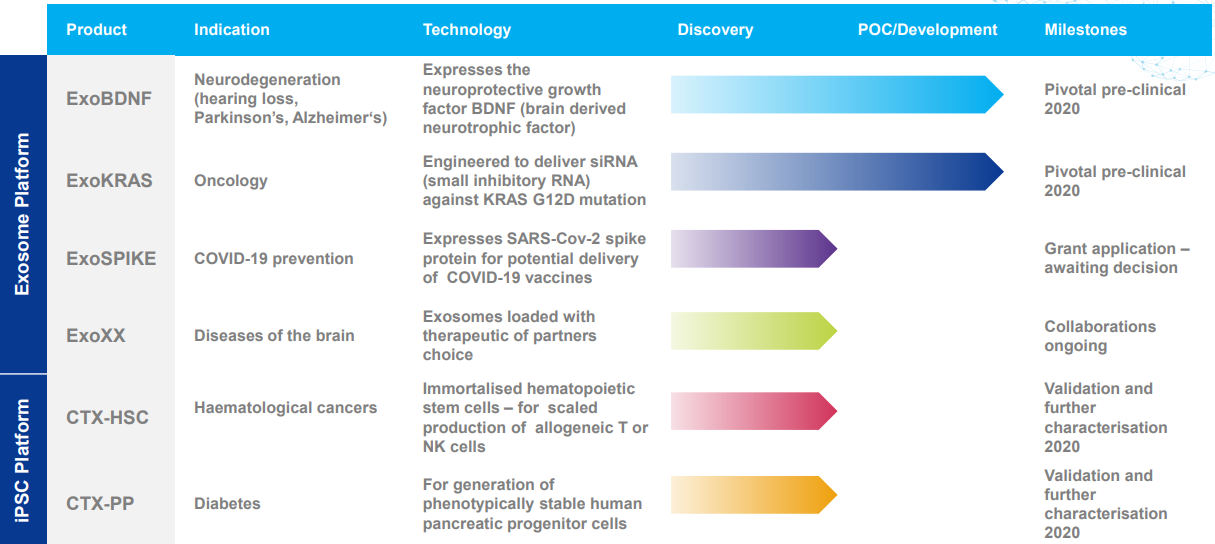
ReNeuron has a portfolio of potential exosome opportunities (Exhibit 8).
|
Exhibit 8: Exosome and progenitor cell projects |
|
|
Source: ReNeuron |
We are aware of only one very small academic trial with exosomes so far. There are also some emerging specialist companies such as Evox Therapeutics, based in Oxford, UK. Evox announced a deal with Takeda in 2020 worth up to €803m (over several years and assuming successful development). The US company Codiak has two late-stage preclinical projects in the area of tumour immunotherapy deigned to stimulate anti-tumour responses.
Exosomes are hard to value. ReNeuron has several promising projects and two collaborations running. Management has positioned exosomes as a delivery system that can mimic viral particles (so a possible SARS-CoV2 vaccine candidate and, of more commercial interest currently, as a method of delivering genetic therapies to the brain). As such, ReNeuron exosomes could be the delivery component of a patented therapeutic and ReNeuron would gain royalties and potentially a product supply agreement. Exosome competitors have signed significant agreements after showing the potential for their technologies in preclinical models. ReNeuron has indicated it will have similar data from late 2020 (announced as published, so in stages) and deals could be signed from H221 onwards. Exhibit 9 shows recent deals in the exosome area indicating it could be very valuable.
|
Exhibit 9: Recent Exosome deals |
|
|
Source: ReNeuron |
Two IPSC projects are also shown in Exhibit 7. We expect more information on these in 2021 after further preclinical development in 2020; again there are no specific trials so data can be announced as it is published. The projects are promising, allogeneic CAR T-cells, for example, are a ‘hot’ clinical area, but they are still early stage and would presumably be partnered. Indications such as diabetes and haematological cancers are complex and crowded markets.
Sensitivities
ReNeuron is in a transition phase where there is a strong set of projects and putting the CTX stroke disability project on hold has opened up some strategic flexibility and freed resources. The lead hRPC project looks strong and capable of moving into pivotal studies in 2022. However, it is still subject to considerable uncertainty. We have limited clarity of potential maximal efficacy or duration of treatment. We do not know the distribution of visual degeneration in the treatable population and the treatable population itself is subject to considerable uncertainty. One crucial sensitivity is if multiple hRPC treatments are needed to sustain efficacy over a 30 to 40-year treatment period – this seems possible to us but there is no data as yet.? If so, this alters the pricing dynamics and could make the project much more valuable. In the medium term the interest in ReNeuron is mainly deal driven. What exosome deals can be struck in 2021 and can a large hRPC deal be done before pivotal studies in 2022? There is still potential for returns from CTX, not least with Fosun in China and Asia, and the IPSC projects should start to become more visible.
Valuation: Revised to £170m based on hRPC
The following adjustments have been made with the discount date reset to 30 June 2020. For some items, we use nominal values based on our best estimates. As nominal, values are not discounted; an investor can adjust the value by subtracting the nominal amount or substitute a different value. The revised value is shown in Exhibit 10. Overall, these revisions change the valuation to £170m (30 June 2020) from £107m.
Exhibit 10: Revised ReNeuron valuation
Product |
Indication |
Status |
Launch |
NPV (£m) |
Probability of success |
Royalty rate |
rNPV (£m) |
|
Jul-20 |
Jun-20 |
|||||||
hRPC |
RP |
Phase I/II |
2025 |
550 |
30% |
25% |
168 |
64 |
hRPC US partnering* |
RP |
FY23 deal |
2022 |
20 |
50% |
N/A |
10 |
N/A |
Fosun (China + Asia ex Japan) |
N/A |
Milestones |
N/A |
33 |
N/A |
N/A |
32 |
17 |
Other hRPC* |
N/A |
Preclinical hold |
N/A |
N/A |
N/A |
5 |
11 |
|
Exosomes* |
Delivery |
Preclinical validation |
N/A |
N/A |
N/A |
5 |
N/A |
|
CTX* |
Stroke |
Phase II (hold) |
N/A |
NA |
Nominal |
N/A |
6 |
6 |
Portfolio total |
603 |
220 |
99 |
|||||
Cash 31th March 2020 |
13 |
8 |
||||||
Non-clinical cash need FY21-22 |
(12) |
|
||||||
Operational costs to 2034 |
(51) |
|
||||||
Overall valuation |
170 |
107 |
||||||
Source: Edison Investment Research Note * = Nominal amount
Revenues
■
RP revenues from sales of hRPC are as discussed for the US, Europe and Japan. We used a price of $275,000 per treatment for both eyes in the US reduced by 30% in Europe and Japan. As discussed above, we assume the project is partnered. The previous assumption of a 30% royalty rate appears too high and we have adjusted this to 25%. Clearly, these assumptions will be revised if and when a deal is announced. The probability of success is unchanged at 30%.
■
Assumed hRPC partnering milestones and fees, these have a nominal NPV of £20m with a 50% deal probability by 2023. We note the very high value of gene therapy deals and acquisitions so this appears very `conservative.
■
Fosun milestones have been adjusted. Prior estimates of payment for FY21 and FY22 have been revised form £3m per year to £1m per in line with management guidance. We have shown milestones as a separate value item.
■
Fosum royalties have been extended to 2032 (2030 previously) staring in 2024 (unchanged). The hRPC royalties are been revised as above. The peak rate is 5% for both incidence and prevalence and as we are not certain of the regional diagnosis and treatment rates in China. The CTX China values are unchanged. This has given an increased value for these royalties, unchanged at 13%.
■
Other hRPC indications: the previous estimates for cone-rod dystrophy of £11m NPV have been removed as this is not an active project. We recognise the further potential of the technology by giving a nominal £5m value.
■
Exosomes: this is an exciting delivery system with multiple partnering and licensing opportunities. We do not foresee independent development. ReNeuron has indicated that it needs to validate the concept before deals. We therefore give a £5m nominal value at this time.
■
Stroke: the CTX cell project to treat stroke disability was revised after the strategic review in June 2020 halted further investment while ReNeuron seeks regional partners. We do not expect any product approval before 2027 (excluding China and Asia where the project is being developed by Fosun). We have converted our June 2020 estimate of £6m NPV to a nominal value that will not be adjusted until partnering occurs.
Costs and cash
■
Cash is stated as of 31 March 2020.
■
We have subtracted the G&A and R&D costs needed for FY21 and FY22. Some clinical costs are included in individual project NPV estimates and have been deducted from R&D.
■
We have estimated the basic corporate running costs for the forecast period from 2023–2034 based on £4m administration costs and our estimate of £8m R&D core costs. Tax is included in individual project estimates as before, although this has the does not fully utilise tax losses. This approach makes clear that we anticipate ReNeuron operating as a going concern
Financials: FY20
Exhibit 11 shows our updated financial forecast with reported full-year accounts to 31 March 2020 and revised FY21 and FY22 forecasts.
FY20 was as expected with £6m of revenues from the Fosun deal and a tax credit of £2.6m. R&D was level at £16.3m with general and admin costs slightly lower at £4.2m (vs £4.7m FY19). Operating cash outflow was £13.7m (before interest, tax and capex) as no offsetting tax credit was received in cash in the period; we expect it in the current financial year and note a tax credit receivable of £5.8m in the balance sheet. Overall cash (31 March 2020) was £12.6m (with no outstanding debt) and all investments have been converted to cash.
Over FY21 and FY22, further Fosun milestones are, according to management, expected to be about £2m in total. We have spread these over the two years, but they may be weighted to FY22.
The spending outlook for FY21 is of lower cash use as R&D costs are guided by management to fall 30–40%. This is because the CTX stroke trial is suspended and will only resume when a funding partner is found. The extension trial of hRPC could start in late September but with only nine patients and deliberately cautious recruitment; costs are unlikely to be high in FY21 or FY22. A pivotal hRPC study is not likely to start until Q1 of calendar year 2022 (Q4 FY22) so our assumption of increased R&D in FY22 might be aggressive. Costs will certainly be higher from FY23 if ReNeuron funds a large multicentre Phase III trial but it is possible the project might be partly or wholly partnered by then.
In cash terms, we assume an FY21 funding requirement of about £20m, down from £30m previously. The capital needed will depend on investment in other projects and on any deals.
Exhibit 11: Financial summary
£'000s |
2019 |
2020 |
2021e |
2022e |
||
Year end 31 March |
IFRS |
IFRS |
IFRS |
IFRS |
||
PROFIT & LOSS |
||||||
Revenue |
|
|
2,720 |
6,165 |
1,100 |
1,100 |
Cost of Sales |
0 |
0 |
0 |
0 |
||
Gross Profit |
2,720 |
6,165 |
1,100 |
1,100 |
||
R&D expenses |
(16,246) |
(16,335) |
(10,618) |
(11,000) |
||
SG&A expenses |
(4,773) |
(4,239) |
(4,000) |
(4,200) |
||
EBITDA |
|
|
(18,129) |
(14,250) |
(13,368) |
(13,950) |
Operating Profit (before amort. and except.) |
|
(18,299) |
(14,409) |
(13,518) |
(14,100) |
|
Intangible Amortisation |
0 |
0 |
0 |
0 |
||
Exceptionals |
0 |
0 |
0 |
0 |
||
Operating Profit |
(18,299) |
(14,409) |
(13,518) |
(14,100) |
||
Other |
0 |
0 |
0 |
0 |
||
Net Interest |
1,064 |
551 |
460 |
460 |
||
Profit Before Tax (norm) |
|
|
(17,235) |
(13,858) |
(13,058) |
(13,640) |
Profit Before Tax (FRS 3) |
|
|
(17,235) |
(13,858) |
(13,058) |
(13,640) |
Tax |
2,887 |
2,446 |
1,600 |
2,000 |
||
Profit After Tax (norm) |
(14,348) |
(11,412) |
(11,458) |
(11,640) |
||
Profit After Tax (FRS 3) |
(14,348) |
(11,412) |
(11,458) |
(11,640) |
||
Average Number of Shares Outstanding (m) |
31.6 |
31.8 |
31.9 |
31.8 |
||
EPS - normalised (p) |
|
|
(45.34) |
(35.85) |
(35.97) |
(36.57) |
EPS - FRS 3 (p) |
|
|
(45.34) |
(35.85) |
(35.97) |
(36.57) |
Dividend per share (p) |
0.0 |
0.0 |
0.0 |
0.0 |
||
BALANCE SHEET |
||||||
Fixed Assets |
|
|
1,522 |
1,229 |
1,129 |
1,029 |
Intangible Assets |
186 |
186 |
186 |
186 |
||
Tangible Assets |
632 |
452 |
452 |
452 |
||
Other |
704 |
591 |
491 |
391 |
||
Current Assets |
|
|
29,988 |
19,147 |
28,623 |
17,917 |
Stocks |
0 |
0 |
0 |
0 |
||
Debtors |
834 |
696 |
696 |
696 |
||
Cash and deposits |
26,386 |
12,625 |
22,947 |
11,841 |
||
Other |
2,768 |
5,826 |
4,980 |
5,380 |
||
Current Liabilities |
|
|
(7,402) |
(6,446) |
(6,446) |
(6,446) |
Creditors |
(7,261) |
(6,280) |
(6,280) |
(6,280) |
||
Short term borrowings |
0 |
0 |
0 |
0 |
||
Short term leases |
(141) |
(166) |
(166) |
(166) |
||
Other |
0 |
0 |
0 |
0 |
||
Long Term Liabilities |
|
|
(864) |
(707) |
(20,541) |
(20,375) |
Long term borrowings |
0 |
0 |
(20,000) |
(20,000) |
||
Long term leases |
0 |
0 |
0 |
0 |
||
Other long term liabilities |
(864) |
(707) |
(541) |
(375) |
||
Net Assets |
|
|
23,244 |
13,223 |
2,765 |
(7,875) |
CASH FLOW |
||||||
Operating Cash Flow |
|
|
(15,037) |
(13,651) |
(12,090) |
(12,672) |
Net Interest |
303 |
258 |
260 |
260 |
||
Tax |
3,129 |
(611) |
2,446 |
1,600 |
||
Capex |
(239) |
(119) |
(150) |
(150) |
||
Acquisitions/disposals |
0 |
0 |
0 |
0 |
||
Financing |
0 |
188 |
20,000 |
0 |
||
Dividends |
0 |
0 |
0 |
0 |
||
Other |
4,365 |
6,128 |
19,856 |
(144) |
||
Net Cash Flow |
(7,479) |
(7,807) |
30,322 |
(11,106) |
||
Opening net debt/(cash) |
|
|
(27,911) |
(26,245) |
(12,459) |
(22,781) |
HP finance leases initiated |
0 |
0 |
0 |
0 |
||
Other |
5,813 |
(5,979) |
(20,000) |
0 |
||
Closing net debt/(cash) |
|
|
(26,245) |
(12,459) |
(22,781) |
(11,675) |
Source: ReNeuron accounts, Edison Investment Research
|
|||||||||||||||||||||||||||||||||||||
|
|
Research: Healthcare
Newron is focusing on its novel schizophrenia drug, Evenamide, and on a further Xadago study. The Evenamide preclinical studies required by the FDA have been successfully completed. A four-week, 120-patient Phase II safety study is now underway to report in Q121; Newron notes that Phase III could start in Q221. Discussions with Zambon on a Xadago dyskinesia study are progressing. Newron drew down a €7.5m EIB loan in April (a €15m loan facility remains) and had €39m cash at end December 2019. Newron has cash well into 2022. Our indicative value remains at CHF121m.