Last close As at 06/08/2026
—
— 0.00 (0.00%)
Market capitalisation
—
Research: Healthcare
ReNeuron’s FY23 results provide a recap of financial and operational highlights from the period. Following the restructuring announcement in January 2023, the company’s focus rests on its proprietary stem cell-derived exosome platform, CustomEx. In vivo animal studies to validate the platform’s capabilities are ongoing, and ReNeuron plans to release readout data in H2 CY23, which we anticipate could be a key catalyst and generate traction for partnerships. Due to the macroeconomic environment, management is closely monitoring and managing expenses. As of 31 March 2023, the company’s cash balance was £7.2m, which management expects should fund operations into July 2024. While FY23 operating expenses were lower year-on-year and we have reduced future opex projections given the restructuring and guidance, we have also taken a more conservative approach to the long-term assumptions of potential licensing deals to reflect the current macroeconomic (funding and activity) environment. These adjustments and rolling our model forward result in a revised valuation of £29.3m or 51p/share (previously £44.2m or 77p).
Written by
ReNeuron Group |
Full steam ahead with CustomEx |
FY23 results |
Pharma and biotech |
30 May 2023 |
Share price performance
Business description
Next events
Analysts
ReNeuron Group is a research client of Edison Investment Research Limited |
|||||||||||||||||||||||||||||||||||||||||||||||||||||||||||
ReNeuron’s FY23 results provide a recap of financial and operational highlights from the period. Following the restructuring announcement in January 2023, the company’s focus rests on its proprietary stem cell-derived exosome platform, CustomEx. In vivo animal studies to validate the platform’s capabilities are ongoing, and ReNeuron plans to release readout data in H2 CY23, which we anticipate could be a key catalyst and generate traction for partnerships. Due to the macroeconomic environment, management is closely monitoring and managing expenses. As of 31 March 2023, the company’s cash balance was £7.2m, which management expects should fund operations into July 2024. While FY23 operating expenses were lower year-on-year and we have reduced future opex projections given the restructuring and guidance, we have also taken a more conservative approach to the long-term assumptions of potential licensing deals to reflect the current macroeconomic (funding and activity) environment. These adjustments and rolling our model forward result in a revised valuation of £29.3m or 51p/share (previously £44.2m or 77p).
Year end |
Revenue |
PBT* |
EPS* |
DPS |
P/E |
Yield |
03/22 |
0.4 |
(11.1) |
(17.0) |
0.0 |
N/A |
N/A |
03/23 |
0.5 |
(6.7) |
(9.5) |
0.0 |
N/A |
N/A |
03/24e |
0.9 |
(7.1) |
(10.5) |
0.0 |
N/A |
N/A |
03/25e |
12.3 |
3.9 |
5.7 |
0.0 |
1.0 |
N/A |
Note: *PBT and EPS are normalised, excluding amortisation of acquired intangibles, exceptional items and share-based payments.
Incoming in vivo data to facilitate future partnerships
ReNeuron continues to focus on positioning CustomEx as a valuable and differentiated drug delivery platform. In FY23, the company made progress in proof-of-concept studies, demonstrating in vitro targeting and delivery for all seven of its proprietary exosome populations. These studies included an investigation into the uptake and delivery of small interfering ribonucleic acid (siRNA) as a therapeutic cargo, showing a 600% improvement over human embryonic kidney (HEK)-derived exosomes. In vivo studies are also ongoing to validate the platform’s cellular and tissue targeting capabilities, and functional delivery of therapeutic payloads using CustomEx. ReNeuron plans to release data in H2 CY23 and management expects this may facilitate ongoing discussions regarding collaborations and partnerships.
Cash runway into 2024
Following a restructuring, which reduced the headcount by 40%, management expects the current cash balance of £7.2m to provide a runway into July 2024. In the event of delay or absence of milestone payments, expected from potential licensing in FY25, we anticipate the need to raise c £15m from external sources by mid FY25.
Valuation: £29.3m or 51p per share
We value ReNeuron at £29.3m or 51p per share (from £44.2m or 77p). Despite the lower operating expense run rate, we have adopted a more conservative approach in our long-term assumptions to reflect the current macroeconomic environment.
Exosomes continue to be front and centre
As part of its FY23 results, ReNeuron restated its commitment to progressing the development of its proprietary stem cell-derived exosome platform, CustomEx. The company operates as a contract research and development organisation, generating early-stage revenue streams through its exosome research services. However, management’s longer-term ambitions lie in becoming a key developmental partner, establishing multiple partner programmes with licensing agreements consisting of upfront milestones related to development and back-end royalties on sales. Management views its technology enabling CustomEx platform as a key differentiator, which it believes limits the possibility of switching to competitive technologies, something that may be possible with conventional HEK-derived exosomes. Unlike contract development and manufacturing organisations such as Oxford Biomedica, the company does not currently foresee itself becoming a large-scale good manufacturing practice-accredited manufacturing partner. Instead, the group will focus more on smaller-scale manufacturing capabilities for preclinical and potentially early-stage clinical requirements and will look to outsource larger-scale production to third parties. The company has relevant technology transfer experience having previously transferred the manufacturing of its clinical-stage stem cell programmes to contract manufacturing organisations. We see this as a sensible strategy for ReNeuron that removes the risk of conducting large capital expenditure programmes requiring significant investment.
Structural reorganisation extends cash runway into 2024
Management has taken significant action to extend the company’s current operating cash runway into Q225. In a bid to reduce operating expenses and improve efficiencies, the group consolidated its workforce to 23 employees in January 2023, reducing the company’s overall headcount by 40%. We believe the macroeconomic (funding and activity) environment remains challenging, as noted in the company’s H123 update. Prior to the restructuring (in January 2023), Catherine Isted stepped down as CEO of ReNeuron, having held the position since September 2022. Iain Ross has subsequently been appointed executive chairman and will lead ReNeuron in executing its exosome development strategy in the near term.
Additional partners may extend the runway further
ReNeuron’s exosome development programme consists of seven discovery-stage collaborations with both industrial and academic partners. The programmes are investigating the use of ReNeuron’s proprietary exosome platforms as targeted delivery vehicles across a range of drug types, primarily focused on central nervous system (CNS) diseases. The therapeutic payload diversification across its programmes represents an important differentiator for the company’s exosome technology, in our view. While the nature of these collaborations remains undisclosed, we anticipate the existing collaborations may have the potential to translate into larger licensing opportunities. Additionally, the signing of new partner contracts may further extend the runway beyond the currently guided Q225. However, we note that the company has not announced the establishment of any new exosome partnerships during FY23.
A differentiating exosome technology
We note that in Q1 CY23, a major development in the exosome market was the announcement that Codiak BioSciences, an exosome-focused biotech, would be filing for Chapter 11 bankruptcy. Codiak may have been considered one of the leading exosome developers, being one of the only companies in the industry to initiate exosome-focused clinical trials (NCT05375604, NCT04592484). While the news may paint a slightly negative picture of the current exosome market, we consider ReNeuron’s CustomEx exosome platform to be differentiated from competitive technologies (Exhibit 1).
Exhibit 1: Exosomes – competitor analysis
Company |
Stem cell line |
Advantages |
Disadvantages |
Targeted indications |
Stage |
Codiak* |
HEK293 |
Scalable production Can be manipulated easily |
Difficulty in targeting brain Single cell line only producing single exosome, limiting tissue targeting diversity |
Solid tumours and myeloid-rich cancers |
Two Phase I clinical programmes (NCT05375604, NCT04592484) |
Evox |
HEK293 |
Scalable production Can be manipulated easily |
Difficulty in targeting brain Single cell line only producing single exosome, limiting tissue targeting diversity |
Rare diseases |
Preclinical |
ReNeuron |
Neural |
Can target the brain Low immunogenicity Multiple cell lines offer exosome tissue targeting diversity |
Potential scale up challenges |
CNS diseases |
Preclinical |
Source: Derived from Kim et al. Note: *Filed for bankruptcy in Q123.
ReNeuron’s exosome populations are derived from the group’s catalogue of seven proprietary stem cell lines: four neural stem cell (NSC) lines (cortex, striatum, hippocampus and ventral mesencephalon), and three stem cell lines from areas outside of the brain (retinal, liver and pancreatic). However, the most advanced competitor exosomes are currently derived from HEK293 stem cell lines. While initial data have provided clinical validation of HEK-derived exosomes as platforms for drug delivery, the use of a single cell line to produce a single type of exosome may limit the tissues they can target. This may result in significant challenges when designing exosomes to target challenging-to-reach tissues, such as crossing the blood-brain barrier to treat CNS diseases. In our view, ReNeuron’s diversification in stem cell lines and ability to produce exosomes with enhanced natural tissue targeting affinity, particularly neural stem cell lines to target CNS indications, currently offers market differentiation against strategies involving single cell lines, such as Codiak’s approach.
Encouraging signs in the preclinical stages
ReNeuron continues to work with its partners to progress its exosome platforms towards the clinic; however, the company has already reported encouraging preclinical proof-of-concept data demonstrating the technology’s unique targeting ability and potential clinical utility. In a preclinical mouse model, NSC-derived exosomes were loaded with a therapeutic protein on their surface, called brain-derived neurotrophic growth factor (BDNF). BDNF is a neurotransmitter modulator that plays an important role in neural cell survival, growth and neuronal plasticity by activating the mitogen‑activated protein kinase (MAPK) pathway. The mouse model data highlighted that those mice treated with BDNF-engineered NSC-derived exosomes experienced increased levels of gene expression associated with the MAPK pathway (Exhibit 2). The response was not observed in mice treated with BDNF or exosomes alone, demonstrating the improved delivery of a functional protein to the brain when incorporated into tissue targeting exosomes.
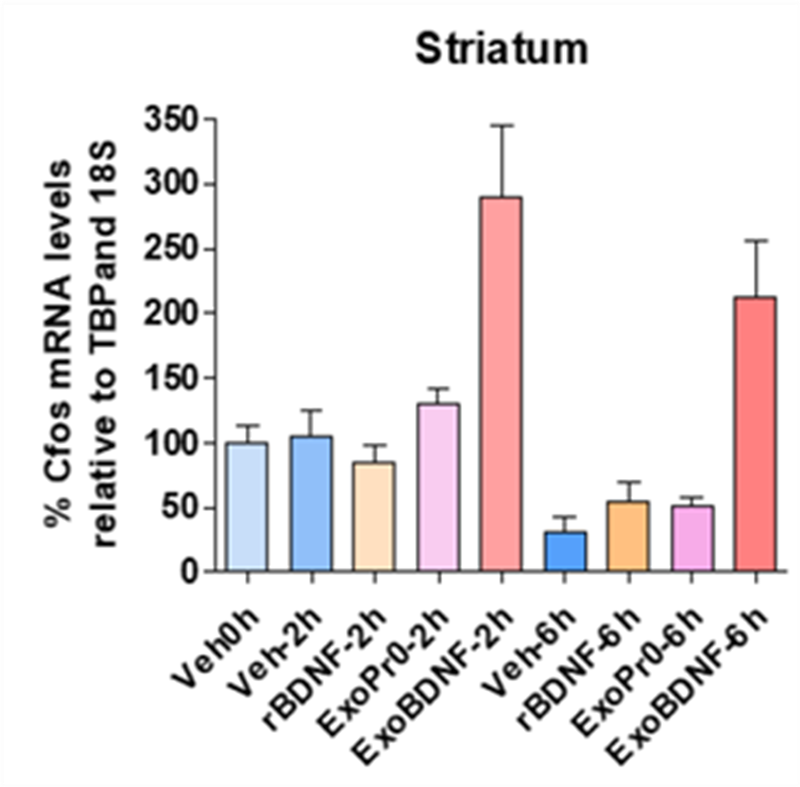
Of note, a sustained response (up to six hours) was observed selectively in the striatum with only a transient response (up to two hours) in the hippocampus, and no responses in any other areas of the brain (Exhibit 3). Neuropathological changes in striatal cells have been associated with diseases such as Parkinson’s disease (PD) and Huntington’s disease, so this highlights the potential clinical utility of ReNeuron’s platform. Additionally, this targeted delivery was achieved by lumbar puncture (administration into spinal fluid), and did not require direct injection into the brain, providing a potentially safer and cheaper (and more convenient) method for patient dosing.
|
Exhibit 2: Gene activation by therapeutic exosomes |
Exhibit 3: Gene activation of striatum cells after two and six hours |
|
|
|
Source: ReNeuron corporate presentation |
|
Exhibit 2: Gene activation by therapeutic exosomes |
|
|
Source: ReNeuron corporate presentation |
|
Exhibit 3: Gene activation of striatum cells after two and six hours |
|
|
Source: ReNeuron corporate presentation |
In October 2022, ReNeuron announced positive results from a separate preclinical study in which it demonstrated the enhanced cellular specificity and drug delivery capabilities of its exosome technologies over conventional HEK293 exosomes. ReNeuron’s exosomes displayed a minimum 10-fold increase in cellular uptake across three cell types (endothelial, neural and epithelial) versus HEK-derived exosomes, with an 18-fold increase observed in endothelial cells. Additionally, when loaded with therapeutic cargo (siRNA), a 600% improvement in delivery to the target cell was recorded versus HEK293 exosomes. These results therefore not only provide encouraging signs for the clinical progression of ReNeuron’s exosomes but may also provide a distinct competitive advantage against HEK293 competitors, in our view.
Notably, the study was able to demonstrate the effective delivery of siRNA, an emerging class of complex drug modality, in which targeted drug delivery is a significant challenge, and overcoming first-pass liver metabolism remains a developmental issue. The RNA therapeutic pipeline is poised to deliver further drug candidates, and we therefore view this market as a potential opportunity for ReNeuron. However, we note that results from these early-stage preclinical studies may not necessarily translate into the clinic.
Exosomes pencilling preclinical deals
While therapeutic exosomes may still be in their clinical infancy, there have been a handful of licensing agreements secured among leading exosome research companies. The most substantial of these have involved Codiak, Evox and PureTech Health, which have amassed combined deal values worth up to c $3.4bn to develop exosome-based therapeutics (Exhibit 4). Notably, these partnerships have been established during the early stages of drug development, indicating the potential value and upside that can be realised through demonstrating robust preclinical proof-of-concept data. With its seven established collaborations, we view ReNeuron’s pipeline as being uniquely positioned for potential future out-licensing opportunities, should positive data be generated. Monetisation of its preclinical exosome assets is a key focus for management, and deals could represent a significant catalyst for the share price. However, a breadth of statistically significant preclinical data will need to be generated before such deals could be realised, in our view.
Exhibit 4: Exosome licensing deals
Exosome company |
Deal partner |
Indication |
Phase |
Upfront milestone payments ($m) |
Total potential deal value |
Codiak* |
Jazz Pharmaceuticals |
Multiple cancers |
Preclinical |
56 |
|
Codiak** |
Sarepta |
Neuromuscular disease |
Preclinical |
Undisclosed |
|
Evox |
Takeda |
Rare diseases |
Preclinical |
44 |
|
Evox |
Eli Lilly |
CNS indications |
Preclinical |
20 |
|
Evox |
Boehringer Ingelheim |
Undisclosed |
Preclinical |
Undisclosed |
|
PureTech Health |
Roche |
Immunological disorders |
Preclinical |
36 |
|
Median |
40 |
c 180/asset |
|||
Source: Edison Investment Research. Note: *Codiak filed for Chapter 11 bankruptcy in Q123. **Deal terminated.
Financials
ReNeuron reported total revenue of £0.5m in FY23, slightly up from £0.4m in FY22, mainly related to income from research services and royalties from one of its legacy stem cell lines. FY23 revenue also included the upfront payment of £0.32m from Fosun Pharma, which was received in January 2022 as part of the existing technology transfer and supply agreement.
Total operating expenses significantly declined to £7.6m in FY23 from £11.6m in FY22, as a result of the halt in the clinical development of the human retinal progenitor stem cell programme in January 2022 and further business restructuring and operational re-alignment as announced in January 2023. This translated into a 40% reduction in employee headcount and lower variable costs for the company. While general and administrative (G&A) expenses were down 10.7% y-o-y to £3.2m, R&D expenses nearly halved to £4.5m (FY22: £8.1m), reflecting reduced clinical activities and the impact of cost reductions. The decline in operating expenses resulted in an improved operational loss of £7.1m in FY23 from £11.2m in FY22.
The total R&D tax credit stood at £1.2m versus £1.4m in FY22, indicating lower R&D spend during the year. The company recorded a net loss of £5.4m in FY23 compared to £9.7m in FY22. Net cash outflow from operating activities was reported at £7.5m (£7.4m in FY22) as the improved net loss was offset by higher working capital investments to support the exosome platform development.
Forecast revisions
Based on the FY23 results and management’s operating expense guidance, we have made some adjustments to our FY24 estimates and introduced FY25 estimates. Our revenue estimate for FY24 remains unchanged at £0.9m, which is based on the company’s existing research collaborations. In FY25, we forecast total revenue of £12.3m as we assume that ReNeuron will secure a licensing deal for its first exosome programme in FY25, receiving up to $12m (£9.7m) in upfront and milestone payments, although this remains uncertain at the moment due to low visibility. We also forecast a further £2.0m from Fosun Pharma, as per the supplemental terms of the additional technology transfer and supply agreement that was signed in July 2022.
In line with management’s expectation of the full year benefit of the cost reduction to be realised in FY24, we have reduced our estimates for operating expenses to £8.0m (£10.5m previously) in FY24 and anticipate a marginal increase to £8.4m in FY25. While we slightly reduce our G&A estimate to £3.3m in FY24 (£3.6m previously), we have lowered our R&D expense estimates significantly by c 32% to £4.7m (from £6.9m previously) to indicate reduced R&D spending requirements. For FY25, we forecast R&D and G&A expenses of £4.9m and £3.5m, respectively. These changes result in a forecast operating loss of £7.1m (£9.6m previously) in FY24 and operating profit of £3.9m in FY25.
At end-March 2023, the company reported a cash balance of £7.2m with no debt and an operating cash outflow of £7.5m for FY23. Management believes this should provide a cash runway into July 2024 (early Q225), supported by management estimates of revenues and funding. However, if these revenues or funding do not materialise, management expects its cash balance to last until February 2024. Based on our forecasts, we project an operating cash outflow of £6.7m in FY24, which, with the current cash balance of £7.2m, should fund the company’s operations into early FY25. Further, in FY25, we assume upfront and milestone payments of £9.7m from a potential first exosome licensing deal and £2.0m from the existing agreement with Fosun Pharma. Based on these projections, we forecast a positive operating cash flow of £4.5m in FY25. However, we note that the upfront and milestone payments are conditional, and the potential timing and realisation of an exosome deal seems uncertain at the moment given the current market uncertainty. To help reflect this uncertainty and to provide additional flexibility, we assume the company will need to raise £15.0m from external sources in Q125, shown as illustrative debt in the model.
Valuation
Our valuation of ReNeuron decreases to £29.3m or 51p per share, versus our previous £44.2m or 77p per share. In addition to the above-mentioned changes to our FY24 forecasts, we have reduced our long-term assumptions regarding two licensing deals for its exosome programmes in Alzheimer’s disease (AD) and PD, forecast in FY25 and FY26, respectively. We reiterate that ReNeuron’s closest competitor, Codiak BioSciences, recently filed for bankruptcy; therefore, to capture the ongoing market risk and low visibility from the management on the status of existing or potential partnerships, we have revisited our assumptions. As a reminder, previously we assumed a licensing deal for its first exosome programme (AD) in FY25, worth $180m, receiving up to $40m (£32m) in upfront payments, a further $140m (£113m) in developmental and sales milestones and low double-digit royalties on net sales. For PD, we projected a similar licensing deal of $180m in FY26, receiving up to $40m (£32m) in upfront payments, a further $140m (£113m) in developmental and sales milestones and low-double digit royalties on net sales.
To incorporate the current market uncertainty, we have applied a discount of 33% on the total potential deal values for AD and PD, which reduces the value to $120m from $180m previously (for each of the programmes), and made the required changes in further milestone payments accordingly. As a result, our rNPV values for Exosome programme 1 and Exosome programme 2 decline to £15.2m and £1.5m from £22.2m and £6.3m respectively. As our underlying assumptions for the Fosun Pharma deal remain changed, its rNPV value slightly improves to £5.5m from £5.2m previously, given the rolling forward of time value.
The change in valuation is also driven by the combined effect of reduced operating expense forecasts, updated foreign exchange rates and rolling forward our model, which were offset by the lower net cash position (£7.2m in FY23 from £10.5m by end H123). As stated earlier, we assume that ReNeuron would raise c £15m in Q125, modelled as illustrative debt in the model. If these funds are raised through an equity issue, ReNeuron would need to issue an additional 246m shares (at the current share price of £0.0610), which would dilute our per share valuation to 10p per share from 51p per share currently. Our rNPV breakdown is presented in Exhibit 5.
Exhibit 5: ReNeuron’s valuation
Valuation by NPV |
||||||||||
Product |
Indication |
Launch |
Peak |
Peak sales (£m) |
Value |
Probability |
rNPV |
rNPV/share (p) |
||
Exosome programme 1 |
AD |
2032 |
2037 |
6,154.6 |
609.3 |
2% |
15.2 |
27 |
||
Exosome programme 2 |
PD |
2033 |
2038 |
550.0 |
54.0 |
2% |
1.5 |
3 |
||
Fosun Pharma |
Stroke |
2028 |
2033 |
337.5 |
96.4 |
5% |
5.5 |
10 |
||
Net cash at 31 March 2023 (including bank deposits) |
|
|
7.2 |
100% |
7.2 |
13 |
||||
Valuation |
|
|
|
|
768.0 |
|
29.3 |
51 |
||
Source: Edison Investment Research
Exhibit 6: Financial summary
Accounts: IFRS; year-end 31 March; £000s |
|
|
2022 |
2023 |
2024e |
2025e |
PROFIT & LOSS |
|
|
|
|
|
|
Total revenues |
|
|
403 |
530 |
906 |
12,297 |
Cost of sales |
|
|
0 |
0 |
0 |
0 |
Gross profit |
|
|
403 |
530 |
906 |
12,297 |
Total operating expenses |
|
|
(11,631) |
(7,645) |
(8,027) |
(8,429) |
Research and development expenses |
|
|
(8,068) |
(4,463) |
(4,686) |
(4,920) |
SG&A |
|
|
(3,563) |
(3,182) |
(3,341) |
(3,508) |
Operating income (reported) |
|
|
(11,228) |
(7,115) |
(7,121) |
3,869 |
Finance income/(expense) |
|
|
170 |
458 |
19 |
(10) |
Exceptionals and adjustments |
|
|
0 |
0 |
0 |
0 |
Profit before tax (reported) |
|
|
(11,058) |
(6,657) |
(7,102) |
3,859 |
Profit before tax (normalised) |
|
|
(11,058) |
(6,657) |
(7,102) |
3,859 |
Income tax expense (includes exceptionals) |
|
|
1,369 |
1,249 |
1,079 |
(586) |
Net income (reported) |
|
|
(9,689) |
(5,408) |
(6,023) |
3,273 |
Net income (normalised) |
|
|
(9,689) |
(5,408) |
(6,023) |
3,273 |
Basic average number of shares, m |
|
|
57.0 |
57.1 |
57.2 |
57.2 |
Basic EPS (pence) |
|
|
(17.0) |
(9.5) |
(10.5) |
5.7 |
Adjusted EPS (pence) |
|
|
(17.0) |
(9.5) |
(10.5) |
5.7 |
Dividend per share (£) |
|
|
0.00 |
0.00 |
0.00 |
0.00 |
BALANCE SHEET |
|
|
|
|
|
|
Tangible assets |
|
|
288 |
338 |
201 |
434 |
Intangible assets |
|
|
186 |
186 |
186 |
186 |
Right-of-use assets |
|
|
373 |
283 |
226 |
181 |
Other non-current assets |
|
|
0 |
0 |
0 |
0 |
Total non-current assets |
|
|
847 |
807 |
613 |
801 |
Cash and equivalents |
|
|
14,548 |
7,153 |
210 |
19,192 |
Current tax receivables |
|
|
1,392 |
1,185 |
1,079 |
0 |
Trade and other receivables |
|
|
536 |
500 |
525 |
551 |
Other current assets |
|
|
0 |
0 |
0 |
0 |
Total current assets |
|
|
16,476 |
8,838 |
1,814 |
19,743 |
Non-current loans and borrowings |
|
|
0 |
0 |
0 |
0 |
Non-current lease liabilities |
|
|
416 |
268 |
115 |
115 |
Long term debt |
|
|
0 |
0 |
0 |
15,000 |
Total non-current liabilities |
|
|
416 |
268 |
115 |
15,115 |
Accounts payable |
|
|
6,873 |
4,167 |
3,125 |
2,969 |
Illustrative debt |
|
|
0 |
0 |
0 |
0 |
Current lease obligations |
|
|
146 |
153 |
153 |
153 |
Other current liabilities |
|
|
0 |
0 |
0 |
0 |
Total current liabilities |
|
|
7,019 |
4,320 |
3,278 |
3,122 |
Equity attributable to company |
|
|
9,888 |
5,057 |
(966) |
2,307 |
CASH FLOW STATEMENT |
|
|
|
|
|
|
Operating income |
|
|
(11,228) |
(7,115) |
(7,121) |
3,869 |
Depreciation and amortisation |
|
|
324 |
267 |
294 |
312 |
Share based payments |
|
|
649 |
576 |
0 |
0 |
Other adjustments |
|
|
1,788 |
1,436 |
1,168 |
482 |
Movements in working capital |
|
|
1,056 |
(2,648) |
(1,067) |
(183) |
Cash from operations (CFO) |
|
|
(7,411) |
(7,484) |
(6,726) |
4,481 |
Capex |
|
|
(302) |
(220) |
(100) |
(500) |
Acquisitions & disposals net |
|
|
0 |
0 |
0 |
0 |
Bank deposits |
|
|
2,500 |
5,000 |
0 |
0 |
Other investing activities |
|
|
26 |
131 |
36 |
1 |
Cash used in investing activities (CFIA) |
|
|
2,224 |
4,911 |
(64) |
(499) |
Capital changes |
|
|
23 |
1 |
0 |
0 |
Debt Changes |
|
|
(157) |
(148) |
(153) |
0 |
Other financing activities |
|
|
0 |
0 |
0 |
0 |
Illustrative Debt |
|
|
0 |
0 |
0 |
15,000 |
Cash from financing activities (CFF) |
|
|
(134) |
(147) |
(153) |
15,000 |
Cash and equivalents at beginning of period |
|
|
14,703 |
9,548 |
7,153 |
210 |
Increase/(decrease) in cash and equivalents |
|
|
(5,321) |
(2,720) |
(6,943) |
18,982 |
Effect of FX on cash and equivalents |
|
|
166 |
326 |
0 |
0 |
Cash and equivalents at end of period |
|
|
9,548 |
7,153 |
210 |
19,192 |
Net cash/(debt) |
|
|
9,548 |
7,153 |
210 |
4,192 |
Source: Company reports, Edison Investment Research
|
|
Research: Healthcare
Q123 has been an active quarter for Scandion Oncology with completion of the Phase 1b PANTAX (dose-finding) study and management’s decision to expand the scope of SCO-101 into acute myeloid leukaemia (AML). With many upcoming catalysts, including an update on AML preclinical work in H223, top-line results for CORIST part 3 in H223, and full top-line data for PANTAX by H124, if favourable, we expect material progression of the company’s pipeline. Scandion reported an operating loss of DKK12.0m in Q123 (vs DKK16.3m in Q122) mainly due lower R&D expenses, reflecting the impact of cost control measures announced by management in H222. After updating the net cash position and incorporating the impact of foreign exchange, our valuation of Scandion stands at SEK240.0m or SEK5.9/share (vs SEK238.2m or SEK5.8/share previously).