“Edison is the go-to for a new investor to get full understanding of the investment case and business. Edison’s distribution reaches investors that we want to connect with directly.”
Investor relations (IR) has always been about communication – although for most of its history, it looked more like reporting: annual results, a roadshow, a well-maintained IR website. The shift that is now underway is as much about format as it is about intent. The audience has moved on, and the format preferences have moved with it.
Exhibit 1: Investor communications: Why video is no longer optional
Source: Cisco/Searchlab, 2026; Coalition Greenwich; Brunswick Group Digital Investor Survey, 2023
The medium has changed as much as the message
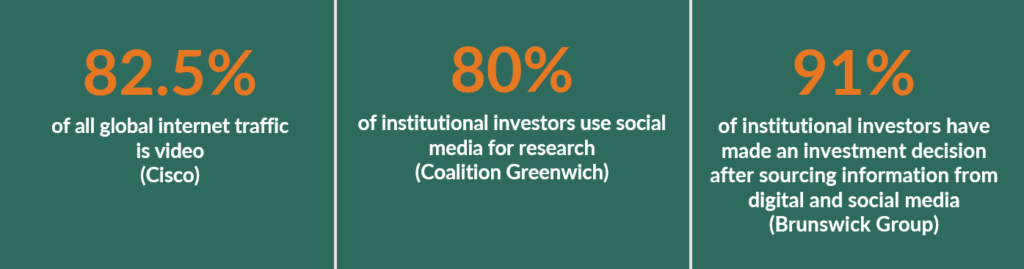
Video now accounts for 82.5% of all global internet traffic, and the average viewer watches nearly two hours of online video each day. These are not niche consumer behaviours; they reflect a structural shift in how people process and retain information. Investors, institutional and retail alike, are not exempt from this shift. They bring the same cognitive habits and format preferences to their investment research that they apply to every other area of their digital lives.
Institutional investors are already here
Coalition Greenwich research finds that 80% of institutional investors use social media as a regular part of their research workflow, and 30% say information gathered through those channels has directly influenced an investment recommendation or decision. A Brunswick Group Digital Investor Survey found that 96% of institutional investors systematically harvest data from digital and social sources, and 91% say they have made an investment decision after sourcing information on those channels. YouTube, with more than 2.5bn monthly active users, is now the world’s second-largest search engine, and investors use it to search for CEO interviews, results commentary and investment propositions.
The communication gap and what it costs
Against this backdrop, the persistence of text-heavy disclosure as the primary investor communication format represents a meaningful strategic gap. Nasdaq noted that, according to research from Bain & Company, 90% of companies fail to connect their IR function with overall business strategy, leaving the investment narrative disconnected from the channels and formats that investors actually use. This is not primarily an analyst relations problem – it is a communication problem, and the investment community has largely moved on to the formats that address it.
What good investor video looks like
The formats that work in IR video are not complicated. Leadership commentary – a CEO or CFO speaking directly to camera, clearly and accessibly – builds the kind of trust that a regulatory announcement cannot replicate. A two-minute investment proposition, explaining the investment case in plain language, is more engaging and potentially conveys more useful content than pages of supporting analysis. A short results summary, timed alongside formal disclosure, ensures key messages reach the broader investor audience that now shapes perception and, ultimately, price.
The most effective IR programmes combine analytical rigour with accessible delivery. Video does not replace formal disclosure or independent research; it extends their reach and improves their impact. A clear investment proposition, supported by credible independent research and distributed across the platforms where investors actually spend their time, reaches audiences that static documents simply cannot.
The risk of doing nothing
Companies that have not invested in their digital capability are not simply missing an opportunity; they are ceding the narrative to whichever third-party sources – such as market commentators, social media and finfluencers – happen to be covering them. The investment story needs to be told by the company. And increasingly, it needs to be seen.
To find out how Edison helps companies build meaningful engagement with their investor base, visit edisongroup.com.