“Edison is the go-to for a new investor to get full understanding of the investment case and business. Edison’s distribution reaches investors that we want to connect with directly.”
The global tungsten industry has entered a period of fundamental structural realignment. Following a decade of price stagnation and geographic concentration, the market experienced a supply shock in early 2025 that has persisted into the second quarter of 2026. Ammonium paratungstate (APT) prices, the global benchmark, have moved from a five-year average of c US$300 per metric tonne unit (mtu) to a current ex-China spot price of c US$3,000/mtu. This c 10x appreciation reflects a primary supply deficit caused by a synchronised contraction in Chinese export availability and a step-change in demand from renewable energy, semiconductors and defence.
How is China’s strategic pivot creating structural headwinds?
The supply side remains defined by extreme geographic concentration, with China historically accounting for c 79–82% of global mine production.
In February 2025, China’s Ministry of Commerce introduced comprehensive export licensing requirements for 20 tungsten-related products, signalling a shift towards strategic management’ of domestic resources. As a result, market participants report a material decline in Chinese APT and tungsten oxide availability to Western buyers. China’s domestic production also faces structural headwinds:
Depleting ore grades: Average grades in major producing hubs like Jiangxi have declined from 0.40% tungsten trioxide (WO3) to below 0.28%.
Regulatory tightening: 2025 mining quotas were reduced by 6.5% to preserve domestic reserves for high-value downstream manufacturing, specifically semiconductors and aerospace.
What is the 2027 ‘cliff edge’ and why does it matter?
A primary catalyst for the current accelerated de-risking of supply chains is the US National Defense Authorization Act (NDAA) mandate.
Effective 1 January 2027, US defence procurement rules will prohibit tungsten ‘covered materials’ – including tungsten metal powder, tungsten heavy alloy and relevant components – where the supply chain includes mining, production, refining or processing in ‘covered countries’ such as China, Russia, North Korea or Iran.
Unlike previous restrictions, this mandate requires metallurgical traceability to the mine level. This could render much of the existing global merchant stockpiles non-compliant for US defence applications, forcing a structural decoupling of the Western military-industrial complex from Chinese-linked tungsten supply.
Can Western production close the supply gap?
While Western nations have designated tungsten as a critical mineral, the route to self-sufficiency remains constrained. The commissioning of Almonty Industries’ Sangdong Mine in South Korea (Phase 1 completed in March 2026) represents the most significant addition to Western supply in decades. However, even with Sangdong and the restart and expansion of assets in Australia and Spain, the global market remains in a deep deficit due to the five to seven year lead times required for greenfield development.
How are tungsten prices reflecting extreme market tightness?
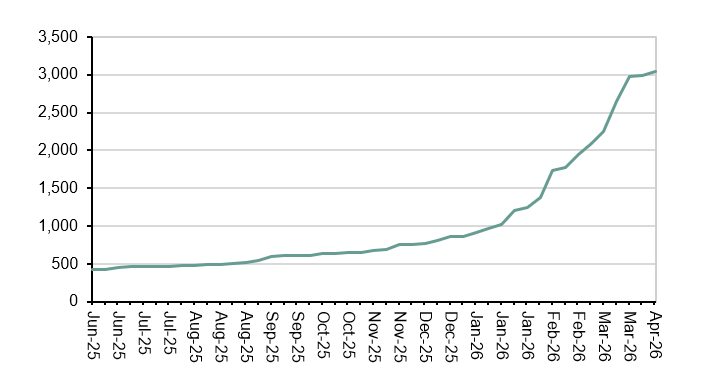
The current tungsten price environment is characterised by extreme tightness and a sharp reduction in traditional spot market liquidity. Following the introduction of China’s export controls in early 2025, ex-China APT prices breached US$1,200/mtu by December 2025. By Q126, as inventories hit critical lows and China’s export controls tightened Western availability, prices surged past US$2,000/mtu, with the ex-China APT spot price trading above US$3,000/mtu as of April 2026.
Exhibit 1: The unprecedented rise in ex-China APT price, US$/mtu
Source: LSEG Data & Analytics
What is driving the demand revolutionbeyond traditional carbides?
Tungsten demand has historically correlated with global GDP and industrial production (cemented carbides for machining). However, in 2025-26 the demand curve has decoupled from traditional industrial indices due to the following high-growth sectors:
Photovoltaic (PV) tungsten wire: The solar industry has rapidly transitioned from carbon steel to ultra-thin tungsten diamond wire (down to 30–35 microns) for silicon wafer slicing to reduce kerf loss. As of Q126, PV-related consumption has surpassed 14% of the total global market, up from negligible levels in 2021.
AI hardware and semiconductors: High-purity tungsten is increasingly important in advanced semiconductors because of its thermal stability, high melting point and suitability for contact plugs and interconnects. The expansion of AI data centres has also increased interest in tungsten-based thermal-management applications.
Defence procurement and stockpiling: The depletion of global munitions stockpiles and heightened geopolitical tensions are driving increased demand for tungsten-based kinetic energy penetrators.
How is upstream strategy evolving in mining and processing?
The upstream has become the focal point for institutional investment, with capital flowing into Western-aligned projects to bridge a projected structural market deficit.
Advanced extraction: Producers are deploying X-ray Transmission (XRT) sorting to maximise margins. EQ Resources has successfully implemented this at Mt Carbine to process historic low-grade waste piles profitably at current price levels.
The Sangdong catalyst: With an average grade of 0.51% WO3 – roughly three times the global average – the Sangdong mine is designed, at full capacity, to supply c 40% of non-Chinese global demand. Phase 1 is currently processing 640ktpa ore to produce 2,300tpa of tungsten concentrate. Phase 2 is planned for 2027 and could lift capacity to c 1.2Mtpa ore and c 4,600tpa concentrate.
Secondary supply: Recycled tungsten now accounts for c 35% of the total mix. However, the high energy costs of chemical recycling (converting scrap back to APT) maintain a high floor price for secondary material.
Who are the key upstream players in tungsten?
Listed tungsten exposure can be grouped into three broad categories:
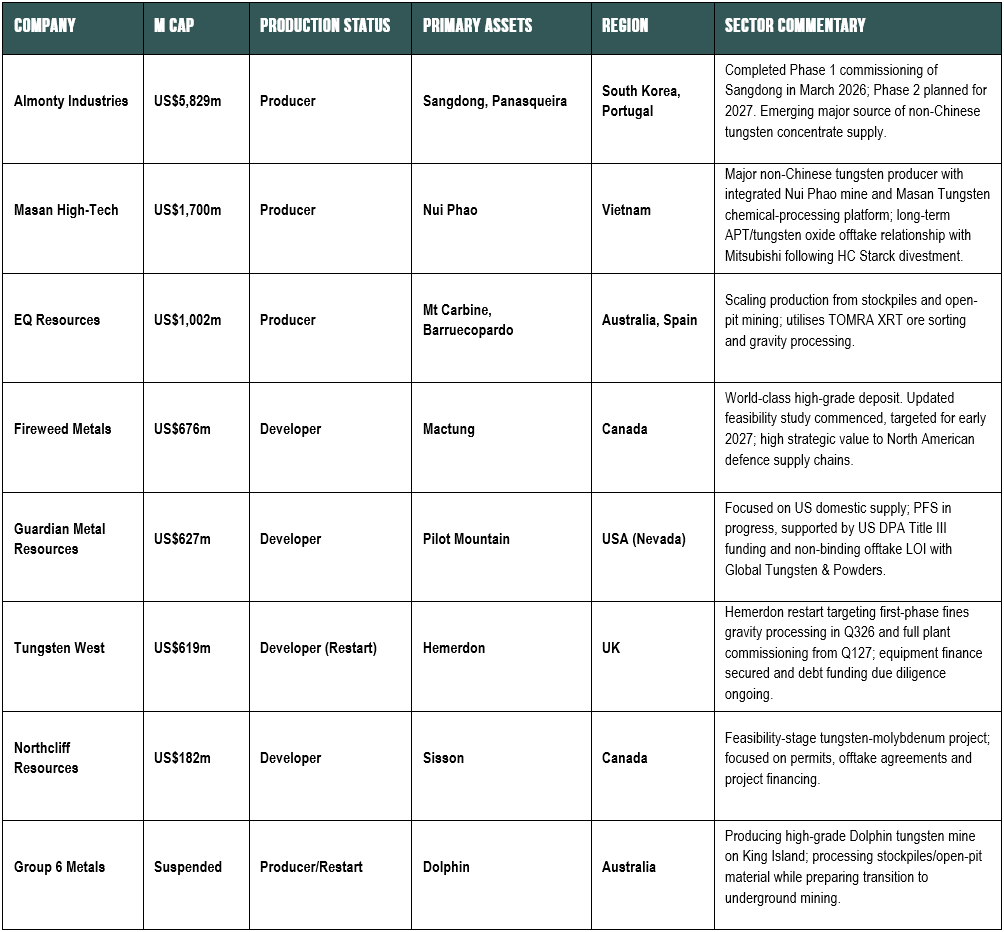
Tier-1 producers: Companies like Almonty Industries and EQ Resources are the primary beneficiaries of the current favourable price environment. Almonty’s Sangdong project is now the world’s largest non-Chinese mine, providing a critical hedge against China’s supply shocks.
The strategic developers: Fireweed Metals (Mactung) and Guardian Metal Resources (Pilot Mountain) represent the next wave of supply. These projects are characterised by high-grade deposits in low-risk jurisdictions, often backed by strategic partnerships with major tech firms (eg JX Advanced Metals’ investment in Fireweed).
The restructuring class: Operations like Group 6 Metals (Dolphin) are navigating the high-cost transition to underground mining, with the market watching closely to see if record prices can offset operational complexities.
For investors, this creates two distinct exposures: near-term producers benefiting from spot scarcity, and developers whose strategic value may rise further if Western governments and OEMs continue to prioritise secure supply over lowest-cost material.
What should investors watch?
The shift from a China-dependent market to a diversified, traceable supply chain creates three key milestones for investors:
Traceability certification: Producers’ ability to provide metallurgical proof of origin will be the primary gatekeeper for supplying the US defence sector after 1 January 2027.
Sangdong Phase 2 expansion: The industry will be watching for the 2027 planned Phase 2 expansion at Sangdong to determine whether non-Chinese supply can help narrow the projected structural market deficit.
Technical milestones: For strategic developers like Fireweed Metals and Guardian Metal Resources, progress through feasibility studies will be critical for de-risking the next wave of Western supply.
Exhibit 2: How to get equity exposure to tungsten
Source: Edison Investment Research
Edison insight
Tungsten has shifted from a cyclical industrial input to a strategic material priced increasingly by security of supply. China’s export controls, the 2027 US defence procurement deadline and demand growth from PV wire, semiconductors and defence have created a market in which provenance may matter as much as price. The key investment question is not simply who has tungsten resources, but who can deliver traceable, Western-aligned material into qualified supply chains before new mine supply arrives.
Megatrends: resource scarcity, supply-chain security, defence rearmament, energy transition, disruptive technologies, semiconductor innovation, industrial automation and electrification.