“Edison is the go-to for a new investor to get full understanding of the investment case and business. Edison’s distribution reaches investors that we want to connect with directly.”
The combination of conflict in the Middle East, rising fuel costs and a weaker consumer backdrop meant that when easyJet’s shares dropped by more than 20% earlier this year, many investors focused on the risks. Then, on 29 May Castlelake disclosed that it was considering a potential bid for the airline, and the share price rose by over 11%. The bid suggests acquirers are tired of waiting for the economic backlog to clear before making an offer.
More importantly, this was not an isolated event. From Bodycote being approached by Apollo Global Management to Tate & Lyle being approached by Ingredion, in the last six years the UK has seen almost 300 bids for UK-listed companies. Takeover activity continues to emerge despite an economic backdrop that should, in theory, be discouraging it.
Which factors suggest UK M&A should not be accelerating?
Historically, M&A activity has tended to slow when investor confidence weakens and political instability rises.
The UK 10-year gilt yield has exceeded 5%. Geopolitical uncertainty remains elevated with the war in Ukraine and conflict in the Middle East. Global trade tensions continue to create uncertainty around future economic growth, energy prices and consumer demand.
Taken together, these factors would normally be expected to suppress M&A activity. Higher financing costs increase the cost of acquisitions, while greater uncertainty reduces confidence in forecasting future earnings and returns, yet we are still seeing an M&A acceleration.
Can takeover targets be identified before a bid emerges?
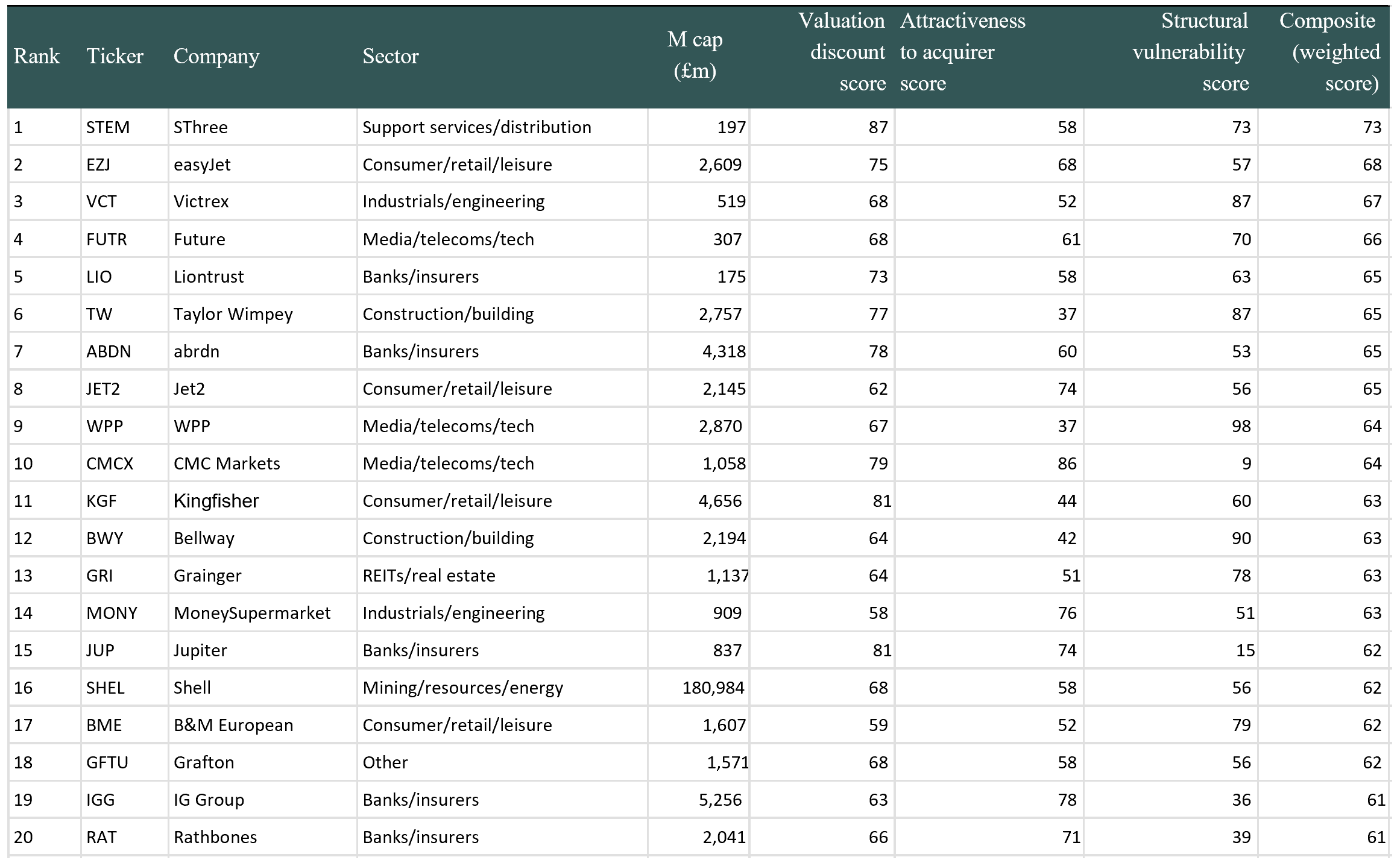
To test whether recent targets share identifiable characteristics, on 18 May 2026 Edison ran a screen on the UK 350 to detect vulnerable companies (see Exhibit 1). The screen combined three factors associated with takeover susception: valuation discounts, attractiveness to acquirer and structural vulnerability.
The rationale was to identify businesses that look good value from an intrinsic basis, with strong balance sheets and robust cash generation. The focus was on clean, unlevered cash-generative businesses that have room to be leveraged up and shareholder registers that would be likely to accept a bid at a premium to the prevailing share price.
The screen results labelled easyJet as second on the takeover vulnerability rankings, prior to Castlelake’s potential offer on 29 May. The screen also flagged Bodycote before Apollo’s disclosure on 22 May.
The most consistent characteristic among highly ranked companies was valuation, followed by weak share price performance. Many companies that were on the screen owned strategic assets, such as easyJet’s airport slots and route network, Taylor Wimpey’s strategic land bank and Grainger’s residential portfolio, making them more attractive to potential acquirers.
Exhibit 1: Top 20 likely targets from Edison’s screen
Source: FactSet, Edison Investment research, data from 18 May 2026
Why does the UK market structure attract acquirers?
Part of the reason lies in the withdrawal of domestic capital from UK equities. UK pension funds have reduced domestic share allocations over the past two decades, from over 50% in the early 2000s to 4–6% currently. This reflects a shift towards investing in line with global indices, such as the US. With low domestic demand and small- and mid-caps being more thinly traded than large-caps, more opportunities have been created for overseas acquirers.
The UK’s governance framework also makes these discounted companies much easier to buy than other countries. In the UK, boards are expected to consider offers that are in shareholders’ interests. As ownership structures are less defensive in the UK than in other markets and offers must be considered whether they are domestic or foreign, acquirers may view UK-listed companies as more accessible targets.
Over the past six years, UK-listed companies have repeatedly attracted takeover premiums of 40–60%. That buyers are willing to consistently pay such premiums suggests that public market valuations do not fully reflect underlying corporate value.
Which sectors appear reasonably exposed?
While the screen identified vulnerable companies across a range of industries, several sector clusters emerged. These sectors include housebuilders, such as Taylor Wimpey and Bellway; asset managers, such as abrdn and Liontrust; consumer and leisure businesses, such as easyJet, Jet2 and Kingfisher; REITs, such as Grainger and British Land; media companies, such as WPP and Moneysupermarket; and industrials, with quality compounders such as Spirax, S&N and Halma.
Why foreign buyers?
Foreign buyers have become an increasingly prominent feature of UK takeover activity. The recent situations involving Castlelake and easyJet, Apollo and Bodycote and Ingredion’s recent acquisition of Tate & Lyle suggest that, despite a challenging macroeconomic backdrop, overseas acquirers continue to see value in UK-listed companies. Through purchasing UK businesses, foreign buyers are purchasing global earning streams but at lower market valuations.
How can the UK reduce takeover vulnerability?
One way to reduce the UK’s vulnerability to takeovers would be to encourage more capital into domestic equities. Measures that have been suggested, such as abolishing stamp duty on share purchases and encouraging greater retail participation, should increase domestic investment and make it harder for acquirers to identify opportunities.
Edison insight
Perhaps the most important point is that strategic buyers have stopped delaying. Historically, people’s expectations were that takeover activity would increase once geopolitical tensions were low and economic visibility was high. Instead, acquirers appear to have decided that waiting for conditions to improve is no longer a viable strategy and that the opportunities that are being presented outweigh the macroeconomic reasons for waiting.
Stock of the month – International Airlines Group (IAG)
Record FY25 profitability and a strong Q126 demonstrate the resilience of IAG’s premium long-haul franchise, while hedging for 70% of FY26 fuel costs, a strong balance sheet and an active €1.5bn buyback support shareholder returns through the Middle East-driven fuel headwind.