“Edison is the go-to for a new investor to get full understanding of the investment case and business. Edison’s distribution reaches investors that we want to connect with directly.”
The global mining industry has entered a renewed period of consolidation, with transaction activity reaching levels not seen since the commodities supercycle of the early 2010s. According to FactSet, 180 mining transactions worth around US$89bn were completed during 2025, representing the strongest year for deal activity in more than a decade. Precious metals accounted for much of this resurgence, with the number of gold-focused transactions increasing by around 42% y-o-y. Bain & Company, using a narrower definition of transactions exceeding US$500m, estimates that total deal value increased by around 45% over the same period. The principal catalyst has been the sustained appreciation in the gold price. Having surpassed US$3,000/oz in March 2025, gold continued to set successive record highs before reaching US$5,589/oz on 28 January 2026. Although prices have since moderated to around US$4,100–4,200/oz, they remain within sight of record highs and continue to generate exceptional operating margins across the industry.
However, the current consolidation wave reflects more than favourable commodity prices. Strong cash generation has enabled producers to return capital to shareholders, invest in existing operations and pursue acquisitions simultaneously. At the same time, structural industry challenges have made acquisitions an increasingly attractive route to growth. The industry’s growing reliance on acquisitions stems from longer-term challenges that have made replacing mined reserves increasingly difficult through exploration alone.
What is pushing producers to buy rather than build?
Reserve replacement has deteriorated markedly over the past decade. Gold mine production reached a record 3,672 tonnes in 2025, compared with 3,292 tonnes in 2017, highlighting the growing difficulty of discovering new economic deposits. S&P Global reports that no gold discoveries exceeding 2Moz were made during either 2023 or 2024, while McKinsey estimates that the reserve base of the world’s largest gold producers declined by approximately 26% between 2012 and 2017. At current production rates, identified global reserves of around 59,000 tonnes equate to c 16 years of mining. For producers, declining reserve replacement presents a strategic challenge. Without replenishing depleted resources, companies face falling production profiles, shorter mine lives and declining long-term cash generation. Acquiring advanced development projects or producing mines therefore provides a more immediate and predictable route to replacing reserves than relying on uncertain exploration programmes.
At the same time, greenfield development has become increasingly expensive and time consuming. Rising capital costs, more complex environmental regulation and longer permitting processes have fundamentally altered the economics of mine development. For many major producers, acquiring a defined resource with an established feasibility study and a credible pathway to production offers a lower-risk and more predictable method of replacing reserves than relying on exploration alone. As a result, high-quality development assets have become increasingly strategically valuable.
Why is Africa becoming increasingly important?
Africa (excluding South Africa) has emerged as one of the principal beneficiaries of this structural shift. The continent hosts some of the world’s largest undeveloped, high-quality gold resources and remains one of the few regions capable of supplying projects large enough to materially extend the reserve base of major producers. Long before European traders arrived, the medieval empires of Ghana, Mali and Songhai were built on gold carried north across the Sahara by the 14th-century Malian ruler Mansa Musa. South Africa’s Witwatersrand basin, discovered in 1886, has produced more gold than any deposit on Earth, estimated at over 40% of all the gold ever mined. And the continent remains a major, growing supplier.
Why is South Africa no longer number one?
While South Africa historically dominated global production, Africa’s gold industry has diversified significantly. Ghana is now the continent’s largest gold producer, selling c 177t in 2025 (on a par with South Africa in 2012) and generating c US$20.9bn of export revenue.
The changing geography of African gold reflects both geological and economic factors. South Africa’s remaining deposits lie at exceptional depths, making extraction increasingly costly and technically challenging. These pressures have been compounded by persistent electricity shortages, ageing infrastructure, rising labour costs and regulatory uncertainty, encouraging exploration capital to shift elsewhere on the continent.
Why are East and West Africa emerging?
The beneficiaries have been the emerging gold districts of West and East Africa, each of which possesses distinct geological characteristics and investment profiles. West Africa is centred on the West African Craton, one of the oldest geological formations on Earth. Its Birimian greenstone belts host numerous world-class gold deposits that have supported rapid industry growth over the past two decades. Ghana is now the region’s largest producer, contributing to around 5% of global mined output, while Mali, Burkina Faso, Côte d’Ivoire, Guinea and Senegal have all established mining industries.
East Africa is underpinned by a different geological province, the Arabian Nubian Shield, which extends from Egypt and Saudi Arabia through Sudan, Eritrea and Ethiopia before continuing south towards Kenya and Tanzania. Although mining activity remains less mature than in West Africa, the region possesses considerable geological potential. Tanzania has already developed into one of Africa’s leading producers while exploration activity has accelerated across Ethiopia and Kenya as investment conditions continue to improve.
Why is jurisdiction important for investors?
Jurisdiction remains one of the most important drivers of mining investment. Gold deposits are geographically fixed, making political stability, regulatory consistency and fiscal policy critical determinants of project value. For this reason, differences in jurisdictional quality continue to exert a significant influence on both public market valuations and acquisition prices.
Africa is frequently perceived as a higher-risk destination than established mining regions such as North America or Australia. In certain jurisdictions, that perception is justified. Political instability, infrastructure constraints, foreign exchange restrictions and security concerns continue to increase operational risk in parts of the continent, while resource nationalism has become an increasingly important consideration for investors evaluating projects.
However, it is equally important to recognise that mining has become more challenging in many traditional jurisdictions. Across North America and Europe, environmental permitting has become increasingly complex, community consultation requirements have expanded, and legal challenges frequently delay project development for many years. Capital costs have also risen materially, reducing the economic attractiveness of greenfield developments, even in politically stable countries.
The investment decision is therefore not simply a choice between high- and low-risk jurisdictions. Rather, it involves assessing whether the risks associated with a particular jurisdiction are appropriately reflected in asset valuations and whether expected returns provide adequate compensation for those risks.
Current market conditions have strengthened that trade-off. Gold prices above US$4,000/oz have significantly increased operating margins across the industry, allowing producers to contemplate absorbing greater political and operational risk than would have been acceptable during previous commodity cycles. Continued purchases by central banks, which acquired a net 244 tonnes of gold during the first quarter of 2026 alone, have reinforced confidence in the long-term outlook for the gold price, further supporting investment into jurisdictions capable of delivering meaningful production growth.
Consequently, investor attention has increasingly shifted towards those African countries where regulatory frameworks are improving and governments are seeking to attract long-term mining investment. Rather than viewing the continent as a homogeneous investment destination, market participants are becoming increasingly selective, rewarding jurisdictions that combine prospective geology with improving governance and stable fiscal regimes.
How do East and West Africa compare for investors?
The distinction between West and East Africa has become increasingly important. West Africa remains the continent’s most established gold-producing region, benefiting from extensive infrastructure and a long history of mining. However, military governments in Mali, Burkina Faso and Niger have increased investor concerns through interventionist mining policies, including higher state ownership, licence reviews and, most notably, the seizure of gold stocks from Barrick Mining Corporation’s operations in Mali during 2025. These developments have increased perceptions of jurisdictional risk despite the region’s exceptional geological endowment.
Importantly, these challenges are not representative of West Africa as a whole. Ghana and Côte d’Ivoire continue to maintain comparatively stable political environments, established legal systems and investment-friendly mining legislation, allowing both countries to remain attractive destinations for international capital.
East Africa presents a different proposition. Although its mining industry remains less mature, the direction of travel has been consistently positive. Tanzania, Ethiopia, Kenya and Uganda have introduced a series of reforms aimed at improving regulatory certainty, attracting foreign investment and strengthening partnerships with international mining companies. While risks remain, including a civil conflict in Sudan, localised security concerns within Ethiopia and foreign exchange constraints, the region is increasingly viewed as one of Africa’s most promising growth markets. As regulatory frameworks continue to improve, East African assets have the potential to narrow the valuation gap with more established mining jurisdictions.
How much gold M&A has Africa seen and what are buyers paying?
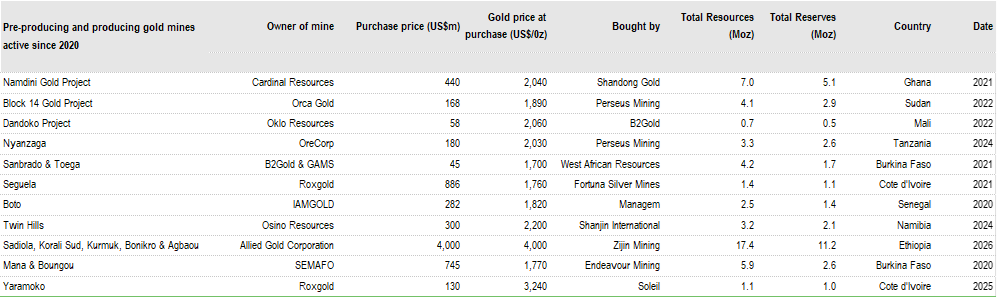
Exhibit 1: M&A activity for pre-production and producing African mining companies since 2020
Source: Edison Investment Research
Recent acquisition activity demonstrates that buyers are increasingly willing to pay substantial prices for high-quality African gold projects. Since 2020, more than a dozen producing and development-stage assets have changed ownership across the continent, including Shandong Gold’s acquisition of Namdini in Ghana, Perseus Mining’s purchase of Nyanzaga in Tanzania and Zijin Mining’s expected c US$4bn acquisition of Allied Gold, centred on the Kurmuk Gold Project in Ethiopia.
Exhibit 2: Average valuation of producers and pre-production African miners
Source: Edison Investment Research
Two themes emerge from these transactions. First, producing assets command significantly higher valuations than pre-production stage projects. Acquirers have paid an average of c US$159 per resource ounce for producing mines compared with around US$64 per ounce for projects that have yet to enter production. By the time a mine reaches production, many of the principal technical, financing and permitting risks have been removed, justifying substantially higher acquisition multiples.
Exhibit 3: Average valuation of pre-production East and West African miners
Source: Edison Investment Research
Second, despite differing political environments, acquisition pricing has remained remarkably consistent across Africa’s principal gold regions. West African transactions have averaged c US$56 per resource ounce compared with around US$47 per ounce in East Africa. While West Africa has accounted for a considerably larger number of transactions, the relatively modest valuation differential suggests that investors increasingly recognise the geological quality of East African assets despite the region’s shorter mining history.
Importantly, these historical transactions were completed during a period when the average gold price was close to US$1,900/oz. With gold now trading comfortably above US$4,000/oz, the economics underpinning many development projects have improved substantially. As such, today’s market environment provides scope for strategic assets to command significantly higher valuations than those observed over the past five years.
How should investors value a company that is not yet producing?
The progression from exploration to production remains one of the most important drivers of value creation within the mining sector. As projects advance through technical studies, permitting and construction, development risk declines, financing becomes more accessible and future cash flows become increasingly valuable. In principle, investors should therefore expect valuation multiples to rise as a project moves closer to production.
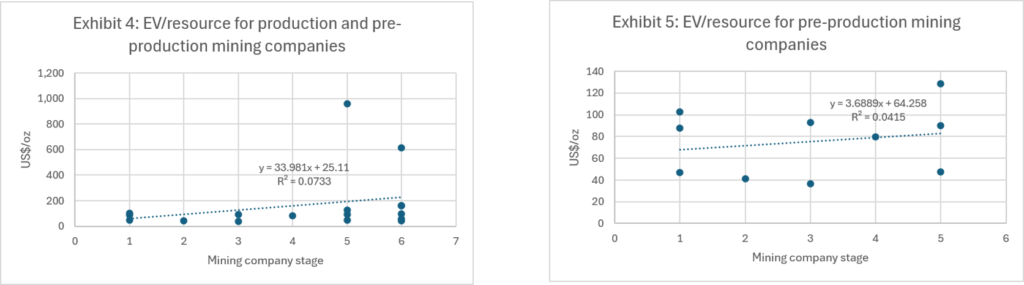
The market, however, paints a more nuanced picture. While producing assets generally attract the highest valuations, this is not always the case. The trend is positive but highly dispersed, indicating that progression through the development pipeline alone does not guarantee a meaningful re-rating.
This becomes even clearer when attention is restricted to development-stage companies. Although later-stage developers typically trade at slightly higher valuations than early-stage explorers, the relationship is almost flat, with considerable variation around the trend line. Advancing from exploration to a preliminary economic assessment, or from a feasibility study to permitting, often delivers only modest changes in valuation when considered in isolation.
Instead, the market appears to place greater emphasis on the quality of the underlying asset than on development stage alone. Projects with perceived large and/or high-grade resources, favourable metallurgical characteristics and attractive operating costs consistently command premium valuations irrespective of whether they have advanced one additional stage in the development process.
Execution credibility also matters. Management teams with established records of financing, constructing and operating mines are often awarded higher valuations than less experienced peers, reflecting investors’ confidence that technical and financing risks can be successfully negotiated.
Ultimately, development stage establishes the framework within which a company’s valuation is determined, but it is asset quality, execution capability and jurisdiction that explain much of the variation observed between companies at similar stages of development.
Does the quality of the asset and the jurisdiction change the picture?
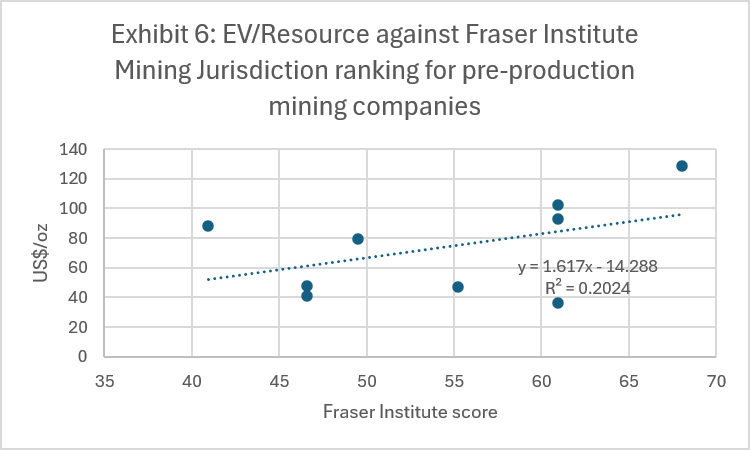
While development stage influences valuation, jurisdiction frequently proves to be the stronger differentiator. Comparing enterprise value per resource ounce with the Fraser Institute’s assessment of mining investment attractiveness reveals a clearer relationship than that observed for development stage alone. Companies operating in jurisdictions with established legal frameworks, stable fiscal regimes and supportive mining policies consistently command higher valuations than those exposed to countries perceived as carrying greater political or regulatory risk.
Source: Edison Investment Research and Fraser Institute
This relationship is even more pronounced within acquisition transactions than in public market valuations. Strategic buyers committing substantial amounts of capital appear willing to pay meaningful premiums for projects located in jurisdictions where regulatory risk is lower and long-term operating conditions are more predictable.
Importantly, jurisdiction is also dynamic. Mining investment attractiveness evolves over time as governments reform legislation, improve licensing procedures and strengthen relationships with industry participants. Countries capable of demonstrating sustained regulatory improvement have the potential to experience valuation re-ratings independent of changes in underlying project economics.
This dynamic is particularly relevant to East Africa. Although the region has historically traded at a discount to more established mining districts, continued regulatory reform and increasing investor confidence suggest that this valuation gap may narrow over time. Should this occur, companies operating high-quality projects within improving jurisdictions could benefit from both operational de-risking and an expansion in valuation multiples.
How much upside is really on the table?
Public market valuations suggest that investors continue to apply significant discounts to projects that have yet to reach production. For companies that have completed preliminary economic assessments, pre-feasibility studies or more advanced technical work, enterprise values typically represent only around 6–20% of published project net present value. In other words, the market frequently values these companies at only a fraction of the discounted cash flows that their projects could generate if successfully developed, reflecting the market’s perception of the risks involved in bringing a project to account.
Exhibit 7: EV/NPV for PEA, PFS and permitting-stage pre-production gold companies
Source: Edison Investment Research
Development-stage mining projects remain exposed to financing risk, permitting delays, construction challenges, cost inflation and commodity price volatility. Each of these uncertainties justifies a degree of conservatism when valuing future production. Nevertheless, the magnitude of the discount highlights the potential value created via successful project execution. As companies secure financing, obtain regulatory approvals and progress towards construction, uncertainty declines and valuations increasingly converge towards underlying project economics. This pattern is consistent with the acquisition data, where producing assets command significantly higher multiples than development-stage projects. However, it should be noted that very few projects ever make that transition (about one in a thousand), therefore, the premium attached to production is not simply a reward for lower risk, it also reflects how rare a successfully executed project actually is.
For investors, the opportunity lies in identifying projects where the market may be overestimating development risk relative to the quality of the underlying asset. Companies combining robust project economics, experienced management teams and exposure to improving jurisdictions offer the greatest potential for valuation re-rating as execution milestones are achieved.
Ethiopia: A potential emerging gold jurisdiction
Ethiopia has become one of the most compelling examples of an emerging African mining jurisdiction. Although it sits within the highly prospective Arabian Nubian Shield, the country has historically remained underexplored relative to neighbouring Tanzania and Egypt, leaving investors exposure to a region early in its mining lifecycle.
Mining is now one of Ethiopia’s fastest-growing industries, with gold overtaking coffee as the country’s largest export. The government has introduced a series of reforms designed to attract international investment, including changes to mining legislation, tax incentives, licensing reforms and the liberalisation of the Ethiopian birr. Ethiopia also benefits from a structural competitive advantage unavailable to many emerging mining jurisdictions. The expansion of hydroelectric generation through the newly commissioned Grand Ethiopian Renaissance Dam has created access to abundant, low-cost renewable hydroelectricity, reducing dependence on imported diesel and improving the long-term operating economics of new mines. At a time when energy costs have become an increasingly important determinant of mine profitability, this provides a meaningful competitive advantage for future developments.
Investor confidence in the jurisdiction is beginning to strengthen accordingly. Perhaps the clearest endorsement came in early 2026, when Zijin Mining agreed to acquire Allied Gold for approximately US$4bn, with the transaction centred on the Kurmuk Gold Project in western Ethiopia. The acquisition represents one of the largest recent investments in Ethiopia’s mining sector and highlights the willingness of major international producers to commit significant capital to high-quality Ethiopian assets. Although challenges remain, including regional security concerns and administrative capacity, the direction of travel is increasingly positive.
KEFI Gold and Copper*: A case study in the current environment
KEFI Gold and Copper represents a practical example of many of the themes driving today’s gold M&A market. Its flagship Tulu Kapi project combines an advanced-stage development asset with exposure to one of Africa’s fastest-improving mining jurisdictions. During April 2026, the company secured c US$355m of project financing, significantly reducing one of the largest risks facing development-stage mining companies and allowing construction activities to advance.
From an operational perspective, Tulu Kapi possesses many of the characteristics currently sought by strategic acquirers. The project is expected to produce approximately 140,000 ounces of gold per year over the seven years of mining the open pit while maintaining all-in sustaining costs (AISC) of approximately US$900–1,100/oz. At prevailing gold prices, this positions the project among the lower-cost and potentially higher-margin new gold developments globally.
More broadly, Tulu Kapi reflects the type of asset increasingly attracting strategic interest across the sector. It combines a sizeable defined resource, advanced technical work, secured financing and improving jurisdictional fundamentals, reducing many of the uncertainties typically associated with earlier-stage development projects. As producers continue to seek high-quality replacement ounces, projects possessing these characteristics are likely to become increasingly scarce and, consequently, increasingly valuable.
Edison Insight
Gold M&A has entered its most active phase since the early-2010s supercycle and the driver is structural, not simply the record gold price. Major producers are running short of reserves and can no longer replace them through exploration alone, redirecting capital towards Africa, home to some of the world’s largest undeveloped, high-quality gold resources. Yet, the market rewards a project’s progress through the development stages surprisingly little. The re-rating comes with production (acquirers have paid c US$159 per resource ounce for producing mines against c US$64 for pre-production ones) and with jurisdiction, for which strategic buyers pay a clear premium. The implication for investors is that the greatest upside lies in advanced, financed development assets in African jurisdictions that are themselves improving, where operational de-risking and a jurisdictional re-rating can compound. East Africa, and Ethiopia in particular, is where that combination is emerging most clearly.
Megatrends: Resource scarcity
*KEFI Gold and Copper is a client of Edison Investment Research.