“Edison is the go-to for a new investor to get full understanding of the investment case and business. Edison’s distribution reaches investors that we want to connect with directly.”
For most of the past three decades, new nuclear power construction in the West slowed. According to the International Energy Agency (IEA) in the past decade alone 94% of nuclear reactors that started construction were of Chinese or Russian design. Construction in the West was held back by high costs, long timelines and public unease after accidents at Three Mile Island, Chernobyl and Fukushima. A surge in electricity demand, led by the data centres behind the AI boom, alongside the need for energy security as a result of the recent geopolitical tensions has combined with the need for reliable, low-carbon power, and nuclear is suddenly back in favour. Governments are setting ambitious targets, utilities are restarting shuttered reactors, and, in a striking reversal, the world’s largest technology companies are helping to fund the build-out. For investors, the combination of a decarbonisation mandate and relentless demand growth is what makes the theme structural rather than cyclical.
What is driving the revival?
Three forces are at play. The first is a jump in electricity demand: JP Morgan Global Research expects power demand to grow by more than 2% a year over the next five years, up from just 0.5% over the past decade, driven by AI, data centres, electrification and reshored manufacturing. The second is energy security. Recent swings in oil prices tied to geopolitical conflict, including the US-Iran confrontation and the Russia-Ukraine war, have exposed the risks of relying on a narrow set of fuels and shone the light on nuclear as a more reliable source, offering a stable home-grown energy supply. The third is policy. At COP30, 33 countries pledged to triple nuclear capacity by 2050, and, because nuclear generates round-the-clock power with almost no carbon emissions, it qualifies as clean energy under frameworks such as the EU Taxonomy for Sustainable Activities, unlocking ESG-driven capital.
How does a nuclear power station work?
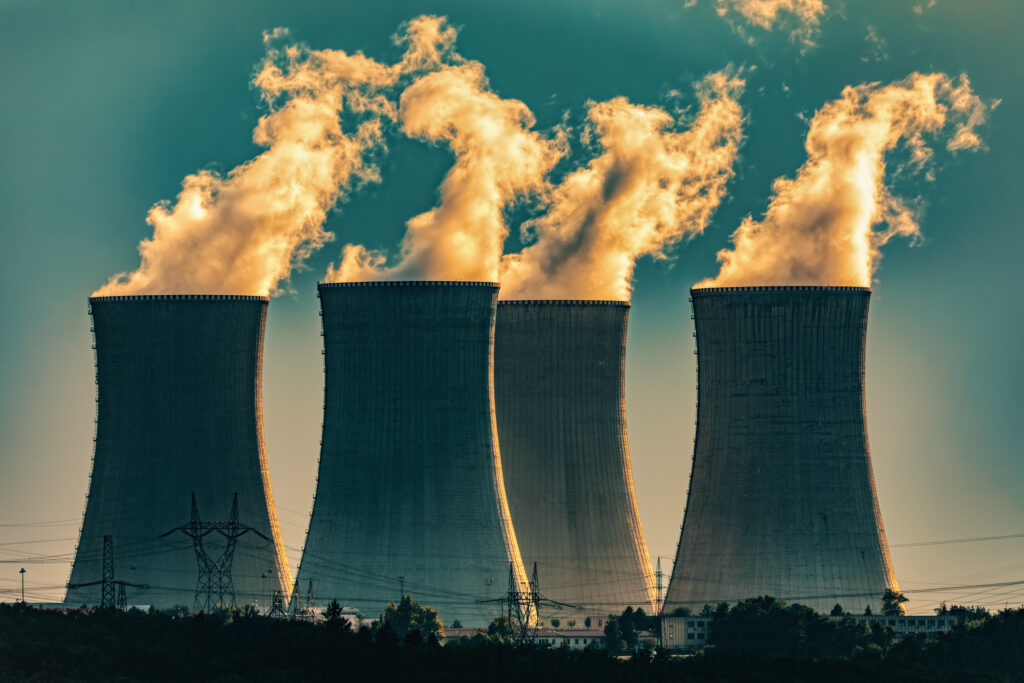
A conventional nuclear reactor splits atoms of uranium in a process called fission. This process releases heat, which is used to boil water into steam, and the steam drives a turbine connected to a generator, producing electricity. According to McKinsey, the appeal is that reactors deliver steady, around-the-clock output, known as baseload power, with a minimal carbon footprint, and modern designs are built to run for at least 60 years. That constancy is what sets nuclear apart from wind and solar, whose output rises and falls with the weather. Today around 440 reactors supply roughly a tenth of the world’s electricity across more than 30 countries, about a quarter of all low-carbon power, according to figures cited at the 2026 Nuclear Energy Summit hosted by France and the International Atomic Energy Agency.
How big is the electricity demand coming from AI?
Demand from AI is growing faster than almost anyone expected. The IEA projects that data centres worldwide will consume c 1,100TWh of electricity in 2026, roughly equivalent to Japan’s entire national consumption an 18% upgrade on the IEAs December 2025 estimate. To picture the scale, the IEA notes that a single mid-sized AI data centre uses as much power as about 100,000 households. Morgan Stanley expects global power demand to rise by more than a trillion kilowatt-hours a year through 2030, with AI data centres accounting for close to a fifth of that growth. This has resulted in hyperscalers, the largest cloud and data-centre operators such as Amazon, Microsoft, Google and Meta, scrambling to lock in reliable power. Data centres need power that is both clean and constant. While wind and solar are cheaper per unit and are being built at record pace, with the IEA expecting solar alone to overtake both wind and nuclear generation during 2026, but their output is intermittent, whereas AI computing runs continuously. Nuclear supplies firm, carbon-free electricity at high density on a small footprint and helps keep the grid stable.
Can new capacity be built out quickly enough?
Big plants take a decade or more and routinely overrun schedules. The Vogtle plant in Burke County, Georgia, the first newly built US reactor to come online in decades, took about 15 years and cost more than $30bn, according to Bloomberg Intelligence. The near-term focus is on cheaper, faster options. One option is extending the life of existing reactors: the US nuclear regulator has cleared most of the fleet to run for 60 years, and a dozen for 80. Another option is restarting shut-down plants. Wood Mackenzie estimates c 27GW of retired US capacity could be revived in months rather than years, at a fraction of new-build cost. Holtec International’s Palisades in Michigan is returning to service, and Constellation Energy is restarting Three Mile Island, which was the site of America’s worst nuclear accident, under a 20-year deal to supply Microsoft, renaming it to Crane Clean Energy Center.
What are SMRs, and why should they be on our radar?
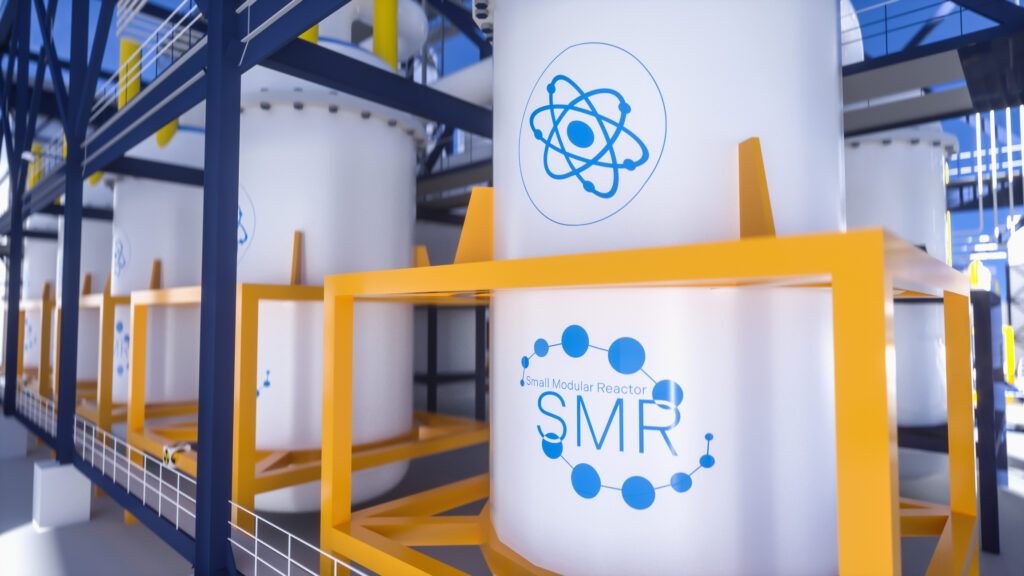
There has been a lot of attention focused on small modular reactors (SMRs), where much of the excitement now sits. As the name suggests, they are smaller, typically under 300MW against roughly 1,000MW for a conventional plant, and built in factories from standardised modules, then assembled on site. In principle that means lower upfront costs, shorter build times and fewer of the cost overruns that plagued large projects such as Vogtle, where budgets more than doubled. Many designs also use ‘passive’ safety systems that shut the reactor down automatically, without operator action. According to the IEA, their smaller scale makes SMRs easier to finance and to site near the data centres and industrial users that need them, and more than 90 designs are now in development worldwide. China’s Linglong One is expected to become the first commercial land-based SMR to start up during 2026, while in the UK Rolls-Royce is preferred bidder to build the country’s first units, each generating 470MW. While promising, broad SMR deployment is unlikely before the mid-2030s.is unlikely before the mid-2030s.
Exhibit 1: Concept rendering of a SMR future energy concept.
Source: iStock.com/audioundwerbung
Who is putting money into nuclear?
While governments once had to coax investment into nuclear power, technology companies are now competing to secure supply. The main tool companies are using is long-term power-purchase agreements (PPAs), under which a buyer commits to take a plant’s output for years ahead, giving developers the revenue that lenders require. Microsoft is underpinning Constellation’s Three Mile Island/Crane Clean Energy Center restart this way, and Google has signed a 25-year PPA for NextEra Energy’s Duane Arnold Energy Center. Some companies have ‘behind-the-meter’ deals, in which a reactor sits beside the data centre and feeds it directly, bypassing the congested grid. Others take equity stakes: Amazon has committed $500m to developer X-energy, and Meta has backed Oklo and TerraPower. Bloomberg Intelligence estimates such commitments could help unlock as much as $350bn of new US nuclear funding by 2050, which matters most for unproven first-of-a-kind projects.
What could derail the theme?
There are a number of risks to consider that could derail the theme. The most pressing is fuel. Turning uranium into reactor fuel requires enrichment, a step controlled by very few companies, and the next generation of reactors needs more highly enriched fuel, known in the industry as high-assay low-enriched uranium (HALEU), which the West has little capacity to produce. Wood Mackenzie expects US enrichment to fall well short of demand even after planned expansions. That gap will be sharpened by a ban on Russian nuclear fuel (taking effect in 2027), which has historically supplied more than a third of the US market. Uranium mining is concentrated too, with Kazakhstan alone providing 43% of global output according to the IEA. As seen with Vogtle, cost and delivery are also a risk. First-of-a-kind projects can run enormously over budget, and Bloomberg Intelligence expects only a handful of SMR developers to survive. In addition, public acceptance still constrains the build-out in countries such as Germany, and policy that shifts midway through construction can wreck a project’s economics.
How can investors gain exposure?
There is no single ‘nuclear power’ trade. Exposure spans the value chain: uranium and fuel processing; construction and engineering services; advanced reactor developers; and utilities running existing plants. At the front end sit the fuel suppliers: uranium miners such as Cameco, the largest holding in the Nuclear Renaissance ETF and co-owner of the reactor maker Westinghouse, and enrichment specialists such as Centrus. Next come the equipment makers that build the reactors, among them GE Vernova and Japan’s Mitsubishi Heavy Industries. Then there are the utilities and generators that own and run the plants, including Constellation, Vistra, Talen Energy and Dominion Energy; several of them have signed supply deals with the technology giants. These stocks can be volatile; Bloomberg Intelligence notes Constellation fell almost 30% in the first half of 2026 as contract activity cooled. In addition, at the higher-risk end sit pure-play SMR developers such as Oklo, NuScale and X-energy, most still pre-revenue. For diversified exposure, thematic funds such as the Nuclear Renaissance ETF hold names from across the chain. For investors, the case for nuclear is compelling, but execution matters as much as the theme: with long timelines, high costs and shifting policy, the rewards will go to those who back the projects and companies that can deliver.
Edison Insight
Nuclear power is emerging from three decades of stagnation, propelled by the AI-driven surge in electricity demand, renewed concern for energy security and policy that now counts nuclear power as clean energy. Unlike wind and solar, nuclear energy supplies firm, carbon-free baseload power around the clock, making it a natural partner for data centres. Near-term growth will come from reactor restarts and life extensions, with small modular reactors scaling in the 2030s; in a striking shift, technology giants are now helping to fund the growth. For investors, this opens exposure across the fuel, equipment and utility value chain, though not without execution risk.
Megatrends: energy transition, resource scarcity, disruptive technologies, climate change, automation & industrial innovation, digital economy