IP Group — 12 videos in collection
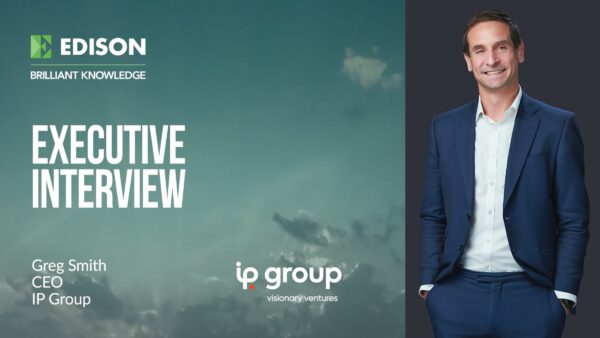
In this interview, Greg Smith, CEO of IP Group, speaks to Dan Ridsdale, managing director, technology, at Edison Group, about the company’s H1 results, including a 3.2% rise in NAV per share to 114p and nearly £67m of realisations. They discuss progress towards IP Group’s £250m realisations target by 2027 and the de-risking of its exposure to Pfizer’s anti-obesity programme. They also cover developments across the portfolio, including Oxford Nanopore, Enterprise Therapeutics, Hysata and Oxa as well as IP Group’s investments in quantum computing and future compute, the expansion of its third-party capital platform and its approach to capital allocation.
What were the key highlights of IP Group’s H1 results, including NAV per share growth and realisations?
Greg Smith: The NAV per share increase to 114p was the single metric which is easiest to get your head around and demonstrates progress over the long term. For us as a business, I think it was the breadth of the progress that was encouraging.
We made very good progress on realisations. That’s been one of our medium-term targets that we have put out to the market, and we’re making good progress against it. We saw some de-risking of our Pfizer asset, which I’m sure we’ll have a bit of time to talk about. Oxford Nanopore made good progress in the period. And encouragingly, some of the things that we talked about in the half year were around the progress in some of those companies that are outside of the top five or 10 holdings that make up a big proportion of the value now, but that hopefully will be the drivers of value in the future.
I think it was the breadth of the progress as well as the NAV per share increase that was encouraging, and I think it gives investors confidence that the business is moving in the right direction.
Does IP Group’s progress towards its £250m realisations target show that the portfolio is reaching a more mature, sustainable phase?
Greg Smith: I think that’s the right conclusion to reach. As you say, we’re making good progress against that £250m. I remember the process of setting what we considered to be quite a stretching objective back at the beginning of 2025, and at that point it was getting on for more than half of our market cap at the time. So we set ourselves an ambitious target to try and monetise some of that NAV value into cash, and shareholders can really then see that proving out in cash terms.
The portfolio’s definitely matured. If you roll back five, 10 years, I would say there were more companies that were more heavily weighted towards technology risk than commercialisation risk, and I think that balance has shifted a bit more in favour of commercialisation risk. As companies get further through their commercialisation journey, it gives us, as an investment team and as a management team, more opportunity and more options when it comes to realising that value into cash for shareholders.
And again, it was the diversity of sources of realisations that was encouraging in the first half and beyond. We had a couple of public market companies. One was selling down in Hinge Health, which listed at the back end of 2025 on the New York Stock Exchange. There was a full acquisition of another public business by Lilly. And we also had an outright private sale to a strategic acquirer. So, three different sources, and that breadth of potential realisation opportunities is what gives us confidence around delivering that £250m cumulative by the end of 2027.
How has the de-risking of Pfizer’s anti-obesity programme driven IP Group’s NAV uplift, and what are the next key milestones?
Greg Smith: That, again, was a story of more clinical progress. As viewers and shareholders will be aware, we’ve got exposure across a number of different programmes that Pfizer is taking forward. Incredibly, they’re running 10 Phase III programmes across the lead compound, berobenatide. Just after the period ended, as far as our results are concerned, Albert Bourla, the chief executive of Pfizer, came out and said that of the three Phase III programmes that are actually running, all three are now almost fully recruited.
As we look forward to the next milestones, which, of course, are successfully completing those trials on time, getting the readouts and then seeing what the next commercial point of progress is for the businesses. That’s a pretty key statement from them, because often the thing that drives the timing of those clinical trial outputs is being able to recruit the patients onto the trial. So that was very encouraging.
The thing during the period, which had the biggest impact on our valuation, was actually progress in the second programme, which is a combination of berobenatide with amylin, another compound that’s used in the same treatment area. That moved into Phase IIb, and so the risk that we apply to those future cash flows just reduces a bit. That’s what led to the uplift.
As we look forward for the rest of this year and into next year, progress in those two areas is obviously important. There are also a number of other compounds that we’ve licensed to Pfizer that they’re developing. A couple of those are in Phase I. There’s a prodrug, which could potentially be quarterly dosing, so very long distances between dosing. We’ve got little to no value on those very early programmes at all in our current valuation. So as they hopefully progress successfully through Phase I and beyond, that could be another value driver.
So, it’s encouraging to see, but it’s important for our shareholders to recognise it’s not like we’ve got a single programme and we’re waiting on the results of a single programme. It’s a breadth of different compounds moving through the clinic in different indications, and that’s why we like the risk/reward profile of that asset.
What were the other key developments across IP Group’s portfolio, including Oxford Nanopore and the exit from Metsera?
Greg Smith: Oxford Nanopore, which you picked up there, is an obvious example. That is a business that is reaching a good stage of maturity now. We’ve been holders for a long time. Our thesis over the last 12 to 18 months has been around that business successfully moving to break-even. I think we were maybe a bit more confident than the rest of the City that they would achieve that on the timetable that they set out. The half-year results, and particularly the very significant improvement in their EBITDA loss, have led to increased confidence across the analyst community. I think our investment thesis there will play out over the next 12 to 18 months. And again, that gives us some more options for thinking about liquidity and realisation.
We had some good progress on the clinical side. For example, Enterprise Therapeutics, which is another one of our clinical-stage therapeutics businesses, had a very interesting readout in cystic fibrosis. It’s a very difficult-to-treat area, and it can hopefully be very valuable commercially because it’s a very difficult-to-treat disease.
On the clean tech side, it was very encouraging to see Hysata, our next-generation hydrogen electrolyser business, achieve its first commercial 1MW plant order. That’s obviously a milestone in itself, and now they need to go on and deliver that in the field during the first half of next year.
Then, straddling deep tech and clean tech, there’s Oxa, our self-driving autonomous vehicle software business, which is now very much focused on off-road applications – things like ports and airports, where you’re having to tow stuff around. Not only did that company complete a $100m funding round that we announced in January, it also entered into a very interesting strategic joint venture with Dubai Future Foundation. That is to put a number of vehicles into Dubai’s logistics system, and it could, hopefully, be the gateway into scaled deployment. So, a very important commercial milestone for the business.
Coming back to the theme that we started with, it was encouraging to see that breadth of progress across the portfolio.
How has IP Group’s long-standing investment in quantum computing developed, and how does the company see the sector evolving?
Greg Smith: We were delighted for the teams at both Oxford Quantum Circuits and Quantum Motion. We’ve been with them since the very first funding round, and I think the long-term opportunity in quantum is really interesting and exciting. For IP Group shareholders, there’s roughly 2p a share in exposure to that.
But one of the possibly more interesting trends, and what it says about IP Group’s investment philosophy, is that we have quite a deep thematic focus on what we call future compute, of which quantum is a component. This is all around, something which is very familiar to everyone who’s listening, I’m sure, the increasing digitisation and, certainly, the huge increase in processing power and memory that is needed to support things like large language models [LLMs] and the huge increase in machine learning.
That theme of hardware for next-generation compute is something that we’ve been investing in for the last five, 10 years. There were three other companies in that same space that made good progress during the period, and we think they could be catalysts for the next six, 12, 18 months.
They include an analogue optical computing company called Lumai, which is looking at doing the inference steps, in the computation needed for inference, much more energy efficiently, using light in 3D space. That’s an important component of trying to increase the speed and bring down the energy cost of compute for LLMs.
We have a next-generation memory technology, which is all about shrinking the form factor and being able to get it closer to the processing, because a lot of the energy and time is wasted transferring data between the processor and the memory chip – so you can co-locate them. Again, it’s a fascinating business called Intrinsic [Semiconductor Technologies].
And then there’s probabilistic compute [Quantum Dice]. You and I have spoken occasionally about the importance of randomness. If you can use the quantum effect to create truly random numbers for things like optimisation problems and other computation areas, that’s also important.
I think all three of those businesses are nicely set, and we own somewhere between 15% and 28% of each of them. So, if they deliver as we think – there is the opportunity for them to do so – our shareholders have got good exposure to those. So we’re really pleased with the quantum companies – a couple of percent of exposure – but we’ve also got this big theme of future compute that seems to be bearing out.
How is IP Group expanding its third-party capital platform through Aberdeen, Parkwalk and Climate Catalyst, and what does this mean for the business as a whole?
Greg Smith: This is a theme that I’ve been talking about for quite a long time, so I think it’s very encouraging to see two new mandates signing during the year. I said at the time of the full-year results, when we announced the Aberdeen partnership, that I hoped we’d be able to deliver another one. The Climate Catalyst one was signed and announced, I think, within a couple of weeks of the full-year results. The next phase of development for both of those now is to make our first investments and get the first portfolio companies funded under those two mandates.
On the broader opportunity, IP Group has traditionally – five, 10, 15 years ago – been a balance-sheet investor first and foremost. I think the balance sheet remains a really important strategic asset, and it’s where the vast majority of shareholder value lies. But on a slightly longer-term basis, the addition of private capital brings a number of benefits alongside the balance sheet.
Although it’s a relatively nascent area, having more recurring fee income helps to mitigate the cost base and enables us to leverage the platform that we’ve built. It also provides opportunities – in the case of Parkwalk – where the cost of capital is probably a bit lower than the balance sheet because of the tax incentives. So we can cast a wider net for new portfolio opportunities, and a subset of those that progress could then be funded on the balance sheet.
Similarly, on the scale-up capital side, as we’ve seen with the quantum companies, there are hopefully an increasing number of businesses with the pedigree to raise a few hundred million, and that’s beyond the capacity that we have on the balance sheet. So, it should be complementary capital to help accelerate those businesses and really prove you can create businesses at scale here in the UK. That will obviously be good for investors, but I think it will also be good for society and the economy as we look to build the next shape of the UK economy.
How is IP Group balancing capital allocation between new investments, existing portfolio companies and returns to shareholders?
Greg Smith: Capital allocation remains probably the most important job that the board and the management team have to do, day to day, week to week, month to month. As a board, we remain very strongly of the view that returns to shareholders are an important component of the overall value story. Ultimately, the large proportion of our capital is invested into the existing maturing businesses that we are looking to progress to the point where we can monetise them and start the cycle again. But we do think that things like buybacks are very additive for short-term and long-term shareholders, and we continue to advocate for that position.
As you mentioned, it’s also about a balance of investing in new things. I think we’ve shown good progress this year in terms of refilling the hopper with new opportunities. I spoke at the back end of 2024 and early 2025 about trying to use Parkwalk more proactively as our sourcing engine, and we’ve made three new investments onto the balance sheet this year so far.
One of them is AI for materials discovery. It comes from a world-leading lab and brings together a proper world-leading professor in the space with a multi-hundred-million-pound development lab. We’ve also brought those two ingredients together with an experienced entrepreneurial leader whom we’ve backed previously. We haven’t announced that yet, but, hopefully it will be announced in the next few weeks. It’s about bringing together those components of the ecosystem that we’ve operated in for the last 20, 25 years.
There was that one, and we had another, a hyperspectral imaging company in the healthcare space, which was a slightly later-stage Series A investment. It’s all about helping both human and robotic surgeons to assess the health of tissue live during surgery, increasing the success rates and decreasing the repeat rates for surgical procedures.
So, we’re now seeing quite a healthy flow of new things onto the balance sheet. As we’re being successful in delivering realisations, we’re hopefully able to return a portion of that to shareholders. We’re also ensuring that we’re investing in the future opportunities that will deliver growth for shareholders in future years.
This transcript has been lightly edited for clarity and readability. Verbal fillers, false starts and minor repetitions have been removed from the interviewee’s responses only. Punctuation, spelling and formatting have also been standardised in line with Edison house style. No substantive changes have been made to the meaning of the discussion.