“Edison is the go-to for a new investor to get full understanding of the investment case and business. Edison’s distribution reaches investors that we want to connect with directly.”
Few substances on Earth have a more extraordinary origin story than helium. Formed over millions of years through the radioactive decay of uranium and thorium deep underground, it slowly seeps through rock until trapped alongside natural gas. It is the lightest gas after hydrogen, chemically inert and small enough to slip through physical barriers most substances cannot penetrate. When cooled to -269°C (4 Kelvin), just four degrees above absolute zero (-273°C or 0 Kelvin), it transforms into a superfluid that flows without friction and seemingly defies gravity.
Helium is one of the most abundant elements in the universe, but it remains relatively scarce on Earth. It cannot be manufactured, is difficult to store and extract and has become indispensable to some of the world’s most advanced technologies. Most investors rarely think about helium, but the war in the Middle East may force them to.
Why is helium one of the most irreplaceable materials?
What makes helium so remarkable is that its most useful properties seem almost contradictory. It conducts heat better than any other gas yet cools systems to ultra-low temperatures nothing else can reach. It is the second-smallest atom, and it is that small size that makes it the world’s most sensitive leak detector. In addition, helium does not readily react, which is precisely what the most demanding industrial processes require. In semiconductor manufacturing, it cools silicon wafers during etching and helps maintain the vacuum conditions required for extreme ultraviolet (EUV) lithography, which is the process used to produce the most advanced AI chips. Tiny temperature fluctuations during this process can ruin yields, making helium essential. It is equally vital in MRI machines, where liquid helium cools superconducting magnets to 4 Kelvin. If supplies fail and the magnets warm, the resulting ‘quench’ can permanently damage the machine. Quantum computers depend on these same cryogenic capabilities to keep qubits operating at near absolute zero temperatures.
In many of these applications, there are no practical substitutes. The US Geological Survey notes that nothing can replace helium in cryogenic systems below ‑256°C. Demand for helium is rising fast, with IDTechEx forecasting global helium demand to increase from 176m cubic metres in 2024 to 322m by 2035, where semiconductor consumption alone increases more than five times as chip nodes shrink and helium dependence deepens with each generation.
Why is the global helium supply chain so fragile?
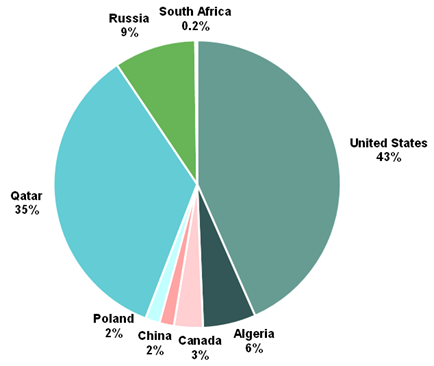
The helium in the global supply chain is produced almost exclusively as a byproduct of natural gas processing, usually at concentrations below 0.5%, meaning separating it requires cryogenic distillation, a specialised method that is only economical at a very large scale. Therefore, production is concentrated in a handful of countries, with the US, Qatar, Russia and Algeria dominating global supply.
Exhibit 1: Helium production by country (2024)
Source: US Geological Survey
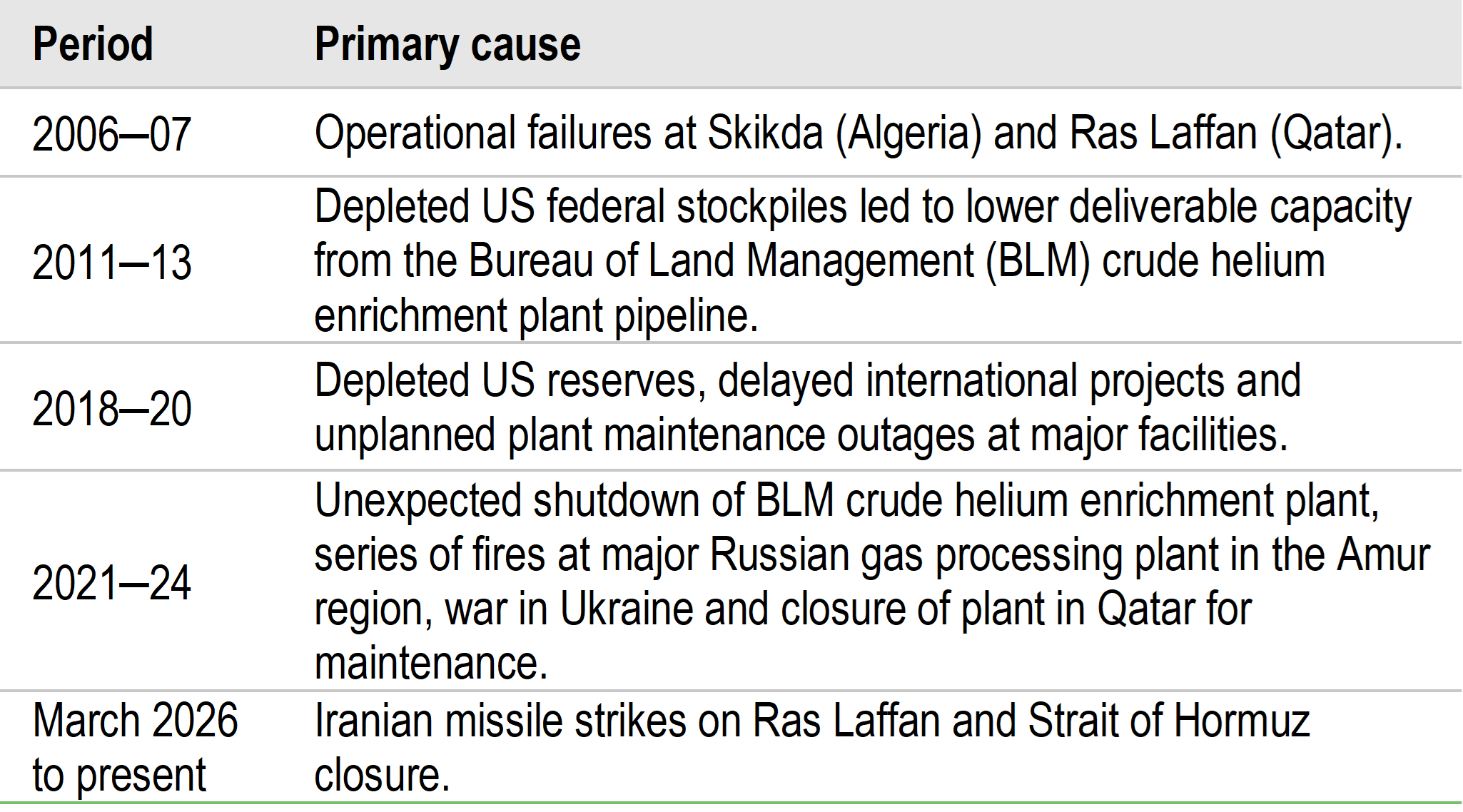
A critical distinction exists between crude helium (50–80% helium content) and grade-A helium (≥99.995% helium content), the latter being essential for semiconductor manufacturing where trace impurities at parts-per-billion levels destroy chip yields. Qatar’s Ras Laffan is one of the largest sources of grade-A helium globally, where its share of high-purity supply is disproportionately large relative to its headline production volume. The high-purity supply chain is considerably more concentrated than the aggregate production figures suggest, and it is that concentration that makes the current disruption so acute. This fragility has already contributed to four major helium shortages since 2006, with prices roughly doubling since 2021.
Why the conflict in Iran changes everything?
Iran’s closure of the Strait of Hormuz has removed the single chokepoint through which all Qatari liquefied natural gas (LNG) and the helium extracted from it must travel to reach global markets. QatarEnergy halted operations at Ras Laffan on 2 March 2026 and declared force majeure two days later. Subsequent Iranian missile strikes caused what QatarEnergy described as ‘extensive damage’, wiping out 17% of the country’s LNG capacity with repair timelines of three to five years, simultaneously removing an estimated 27–30% of global helium supply.
The disruption is compounded by helium’s transport constraints. Liquid helium must travel in specialised cryogenic ISO containers maintained at -269°C, which can preserve it for only 35–48 days before pressure release valves begin venting boil-off. Around 200 such containers, each costing c $1m, are currently stranded in the Middle East. Major carriers, including Maersk, MSC and Hapag-Lloyd, have suspended all Hormuz crossings, rerouting vessels around South Africa’s Cape of Good Hope and adding 10–14 days to the standard month-long transit times alongside c $1m in additional fuel costs per voyage. Therefore, given helium’s storage window, this additional journey time directly reduces the volume arriving at its destination. As helium specialist and expert witness Phil Kornbluth, who has over four decades of expertise in the global helium industry, puts it: ‘There is a tsunami coming, but it’s still a thousand miles offshore.’
Why is this shortage more dangerous than previous ones?
The world has faced helium shortages before, caused by maintenance outages, plant fires and geopolitical disruptions, but those events were temporary. What distinguishes the current crisis from previous shortages is the large-scale destruction of infrastructure with repair timelines measured in years, not months. Even in the most optimistic ceasefire scenario, Kornbluth estimates at least five weeks before any Qatari production restarts.
Exhibit 2: Historical global helium shortages
Source: BBC, IDTechEx and Edison Investment Research
Despite the global market entering 2026 in an oversupply, with a demand of c 170m cubic metres running below a supply of c 184m cubic metres according to Fortune, liquid helium degrades after 35–48 days and so cannot be stockpiled indefinitely because it gradually escapes storage containers.
Can any country realistically replace Qatar’s supply?
The US is the most credible near-term alternative at 81m cubic metres annually, with Oxford Economics noting meaningful room to redirect US volumes towards Taiwan and South Korea, which largely rely on helium from Qatar. However, what could have been a key US buffer was removed in June 2024 when the BLM completed the sale of the Federal Helium Reserve to German gas company Messer. The reserve had historically acted as a strategic swing supplier, being able to release volumes into the market during shortages to stabilise supply and price. Under private ownership that function disappears, with Messer operating it as a commercial asset optimised for its own contractual obligations. Algeria and Canada provide additional partial buffers.
Russia initially appeared to be a potential relief valve with its Amur Gas Processing Plant operating below capacity under Western sanctions, and Prime Minister Mishustin had publicly acknowledged the war ‘opened up new trade opportunities’ for Russian helium exports. However, in April 2026 Russia imposed temporary export controls on helium for any exports outside the Eurasian Economic Union, valid until end-2027, in order to preserve domestic supply for military fibre optic networks and drone production. Both sectors depend on AI chips whose fabrication requires helium, meaning that Russia is prioritising its own downstream technology and defence industries over the export revenues the crisis might otherwise have generated. That leaves the global market unusually constrained: Qatar is offline, Russia is restricting exports and the former US Federal Helium Reserve has already been privatised.
What happens if helium prices keep surging?
According to the Bank of America, spot helium prices have already surged between 40% and 100%. Most industrial supply is still governed by long-term contracts that have not yet seen a change in pricing. The trigger for change is force majeure: once suppliers formally cannot fulfil contracts, renegotiations become inevitable. Helium represents roughly 0.03% of the cost of an EUV wafer, meaning chipmakers can comfortably outbid any other consumers to maintain supply. The real risk is not price inflation but allocation failure as a single missing input can halt an entire production line. Lower-priority consumers, such as welding and lifting gases, will absorb the shortfall first, freeing high-purity volumes for critical fabrications. But if the Qatar outage extends into months, contract renegotiations will translate spot price surges into sustained structural cost increases across the industrial gas sector.
How are chipmakers responding?
South Korea is the most exposed major semiconductor nation, with Samsung and SK Hynix having sourced c 64.7% of their helium from Qatar in 2025, according to Forbes. Together they produce roughly 70% of global dynamic random access memory and a commanding share of the high-bandwidth memory used in AI accelerators. Both reportedly entered 2026 with c six months of supply-chain inventory, and Samsung has deployed its Helium Reuse System, recovering and purifying exhaust helium to cut net consumption. Taiwan Semiconductor Manufacturing Company, producing roughly 90% of the world’s most advanced logic chips, has stated it does not anticipate a significant near-term impact, citing recycling rates of 80–90% and diversified contracts. However, the $650bn committed by hyperscalers, including Amazon, Microsoft, Google and Meta to AI infrastructure this year depends on stable helium supply as there is not yet a scalable substitute.
Who stands to benefit from the shortage?
The clearest beneficiaries are the industrial gas majors. JPMorgan upgraded Linde, up 15% in 2026 year-to-date through late March, against a 3% decline in the S&P 500. Wells Fargo upgraded Air Products to overweight. Both Deutsche Bank and JPMorgan flagged ExxonMobil as a key beneficiary given its domestic US production. Bank of America noted that while helium represents only a low- to mid-single-digit percentage of gas company revenues, prolonged tightening drives meaningful earnings upside as price inflation across the customer base outweighs volume losses. For chipmakers, scarce high-purity helium will be allocated to high-margin AI products at the expense of legacy consumer chips.
The longer-dated structural story favours companies investing in recycling and reclamation, with IDTechEx forecasting leak-testing helium demand to be c 40% lower by 2035 as reclamation systems are adopted at scale. The Iran war has not created that imbalance it has simply moved the reckoning forwards by years.
Edison insight
Helium rarely features in investor conversations, but the Iran war has exposed it as one of the most vulnerable inputs in the global technology supply chain. It is irreplaceable in semiconductor fabrication, MRI imaging and quantum computing not because alternatives have not been explored, but because physics does not permit them at the tolerances these industries require. The usual relief valves are simultaneously unavailable: Qatar is offline, Russia has imposed export controls, and the US strategic reserve has been privatised. The near-term beneficiaries are industrial gas majors with domestic US production as contract renegotiations follow force majeure declarations. The duration of the conflict is the key variable. The longer-term case is more structural with IDTechEx forecasting global helium demand to nearly double by 2035 while production capacity grows only 1.5-fold. The Iran war has not created that imbalance, it has simply made it arrive sooner.
Megatrends: Resource scarcity, disruptive technologies, automation and industrial innovation, healthcare innovation, digital economy, cities of future