What if you learnt that one region of the UK is likely to receive more investment than it saw during the entire North Sea oil boom? The Highlands and Islands of Scotland are experiencing what could be the most significant economic transformation in generations, with up to £100bn in investment set to reshape the region. However, unlike the oil rush of the 1970s, this boom spans multiple sectors and promises more sustainable, long-term benefits for local communities.
How big is £100bn in context?
Research by Highlands and Islands Enterprise (HIE) reveals the staggering scale: £100bn of potential investment over the next 15 years . To put this in perspective, the North Sea oil and gas capital expenditure between 1965 and 1980 totalled around £78bn in today’s money.
This is not just about one industry. The potential investment pipeline spans multiple industries involved with renewable energy:
- Offshore wind: £40.6bn
- Pumped storage hydro: £13.2bn
- Onshore wind: £10.9bn
- Green hydrogen: £9.1bn
- Supporting infrastructure: £21.9bn
Exhibit 1: Investment breakdown
Source: HIE 2025 report ‘Regional Transformational Opportunities in the Highlands and Islands’
Could Scotland really become Europe’s renewable energy powerhouse?
Scotland’s renewable energy transition sits at the heart of the UK’s net zero ambitions. The region already produces around 59% of Scotland’s renewable electricity through onshore wind alone. With offshore wind capacity targets of 11GW by 2030 and vast untapped marine energy resources, the Highlands and Islands could become Europe’s renewable energy powerhouse. However, this will require up to 11,400 additional workers per year.
Where will these workers come from?
The human impact is equally striking. HIE’s research identifies potential for:
- 11,400 jobs per year during construction phases
- Peak annual employment of 16,000 temporary construction jobs
- 18,000 permanent operational jobs by 2040
For scale, Scotland’s current construction workforce is approximately made up of 12,250 workers. The energy transformation would require rapid sector growth and/or substantial worker migration from other regions, including doubling housing output.
Can Scottish councils really double housing output?
This employment boom creates an unprecedented housing challenge. Highland Council alone is targeting 24,000 new homes, effectively doubling housing output over the next decade. The council expects to be the first to use new Masterplan Consent Area powers in Scotland to streamline delivery.
Property developer Springfield Properties, which has refocused its entire strategy on Northern Scotland, describes the opportunity as ‘exceptional.’ The company has secured options over 1,400 acres and is in advanced discussions with infrastructure providers seeking worker accommodation.
Springfield’s approach reveals an emerging investment model: build homes leased to infrastructure companies for multi-year contracts, then transition to permanent community housing. This creates revenue streams during construction while building long-term housing stock.
What infrastructure upgrades are needed to make this work?
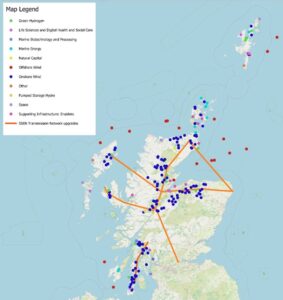
The transformation depends on massive infrastructure upgrades:
- Grid capacity: SSEN Transmission’s Pathway to 2030 programme requires a £7bn investment in transmission infrastructure.
- Transport: accelerated completion of A9 and A96 dualling road infrastructure programmes will need to be undertaken.
- Ports: major upgrades are needed to handle offshore wind components.
- Digital connectivity: the implementation of enhanced broadband and mobile coverage for remote operations.
Exhibit 2: Map of potential projects
Source: HIE 2025 report ‘Regional Transformational Opportunities in the Highlands and Islands’
What could derail this transformation?
What could derail this transformation?HIE’s research models three scenarios. Under a ‘status quo plus grid constraints’ scenario, only 19% of the potential investment materialises. The key risks include:
- Inadequate grid infrastructure upgrades
- Planning bottlenecks and regulatory delays
- Skills shortages and housing constraints
- Competition from other international renewable energy hubs
To address these risks, authorities and industry are taking active countermeasures: SSEN Transmission is investing over £20bn by 2030 in grid upgrades, including major subsea links connecting Scotland to England, while the UK and Scottish governments launched planning reforms in October 2024 to reduce project approval times from four years.
SSEN Transmission has also pledged over 1,000 new homes for workers by 2030 and new skills training centres are being established across the Highlands and Islands to address housing and skills shortages.
Is this an economic boom in the making?
This is not just regional development; it is fundamental to UK energy security. Scotland was a net electricity, mostly renewable, exporter of 19.7TWh in 2024. The Northern Scotland transformation could position the UK as a clean energy superpower.
The parallels with previous transformational periods are striking. Like the hydroelectric developments of the 1940s–60s and the North Sea oil boom, this represents a once-in-a-generation opportunity to reshape an entire region’s economy.
Unlike previous booms that benefited specific areas, this transformation spans multiple sectors across the entire Highlands and Islands, potentially creating a more resilient and diversified economic base.
The question is not whether this transformation will happen, the investment pipeline and policy momentum make it inevitable, but whether Scotland can capture maximum value for its communities and position itself as a global leader in the clean energy transition.