Grand City Properties (GCP) is a specialist residential real estate company investing in underperforming assets in major German urban centres. Its €4.9bn portfolio has grown at a compound rate of 85% in the past four years and its revenues have increased more than tenfold. This growth, combined with asset management and modernisation, has seen EPRA NAV reach €2.5bn in 2016, from just €47m in 2010. Although portfolio growth has slowed, GCP has substantial firepower to make acquisitions, with cash and liquid assets of €632m and an LTV of just 35%. Despite this track record, the growth potential and a dividend yield above the sector average, it trades on a discount to both forecast NAV and its sector peers.
Written by
Grand City Properties |
Value-add specialist
Real estate |
Scale research report - Initiation
26 April 2017 |
Share price graph
Share details
Business description
Bull
Bear
Analysts
|
|||||||||||||||||||||||||||||||
Grand City Properties (GCP) is a specialist residential real estate company investing in underperforming assets in major German urban centres. Its €4.9bn portfolio has grown at a compound rate of 85% in the past four years and its revenues have increased more than tenfold. This growth, combined with asset management and modernisation, has seen EPRA NAV reach €2.5bn in 2016, from just €47m in 2010. Although portfolio growth has slowed, GCP has substantial firepower to make acquisitions, with cash and liquid assets of €632m and an LTV of just 35%. Despite this track record, the growth potential and a dividend yield above the sector average, it trades on a discount to both forecast NAV and its sector peers.
Strategy: Restructuring of underperforming assets
GCP’s strategy is to acquire mismanaged portfolios with vacancy and low rents and improve performance via refurbishment and repositioning. It focuses on the most densely populated areas of Germany including North Rhine Westphalia, Munich and Berlin. It tends to hold 90% of the portfolio for the long term and dispose of up to 10% to generate capital gains. GCP intends to continue expanding its portfolio via acquisitions that meet its investment criteria, while maintaining a conservative balance sheet, with an LTV capped at 45%.
Financials: Low gearing and increased payout
GCP’s portfolio growth slowed in 2016, rising 9% to 83,000 units but, with a strong rise in average rental rates and occupancy, revenue growth remained above 30%. Adjusted EBITDA was 27% higher and funds from operations (FFO) increased by 25%. EPRA NAV increased 32% (reaching €3.2bn including the perpetual notes) and NAV per share (NAVPS) was 34% higher on this basis, boosted by a €598m revaluation gain. With an LTV of 35% and large cash reserves, GCP increased the dividend by 172% and raised the payout ratio to a policy of 65% of FFO.
Valuation: Discount to the main sector peers
GCP trades on a small discount to NAV for this year and 16% for 2018e, as well as a discount to the sector in each year. This is despite a yield of 4.1% for 2017 and 4.6% for next year, above the average for its peers. This is also despite GCP’s cash reserves, low gearing and growth potential. The discount also seems to ignore the improved disclosure in FY16 to prepare for the expected Prime Standard listing in 2017. The average consensus target price is €21.6, implying 25% potential upside.
|
Consensus estimates
Source: MBC data. Note: MBC listed in June 2016. |
Edison Investment Research provides qualitative research coverage on companies in the Deutsche Börse Scale segment in accordance with section 36 subsection 3 of the General Terms and Conditions of Deutsche Börse AG for the Regulated Unofficial Market (Freiverkehr) on Frankfurter Wertpapierbörse (as of 1 March 2017). Two to three research reports will be produced per year. Research reports do not contain Edison analyst financial forecasts.
Company description: Residential real estate focused
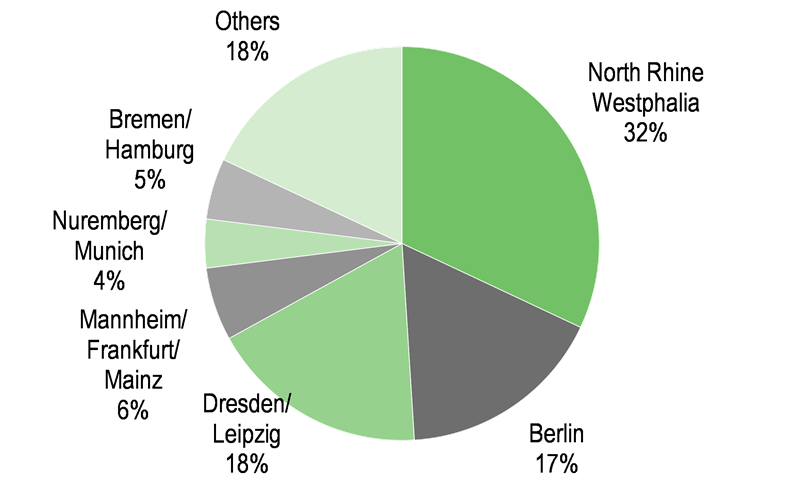
Grand City Properties is a residential real estate specialist, with a focus on buying and redeveloping value-add opportunities in Germany. It acquires well located properties that have limited downside, but have the potential to create further value, via refurbishment and repositioning. It carries out all its asset and property management activity in house and uses targeted modernisation and intensive management of tenants to achieve the potential of the assets. Its founders started operating in 2004, initially refurbishing buildings in Berlin. The current focus is on the most densely populated areas of Germany including North Rhine Westphalia, Berlin, Dresden/Leipzig, Frankfurt and Munich.
GCP currently has 84,000 residential units in its portfolio, up from 5,000 in 2010. It has a portfolio value of €4.9bn and employs over 700 staff. In addition, GCP has a centralised 24/7 service centre to co-ordinate its operations and ensure its tenants are satisfied with the company’s service.
|
Exhibit 1: Apartment units |
Exhibit 2: Regional split by value (February 2017) |
|
|
|
Source: Grand City Properties |
|
Exhibit 1: Apartment units |
|
|
Source: Grand City Properties |
|
Exhibit 2: Regional split by value (February 2017) |
|
|
Source: Grand City Properties |
GCP listed on the Entry Standard segment of the Frankfurt Stock Exchange in 2012 at a price of €2.75. It has raised over €3.3bn of capital since then, across the equity, debt, perpetual and convertible markets. The current market value is €2.7bn. Since March 2015, GCP has been included in the FTSE EPRA/NAREIT indices, including the FTSE EPRA/NAREIT Global, Developed and Developed Europe indices. In December 2015 it was also included in the GPR 250 index. It is a public limited liability company (Société Anonyme) incorporated in Luxembourg.
Business model focused on value-add opportunities
The business model is based on repositioning formerly mismanaged portfolios with rents below market levels and a lack of cost control. It is an asset management-intensive model, generating additional rental income from limited incremental capex. GCP believes the attractive fundamentals of the German residential real estate market will enable it to pursue growth opportunities for years to come. To achieve this it has established a number of acquisition guidelines, which are based on asset quality and the potential value uplift post acquisition (see page 3).
GCP has a deal sourcing network that it has built up over 14 years, which includes private equity, institutional investors, banks and receivers, as well as the broker network. Generally, its deal size is too large for private investors and too small or too complicated for institutional investors. Following due diligence and the negotiation of deal terms, GCP will invest to reposition the asset. The intention is to reduce vacancy rates and increase rental levels, while also reducing operating and non-recoverable costs, using its in-house proprietary software to manage the process. This provides data on both existing and prospective tenants, allowing GCP to see opportunities for rent increases and to reduce re-letting risk. At the same time, GCP uses its CRM system to improve the satisfaction of existing tenants and its staff are available 24/7 via its service centre, which has TUV certified service quality (the German Technical Inspection Association).
With improved yields and asset valuations, GCP is able to introduce long-term debt financing to recycle funding into future projects. 90% of the properties will be held for the long term and up to 10% being sold to generate capital gains. This has driven the growth in FFO and NAV shown in the charts below.
|
Exhibit 3: Funds from operations per share (€) |
Exhibit 4: EPRA NAV excluding perpetual notes (€m) |
|
|
|
Source: Company accounts |
|
Exhibit 3: Funds from operations per share (€) |
|
|
Source: Company accounts |
|
Exhibit 4: EPRA NAV excluding perpetual notes (€m) |
|
|
Source: Company accounts |
Strategy: Targeting densely populated cities
The strategy is to focus on undermanaged opportunities in the most densely populated areas of the German residential real estate market, while maintaining a conservative balance sheet and its investment grade rating. As mentioned above, it believes that North Rhine Westphalia, Dresden/Leipzig and Berlin offer the best fundamentals and the most acquisition opportunities for growth in the medium and long term. GCP intends to expand its portfolio via acquisitions that meet its investment criteria and is constantly evaluating opportunities. There are six main aspects to the strategy:
■
Focus on densely populated areas and major cities.
■
Highly cash-generating assets.
■
The potential for vacancy reduction.
■
Under-rented properties with upside potential and low downside risk.
■
Purchase prices below replacement cost and below market value.
■
The potential to reduce operating costs.
The other piece of the jigsaw is the conservative balance sheet, with a target LTV ratio of below 45%, good financial coverage ratios and keeping the majority of its assets ungeared, so that it has the flexibility to make future acquisitions.
Newsflow and catalysts
FY16 results were announced on 21 March and the Q117 results are due to be released on 15 May. The AGM is set for 28 June. Other than that, the most likely next newsflow is a potential debt rating upgrade.
Market overview: Strong demand and limited supply
The German residential market is the largest in Europe and benefits from a number of demographic advantages, which have become more favourable recently. Not only has the German economy been performing well recently, with low unemployment, rising monthly wages and a small budget surplus, but the population has been rising too. This rising population, which is now nearly 83 million, has also seen improving disposable income and purchasing power. The growth in population has been driven by inward migration, which peaked at 1.14 million people in 2015. Before then it was rising at less than 1% a year. Germany also has a significantly higher population density than the EU average at 229 residents per km2 and a rising level of urbanisation, despite already being a developed economy. Renting is also more popular in Germany than most other European countries and there has been significant migration to the cities, especially by the younger generation.
This demand has recently coincided with a lack of supply, following a steady fall in building permits after the reunification boom came to an end in the mid-1990s. Housing supply went into a significant deficit in 2015 as a result of these two factors, as the chart below shows.
|
Exhibit 5: Inward migration balance (m people) |
Exhibit 6: German apartment surplus/(deficit) |
|
|
|
Source: Destatis.de |
Source: Company accounts |
|
Exhibit 5: Inward migration balance (m people) |
|
|
Source: Destatis.de |
|
Exhibit 6: German apartment surplus/(deficit) |
|
|
Source: Company accounts |
As an example of these effects, the Berlin market has seen steady population growth, with migration adding 40-50,000 residents a year. The population density has reached 4,000 residents per km2 as a result. It has also attracted start-up capital and companies, which gives it a broader appeal for residents. This has pushed up median rents from as low as €5.50 per m2 per month in 2008 to approximately €9.50 by the end of last year. Purchase prices have also more than doubled over the same period. Similarly North Rhine Westphalia, which is the most heavily populated federal state, has a population density double the rest of the country after recent migration. As a result, median rents and purchase prices in cities like Cologne and Düsseldorf have seen significant increases in the past five years.
CBRE research has shown that, despite an improvement in building permits and housing completions in multistorey residential buildings, supply remained insufficient to meet demand in 2016. The result was a further 35% increase in purchase prices to an average of €93,000 per unit and €1,490 per sqm. CBRE expects this supply deficit to continue in 2017, with the effect that the competition for the best property locations will intensify and prices will increase again. CBRE expects this to be exacerbated by international investors, who are attracted by the stable economic and political environment in Germany. As a result, CBRE forecasts transaction volumes in portfolios of over 50 units to be at a similar level to last year’s €13.7bn.
Despite being a fragmented market there has been some consolidation in the sector in recent years, with Deutsche Annington acquiring Gagfah in 2014 and then rebranded to Vonovia, plus Deutsche Wohnen acquiring GSW Immobilien. However, even with their huge portfolios, the leading listed companies in the sector still account for only a few percent of the total market.
GCP focuses on cities that have an average household size below the German average of two people. These cities also have a ratio of single person households well above the national average of 40%. Some of its target cities have levels well above 50%. With 84,000 units under management it is now a major player in the residential market.
Financials
Income statement: Strong growth continued in 2016
GCP’s portfolio growth slowed to 9% in 2016, rising from 76,000 units to 83,000. It has since increased further to 84,000. However, gross rental income still increased by 31% to €436m. Although the reported net rent of €5.4 per m2 increased 2% year-on-year, the average monthly rental income per unit was up 20%. This was partly due to a fall in the vacancy rate from 12.5% to 7.8%. The average tenancy length was 14 years. Adjusted EBITDA was 27% higher at €225m and FFO increased by 25% to €160m.
Reported net income of €653m (+66%) was boosted by revaluation gains of €598m. However, the gains are a reflection of GCP’s investment in and improvement of its portfolio. Basic EPS were up 32% to €3.56, despite a 20% increase in the average shares outstanding. FFO per share, which excludes the fair value gains, improved by 4% to €1.05, driven by new acquisitions and operational improvements. Nevertheless, the dividend was raised 172% to €0.68, due to a change in the payout ratio from 50% to 65% of FFO per share. Management said this was a reflection of the strength of the balance sheet at year-end, its more mature stage of development and a desire to increase shareholder returns.
Revenue run rate has increased to €462m
The current annualised run rate for FY17 shows the portfolio is generating rental income of c €462m, adjusted EBITDA of €237m and FFO, before adjusting for hybrid equity, of €168m. Beyond the current run rate, management estimates that the annualised market potential of the portfolio is €584m, including the effects of vacancy reduction, a potential increase of 26% from the run rate. This is explained by the fact that 85% of GCP’s portfolio is currently rented below the market rate.
Consensus forecasts growth to slow this year
GCP has seen significant growth over the past four years, with revenues and assets increasing more than tenfold. This has been driven by the history of portfolio acquisitions and revaluation gains derived largely from GCP’s asset management. Looking forward, the consensus is forecasting a slowdown in the rate of growth. Revenue is expected to grow 12% this year and 9% in 2018, down from over 30% in 2016. Similarly, EBITDA, adjusted for revaluation gains, is expected to increase just 13% this year. Growth in NAV per share is also forecast to slow to 7% this year, although it is expected to pick up again to 17% in 2018.
|
Exhibit 8: Gross rental income (€m) |
Exhibit 9: Diluted EPS (€) |
|
|
|
Source: Grand City Properties |
|
Exhibit 8: Gross rental income (€m) |
|
|
Source: Grand City Properties |
|
Exhibit 9: Diluted EPS (€) |
|
|
Source: Grand City Properties |
Exhibit 10: Financial summary
€m |
2012 |
2013 |
2014 |
2015 |
2016 |
||||
Year end 31 December |
IFRS |
IFRS |
IFRS |
IFRS |
IFRS |
||||
Income Statement |
|||||||||
Gross rental income |
39.9 |
99.6 |
216.8 |
333.5 |
435.7 |
||||
Profit Before Tax (as reported) |
109.1 |
302.4 |
287.6 |
460.4 |
775.4 |
||||
Attributable net income (as reported) |
81.8 |
226.3 |
205.6 |
343.9 |
544.8 |
||||
FFO I |
11.4 |
38.1 |
76.1 |
127.9 |
160.1 |
||||
Basic EPS (as reported) – (€) |
1.97 |
2.97 |
1.78 |
2.71 |
3.56 |
||||
FFO I per share (€) |
0.26 |
0.50 |
0.66 |
1.01 |
1.05 |
||||
Balance Sheet |
|||||||||
Total non-current assets |
437.0 |
1,402.5 |
2,227.2 |
4,061.7 |
5,126.0 |
||||
Total current assets |
117.7 |
248.6 |
401.8 |
627.2 |
1,027.7 |
||||
Total assets |
554.7 |
1,651.1 |
2,629.1 |
4,688.9 |
6,153.7 |
||||
Total current liabilities |
35.1 |
111.3 |
147.5 |
222.6 |
338.3 |
||||
Total non-current liabilities |
316.6 |
771.9 |
1,439.9 |
2,294.0 |
2,750.3 |
||||
Total liabilities |
351.8 |
883.2 |
1,587.4 |
2,516.6 |
3,088.7 |
||||
EPRA NAV |
341.0 |
862.0 |
1,348.7 |
1,923.9 |
2,541.1 |
||||
EPRA NAVPS (€) |
6.14 |
7.47 |
11.38 |
13.65 |
16.40 |
||||
Shareholders’ equity |
202.9 |
767.9 |
1,041.7 |
2,172.3 |
3,065.1 |
||||
Cash flow |
|||||||||
Net cash from operating activities |
34.4 |
61.4 |
113.9 |
157.4 |
201.3 |
||||
Net cash from investing activities |
-51.7 |
-410.9 |
-327.9 |
-1,215.0 |
-557.2 |
||||
Net Cash from financing activities |
90.1 |
401.0 |
351.6 |
1,023.5 |
570.4 |
||||
Net Cash Flow |
72.8 |
51.6 |
137.6 |
-34.1 |
214.5 |
||||
Cash & cash equivalent end of year |
81.0 |
132.5 |
270.1 |
236.0 |
448.9 |
||||
Source: Company accounts
Balance sheet and cash flow
NAV boosted by revaluation gains: EPRA NAV increased 32% in 2016 to €2.5bn and diluted NAVPS was also 32% higher at €16.4. This was boosted by a €598m revaluation gain. The EPRA NAV, including the perpetual notes issued in September 2016 as equity, totalled €3.2bn and the NAVPS on this basis was up 34%. The fair value gain derived from a mixture of lower valuation yields and GCP’s asset management. The average yield used by GCP’s valuers Jones Lang LaSalle fell from 6.19% in 2015 to 5.94% in 2016. The other valuation inputs included an average market rental growth of 1.4%, average void periods of two to four months at the end of each lease, occupacy rates ranging 93-100% and discount rates of 4.75-7.5%.
Debt ratings upgraded in November: GCP is currently rated BBB+ by S&P and Baa2 by Moody’s with a positive outlook, which is supported by the long maturity schedule of its debt. Both ratings were upgraded in November. GCP’s long-term target is to achieve a global debt rating of A-, which it hopes can be achieved by limiting the LTV and debt to capital ratio to 45%, as it believes its financial and business profiles meet all the criteria. It also has targets for keeping more than 50% of its assets unencumbered and keeping a long debt maturity profile. It intends to keep using a mix of long-term usecured bonds and non-recourse bank loans and maintain conservative financial ratios. It currently has 40 separate non-recourse bank loans from over 20 banks and has €200m of revolving credit facilities with leading international banks, to provide liquidity at low cost. Its current cost of debt is just 1.6%, partly due to its conservative capital structure. The year-end net LTV, including assets held for sale and associate assets, fell to 35% from 42% in 2015.
With an interest cover ratio of over 6x, unencumbered assets of €2.8bn (56% of the total) and cash and liquid assets of €632m, the prospects of a further rating upgrade look promising.
|
Exhibit 10: Unencumbered assets (€bn) |
Exhibit 12: 2016 debt coverage ratios (x) |
|
|
|
Source: Grand City Properties |
|
Exhibit 10: Unencumbered assets (€bn) |
|
|
Source: Grand City Properties |
|
Exhibit 12: 2016 debt coverage ratios (x) |
|
|
Source: Grand City Properties |
The chart below shows GCP’s sources of financing, with 56% coming from equity, including the perpetual notes and the remaining 44% deriving from the convertible bond, bank debt and other bonds. GCP has two perpetual notes outstanding, one for €500m with a coupon of 3.75% issued in 2015. The other was issued in 2016 for a total of €200m and a coupon of 2.75%. They are both listed on the Irish Stock Exchange. It also has three listed bonds, with a total of €1.5bn outstanding.
|
Exhibit 13: Financing sources |
|
|
Source: Grand City Properties |
Valuation: A discount to forecast NAV
We have compared GCP to its sector peers on both P/NAV and dividend yield in the table below. In Exhibit 14 we have focused on the history and future trajectory of P/NAV, using the average share price for each historic year and the current share price for the consensus forecasts. It is interesting to note that the current discount to forecast NAV is at odds with the trend over the past two years, when GCP has traded at a premium of between 11% and 20%. This may reflect the growth that was forecast over the past couple of years, which is now expected to slow and could have been used to justify a premium valuation.
|
Exhibit 14: Valuation – historic and forecast P/NAV (x) |
|
|
Source: GCP, Bloomberg estimates |
Peer valuation: A discount to peers on both measures
We have compared GCP’s consensus-based valuation to its main peers in the German residential sector, even though most do not operate in the turnaround space. In terms of size it is one of the middle ranking companies, with a market value of €2.7bn. It trades at a small discount to the sector on a P/NAV basis for this year, mainly because the sector average is pulled down by the smaller operators like ADO and Adler. However, it trades at a comfortable discount to the larger peers on a P/NAV of 0.98x for this year and 0.84x for 2018e. The discount widens further in 2019. The dividend yield is also a premium to the sector in each year of the forecasts. A couple of the companies have higher yields, but they tend to have a higher P/NAV as well
Exhibit 15: Comparative valuations
Price |
Market cap |
P/NAV (x) |
Dividend yield (%) |
|||||
€ |
€m |
2017e |
2018e |
2019e |
2017e |
2018e |
2019e |
|
Deutsche Wohnen |
31.4 |
11,138 |
1.05 |
0.95 |
0.89 |
2.6 |
2.8 |
2.9 |
Vonovia |
33.5 |
15,607 |
1.08 |
0.99 |
0.90 |
3.9 |
4.2 |
4.5 |
LEG |
77.1 |
4,875 |
1.17 |
1.05 |
0.98 |
4.0 |
4.3 |
4.6 |
Adler |
14.6 |
696 |
0.76 |
0.69 |
0.74 |
N/A |
0.2 |
1.5 |
ADO Properties |
33.7 |
1,488 |
0.75 |
0.71 |
0.60 |
2.0 |
2.2 |
2.6 |
TAG |
12.9 |
1,885 |
1.23 |
1.14 |
1.07 |
4.8 |
4.9 |
5.2 |
Grand City Properties |
17.4 |
2.676 |
0.98 |
0.84 |
0.77 |
3.9 |
4.5 |
5.2 |
Average |
38,365 |
1.00 |
0.91 |
0.85 |
3.1 |
3.3 |
3.8 |
|
Source: Bloomberg. Note: Prices as at 24 April 2017
Research: Financials
Record reported assets under management equivalent (AUME) at a record level at the end of March reflecting positive market and currency moves in the company’s final quarter. While flows have fluctuated during FY17, the uncertain macro background is contributing to good levels of interest in Record’s currency management products and this should also be supported by a lengthening period of positive performance from the currency for return products.