Ultra Electronics
Written by
Ultra Electronics |
Facing up to the market |
Moving forward with |
Aerospace & defence |
11 November 2015 |
Share price performance
Business description
Next event
Analysts
Ultra Electronics is a research client of Edison Investment Research Limited |
|||||||||||||||||||||||||||||||||||||||||||||||
Ultra is embarking on the next step in its evolution. The recent reorganisation to a market-facing structure, combined with the acquisitions of EPD and Furnace Parts, display a clear shift towards a more focused, customer-oriented business, which should allow the scale of Ultra’s ambition to increase. It should also enable the company to use its strong cash flows to augment embedded long-term organic growth of 4-5%. The in-line Q3 statement is reassuring, given the signalled departure to the private sector of the well-regarded CFO at her own instigation.
Year end |
Revenue (£m) |
PBT* |
EPS* |
DPS |
P/E |
Yield |
12/13 |
745.2 |
116.8 |
127.1 |
42.2 |
13.7 |
2.4 |
12/14 |
713.7 |
112.0 |
123.1 |
44.3 |
14.2 |
2.5 |
12/15e |
731.0 |
110.5 |
121.6 |
46.7 |
14.4 |
2.7 |
12/16e |
797.7 |
118.7 |
130.6 |
49.0 |
13.4 |
2.8 |
Note: *PBT and EPS are normalised, excluding intangible amortisation, exceptional items and share-based payments.
More focused approach to growth
In our opinion, the reorganisation announced earlier this year is a clear signal that Ultra is changing gear. Clearer focus on end-markets should permit a more direct prioritisation of pipeline potential, and highlight M&A opportunities to facilitate the group’s future strategies. Overall, Ultra’s embedded organic sales growth currently appears to be slightly lower than the melded rate for the market exposures it addresses. However, it is still in excess of 4%, which the new structure should enhance and which focused acquisitions should augment.
EPD acquisition highlights group is thinking bigger
The acquisition of Kratos’s EPD business for $265m, completed in September, is the largest to date. EPD supplies electronic warfare, an area in which Ultra had a nascent, but subscale presence and which the group's market planning identified as a growth area for the business reorganisation. We are updating our forecasts for the acquisition, which completed on 24 August. Following a largely neutral FY15e EPS impact, the deal enhances our FY16e EPS by c 2%. We believe the deal, allied with the business reorganisation and targeting of larger deals, highlights how Ultra is thinking bigger and implementing the structure to enable that.
Valuation: Driving growth for renewed ratings push
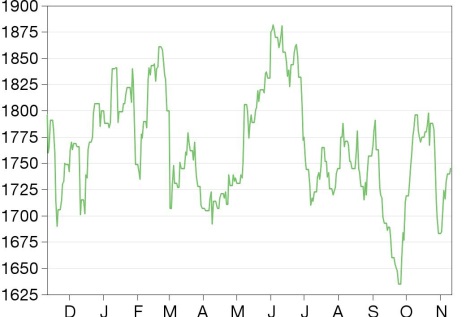
The share price has partly recovered from the current year low of 1,635p on 23 September. The support may well be driven by the resilient nature of defence in periods of economic uncertainty. Indeed, it appears that defence spending may have turned a corner in the Western world, which may permit Ultra to add new growth streams. The stock currently trades on an FY16e discount of c 7% against the UK aerospace & defence sector. Our FY16 basis SOTP implies a fair value of 1,799p.
Trading update – progress as expected
The trading statement issued this morning confirms that the group is in line with its previous expectations, as outlined below. However, it has been accompanied by news of the departure, at her own request, of Mary Waldner, finance director for the last three years. She is to leave after the prelims in February to take up a position in a private company. As she is one of the sponsors of the S3 programme (detailed later in this note), the company needs to execute successfully to demonstrate the strength and depth of the team running the initiative.
In addition to the trading update, the company has announced a consultation on the defined benefit scheme with respect to the ending of accruals. The scheme was closed to new members in 2003, and the intention of the move is to reduce risk for the company.
The interim results in early August were in line with management’s expectations and confirmed guidance for a stable performance for 2015 as a whole. Thus, the weighting to the second half of the year is once again significant, although there is some distortion caused by the Oman contract cancellation last year.
The main elements of the results were:
■
The order book fell by 4% on an underlying basis to £762.1m compared with the prior half year, although this is after £92.5m that was eliminated as a result of the Oman contract cancellation. Order intake in the first half was £310m, a book to bill of 0.93x, providing order cover of 83%.
■
Excluding Oman, revenues grew by 0.7% to £331.7m, although this included a £17.3m additional contribution from the four 2014 acquisitions and a £14m translation benefit following favourable FX movements. Organic revenues fell by 7.8%. SoTECH accounted for almost half of the £26.6m decline due to the impact of legislation on its intercept business in the US. There was also pressure on revenues across other government-related businesses.
■
Operating profits saw a £7.4m impact from the organic declines, a drop-through of 27.8%. Cost improvements were responsible for an underlying net margin improvement of £1.3m despite accelerated headcount reduction costs of £2.2m (£1.4m). Combined with a £2.2m FX benefit and £1.3m additional contributions from acquisitions, this limited the overall profit decline to just £2.6m. As a result, operating margin fell to 15.2% from 15.5% in H114.
■
Cash conversion was adversely affected by working capital increases relating to Oman (£10m) and two major contract advances consumption of c £21m; the End Cryptographic Unit Replacement Programme (ECU RP) for the UK MOD, which is moving into production and should complete by the year end, and the US sonobuoy contract, which moved onto a more closely matched cash profile versus delivery in 2015 compared to the prior year. There was also a £4m inventory build in advance of H2 sales volumes. Largely due to these factors, H1 operating cash conversion fell to 31% (80% H1 14), but is expected to normalise during H2.
■
Ultra closed the half year with net debt of £149.9m, in advance of the outflow relating to EPD's acquisition in September. The early refinancing of a £100m facility to match the coupon will lead to lower interest costs.
■
The interim dividend was increased by 4.5% to 13.8p.
All three of the new divisions experienced order book declines. Only Communications & Security reported an increase in sales and profit, reflecting acquisitions and increased trading on the ECU RP contract, which more than offset the SoTECH issues. Aerospace & Infrastructure was hit by the Oman cancellation, while modest declines were experienced in the Land & Maritime activities as acquisitions offset lower defence trading. Land & Maritime margin was reduced by adverse sonobuoy product mix and prior year contract contingency releases that did not recur.
Business realignment and S3 programme
At Ultra’s June 2015 analyst event, management revealed more detail on the business realignment and S3 programme designed to promote the market-facing capability and take advantage of the shared services across the group.
Market segments provide increased customer intelligence and recognition
Ultra has reorganised its business structure to better assign the niche capabilities into eight key market-facing segments. This not only better matched the business portfolio with the reality of the markets addressed, but also clarifies reporting lines and reduced complexity, with inter-group trading now below 10% compared with the previous level, which was as high as >30%. In doing so, the group has ensured improved alignment of authority, accountability and responsibility in the businesses, ensuring that the company's hallmark entrepreneurial spirit is retained.
In addition, there is also a more coherent and efficient customer interface, whereby the core competency in a market is understood both in the company and by the customer. This increases the cross-sell potential and reduces duplication of capabilities and customer contact points, and opens up discussions regarding the full suite of Ultra’s capabilities rather than those of just one business.
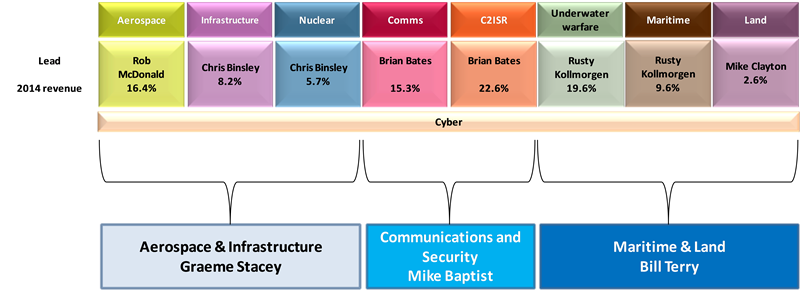
The changes within Ultra have been an evolution, in effect formalising a number of activities already being undertaken. Exhibit 1 below shows the eight market segments, each with their own marketing lead, and how they are subsequently grouped into three new divisions that more closely align with end-market customers.
|
Exhibit 1: New market segmentation and divisional structure and marketing/divisional leads |
|
|
Source: Ultra Electronics’ capital markets day, 24 June 2015 |
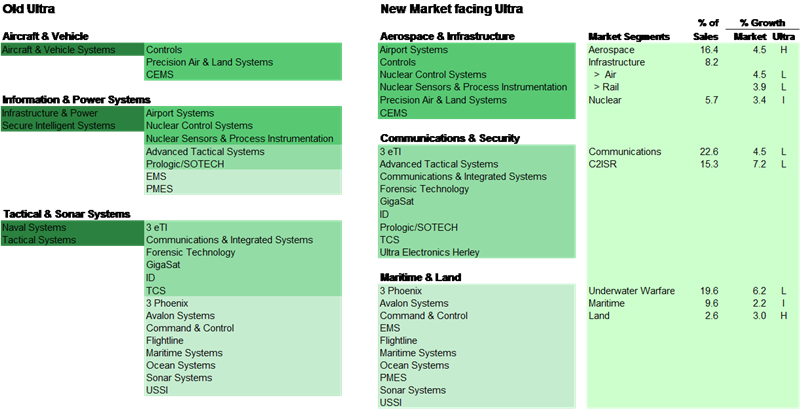
In addition, as can be seen, the group’s cyber capability spans the market segments. This is currently predominantly in the C2ISR and Communications segments, which will derive a group-wide strategy for cyber to develop solutions across a broader range of opportunities. This highlights the increasingly pervasive nature of this capability. The group maintains its 25 underlying businesses, each of which is allocated to the appropriate division from which the majority of revenue is derived. The newly acquired EPD, renamed Ultra Electronics Herley, is placed in the Communications & Security division. As shown in Exhibit 2, the growth rates for the eight markets tend to be GDP plus. Using a sales-weighted average, organic growth for Ultra can be calculated as c 4.5% compared to overall market growth, which we estimate at 4.8%.
|
Exhibit 2: Ultra reorganisation and segment growth potential |
|
|
Source: Ultra Electronics |
S3 programme highlights an evolving business
Ultra also announced that it was launching its Standardisation and Shared Services programme (S3). S3 is a further evolution of Ultra’s business. It reflects the increasing scope for both savings and improved scalability using more consolidated support functions across the group where market differentiation is not required. Rationalisation will be achieved across back-office support functions such as finance, procurement, legal, HR, facilities and IT, the scale and capability of which have been benchmarked against top-performing peers. Transactional aspects of these functions will be provided by shared services, while those key to individual business performance will be retained.
Following initial benchmarking, the group is now entering a three-year change programme that will see modifications to the operational model as well as a rationalisation of ERP systems. To de-risk the programme, Ultra will transition a small number of larger businesses that already predominantly use one of the group’s three key ERP systems, with a parallel operation of existing and shared services to prove the operating model. Once this is complete, it can migrate the rest of the group to the S3 model.
Management’s business case for the programme suggests one-off project costs of £30m over the three years including ERP systems, programme management, restructuring and the cost of site closures. Within this is an initial one-off programme setup cost of £5m (£2m of which will be cash) in 2015. Cost efficiencies will start to flow from 2016, largely due to procurement and facility savings, and the programme will be self-funding from 2016. Overall enduring annual savings of £20m pa are expected from the programme, which will be used in the long term to support increased investment in R&D, improve competitiveness through pricing, and ultimately provide additional profit.
EPD purchase positions Ultra in new expanding market
Ultra's acquisition of Kratos’s EPD business reflected electronic warfare as a growth opportunity in which it was underrepresented and where the model was suited to its approach. The business bolts on to the Communications & Security division.
EPD provides access to growing market
EPD, renamed as Ultra Electronics Herley Industries, designs and manufactures RF and microwave integrated systems and subsystems for use in Electronic Warfare (EW), radar, communication, missile, flight test and simulation applications. The acquisition positions Ultra in the expanding US EW market, forecast to grow at >3% pa, with several sole source positions on a wide range of platforms such as the P-8A Poseidon, Trident II D5 Missile, F-16 Fighting Falcon, EA-18G Growler, SEWIP and Eurofighter Typhoon. While certain programmes are winding down, in particular the EA-18G Growler, the business is well positioned for opportunities on important future programmes such as the F-35 JSF and other key US national defence and security programmes.
Blue chip customer base further strengthens Ultra’s relationships, provides opportunity
EPD operates as a Tier III/Tier IV supplier into customers ranging from Tier 1 defence primes such as Northrop Grumman, which accounted for c 25% of revenue over the last three years, Lockheed Martin (13%), Raytheon (5%) and Boeing (3%) to a broader range of government and Tier II players, none of which account for more than 2% of sales. Ultra has established relationships with a number of these players through its C2ISR segment. However, the mission-critical nature of EPD’s products provides even closer ties. Through Ultra’s due diligence, management confirmed that the business was well respected for its technical solutions, as shown by a 96% business retention rate. Key to Ultra’s opportunity is increasing the win rate on new business, which stood at around 54%, and driving additional cross-selling opportunities.
Terms of the deal, earnings enhancing in first full year
Ultra paid $260m on closing on 24 August after receiving US antitrust and CFIUS clearances. An additional $5m cash is likely to be paid as a result of a long-term tax election expected to be made within 12 months. EPD generated revenues of c $118m in 2014, EBITDA of $22m and PBT of $11m with annual capex and depreciation of c $4m pa. Cash conversion is broadly in-line with that generated group-wide at Ultra.
While EPD’s revenues have declined over the past three years in line with much of the US defence industry, this stabilised over the previous two years and margins have been maintained. We forecast a broadly stable trend during our forecast period with $8m of recurring pre-tax synergies to be delivered in outer years from production efficiencies, site rationalisation and eliminating duplicated overheads. These will begin to kick in from 2017 and are tied to the planned cessation of certain programmes such as the EA18-G Growler.
Following the early refinancing of the £100m facility that is now extended to August 2019 at a rate matching the favourable pricing of the £200m facility, we expect a modest benefit to interest payable. Ultra’s headroom on current facilities is £157.2m with an additional £79.5m on the uncommitted Pricoa bilateral facility. Post-acquisition, we forecast that 2016 net debt:EBITDA will be c 1.7x, providing a comfortable level of headroom on covenants.
The deal will be funded from Ultra’s existing facilities and a new four-year term loan provided by Ultra’s banking group on similar terms and covenants to its existing facilities.
Furnace Parts acquisition a small technology bolt-in to nuclear
In early October, management announced the much smaller $12m bolt in acquisition of Furnace Parts, a manufacturer of thermocouple-based sensors that complements Ultra’s existing nuclear portfolio. In our view, while relatively small in terms of financial impact, this again highlights a determination to develop the eight clusters that now drive Ultra.
Exhibit 3 below summarises our updated forecasts.
Exhibit 3: Updated Edison forecasts
|
|
2014 |
2015e (old) |
2015e (new) |
2016e (old) |
2016e (new) |
Sales (£m) |
||||||
Aerospace & Infrastructure |
198.6 |
- |
187.4 |
- |
193.0 |
|
Maritime & Land |
290.7 |
- |
300.9 |
- |
306.9 |
|
Communications & Security |
224.4 |
- |
242.8 |
- |
297.9 |
|
of which EPD |
- |
- |
16.1 |
- |
64.4 |
|
Total Sales |
|
713.7 |
715.8 |
731.0 |
734.4 |
797.7 |
Operating Margin |
||||||
Aerospace & Infrastructure |
14.9% |
- |
14.9% |
- |
14.9% |
|
Maritime & Land |
17.7% |
- |
17.2% |
- |
17.5% |
|
Communications & Security |
16.5% |
- |
16.2% |
- |
16.8% |
|
Group Margin |
|
16.5% |
16.5% |
16.3% |
16.5% |
16.6% |
Underlying operating profit (£m) |
||||||
Aerospace & Infrastructure |
29.6 |
- |
27.9 |
- |
28.8 |
|
Maritime & Land |
51.5 |
- |
51.7 |
- |
53.7 |
|
Communications & Security |
37.0 |
- |
39.3 |
- |
50.0 |
|
of which EPD |
- |
- |
2.7 |
- |
11.6 |
|
Total Underlying Operating Profit |
118.1 |
118.2 |
119.0 |
121.4 |
132.5 |
|
Underlying finance costs |
(6.0) |
(6.0) |
(8.5) |
(5.0) |
(13.8) |
|
Underlying PBT (£m) |
112.0 |
112.2 |
110.5 |
116.4 |
118.7 |
|
Tax |
(26.0) |
(25.8) |
(25.4) |
(26.8) |
(27.3) |
|
Underlying Tax rate |
23.2% |
23.0% |
23.0% |
23.0% |
23.0% |
|
Minorities |
14.3 |
0.0 |
0.0 |
0.0 |
0.0 |
|
Underlying net income |
100.3 |
86.4 |
85.1 |
89.6 |
91.4 |
|
EPS (p) |
123.1 |
122.7 |
121.6 |
127.3 |
130.6 |
|
Source: Edison Investment Research
We see a broadly neutral EPS impact of the acquisitions in 2015, followed by a c 2% accretion in 2016. As further synergies are delivered in outer years, we anticipate further growth potential beyond our forecast horizon. Our forecast for the continuing businesses in FY15 is modestly reduced, reflecting the modest margin pressures at the half year. However, we expect this to start reversing modestly in H116.
Valuation
We continue to believe that Ultra’s strategy positions it well for sustained medium-term growth. We maintain our SOTP approach, but now use the new divisional structure and FY16 as the basis, given the acquisition of Herley late in the year, which distorts the FY15 financials. FY15 includes the full impact of the cash outflow from the EPD acquisition, but only an initial three months’ contribution to EBITA, hence undervalues the SOTP. The FY16 SOTP-based fair value is 1,799p, as shown in Exhibit 4 below, using the new divisional basis.
Exhibit 4: Edison sum-of-the-parts valuation (FY16 basis)
£m |
2016 EBITA |
Tax rate |
2016 NOPAT |
P/E |
Value (£m) |
Basis |
Aerospace & Infrastructure |
28.8 |
23.0% |
22.1 |
15.7 |
349 |
US peers (Raytheon, Rockwell Collins) + prem to Thales & BAE - Civil Aviation |
Maritime & Land |
53.7 |
23.0% |
41.4 |
15.5 |
641 |
Premium to UK sector (14.1x) - Pivot to Pacific opportunity |
Communications & Security |
50.0 |
23.0% |
38.5 |
14.7 |
565 |
Premium rating to US peers (Rockwell Collins, L-3 Communications), Enhanced Commercial exposure |
Enterprise value |
1,555 |
|||||
Net debt |
-296 |
Forecast December 2015 net debt (post EPD acquisition) |
||||
Equity value |
1,259 |
|||||
Shares in issue (m) |
70 |
|||||
Implied fair value per share (p) |
|
|
|
|
1,799 |
Source: Edison Investment Research
Our FY16-based SOTP fair value equates to 1,799p/share, equivalent to a FY16e P/E rating of 13.8x. We believe such a rating is justified by Ultra’s strong cash generation, with high margins in areas attracting long-term defence spend, as well as the latent commercial aircraft revenue growth potential as new aircraft build rates increase.
Exhibit 5: Financial summary
£m |
2013 |
2014 |
2015e |
2016e |
|
Year end 31 December |
IFRS |
IFRS |
IFRS |
IFRS |
|
PROFIT & LOSS |
|||||
Revenue |
|
745.2 |
713.7 |
731.0 |
797.7 |
Cost of Sales |
(523.7) |
(494.3) |
(514.1) |
(580.9) |
|
Gross Profit |
221.5 |
219.4 |
216.9 |
216.8 |
|
EBITDA |
|
133.1 |
128.9 |
129.9 |
144.1 |
Operating Profit (before amort. and except.) |
|
121.7 |
118.1 |
119.0 |
132.5 |
Intangible Amortisation |
(2.9) |
(3.4) |
(4.6) |
(5.6) |
|
Exceptionals |
(66.1) |
(97.8) |
(53.5) |
(32.9) |
|
Other |
0.0 |
0.0 |
0.0 |
0.0 |
|
Operating Profit |
52.8 |
16.8 |
60.9 |
94.0 |
|
Net Interest |
(4.9) |
(6.0) |
(8.5) |
(13.8) |
|
Profit Before Tax (norm) |
|
116.8 |
112.0 |
110.5 |
118.7 |
Profit Before Tax (FRS 3) |
|
47.9 |
10.8 |
52.4 |
80.2 |
Tax |
(11.1) |
(15.0) |
(13.1) |
(19.7) |
|
Profit After Tax (norm) |
88.5 |
86.0 |
85.1 |
91.4 |
|
Profit After Tax (FRS 3) |
36.7 |
(4.2) |
39.3 |
60.5 |
|
Average Number of Shares Outstanding (m) |
69.6 |
69.9 |
70.0 |
70.0 |
|
EPS - normalised (p) |
|
127.1 |
123.1 |
121.6 |
130.6 |
EPS - normalised and fully diluted (p) |
|
126.7 |
122.8 |
121.0 |
130.0 |
EPS - (IFRS) (p) |
|
52.8 |
14.5 |
56.1 |
86.4 |
Dividend per share (p) |
42.2 |
44.3 |
46.7 |
49.0 |
|
Gross Margin (%) |
29.7 |
30.7 |
29.7 |
27.2 |
|
EBITDA Margin (%) |
17.9 |
18.1 |
17.8 |
18.1 |
|
Operating Margin (before GW and except.) (%) |
16.3 |
16.5 |
16.3 |
16.6 |
|
BALANCE SHEET |
|||||
Fixed Assets |
|
444.0 |
532.1 |
672.6 |
648.7 |
Intangible Assets |
377.6 |
461.5 |
557.2 |
533.7 |
|
Tangible Assets |
59.1 |
62.6 |
105.3 |
103.0 |
|
Investments |
7.3 |
8.1 |
10.1 |
12.0 |
|
Current Assets |
|
271.4 |
250.6 |
267.0 |
288.2 |
Stocks |
57.8 |
73.7 |
77.8 |
87.4 |
|
Debtors |
133.0 |
101.5 |
113.3 |
122.6 |
|
Cash |
30.6 |
41.3 |
41.3 |
41.3 |
|
Other |
50.1 |
34.1 |
34.7 |
36.9 |
|
Current Liabilities |
|
(224.2) |
(199.8) |
(161.5) |
(175.6) |
Creditors |
(224.2) |
(199.8) |
(161.5) |
(175.6) |
|
Short term borrowings |
(0.0) |
0.0 |
0.0 |
0.0 |
|
Long Term Liabilities |
|
(170.1) |
(279.6) |
(449.7) |
(401.3) |
Long term borrowings |
(72.7) |
(170.8) |
(337.3) |
(285.1) |
|
Other long term liabilities |
(97.4) |
(108.8) |
(112.4) |
(116.2) |
|
Net Assets |
|
321.2 |
303.4 |
328.3 |
360.1 |
CASH FLOW |
|||||
Operating Cash Flow |
|
96.4 |
97.8 |
82.8 |
138.5 |
Net Interest |
(4.0) |
(4.5) |
(6.0) |
(8.5) |
|
Tax |
(25.6) |
(22.9) |
(26.0) |
(25.4) |
|
Capex |
(21.5) |
(17.7) |
(18.6) |
(19.3) |
|
Acquisitions/disposals |
(21.8) |
(104.5) |
(167.5) |
0.0 |
|
Financing |
6.0 |
(3.4) |
0.0 |
0.0 |
|
Dividends |
(28.1) |
(29.7) |
(31.3) |
(33.0) |
|
Net Cash Flow |
1.6 |
(84.9) |
(166.6) |
52.2 |
|
Opening net debt/(cash) |
|
43.0 |
42.2 |
129.5 |
296.1 |
HP finance leases initiated |
0.0 |
0.0 |
0.0 |
0.0 |
|
Other |
(0.7) |
(2.5) |
0.0 |
(0.0) |
|
Closing net debt/(cash) |
|
42.2 |
129.5 |
296.1 |
243.9 |
Source: Company accounts, Edison Investment Research
|