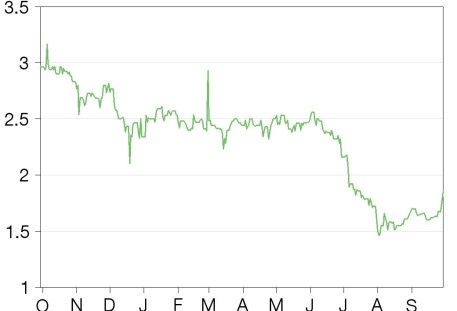
Data presented at the European Society for Medical Oncology (ESMO) congress by third parties has positive implications for Prima Biomed’s LAG3 pipeline, both its in-house IMP321 APC activator and the anti-LAG3 program out-licensed to Novartis. Prima itself presented encouraging data from ongoing studies of IMP321 in FY17, including a 47% response rate in the run-in phase of its AIPAC breast cancer Phase II. Prima earned a $1m milestone from Novartis in August, showing that the partnered anti-LAG3 program is progressing. The company guides that the ~$5m raised from US investors in July extends the funding runway to Q4 CY18. We increase our valuation to $206m (vs $192m) or $8.75/ADR.
Written by
Prima BioMed |
Support for anti-LAG-3 and APC-activator combos |
FY17 update |
Pharma & biotech |
2 October 2017 |
ADR research
ADR share price performance
Business description
Next events
Analysts
|
||||||||||||||||||||||||||||||||||||||||
Data presented at the European Society for Medical Oncology (ESMO) congress by third parties has positive implications for Prima Biomed’s LAG3 pipeline, both its in-house IMP321 APC activator and the anti-LAG3 program out-licensed to Novartis. Prima itself presented encouraging data from ongoing studies of IMP321 in FY17, including a 47% response rate in the run-in phase of its AIPAC breast cancer Phase II. Prima earned a $1m milestone from Novartis in August, showing that the partnered anti-LAG3 program is progressing. The company guides that the ~$5m raised from US investors in July extends the funding runway to Q4 CY18. We increase our valuation to $206m (vs $192m) or $8.75/ADR.
Year end |
Revenue (US$m) |
PTP |
EPADR |
DPADR |
P/E |
Gross yield |
06/16 |
1.5 |
(10.4) |
(0.47) |
0.0 |
N/A |
N/A |
06/17 |
3.1 |
(6.4) |
(0.28) |
0.0 |
N/A |
N/A |
06/18e |
2.7 |
(6.4) |
(0.31) |
0.0 |
N/A |
N/A |
06/19e |
8.0 |
(0.0) |
(0.00) |
0.0 |
N/A |
N/A |
Note: Converted at A$1/US$0.76 for the table above and throughout the note.
ESMO data support APC-activator combos
Idera Pharmaceuticals reported at ESMO that combining intra-lesional injections of its antigen presenting cell (APC) activator IMO-2125 with the anti-CTLA4 immune checkpoint inhibitor (ICI) Yervoy led to a high response rate in melanoma patients (44% vs 10-16% for Yervoy in historical studies). This has positive read-through for Prima’s TACTI-Mel study, which combines its IMP321 APC activator with the anti-PD1 ICI drug Keytruda. Prima has already reported one complete response among the six melanoma patients treated with the lowest dose of IMP321 in TACTI-mel.
BMS results validate anti-LAG-3 strategy in cancer
Separately, BMS reported an encouraging response rate to anti-PD1/anti-LAG3 combination therapy at ESMO, and plans to progress its anti-LAG3 drug into later stage clinical trials. This validation of the efficacy of anti-LAG-3 drugs bodes well for ongoing studies of LAG525 which Prima out-licensed to Novartis.
Steady news flow anticipated in FY18
TACTI-mel cohort 2 data are due in Q417, and results from all three dose cohorts in H118; final results from the 15-patient AIPAC run-in are expected Q417. The AIPAC Phase II is expected to fully recruit in H118 and report first results by mid-2019. News is also expected from LAG3 programs partnered with Novartis and GSK.
Valuation: Increased to $206m, $8.75 per ADR
We have rolled forward our DCF model and updated our financial forecasts to account for the $5m capital raise and FY17 results. Our valuation has increased to $206m, which is equal to $8.75 per ADR (undiluted) or $6.14 per ADR diluted for options, warrants and convertible notes (both unchanged). Company guidance is that cash reserves will be sufficient to fund operations to Q4 CY18, excluding any further milestone payments from partners Novartis and GlaxoSmithKline. Milestone revenue (we model ~ $6m in FY19) would extend the cash runway.
Positive read-through from ESMO presentations
Prima did not present any data on IMP321 at the ESMO congress held in Madrid on 8-12 September, nor did its partner Novartis present anything on its LAG525 (IMP701) LAG-3 antagonist antibody. Despite this, we believe that promising results for drug candidates with similar mechanisms of action have positive implications for these two development programs.
TLR9 study validates/supports APC-activator/ICI combo therapy
Prima’s TACTI-mel study is investigating the use of IMP321 (its LAG-3-based antigen presenting cell activator) to enhance efficacy in melanoma patients who have had a suboptimal initial response to the PD1 immune checkpoint inhibitor Keytruda. Positive early data for IMO-2125 that was presented at ESMO by Idera Pharmaceuticals supports the strategy of combining APC-activator and ICI drugs in melanoma patients.
Idera reported an objective tumor response rate (ORR) of 44% (4/9) among nine melanoma patients who had failed prior anti-PD1 ICI therapy, when they were treated with intra-lesional injections of IMO-2125 in combination with the marketed anti-CTLA4 ICI drug Yervoy (ESMO abstract 1187P). The 44% ORR compares to response rates of 10-16% reported for similar patients treated with Yervoy on its own in historical studies.
IMO-2125 is a toll-like receptor 9 (TLR9) agonist drug which activates antigen presenting cells (APC) including dendritic cells and B lymphocytes to initiate an immune response. This mechanism of action has a lot of parallels to IMP321, with both drugs aiming to stimulate the initial steps of the immune response via the innate immune system. Although the number of patients treated with IMO-2125 is still quite small, in our view the high response rate provides further support for the approach that Prima is taking of combining its IMP321 APC-activator with an ICI drug in the TACTI-mel study. IMP321 has the advantage that it is administered via subcutaneous injections, which is a much simpler and more versatile route than the intra-lesional injection required for IMO-2125.
Data on all three TACTI-mel cohorts expected H118
Prima’s TACTI-mel study of IMP321 plus Keytruda in melanoma patients who have had a suboptimal response to initial treatment with Keytruda has commenced recruiting subjects in the third and final cohort. The third cohort is testing a 30mg dose of IMP321; the first two cohorts showed that the 1mg and 6mg doses were well tolerated.
Prima reported at the Immune Checkpoint Inhibitors conference in Boston in March that one of the six patients (17%) in the low-dose cohort experienced a complete response (CR). Even though there is only one patient with a CR, the initial CR rate compares favorably with rates of 2-6% seen in Merck’s Phase III trials of Keytruda monotherapy in melanoma.
Data from the first two cohorts will be reported in Q417, with data from all three cohorts expected in H118.
BMS data show efficacy of anti-LAG-3 combo
Novartis is developing LAG525, an anti-LAG-3 antibody which is based on a program that it in-licensed from Prima. LAG525 blocks the LAG-3-mediated inhibitory signal given to tumor-infiltrating T-cells and thus activates T-cell proliferation. Bristol-Myers Squibb (BMS) reported positive data for a comparable anti-LAG3 antibody at ESMO, which provides initial clinical validation for the anti-LAG-3/anti-PD1 combination therapy approach being pursued by Novartis.
BMS reported data at ESMO (LBA18) from a study of its BMS-986016 anti-LAG-3 antibody in combination with the anti-PD1 ICI Opdivo in melanoma patients who had failed prior ICI therapy. The ORR was 18% (6/33) in patients who had high (>1%) LAG-3 expression in tumor cells; for patients with low LAG-3 tumor expression the ORR was 5% (1/20).
BMS considers the efficacy as encouraging for these patients for whom treatment with the best available therapies had failed. It has expanded the study to include 150 patients who have failed prior ICI therapy. It has re-named the BMS-986016 compound relatlimab, and disclosed in an interview in September that relatlimab will be investigated in later-stage trials, initially in melanoma.
We note that on 22 September the FDA approved Keytruda for the treatment of stomach cancer patients who had failed two prior lines of therapy, on the basis of a 13% ORR (19/143) in patients with >1% PD-L1 expression in their tumors. This supports the view that the 18% response rate seen for BMS’s anti-LAG-3 combo is a clinically meaningful benefit for a group of patients who have failed the best available therapies.
Novartis expands partnered anti-LAG-3 program and pays development milestone to Prima
Novartis is conducting a 416-patient Phase I/II trial of LAG525 under its collaboration and licensing agreement with Prima. The trial (clinicaltrials.gov identifier: NCT02460224) is testing LAG525 in combination with Novartis’s in-development anti-PD-1 ICI PDR001. The Phase II component of the study was initially targeting patients with melanoma, non-small cell lung cancer and renal cancers, but on 25 September the protocol was expanded to also enroll patients with mesothelioma and triple-negative breast cancer. The trial began in June 2015 and has an estimated completion date of April 2019 (previously October 2018).
To our knowledge, Novartis has not yet published any results from the LAG525 combination study, but on 17 July Prima announced that it had earned a $1m payment from Novartis for a significant, but undisclosed, clinical milestone in the LAG525 program. The milestone payment and the recent expansion to the LAG525 clinical trial to include mesothelioma and breast cancer are evidence that the LAG525 program is progressing as anticipated.
The positive results from BMS’s anti-LAG-3 combo study support the thesis that simultaneous blockade of LAG-3 and PD-1 may synergistically restore T-cell activation and enhance anti-tumor immune responses, so we continue to be optimistic that Novartis’s LAG525 trial may also produce positive results.
Final data from AIPAC safety run-in due Q417
Prima presented encouraging data from the safety run-in phase of its AIPAC Phase IIb breast cancer trial at the American Society of Clinical Oncology (ASCO) meeting held in Chicago on 2-6 June 2017. The trial is testing the IMP321 soluble LAG-3 fusion protein combined with paclitaxel in women with hormone receptor positive metastatic breast cancer (mBC) who have not previously received chemotherapy for metastatic disease.
In the safety run-in phase 15 women were treated with either 6mg or 30mg of IMP321 in combination with weekly paclitaxel chemotherapy (80mg/m2 in three weeks out of every four). Both doses of IMP321 were found to be safe and well tolerated when used in combination with paclitaxel, with no dose-limiting toxicities reported.
The overall response rate (ORR) for the 15 patients was 47% and the disease control rate (DCR, tumor response or stable disease) was 87%. The 47% ORR compares favorably with response rates of 23-41% reported in historical studies1,2. Final data on the first 15 patients are expected to be reported in Q417.
Gray et al, J Clin Oncol. 2009 Oct 20;27(30):4966-72.
Martin et al, Lancet Oncol 2011; 12: 369–76
Prima dosed the first patient in the randomized Phase IIb component of AIPAC in January 2017. The randomized double-blind phase will enroll 226 patients, with half receiving standard paclitaxel chemotherapy plus 30mg of IMP321, while the other half will receive paclitaxel plus placebo.
Recruitment is underway in 24 clinical sites in Belgium, the Netherlands, the UK, Poland, Germany and Hungary, and the study is expected to be fully recruited in H118. The record of the AIPAC trial on clinicaltrials.gov (NCT02614833) indicates that final data for the progression-free survival (PFS) primary endpoint are expected to be collected in June 2019. Depending on the recruitment rate and PFS observed, we estimate that top-line PFS data could mature sometime between late 2018 and mid-2019.
IMP731/GSK2831781 Phase I in psoriasis ongoing
GlaxoSmithKline (GSK) is continuing its Phase I trial of GSK2831781, which is based on LAG-3 technology in-licensed from Prima. GSK2831781 is a cytotoxic mAb that will kill the few LAG-3+ activated T-cells that infiltrate autoimmune disease sites.
The trial will measure the activity of escalating doses of GSK2831781 in patients with the autoimmune disease plaque psoriasis, including the proportion of patients achieving 50% and 75% improvement from baseline in Psoriasis Area Severity Index (PASI), and change from baseline in Psoriatic Lesion Severity Scores (PLSS). This suggests that the Phase I trial could potentially produce early evidence of activity of the therapy in psoriasis patients.
The estimated completion date for the study is currently listed as August 2018 on the GSK clinical studies register, vs June 2018 previously. As a result, we have delayed forecast receipt of the next clinical development milestone payment from GSK from FY18 to FY19.
Following a portfolio review, GSK announced in July that around 30 drug development programs were to be terminated or divested. The LAG-3 program has been retained, which suggests that the company is satisfied with the way that the Phase I trial is progressing.
Valuation
Our valuation of Prima has increased to $206m (previously $192m) or $8.75 per ADR (undiluted, unchanged). On a fully diluted basis our valuation is unchanged at $6.14 per ADR, after taking into account the options, warrants and convertible notes on issue. Exhibit 1 summarizes the constituent parts of our valuation, which is based on a discount rate of 12.5%. Prima’s primary listing is on the ASX under the code PRR; each NASDAQ-listed ADR represents 100 ordinary shares. Our undiluted valuation equals A$0.12 per ASX-listed ordinary share at current exchange rates.
We have updated our financial forecast to account for the $5m raised from US investors in June/July, and have rolled our risk-adjusted NPV model forward in time to incorporate estimated net cash for the end of the current financial year (FY18e) and the rNPV of forecast cash flows for FY19 to FY35.
We have deferred forecast receipt of $6m of milestone revenue from GSK from FY18 to FY19 as the Phase I clinical trial of GSK2831781 is now not expected to be completed until August 2018.
We forecast the gross cash balance at end FY18e to be $7.2m. For valuation purposes we deduct the $10.5m face value of the Ridgeback Capital convertible note in calculating end-FY18e net debt of $3.2m as shown in Exhibit 1. We note that this is different to the accounting treatment of the convertible note, which includes only the $4.4 estimated fair value of the convertible note as a non-current liability with the remainder treated as equity, resulting in a balance sheet net cash figure of $3.0m as shown in Exhibit 3.
Our unchanged peak sales estimates for IMP321 and IMP701/LAG525 are based on pricing per patient of $60k and $40k in the US and Europe, respectively. The marketed ICIs Keytruda, Nivolumab and Tecentriq are all priced at about $12,500 per month ($150k per year) in the US, which suggests that our pricing assumptions may be conservative depending on the approved indications, duration of treatment and total cost of combination therapies.
Exhibit 1: DCF valuation of Prima BioMed
Value driver |
Launch date |
Likelihood of success |
Peak sales ($m) |
Royalty |
Value ($) |
Value per ADR ($) |
IMP321-MBC |
2021 (EU), |
35% |
971 |
17.5% |
142.6 |
6.05 |
IMP321+anti-PD1 ICI-melanoma |
2025 |
15% |
480 |
17.5% |
23.5 |
1.00 |
IMP321 milestones - assume partnered post PII in MBC |
$225 estimated risk-adjusted milestones from out-licensing North American and European rights. |
47.5 |
0.02 |
|||
IMP731-autoimmune disease |
2023 |
15% |
1,079 |
8% |
32.2 |
1.37 |
Potential IMP731 milestones from GSK |
$90m of total $100m in risk-adjusted milestones from GSK |
17.8 |
0.01 |
|||
IMP701-solid tumors (lung cancer) |
2025 |
15% |
2,440 |
5% |
33.5 |
1.42 |
Potential IMP701 milestones from Novartis |
$20m in risk-adjusted milestones from Novartis |
2.9 |
0.00 |
|||
Grants |
1.3 |
0.05 |
||||
R&D expenses |
(5.4) |
(0.23) |
||||
Admin expenses |
(4.7) |
(0.20) |
||||
Capex |
(0.0) |
(0.00) |
||||
Tax |
(65.8) |
(2.79) |
||||
Net cash |
End FY18e net cash (including $10.5m convertible note at face value) |
(4.2) |
0.00 |
|||
Total |
206.4 |
8.75 |
||||
Source: Edison Investment Research
Exhibit 2 shows that in addition to the 2,358m Prima shares (equivalent to 23.6m ADRs) currently in issue, there are a further 14.6m potential ADRs that could be issued on the exercise of options, warrants and convertible notes, all of which would be in the money at our $8.75 per ADR undiluted valuation. Exhibit 2 shows that after taking into account these potential shares, our diluted valuation is $6.14 per ADR. Depending on trial progress and the timing of milestone payments from partners, Prima may require additional funding to complete the IMP321 clinical trials; our diluted valuation OF $6.14 per ADR does not take into account potential dilution from any future capital raising.
Exhibit 2: Potential further dilution and value per ADR
Average exercise price ($) |
m |
|
Current number of ADRS |
23.6 |
|
Ridgeback convertible note potential ADRS |
1.52 |
6.9 |
Ridgeback warrants |
1.80 |
3.8 |
Listed options |
2.51 |
2.0 |
Unlisted options |
3.83 |
1.5 |
Performance rights |
0.00 |
0.4 |
Total in-the-money potential ADRs |
14.6 |
|
Total potential diluted number of ADRs |
38.2 |
|
Net cash raised from options and CN exercise |
28 |
|
Valuation (above plus additional cash) |
234 |
|
Diluted value per ADR |
6.14 |
Source: Edison Investment Research
The breadth of the LAG-3 pipeline means there could be further upside if Prima or its partners launch additional products into the clinic or broaden the indications being studied.
We include risk-adjusted milestones payable by current partners GSK for IMP731 and Novartis for IMP701, plus milestones from prospective deals for IMP321. Possible catalysts include efficacy data from the AIPAC dose-finding cohorts, progression of the licensed anti-LAG-3 antibody into Phase II by GSK or news on partnering, all of which could provide upside to our current valuation.
Financials
Prima’s gross cash position at the end of June 2017 was $9.3m. Since the start of FY18 it has received gross cash proceeds of ~$4.9m from a capital raise from US investors, a $1m milestone payment from Novartis, and $1.0m from the French government’s research incentive scheme. Operating cash burn in FY17 was $6.5m, 25% lower than in the previous year.
We have deferred the receipt of $6m of risk-adjusted milestone payment from FY18 to FY19 in our forecasts, due to the later expected completion date for GSK’s Phase I trial. The lower revenue sees our forecast FY18 EBITDA loss double to $6.6m (vs $3.3m). We forecast a small $0.2m EBITDA loss in FY19.
Company guidance is that it has a projected cash reach to Q4 CY18. Our forecasts assume that Prima receives a risk-adjusted $6m milestone payment from GSK in FY19 under the IMP731/GSK2831781 license agreement, which would extend its cash reach into FY20.
Sensitivities
Prima is exposed to the same clinical, regulatory and commercialization risks as all biotech companies. The key sensitivity is clinical progress of its pipeline of LAG-3 candidates, primarily the internally funded IMP321. While Prima has funds to conduct the IMP321 Phase II study in MBC, it would require a partnership or alternative forms of funding to advance IMP321 further. Existing partnerships with big pharma reduce the financial and execution risk for IMP701 and IMP731; in addition, if the Phase I study of IMP701 reveals evidence of efficacy, it could lead GSK to extend the study to additional indications including rheumatoid arthritis and multiple sclerosis, which could increase the potential peak sales and therefore the value of the product.
Exhibit 3: Financial summary
|
US$000s |
2015 |
2016 |
2017 |
2018e |
2019e |
|
Year end 30 June |
IFRS |
IFRS |
IFRS |
IFRS |
IFRS |
||
PROFIT & LOSS |
|||||||
Revenue |
|
|
1,015 |
1,481 |
3,129 |
2,660 |
7,976 |
Cost of Sales |
(6,804) |
(5,365) |
(5,720) |
(5,891) |
(4,713) |
||
Gross Profit |
(4,350) |
(5,307) |
(3,304) |
(3,403) |
(3,505) |
||
EBITDA |
|
|
(10,142) |
(9,191) |
(5,895) |
(6,634) |
(241) |
Operating Profit (before GW and except.) |
|
(10,390) |
(9,329) |
(5,905) |
(6,636) |
(244) |
|
Intangible Amortization |
(772) |
(1,515) |
(1,283) |
(1,301) |
(1,184) |
||
Exceptionals |
(13,937) |
(36,076) |
0 |
0 |
0 |
||
Operating Profit |
(25,099) |
(46,920) |
(7,188) |
(7,937) |
(1,428) |
||
Other |
409 |
(1,304) |
(571) |
0 |
0 |
||
Net Interest |
146 |
194 |
79 |
279 |
217 |
||
Profit Before Tax (norm) |
|
|
(9,835) |
(10,439) |
(6,397) |
(6,357) |
(27) |
Profit Before Tax (IFRS) |
|
|
(24,543) |
(48,029) |
(7,680) |
(7,658) |
(1,211) |
Tax |
108 |
898 |
560 |
0 |
0 |
||
Profit After Tax (norm) |
(9,727) |
(9,541) |
(5,837) |
(6,357) |
(27) |
||
Profit After Tax (IFRS) |
(24,435) |
(47,132) |
(7,119) |
(7,658) |
(1,211) |
||
0.0 |
0.0 |
0.0 |
0.0 |
0.0 |
|||
Average Number of Shares Outstanding (m) |
1,490.1 |
2,016.6 |
2,072.5 |
2,079.7 |
2,358.4 |
||
Average Number of ADRs Outstanding (m) |
14.9 |
20.2 |
20.7 |
20.8 |
23.6 |
||
EPS - normalized (c) |
|
|
(0.7) |
(0.5) |
(0.3) |
(0.3) |
(0.0) |
EPS - IFRS (c) |
|
|
(1.6) |
(2.3) |
(0.3) |
(0.4) |
(0.1) |
Dividend per share (c) |
0.0 |
0.0 |
0.0 |
0.0 |
0.0 |
||
Earnings per ADR - normalized ($) |
(65.3) |
(47.3) |
(28.2) |
(30.6) |
(0.1) |
||
Earnings per ADR - IFRS (c) |
(164.0) |
(233.7) |
(34.4) |
(36.8) |
(5.1) |
||
Dividend per ADR (c) |
0.0 |
0.0 |
0.0 |
0.0 |
0.0 |
||
Gross Margin (%) |
N/A |
N/A |
N/A |
N/A |
N/A |
||
EBITDA Margin (%) |
N/A |
N/A |
N/A |
N/A |
N/A |
||
Operating Margin (before GW and except.) (%) |
N/A |
N/A |
N/A |
N/A |
N/A |
||
BALANCE SHEET |
|||||||
Fixed Assets |
|
|
17,450 |
15,871 |
14,474 |
13,176 |
11,995 |
Intangible Assets |
17,223 |
15,847 |
14,455 |
13,154 |
11,971 |
||
Tangible Assets |
226 |
24 |
18 |
21 |
24 |
||
Other |
0 |
0 |
0 |
0 |
0 |
||
Current Assets |
|
|
6,098 |
16,470 |
12,099 |
10,035 |
10,005 |
Stocks |
0 |
0 |
0 |
0 |
0 |
||
Debtors |
240 |
128 |
1,667 |
1,667 |
1,667 |
||
Cash |
5,137 |
15,868 |
9,300 |
7,237 |
7,207 |
||
Other |
720 |
473 |
1,131 |
1,131 |
1,131 |
||
Current Liabilities |
|
|
(3,329) |
(1,119) |
(2,001) |
(2,001) |
(2,001) |
Creditors |
(2,121) |
(1,098) |
(1,967) |
(1,967) |
(1,967) |
||
Short term borrowings |
(1,146) |
(0) |
(0) |
(0) |
(0) |
||
Short term leases |
0 |
0 |
0 |
0 |
0 |
||
Other |
(61) |
(21) |
(33) |
(33) |
(33) |
||
Long Term Liabilities |
|
|
(1,455) |
(4,381) |
(4,408) |
(4,408) |
(4,408) |
Long term borrowings incl. conv. note |
0 |
(3,821) |
(4,392) |
(4,392) |
(4,392) |
||
Long term leases |
0 |
0 |
0 |
0 |
0 |
||
Other long term liabilities |
(1,455) |
(560) |
(16) |
(16) |
(16) |
||
Net Assets |
|
|
18,764 |
26,841 |
20,164 |
16,803 |
15,592 |
CASH FLOW |
|||||||
Operating Cash Flow |
|
|
(5,917) |
(8,811) |
(6,544) |
(6,634) |
(241) |
Net Interest |
0 |
216 |
79 |
279 |
217 |
||
Tax |
(1) |
0 |
0 |
0 |
0 |
||
Capex |
(37) |
(21) |
(5) |
(5) |
(6) |
||
Acquisitions/disposals |
(15,894) |
99 |
0 |
0 |
0 |
||
Financing |
5,886 |
20,694 |
(6) |
4,297 |
0 |
||
Dividends |
0 |
0 |
0 |
0 |
0 |
||
Other |
(125) |
0 |
0 |
0 |
0 |
||
Net Cash Flow |
(16,088) |
12,176 |
(6,477) |
(2,063) |
(30) |
||
Opening net debt/(cash) |
|
|
(17,632) |
(3,991) |
(12,047) |
(4,908) |
(2,844) |
HP finance leases initiated |
0 |
0 |
0 |
0 |
0 |
||
Other |
2,447 |
(4,120) |
(663) |
(0) |
0 |
||
Closing net debt/(cash) |
|
|
(3,991) |
(12,047) |
(4,908) |
(2,844) |
(2,814) |
Source: Prima Biomed accounts, Edison Investment Research. Note: Solely for the convenience of the reader the financial summary table has been converted to US$ at a rate of US$0.76 to A$1. Prima reports statutory accounts in Australian dollars. These translations should not be considered representations that any such amounts have been or could be converted into US dollars at the assumed conversion rate.
|
|
Research: Investment Companies
The Bankers Investment Trust (BNKR) invests globally, with the aim of generating higher long-term total returns for its largely UK investor base than it could have achieved in its home market. Share price and NAV returns are ahead of the benchmark FTSE All-Share Index over both the short and longer term, with annualised NAV total returns of more than 15% pa over five years. BNKR also aims to grow its dividend ahead of inflation, and has the joint-longest record of unbroken dividend growth of any investment company, on track for a 51st year in FY17. Lead manager Alex Crooke, at the helm since 2003, has slightly reduced the North America allocation as leading economic indicators begin to look less favourable, diverting resources to European portfolio manager Tim Stevenson, who is finding good value opportunities particularly among financial stocks.