Elk Petroleum (ELK) is an ASX-listed oil and gas producer and developer with a focus on enhanced oil recovery (EOR) from mature fields. The company’s current focus is on CO2 EOR projects in Wyoming, US, where it’s first EOR development project, Grieve, is due on stream in late 2017/ early 2018. Grieve, combined with the recent acquisition of a c 14% interest in the Madden gas field is due to turn ELK into a producer and material CO2 resource owner. We visited both Grieve and Madden in July 2017, which helped highlight a number of opportunities management is actively engaged in targeting. These include resource upside at both Grieve and Madden, numerous high IRR infrastructure optimisation opportunities and CO2 EOR opportunities in the vicinity of ELK’s operated assets. Our valuation of ELK reduces from A$0.11/share to A$0.09/share due to a reduction in Edison’s long term oil price assumption from $80/bbl (2022) to 70$/bbl.
Written by
Elk Petroleum |
Rockies CO2 EOR consolidation |
Company outlook/site visit |
Oil & gas |
14 August 2017 |
Share price performance
Business description
Next events
Analysts
Elk Petroleum is a research client of Edison Investment Research Limited |
|||||||||||||||||||||||||||||||||||||||||||||||
Elk Petroleum (ELK) is an ASX-listed oil and gas producer and developer with a focus on enhanced oil recovery (EOR) from mature fields. The company’s current focus is on CO2 EOR projects in Wyoming, US, where it’s first EOR development project, Grieve, is due on stream in late 2017/ early 2018. Grieve, combined with the recent acquisition of a c 14% interest in the Madden gas field is due to turn ELK into a producer and material CO2 resource owner. We visited both Grieve and Madden in July 2017, which helped highlight a number of opportunities management is actively engaged in targeting. These include resource upside at both Grieve and Madden, numerous high IRR infrastructure optimisation opportunities and CO2 EOR opportunities in the vicinity of ELK’s operated assets. Our valuation of ELK reduces from A$0.11/share to A$0.09/share due to a reduction in Edison’s long term oil price assumption from $80/bbl (2022) to 70$/bbl.
Year end |
Revenue (US$m) |
EBITDA |
PBT* |
Net (debt)/ |
Debt |
Capex |
06/16 |
0.0 |
(4.5) |
(4.5) |
(2.7) |
(16.1) |
(2.2) |
06/17e |
6.3 |
(2.4) |
(4.5) |
(61.7) |
(76.9) |
(57.9) |
06/18e |
31.0 |
14.0 |
(2.9) |
(73.9) |
(82.9) |
(7.5) |
06/19e |
49.7 |
29.4 |
7.2 |
(55.9) |
(64.9) |
(1.8) |
Note: *PBT is normalised, excluding amortisation of acquired intangibles, exceptional items and share-based payments. Note the change in reporting currency to US$.
Asset optimisation and inorganic growth
With ELK’s Grieve EOR project nearing completion and the acquisition of a 13.6% interest in the prolific Madden gas field, ELK is well placed to set its sights on asset optimisation opportunities and incremental inorganic growth. Low-hanging fruit includes unlocking resource upside at both Grieve and Madden through subsurface studies and facility optimisation. Inorganic growth is likely to include the acquisition of additional CO2 resource/midstream infrastructure as well as upstream EOR candidates. Previous transactions have demonstrated ELK’s ability to originate value-accretive transactions that offer synergies with current operations.
Valuation: Compares well to US peers
Our NAV-based valuation for ELK is split A$0.17/share for Grieve, A$0.06/share for Madden and a total NAV of A$0.09/share (NPV10) after deducting net debt and admin costs. Given ELK’s US onshore focus, we make valuation comparisons to similarly located and sized US E&Ps. ELK compares favourably on a number of these metrics including EV/1P ($/boe) and EV/flowing barrel. Our ELK valuation is sensitive to numerous factors including resource recovery and timing of the Grieve development, Lost Cabin Gas Plant (LCGP) plant life/gas recovery, asset integrity and uptime. We note that ELK is not exposed to cost overruns at the Grieve development given its contractual arrangements with operator Denbury.
Investment summary
Elk Petroleum (ELK) is an ASX-listed oil and gas producer and developer with a focus on enhanced oil recovery (EOR) from mature oil fields using established technology. Its current projects involve CO2 EOR, where CO2 is injected into a mature oil field at pressure and temperature conditions at which it becomes miscible with oil, enabling previously immobile oil to be recovered. The company’s first project, Grieve, is close to delivering first oil and ELK recently acquired a 14% interest in the Madden Gas Field and Lost Cabin Gas Plant (LCGP) in Wyoming from Freeport-McMoRan, affording it access to a prolific CO2 source. Net cash flow from Madden and the near-to-completion Grieve project will have a material impact on group operational cash flow and earnings in calendar year 2018. The precise shape of the company’s earnings growth profile will depend on the timing of Grieve first oil, commodity prices and plant uptime.
Grieve nears completion; Madden provides strategic CO2
The Denbury-operated Grieve project is rapidly approaching first oil, with the operator targeting late 2017 or early 2018. 41.2bcf of CO2 has been injected at Grieve and the field is now fully repressured, with average reservoir pressure well above the minimum miscible pressure required for CO2 to go into phase with the remaining oil in the field. Critical items at Grieve include transport of larger pieces of process equipment and the workover of remaining injection and production wells prior to site access potentially becoming restricted in the winter. ELK expects the planned well programme to be complete by the end of August 2017 and major equipment on site before end September 2017. Given the substantial CO2 requirement to establish an EOR project and its importance in securing financing, ELK regards vertical integration and CO2 supply ownership as essential to underpin its future acquisition and development strategy and provide a long-term competitive advantage. ELK believes the investment approach it took at the Grieve EOR project is highly repeatable and is actively looking at further oil field CO2 EOR candidates, CO2 sources and compression/ transportation infrastructure. Across the Rockies, the CO2 EOR opportunity is estimated at 2-6bnbbls by the Department of Energy (DoE).
Numerous upside opportunities
Alongside field operators Denbury and ConocoPhillips, ELK management has identified numerous field optimisation opportunities with high risk-adjusted returns (many in the 50-100% IRR range). These include shooting 3D seismic over the Grieve to better define the structural/stratigraphic closure in order to identify volumetric upside. Material resource upside exist if ConocoPhillips is able to extend plant life beyond current NSAI 2P assumptions, helped by recent operational data that suggest a shallower decline rate than previous operator forecasts. Risks to our assumptions include timing slippage at Grieve and/or well or facility integrity issues at Madden. We address these risks later in this note.
Valuation and financials
Our NAV-based valuation for ELK is split A$0.17/share for Grieve, A$0.06/share for Madden and a total NAV of A$0.09/share after deducting net debt and admin costs. Gross production from Grieve is expected to be c 3-4kbod in calendar year 2018, with ELK owning a 49% interest. Combined revenues from Grieve and Madden in FY18 (July 2018 to June 2019) are estimated at US$31m, generating operating cash flow of US$3.9m before working capital movements. We forecast net debt to reduce rapidly even at spot oil prices once Grieve is in production.
ELK: Accessing low-hanging fruit
ELK is close to delivery on its first CO2 EOR development at Grieve and with the acquisition of Madden CO2 resource is looking to pursue further EOR projects in Wyoming. Grieve and Madden cash flows should enable ELK to pay down project debt (last reported net debt of US$65.4m at 30 June 2017) and pursue inorganic growth. We expect management to continue to pursue acquisitions such as incremental CO2 source gas and associated infrastructure, as well as EOR opportunities in close proximity to the company’s Wyoming asset base. ELK has identified a number of opportunities including infrastructure assets being divested by majors and EOR opportunities that lie below the radar of larger peers.
What is CO2 EOR?
CO2 EOR has been used as a method of tertiary oil recovery for over 40 years, and the prevalence of suitable reservoirs as well as CO2 supply has driven utilisation of the technique across the US. There are over 120 successful CO2 EOR projects in the US across multiple basins – the application of CO2 tertiary recovery is generally viewed as low risk. During a CO2 flood, CO2 is injected into the reservoir where, under the correct conditions, it will mix with the residual oil to become a single phase, ie it becomes miscible. This allows the CO2 to displace the oil from the rock. As the CO2 dissolves in the oil, it swells the oil and reduces its viscosity. This improves the efficiency of the displacement process. The oil forms an oil bank, which is then swept towards the producing wells. Once recovered at surface, the produced fluids are separated, with the CO2 separated from the produced gas stream, recompressed and reinjected.
Group strategy – CO2 EOR development and consolidation
ELK is on the verge of completing its first EOR development project at Grieve and over the last three years has gained considerable experience in CO2 EOR project management and execution from operator Denbury. ELK’s strategic goal is to source CO2, which it has done successfully through the acquisition of the Madden field. The company’s immediate strategy is to focus on short-term asset optimisation opportunities and incremental inorganic growth.
Management
ELK’s management team is formed of a number of former Drillsearch Energy directors. ELK’s managing director and CEO, Bradley Lingo, was CEO of Drillsearch where he oversaw a more than eightfold increase in market cap over a six-year period. Alexander Hunter, CFO, was previously general manager of business development at Drillsearch and David Evans, COO, was formerly Drillsearch’s chief technical officer. The company’s Denver-based US management team has extensive US onshore development experience. J Scott Hornafius, president of ELK’s US subsidiary, was formerly president of Mega Energy where he developed a Marcelles shale gas play. Brian Dolan, COO of ELK’s US subsidiary, has over 26 years of engineering, management and operations experience including the development of US shale resources across four different plays.
Grieve CO2 EOR project update
ELK has a 49% working interest in the Grieve CO2 EOR project located in the Wind River Basin, Northern Rockies, Wyoming. Denbury Resources operates the development with a 51% operated interest, and a fixed time and cost construction contract with ELK minimising ELK’s exposure to cost or time overruns.
The Grieve project is now over 80% complete and first oil is expected in late 2017/early 2018. We visited the Grieve project in early July 2017 and were able to view site progress, and discuss schedule and project expectations with senior management. We highlight some of the key construction milestones that have been met and the remaining construction scope below.
Key milestones delivered at time of site visit
■
41.2bcf of CO2 injected and Grieve field now fully repressured ahead of first oil.
■
Average bottom hole pressure now 3,189 PSI, as of 7 July 2017 and well above minimum miscible pressure as shown in Exhibit 1.
■
Civil works: facility foundations and building footings in place.
■
Production test separator installed in existing process building.
■
Low- and high-pressure compressors delivered and installed.
■
Partial installation of major heat exchanger facilities.
■
Installation of LACT unit for measurement and export of crude oil.
■
Electrical works commenced to connect power from completed substation.
■
Grieve-31 well workover complete.
|
Exhibit 1: Grieve bottom hole pressure survey |
Exhibit 2: Grieve-31 workover and re-completion |
|
|
|
Source: Elk Petroleum |
|
Exhibit 1: Grieve bottom hole pressure survey |
|
|
Source: Elk Petroleum |
|
Exhibit 2: Grieve-31 workover and re-completion |
|
|
Source: Elk Petroleum |
Denbury is making good process on site and the operator appeared to be comfortable with a late 2017/early 2018 first oil based on the current project schedule. In our view, critical items include ensuring delivery of all larger outstanding process equipment and tank storage to site as well as completion of well work ahead of winter weather potentially restricting site access from late September 2017. Denbury is currently in the process of enclosing new process buildings around newly installed equipment in order to weather proof the project in order to mitigate against weather restrictions. Our forecasts assume an early 2018 start-up broadly in line with management guidance. We note that while there would be a time value impact of delays as ELK net cash flows are deferred, the direct cost of delays is minimised through ELK’s contractual arrangements with operator Denbury.
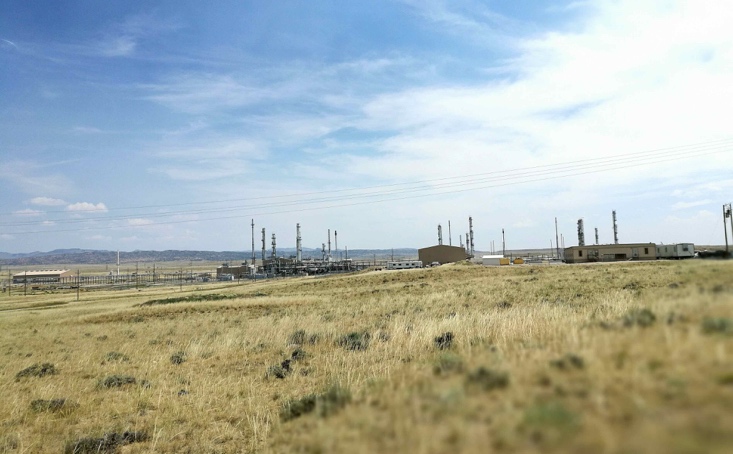
A site layout of the Grieve project is provided below, showing key newbuild facilities highlighted in yellow. This can be compared against an aerial photo of the Grieve site taken at the time of our site visit on 10 July 2017.
Items remaining prior to first oil
■
Installation of oil and produced water storage tanks.
■
Construction of CO2 recycle compression building.
■
Installation of process piping and instrumentation.
■
Liquid pumping and VRU building.
■
Tie-in to export pipeline.
■
Workover and recompletions of seven existing wells and drilling of one new oil producer.
■
Plant commissioning.
|
Exhibit 3: Grieve site layout |
|
|
Source: Elk Petroleum |
|
Exhibit 4: Site view (10 July 2017) |
|
|
Source: Elk Petroleum |
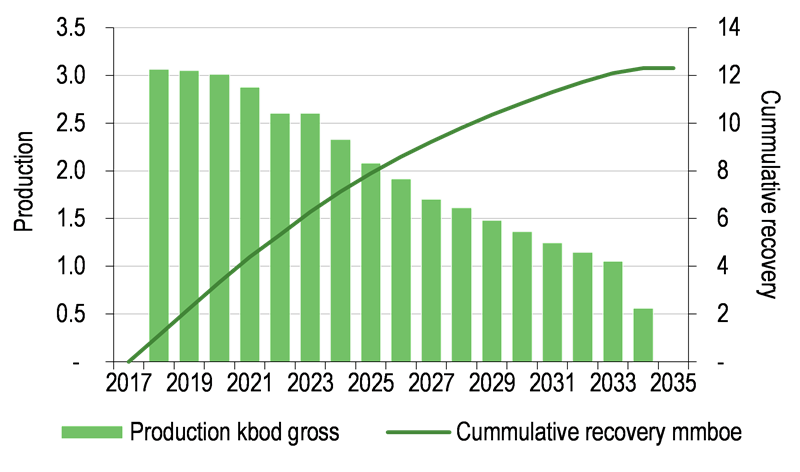
Our Grieve oil recovery and production profile forecasts are in line with management’s 2P projections, assuming incremental recovery of 12.3mmbbls taking total recovery of original oil in place to 63% from 50%. We note that Denbury has publically disclosed a slightly lower gross recoverable figure of 10mmbbls (5mmbbls net). Elk management believes there is material upside beyond current projections of 2P reserves through the optimisation of the CO2 EOR and potentially through shooting a 3D seismic survey (cost estimated at $1.5m) to fully delineate the Grieve field and to position future producers/injectors to target volumetric upside. Given the sunk capex, the economics of incremental oil recovery are likely to be extremely attractive.
The exhibits below outline our projections of production and net cash flow from Grieve (calendar years) based on current 2P production profiles and assuming first oil in early 2018.
|
Exhibit 5: Grieve gross production profile (calendar years) – pre-royalty |
Exhibit 6: Grieve net cash flow profile (post royalty and tax) |
|
|
|
Source: Edison Investment Research |
|
Exhibit 5: Grieve gross production profile (calendar years) – pre-royalty |
|
|
Source: Edison Investment Research |
|
Exhibit 6: Grieve net cash flow profile (post royalty and tax) |
|
|
Source: Edison Investment Research |
Grieve pipeline update
ELK has a 100% operated interest in the Grieve pipeline, which transports crude from Grieve to the Spectra oil storage tank farm and connection to the Enbridge-operated Platte River Crude Oil Pipeline, a 933-mile interstate crude oil transportation pipeline that currently transports c 150kbod. Recently acquired intelligent pigging data confirmed the pipeline to be within operational wall thickness tolerances and cathodic protection has been installed in order to maintain pipeline integrity. Enbridge is now installing the reconnection of the crude oil pipeline to the North Platte Interstate Transmission crude oil pipeline. The only pipeline works remaining are the Denbury connection of the Grieve production facility to the Grieve pipeline, followed by packing the line with crude oil ahead of first oil export.
Madden and Lost Cabin Gas Plant
In line with ELK’s strategy to become integrated along the CO2 EOR value chain supporting the acquisition and development of further enhanced recovery projects, it acquired Freeport-McMoRan’s 13.6% interest in the Madden Gas Field for US$17.5m. In addition to being a prolific methane producer, Madden also produces a significant sour gas component, giving ELK access to a material CO2 resource. The acquisition, which had an effective date of 1 January 2017, elevates ELK to producer status. ELK estimates attributable free cash flow of US$7m in 2017 from Madden.
Current proven developed reserves of CO2 in the Madden Gas Field are approximately 220bcf. The total recoverable resource potential of raw gas is over 1tcf. The raw gas stream has a CO2 content of 20%, methane and ethane (68% combined) and hydrogen sulphide or H2S (12%). The LCGP is designed to separate raw gas into pipeline specification methane, a purified CO2 stream, and elemental sulphur for sale to the fertiliser market. Operations began in 1995 and, after a number of major expansions, the plant consists of three gas processing trains with total capacity of 310mmscfd. The Madden Gas Field is the second largest supplier of CO2 into the Northern Rockies CO2 gas transmission and supply pipeline network.
The Madden Gas Field is a conventional gas field located in the Wind River Basin in Wyoming. It was discovered in 1968 and is one of the state’s largest gas fields. The field sits on the Madden anticline and covers an area of 518km2.
The field produces from multiple reservoir units ranging in depth from 1,500m to 7,600m.
■
Deep wells: the majority of current gas production comes from the fully developed deep Carboniferous (Mississippian) Madison Formation from only eight production wells. The Madison Formation reservoir is continuous over a 103km2 structure with a continuous gas column that extends over 365m. Production from the existing deep wells remains strong and there are no current plans to drill additional wells in the Madison Formation. The majority of Madison Formation reserves acquired by ELK are classified as PDP. Under the Society of Petroleum Engineers reserve classification guidelines, no additional capital investment is required to develop or produce hydrocarbons under this classification. These deeper wells have produced over 1.1tcf since commencement of production in 1995. Initial well production rates have ranged from 45mmscfd to 60mmscfd. Individual wells have produced 21-225bcf each, making them prolific producers.
■
Shallow wells: shallow gas production comes from multiple, discontinuous, stacked fluvial sandstones in the Upper Cretaceous to Early Tertiary Lower Fort Union, Lance and Cody formations. Gas is produced from 165 active gas wells. Shallow gas production is currently very limited at prevailing gas prices. The make-up of these shallow producing sands is similar to the primary gas-producing intervals in the Cooper Basin in central Australia. ConocoPhillips has identified additional development potential within the shallow units from undeveloped zones across 4,500m of gas-bearing intervals through well completions, vertical infill drilling and horizontal drilling. We note that the auditor at the time of acquisition, NSAI, had assumed that the shallow horizons of the Madden field would be shut in and facilities decommissioned. However, the field operator ConnocoPhillips has plans to continue to operate this facility, improving economics through well workovers and facility optimisation. Our current model excludes value for the Madden shallow horizon, in line with NSAI’s last published reserve report, which assumes zero production beyond 2017. We expect to update our valuation and assumptions once NSAI has re-evaluated Madden shallow based on the operator’s latest production and forecasts which suggest up to 90mmbbls gross recoverable behind-pipe resources that can be commercially exploited subject to commodity prices. We expect this asset to have a modest positive NPV at current gas prices.
Madden CO2 access and opportunity
As part of the CO2 supply arrangements, Denbury Resources (DNR:NYSE) constructed a CO2 receiving and compression facility adjacent to the LCGP and the 373km Greencore CO2 gas pipeline. This has an ultimate capacity to transport 725mmscfd of CO2 for EOR projects in Wyoming and Montana. This implies total annual capacity of approximately 260bcf CO2. By way of comparison, ELK expects that a total of approximately 52bcf of CO2 will be injected into the Grieve field within the first 12 months of first oil production.
ELK is looking at options of using Madden CO2, which is currently being vented and is unutilised. Short-term options include the reinjection of CO2 into the Madden reservoir to improve methane recovery and capture tax credits. Longer term, the expectation is that CO2 will be sold to Denbury under an existing long-term contract for export into the Greencore pipeline.
|
Exhibit 7: Lost Cabin Gas Plant |
Exhibit 8: Lost Cabin Gas Plant Sulphur recovery unit |
|
|
|
Source: Edison Investment Research |
|
Exhibit 7: Lost Cabin Gas Plant |
|
|
Source: Edison Investment Research |
|
Exhibit 8: Lost Cabin Gas Plant Sulphur recovery unit |
|
|
Source: Edison Investment Research |
Plant and well integrity a key consideration
Due to the sour gas nature of the Madden gas field and the acid gasses process at the LCGP, facility integrity and maintenance is an important consideration when considering plant life and ultimate gas recovery. ELK’s and Edison’s production forecasts assume regular plant turnarounds (every 18-24months) and maintenance spend to ensure asset integrity. In our view, our key considerations include monitoring and maintenance of Madden deep production tubing, casing strings and field pipelines to ensure integrity of the field’s valuable well stock (deep wells can cost up to $120m to drill and complete due to the exotic metallurgy used for sour gas service) over field life. ConocoPhillips began a well integrity programme in 2016, and a total of three of the eight producing wells have been inspected to date with corrosion evaluation work ongoing.
Maintenance of the LCGP sour gas processing facilities, in particular the sulphur recovery train, is also an important consideration in ensuring the facility meets regulated and permitted emissions targets. Facility integrity and uptime is optimised through regular plant turnarounds that include cleaning out process equipment and equipment repairs. The EPA has set a stringent one-hour SO2 standard and the LCGP has a monitoring station immediately south of the plant operational since 1 January 2017. The plant operator is working to identify operating and mechanical modification to reduce the risk of emissions exceeding regulated levels.
|
Exhibit 9: Madden gross production profile (calender years) |
Exhibit 10: Madden net cash flow profile (post-royalty and tax) |
|
|
|
|
|
Source: Edison Investment Research |
|
|
Exhibit 11: Madden gas field and pipeline connectivity |
||
|
||
|
Source: Elk Petroleum |
||
Management
Neale Taylor, Chairman: Dr Taylor has extensive technical, operating and commercial experience in oil and gas exploration and production with Esso Australia, Nexus Energy and Cambrian Oil & Gas. He is a former non-executive director of Terra Gas Trader, former non-executive chairman of Tap Oil, a former managing director of Cambrian Oil & Gas and director of various subsidiaries of Xtract Energy. He is a member of the Society of Petroleum Engineers and a Fellow of the Australian Institute of Company Directors.
Bradley Lingo, Managing Director and CEO: Mr Lingo is an experienced international resource and energy executive with a proven track record of successfully building companies in the upstream and midstream oil and gas energy sectors. Recently, Mr Lingo was MD and CEO of Drillsearch Energy, where he oversaw a more than eightfold increase in the share price and market cap over a period of six years, helping build that company into one of Australia’s leading onshore oil and gas producers. He held previous roles in business development, new ventures, mergers and acquisitions and corporate finance with Tenneco Energy and El Paso Corporation in the US and Australia, and was senior VP and head of oil & gas at the Commonwealth Bank of Australia. His skills include leadership, ability to build market confidence, financial and technical skills, organisation building, business development and funding capability, and entrepreneurship. His experience also includes equity and debt capital raising, project and transaction financing and structuring to achieve attractive financial, tax, accounting and legal treatment for complex commercial, project and financing transactions, similar to ELK’s current needs.
Alexander Hunter, CFO: Mr Hunter has over 10 years’ experience in resources sector M&A and capital raising, and previously worked for 10 years in construction and infrastructure project management. He was most recently general manager of business development at Drillsearch Energy, where he helped to rationalise and grow the business leading various successful takeovers, divestments and capital raisings. He holds an MBA from the University of Southern California Marshall School of Business, a Bachelor of Engineering and postgraduate qualifications in corporate finance and business law.
David Evans, COO: Mr Evans is a geologist with 30 years’ upstream global oil and gas development, production and exploration experience, with significant exposure to Brownfield redevelopments and EOR projects. He joins ELK from Drillsearch, where over a six-year period he held the positions of chief technical officer and acting chief operating officer.
Valuation and sensitivities
Our valuation of ELK and its core assets, Grieve and Madden, is based on discounted cash flows (NPV10) adjusted for group net debt and administration costs. At this stage, we do not include incremental value for potential value-accretive inorganic growth. Our base case assumptions and commodity price sensitivity are provided below.
Oil and gas price scenarios
■
Gas base case: EIA Short-Term Energy Outlook (STEO), July 2017. Forecast of US$3.1/mcf for 2017 and US$3.4/mcf for 2018 and escalated by 2.5% pa from 2019 reaching $3.8/mcf in 2022.
■
Gas hedging: ELK has initiated gas price hedging for 80% of the next 12 months (August 2017 to July 2018) forecast Madden PDP production at an average price of $2.93/mmbtu and 40% of PDP production for the following year at an average price of US$2.82/mmbtu.
■
Oil base case: we have used Edison’s oil price forecasts to value the Grieve project. These are highlighted in the table below and reflect our new long-term oil price of US$70/bbl WTI in 2022. Please see our recently published macro note for more detail.
■
Oil hedging: to reduce downside risk, a comprehensive oil price hedging programme was put in place at the same time as ELK’s term loan facility to underwrite the Grieve project. As such, 75% of forecast oil production from the Grieve project during calender years 2018 and 2019 has been hedged with put options at a floor of 45$/bbl. ELK retains oil price upside.
Exhibit 12: Oil and gas price forecasts
2017 |
2018 |
2019 |
2020 |
2021 |
|
Oil price (WTI) (US$/bbl) |
49.0 |
49.6 |
57.9 |
62.9 |
66.4 |
Gas price (Henry Hub) (US$/mcf)* |
3.1 |
3.4 |
3.5 |
3.6 |
3.7 |
Source: Edison Investment Research. Note: *Uses conversion factor of 0.9756 to convert US$/mmbtu to US$/mcf.
CO2 production
■
CO2 assumed to be sold at cost.
■
Direct ownership of CO2 production provides leverage to negotiate acquisitions and the availability of CO2 for development EOR projects.
■
Expected cost differential of own low-cost CO2 production vs potential higher cost of on-market purchase of CO2. There is a risk that third-party purchases of CO2 are not possible at the quantities or to the schedule required.
Sulphur production
The Lost Cabin Gas Plant produces 1,200-1,400t/day of sales-grade sulphur (gross). The majority is transported by rail to Tampa, Florida to supply the fertiliser market. The remainder is transported to a local fertiliser plant in south-west Wyoming.
■
Sulphur assumed to be sold at cost – margin neutral.
■
Cyclical periods of shortages may lead to occasional periods of high prices.
Decommissioning
The Lost Cabin Gas Plant is a sizeable and complex plant, which will incur a material decommissioning expense at the end of field life. We include estimates for the cost of mothballing Train 1 (2033) and decommissioning the entire plant at the end of field life in line with NSAI 2P projections.
NAV valuation summary
We have used our base case oil and gas prices (Exhibit 12) in our valuation of ELK’s 2P asset base, which stands at A$0.09/share. We see material upside in the event of higher commodity prices and/or resource recovery in excess of audited 2P estimates. In particular, we flag that ConocoPhillips holds significantly greater estimates than NSAI for Madden 2P reserves within its own operator estimates. Our base case valuation breakdown is provided below.
Exhibit 13: ELK base case valuation*
|
Country |
Diluted |
Recoverable reserves |
Net risked |
Value/share |
|||
Asset |
WI |
CoS |
Gross |
Net |
NPV/boe |
value |
risked |
|
|
|
% |
% |
mmboe |
mmboe |
$/boe |
US$m |
A$/share |
Net (debt)/cash: December 2017 inc convert |
100% |
100% |
(80) |
(0.12) |
||||
SG&A - NPV of 2 years |
100% |
100% |
(8) |
(0.01) |
||||
Production |
||||||||
Grieve 2P |
US |
49% |
100% |
12.3 |
5.3 |
21.7 |
114.7 |
0.17 |
Madden Deep 2P |
US |
14% |
100% |
1,057.6 |
143.8 |
0.3 |
38.6 |
0.06 |
Core NAV |
|
|
|
|
|
|
65 |
0.09 |
Source: Edison Investment Research. Note: *All assets discounted from 1 January 2018.
To quantify commodity price sensitivity we provide a 2P NAV sensitivity to both long-term oil price and gas price assumptions. As can be seen in the table below, ELK is highly sensitive to both oil and gas pricing given its operational and financial leverage. Our-long term assumptions are assumptions are $70/bbl WTI (2022) and $3.85/mcf Henry Hub (2022).
Exhibit 14: NAV sensitivity to oil and gas price (A$/share)
Long-term gas price from 2022 (US$/mcf) |
Long-term oil price from 2022 (US$/bbl) |
||||
40 |
50 |
60 |
70 |
80 |
|
3.00 |
0.01 |
0.03 |
0.05 |
0.07 |
0.09 |
3.85 |
0.04 |
0.06 |
0.08 |
0.09 |
0.11 |
5.00 |
0.07 |
0.09 |
0.11 |
0.13 |
0.15 |
6.00 |
0.10 |
0.12 |
0.14 |
0.16 |
0.18 |
Source: Edison Investment Research
With the current share price implying that long-term commodity prices remain below current spot levels and with a significant amount of oil production hedged over the next two years, commodity price-driven downside is largely protected. Nevertheless, company-specific operational risks centre around ELK’s ability to recover reserves in line with audited 2P estimates, maintain high levels of operational uptime/plant integrity and minimise the NPV of decommissioning liabilities associated with large capital items such as the Lost Cabin Gas Plant.
Valuation versus US peers
ELK’s current asset base is concentrated in the state of Wyoming, US and as such lacks a suitable comparable peer group on the ASX. In this section, we compare ELK to a number of US onshore conventional and unconventional producers that operate similar US onshore assets in comparable basins. These comparisons are based on data available in company SEC filings, Bloomberg and publicly available data. We focus on metrics commonly used in US equity markets for the mid-cap onshore exploration and production sector.
ELK currently trades at a distinct discount to US onshore peers on an EV/1P $/boe basis at just 7.0$/boe.
|
Exhibit 15: ELK vs US peers EV $/1P boe |
Exhibit 16: ELK vs US peers – EV/EBITA vs net debt/ EBITDA |
|
|
|
Source: Bloomberg, Edison Investment Research |
|
Exhibit 15: ELK vs US peers EV $/1P boe |
|
|
Source: Bloomberg, Edison Investment Research |
|
Exhibit 16: ELK vs US peers – EV/EBITA vs net debt/ EBITDA |
|
|
Source: Bloomberg, Edison Investment Research |
ELK also stands out when looking at valuation on a flowing barrel basis (EV/bbd) despite leverage (net debt/EBITDA) close to the peer group average, however $/acre multiples remain substantially higher than US peers. Elk focuses on production rather than exploration assets and we would expect the company’s developed acre multiple to fall once behind-pipe resource at Madden shallow (90mmbbls gross) is included.
|
Exhibit 17: EV/bbd versus net debt/EBITDA |
Exhibit 18: EV/developed acre vs net debt/EBITDA |
|
|
|
Source: Bloomberg, Edison Investment Research |
|
Exhibit 17: EV/bbd versus net debt/EBITDA |
|
|
Source: Bloomberg, Edison Investment Research |
|
Exhibit 18: EV/developed acre vs net debt/EBITDA |
|
|
Source: Bloomberg, Edison Investment Research |
ELK’s realisations per barrel are towards the lower end of the peer group given its gas bias on a volume basis. However, realisations are robust given the hydrocarbon mix. Lifting costs and finding and development (F&D) costs are among the lowest in the peer group. Operating costs at Grieve are c US$10-13/bbl and Madden at c 10$/boe.
|
Exhibit 19: Realisations across peer group |
Exhibit 20: Lifting costs and F&D* costs across peer group |
|
|
|
Source: Bloomberg, Edison Investment Research |
Source: Bloomberg, Edison Investment Research. Note: *Edison estimates for ELK. |
|
Exhibit 19: Realisations across peer group |
|
|
Source: Bloomberg, Edison Investment Research |
|
Exhibit 20: Lifting costs and F&D* costs across peer group |
|
|
Source: Bloomberg, Edison Investment Research. Note: *Edison estimates for ELK. |
Financials
To date, ELK has used a combination of debt and equity to fund growth. We expect operational cash flow from Madden and Grieve in late 2017/early 2018 to enable ELK to significantly pay down debt over the course of 2018-2020 and fund further expansion. We discuss the company’s balance sheet in further detail below.
Earnings
The effective date for the Madden gas field acquisition is 1 January 2017. From this date, ELK became a producing oil and gas company and begins to generate operating earnings from gas sales. Expected first oil production from the Grieve CO2 EOR project is expected in late 2017/early 2018.
The earnings forecasts in Exhibit 23 use Edison oil price forecasts and EIA gas price forecasts, as shown in Exhibit 12. Almost all the Madden gas is sourced from the Madden Deep wells, where future capital expenditure requirements are low as no new wells are required to underpin the company’s 2P reserve profile.
Cash flow
Assuming January 2017 consensus gas price forecasts, ELK has estimated positive attributable net free cash flow of approximately US$7m for CY17 from Madden. At the outset of production, our pre-tax cash flow forecasts for Madden are broadly in line with this figure.
Balance sheet
ELK’s capital structure consists of several debt lines ranging in cost and asset security. Key elements are highlighted below:
■
Benefit Street Partners facility totalling US$58m conventional term loan for oil field development financing available to fund ELK’s outstanding capital requirements to first oil at Grieve. US$56.3m was drawn as of 30 June 2017. We expect the remainder of this to be drawn down over the course of the next quarter.
■
US$10m convertible loan with a three-year term maturing on 31 March 2020, 11% annual interest and convertible to shares at A$0.103/share.
■
Additional US$4.5m convertible loan facility with term of three years maturing on 31 March 2020. Holders have the option to convert to shares at A$0.103/share.
■
ELK has made a final payment of US$5.5m for the acquisition of Madden. To fund this payment, ELK secured a US$6m credit facility with Oklahoma-based CrossFirst Bank with an annual interest rate of US prime plus 2%, with a three-year, straight-line amortisation.
FY17 saw a material increase in debt as ELK drew down on the Benefit Street Partners loan and took on an additional US$10m of convertible debt to fund the Madden/Lost Cabin transaction. We expect this to be paid down rapidly from cash flow once Grieve is on stream even at spot oil prices.
|
Exhibit 21: Debt reduction – Edison base case |
Exhibit 22: Debt reduction – US$50/bbl long term |
|
|
|
Source: Edison Investment Research |
|
Exhibit 21: Debt reduction – Edison base case |
|
|
Source: Edison Investment Research |
|
Exhibit 22: Debt reduction – US$50/bbl long term |
|
|
Source: Edison Investment Research |
Exhibit 23: Financial summary
|
|
A$'000 to FY16 then US$'000 |
2016* |
2017e |
2018e |
2019e |
2020e |
Year end June |
|
IFRS |
IFRS |
IFRS |
IFRS |
IFRS |
|
PROFIT & LOSS |
|||||||
Revenue |
|
|
48 |
6,257 |
30,967 |
49,662 |
47,462 |
Cost of sales |
(317) |
(3,622) |
(11,966) |
(15,229) |
(13,576) |
||
Gross profit |
(269) |
2,635 |
19,002 |
34,434 |
33,886 |
||
General & admin |
(4,762) |
(5,052) |
(5,052) |
(5,052) |
(5,052) |
||
EBITDA |
|
|
(5,031) |
(2,417) |
13,950 |
29,382 |
28,834 |
Depreciation |
(175) |
(1,512) |
(8,402) |
(13,095) |
(11,259) |
||
Operating Profit (before amort. and except.) |
(5,206) |
(3,928) |
5,548 |
16,286 |
17,575 |
||
Intangible amortisation |
0 |
0 |
0 |
0 |
0 |
||
Exceptionals |
(1,483) |
0 |
0 |
0 |
0 |
||
Other |
0 |
0 |
0 |
0 |
0 |
||
EBIT |
(6,689) |
(3,928) |
5,548 |
16,286 |
17,575 |
||
Net interest |
(479) |
(556) |
(8,449) |
(9,115) |
(7,153) |
||
Profit Before Tax (norm) |
|
(5,685) |
(4,485) |
(2,901) |
7,171 |
10,421 |
|
Profit before tax (FRS 3) |
|
(7,168) |
(4,485) |
(2,901) |
7,171 |
10,421 |
|
Tax |
0 |
(188) |
(1,612) |
(3,552) |
(6,656) |
||
Profit After Tax (norm) |
(5,685) |
(4,485) |
(4,512) |
3,619 |
3,765 |
||
Profit after tax (FRS 3) |
(7,168) |
(4,485) |
(4,512) |
3,619 |
3,765 |
||
Average number of shares outstanding (m) |
263.2 |
826.7 |
854.0 |
854.0 |
854.0 |
||
EPS - normalised (c) |
|
(2.2) |
(0.6) |
(0.5) |
0.4 |
0.4 |
|
EPS - normalised fully diluted (c) |
(2.2) |
(0.6) |
(0.5) |
0.4 |
0.4 |
||
EPS - (IFRS) (c) |
|
(2.7) |
(0.6) |
(0.5) |
0.4 |
0.4 |
|
Dividend per share (c) |
0.0 |
0.0 |
0.0 |
0.0 |
0.0 |
||
Gross margin (%) |
-564.2 |
42.1 |
61.4 |
69.3 |
71.4 |
||
EBITDA margin (%) |
-10,553.4 |
-38.6 |
45.0 |
59.2 |
60.8 |
||
Operating margin (before GW and except.) (%) |
-10,920.4 |
-62.8 |
17.9 |
32.8 |
37.0 |
||
BALANCE SHEET |
|||||||
Non current assets |
|
41,926 |
98,273 |
97,367 |
86,108 |
75,936 |
|
Intangible assets |
41,768 |
46,175 |
46,175 |
46,175 |
46,175 |
||
Tangible assets |
158 |
52,099 |
51,193 |
39,933 |
29,762 |
||
Investments |
0 |
0 |
0 |
0 |
0 |
||
Current assets |
|
19,904 |
17,095 |
10,971 |
12,851 |
12,397 |
|
Stocks |
0 |
0 |
631 |
1,258 |
1,106 |
||
Debtors |
1,801 |
1,801 |
1,262 |
2,515 |
2,213 |
||
Cash |
18,103 |
15,294 |
9,078 |
9,078 |
9,078 |
||
Other |
0 |
0 |
0 |
0 |
0 |
||
Current liabilities |
|
(13,570) |
(13,570) |
(5,052) |
(10,065) |
(8,856) |
|
Creditors |
(13,565) |
(13,565) |
(5,048) |
(10,061) |
(8,852) |
||
Short term borrowings |
(4) |
(4) |
(4) |
(4) |
(4) |
||
Long term liabilities |
|
(25,476) |
(80,325) |
(86,325) |
(68,313) |
(55,132) |
|
Long term borrowings |
(22,095) |
(76,944) |
(82,944) |
(64,932) |
(51,752) |
||
Other long term liabilities |
(3,381) |
(3,381) |
(3,381) |
(3,381) |
(3,381) |
||
Net assets |
|
|
22,784 |
21,473 |
16,961 |
20,580 |
24,345 |
CASH FLOW |
|||||||
Operating cash flow |
|
(4,286) |
(3,161) |
(4,720) |
19,848 |
14,269 |
|
Net interest |
0 |
0 |
0 |
0 |
0 |
||
Tax |
0 |
0 |
0 |
0 |
0 |
||
Capex inc acquisitions |
(3,365) |
(57,859) |
(7,496) |
(1,836) |
(1,088) |
||
Other |
0 |
0 |
0 |
0 |
0 |
||
Equity issued |
24,328 |
3,362 |
0 |
0 |
0 |
||
Dividends |
0 |
0 |
0 |
0 |
0 |
||
Net cash flow |
16,677 |
(57,658) |
(12,216) |
18,012 |
13,181 |
||
Opening net debt/(cash) |
|
20,949 |
3,996 |
61,655 |
73,871 |
55,859 |
|
HP finance leases initiated |
0 |
0 |
0 |
0 |
0 |
||
Other |
276 |
0 |
0 |
(0) |
(0) |
||
Closing net debt/(cash) |
|
3,996 |
61,655 |
73,871 |
55,859 |
42,678 |
|
Source: Company accounts, Edison Investment Research. Note: Elk Petroleum reports in US$ for FY17 (year ending 30 June 2017). *As reported in A$000.
|
|||||||||||||||||||||||||||||||||||||||||||||||
|
|
Is Yatirim (ISY) produced a very strong result in H117 against the backdrop of an improved political and economic environment in Turkey, which has seen a strong improvement across capital markets. With the benefit of leading market positions, ISY has seen revenues increase across all product areas with particular strength in interest and trading. Meanwhile, costs have been kept under tight control and below the level of inflation, which is running in excess of 9% pa. We have significantly increased our forecasts for the current year, while prudently making little change to FY18 given the inherently uncertain nature of capital markets.