R&D update: Multiple data publications across pipeline
Selvita has been executing on its new, multi-year strategy following a successful share issue in March 2018 that raised PLN134m. The company will raise additional funds from sales, subsidies and loans to a total expected amount of c PLN390m. All the money raised will fund Selvita’s accelerated R&D strategy and expansion of other business areas over the next several years. We discussed in detail the company’s ongoing programmes in our last outlook report. Since then Selvita has made progress with its projects across the pipeline and presented fresh preclinical data in several publications as well as posters at the AACR in April 2018.
Exhibit 1: Selvita’s R&D pipeline
|

|
|
|
Targeted therapeutics: SEL24/MEN1703 – Phase I/II enrolling
The Phase I/II trial with SEL24 in AML has resumed in all three US recruitment sites after the clinical hold had been lifted by the FDA in December 2017 and two additional US sites were opened. Menarini Group, which has in-licensed the asset, and Selvita continue to expect the first data by the end of this year. In March 2018, a peer-reviewed article was published in Oncotarget describing SEL24’s existing data in AML. The article highlights how SEL24 specifically inhibits PIM- and FLT3-related pathways and exhibits broader anti-tumour activity in AML compared to selective FLT3 or PIM inhibitors.
FMS-like tyrosine kinase receptor-3 gene (FLT3) is one of the most common genetic lesions in AML (around 25% of newly diagnosed AML cases) and, although its inhibition has been shown to be effective in clinical trials, resistance to treatment develops rapidly. The latest achievement in this area was Daiichi Sankyo’s results presentation from its Phase III QuANTUM-R study at the European Hematology Association (EHA), 14-17 June in Stockholm, Sweden. The trial tested quizartinib as a salvage therapy in patients with relapsed/refractory AML with FLT3-ITD mutations after first-line treatment with or without hematopoietic stem cell transplantation. The results demonstrated that quizartinib significantly prolonged overall survival (OS) compared to standard of care salvage chemotherapy (27% versus 20% respectively, at week 52). While this is positive news and quizartinib is likely to capture some market share when launched, this is a subgroup of difficult patients who carry the FLT3-ITD mutation and have already failed first-line treatment; there are no other targeted therapies approved for these patients (around 25% of newly diagnosed AML cases carry the mutation and most of them relapse). In addition, as described below, Selvita’s SEL24 is potentially effective in AML despite the FLT3 status, pan-FLT3 inhibitor. Lastly, while the OS improvement in the QuANTUM-R trial was significant, in absolute terms it amounted to a median OS of 27 weeks in the quizartinib arm and 20.4 weeks in the standard of care arm; this means the unmet medical need will still be high. We presented a more detailed overview of the FLT3 inhibitor landscape in our last outlook report.
PIM kinases are major oncogenes and downstream targets with expression triggered by FLT3-induced STAT5 activity. The expression of PIM kinases amplifies FLT3’s oncogenic potential in addition to other pro-oncogenic signalling, thus presenting a rationale for a dual FLT3/PIM inhibition. Previously, third-party data have shown PIM expression increases cancer resistance to FLT3 inhibitors, while PIM inhibition would restore cancer sensitivity to FLT3 inhibitors. Selvita’s SEL24, a first-in-class dual inhibitor of PIM and FLT3 kinases, can simultaneously inhibit both kinases and provides a novel treatment strategy. The newly published results summarise data from various in vitro and in vivo studies of SEL24 comparing it to control or active treatment with a selective PIM inhibitor (AZD1208, AstraZeneca) or FLT3 inhibitor (AC220, Daiichi Sankyo):
■
Synergistic effect of dual inhibition. SEL24 has been described as a potent, dual inhibitor of PIM and FLT3 kinases and has anti-proliferative activity in AML cell lines, which was broader than that of selective PIM inhibitors or FLT3 inhibitors. The combination of AZD1208 and AC220 also demonstrated a synergistic effect further supporting a dual specificity treatment rationale.
■
Overcoming resistance. Point mutation in the activation loop of the tyrosine kinase domain (TKD) is another type of activating mutation of FLT3. FLT3-TKD is known to cause resistance to FLT3-ITD specific inhibitors. Therefore, as expected, AML cell lines with FLT3-TKD mutation were less sensitive to a specific FLT3-ITD inhibitor (AC220). A selective PIM inhibitor (AZD1208) only marginally affected viability regardless of the FLT3 status. In stark contrast, SEL24 with its dual targeting was similarly effective in all tested mutant FLT3 cells.
■
Efficacy in vivo animal models (Exhibit 2). SEL24 was tested in several in vivo xenograft models.
•
In a single-agent test in mice bearing FLT3-ITD tumours (MV-4-11) a dose dependent reduction in tumour volume by 67-82% has been observed (Exhibit 2A). In the FLT3-WT (wild-type, ie not mutated) model (MOML-16) c 100% tumour growth inhibition was observed at certain doses.
•
To compare the efficacy of SEL24 versus PIM inhibitor AZD1208 and FLT3-ITD inhibitor AC220, the drugs were used in two models – MOLM-13 (FLT3-ITD) and KG-1 (FLT3-WT). SEL24 reduced tumour growth by c 50% in both models. AZD1208 had a variable effect with 20% response in FLT3-ITD and 60% in FLT3-WT. AC220 had no effect in FLT3-WT mice, but reduced the volume growth in the FLT3-ITD tumour by 100% surpassing the effect of SEL24 (Exhibits 2B, A). Researchers stipulated that this could have been caused by SEL24’s relatively short half-life. Previously, other in-house data (not included in the article) showed higher tumour growth inhibition by SEL24 with twice-daily dosing (the current study used a once-daily regime) (Exhibit 2B).
Of particular note is that SEL24 had a largely similar effect in both the FLT3-WT and FLT3-ITD models (although in the FLT3-ITD model there is the potential to observe even higher efficacy with different dose regimens as explained above). PIM kinases are known to be expressed also in FLT3-WT AML cells. Therefore SEL24 could, theoretically, potentially be used to treat AML patients even with FLT3-WT status. However, while a biomarker to identify AML patient status already exists in FLT3, in the PIM case it still needs to be developed, ie to identify which patients are likely to respond better to SEL24 with respect to PIM status. Selvita has already done some work in identifying such biomarkers. While SEL24 is in the hands of Menarini, the potential to expand the accessible AML patient population beyond FLT3-ITD could become attractive and patient stratification according to selected PIM biomarkers could be part of the later stage clinical development of SEL24, in our view.
In our previous outlook report we described other selective FLT3 and PIM inhibitors in the industry, existing data with these agents and the competitive advantages of SEL24 given its dual mechanism of action.
Exhibit 2: In vivo models with SEL24, AZD1208 and AC220
|

|
Source: W Czardybon et al. MOLM-16, MV-4-11, KG-1 and MOLM-13 cell lines were implanted subcutaneously in immunodeficient mice.
|
Targeted therapeutics platform: SEL120 – new data presented
Preparations for the clinical development of SEL120 (first-in-class selective CDK8 inhibitor) are ongoing. Selvita plans to file an IND application in 2018, with a Phase I trial following subsequently, likely in Q119. CDK8 is a uniquely differentiated target and plays a part in a multi-protein complex that regulates gene expression. So far, preclinical studies point to potential efficacy in haematological malignancies, which should be further explored in Phase I. Preclinical efficacy has also been established in solid tumours, such as colorectal cancer or triple-negative breast cancer, and in combination therapies with immunoncology products, which are all potential indications for expansion in later trials. In addition, Selvita is developing SEL120 in cooperation with the Leukemia and Lymphoma Society for AML. Newest preclinical findings were presented at the AACR conference in April 2018, while previous data have been discussed in our outlook reports.
With the AACR presentation, Selvita demonstrated the anti-cancer effects of SEL120 by the elimination of leukaemia stem cells (LSCs). LSCs can be described as a subtype of AML cells that are the most difficult to eliminate with conventional therapy and the most responsible for relapse due to their capacity of self-renewal, proliferation and differentiation (D Pollyea et al). While described in the 1990s, treatments specifically targeting cancer stem cells are still in development stages (X Wang et al). Newly presented results describing SEL120’s effects in vitro and in vivo AML models include:
■
Activated STAT signalling and CD34 expression were previously described as features of leukaemia stem cells (LSC) that contribute to AML relapse through treatment-resistant clones. Selvita has shown that SEL120 is effective with nanomolar activity in these cell lines.
■
Treatment of CD34+ cells (feature of LSCs) with SEL120 resulted in decreased levels of CD34+ and increased levels of CD38+ on the cell surface, indicating that SEL120 induces cell differentiation, ie immature leukaemic cells turn into mature blood cells. Gene expression analysis also confirmed such a pattern.
■
SEL120 was shown to have a synergistic effect when administered after the treatment with cytarabine and caused increased cancer cell death and decreased population of CD34+ cells. Cytarabine is one of the core combination drugs in treating AML.
■
In an in vivo model CD34 enriched or depleted MOLM-16 (AML) cells were inoculated subcutaneously into mice and CD34+ tumours exhibited the most robust tumour growth (Exhibit 3A). SEL120 was highly active in the CD34+ tumours (Exhibit 3B).
Exhibit 3: SEL120 is highly active in CD34+ tumours
|

|
Source: E. Majewska et al. Selvita poster presentation, AACR meeting, Chicago, IL, April 2018
|
Cancer metabolism and immunometabolism: A2A/A2B inhibitor
Natural molecule adenosine is a key element in immune regulation and many cancers have the ability to accumulate it, which allows them to escape detection by the immune system. Antagonising adenosine receptors (A2A/A2B) or inhibiting the enzymes of the adenosine synthesis pathway (CD39/CD73, another project in Selvita’s portfolio) was shown to restore the adenosine-suppressed anti-tumour response of the immune system.
While this type of technology is still mostly in early clinical development, over the past three years there have been multiple deals in the industry with values reaching $500m as large pharma in-license assets targeting this pathway. More recently, Arcus Biosciences, a US-based biotech company, underwent a successful IPO, raising $120m. The company is running Phase I/II trials with its lead drug candidates AB928, a dual adenosine receptor antagonist, and AB122, a PD-1 antibody. In September 2017, Taiho announced an option agreement with Arcus for a portfolio of regional rights in Asia (excluding China) to preclinical cancer immunotherapy candidates. The upfront and royalties were not disclosed, but Arcus will receive $35m over three years and could get $275m for each drug programme that Taiho in-licenses. Further news in this area came from a private Belgian biotech iTeos Therapeutics, which raised €75m from a consortium of investors in an oversubscribed funding round in June 2018. iTeos develops the A2A antagonist for cancer and aims to start clinical development with the new funds.
Selvita’s asset (SEL330) stands out, in our view, because of its dual A2A/A2B inhibition activity, while other technologies in the area mainly are selective A2A inhibitors. Selvita believes the relevant target populations could be broad, with the immunosuppressive environment prevalent in around 50% of all cancers. There is also a strong rationale for synergistic potential with checkpoint inhibitors. In Q118, Selvita continued work to identify the clinical candidate with the highest in vivo efficacy and also establish which combinations with other anticancer therapies (eg checkpoint inhibitors and chemotherapy) would be optimal for the clinical trials. Selvita’s poster presentation at the AACR meeting included existing data describing the discovery process and in vivo data. Main conclusions include:
■
Selvita’s discovered novel, dual A2A/A2B inhibitors are potent with picomolar activity in vitro.
■
SEL330 demonstrated dose-dependent activity to restore the adenosine agonist-impaired functionality of CD4+ and CD3+ human T-lymphocytes and rescue adenosine-suppressed cytotoxicity of NK cells. This indicates the potential to restore the anti-tumour response of the patient’s immune system.
■
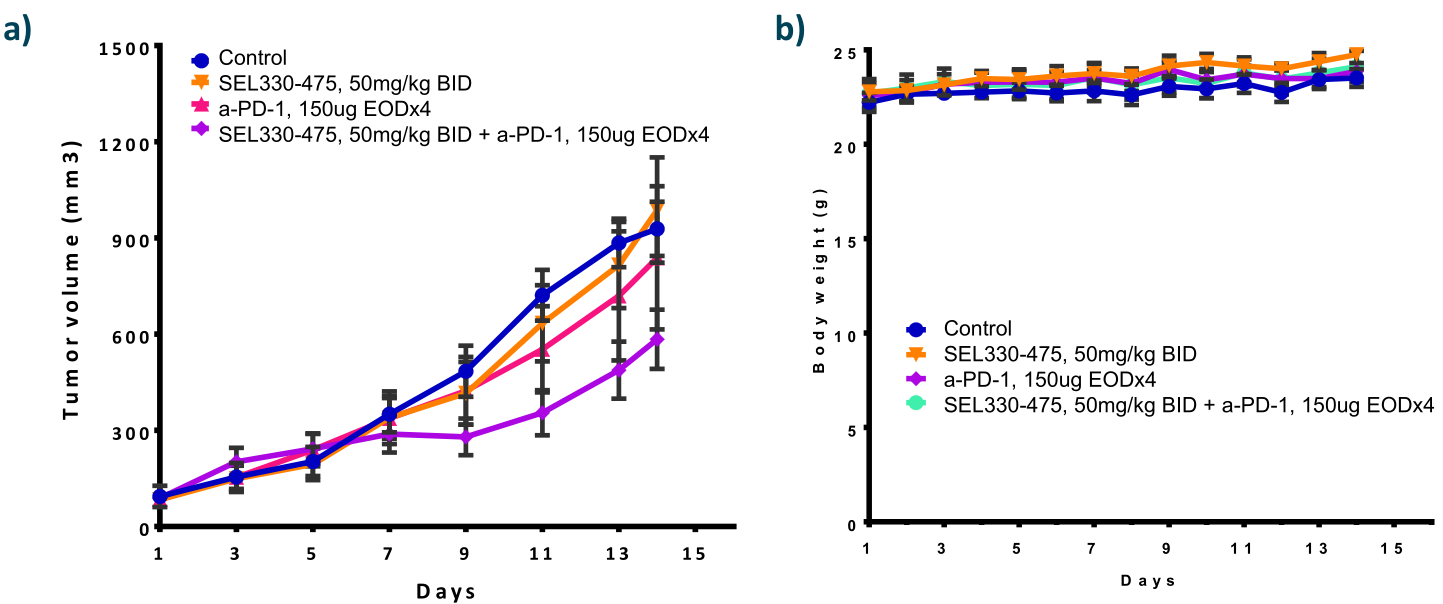
SEL330 demonstrated synergistic activity with PD-1 inhibitor in syngeneic mouse cancer model (Exhibit 4).
Exhibit 4: SEL330 is synergistic with anti‐PD‐1 in mouse models
|
|
Source: P. Węgrzyn, M. Gałęzowski et al. Selvita poster presentation, AACR meeting, Chicago, IL, April 2018
|
Immunology platform: STING inhibitors
The most advanced immunooncology project in this platform is STING (stimulator of interferon genes) pathway modulators. A STING receptor is a known mediator of the immune system, which when activated induces expression of type I interferon and other T-cell recruitment factors. This results in the activation of dendritic cells, which act as antigen presenting cells. The ultimate outcome is the specific immune response with ‘trained’ CD8+ T cells attacking the cancer. The strategic opportunity for STING agonists could be patients not responding to checkpoint inhibitors (CPIs), but also there is potential for use in combination with CPIs. The strong rationale for combinations is based on the fact that CPIs act late in the immunity cycle (makes the tumour ‘visible’ to T cells), while the STING pathway appears to prime the production of cancer-specific T-cells, so both technologies are potentially synergistic. Selvita identified a potentially first-in-class small molecule of the STING agonist, a direct protein binder. This unique structure and optimised ADME properties distinguish Selvita's compounds from the competitors that develop derivatives of nucleic acid which, due to their chemical nature, can mainly be used for inconvenient intratumoural injections. In Q118, Selvita worked on the optimisation of the lead compound, which is planned to be tested in in vivo proof-of-concept studies in 2018.
Another project in the inflammation field, NLRP3 inflammasome inhibitors, was spun out to NodThera and seeded together with Epidarex Capital in 2016 (detailed overview). Recent news outlined NodThera’s £28m fundraising from a consortium of investors, which indicates active development since then. NodThera centres on NLRP3 inflammasome inhibitors, a first-in-class technology, based on the scientific programme originated and developed at Selvita since 2012. Inflammasomes have been identified as the molecular mechanism behind the activation cascade of interleukin (IL)-1. IL-1 is a family of pro-inflammatory cytokines that have been widely implicated in pain, inflammation and autoimmune conditions and more recently in cancer. Therefore, NodThera’s focus is currently rather broad as the asset is in a preclinical stage. This will be narrowed down once past the proof-of-concept clinical trials, for which the new funds should be sufficient, according to the company.