Last close As at 05/08/2026
GBP4.38
▲ 2.00 (0.46%)
Market capitalisation
GBP527m
Research: Investment Companies
VinaCapital Vietnam Opportunity Fund (VOF) posted a -17.1% sterling NAV total return (TR) over the 12 months to end-November, outperforming the Vietnam VN Index (-28.0% TR in sterling and -29.0% in local currency), and its two London-listed peers, amid an increase in global market volatility. The manager, VinaCapital, believes that in 2022 Vietnam’s stock market has sold off consistently with global markets. Recent volatility and selling pressure has been exacerbated by margin calls triggered for both institutional and private investors. Despite this, VinaCapital is confident that in 2022–23 Vietnam’s economic growth and listed companies’ aggregate earnings will remain strong and intact.
Written by
VinaCapital Vietnam Opportunity Fund |
Private holdings provide resilience |
Investment companies |
16 December 2022 |
Analyst
|
||||||||||||||||||||||||||||||||||||||||||||||||||||||||||||||||||||||||||||||||||||||||||||||||||||||
VinaCapital Vietnam Opportunity Fund (VOF) posted a -17.1% sterling NAV total return (TR) over the 12 months to end-November, outperforming the Vietnam VN Index (-28.0% TR in sterling and -29.0% in local currency), and its two London-listed peers, amid an increase in global market volatility. The manager, VinaCapital, believes that in 2022 Vietnam’s stock market has sold off consistently with global markets. Recent volatility and selling pressure has been exacerbated by margin calls triggered for both institutional and private investors. Despite this, VinaCapital is confident that in 2022–23 Vietnam’s economic growth and listed companies’ aggregate earnings will remain strong and intact.
|
10-year performance to end-November 2022 |
|
|
Source: Refinitiv, Edison Investment Research. Note: Total returns in sterling. |
Why invest in VOF now?
The key to VOF’s success has been its strategy of finding future market leaders, while they are still small private businesses, and investing in them for the long term. Portfolio construction allows VOF to take material investments in these businesses, often on special privately agreed terms, help investee companies to grow over years, improve their financials as well as ESG practices, and then, in most cases, go public. This allows VOF to harvest strong returns for investors while ensuring downside protection, typically embedding put options in held stocks. VOF is the only London-listed Vietnamese equities fund to pay a dividend. This has been set by the board for FY22 at 16c per share, consistent with the previous year.
The analyst’s view
VinaCapital’s team has many years of experience in sourcing and structuring the private deals that have formed the bedrock of the VOF portfolio. In 2022 VOF’s private equity ethos and significant exposure to non-public holdings clearly set it apart amid greater stock market volatility driven by fears over inflation, China and the war in Ukraine. VOF’s mid- and long-term performance has been strong, with NAV and share price total returns in excess of 10% pa over one, three, five and 10 years. The recent market sell-off means that via VOF overseas investors can access private Vietnamese businesses (otherwise inaccessible to them) and at favourable valuations. At a c 15.5% discount to NAV (wider than short- and medium-term averages), potential investors may see a good entry opportunity.
Economic and market backdrop: Cautiously optimistic
VinaCapital believes that Vietnam’s robust domestic-driven economic growth coupled with the strong resolve of Vietnamese policymakers to maintain a stable macro-economy make Vietnam somewhat of an ‘economic safe haven’ among emerging markets. VinaCapital estimates inflation in Vietnam at 3–3.5%, still being below the Vietnamese government’s target of 4%. Vietnam’s currency depreciation of over 8% year to date against the US dollar was less than expected by the market consensus, despite the near 20% year-to-date surge in the value of the US dollar and circa 10% depreciation in the value of China’s Yuan.
Vietnam’s GDP grew by 13.7% y-o-y in calendar Q322, which was much stronger than expected by the market consensus. VinaCapital believes that Vietnam’s robust economic growth is currently primarily being driven by domestic consumption. The International Monetary Fund (IMF) forecasts GDP growth for Vietnam of 7.0% in 2022 and 6.7% in 2023. VinaCapital’s chief economist, Michael Kokalari, is cautiously optimistic, predicting 6.5–7.0% growth in 2022 and 2023, in line with the 7.0% average of the five years pre-pandemic and consistent with the government target for this year. He says that the prospects for a recovery in domestic consumer spending are huge.
Exhibit 1 illustrates that the positive economic developments have, thus far this calendar year, failed to translate into strong stock market performance and the Vietnamese market has sold off. Over the past 12 months to end-November 2022, the Vietnam VN Index is down 28% (in sterling and 29% in local currency) compared to a flat (c 0%) sterling TR for the MSCI World Index.
|
Exhibit 1: Performance and valuation of Vietnam and regional equity markets |
|||||||||||||||||||||||||||||||||||||||||||
Performance of Vietnam, Asia and world equities over five years (£) |
Forward P/E valuations of Datastream indices (at 1 December 2022) |
||||||||||||||||||||||||||||||||||||||||||
|
|
||||||||||||||||||||||||||||||||||||||||||
|
Source: Refinitiv, Edison Investment Research. Note: Total return performance. |
|||||||||||||||||||||||||||||||||||||||||||
The government’s regulatory crackdown dampened local investors’ enthusiasm for investing in the stock market, says Kokalari, which is evidenced by the sharp fall in trading activity. Kokalari believes that the main reason for the recent dour sentiment among Vietnamese retail investors is the government’s regulatory scrutiny on illegal practices by certain companies that started at the end of March. That crackdown targeted companies that issued corporate bonds and used the proceeds of that bond issuance to speculate in the stock market. We note that VOF has confirmed it has not invested in such companies.
According to Khanh Vu, deputy managing director, investments for VinaCapital, most of the recent disciplinary action, which started in April, has been focused on unlisted residential developments. The latest example is the chair of Van Thinh Phat, a large private real estate development group in Vietnam; she was arrested on 8 October as part of the widespread investigation and crackdown on regulatory breaches, specifically the fraudulent proceeds from bond issuances. The VinaCapital team considers this disciplinary scrutiny as a non-systemic issue and remain optimistic about the long-term prospects of Vietnam’s real estate sector and stock market.
Vietnam’s stable and decisive government, high-quality workforce and low wage costs (c 60% below China’s, on average) continue to attract businesses keen to set up manufacturing bases there, including LEGO’s first fully carbon-neutral factory, announced in December. All this adds up to a very positive outlook for the economy and market, according to Kokalari and VinaCapital’s head of research, Ismael Pili (see next section).
The fund manager: VinaCapital
The manager’s view: Expect Vietnamese stocks to bounce
Analyst consensus expectations are for earnings growth in Vietnam for both 2022 and 2023 to average 20%. According to VinaCapital, stronger earnings will result in a subsequent stock market rebound. VinaCapital expects the earnings of VOF’s portfolio companies to grow by over 25% over the next year, as the manager continues to tilt the portfolio toward companies benefiting from the ongoing reopening of the economy. The portfolio manager expects a broad-based improvement to several sectors in 2023, led by banks, consumers and industrial sectors. They believe that the market will recognise commercial banks' post-COVID-19 asset quality issues to be much less severe than many investors had feared, especially in light of Vietnam’s very high (relative to most world economies) GDP growth in 2022.
Kokalari and Pili are strong advocates of active investment management, and, alongside fund managers Andy Ho (the managing director and chief investment officer) and Khanh Vu, believe that in addition to the divergence between the performance of Vietnam’s economy and the country’s stock market this year, there is another likely divergence emerging between the price performance of companies with the very highest earnings growth and the overall market. This gives active fund managers, such as VinaCapital, which take a private equity approach to investing, the opportunity to outperform the Vietnam VN Index, which VOF has done over the past ten years to date, outperforming the VN Index by 4.5pp (p.a. on an annualised basis) on average (in sterling to end-October 2022).
Vietnam, explains Kokalari, is one of the few countries in the world with positive real interest rates: the central bank recently raised its refinancing rate to 6.0%, while consumer price index inflation is c 3%. Having reviewed the potential impact that higher inflation and rising interest rates would have on the banking sector, the team consolidated investments into higher-quality banks, such as Asia Commercial Bank (ACB, the top holding position at 12.3% of the end-October 2022 portfolio), which will be able to increase their net interest income and earnings in a rising rate environment. Ho believes that banks within the portfolio will also perform strongly in 2023.
In terms of other sectors with bright outlooks for 2023, Pili highlights urban logistics, industrial parks and real estate. Vu and Kokalari point to tremendous demand for real estate in Vietnam, estimating that each year c 60,000 new residential units are built in the country, which still is a shortfall to the level of housing demand as the urbanisation trend continues. They also consider foreign direct investment (FDI) streams into Vietnam by multinational companies beneficial for further boosting demand in real estate and industrials. A newly emerging industrial estate creates a whole ecosystem around it, explains Vu, including logistic companies, residential units, production and supply chain systems. While not buying into or directly competing with large FDI investors, such as Apple and LEGO, VinaCapital enters surrounding opportunities, in most cases privately or on private terms.
Vietnam remains relatively insulated from volatility in the Chinese economy and markets, and in fact is benefiting from an increased pace of manufacturing being ‘reshored’ from China to Vietnam, given Vietnam’s more pragmatic approach to dealing with COVID-19.
Asset allocation
Portfolio positioning
VOF’s portfolio, which consists of four segments (Exhibit 2, please also see the investment process section on page 10 for details about the segments), had 59% in listed equity at end-June 2022. Public equity holdings often start in the private portfolio as relatively small positions and grow over time (the top 10 private equity holdings account for c 28% of all portfolio private holdings at the end-June 2022 portfolio). FPT Corporation (FPT), the fifth largest holding at 5.4% of the portfolio, and an IT giant in Vietnam with market cap of over $3bn, was a small private company when VinaCapital initially bought a stake in it in 2007. The purchased stake was significant for FPT at the time, and VinaCapital has been able to materially contribute to FPT’s growth and development. As successful companies grow, mature and go public, they make up a significant proportion of VOF’s portfolio. The top 10 public equity holdings account for the 62.8% listed equity allocation (at end-June 2022, Exhibit 4).
|
Exhibit 2: Portfolio breakdown by asset type (31/10/22) |
Exhibit 3: Portfolio breakdown by sector* (31/10/22) |
|
|
|
Source: VinaCapital Vietnam Opportunity Fund, Edison Investment Research. |
|
|
Exhibit 2: Portfolio breakdown by asset type (31/10/22) |
|
|
|
|
Exhibit 3: Portfolio breakdown by sector* (31/10/22) |
|
|
|
|
Source: VinaCapital Vietnam Opportunity Fund, Edison Investment Research. |
The top 10 public equity holdings include two companies technically classified as ‘unlisted equity’ (11% of the portfolio at end-June 2022), as they are currently listed on the Unlisted Public Company Market (UPCoM), the segment of the Vietnamese market for smaller and up-and-coming companies (see page 10). These holdings are Airports Corporation of Vietnam and Quang Ngai Sugar. Orient Commercial Bank listed on the Ho Chi Minh City Stock Exchange in January 2021.
Exhibit 4: Top 10 public equity holdings (as at 31 October 2022)
Company |
Sector |
Portfolio weight % |
|
31 October 2022 |
31 October 2021* |
||
Asia Commercial Bank (ACB) |
Financials |
12.3 |
5.6 |
Khang Dien House (KDH) |
Real estate |
8.3 |
11.8 |
Hoa Phat Group (HPG) |
Materials |
7.4 |
17.8 |
Airports Corporation of Vietnam (ACV) |
Industrials |
6.7 |
5.9 |
FPT Corporation (FPT) |
Information technology |
5.4 |
4.3 |
Phu Nhuan Jewelry (PNJ) |
Consumer discretionary |
4.3 |
N/A |
Quang Ngai Sugar (QNS) |
Consumer staples |
4.2 |
3.7 |
Vinhomes (VHM) |
Real estate |
4.1 |
5.8 |
Orient Commercial Bank (OCB) |
Financials |
3.4 |
5.1 |
Vietcombank (VCB) |
Financials |
2.1 |
N/A |
Top 10 (% of holdings) |
58.2 |
67.9 |
|
Source: VinaCapital Vietnam Opportunity Fund, Edison Investment Research, Bloomberg, Morningstar. Note: *N/A where not in end-October 2021 top 10.
While steelmaker Hoa Phat Group (HPG) remains within the top three holdings (9.2% at end-June 2022), representing nearly half of the materials sector exposure, as a high-quality business within a strategically important sector, and contributed materially to VOF’s FY21 NAV total return, its weighting has been cut by 10.4pp compared with October 2021. The managers seek to manage the concentration risk and focus their current efforts elsewhere, in areas such as financials, real estate and consumer stocks, particularly healthcare.
Lead fund manager Andy Ho says the key sector calls for the year ahead are banks and industrials, where VinaCapital sees high growth potential. Among banks (the VOF team prefers commercial banks to state-owned names), the key drivers of performance are expected to be higher margins, higher fees and lower credit costs. Two of the current top-10 names, ACB and state-owned commercial bank Vietcombank, which at a US$14bn market capitalisation is the largest bank in Vietnam, were added to the portfolio during FY21. Some of the proceeds from trimming the HPG position went to increase the holding in ACB, which went up 5.2pp, and at 11.5% was the top holding in VOF at end-June 2022.
The largest sector within the portfolio (Exhibit 3) is real estate, which focuses on the top residential property developers, with Khang Dien House (KDH) the second largest holding in the portfolio at 8.3% (of the end-October 2022 portfolio). KDH is the leading landed property developer in and around metropolitan Ho Chi Minh City. The company has a strong balance sheet and is not as over-leveraged as other developers. Its pipeline of development projects over the next decade assumes strong sales and demand from homeowners seeking quality properties. VinaCapital says that volatile market conditions have prompted the investment manager to possibly consider reducing exposure to the real estate sector.
On 29 November 2022 the company announced that, given the recent decline in the real estate market in Vietnam, the board has reviewed the fair values of certain investments categorised by the investment manager as ’public equity with private terms’ (Exhibit 2), which has led to a $26.2m reduction in the NAV of the company, as of 30 November 2022 with immediate effect. The board and the investment manager believe that the revaluation was a prudent step to take in response to recent market volatility.
VOF has downside protection in its ’public equity with private terms’ investments, typically through put options to sell the shares at a fixed price at a point in the future. This adjustment is solely in respect of the current fair value of the investments and none of these instruments is in default and the maturity dates are some time in the future. The investment manager will continue to value assets categorised as ‘public equity with private terms’ on a weekly basis.
VinaCapital says that while the downwards valuation is somewhat disappointing, this downside protection has been beneficial for VOF shareholders over the long term, limiting the volatility of the NAV, versus listed markets. The investment manager believes that such adjustments are possible due to the unique terms of investments within the strategy and that they help protect investors during times of market volatility and uncertainty.
The traditional private equity investments were last valued by KPMG, an external valuer, at 30 June 2022 and will next be valued by the investment manager using the same approach as the external valuer but with inputs updated, as at the half-year-end on 31 December 2022.
As Vietnam’s economy develops, the team sees a wider range of opportunities. In addition to consumer spending, infrastructure investment and FDI-supported manufacturing growth, these include ‘21st century’ themes such as digitisation and environmental initiatives and greater demand for services, such as better housing and healthcare. Within the private space, for example, VOF owns seven hospitals along with three clinics and VinaCapital sees great growth and investment potential within these.
During the COVID-19 pandemic, hospitals in Vietnam faced cash flow challenges, because patients were reluctant to visit hospitals out of fear that they may contract COVID-19 and the government’s focus on COVID-19 patients delayed other patients’ treatments in hospitals. VinaCapital supported its investee companies through these difficult times. For example, the investment manager is focusing on helping some of these hospitals in provincial cities improve their operational performance, particularly the Thai Hoa International Hospital (1.0% of the portfolio at end October 2022) in the Dong Thap province in the Mekong Delta.
Performance: NAV beats VN Index again
Exhibit 5: Five-year discrete performance data
12 months ending |
Share price |
NAV |
Vietnam VN Index (%) |
MSCI AC Asia ex-Japan (%) |
MSCI World |
CBOE UK All Companies (%) |
30/11/18 |
8.0 |
4.9 |
2.6 |
(3.8) |
6.8 |
(1.8) |
30/11/19 |
1.8 |
0.1 |
5.8 |
6.6 |
13.6 |
11.3 |
30/11/20 |
17.9 |
15.8 |
2.2 |
21.3 |
11.5 |
(11.2) |
30/11/21 |
35.0 |
46.4 |
53.0 |
1.6 |
23.4 |
17.1 |
30/11/22 |
(12.0) |
(17.1) |
(28.0) |
(9.0) |
(0.5) |
7.9 |
Source: Refinitiv. Note: All % on a total return basis in pounds sterling.
VOF’s NAV total return beat the VN Index total return (in sterling) in three of the last five years to November, throughout rising and falling markets (Exhibit 5). Exhibit 6 shows that during a volatile year in 2022 the company’s NAV has stood up better than the VN Index (12 months ending November 2022). On a rolling, cumulative basis VOF has consistently outperformed the index over the long term (see Exhibit 7).
|
Exhibit 6: Investment company performance to 30 November 2022 |
|
Price, NAV and index total return performance, three-year rebased |
Price, NAV and comparative index* total return performance (%) |
|
|
|
Source: Refinitiv, Edison Investment Research. Note: Three-, five- and 10-year performance figures annualised. * Vietnam VN Index. |
|
During FY22 (year to June) the company’s reported NAV per share declined by 85.0 cents, or by 8.8pp on a total return basis, taking into account the 16.0 cents per share dividend paid during the year (NAV per share increased by 8.0 pence due to the weakness of sterling). This result was driven by a sell-off in the Vietnamese market, which occurred mostly in the second quarter of calendar 2022; prior to that on 28 February 2022 VOF recorded its highest-ever month-end NAV per share of $8.65. For UK-based investors, market movements were mitigated by the strength of the dollar.
During calendar 2022, VOF’s major detractor to performance was the real estate sector, as it experienced difficulties in the light of the government’s efforts to clamp down on stock market manipulation within the small-cap real estate companies and the scrutiny concerning the use of proceeds from the raising of corporate bonds. This has had an impact on the sector’s performance over H222, with the sector declining 23.5% during the January to June 2022 period. Mitigating the overall weak performance during FY22 was the materials sector. The top three largest public equity position, steelmaker HPG (third largest portfolio holding at end-June 2022) was among the biggest individual contributors to VOF’s returns in FY22, as the investment team trimmed this holding at a profit.
Exhibit 7: Share price and NAV total return performance, relative to indices (%)
|
One month |
Three months |
Six months |
One year |
Three years |
Five years |
10 years |
Price relative to Vietnam VN Index |
6.0 |
16.7 |
13.5 |
22.2 |
24.5 |
25.9 |
17.5 |
NAV relative to Vietnam VN Index |
0.1 |
7.2 |
5.6 |
12.0 |
21.5 |
17.4 |
(8.5) |
Price relative to MSCI AC Asia ex-Japan |
(11.0) |
(8.9) |
(7.5) |
(3.3) |
25.0 |
33.9 |
132.1 |
NAV relative to MSCI AC Asia ex-Japan |
(15.9) |
(16.3) |
(14.0) |
(11.4) |
21.9 |
24.8 |
80.7 |
Price relative to MSCI World |
(1.1) |
(14.8) |
(13.5) |
(11.6) |
2.3 |
(7.4) |
33.6 |
NAV relative to MSCI World |
(6.6) |
(21.7) |
(19.5) |
(19.0) |
(0.2) |
(13.7) |
4.1 |
Price relative to CBOE UK All Companies |
(4.7) |
(17.1) |
(10.8) |
(18.5) |
24.9 |
25.4 |
143.5 |
NAV relative to CBOE UK All Companies |
(10.0) |
(23.8) |
(17.0) |
(25.3) |
21.8 |
16.9 |
89.6 |
Source: Refinitiv, Edison Investment Research. Note: Data to end-November 2022. Geometric calculation.
As shown in Exhibit 7, VOF has outperformed the VN Index over the long term (and significantly so in share price terms, given a very wide discount to NAV at the start of the 10-year period; see Exhibit 11). While the picture over shorter periods has been more mixed versus the Vietnam VN Index, performance versus the broader Asia ex-Japan Index has been extremely strong, and even compared with the US-heavy MSCI World Index, VOF has outperformed over longer that one-year periods shown. During the 12 months to end-November 2022, VOF’s NAV total return has outperformed the index (Exhibit 8), to a large extent owing to the stabilising effect of private investment in more volatile equity market conditions.
|
Exhibit 8: NAV performance versus VN Index over three years |
|
|
Source: Refinitiv, Edison Investment Research |
Peer group comparison
Exhibit 9: Selected peer group as at 16 December 2022*
% unless stated |
Market cap £m |
NAV TR |
NAV TR |
NAV TR |
NAV TR |
Ongoing |
Perf. |
Discount |
Net |
Dividend |
VinaCapital Vietnam Opp Fund |
720.4 |
(17.1) |
39.7 |
46.0 |
272.7 |
1.5 |
Yes |
(15.5) |
100 |
3.0 |
Vietnam Enterprise Investments |
1,209.6 |
(31.6) |
22.3 |
28.4 |
370.0 |
2.2 |
No |
(13.5) |
100 |
0.0 |
Vietnam Holding |
76.0 |
(25.2) |
35.7 |
31.6 |
305.2 |
2.6 |
No |
(14.2) |
100 |
0.0 |
Vietnam funds average (3 funds) |
668.7 |
(24.6) |
32.6 |
35.4 |
316.0 |
2.1 |
(14.4) |
100 |
0.6 |
|
VOF rank in peer group |
2 |
1 |
1 |
1 |
3 |
1 |
3 |
N/A |
1 |
Source: Morningstar, Edison Investment Research. Note: *Performance in sterling as at 30 November 2022 based on cum-fair NAV. TR = total return. Net gearing is total assets less cash and equivalents as a percentage of net assets.
Exhibit 9 shows the performance of the three Vietnamese equities closed-ended funds listed on the London Stock Exchange. VOF is the second largest fund by market cap versus its peers Vietnam Enterprise Investments (VEIL) and Vietnam Holding (VNH). Over the year to 30 November 2022, VOF outperformed both VEIL and VNH on an NAV total return basis. Following two years of strong performance for listed companies in Vietnam, the public equities market has sold off this year. For UK investors, dollar strength cushioned the effect of market falls. VOF’s private equity holdings (c 20% of the portfolio) may have cushioned its returns versus the other two funds, both of which are focused on public markets. VOF also ranks top of the three funds for NAV total return performance over three and five years, and third over 10 years, but in all cases has produced strong mid- to long-term absolute returns.
VOF has the lowest ongoing charges in the peer group, although it is the only fund to have a performance fee structure. It is also the only one of the three Vietnam funds to pay a dividend. Following a sell-off in many areas of global equity markets since the turn of the year, compounded by the war in Ukraine, discounts to NAV have increased for all three Vietnam specialists in 2022 to date.
Dividends: Only Vietnam fund with regular payouts
Since 2017, VOF has paid semi-annual dividends, reflecting the board’s view that such payouts are an efficient way (alongside share buybacks) of returning capital to shareholders while the shares continue to trade at a discount to NAV, as well as providing greater appeal to potential investors and ensuring the investment managers remain focused on high-return investment opportunities. The intention is for the dividends to represent c 2% of VOF’s prevailing US dollar NAV per share (on an annual basis), although payouts had been held at 5.5c per share during FY19 and FY20 (both years that saw VOF’s NAV decline) to avoid a cut in absolute terms. As performance rebounded in FY21, dividends also increased, with 16.0c paid for both FY21 and FY22 (an increase of 27% in the total dividend compared with FY20). On 24 October 2022, the board announced the second interim dividend for FY22 of 8.0c per share. The dividend will be paid on or around 5 December 2022.
The board maintained the FY22 dividend at the FY21 level despite challenging market conditions, particularly in public markets, where valuations declined materially, and dividend income from portfolio holdings fell to $58.3m (c 36c per VOF share), a 43% decline year-on-year.
VOF’s new chairman, Huw Evans, stated in the H122 report: ‘Given the current global uncertainties, the Board has decided not to increase the dividend at this stage.’ According to VOF’s annual report for FY22, the board will next consider the dividend at the time it approves the interim accounts in March 2023, bearing in mind the NAV per share at that time.
|
Exhibit 10: Dividend history since F16 (full year) |
|
|
Source: VinaCapital Vietnam Opportunity Fund, Edison Investment Research |
Dividends are paid in April/May and November. Investors can receive their dividends in sterling (Exhibit 10), at an exchange rate set around 10 days before the payment is made. Because of FX volatility, the sterling value of the dividends can fluctuate, with the 11c total dividends in FY18, FY19, FY20 and FY21 translating to 8.15p, 8.48p, 8.61p and 10.2p, respectively. FY22’s total dividend in sterling amounted to 13.16p (based on the FX rate at the time of declaration), as sterling weakened against the dollar. Based on the current share price and the FY22 sterling dividends, VOF has a dividend yield of 3.0%.
Discount: Fluctuates around mid-term averages
|
Exhibit 11: Discount over 10 years |
Exhibit 12: Buybacks and issuance |
|
|
|
Source: Refinitiv, Edison Investment Research |
Source: Morningstar, Edison Investment Research |
|
Exhibit 11: Discount over 10 years |
|
|
Source: Refinitiv, Edison Investment Research |
|
Exhibit 12: Buybacks and issuance |
|
|
Source: Morningstar, Edison Investment Research |
VOF’s current 15.5% discount to cum-income NAV (Exhibit 11) is above the one-year average of 19.4% and the medium-term averages (17.7% and 17.4% over three and five years, respectively). We would argue that having produced NAV and share price total returns of over c 10% pa over three, five and 10 years (Exhibit 6, right-hand chart), the persistent double-digit discount to NAV remains unwarranted, but possibly reflects dollar strength and the less favourable sentiment towards emerging markets.
The board operates an active share buyback policy and during FY22 repurchased 4.9m shares (FY21: 7.7m) at a cost of $31.8m. The discounts at which these shares were bought added c 4.2c per share to US dollar NAV. So far in FY23, an additional 2.0m shares (c 1.2% of the share base) have been bought back (Exhibit 12).
Fund profile: Long-established Vietnam specialist
VOF, launched in 2003, is one of the largest and longest-established specialist Vietnam-focused investment companies. Listed on the London Stock Exchange, it is included in both the main broad UK stock market index and the mid-cap index of the 250 next-largest companies outside the top 100, which aids the visibility and liquidity of the shares given buying by index-tracking funds. Rather than replicating the Vietnamese stock market index (which investors could access cheaply by buying an exchange-traded fund or similar), VOF seeks to add value through an actively managed approach, investing in both public and private companies, primarily via privately sourced deals, with the aim of taking advantage of market inefficiencies. The fund’s diversified portfolio provides broad exposure to Vietnam’s economy, across three main asset class segments: listed equity, unlisted equity and private equity. Investments are focused on Vietnam’s domestic economy, in sectors the manager believes will see the strongest growth, notably consumption, real estate and financials.
VOF’s lead portfolio manager is VinaCapital’s Chief Investment Officer Andy Ho, who has been managing the fund for 15 years. He is supported by two long-serving deputy managing directors: co-manager Khanh Vu, who has been with the fund for 10 years, and Dieu Phuong Nguyen, who has been with the fund for 15 years and leads the private equity investments. They are supported by a deep bench of almost a dozen private equity investment professionals, as well as VinaCapital’s Chief Economist Michael Kokalari and a large research team led by Ismael Pili.
VOF mainly sources investments at the private equity or pre-IPO stage via privately negotiated deals, including government privatisations and structuring them to include a degree of downside protection. The fund typically takes super-minority stakes in companies, aiming to secure up to three-year performance commitments, with financial penalties; ‘drag along’ rights to ensure shareholders participate on equal terms if a business is sold to a third party; and board representation to influence company management. As the public equity market in Vietnam develops further, private companies may seek to list on an exchange earlier in their journey than may previously have been the case. Because of this, VOF’s managers are increasingly also seeking terms on private equity deals that offer a degree of downside protection when a company lists.
Thanks in part to the way it structures its private equity investments, but also reflecting a growing dividend culture among listed Vietnamese companies, VOF is the only one of its three-strong UK-listed peer group to pay a dividend.
Investment process: Active public/private approach
VOF’s portfolio construction is based on a research-intensive, bottom-up investment process. Vietnam’s equity market is not well covered by sell-side research, so the vast majority of the analysis used in the selection of both public and private equity investments is the proprietary output of the in-house investment and research team, although external resources may be used for analysis of ESG factors.
The portfolio is built on a three- to five-year view, with the manager selecting investments that he believes present the greatest value opportunities from a range of industry sectors and asset classes. Ho favours a concentrated portfolio and makes investments into companies and sectors without reference to index weightings; together with its private equity-like approach, this differentiates VOF from other, more index-oriented funds. Prospective investments are subject to detailed analysis to identify the best risk-adjusted returns, and the manager prefers to invest where the team can influence the strategic direction of a business. The fund’s listed holdings are typically sizeable minority stakes, which can often be divested at a premium to the market price in cases where a strategic investor is seeking to acquire a controlling stake.
Private deal sourcing lies at the heart of VOF’s investment approach, with unlisted and private equity investments having historically generated the portfolio’s best returns. According to Ho and Vu, the team spends over three-quarters of its time analysing private companies.
To better reflect VOF’s investment strategy and highlight the negotiated terms of investments for several of the investments in the portfolio, as of March 2022 the investment manager has reclassified the portfolio by asset class into ‘buckets’ to help investors better understand the nature of VOF’s investments and terms. The buckets are:
■
Listed equities: investments that are held in the portfolio that do not have privately negotiated terms, or where these privately negotiated terms of investment have expired, aside from what is permitted under the relevant securities law.
■
Unlisted equities: publicly traded securities that are listed on either the UPCoM exchange of the Hanoi Stock Exchange, or are traded over the counter and are generally illiquid in nature. These investments may be entered through a privately negotiated process or privatisation of a state-owned entity, but no longer have privately negotiated terms, or these privately negotiated terms of investment have expired, aside from what is permitted under the relevant securities law.
■
Public equity with private terms: investments in generally unlisted instruments issued by publicly listed companies which have unique terms, such as downside protections and profit commitments, that are not available to general market participants. Where these terms have expired or are no longer relevant, these investments will be reclassified to either listed equities or unlisted equities.
■
Private equity: illiquid investments in private companies with specific terms of investment including downside protections and profit commitments, as well as operating assets that generate an ongoing yield.
Unlisted equity investments are holdings in companies that are progressing towards listing on a main exchange. To meet the conditions for listing, a company must allot sufficient shares to have at least 100 shareholders, then list within six months on Vietnam’s UPCoM. Valuations often move to a substantial premium upon listing on UPCoM, as well as on a subsequent main exchange listing, but the manager stresses it is a company’s fundamental prospects that drive VOF’s investments, not potential IPO upside. As private companies do not publicly report, ESG analysis forms an important part of the research process (see next section), and VOF will engage with a potential investee company to ensure it tackles any ESG deficiencies, or it may walk away if there is no commitment to improve.
Thorough due diligence is performed on all new public and private positions, with potential exit routes identified and evaluated before VOF commits to an investment. For private equity investments, the manager typically seeks to invest at a discount to equivalent listed company valuation multiples, aiming to achieve an internal rate of return (IRR) of 20% or more. Prospective new investments are also reviewed by a risk committee, prior to submission to the investment committee for final approval.
As VOF is a long-term investor, the annual portfolio turnover is very low, typically at 13–15%.
The investment manager takes a view that most investment opportunities in Vietnam, whether they are into private or public companies, tend to be illiquid. Therefore, the manager spends a lot of effort in considering and negotiating the path of exit for VOF’s investments, which needs to be well managed and planned in advance. Exits can be made through a trade sale to a strategic buyer through an M&A process or through an IPO and listing on the stock market.
The investment manager typically seeks private negotiated investment terms that will include put options, redemption rights, drag along rights and/or IPO commitment, which provides various options for VOF to exit its holdings. Even if a company is listed, the manager often finds that exiting the shares without compromising the market price to be challenging given illiquidity and, as such, seeks to have various exit terms providing more options for a liquidity event.
VOF’s approach to ESG
The VOF team actively addresses ESG issues using a range of approaches, drawing on codes and standards such as the United Nations-backed Principles for Responsible Investment (PRI) and the Performance Standards on Environmental and Social Sustainability produced by the International Finance Corporation, a sister organisation of the World Bank that supports the development of financial markets in less economically developed countries.
In common with many investors, VOF’s managers see ESG risk as an investment risk, having observed ‘situations in which shareholder value declined significantly when businesses polluted the environment, ignored global standards, relocated families from land without paying adequate compensation, or did not adhere to international best practices with respect to corporate governance’. To mitigate such risks, it incorporates ESG assessment and engagement into both its private and public equity investment decisions.
Detailed due diligence on private investment opportunities may uncover ESG weaknesses relative to local and international standards. VOF’s managers say a company’s willingness to engage with their recommendations to improve ESG practices is a key influence on whether to invest; a motivation to change and a ‘clear roadmap for improvement’ can create significant value in a business, resulting in a better investment outcome for VOF.
For listed equities, the research team has developed an ESG grading system that assesses each company based on more than 120 questions. This allows the team not only to gauge the current ESG ‘quality’ of the portfolio, but also to set a benchmark for where they would like to see it in one to two years’ time, which can then drive engagement with investee companies to encourage ESG improvements. Where such engagement is unsuccessful, VOF’s managers may exit positions that score poorly on ESG measures.
VOF’s full ESG policy is available on the VinaCapital website.
Gearing: First borrowings
Gearing is permitted up to 10% of net assets. However, until 2022 VOF had no corporate-level borrowing, having deemed the cost prohibitive given the borrowing rates on offer. As Vietnam’s equity market has matured, the potential cost of borrowing has come down, and in March 2022 VOF entered into a $40m three-year secured revolving credit facility (renewable annually) with Standard Chartered Bank, representing potential gearing of c 3% of NAV. The gearing was agreed on ‘attractive commercial terms’ and provides the managers with a source of short-term liquidity that can be used to help manage the timing of investments and divestments, particularly in the private equity space.
Fees and charges
VOF’s management fee is paid at a tiered rate of 1.50% of net assets up to $500m, 1.25% from $500m to $1.0bn, 1.00% from $1.0bn to $1.5bn, 0.75% from $1.5bn to $2.0bn and 0.50% above $2.0bn. Prior to the start of FY19 it was charged at a flat rate of 1.50%. The incentive fee structure was also revamped at the same time, reducing to 12.5% from 15.0% of any increase in NAV above 8% per year, capped at 1.5% of average net assets. 25% of any incentive fee paid to the manager is used to purchase VOF shares in the market, thereby ensuring that there is alignment of interests between the manager and shareholders, and excess fees above the cap are carried forward but can be clawed back if the NAV declines in a subsequent year. Following $16.6m being paid out to the manager in October 2021, $15.2m was clawed back during FY22. $20.3m of the deferred fee will be paid out for the FY22 (given the incentive cap and a carried forward accrual of $43.1m) with the remaining $22.8m carried forward and is potentially due in future years (discounted to $20.4m) to reflect the time value of money and is shown as deferred incentive fees. Ongoing charges for FY22 were 1.5% (1.6% for FY21), although clawing back the incentive fee lowers the total fees to 0.9% in respect of FY22.
Capital structure
|
Exhibit 13: Major shareholders |
Exhibit 14: Average daily volume |
|
|
|
Source: Bloomberg, as at 27 October 2022 |
Source: Refinitiv. Note 12 months to 27 October 2022. |
|
Exhibit 13: Major shareholders |
|
|
Source: Bloomberg, as at 27 October 2022 |
|
Exhibit 14: Average daily volume |
|
|
Source: Refinitiv. Note 12 months to 27 October 2022. |
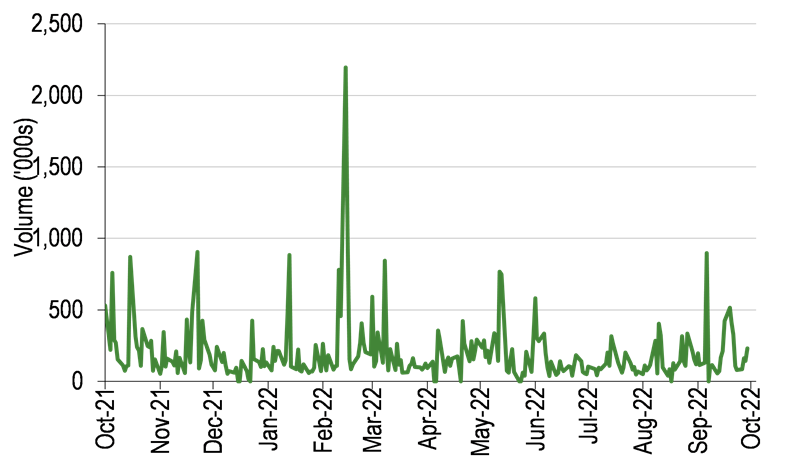
VOF is a Guernsey-domiciled, closed-end investment company with one class of share. At 31 October 2022, it had 161.5m ordinary shares in issue, with a further 16.2m held in treasury. There is a discontinuation vote every five years, with the next due in 2023. As shown in Exhibit 13, VOF’s major shareholders include discount-focused institutions (City of London), mainstream asset managers (Janus Henderson, BlackRock, Lazard and Allspring Global Investors, formerly Wells Capital) and retail investor platforms (Hargreaves Lansdown, Interactive Investor). Trading liquidity (Exhibit 14) is comparable with the two Vietnam-focused peers; on average 197,600 VOF shares (0.12% of the share base) changed hands daily in the 12 months to 31 October 2022, compared with an average of c 0.14% of the share base for the three funds in aggregate.
The board
Exhibit 15: VOF’s board of directors
Board member |
Date of appointment |
Remuneration in FY22 |
Shareholdings at end-FY22 |
Huw Evans (chairman) |
2021 |
$98,723* |
35,000 |
Julian Healy (audit committee chair) |
2018 (2021) |
$90,000 |
15,000 |
Thuy Bich Dam |
2014 |
$80,000 |
0 |
Kathryn Matthews |
2019 |
$80,000 |
9,464 |
Peter Hames |
2021 |
$80,000 |
8,000 |
Hai Thanh Trinh** |
2022 |
$219** |
0 |
Source: VinaCapital Vietnam Opportunity Fund. Note: *Evans was appointed chairman following the December 2021 AGM. **On 30 June 2022, Hai Thanh Trinh was appointed as a member of the board.
Huw Evans, the chairman, was appointed to the board at the December 2021 AGM, as Steve Bates, VOF’s chairman since May 2013, retired. Peter Hames was appointed to the board in June 2021. Hai Thanh Trinh was appointed in June 2022 and has over 30 years’ business experience, having held various managerial and senior executive positions at financial services institutions in Vietnam and in the United States, including An Binh Bank, Indochina Capital, New York Life and BAOVIET. He recently retired as an independent director of Saigon Hanoi Commercial Bank. A well-regarded investment professional in Asia and the UK, he previously helped launch Aberdeen's business in Asia in 1992. He currently serves as independent director and chairman of the audit committee for Van Phu Invest, a real estate developer in Vietnam that is listed on the Ho Chi Minh City Stock Exchange.
|
|
|
|
Investment Companies
Research: Healthcare
Oryzon Genomics has announced that it has been awarded an EU grant to initiate a project to investigate the company’s lead clinical oncology asset, iadademstat, in combination with immunotherapy drugs that include immune checkpoint inhibitors (ICIs) and/or cancer vaccines. The project has a global budget of €1.4m of which Oryzon will contribute c 50%; this will be partly offset by the company receiving up to €0.4m under the Eurostars-3 programme. Investigations are anticipated to start on 1 May 2023 and will be run in collaboration with the Danish immunotherapy focused biotech InProTher and the University of Copenhagen. In our view, combination therapies will form the cornerstone of future innovation in oncology, so the EU grant provides a critical platform to investigate iadademstat in novel treatment regimens and potential expansion into new indications. We value Oryzon at €847m or €15.5 per share.