Last close As at 06/08/2026
—
— 0.00 (0.00%)
Market capitalisation
—
Research: Industrials
The recent orders in the LCV and rail transport segments illustrate Delignit’s ability to deliver customised solutions and foster technological advancements in ecological materials. Dependence on the domestic market is also gradually reducing as the group is diversifying its revenue base globally. Delignit posted a 9.2% revenue CAGR in FY12-16 and management’s guidance is for a 10-15% sales increase in FY17, which is reflected in an FY16 P/E multiple of c 33x.
Delignit |
Leveraging ecological strengths
Materials |
Scale research report - Initiation
19 July 2017 |
Share price graph
Share details
Business description
Bull
Bear
Analysts
|
||||||||||||||||||||||||||||||
The recent orders in the LCV and rail transport segments illustrate Delignit’s ability to deliver customised solutions and foster technological advancements in ecological materials. Dependence on the domestic market is also gradually reducing as the group is diversifying its revenue base globally. Delignit posted a 9.2% revenue CAGR in FY12-16 and management’s guidance is for a 10-15% sales increase in FY17, which is reflected in an FY16 P/E multiple of c 33x.
Niche position as wood-based industrial supplier
Delignit has built strong niche capabilities in developing customised system solutions using beech wood, primarily for the LCV, rail transport and safety equipment industries. In Germany, the company has a good market position because of its products’ ecological and technological characteristics and its advisory capabilities. Building on its success in Germany, the company has expanded globally in recent years. A focus on expanding product applications should enable it to capitalise on the positive outlook for the auto industry.
FY16 sales momentum continuing into FY17
In FY16, Delignit sales grew robustly at 9.4% and the EBITDA margin was stable at 7.5%. With over 70% of sales derived from the automotive industry, the company is well positioned to benefit from the favourable outlook for the industry. Over the last 12 months, the company has secured large, repeat orders from existing and new Original Equipment Manufacturers (OEM). Management has provided guidance of 10-15% sales growth in FY17. Costs are likely to remain under control and the company has guided for an EBITDA margin of 7.5-8.3% vs 7.5% in FY16. According to management, economies of scale from Delignit’s ongoing investment programme could increase margins in the medium term.
Valuation: Strong growth outlook priced in
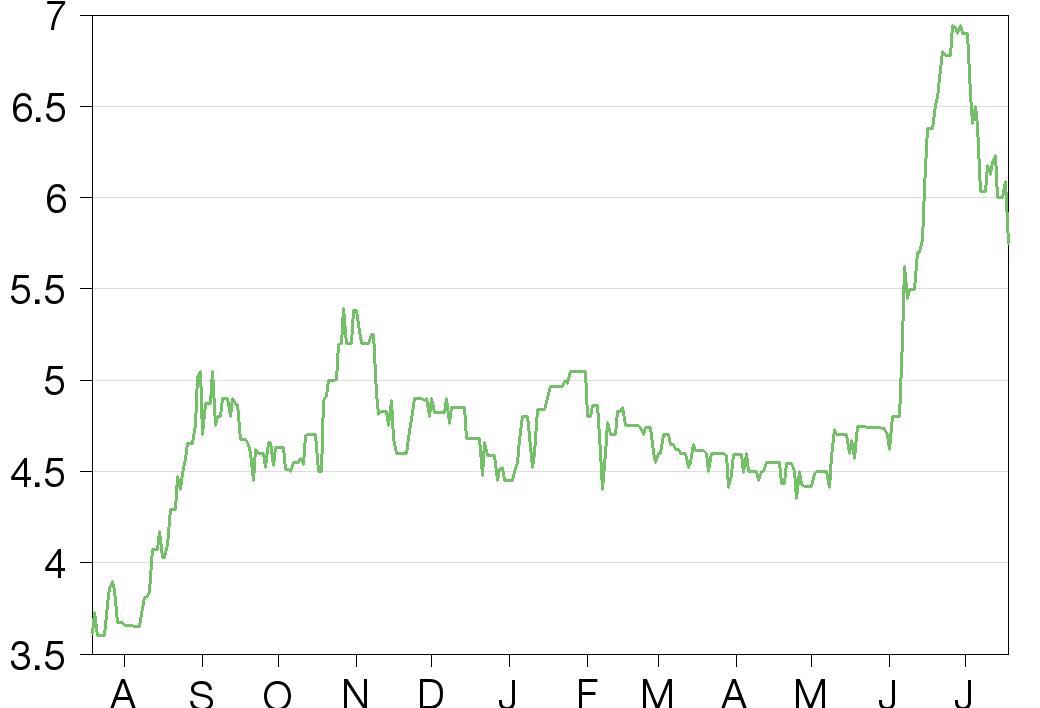
Year to date, Delignit’s stock has rallied c 30% and is now trading at an FY16 P/E ratio of c 33x – a premium to both its wood processing and automotive supplier peer group – indicating that the growth outlook is priced in. Management guidance (no consensus data available) for FY17 suggests an EV/EBITDA multiple of 11.1-12.9x, which is still well ahead of the 5.8x peer average.
|
Historical financials
Source: Delignit accounts, Edison Investment Research |
Edison Investment Research provides qualitative research coverage on companies in the Deutsche Börse Scale segment in accordance with section 36 subsection 3 of the General Terms and Conditions of Deutsche Börse AG for the Regulated Unofficial Market (Freiverkehr) on Frankfurter Wertpapierbörse (as of 1 March 2017). Two to three research reports will be produced per year. Research reports do not contain Edison analyst financial forecasts.
Company description: Eco-products supplier
Delignit is a German manufacturer of ecological products and system solutions based on hardwood. The company positions itself as a recognised development and project partner and series supplier, primarily for the automotive, rail and safety equipment industries. Delignit’s products are mainly based on beech, which is one of the toughest types of wood. The products are characterised by special technical and mechanical properties, including 1) abrasion- and wear-proof; 2) dimensional stability; and 3) high breaking loads. The company sells its products under four core brands: Delignit, VANyCARE, Carbonwood and Dunacore. It also has several minor brands such as Feinholz, Festholz and Panzerholz.
The company operates in two core segments:
■
Automotive (73% of group sales in FY16): The main focus is on developing 1) loading area protection and security systems (floors, walls and partitions) for light commercial vehicles (LCVs); 2) interior equipment such as luggage compartment covers for passenger cars; and 3) Heavy commercial vehicles (HCV) trailer floors, 4)fire resistant compact wood. The segment caters to OEMs, vehicle body producers, automotive fitment providers, importers and dealers. Its main customers include Audi, Daimler and Volkswagen. This business was strengthened by the acquisitions of DHK automotive and HTZ Holztrocknung in 2013, allowing Delignit to enter the passenger car segment.
■
Technological Applications (27% of group sales in FY16): The products in this segment are broadly classified into three main groups: 1) building equipment such as floors for production sites; 2) special applications such as bullet-proof fittings; and 3) standard products. The products are delivered to a wide range of industries, including conveyor and storage operators, building and factory outfitters, aviation, rail transport and safety equipment providers.
Although 70% of group sales are generated domestically, the share of exports has continued to rise from just c 19% in FY12. Key export markets include Poland (c 6% of consolidated sales in FY16), the UK (5%), Spain (5%), China (3%), Japan (1-2%) and Argentina (1-2%).
|
Exhibit 1: Revenues by segment |
Exhibit 2: Revenues by geography |
|
|
|
Source: Delignit accounts |
Source: Delignit accounts, Edison Investment Research |
|
Exhibit 1: Revenues by segment |
|
|
Source: Delignit accounts |
|
Exhibit 2: Revenues by geography |
|
|
Source: Delignit accounts, Edison Investment Research |
|
Exhibit 3: Revenue and margin progression |
Exhibit 4: Net profit progression (€000) |
|
|
|
Source: Delignit accounts |
|
Exhibit 3: Revenue and margin progression |
|
|
Source: Delignit accounts |
|
Exhibit 4: Net profit progression (€000) |
|
|
Source: Delignit accounts |
Strategy
Delignit’s strategic initiatives are broadly aligned with the trends emerging in the sector, including 1) increasing importance of renewable materials; 2) technological advancements in ecological materials to enhance competitiveness and the ability to replace non-renewable resources; 3) industrial players’ need for professional system partners; and 4) focus on energy-efficient and lightweight construction solutions.
The company aims to benefit from these trends through its core competencies. Delignit uses lifecycle carbon-neutral material based on beech wood that has an ecological advantage over non-regenerative materials such as plastic and steel. Moreover, the company repositioned itself in 2000 as a provider of systems instead of a pure producer of wood materials. The company has a good market position, underpinned by the ecological and technological characteristics of its products, system competence, as well as product development and implementation advisory capabilities.
Ongoing strategic initiatives include:
Investment in product development: Management is focusing on developing customised products for specific customer requirements and applications. The company has committed to continued investment in product development in 2017, mainly to showcase the advantages of ecological products over non-renewable raw materials in technological applications.
Business model transition: Delignit plans to leverage existing solutions to expand its regional outreach and add new applications to its portfolio.
■
Global diversification: The company could leverage its strength in LCV cargo bay and load protection systems to penetrate new markets and diversify its revenue base. Continued marketing of technological application products globally should allow Delignit to diversify its geographical revenue base. This strategy has started to deliver results: the group generated 30% of its total revenue from outside Germany in FY16 vs just 19% in FY12. The recent rail transport contracts for the equipment of regional trains in Scotland and high-speed trains in the UK also demonstrate the diversification.
■
Increase product application: Management is looking to expand the range of product applications, especially in 1) the light commercial vehicle segment with a strategy to generate ‘more revenue per vehicle’; and 2) the rail transport industry.
Leverage ecological strengths: Management’s strategy to position the company’s products as a sustainable solution, given their raw material advantage, should provide an edge to the company over its peers that use non-renewable raw materials. Its market reputation should also support improved market penetration in the medium term.
To meet the increasing demand for the company’s products, in 2016 Delignit launched a two-year investment programme of €6.0m, aimed at capacity expansion and efficiency gains. Key investment projects under this plan include 1) conversion of the Lothe logistics site into a production site; 2) investment in a cutting plant for sidewalls; 3) Computer Numerical Control (CNC) capacity ramp-up at the Lothe production site; and 4) efficiency improvements and capacity expansion through a new multi-daylight press for LCV floor plates.
Recent news flow and upcoming catalysts
Delignit has announced several important order wins over the last 12 months. In August 2016, the company won a 10-year follow-up repeat order from a large German automotive OEM customer. The contract covers a wider scope of delivery than the previous one (sidewalls panelling, partition walls, and cargo-bay flooring) and will also include wheel house fairings for the interior. The company has even decided to establish a subsidiary in North America (Atlanta) to supply the client’s new US site. Simultaneously, the company disclosed that it won a new contract of longerthan 10 years in the LCV business from another German OEM player for cargo-bay protection solutions. The order should contribute to FY17 sales. According to the company, both orders together should translate into additional €10m of revenue by FY18.
In June 2017, the company reported two additional serial contracts in the LCV segment for comprehensive cargo-bay protection solutions. One of the contracts has a lifespan of several years, while the second one has duration of one year and includes an extension option. Importantly, the orders should already contribute to FY17 sales and represent a low single-digit million annual sales amount. Furthermore, the company was able to attract two orders in the rail transport segment. The contracts cover the delivery of products based on Delignit Railfoor Basic solution for 29 and 70 trains until end-2018, respectively.
The above business inflow demonstrates Delignit’s ability to effectively convert innovative offerings in both the automotive and rail transport segments into incremental sales. The upcoming publication of interim results by end-August might constitute an additional stock catalyst.
Market overview
Historically, Delignit’s products competed with both pure plywood and wood materials producers – particularly from Northern and Eastern Europe – and system providers. However, Delignit is no longer a pure plywood products manufacturer. It is now positioned as a customised system component provider competing directly with other system providers such as Sortimo, Westag & Getalit and Röchling.
Delignit’s sales momentum in the automotive division is visibly correlated with growth in new LCV registrations in the company’s target markets, particularly Germany (see Exhibit 5). In FY16, the segment benefited from 8.5% growth in LCV registrations in Germany. Overall EU LCV registrations in 2016 recovered to 1.92m (growth of 11.9% y-o-y) – similar to the 1.98m in 2008. The growth momentum seems to have continued through FY17 as well, with LCV registrations in Germany up 5.2% y-o-y in January-May. However, export markets are showing signs of slowdown. Combined growth of Delignit’s major EU export markets – Poland (0%), the UK (-5.0%), China (2.8%) and Spain (18.2%) – was just 2.0% YTD.
After the acquisitions in 2013, Delignit’s automotive target market expanded to the passenger car segment. This business also benefited from improved demand in 2016, with registrations up 4.5% y-o-y in Germany. In the first six months of FY17, growth in registrations in Germany and Delignit’s major EU export markets was modest at 3.1% and 2.6%, respectively.
Despite the softer trading conditions in the EU compared with the prior year (a high base effect), we believe that management guidance for FY17 looks achievable given the strong new orders pipeline.
Delignit’s high exposure to the automotive industry means, that the company is likely to benefit from continued positive trends on the back of sustained vehicle production growth, expanding fleet size, economic growth prospects and continued investment in R&D. However, in case conditions on the auto market deteriorate, the company might be hit significantly due to the strong pricing power of OEM customers.
|
Exhibit 5: Delignit’s Automotive business vs market |
Exhibit 6: LCV registrations (DE/PL/UK/ES) |
|
|
|
Source: ACEA, Edison Investment Research |
|
Exhibit 5: Delignit’s Automotive business vs market |
|
|
Source: ACEA, Edison Investment Research |
|
Exhibit 6: LCV registrations (DE/PL/UK/ES) |
|
|
Source: ACEA, Edison Investment Research |
Management, organisation and corporate governance
Supervisory board and management board
Like other Germany-listed companies, Delignit has a two-tier board structure, where the management board sits beneath the (non-executive) supervisory board.
Management board
CEO and chairman Markus Büscher joined the board in July 2007. He has more than 20 years of experience across different industries such as plastic packaging and garden tool manufacturing and is responsible for the following business areas: strategic development, controlling, legal, procurement, IT, production, research and development and investor relations. Markus Büscher began his career in 1994 at Bischof + Klein as a purchase consultant. In 1996, he joined klr-Mediapartner and became the Head of Business in 2000. In 2003, he became Managing Director of FREUND VICTORIA Gartengeräte.
Chief sales officer Thorsten Duray joined the board in July 2007 along with Markus Büscher. His primary responsibilities are sales and marketing. Thorsten Duray has been with Blomberger Holzindustrie (a subsidiary of Delignit) since 1991. He has held various positions in the company in the sales and marketing division, including as the head of sales and marketing. He has been a member of the management board of Blomberger Holzindustrie since January 2007.
Supervisory board
The supervisory board comprises Dr. Christof Nesemeier (chairman), Gert-Maria Freimuth (deputy chairman) and Anton Breitkopf.
Dr. Christof Nesemeier has been the chairman of the board since July 2007. He is also the CEO of MBB SE (Delignit’s parent company) and a member of the board in other companies.
Gert-Maria Freimuth (Deputy Chairman) has held senior positions across a wide range of companies. He joined the board of Delignit in July 2007. He is also the chairman of the board at MBB SE.
Anton Breitkopf is the CFO at MBB SE and has been with Delignit’s board since July 2007. His prior experience includes the areas of Finance and Control at Daimler-Benz. He is also a member of the supervisory board of DTS IT.
Organisation
Delignit capital group consists of three core fully owned subsidiaries: Blomberger Holzindustrie, DHK automotive and HTZ Holztrocknung. Furthermore, Delignit holds direct and indirect stakes in the following equity-consolidated companies: S.C. Cildro Plywood (24.0%), S.C. Cildro (17.9%) and S.C. Cildro Service (17.9%) in Germany and Romania. The parent company also owns Delignit Immobiliengesellschäft (100%).
|
Exhibit 7: Delignit and major subsidiaries |
|
|
Source: Delignit |
Corporate governance
The company’s management board structure is in line with the corporate governance policies adopted in Germany. The policies require that the management board consists of several members and shall have a chair or spokesperson. Majority shareholder MBB SE has all three seats on the supervisory board.
Shareholders and free float
MBB SE holds a 76.1% stake (free float of 23.9%) in the company. MBB SE is a Germany-based private equity firm specialising in the acquisitions of established medium-sized industrial companies. Delignit was acquired by MBB in 2003 from the Hausmann and Thelemann families, who had established the company in 1799 as Germany’s first plywood factory. The company was listed on the Frankfurt stock exchange in 2007.
Financials
Delignit’s five-year financial history is presented in Exhibit 8. The company has consistently delivered solid EBITDA, with an EBITDA margin of 7.5-9.5% over the last five years. Net income was more volatile during that period, with the decline in FY14 mainly attributable to a sharp increase in D&A and the effective tax rate. Management has been prudent in its capital management with capex and dividends largely funded by operating cash flows (thus maintaining leverage at a modest level), with the exception of FY16 when the company launched its extensive capex programme.
Exhibit 8: Financial summary
€'000s |
2012 |
2013 |
2014 |
2015 |
2016 |
|
Year end 31 December |
IFRS |
IFRS |
IFRS |
IFRS |
IFRS |
|
Income Statement |
||||||
Revenue |
34,140 |
35,299 |
42,718 |
44,402 |
48,565 |
|
EBITDA |
3,079 |
3,468 |
3,517 |
3,455 |
3,722 |
|
EBITDA margin* |
8.7% |
9.4% |
8.0% |
7.5% |
7.5% |
|
Profit Before Tax (as reported) |
1,935 |
2,201 |
1,731 |
1,699 |
2,140 |
|
Net income (as reported) |
1,249 |
1,731 |
1,031 |
1,107 |
1,448 |
|
EPS (as reported) – (€) |
0.15 |
0.21 |
0.13 |
0.14 |
0.18 |
|
Dividend per share (€) |
0.00 |
0.00 |
0.03 |
0.03 |
0.03 |
|
Balance Sheet |
||||||
Total non-current assets |
11,334 |
14,464 |
14,309 |
14,605 |
16,784 |
|
Total current assets |
10,031 |
11,512 |
12,438 |
14,969 |
15,687 |
|
Total assets |
21,365 |
25,975 |
26,747 |
29,574 |
32,471 |
|
Total non-current liabilities |
6,367 |
6,538 |
6,437 |
8,398 |
7,352 |
|
Total current liabilities |
4,492 |
7,485 |
7,637 |
7,499 |
10,342 |
|
Total liabilities |
10,859 |
14,023 |
14,074 |
15,897 |
17,694 |
|
Net Assets |
10,506 |
11,952 |
12,673 |
13,677 |
14,777 |
|
Shareholder equity |
10,506 |
11,952 |
12,673 |
13,677 |
14,777 |
|
Cashflow |
||||||
Net cash from operating activities |
2,152 |
1,964 |
786 |
1,594 |
1,831 |
|
Net cash from investing activities |
-709 |
-1,221 |
-703 |
-1,128 |
-3,459 |
|
Net Cash from financing activities |
-2,666 |
-1,129 |
442 |
1,204 |
-1,124 |
|
Net Cash Flow |
-1,224 |
-386 |
525 |
1,670 |
-2,752 |
|
Cash & cash equivalent end of year |
2,487 |
2,101 |
2,626 |
4,296 |
1,544 |
|
Source: Delignit accounts; *Note that the EBITDA margin is calculated based on total revenue (including other operating income, change in inventories and own work capitalised).
Income statement
Delignit’s sales growth was robust at 9.4% in FY16, surpassing growth in FY15 (3.9%) and average organic growth over FY12-15 (4.6%, excluding the impact of the two acquisitions in FY13). Growth was mainly driven by export sales (up 34.4% y-o-y), which constituted around 30% of group sales vs 19% in FY12. Domestic sales remained broadly stable in FY16 (up 1.3% y-o-y). While the 8.4% growth in the automotive segment was driven by the strong OEM business and new orders from carmakers, the 12.1% growth in the technological applications segment was assisted by the special applications product group (includes rail transport solutions). Importantly, management believes that the company’s sales momentum was higher than growth in some of its end-markets in FY16.
Group EBITDA was €3.7m in FY16 (up 7.7% y-o-y), with the EBITDA margin remaining stable at 7.5%. EPS grew 30.8% y-o-y from €0.14 to €0.18, driven by a lower D&A charge (€1.36m vs €1.49m in FY15), as well as a slight decline in the effective tax rate and interest expenses.
Management guides for group annual sales growth in FY17 of 10-15% y-o-y, implying sales of €53.4m–€55.9m, supported by the recent OEM extension order and the new LCV order. These should start contributing to sales in FY17, adding €10m to revenues by FY18. Management expects an EBITDA margin of 7.5-8.3% in FY17 vs 7.5% in FY16. According to management, upon completion of the current investment programme the company should have capacity to support €60m of annual sales, with economies of scale potentially driving the EBITDA margin higher.
|
Exhibit 9: 5-year ROE and ROCE evolution |
Exhibit 10: 5-year margin evolution |
|
|
|
Source: Edison Investment Research |
|
Exhibit 9: 5-year ROE and ROCE evolution |
|
|
Source: Edison Investment Research |
|
Exhibit 10: 5-year margin evolution |
|
|
Source: Edison Investment Research |
Balance sheet and cash flow
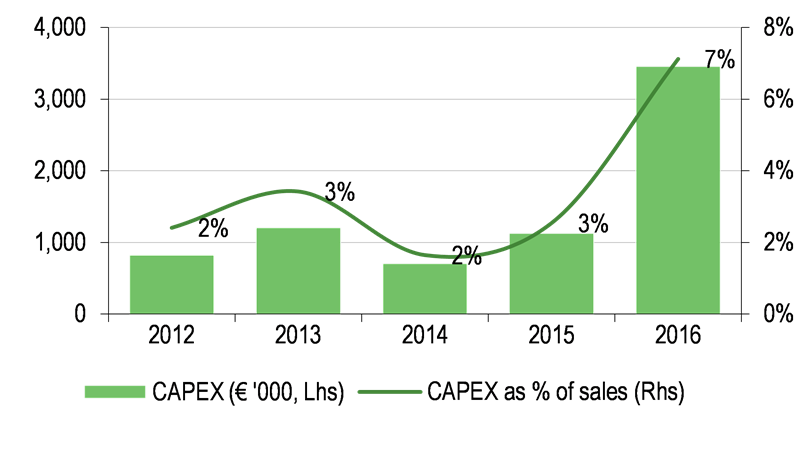
Cash flow from operations improved by 15% in FY16, despite a significant increase in accounts receivable from €0.8m in FY15 to €3.0m in FY16. While capex was modest over FY12-15, averaging 2.5% of revenue, it tripled in FY16 to €3.5m (7% of group sales) on the back of the 2016/17 €6.0m investment programme aimed at capacity expansion and efficiency gains. Free cash flows were hence -€1.6m in FY16 vs an average €0.7m over FY12-15. In conjunction with the dividend payout (€0.3m) and debt repayment (net €0.7m), this resulted in a net cash outflow of €2.8m in FY16 vs net inflow of €1.7m in FY15.
|
Exhibit 11: Capex as % of sales |
Exhibit 12: Net cash flow components (€ 000) |
|
|
|
Source: Edison Investment Research |
|
Exhibit 11: Capex as % of sales |
|
|
Source: Edison Investment Research |
|
Exhibit 12: Net cash flow components (€ 000) |
|
|
Source: Edison Investment Research |
Consequently, net debt went up by 85% to €4.5m. However, net debt to EBITDA remains at a safe level of 1.2x vs 0.7x in FY15, giving Delignit ample space for further growth investments.
|
Exhibit 13: Net debt/EBITDA |
Exhibit 14: Net debt/equity |
|
|
|
Source: Edison Investment Research |
|
Exhibit 13: Net debt/EBITDA |
|
|
Source: Edison Investment Research |
|
Exhibit 14: Net debt/equity |
|
|
Source: Edison Investment Research |
Valuation
We have identified a set of peers, which are listed in Exhibit 15. Given that there are no companies that match closely Delignit’s business profile, we have selected four companies from the broader wood processing space, albeit with lower exposure to the automotive sector (Westag & Getalit, Pfleiderer, Surteco and Ober), as well as four automotive suppliers (Grammer, Progress Werk, SHW and Aldel) offering various products such as seat covers, insulation, components and systems for car interiors.
As consensus forecasts for the company are not available, we have conducted a comparative analysis based on the last two reported years, as well as management’s EBITDA margin guidance for FY17. Following the recent stock price rally (the share price has appreciated by nearly 30% YTD), Delignit trades at a considerable premium to the blended peer group on trailing P/E (73%) and trailing EV/EBITDA (108%). This suggests that the company’s strong growth outlook is already priced in. Management’s guidance commentary for FY17 implies EV/EBITDA of 11.1-12.9x, well ahead of the 5.8x peer average.
Exhibit 15: Peer group comparison
Market cap |
PE (x) |
EV/EBITDA (x) |
Dividend yield (%) |
||||||
(m) |
2015 |
2016 |
2017e |
2015 |
2016 |
2017e |
2015 |
2016 |
|
Wood processing companies |
|||||||||
Westag & Getalit |
140.8 € |
21.6 |
18.1 |
19.0 |
9.0 |
8.3 |
N/A |
3.0% |
3.8% |
Pfleiderer |
663.2 € |
19.3 |
44.6 |
16.3 |
17.7 |
8.3 |
6.1 |
0.0% |
2.2% |
Surteco |
373.8 € |
21.1 |
15.6 |
14.3 |
5.8 |
5.0 |
6.2 |
3.3% |
3.3% |
Ober |
19.6 € |
30.2 |
13.7 |
13.6 |
11.6 |
8.6 |
N/A |
7.4% |
6.6% |
Automotive suppliers |
|||||||||
Grammer |
551.5 € |
22.8 |
11.9 |
10.8 |
8.3 |
5.8 |
5.3 |
1.6% |
2.7% |
Progress Werk |
138.5 € |
18.5 |
14.6 |
11.5 |
6.2 |
5.9 |
5.7 |
3.2% |
3.5% |
SHW |
238.5 € |
16.7 |
18.9 |
19.5 |
5.5 |
5.5 |
5.8 |
2.7% |
2.7% |
Aldel |
93.6 € |
14.5 |
12.9 |
9.1 |
9.1 |
8.8 |
5.5 |
1.9% |
1.7% |
Peer group average |
20.6 |
18.8 |
9.2 |
9.2 |
7.0 |
5.8 |
2.9% |
3.3% |
|
Delignit |
47.1 € |
42.6 |
32.5 |
N/A |
14.9 |
13.9 |
11.1-12.9 |
0.5% |
0.5% |
Premium/(discount) to peer group |
107% |
73% |
N/A |
63% |
97% |
>100% |
453% |
536% |
|
Source: Company accounts, Bloomberg, company guidance. Note: Prices as of 18 July 2017.
Sensitivities
The financial and share price performance may be sensitive to the following factors:
■
Macroeconomic risk: Despite the gradually increasing share of exports, the company still generates 70% of group sales in Germany. Consequently, an economic downturn domestically might have a significant negative impact on Delignit’s financial performance.
■
Dependency on major automotive OEM customers: Solid new orders flow from large OEM players is key for the company’s development. However, it increases Delignit’s reliance on single large contracts. Important from that perspective is also the high potential impact of counterparty default risk. In FY16, top 2 OEM customers were responsible for 40.3% and 10.7% of Delignit’s group sales, respectively.
■
High exposure to the automotive sector: As more than 70% of company’s sales are generated from automotive customers, Delignit’s earnings growth strongly depends on the outlook in the rather cyclical automobile industry.
■
Potential shortage of raw wood: Continued high use of wood as an energy source, as well as the trend towards shorter harvest seasons, may result in limited supply of wood for Delignit’s production process.
■
Raw material price fluctuations: The company uses several materials other than wood in the production process, including glues, films and resins, the prices of which are directly or indirectly linked to crude oil prices. Similarly, the company’s energy costs depend on oil prices.
■
Project risks: Delignit executes large volume projects that are more challenging not only in expected effort estimation, but also bear additional risk as the company incurs significant expenditures during the initial phases of product development and series preparation ahead of the actual delivery to clients. Consequently, an order cancellation or postponement might have important financial implications for the company.
■
Production capacity shortage: In case of any delays in the current investment programme for capacity expansion, the company might lose important contracts to competitors due to insufficient production capacity, leading to suboptimal revenue growth.
Frankfurt +49 (0)69 78 8076 960 Schumannstrasse 34b 60325 Frankfurt Germany |
London +44 (0)20 3077 5700 280 High Holborn London, WC1V 7EE United Kingdom |
New York +1 646 653 7026 295 Madison Avenue, 18th Floor 10017, New York US |
Sydney +61 (0)2 8249 8342 Level 12, Office 1205 95 Pitt Street, Sydney NSW 2000, Australia |
|
Research: TMT
In H117 EMIS traded in line with expectations. Primary Care, Community Care and Community Pharmacy are progressing well whereas Acute is still seeing budgetary pressure. The development of the Patient business is underway and likely to cost less than originally expected. Cash generation is on track and management expectations for the full year are unchanged. We make no change to our underlying forecasts; interim results are due on 1 September.