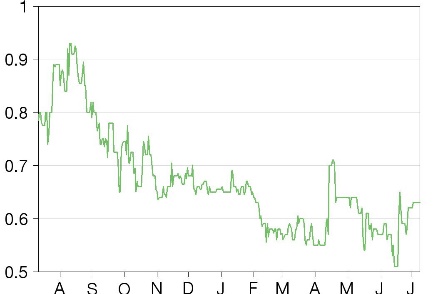
Last close As at 12/08/2026
AUD0.38
▲ −0.01 (−2.60%)
Market capitalisation
AUD118m
Research: Healthcare
Recent months have been eventful for Recce Pharmaceuticals, with the company presenting its Q323 operational update and announcing ethics approval in April 2023 to commence Phase I/II clinical trials in healthy volunteers for the intravenous (IV) formulation of its lead broad-spectrum synthetic polymer anti-infective compound, RECCE 327 (R327), using a more rapid infusion rate. The Phase I part of the study will assess faster infusion rates of R327 in c 16 healthy participants across three cohorts, with the first cohort recently having successfully completed a 2,500mg R327 dose. A Phase II efficacy study in patients with uncomplicated or recurrent urinary tract infections (UTIs) is expected to commence in H2 CY23. While several potential value inflection points may arise in the next 12 months, obtaining financing is likely to be a near-term strategic priority given the current cash at hand (A$4.6m at 28 April 2023). We value Recce at A$535.6m, up from A$497.4m previously.
Recce Pharmaceuticals |
Gearing up for more R327 studies |
Progress update |
Healthcare |
11 July 2023 |
Share price performance
Business description
Next events
Analyst
Recce Pharmaceuticals is a research client of Edison Investment Research Limited |
|||||||||||||||||||||||||||||||||||||||||||||||
Recent months have been eventful for Recce Pharmaceuticals, with the company presenting its Q323 operational update and announcing ethics approval in April 2023 to commence Phase I/II clinical trials in healthy volunteers for the intravenous (IV) formulation of its lead broad-spectrum synthetic polymer anti-infective compound, RECCE 327 (R327), using a more rapid infusion rate. The Phase I part of the study will assess faster infusion rates of R327 in c 16 healthy participants across three cohorts, with the first cohort recently having successfully completed a 2,500mg R327 dose. A Phase II efficacy study in patients with uncomplicated or recurrent urinary tract infections (UTIs) is expected to commence in H2 CY23. While several potential value inflection points may arise in the next 12 months, obtaining financing is likely to be a near-term strategic priority given the current cash at hand (A$4.6m at 28 April 2023). We value Recce at A$535.6m, up from A$497.4m previously.
Year end |
Revenue (A$m) |
PBT* |
EPS* |
DPS |
P/E |
Yield |
06/21 |
1.9 |
(13.5) |
(0.09) |
0.0 |
N/A |
N/A |
06/22 |
3.1 |
(11.0) |
(0.06) |
0.0 |
N/A |
N/A |
06/23e |
6.2 |
(14.3) |
(0.08) |
0.0 |
N/A |
N/A |
06/24e |
4.7 |
(42.4) |
(0.24) |
0.0 |
N/A |
N/A |
Note: *PBT and EPS are normalised, excluding amortisation of acquired intangibles, exceptional items and share-based payments.
Several upcoming catalysts
Following a successful Phase I single dose-escalation safety study of the IV formulation in doses up to 6,000mg (over a one hour infusion) in over 60 volunteers, the ongoing Phase I IV study is assessing faster IV infusions of R327 to evaluate antibacterial effects of the treatment in c 16 healthy volunteers (first cohort of 2,500mg already completed in both male and female subjects). The Phase II portion in patients with UTIs, with a focus on efficacy, is also planned to start in H2 CY23 with readouts in or around year-end CY23. We expect insights from this study to influence the design of the planned Phase II trial in urosepsis in CY24 (c 25% of all sepsis cases are caused by UTIs). Upcoming data readouts from the Phase I/II burn wound infection and diabetic foot infection (DFI) trials are expected in Q4 CY23 and we view these as potential inflection points for Recce.
Financing likely to be a near-term focus
Recce ended Q323 with a cash balance of A$4.0m supported by a A$4.3m R&D receipt from the Australian tax office and a further A$1.9m in advance payments received from Radium Capital during the quarter. An additional A$0.97m was received from Radium Capital in April, taking the total cash balance to A$4.61m as at 28 April. We expect this will be sufficient to fund operations into Q3 CY23. We model that the company will raise A$55m before the end of FY24.
Valuation: Upward revision to A$536m
We have rolled our model forward and updated our forex assumptions, while keeping other underlying assumptions unchanged. Our revised valuation for Recce is A$535.6m (or A$3.00 per share), up from A$497.4m previously.
Groundwork in progress to test R327’s efficacy in sepsis
In April 2023, Recce announced that it received approval from a Human Research Ethics committee to conduct a Phase I/II clinical trial to evaluate the safety, tolerability and pharmacokinetics of faster IV infusion rates of its lead therapeutic candidate, R327, in healthy volunteers. One of the sites conducting the trial will be the CMAX Clinical Research facility in Adelaide, which is the same site as for the previous single dose-escalation Phase I trial that tested a slower IV infusion rate (with the drug dosed over a 60-minute period) and at doses up to 6,000mg. The company recently reported that it has received approval from the Human Research Ethics Committee to expand this study to include the Scientia Clinical Research site. This site is a US Food and Drug Administration (FDA) audited clinical trials facility in Sydney, Australia, specialising in first-in-human and first-in-patient studies, and is co-located in a large research precinct involving several hospitals and research centres.
In August 2022, the company reported that R327 was well-tolerated at a one-hour IV dose up to 6,000mg with no serious adverse events in a cohort of 10 patients at that dosing range. The rationale for now testing with faster infusion rates is the potential benefit of providing broader access to the drug in primary care and acute patient care settings.
The Phase I portion of this IV safety study is evaluating faster infusions of R327 in c 16 participants, across three cohorts. Plasma and urine samples are being collected at various time points during and following dosing to evaluate the drug’s concentrations and its antibacterial effect in the urine on various bacterial strains. The company recently announced that the first cohort (including both male and female subjects) in this rapid infusion study safely and successfully dosed 2,500mg of R327. The company is assessing the effectiveness of R327’s antibacterial activity in urine samples of study participants, but it notes that in the prior 80-subject Phase I IV study assessing one-hour infusion rates, data showed that R327 concentrated in the urine by greater than 15-fold compared to plasma concentrations.
Based on the results from the Phase I portion of the trial, optimal dosing levels and infusion rates will be decided for the Phase II portion, which will be conducted in patients with uncomplicated or recurrent UTIs. We expect the Phase II part of the study to also commence in H2 CY23 with likely readouts in or around year-end CY23.
If results are positive, we expect Recce to submit an Investigational New Drug application to the US FDA and then start a separate multiple-dose Phase II efficacy study in urosepsis in CY24. About 25–30% of sepsis cases are believed to originate in the urinary tract. We assume that if results of the urosepsis study are positive, the pivotal Phase III programme (and overall commercial sepsis programme) would include all forms of sepsis. While company guidance has been for a Phase III sepsis study on the IV drug formulation to start in H2 CY24, we anticipate the start of such pivotal sepsis studies (in Europe and the United States) in CY25 and, if the drug is approved, for it to be commercialised in CY28.
Topical R327 DFI study underway
In October 2022, Recce announced that it will be assessing its topical (spray-on) R327 formulation to assess mild DFIs, and in December 2022, it received Australian approval to start an open-label Phase I/II study at the South West Sydney Limb Preservation and Wound Research Unit. The study will assess R327 in this indication in up to 32 patients with mild skin and soft tissue DFIs, and the company believes that this study is now the largest DFI study currently underway in Australia. In May 2023, Recce announced that it has partnered with healthcare provider Ascott (an Iqvia company) to facilitate the study’s progression with the aid of Ascott’s network of in-home (outpatient) nurses who will have been trained in R327 DFI treatment protocols (as per Australian clinical trial guidelines). Ascott nurses are expected to provide the same level of care that patients would receive at on-site clinical trial visits, supporting the likelihood of full protocol adherence and dosing completion. The in-home nurses will also gather vital signs, provide basic wound evaluation and cleaning, and administer R327 topically (and concomitant medication as indicated), and monitor for adverse events.
Ascott is supporting 29 active clinical trials in Australia and New Zealand in the home setting and its network of around 300 nurses interact with over 25,000 patients per year.
Diabetic foot ulcers are frequent complications of patients who have diabetes mellitus, if the condition is not adequately controlled. Approximately 37 million people have diabetes in the United States, and among them about 2–4% will obtain foot ulceration each year, of which 50–60% will result in DFIs, the leading cause of foot morbidity in diabetic patients. Recce believes that topical R327 could potentially be useful in mild DFIs (as more advanced cases require systemic antibiotics).
While current literature suggests that topical application of antimicrobials may have merit in many cases (such as patients who do not tolerate oral antibiotics), there is limited high-quality evidence on the appropriate indications, dosages and pharmacokinetics and, consequently, treatment guidelines do not encourage the use of any currently approved topical anti-infective for treating mild DFIs. Hence, there is a considerable opportunity should topical R327 in a controlled setting demonstrate clinical benefit (such as the prevention of DFI progression or recurrence), although we remain cognisant of the historical challenges of topical drugs in this indication.
If the current Australian Phase II study is successful, we assume the company would pursue a second Phase II study in CY24 that would include multiple sites (including the United States and/or Europe) before starting a Phase III pivotal programme in CY25, which we model could lead to launch in CY29.
In addition to this study of topical R327 in DFI, a Phase I/II trial for topical R327 in burn wound infections, sponsored by the West Australian health department and conducted at Fiona Stanley Hospital, remains ongoing. The non-randomised Phase I/II R327 spray formulation study is enrolling up to 30 patients with clinical signs and symptoms of local burn wound infection. Over a 14-day treatment period, 10 patients will receive R327 daily and 20 patients in a separate cohort will receive the drug three times per week. The drug showed its broad-spectrum activity in the clinical setting with visible infection reduction within 24 hours of dosing in all patients, according to the company’s Phase I/II interim results announcement on 7 December 2021. Further updates are anticipated during CY23.
Recent patent wins in Australia and QIDP designation
Following Recce’s announcements of Australian Patent Office wins for its Family 3 and Family 4 class of patents, the company indicates that its family of over 40 global patents provides intellectual property protection into 2041 at least. Further, R327 has been granted Qualified Infectious Disease Product (QIDP) designation by the US FDA, which comes with an additional five-year exclusivity that adds to the exclusivity granted for a new chemical entity. Thus, regardless of patent life, R327 would qualify for a minimum of 10 years of US market exclusivity, provided that regulatory approval is obtained.
Financials: Limited funding headroom
Recce reported A$4.0m in gross cash at 31 March 2023, which includes A$4.3m from an Australian government R&D tax credit rebate and an additional A$1.9m advance payment from Radium Capital (which corresponds with a portion of the anticipated R&D tax credit to be received for the FY23 activities). The company received another A$0.97m advance from Radium Capital in early April 2023, resulting in a gross cash balance of A$4.61m at 28 April 2023. Primary cash outflows during Q323 were related to R&D (A$2.0m) and staff and admin expenses (A$2.2m).
Expenditures have increased as the company has progressed clinical development, with its operating cash burn rate increasing from A$9.0m in FY22 to A$10.2m in H123. We estimate that the cash at hand will fund operations into Q3 CY23, and hence we believe there is an imminent funding need. We continue to model that the company will raise A$55m in funding before the end of FY24.
We expect Recce’s cash needs will expand as it funds clinical trials for its four targeted clinical-stage R327 indications (sepsis, UTIs, DFI and burn wounds). While we expect the company to benefit from Australia’s 43.5% R&D refundable tax credit, we continue to expect operating costs to rise in coming years, due to anticipated larger-scale Phase II and Phase III studies required for each of the four sought indications.
We have slightly reduced our FY23 projected burn rate as enrolment for the DFI and IV R327 UTI studies are starting about two to three months later than we anticipated. We now anticipate a net operating cash burn rate of A$14.9m in FY23 (vs A$18.0m previously), while our estimates for FY24 (A$42m) and FY25 (A$65m) are essentially unchanged. We have updated our forex assumptions (US$0.67/A$ vs US$0.66/A$ previously). A significant driver of the year-on-year increase in our operating expense assumptions in FY24 and again in FY25 is our projection that the company will start a multiple-dose Phase II efficacy study in urosepsis in CY24 that includes multiple US sites. Any delays to the start of such a trial will reduce our funding requirements over this period, but may also push back our potential launch forecast in sepsis (currently CY28).
Depending on the availability of capital, the company may decide to prioritise certain programmes, which may affect the timing of launches in non-prioritised indications and affect our overall valuation. Our current funding model assumes Recce will advance all four programmes in parallel. However, if the company in the future prioritises sepsis (and/or urosepsis) and complicated UTIs (cUTIs) and puts its remaining development programmes on hold until the initial R327 commercial approval, this would reduce its overall funding need as it could subsequently apply post-launch commercial revenue towards resuming R&D and product development activities in the remaining targeted indications. In addition, partnerships and/or non-dilutive forms of funding (such as third-party sponsorship of clinical trials) could also reduce the future funding need, although these are not specifically included in our forecasts.
We view sepsis as the primary driver of the company’s valuation and expect Recce will prioritise the sepsis (and/or urosepsis) and cUTI indications. Assuming the company will continue to develop all four planned clinical-stage indications, we assume Recce will need to raise A$220m in total by FY28 before becoming sustainably cash flow positive. As per usual Edison methodology, we model these raises as illustrative debt.
We note that the company has an at-the-market (ATM) equity financing facility with Acuity Capital that expires in January 2026, which provides it with up to A$20m of standby equity capital. Recce is not required to use the ATM and it may terminate the ATM at any time without cost or penalty.
Valuation
We continue to determine a risk-adjusted NPV valuation for Recce applying a 12.5% discount rate to its four primary development programmes. Our core valuation and modelling assumptions are unchanged – please see our initiation note for details. We have rolled forward our model and updated our forex estimates and the net cash figure (to A$2.1m at Q323e, to reflect the A$4.0m gross cash and A$1.9m liability to Radium Capital). Following these changes, we obtain a new rNPV valuation of A$535.6m (or A$3.00 per share), up from A$497.4m previously. As stated earlier, our model assumes all future financing needs will be raised through illustrative debt, as per usual Edison methodology. If our projected funding need of A$220m is raised through equity issuances at the prevailing market price of c A$0.62, our effective value per share would decrease to A$1.42.
Exhibit 1: Recce Pharmaceuticals rNPV valuation
Product |
Indication |
Launch |
Sales (A$m) in 2032 |
NPV |
Probability of success |
rNPV |
rNPV/basic share (A$) |
R327 (IV) |
Sepsis |
2028 |
3,602 |
3,700 |
15% |
547 |
3.07 |
R327 (IV) |
Complicated UTIs |
2029 |
376 |
339 |
15% |
42 |
0.23 |
R327 (topical) |
Burn wounds |
2028 |
267 |
203 |
20% |
30 |
0.17 |
R327 (topical) |
DFIs |
2029 |
124 |
96 |
15% |
8 |
0.04 |
Corporate costs |
|
|
(93.7) |
(93.7) |
(0.53) |
||
Estimated net cash at 31 March 2023 |
|
|
2.1 |
2.1 |
0.01 |
||
Total equity value |
|
|
535.6 |
3.00 |
Source: Edison Investment Research
Exhibit 2: Financial summary
A$(000) |
2020 |
2021 |
2022 |
2023e |
2024e |
||
Year end 30 June |
IFRS |
IFRS |
IFRS |
IFRS |
IFRS |
||
PROFIT & LOSS |
|||||||
Revenue |
|
|
1,122 |
1,857 |
3,085 |
6,219 |
4,670 |
Cost of Sales |
0 |
0 |
0 |
(0) |
(0) |
||
Gross Profit |
1,122 |
1,857 |
3,085 |
6,219 |
4,670 |
||
Sales, General & Administrative |
(3,136) |
(9,511) |
(7,677) |
(9,650) |
(9,450) |
||
Net Research & Development |
(2,071) |
(5,657) |
(6,285) |
(10,735) |
(37,313) |
||
EBITDA |
|
|
(4,085) |
(13,311) |
(10,878) |
(14,166) |
(42,094) |
Depreciation & amortisation of intangible assets |
0 |
0 |
0 |
0 |
0 |
||
Depreciation, amortisation & other |
(201) |
(296) |
(188) |
(197) |
(255) |
||
Normalised Operating Profit (ex. amort, SBC, except.) |
(4,231) |
(8,389) |
(10,809) |
(14,363) |
(42,349) |
||
Operating profit before exceptionals |
(4,286) |
(13,607) |
(11,065) |
(14,363) |
(42,349) |
||
Exceptionals including asset impairment |
0 |
0 |
0 |
0 |
0 |
||
Other |
0 |
0 |
0 |
0 |
0 |
||
Reported Operating Profit |
(4,286) |
(13,607) |
(11,065) |
(14,363) |
(42,349) |
||
Net Finance income (costs) |
(31) |
94 |
79 |
29 |
(61) |
||
Profit Before Tax (norm) |
|
|
(4,317) |
(13,513) |
(10,986) |
(14,335) |
(42,410) |
Profit Before Tax (FRS 3) |
|
|
(4,317) |
(13,513) |
(10,986) |
(14,335) |
(42,410) |
Tax |
0 |
0 |
0 |
0 |
0 |
||
Profit After Tax and minority interests (norm) |
(4,317) |
(13,513) |
(10,986) |
(14,335) |
(42,410) |
||
Profit After Tax and minority interests (FRS 3) |
(4,317) |
(13,513) |
(10,986) |
(14,335) |
(42,410) |
||
Average Basic Number of Shares Outstanding (m) |
127.2 |
155.4 |
174.1 |
177.6 |
178.9 |
||
EPS - normalised (A$) |
|
|
(0.03) |
(0.09) |
(0.06) |
(0.08) |
(0.24) |
EPS - normalised and fully diluted (A$) |
|
(0.03) |
(0.09) |
(0.06) |
(0.08) |
(0.24) |
|
EPS - (IFRS) (A$) |
|
|
(0.03) |
(0.09) |
(0.06) |
(0.08) |
(0.24) |
Dividend per share (A$) |
0.0 |
0.0 |
0.0 |
0.0 |
0.0 |
||
BALANCE SHEET |
|||||||
Fixed Assets |
|
|
505 |
501 |
439 |
412 |
201 |
Intangible Assets |
0 |
0 |
0 |
(101) |
(357) |
||
Tangible Assets |
505 |
501 |
439 |
513 |
557 |
||
Investments in long-term financial assets |
0 |
0 |
0 |
0 |
0 |
||
Current Assets |
|
|
2,739 |
21,181 |
12,185 |
373 |
13,175 |
Short-term investments |
0 |
0 |
0 |
0 |
0 |
||
Cash |
2,682 |
20,873 |
11,582 |
62 |
12,863 |
||
Other |
57 |
308 |
603 |
311 |
311 |
||
Current Liabilities |
|
|
(885) |
(1,078) |
(2,447) |
(4,052) |
(4,052) |
Creditors |
(885) |
(1,078) |
(2,447) |
(1,168) |
(1,168) |
||
Short term borrowings |
0 |
0 |
0 |
(2,884) |
(2,884) |
||
Long Term Liabilities |
|
|
(46) |
(100) |
(115) |
(233) |
(55,233) |
Long term borrowings |
0 |
0 |
0 |
0 |
(55,000) |
||
Other long term liabilities |
(46) |
(100) |
(115) |
(233) |
(233) |
||
Net Assets |
|
|
2,313 |
20,504 |
10,061 |
(3,500) |
(45,909) |
CASH FLOW STATEMENT |
|
|
|
|
|
|
|
Operating Income |
(4,286) |
(13,607) |
(11,065) |
(14,363) |
(42,349) |
||
Movements in working capital |
253 |
144 |
1,532 |
126 |
0 |
||
Net interest and financing income (expense) |
(31) |
94 |
79 |
29 |
(61) |
||
Depreciation & other |
201 |
296 |
188 |
197 |
255 |
||
Taxes and other adjustments |
55 |
5,218 |
256 |
(850) |
(0) |
||
Net Cash Flows from Operations |
|
|
(3,807) |
(7,856) |
(9,010) |
(14,861) |
(42,154) |
Capex and capitalised expenditures |
(6) |
(76) |
(40) |
(40) |
(44) |
||
Acquisitions/disposals |
0 |
0 |
0 |
395 |
0 |
||
Interest received & other investing activities |
0 |
0 |
0 |
0 |
0 |
||
Net Cash flows from Investing activities |
|
(6) |
(76) |
(40) |
355 |
(44) |
|
Net proceeds from share issuances |
6,980 |
26,338 |
287 |
102 |
0 |
||
Net movements in long-term debt |
0 |
0 |
0 |
0 |
55,000 |
||
Dividends |
0 |
0 |
0 |
0 |
0 |
||
Other financing activities |
(888) |
(215) |
(528) |
2,884 |
0 |
||
Net Cash flows from financing activities |
|
6,092 |
26,123 |
(240) |
2,986 |
55,000 |
|
Effects of FX on Cash & equivalents |
0 |
0 |
0 |
0 |
0 |
||
Net Increase (Decrease) in Cash & equivalents |
2,279 |
18,191 |
(9,291) |
(11,520) |
12,802 |
||
Cash & equivalents at beginning of period |
403 |
2,682 |
20,873 |
11,582 |
62 |
||
Cash & equivalents at end of period |
2,682 |
20,873 |
11,582 |
62 |
12,863 |
||
Closing net debt/(cash) |
|
|
(2,682) |
(20,873) |
(11,582) |
2,822 |
45,021 |
Lease debt |
83 |
127 |
75 |
127 |
127 |
||
Closing net debt/(cash) inclusive of IFRS16 lease debt |
(2,599) |
(20,746) |
(11,507) |
2,950 |
45,148 |
||
Free cash flow |
(3,813) |
(7,932) |
(9,051) |
(14,506) |
(42,198) |
||
Source: Edison Investment Research, company accounts
|
|
Research: Industrials
Solid State confirmed record revenues and adjusted PBT in FY23. The positive momentum is continuing into FY24 with a consequent increase in guidance for revenue growth of c 15% and adjusted PBT of c 10%. As a result, consensus estimates for FY24 revenue have increased by 11% to £147m and adjusted PBT has been raised by c 5% to £11.9m.