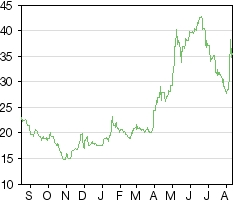
The development of Celyad’s natural killer (NK) receptor-based CAR T-cell therapy (NKR-2/CYAD-01) has taken an important step with the initiation of the SHRINK trial, which moves NK CAR T-cell therapy towards the 90%+ of cancer patients who do not have CD19 or BCMA tumors. CYAD-01 is already being tested in THINK with five solid tumor types plus AML and MM. Promising THINK results have been reported at the lowest dose. Celyad has paid $25m in cash and shares to reduce the royalties payable on potential short-term deals and long-term sales. Our indicative value of Celyad has been revised to $616m or $61 per ADR.
Written by
Celyad |
Gaining value on stable disease observations |
New trial and reshaped deal |
Pharma & biotech |
14 August 2017 |
ADR research
ADR share price performance
Business description
Next events
Analysts
Celyad is a research client of Edison Investment Research Limited |
||||||||||||||||||||||||||||||||||||||||
The development of Celyad’s natural killer (NK) receptor-based CAR T-cell therapy (NKR-2/CYAD-01) has taken an important step with the initiation of the SHRINK trial, which moves NK CAR T-cell therapy towards the 90%+ of cancer patients who do not have CD19 or BCMA tumors. CYAD-01 is already being tested in THINK with five solid tumor types plus AML and MM. Promising THINK results have been reported at the lowest dose. Celyad has paid $25m in cash and shares to reduce the royalties payable on potential short-term deals and long-term sales. Our indicative value of Celyad has been revised to $616m or $61 per ADR.
Year end |
Revenue ($m) |
PTP* |
EPADR |
DPADR |
P/E |
Yield |
12/15 |
0.0 |
(30.6) |
(3.52) |
0.0 |
N/A |
N/A |
12/16 |
9.5 |
(25.3) |
(2.32) |
0.0 |
N/A |
N/A |
12/17e |
9.2 |
(30.2) |
(3.17) |
0.0 |
N/A |
N/A |
12/18e |
10.0 |
(28.0) |
(2.94) |
0.0 |
N/A |
N/A |
Note: *PTP and EPADR are normalized, excluding amortization of acquired intangibles, exceptional items and share-based payments.
THINK: Two stable disease cases and revised deal
Celyad is running the large Belgian and US immuno-oncology autologous CYAD-01 THINK trial. Celyad has reported two cases of stable disease after three months at the first 3x10⁸ dose level in previously progressing colorectal patients. The second 1x10⁹ dose cohort is currently being treated. Overall data (six-month) are possible in H218. Tumors showing efficacy could then move into expanded studies allowing BLA filings from 2020.
SHRINK: Real world solid tumor therapy
Current leading CAR T-cell approaches like the CD19 and BCMA target a restricted patient population. Yet over 90% of US cancer patients have solid tumors, usually treated with chemotherapy. In SHRINK, Celyad will give CYAD-01 a few days after FOLFOX chemotherapy to colorectal patients with potentially resectable liver metastases. This important trial will evaluate if CYAD-01 is synergistic with chemotherapy and explore the optimal dose and timing.
Valuation: Revised to $616m
Celyad has a leading position in solid cancer therapy and has renegotiated the NK CAR T-cell licensing deals, paying $12.5m cash plus $12.5m in shares to reduce the amounts payable. We have increased the indicative value by this amount. The deal will give more cash from near-term deals, perhaps on allogeneic technology, and increase longer-term cash flows. The probability of the colorectal indication has been increased from 10% to 20% reflecting the new observations. Other small adjustments have also been made. The indicative value estimated by Edison on one solid cancer plus AML and MM is therefore revised to US$616m (US$61 per ADR). As a scenario, if all five current solid cancer indications are included, the value would be US$1.5bn and US$153/ADR before dilution. We estimate that Celyad has cash into 2019.
THINK
The THerapeutic Immunotherapy with NKR-2 (THINK) study (NCT03018405) is an open-label, multiple-dose US and European study currently in a dose escalation phase. It is assessing at higher dose levels the safety and clinical activity of autologous NKR-2 CAR T-cells (CYAD-01) in seven refractory cancers: the two hematological cancers with Phase I data (AML and MM) and five solid tumors (colorectal, ovarian, bladder, triple-negative breast, and pancreatic).
The trial is testing three dose levels: 3x10⁸ cells (completed), 1x10⁹ cells (currently being treated) and 3x10⁹ cells. At each dose, a patient receives three successive administrations, two weeks apart, of CYAD-01. It is likely that the highest dose will be needed as Celyad does not use a preconditioning regimen – that is patients are not given a cytotoxic therapy that ablates existing immune cells. The avoidance of preconditioning is based on preclinical work published by Professor Sentman at Dartmouth College who originated the NKG2D CAR T-cell therapy.
Use of preconditioning in B-cell cancers allows the infused CAR T-cells to grow rapidly and become, for a while, a high proportion of the T-cells. As the tumor regresses and normal T-cells recover, the proportion of CAR T-cells drops rapidly. Without preconditioning, the NK CAR T-cells will remain as a small proportion of the overall T-cell population.
However, as noted in the July 2017 Novartis FDA advisory committee presentation on CD19 therapy in paediatric ALL, there were no specific markers or dose response correlations with patient responses.
A key aspect of NK CAR T-cell therapy is its ability to recruit an endogenous T-cell response against the cancer. This could enable successful long-term immune control of the cancer. It is also notable that, so far, NK CAR T-cell therapy has been free of common side effects seen with B-cell targeted CAR T-cells like cytokine release syndrome (CRS) and neurotoxicity (NT). This might be due to the lack of preconditioning, which limits the expansion of the NK CAR T-cells. However, as noted, CRS and NT side effects did not correlate with response in CD19 CAR therapy.
So far, Celyad has seen stable disease over three months in two colorectal patients treated at the lowest dose. There was a previous stable disease response in an AML patient in the previous study at a lower dose still. Note that in solid cancer, the use of any CAR T-cell therapy is experimental and response rates are potentially different to those seen in more tractable B-cell cancers.
Trial design
The dose escalation part of the study will enroll up to 24 patients. Specifically, the trial is split into hematological and solid tumor arms with 12 patients each. The dose escalation cohorts are of three patients dosed sequentially. If a dose-limiting toxicity is noted, a fourth patient is tested at that dose, otherwise the next dose is tested. At the highest tolerated dose, a further three patients are tested to confirm safety. Overall six-month dose data are possible in H218. The two-year primary endpoint data could be due in mid-2020. However, there should be no delay in starting the expansion of different cancer types in H218. In the expansion stage, individual cancer types will be recruited with up to five solid cancer arms plus two possible hematological arms. This phase requires 14 patients per cancer: 98 in total made of 86 further patients plus the 12 at the highest dose cohort. As safety will have been shown by this stage, patients can be dosed as they are enrolled rather than sequentially as at present. This will potentially speed up the trial, perhaps allow further expansion of some indications and therefore lead potentially to BLA filings.
The SHRINK study starts
The Celyad natural killer (NKG2D) receptor CAR T-cell approach, CYAD-01, targets the ubiquitous stress ligands expressed by many cancers. These stress ligands are upregulated in response to chemotherapy. However, they are also expressed by normal cells exposed to toxic agents, if only for a short period. Chemotherapy might make the tumor more stressed and so more susceptible to CYAD-01 targeting. It might also expose some normal tissues to CYAD-01 so timing of dosing is important to allow enough normal tissue recovery post chemotherapy. In the real world, most solid cancer patients will receive chemotherapy and knowing how to combine standard chemotherapy with CAR T-cell therapy is crucial. If it proves to be synergistic, it would be a major cancer therapy breakthrough as most chemotherapy regimens show limited survival gains in a minority of patients.
In SHRINK, CYAD-01 doses will be adjusted to body weight and escalate from 3x10⁸ to 1x10⁹ to 3x10⁹ cells. Patients will receive three CYAD-01 doses two weeks apart. The dose escalation phase will be 18 patients (six/cohort) with 21 in any expansion phase. The trial is being run in Belgium. It has not yet been posted on the clinical trials databases but is approved by the Belgium regulator.
The patients enrolled will suffer from colorectal cancer with potentially resectable liver metastases. These patients routinely receive FOLFOX chemotherapy. FOLFOX is a combination of folinic acid (leucovorin), fluorouracil (5FU) and Oxaliplatin. About 20-30% of colorectal cancer cases are found to have metastatic disease on diagnosis. FOLFOX is not a regimen that targets the immune system, unlike the preconditioning regimen used in B-cell CAR T-cell therapies. We would therefore not expect to see dramatic immediate effects of adding CAR T-cell therapy. FOLFOX is effective at shrinking tumors and multiple treatments are given. Shorter endpoints are likely to be used in initial studies. Overall survival will be crucial for widespread use, but will take some years to determine as FOLFOX gives median overall survival of about two years vs six months on supportive care.
Reshaping the Celdara and Dartmouth licensing deals
On 4 August 2017, Celyad announced that it was paying $25m in cash and shares to receive an “increased share of future revenues” generated by intellectual property licensed from Dartmouth College. The NK CAR T-cell IP was originally licensed in 2010 by OnCyte, a subsidiary of Celdara LLC, a US private venture company. Celyad acquired OnCyte in 2015 from Celdara. The value is being paid as $12.5m cash and $12.5m in shares at $38.17/share, a 14% premium.
Exhibit 1: Celyad agreements with Celdara and Dartmouth College
Date and agreement |
Terms disclosed |
Dartmouth College and Celdara |
In January 2015, Celyad bought all the shares in OnCyte, LLC from Celdara Medical, LLC, for $10m and purchased all the assets including the licence agreements between Celdara and Dartmouth College, related to CAR T-cell therapy. Celyad agreed to milestone payments to Celdara of up to $40.0m for clinical products and of up to $36.5m for pre-clinical products, as well as sales-based milestone payments of up to $80m. Celdara was to receive a tiered single-digit royalty on sales of CAR T-cell products for either 10 years for the first sale or until the last patent expires if later. This agreement has now been modified. |
2010 Dartmouth Licence Agreement on NK CAR T-cell |
Under the April 2010 agreement between Celdara and Dartmouth College (amended in February 2012, July 2013 and January 2015), now owned by Celyad, Dartmouth granted an exclusive, worldwide, royalty-bearing licence to patents on NK and NKP30 receptor CAR T-cell cancer therapeutics. The licence also covered T-cell receptor-deficient T-cells for allogeneic therapies (now licensed non-exclusively to Novartis). There was an annual licence fee of $20k and a low single-digit royalty with minimum obligations beginning 30 April 2024. Celyad also pays a tiered percentage of sublicensing income ranging from the mid-single digits to the mid-teens depending on the deal terms. Celyad also makes milestone payments up to $1.5m. |
2014 Agreement on anti-B7-H6 antibodies |
Under the exclusive licence agreement with Dartmouth entered into in June 2014 (amended January 2015), Dartmouth granted Celyad an exclusive, worldwide, royalty-bearing licence under certain know-how and patent rights to an anti-B7-H6 antibody and fusion proteins. |
Source: Adapted by Edison from SEC filing F1/A June 2015
Valuation
To reflect the change in expected revenues, we have made two major adjustments:
■
Edison assumes that the NPV added due to the Celdara and Dartmouth College deal is the same as the payment of US$25m. The overall indicative value has therefore been increased by this amount. As the information on the deal structure is in outline only (Exhibit 1) and in any case affected by the relatively low probability adjustments used in the current CYAD-01 clinical studies, it is not possible to make precise value adjustments.
■
The other major adjustment is to the CYAD-01 colorectal probability, Exhibit 2. This was 10% as there was no preclinical model available. As there have been stable disease responses reported and as the SHRINK study targets metastatic colorectal cancer, Edison has aligned the probability with ovarian cancer to 20%. Note that the stable disease finding cannot be statistically validated as the two cases occurred in an open-label dose ranging study.
Exhibit 2: Revised CYAD-01 NPV estimates
Indication |
US deaths |
Peak share |
Potential sales US$m |
Probability |
NPV (US) |
Global |
AML |
10,460 |
50% |
638 |
20% |
95 |
140 |
MM |
11,240 |
50% |
686 |
20% |
102 |
151 |
Total |
1,324 |
292 |
||||
Colorectal |
50,310 |
36% |
2,721 |
20% |
334 |
496 |
Ovarian |
14,180 |
69% |
1,464 |
20% |
183 |
271 |
Bladder |
16,,390 |
69% |
1,692 |
10% |
106 |
157 |
Breast |
40,000 |
36% |
2,163 |
10% |
133 |
197 |
Pancreatic |
39,590 |
69% |
4,086 |
5% |
128 |
190 |
Total solid tumors |
12,125 |
883 |
1,310 |
|||
Weighted average of one solid tumor |
238 |
|||||
Source: Edison Investment Research
There are two technical adjustments:
■
The exchange rate used formerly was US$1.06/€. The current rate now used is US$1.176/€, therefore decreasing the value in euro terms. The major market expected is the US.
■
The number of share was 9.53m by 2 August after some options were exercised. The issue of 328.6k new shares (calculated by Edison) in relation to the Celdara and Dartmouth College $12.5m equity payment will take the total number to 9.86m. The shares in the deal will be issued at a 14% premium at $38.17 but only cause 3.4% of dilution.
This gives a revised indicative value estimated by Edison of US$616m, implying US$61 per ADR, Exhibit 3. This is based on only one solid indication reaching the market. This is very cautious as these estimates are already risk-adjusted.
Exhibit 3: Revised value estimate
Item |
Indication |
Probability |
Value ($m) |
CAR values |
AML |
20.0% |
126.5 |
|
MM |
20.0% |
136.0 |
|
Solid tumors (weighted average of one success) |
Variable |
237.9 |
|
Allogeneic |
|
58.8 |
CAR value |
|
|
559.2 |
C-Cure partnered value (milestones plus royalties) |
|
35.0% |
191.0 |
Net operating costs |
(Risk adjusted 2017-23) |
|
-158.9 |
Additional royalties |
|
25.0 |
|
Total indicative value |
|
|
616.3 |
Shares (m) |
|
|
9.86 |
Warrants and options (m) |
|
|
0.30 |
Core value per share ($) |
|
|
60.7 |
Source: Edison Investment Research
As a scenario, if all five current solid indications are included, the value would be US$1.5bn and US$153 per ADR; note that developing, producing and marketing five solid CAR T-cell cancer indications would require extra capital, implying substantial dilution. The C-Cure cardiac therapy value of $191m requires a partner to fund the CHART-2 study needed.
Exhibit 4: Financial summary
US$'000s |
2015 |
2016 |
2017e |
2018e |
||
Year end 31 December |
IFRS |
IFRS |
IFRS |
IFRS |
||
PROFIT & LOSS |
||||||
Revenue |
|
|
3 |
9,461 |
9,191 |
9,990 |
Cost of Sales |
(1) |
(59) |
0 |
0 |
||
Gross Profit |
2 |
9,402 |
9,191 |
9,990 |
||
EBITDA |
|
|
(30,907) |
(26,712) |
(29,659) |
(27,417) |
Operating Profit (before amort and except) |
|
|
(31,210) |
(27,556) |
(30,503) |
(28,261) |
Intangible Amortization |
(844) |
(839) |
(839) |
(839) |
||
Other income and charges |
0 |
(578) |
0 |
0 |
||
Share-based payments |
(882) |
547 |
0 |
0 |
||
Operating Profit |
(32,936) |
(28,426) |
(31,342) |
(29,100) |
||
Net Interest |
619 |
2,217 |
278 |
278 |
||
PTP (norm) |
|
|
(30,590) |
(25,339) |
(30,225) |
(27,983) |
PTP (FRS 3) |
|
|
(32,317) |
(26,209) |
(31,064) |
(28,822) |
Tax |
0 |
7 |
0 |
0 |
||
PAT (norm) |
(30,590) |
(21,625) |
(30,225) |
(27,983) |
||
PAT (FRS 3) |
(32,317) |
(26,203) |
(31,064) |
(28,822) |
||
Average number of ADRs outstanding (m) |
8.7 |
9.3 |
9.5 |
9.5 |
||
EPADR - normalized ($) |
|
|
(3.52) |
(2.32) |
(3.17) |
(2.94) |
EPADR - (IFRS) ($) |
|
|
(3.72) |
(2.32) |
(3.26) |
(3.03) |
Dividend per ADR ($) |
0.0 |
0.0 |
0.0 |
0.0 |
||
Gross Margin (%) |
N/A |
N/A |
N/A |
N/A |
||
EBITDA Margin (%) |
N/A |
N/A |
N/A |
N/A |
||
Operating Margin (before GW and except) (%) |
N/A |
N/A |
N/A |
N/A |
||
BALANCE SHEET |
||||||
Fixed Assets |
|
|
55,617 |
59,318 |
81,399 |
79,883 |
Intangible Assets |
54,156 |
55,018 |
77,776 |
76,937 |
||
Tangible Assets |
1,261 |
3,955 |
3,278 |
2,601 |
||
Investments |
200 |
345 |
345 |
345 |
||
Current Assets |
|
|
121,456 |
94,756 |
52,177 |
23,636 |
Stocks |
0 |
0 |
0 |
0 |
||
Debtors |
609 |
1,508 |
1,508 |
1,508 |
||
Cash |
119,339 |
91,672 |
49,093 |
20,551 |
||
Other |
1,507 |
1,576 |
1,576 |
1,576 |
||
Current Liabilities |
|
|
(12,754) |
(12,515) |
(12,229) |
(11,640) |
Creditors |
(11,757) |
(11,056) |
(11,056) |
(11,056) |
||
Deferred revenue |
0 |
0 |
0 |
0 |
||
Walloon loans for cash payment |
(997) |
(1,460) |
(1,173) |
(585) |
||
Long Term Liabilities |
|
|
(40,583) |
(40,677) |
(39,734) |
(39,090) |
Walloon loans (non-current) |
(11,637) |
(8,731) |
(7,788) |
(6,844) |
||
Other long term liabilities |
(28,945) |
(31,946) |
(31,946) |
(32,246) |
||
Net Assets |
|
|
123,736 |
100,882 |
81,614 |
52,788 |
CASH FLOW |
||||||
Operating Cash Flow |
|
|
(30,927) |
(29,625) |
(30,184) |
(27,282) |
Net Interest |
619 |
2,217 |
956 |
293 |
||
Tax |
0 |
0 |
0 |
0 |
||
Capex |
(930) |
(1,978) |
(23,763) |
(167) |
||
Acquisitions/disposals |
(5,756) |
(1,733) |
0 |
0 |
||
Financing |
121,162 |
0 |
11,798 |
0 |
||
Dividends |
0 |
0 |
0 |
0 |
||
Other |
(3,649) |
3,451 |
(1,386) |
(1,386) |
||
Net Cash Flow |
80,519 |
(27,668) |
(42,579) |
(28,541) |
||
Opening net debt/(cash) |
|
|
(17,847) |
(106,705) |
(81,481) |
(40,132) |
HP finance leases initiated |
0 |
0 |
0 |
0 |
||
Walloon loan recognition (non-cash) |
8,339 |
2,443 |
1,230 |
1,532 |
||
Closing net debt/(cash) |
|
|
(106,705) |
(81,481) |
(40,132) |
(13,122) |
Source: Edison Investment Research estimates, Celyad reports and announcements. Note: The $25m 2017 payment is treated as an intangible asset expected to be amortized against sales income. The equity component is shown as an equity investment. The actual accounting treatment by Celyad may differ.
|
|
Jackpotjoy plc (JPJ) has produced another set of robust quarterly earnings, with Q217 revenues increasing 17% to £75.2m and a 39.9% EBITDA margin. The core Jackpotjoy division grew 18% and is gaining market share. Q3 has started well, management has reiterated its expectations for FY17 and our forecasts remain unchanged. The stock trades at a significant discount to peers, with 2018e multiples of 7.2x EV/EBITDA, 6.1x P/E and 15.0% free cash flow yield. The balance sheet is simplifying following a major earn-out payment and, as the company continues to demonstrate its market dominance, we would expect a re-rating in the shares.