Last close As at 23/10/2026
EUR1.27
— 0.00 (0.00%)
Market capitalisation
EUR162m
Research: Real Estate
Premia Properties REIC offers investors sustainable long-term income from a diversified portfolio of properties that has grown rapidly over the past five years. During this time, Premia has demonstrated its ability to source high-yielding assets, sustaining a portfolio gross yield consistently above 7%, while maintaining virtually full occupancy. We expect recent investments to deliver strong earnings and dividend growth over the next two years and the company’s ambitions extend well beyond this. Supportive shareholders have contributed capital, assets and expertise to its expansion, while broadening ownership and increasing liquidity.
| Year end | Revenue (€m) | EBITDA (adj) (€m) | EPS (€) | DPS (€) | NAV/share (€) | Yield (%) | P/NAV (x) |
|---|---|---|---|---|---|---|---|
| 12/25 | 37.5 | 24.1 | 0.41 | 0.06 | 2.22 | 4.7 | 0.57 |
| 12/26e | 43.6 | 30.1 | 0.10 | 0.06 | 2.26 | 4.7 | 0.56 |
| 12/27e | 93.9 | 48.4 | 0.21 | 0.08 | 2.42 | 6.3 | 0.53 |
| 12/28e | 103.7 | 54.0 | 0.26 | 0.10 | 2.60 | 7.8 | 0.49 |
Since Sterner Stenhus took control in 2020, Premia’s total investment assets have
increased more than sevenfold to €755m at H126, creating a substantially larger, more
diversified and increasingly efficient REIC. Growth has been driven
by acquisitions, redevelopment and strategic partnerships, with hotels and student
accommodation more recently becoming the principal areas of expansion. The agreed
AKTI hotel transaction, expected to complete by year-end, will take total investments
to c €1bn, with hotels accounting for more than half. Meanwhile, the income-generating
student accommodation portfolio will almost double to 765 units during H226 as the
company makes swift progress towards its 2,000 unit ambition.
Premia guides to FY26 adjusted EBITDA growth of 20–24%, while we forecast a step change in FY27 as recent investments, including the AKTI hotels, contribute. Over FY26–30, we forecast average adjusted EBITDA growth of c 20% pa, a doubling of DPS and an average annual NAV total return of 8.7%. Returns benefit from relatively high gearing, with H126 net LTV of 62% expected to rise to c 68% following debt funding for AKTI. Capital recycling can fund further investment, but sustained net portfolio growth while preserving balance sheet strength will require new equity. Premia’s committed strategic shareholders have consistently supported expansion, while minority shareholders have been able to participate in equity issues, as in 2021 and 2025. April’s oversubscribed €150m bond issue also demonstrated strong debt market support.
Premia shares yield 4.7%, in line with selected Greek REIC peers, and trade at c
0.6x NAV versus c 0.7x for peers. In absolute terms this seems low compared with the
significant earnings and dividend growth that the current investment programme should
deliver, and the more than 10% pa total return on NAV that we expect from FY28. Delivery
could narrow the NAV discount.
Premia has grown rapidly from property investments of c €100m at end-FY20 to €755m at H126 and, on our assumptions, around €1bn following completion of the AKTI hotel acquisition. It has built a diversified portfolio across hotels, logistics, offices, student accommodation and other sectors, with high occupancy and good income visibility across much of the rental portfolio, with a long average lease term of more than 10 years. Recent growth has been driven particularly by hotels and student accommodation, areas with attractive supply-demand fundamentals where Premia continues to see significant investment opportunities. Central to this transformation has been the role of strategic shareholders, who have provided not only financial capital but also assets, investment opportunities, property expertise and operating relationships. The July 2025 €40m equity raise illustrates the continuing support of major shareholders alongside Premia’s ability to attract new investors. The issue was 1.5x subscribed and increased the free float to c 22%.
Premia reported strong H126 growth, with revenue increasing by 21% to €21.7m and adjusted
EBITDA by 34% to
€15.0m, benefiting from investments completed during 2025. The company guides to FY26
revenue of €42–43m and adjusted EBITDA of €29–30m, supported by the annualisation
of recent investment and additional income as developments complete. Leasing events,
acquisitions and development completions, including a full-year impact of 2026 events
and a part contribution from expected 2027 events, provide significant momentum to
revenue and earnings into FY27 and to a lesser extent in FY28. We expect FY27 revenues
to more than double, including a full-year contribution from the AKTI hotels. For
the five years FY26–FY30 we forecast an average 20% pa growth in adjusted EBITDA and
an average 15% pa growth in DPS; a doubling to €0.12. The AKTI investment increases
leverage. Our forecast returns benefit from above sector-average gearing: the net
loan-to-value (LTV) ratio was 62% at H126, rising to c 68% post the AKTI transaction.
Capital recycling can fund further investment, but sustained net portfolio growth
while preserving balance sheet strength will require new equity, although none is
forecast. As a guide, maintaining LTV at the H1 level would reduce our forecast five-year
average NAV total return of 8.7% per year by c 100bp.
Premia shares yield 4.7%, in line with selected Greek real estate investment company
(REIC) peers, and trade at c 0.6x
NAV versus c 0.7x for peers. In absolute terms this seems too low compared with the
significant earnings and dividend
growth that the current investment programme should deliver, and the more than 10%
pa total return on NAV that we expect from FY28. Successful delivery and increased
visibility of this growth should support a narrowing of the discount to NAV, with
the re-rating underpinned by increasing dividends. Further growth, beyond that included
in our forecasts, offers additional potential. As well as increasing earnings, continued
portfolio expansion should bring benefits from greater scale and diversification,
potentially supporting a higher valuation multiple. However, with further investment
likely to require additional equity, the terms of any capital increase, particularly
the ability of existing shareholders to participate as was the case with Premia’s
2021 and 2025 equity raises, alongside the returns generated on new investment, will
be important to the outcome for shareholders.
The key sensitivities to our investment case are external macroeconomic conditions and Premia’s success in delivering its investment and development programme. An economic downturn in Greece or weaker tourism demand could reduce rental income and property values, with gearing magnifying the impact. Premia’s development activity represents just 18% of the portfolio and comprises relatively low-risk refurbishment or conversion of existing properties with pre-agreed lease terms. Nonetheless, unforeseen works, cost overruns and delays could postpone income while financing costs continue. Successful execution also depends on access to funding, with leverage already relatively high. Premia’s government and established international tenants provide diversification across economic activities, although expansion into hotels has increased concentration. Nordic Leisure Travel Group (NLTG) accounted for 34% of annualised contracted rents at end-H126, but we estimate its share of combined gross rental and hotel operating revenue will be c 20% on an annualised FY27 basis, following the Kos openings and AKTI acquisition.
Premia has its origins in Pasal, a Greek property company established in 1991 and listed on the Athens Stock Exchange in 2008. Following a period of financial distress, the business was restructured and recapitalised in 2020, with Swedish property group Sterner Stenhus becoming the principal shareholder. At that time, its portfolio comprised just five properties valued at c €32m, predominantly represented by a logistics property in Elefsina. Renamed Premia Properties in 2021 and granted REIC status in 2022, the company has since been transformed into a substantially larger and more diversified property investment business.
Central to this transformation has been the role of strategic shareholders, who have provided not only financial capital but also assets, investment opportunities, property expertise and operating relationships. Sterner Stenhus contributed the Attica schools public-private partnership (PPP), while NOE Metal Constructions contributed interests in logistics properties. Listed Swedish property company Fastighets AB Balder became a major shareholder through the 2021 capital increase, bringing additional capital and real estate expertise. More recently, NLTG became both a shareholder and major tenant following the acquisition and leaseback of hotels in Rhodes and Crete in 2024, establishing a relationship that has supported Premia’s rapid expansion into hospitality.
The contribution of strategic shareholders has helped shape Premia’s portfolio, while successive capital increases have supported its growth and progressively broadened ownership. Sterner Stenhus remains the largest shareholder, with a 33.4% interest, followed by Balder (19.7%), NLTG and affiliated companies (10.6%), Nequiter Invest (7.6%) and NOE-related interests (6.8%). The July 2025 €40m equity raise illustrates the continuing support of major shareholders alongside Premia’s ability to attract new investors. The issue was 1.5x subscribed and increased the free float to c 22%. Premia continues to target a broader shareholder base and improved share liquidity.
Premia has retained management continuity through the transformation of the business. CEO Konstantinos Markazos has led the company since July 2020 and has a background spanning management and finance roles in Greek and multinational businesses. CFO and chief investment officer Nikolaos Baziotis brings banking, investment and corporate finance experience, including senior roles at Alpha Bank and Intracom Holdings, while Constantin Pechlivanidis leads property investment. The management team combines financial and investment expertise with dedicated property investment and asset management capabilities.
Executive chairman Elias Georgiadis provides a direct link to Sterner Stenhus and extensive property and construction experience. Vice-chairman Frank Roseen adds international property investment and capital markets experience, including senior roles at GE Capital Real Estate and Aroundtown.
Following the resignation of Vasileios Andrikopoulos in August 2026, the board comprises seven directors: three executive, two non-executive and two independent non-executive directors. Sterner and NOE have identifiable board links, while Balder, NLTG and Nequiter have no separately identified representatives. The independent directors chair the principal board committees, with Panagiotis Vroustouris chairing the audit committee and Rebecca Pitsika the remuneration and nomination committee.
Premia remains a relatively lean organisation, with 21 employees at end-2025 compared with 17 a year earlier, reflecting its focus on investment, asset management and financing rather than building large operating teams internally.
Premia invests across logistics, retail, offices, schools, wineries, student accommodation and hotels, seeking attractive returns from identifiable occupier demand, strong tenants and long-term, often inflation-linked leases. It also adds value through refurbishment, conversion and asset management, often alongside specialist operating partners. Hotels and student accommodation are the main areas of expansion.
The agreed AKTI hotel transaction (discussed further below) represents a further, selective extension of this strategy. In contrast to Premia’s existing leased hotel portfolio, through its recently formed subsidiary, HotelInvest, it will both own and operate hotels, allowing Premia to capture a greater share of the value created through refurbishment, repositioning and improved hotel performance, albeit with greater operating risk. Day-to-day management will remain with experienced specialist hotel operators.
At end-H126, Premia’s total investments amounted to €755m, comprising €673m of investment properties, €32m of financial assets representing future payments under its PPP agreement covering 10 schools in Attica, €32m of joint venture (JV) investments and €18m of advances for property acquisitions. The investment portfolio had a gross asset value (GAV) of €705m, comprising investment properties and PPP financial assets.
The income-producing investment properties generated annualised contracted rents of €39.2m, representing a gross rental yield of 7.1%. H126 occupancy of 99.7% was consistent with the high levels reported over the past three years, while the weighted average unexpired lease term (WAULT) was 10.1 years. The vast majority of rents are indexed annually to inflation, generally with an additional margin and protection against reductions when inflation is negative. The latest quantified disclosure, at H125, showed 95% of rents linked to consumer price index (CPI) or CPI plus a margin, with the remainder subject to contractual increases.
Premia’s €127m development portfolio is all lower-risk refurbishment and conversion of existing properties with agreed lease terms in place. It does not undertake speculative development. The Kos hotels, already let to NLTG, and student accommodation developments account for almost 90% of its value. While not all projects are pre-let, the strategy is generally focused on identified occupiers or established sources of demand, reducing speculative development risk, although construction costs, completion times and the commencement of income remain important considerations.
Since FY24, growth in portfolio GAV has been led by hotels and student accommodation. Hotels accounted for c €250m at H126 and would exceed €500m, or more than half of pro forma GAV, assuming full ownership of AKTI.
Geographically, the portfolio is spread across mainland Greece and the islands, with
a significant presence in the
Athens and Thessaloniki regions. Its international exposure comprises a hotel in Gran
Canaria, Spain, accounting for approximately 10% of portfolio GAV.
Premia’s principal tenants include government bodies and established international businesses, providing diversification across economic activities. However, tenant concentration has increased significantly with the expansion into hotels. Premia has built its leased hotel portfolio around a strategic relationship with NLTG, which accounts for 34% of annualised contracted rents, potentially increasing to c 42% when the Kos hotels become operational. Following the AKTI acquisition, we expect NLTG’s share of combined gross rental income and hotel operating revenue to fall to c 20% on an annualised FY27 basis.
The second-largest tenant is AADE, the Greek tax authority, providing effectively Greek sovereign credit exposure with more than eight years remaining to lease maturity. The next three largest tenants are also engaged in relatively defensive activities. AB Vassilopoulos, part of Ahold Delhaize, operates in the essential grocery market; Doukas Schools is an established private education provider; and FrieslandCampina Hellas, the Greek subsidiary of a major international dairy group, occupies a refrigerated distribution facility.
Premia reports its investment activities across six sectors: Commercial, Industrial, Serviced apartments, Schools, PPP and Rental hotels. Commercial includes the offices and retail properties, while Industrial comprises the logistics, manufacturing properties and wineries. We follow these classifications in the sector commentary and financial analysis.
Premia invests in established coastal resorts serving international leisure and package-holiday demand, seeking long-term income alongside opportunities for value creation through refurbishment and repositioning. Its strategy is well aligned with the growth and upgrading of Greek tourism. Travel receipts increased by c 30% between 2019 and 2025, while international property consultancy Savills reports that average hotel revenue per available room (RevPAR) increased by c 30% between 2019 and 2024, with higher-category hotels driving much of the growth in sector revenues. Greece has a substantial stock of existing hotels and an active investment market, with Savills Hellas recording more than 170 hotel-related transactions over the past decade, including operating hotels and properties suitable for conversion. This provides opportunities to acquire established properties in attractive locations and reposition them to benefit from the move upmarket. Premia has demonstrated its ability to access such investments through its strategic shareholder and operating relationships, securing initial gross rental yields of more than 7% on its three income-producing hotels leased to NLTG. These relationships may support further acquisitions and opportunities to enhance value through investment in existing properties. The planned AKTI investment offers similar repositioning opportunities, but with Premia participating more directly in the potential growth in hotel earnings.
The current leased portfolio comprises five resorts, all leased to NLTG, a leading Nordic holiday operator serving c 1.3m guests annually. Three are income producing and two are undergoing refurbishment. The three operational hotels have initial 15-year triple-net leases, with two five-year extension options and annual CPI-linked rent reviews. NLTG bears the hotel operating risk, providing Premia with long-term contracted rental income. The two hotels under refurbishment were acquired from third parties and have initial 20-year leases, with opening targeted for May 2027.
NLTG is a leading integrated Nordic tour operator, combining established holiday brands, its own airline and a portfolio of resort hotels. Its financial performance provides some reassurance over its ability to service its rental obligations. In the 12 months to March 2026, NLTG generated revenue of SEK17bn and adjusted EBITDA of SEK1.0bn, with cash of SEK1.5bn at end-2025. However, tourism remains cyclical, and the business has substantial lease commitments, while its group-level financial strength does not itself establish the credit support available under individual leases.
In June 2026, Norwegian Air Shuttle agreed to acquire NLTG, with completion targeted for H226, subject to regulatory approvals. The combination is expected to strengthen NLTG’s distribution capabilities and support further hotel expansion, potentially creating additional opportunities for Premia. Nevertheless, Norwegian Air Shuttle does not automatically become a guarantor of the existing leases. NLTG’s financial performance therefore remains important given Premia’s significant rental concentration, discussed above.
In June 2026, Premia announced a strategic investment agreement with AKTI Hotels & Resorts, marking its planned entry into hotel operations. The proposed transaction encompasses three established beachfront resorts: Akti Imperial in Rhodes and Akti Beach Club and Akti Palace in Kos. Together, the properties comprise 1,316 rooms, with approximately 85,000sqm of buildings on 300,000sqm of land. The hotels have operated for more than 20 years and will continue to be managed by AKTI. The final transaction is targeted for completion by end-2026, with the refurbishment and repositioning programme expected to be completed by 2029. Premia had already made an advance payment of €15m at end-H126, included in acquisition advances rather than portfolio GAV.
Premia estimates that total investment, including acquisition and refurbishment, will exceed €250m. We have assumed €260m, comprising €235m of acquisition expenditure (including the c €15m prepayment) and €25m of subsequent capex. The final ownership and financing structure has not been confirmed, but our forecasts assume 100% ownership and debt funding. Although Premia may introduce a JV partner, we believe this would be driven primarily by the operational or strategic benefits a partner could bring. Such a transaction would release capital for further investment but reduce Premia’s economic exposure to HotelInvest and its future returns.
Most of the serviced apartments portfolio is for student accommodation, the second major focus of new investment. Greece has a significant shortage of modern, professionally managed student accommodation, with most students relying on the conventional private rental market. Only c 9,200 public dormitory beds are operational, compared with c 200,000 students studying away from home (Greek Government, National Housing Strategy 2026–35, p 30). Premia sees opportunities to address this demand by acquiring and converting existing buildings into furnished, serviced accommodation, primarily in university cities. The combination of limited modern supply, relatively resilient demand and opportunities to add value through refurbishment makes the sector attractive.
At end-H126, Premia owned nine income-producing properties and eight under development. Five developments are scheduled to add 370 rooms during H226, increasing the number under management to 765 by year-end. At least another 162 rooms are identified in the development pipeline, which continues to expand. Premia’s longer-term ambition is to develop a portfolio of at least 2,000 student accommodation units.
Premia generally leases the properties to specialist operators, including Hamlet and Unity, which manage the buildings and let rooms. Premia therefore receives contracted, predominantly inflation-linked rent rather than taking individual student occupancy risk. Hamlet’s initial leases were for 20 years.
Logistics represents about three-quarters of Premia’s industrial portfolio, with sites in western Attica and Thessaloniki let to grocery distributors, food businesses, e-commerce and records-storage operators including AB Vassilopoulos, METRO, FrieslandCampina, Skroutz and Iron Mountain. Recent asset management includes the Elefsina reletting and €17m Sindos disposal. The balance comprises manufacturing facilities and the Boutari, Scalarea and Semeli wineries. Premia owns and rents these properties to operating businesses rather than producing goods or wine itself. Specialised buildings strengthen the tenant link, although their limited alternative uses increase the importance of tenant credit quality.
Premia owns two leased educational properties: Doukas Schools, an established private school in Marousi, Athens, and a municipal school in Artemida. Both are let on long leases, initially 15 and 12 years respectively, with approximately 11 and 10 years remaining at H126. The properties benefit from established educational demand and relatively secure, long-term income, with Doukas Schools accounting for c 5% of Premia’s annualised rental income.
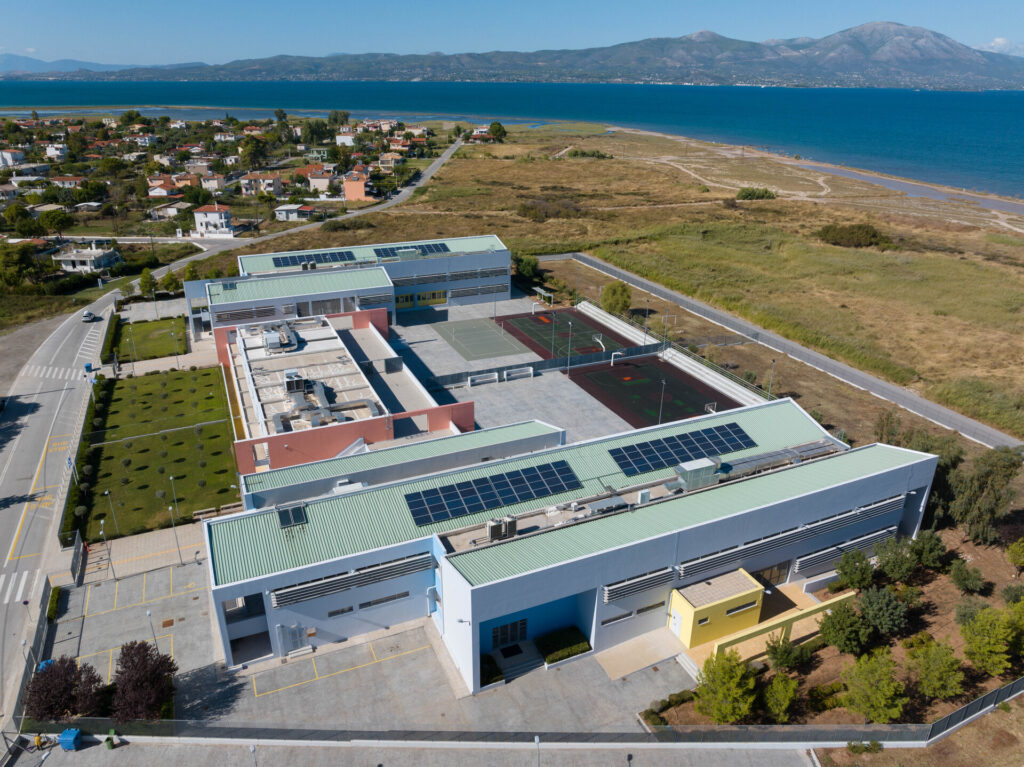
Through its subsidiary JPA, Premia holds a long-term PPP concession covering 10 schools in Attica. The schools have been operational since 2017 and generate contracted payments from a public-sector counterparty for their availability and maintenance. This provides a predictable source of income and cash flow, with limited exposure to the property letting market.
Unlike conventional rental income, the payments comprise service income, a financing return and the gradual recovery of invested capital. Consequently, the contribution to Premia’s EBITDA is modest, with finance income recognised below EBITDA and capital repayments reducing the financial asset rather than passing through earnings. The investment is therefore better assessed on its net cash flows over the remaining concession life, after operating costs and debt service.
Commercial holdings are mainly offices, led by public-sector tenants. AADE, the tax authority (c 13% of rent), occupies the former Athens Heart shopping centre, converted into offices, and a Kalamaria property; its headquarters lease runs to May 2036. The Hellenic Cadastre occupies another Thessaloniki office. Smaller holdings are supermarkets, big-box shops, bank branches and automotive premises let to established operators including AB Vassilopoulos, METRO, Praktiker, Pepco, Public and Alpha Bank. Premia receives property rent, not retail trading income.
Premia reported strong H126 growth, with revenue increasing by 21% to €21.7m and adjusted EBITDA by 34% to €15.0m, benefiting from investments completed during 2025. Funds from operations (FFO) increased by a more modest 15% to €4.7m, reflecting higher financing costs, while lower property revaluation gains contributed to a reduction in net profit to €7.1m (H125: €9.3m). NAV remained broadly unchanged at €278.5m, or €2.22 per share, after payment of a €0.06 dividend. Net LTV increased to 61.8% from 57.3% at end-2025.
The total value of investments increased by 9% or €63m to €755m from €692m at end-2025, including completion of the second hotel in Kos (€20m), the acquisition of four studentaccommodation properties (c €17m), alongside continued investment in hotel refurbishments and student accommodation developments. The increase also included advance payments for acquisition of c €17m, of which c €15m related to the agreed AKTI hotel acquisition. Investments made were partly offset by the disposal of a vacant logistics property in Sindos for €17m, at a premium to book value, releasing capital for redeployment, investment and debt reduction. Portfolio operating metrics remained strong, with a 7.1% gross rental yield and 10.1-year WAULT.
Premia guides to FY26 revenue of €42–43m (+12–15%) and adjusted EBITDA of €29–30m (+20–24%). Growth chiefly reflects a full year contribution from a leased hotel (in Gran Canaria), acquired in September 2025, with additional income from student accommodation acquisitions and developments and leasing events on newly refurbished assets.
Leasing events, acquisitions and development completions, including a full year impact of 2026 events and a part contribution from expected 2027 events, provide significant momentum to revenue and earnings into FY27 and, to a lesser extent, in FY28. We estimate that the main 2026 events will add an incremental €2.2m to FY27 revenues and that the post-refurbishment opening of the Kos hotels, and additional student apartment completions will add c €3.4m (out of annualised rents of €6.3m). Indexed rent uplifts will also support revenue growth, with the Bank of Greece forecasting CPI at 2.7%.
Our base case assumes the AKTI purchase completes at end-2026, wholly owned and debt-funded. The investment and borrowing enter the FY26 closing balance sheet, with hotel earnings from FY27; the remaining €25m refurbishment expenditure is phased over the next three years.
Our hotel revenue estimates are based on advertised room rates, adjusted downwards by more than 40% to reflect the predominantly package-tour and wholesale nature of bookings, together with industry occupancy benchmarks. We assume gradual growth in occupancy and total revenue per occupied room as the refurbishment and repositioning programme progresses. Our 30% EBITDA margin assumption, benchmarked against other hotel operators, includes external hotel management fees.
We forecast hotel revenue increasing from €44.4m in FY27 to €59.4m in FY30, with EBITDA rising from €13.3m to €17.8m. By FY30, this represents an EBITDA yield of 6.8% on the total €260m investment. The acquisition will make a substantial contribution to group earnings, although additional borrowing and finance costs will offset part of the benefit at FFO level.
We forecast a step change in revenue and earnings in FY27, driven by the first full-year contribution from HotelInvest and additional rental income as recent acquisitions and development projects become income producing. Growth should continue as the hotel refurbishment programme progresses, occupancy and room rates improve, and inflation-linked rental increases feed through. Revenues are shown in the detailed financial summary table below. In the following table we split out the contribution to adjusted EBITDA between rental activities, IFRS treatment of PPP, and hotel operating. Over FY25–30, our forecasts imply compound annual growth of c 10% in net rental income, and c 20% in adjusted EBITDA. We expect FFO growth of c 22% per year over FY25–30, slightly ahead of adjusted EBITDA growth of c 20%, as earnings from recent investments build while financing costs stabilise, supporting progressively higher dividends. We forecast five-year average NAV total returns of 8.7% with the annual return increasing to more than 10% per year from FY28.
Our full group forecasts are set out in the financial summary. Despite EBITDA growth, we forecast EPS declining from €0.41 in FY25 to €0.10 in FY26, principally reflecting much lower property revaluation gains (€3m vs €33m), higher financing costs and the full-year impact of the 2025 equity issue on the weighted average share count. Thereafter, we forecast EPS growth averaging c 30% per year over FY27–30, from the lower FY26 base.
We forecast cumulative property revaluation gains of c €42m over FY26–30, driven primarily by organic rental growth, assuming broadly unchanged valuation yields by sector. Although Premia does not explicitly disclose sector yields, indicative yields can be estimated from its published rental income and income-producing property values. We have not assumed gains specific to development activity, which are likely, particularly in respect to the AKTI hotels post refurbishment.
Since 2020, Premia has issued c €155m of equity, including c €58m of non-cash acquisition consideration or debt conversion. Sterner Stenhus, NOE and NLTG have helped source and fund investments, while the 1.5x subscribed €40m July 2025 issue demonstrated access to new equity investors. An oversubscribed €150m seven-year bond in April 2026, at a fixed 4.1% coupon, refinanced existing borrowings and added growth capital, supported by bank facilities.
At end-H126, Premia reported total debt of €485m, comprising €479m of loans and associated grant liabilities and €5.8m of investment-property lease liabilities. After deducting €17.9m of cash and restricted deposits, net debt was €467m, representing gross and net LTV of 64.2% and 61.8%, respectively (62.7% and 57.3% at end-2025). Borrowings had a weighted average remaining maturity of 7.8 years and an average cost of 3.8%. Some 61% were fixed-rate or hedged, including 6% through preferential financing under the EU’s Recovery and Resilience Facility (RRF). Outstanding RRF borrowing amounted to €30.3m.
The €150m seven-year unsecured bond issued in April 2026, at a fixed coupon of 4.1%, refinanced the previous €100m bond and provided additional investment capital, extending the refinanced maturity to 2033. Premia has also continued to arrange secured bank financing, including a further €18.4m, 15-year RRF agreed in May for refurbishment of the Kos hotels. At end-H126, only €19.2m of reported loan-related liabilities was classified as current.
Assuming AKTI is wholly debt-funded, we forecast end-FY26 debt of c €705m and net LTV of c 68%, declining towards c 65% by FY30 as investments contribute and valuations increase in line with rental growth. We forecast Premia to remain fully compliant with the terms of the unsecured bond, which limits adjusted gross debt to 70% of adjusted assets from December 2026 and requires at least 2x interest cover from December 2028. These definitions exclude PPP and differ from reported LTV/EBITDA; secured bank debt has separate property-level tests. Premia reported compliance at H126 and expected no breach through June 2027.
Recycling capital from mature or lower-return assets would provide an opportunity to make new investments and optimise portfolio returns, but further net expansion without sustained high gearing will require additional equity raising. While the issue of new shares at a price below NAV can materially dilute NAV and earnings per share, what ultimately matters to existing shareholders is the overall return on their investment, taking into account their opportunity to participate and the returns generated on new capital.
Premia’s 2025 €40m cash issue at €1.30 was c 39% below pre-issue NAV, reducing immediate NAV/share from €2.15 to c €1.93. Although not a rights issue, existing shareholders were given preferential allocation of new shares, enabling those subscribing proportionately to maintain their ownership and broadly protect the value of their investment. With NAV reaching €2.22 by year-end, we estimate capital-adjusted 2025 NAV total returns of c 22% for proportionate subscribers versus c 8% for non-subscribers, including dividends. Although subscribers committed additional capital, the comparison illustrates why participation opportunities and the returns achieved on new investment are more important than per-share dilution alone.
Our illustrative €60m equity raise at end-2027 is not a forecast, but it demonstrates a lower-gearing funding route as Premia expands. Net of costs, it would reduce FY28 net LTV from c 67% to c 62%, in line with H126. Assuming an issue at €1.28 (a 42% discount to H126 NAV), pro rata participation requires c €0.48 of new capital per existing share. This reduces the subscriber’s FY28 NAV-based return from c 10.8% in the debt-funded case to 9.5% but mitigates financial risk; a non-subscriber would face dilution and a c 4.5% negative return. Five-year annualised NAV returns would be 7.7% for a subscriber versus 8.7% in the base case (5.4% for a non-subscriber).
At €1.29, Premia trades at 0.6x H126 NAV (a c 40% discount), versus 0.7x for selected Greek REIC peers. Its FY25 dividend yield of c 4.7% matches the peer average but is below BriQ and Trade Estates REIC. Exhibit 14 provides the details.
We exclude PRODEA Investments and Ble Kedros from our selected REIC peer group, although both are included in the wider Greek comparison. PRODEA is substantially larger, has a relatively small free float and has undertaken major portfolio disposals and exceptional capital distributions, creating uncertainty over its sustainable dividend policy. Ble Kedros is an outlier, trading at 1.4x NAV and yielding 8.0%, although its FY25 dividend substantially exceeded recurring FFO. We also show LAMDA Development and DIMAND separately. Neither is a REIC and both are primarily development-led businesses, with valuations more dependent on development activity and capital appreciation than recurring rental income. Neither currently pays a dividend.
The peer group spans different strategies: BriQ has substantial logistics exposure, Trade Estates focuses on retail parks, Noval and Orilina have significant development projects, and Trastor pursues value-add commercial and logistics property. Premia differs through its hotels and student accommodation focus, with operating hotels adding earnings potential and risk.
Only three of the selected peer group companies have been listed for a full three years, although Trade Estates has been listed since November 2023. Premia has generated a three-year share price total return of c 24%, ahead of the c 17% return generated by Trade Estates since listing, although over one year Trade Estates has the stronger performance of the two. Both companies have grown rapidly, Premia more so, and both have developments that have yet to make their full earnings contribution. However, their investment strategies differ, with Trade Estates focused on modern retail parks and logistics, compared with Premia’s more diversified portfolio and increasing exposure to student accommodation and hotels.
BriQ and Trastor are the positive and negative outliers, respectively. BriQ’s merger with Intercontinental International REIC in December 2024 was well received by the market and almost doubled its property portfolio, increasing scale, diversification and opportunities for operating efficiencies. Its market capitalisation is now similar to Premia’s, despite its property portfolio remaining substantially smaller. Trastor’s weaker share price performance has coincided with its €150m equity raise in May 2026 at a c 40% discount to NAV. The issue increased the number of shares by 61% and broadened the shareholder base, with 60% allocated to controlling shareholder Piraeus Bank and 40% to other investors. Existing minority shareholders could apply but had no pre-emption rights or guaranteed allocation, leaving non-participants with a 38% reduction in proportionate ownership and diluting NAV per share. Together, the experiences of BriQ and Trastor highlight the importance of both achieving scale and the terms on which expansion is financed.
Premia’s existing investment programme provides significant potential for earnings and dividend growth as recently acquired and developing assets become fully income producing. Successful delivery should also increase visibility over recurring cash flow and dividend cover, potentially supporting a narrowing of the discount to NAV.
Further growth, beyond that included in our forecasts, offers additional potential. As well as increasing earnings, continued portfolio expansion should bring benefits from greater scale and diversification, potentially supporting a higher valuation multiple. However, with further investment likely to require additional equity, the terms of any capital increase, alongside the returns generated on new investment, will be important to the outcome for shareholders.
Greece remains relatively resilient: the European Commission forecasts GDP growth of 1.8% in 2026 and 1.6% in 2027, supported by investment, incomes and tourism, with public debt declining. The rate environment is less favourable: euro-area HICP[1] reached 3.8% in September, the European Central Bank (ECB) deposit rate rose to 2.50%, and the Greek 10-year yield reached c 4.5%. Inflation supports indexed rents, but higher financing costs and risk-free yields weigh on real estate valuations and returns.
Greek tourism has stayed strong, with travel receipts up 9.4% to €23.6bn in 2025 and up a further 12% in January–July 2026, alongside 8.6% more visitors. Hotel revenue is increasingly price-led: hospitality consultancy GBR Consulting reports H1 2026 revenues up 10.1%, against a 0.6% increase in room nights sold, with resort total revenue per available room up 11.2%. Crete and Rhodes arrivals rose, while Kos fell 1.2%. This supports NLTG rent cover and potential HotelInvest trading returns, although air capacity, energy, wages and demand remain risks. Premia’s refurbishment and repositioning can also generate growth independent of the market.
The key sensitivities are economic and property market conditions, delivery of Premia’s investment programme, tenant concentration, hotel operating performance and access to funding.
PREMIA Properties
59 Vasilissis Sofias Avenue
Athens 115 21
GREECE
Telephone: +30 210 696 7600
https://premia.properties/en/
Executive chairman: Elias Georgiadis
Elias Georgiadis is executive chairman of Premia Properties and chairman and CEO of Sterner Stenhus Holding. He has more than two decades of experience running businesses in construction and real estate and has been CEO and a board member of listed Swedish property company Stenhus Fastigheter since 2020. His previous appointments include board roles at Amasten Fastigheter and Handelsbanken’s Skärholmen branch. He completed upper secondary education in commerce.
Managing director: Konstantinos Markazos
Konstantinos Markazos has been CEO of Premia Properties since July 2020, having previously served as its financial director. His earlier roles included financial director of SATO Group, CFO of Wyeth Greece and assistant financial manager at Chipita, following a role in cost accounting at Pharmaserve-Lilly. He also served on the working group that developed Greek Accounting Standards. He is a graduate of the Athens University of Economics and Business and holds an MBA from Brunel University London.
Chief financial officer: Nikolaos Baziotis
Nikolaos Baziotis is chief financial officer and chief investment officer of Premia Properties. He previously served as chief investment officer at Intracom Holdings and a board member of Intrasoft International. At Alpha Bank, he held the positions of head of corporate banking, head of corporate finance and director of investment banking. Earlier roles included investment analyst at Emporiki Real Estate and consultant at PwC. He holds a BSc in international and European economics from the Athens University of Economics and Business and an MSc in finance from Birkbeck, University of London.
Finance and IR manager: Pantelis Voutirakis
Pantelis Voutirakis is finance and investor relations manager at Premia
Properties. He has experience in financial analysis, management information systems
and mergers and acquisitions across real estate, hotels, shipping and healthcare.
He previously served as senior financial controller at Marfin Investment Group, senior
analyst at Piraeus Securities and analyst at Piraeus Bank. He holds a BSc in financial
economics and software engineering from the University of Dundee and an MSc in banking
and finance from Cass Business School, London.
Sterner Stenhus Greece AB
Fastighets AB Balder
Nequiter Invest AB
NLTG HH Greece
Airtours Resort Ownership Espana SL
NOE Metal Constructions*
Elias Tsiklos Holdings*
*Elias Tsiklos is a non-executive director of Premia and chairman and
managing director of NOE.
33.41
19.65
7.57
7.27
3.34
5.48
1.35
General disclaimer and copyright
This report has been commissioned by Premia Properties and prepared and issued by Edison, in consideration of a fee payable by Premia Properties. Edison Investment Research standard fees are £60,000 pa for the production and broad dissemination of a detailed note (Outlook) following by regular (typically quarterly) update notes. Fees are paid upfront in cash without recourse. Edison may seek additional fees for the provision of roadshows and related IR services for the client but does not get remunerated for any investment banking services. We never take payment in stock, options or warrants for any of our services.
Accuracy of content: All information used in the publication of this report has been compiled from publicly available sources that are believed to be reliable, however we do not guarantee the accuracy or completeness of this report and have not sought for this information to be independently verified. Opinions contained in this report represent those of the research department of Edison at the time of publication. Forward-looking information or statements in this report contain information that is based on assumptions, forecasts of future results, estimates of amounts not yet determinable, and therefore involve known and unknown risks, uncertainties and other factors which may cause the actual results, performance or achievements of their subject matter to be materially different from current expectations.
Exclusion of Liability: To the fullest extent allowed by law, Edison shall not be liable for any direct, indirect or consequential losses, loss of profits, damages, costs or expenses incurred or suffered by you arising out or in connection with the access to, use of or reliance on any information contained on this note.
No personalised advice: The information that we provide should not be construed in any manner whatsoever as, personalised advice. Also, the information provided by us should not be construed by any subscriber or prospective subscriber as Edison’s solicitation to effect, or attempt to effect, any transaction in a security. The securities described in the report may not be eligible for sale in all jurisdictions or to certain categories of investors.
Investment in securities mentioned: Edison has a restrictive policy relating to personal dealing and conflicts of interest. Edison Group does not conduct any investment business and, accordingly, does not itself hold any positions in the securities mentioned in this report. However, the respective directors, officers, employees and contractors of Edison may have a position in any or related securities mentioned in this report, subject to Edison's policies on personal dealing and conflicts of interest.
Copyright 2026 Edison Investment Research Limited (Edison).
Australia
Edison Investment Research Pty Ltd (Edison AU) is the Australian subsidiary of Edison. Edison AU is a Corporate Authorised Representative (1252501) of Crown Wealth Group Pty Ltd who holds an Australian Financial Services Licence (Number: 494274). This research is issued in Australia by Edison AU and any access to it, is intended only for "wholesale clients" within the meaning of the Corporations Act 2001 of Australia. Any advice given by Edison AU is general advice only and does not take into account your personal circumstances, needs or objectives. You should, before acting on this advice, consider the appropriateness of the advice, having regard to your objectives, financial situation and needs. If our advice relates to the acquisition, or possible acquisition, of a particular financial product you should read any relevant Product Disclosure Statement or like instrument.
New Zealand
The research in this document is intended for New Zealand resident professional financial advisers or brokers (for use in their roles as financial advisers or brokers) and habitual investors who are “wholesale clients” for the purpose of the Financial Advisers Act 2008 (FAA) (as described in sections 5(c) (1)(a), (b) and (c) of the FAA). This is not a solicitation or inducement to buy, sell, subscribe, or underwrite any securities mentioned or in the topic of this document. For the purpose of the FAA, the content of this report is of a general nature, is intended as a source of general information only and is not intended to constitute a recommendation or opinion in relation to acquiring or disposing (including refraining from acquiring or disposing) of securities. The distribution of this document is not a “personalised service” and, to the extent that it contains any financial advice, is intended only as a “class service” provided by Edison within the meaning of the FAA (i.e. without taking into account the particular financial situation or goals of any person). As such, it should not be relied upon in making an investment decision.
United Kingdom
This document is prepared and provided by Edison for information purposes only and should not be construed as an offer or sol icitation for investment in any securities mentioned or in the topic of this document. A marketing communication under FCA Rules, this document has not been prepared in accordance with the legal requirements designed to promote the independence of investment research and is not subject to any prohibition on dealing ahead of the dissemination of investment research.
This Communication is being distributed in the United Kingdom and is directed only at (i) persons having professional experience in matters relating to investments, i.e. investment professionals within the meaning of Article 19(5) of the Financial Services and Markets Act 2000 (Financial Promotion) Order 2005, as amended (the "FPO") (ii) high net-worth companies, unincorporated associations or other bodies within the meaning of Article 49 of the FPO and (iii) persons to whom it is otherwise lawful to distribute it. The investment or investment activity to which this document relates is available only to such persons. It is not intended that this document be distributed or passed on, directly or indirectly, to any other class of persons and in any event and under no circumstances should persons of any other description rely on or act upon the contents of this document.
This Communication is being supplied to you solely for your information and may not be reproduced by, further distributed to or published in whole or in part by, any other person.
United States
Edison relies upon the "publishers' exclusion" from the definition of investment adviser under Section 202(a)(11) of the Investment Advisers Act of 1940 and corresponding state securities laws. This report is a bona fide publication of general and regular circulation offering impersonal investment-related advice, not tailored to a specific investment portfolio or the needs of current and/or prospective subscribers. As such, Edison does not offer or provide personal advice and the research provided is for informational purposes only. No mention of a particular security in this report constitutes a recommendation to buy, sell or hold that or any security, or that any particular security, portfolio of securities, transaction or investment strategy is suitable for any specific person.
London │ New York │ Frankfurt
20 Red Lion Street
London, WC1R 4PS
United Kingdom
Research: Investment Companies
BB Biotech (BION) delivered positive Q326 results, with NAV increasing 5.6% in Swiss franc terms and the share price returning 6.5%, compared with a 12.0% gain for the Nasdaq Biotechnology Index (NBI). The relative underperformance largely reflected concentrated gains in selected benchmark constituents not represented in BION’s portfolio. Portfolio activity remained substantial, with 12 new investments and eight exits, supported by the redeployment of c CHF280m following the completed acquisitions of Crinetics and Nuvalent. Three portfolio companies secured US regulatory approvals, reinforcing the underlying clinical progress. Encouragingly, the discount to NAV narrowed modestly to 12.2% (from 12.9% at end-June). With an expanded portfolio of 43 companies and multiple Q426 catalysts, BION remains well positioned to capture opportunities across the biotechnology sector.