Last close As at 06/08/2026
—
— 0.00 (0.00%)
Market capitalisation
—
Research: Investment Companies
The Brunner Investment Trust (BUT) is now a much more focused global equity proposition compared with mid-2016: there is a single manager, running a single portfolio (rather than one UK and one overseas), performance has improved and the board has paid off the trust’s longstanding, high-cost debt. Manager Lucy Macdonald believes that the investment cycle is mature, characterised by peaks levels of liquidity, earnings growth and equity valuations, suggesting investors should gravitate towards quality companies that can generate above-average returns on investment. BUT has a distinguished dividend track record; its annual distribution has increased for the last 46 consecutive years.
The Brunner Investment Trust |
Focused global equity exposure |
Investment trusts |
15 November 2018 |
Share price/discount performance
Three-year performance vs index
Gearing
Analysts
|
|||||||||||||||||||||||||||||||||||||||||||||||||||||||||||||||||||||||||||||||||||||||||||||
The Brunner Investment Trust (BUT) is now a much more focused global equity proposition compared with mid-2016: there is a single manager, running a single portfolio (rather than one UK and one overseas), performance has improved and the board has paid off the trust’s longstanding, high-cost debt. Manager Lucy Macdonald believes that the investment cycle is mature, characterised by peak levels of liquidity, earnings growth and equity valuations, suggesting investors should gravitate towards quality companies that can generate above-average returns on investment. BUT has a distinguished dividend track record; its annual distribution has increased for the last 46 consecutive years.
12 months ending |
Share price |
NAV* |
Benchmark** |
FTSE All-Share |
FTSE All-World |
31/10/14 |
4.6 |
3.8 |
5.3 |
1.0 |
9.5 |
31/10/15 |
6.0 |
4.0 |
3.9 |
3.0 |
4.5 |
31/10/16 |
14.4 |
22.6 |
21.8 |
12.2 |
31.2 |
31/10/17 |
29.4 |
19.0 |
13.9 |
13.4 |
14.0 |
31/10/18 |
(1.9) |
(0.2) |
2.5 |
(1.5) |
4.1 |
Source: Thomson Datastream. Note: All % on a total return basis in pounds sterling. *NAV with debt at market value. **Until 21 March 2017, benchmark was 50% FTSE All-Share and 50% FTSE All-World ex-UK index. From 22 March 2017, benchmark is 70% FTSE All-World ex-UK and 30% FTSE All-Share index.
Investment strategy: Stringent, bottom-up selection
Macdonald is able to draw on the deep resources of AllianzGI’s investment team to construct a relatively concentrated portfolio of high-quality global equities. She seeks companies with a well-regarded management team, strong fundamentals and a robust balance sheet, which are trading on reasonable valuations. The manager aims to generate annualised excess returns of 2-3% compared with the composite benchmark (70% FTSE All-World ex-UK index and 30% FTSE All-Share index) on a three- to five-year view. Gearing is permitted up to a maximum 20% of NAV (at the time of drawdown); net gearing was 6.8% at end-September 2018.
Market outlook: Higher levels of share price volatility
Not unsurprisingly, given an uncertain macro backdrop, share prices are once again experiencing higher levels of volatility, following a particularly benign period in 2017. In recent years, equity markets have been supported by ample liquidity, low interest rates and robust corporate earnings. As these positive factors wane, investors are likely to benefit from a more selective approach to global equity exposure.
Valuation: Scope for discount to narrow further
BUT’s current 11.1% share price discount to cum-income NAV (with debt at market value) is at the wider end of the 6.1% to 12.6% range of discounts over the last 12 months. Since early 2017, the discount has narrowed significantly, averaging 9.9% over one year compared with 12.8% over three years. There is scope for BUT’s discount to narrow further given its simplified structure, which may be more appealing to investors. The trust has a progressive dividend policy; the annual distribution has increased for the last 46 consecutive years, and BUT’s current yield is 2.5%.
Exhibit 1: Trust at a glance
Investment objective and fund background |
Recent developments |
||||||||||||||||||||||||||||||||||||||||||||||||||||||||||||||||||||||
The Brunner Investment Trust aims to provide growth in capital value and dividends over the long term through investing in a portfolio of UK and international securities. From 25 March 2008, the benchmark was a composite of 50% FTSE All-Share and 50% FTSE All-World ex-UK Index (£). From 22 March 2017 the benchmark is a composite of 70% FTSE All-World ex-UK (£) and 30% FTSE All-Share Index. |
■ 14 October 2018: Announcement of 4.05p third quarterly dividend (+15.7% year-on-year). ■ 23 July 2018: Six-month report to 31 May 2018. NAV TR +4.0% versus +4.5% for composite benchmark. Announcement of 4.05p second quarterly dividend (+15.7% year-on-year). ■ 13 June 2018: Announcement of 4.05p first quarterly dividend (+15.7% year-on-year). |
||||||||||||||||||||||||||||||||||||||||||||||||||||||||||||||||||||||
Forthcoming |
Capital structure |
Fund details |
|||||||||||||||||||||||||||||||||||||||||||||||||||||||||||||||||||||
AGM |
March 2019 |
Ongoing charges |
0.72% |
Group |
Allianz Global Investors |
||||||||||||||||||||||||||||||||||||||||||||||||||||||||||||||||||
Final results |
February 2019 |
Net gearing |
6.8% |
Manager |
Lucy Macdonald |
||||||||||||||||||||||||||||||||||||||||||||||||||||||||||||||||||
Year end |
30 November |
Annual mgmt fee |
0.45% |
Address |
199 Bishopsgate |
||||||||||||||||||||||||||||||||||||||||||||||||||||||||||||||||||
Dividend paid |
Jun, Sep, Dec, Mar |
Performance fee |
None |
||||||||||||||||||||||||||||||||||||||||||||||||||||||||||||||||||||
Launch date |
January 1927 |
Trust life |
Indefinite |
Phone |
+44 (0)800 389 4696 |
||||||||||||||||||||||||||||||||||||||||||||||||||||||||||||||||||
Continuation vote |
None |
Loan facilities |
See page 7 |
Website |
|||||||||||||||||||||||||||||||||||||||||||||||||||||||||||||||||||
Dividend policy and history (financial years) |
Share buyback policy and history (financial years) |
||||||||||||||||||||||||||||||||||||||||||||||||||||||||||||||||||||||
From FY14, dividends have been paid quarterly in June, September, December and March. Dividends are expected to rise over the long term and have increased for 46 consecutive years. |
Renewed annually, the trust has authority to purchase up to 14.99%, and allot up to 5% of issued share capital. |
||||||||||||||||||||||||||||||||||||||||||||||||||||||||||||||||||||||
|
|
||||||||||||||||||||||||||||||||||||||||||||||||||||||||||||||||||||||
Shareholder base (as at 31 October 2018) |
Portfolio exposure by geography (as at 30 September 2018) |
||||||||||||||||||||||||||||||||||||||||||||||||||||||||||||||||||||||
|
|
||||||||||||||||||||||||||||||||||||||||||||||||||||||||||||||||||||||
Top 10 holdings (as at 30 September 2018) |
|||||||||||||||||||||||||||||||||||||||||||||||||||||||||||||||||||||||
|
|||||||||||||||||||||||||||||||||||||||||||||||||||||||||||||||||||||||
Source: The Brunner Investment Trust, Edison Investment Research, Bloomberg, Morningstar. Note: *N/A where not in end-September 2017 top 10.
Market outlook: More selective approach warranted
As shown in Exhibit 2 (LHS), this year has seen a return to more normal levels of stock market volatility following a particularly benign period in 2017. Investors are becoming more discerning, given an uncertain macro backdrop due to trade tensions and central banks moving towards a more normal monetary environment. While corporate earnings growth remains robust, estimate revisions are looking less positive than in recent quarters and, despite near-term share price weakness, on a forward P/E multiple basis global equities are still trading at a premium to their 10-year average (Exhibit 2, RHS). Taking these factors into consideration, investors may benefit from a focus on well-researched, high-quality companies that are able to thrive in their respective industries.
|
Exhibit 2: Market performance and valuation |
|||||||||||||||||||||||||||||||
Performance of indices (last 10 years in £ terms) |
Datastream World Index valuation metrics (as at 14 November 2018) |
||||||||||||||||||||||||||||||
|
|
||||||||||||||||||||||||||||||
|
Source: Thomson Datastream, Edison Investment Research |
|||||||||||||||||||||||||||||||
Fund profile: Well-established global equity fund
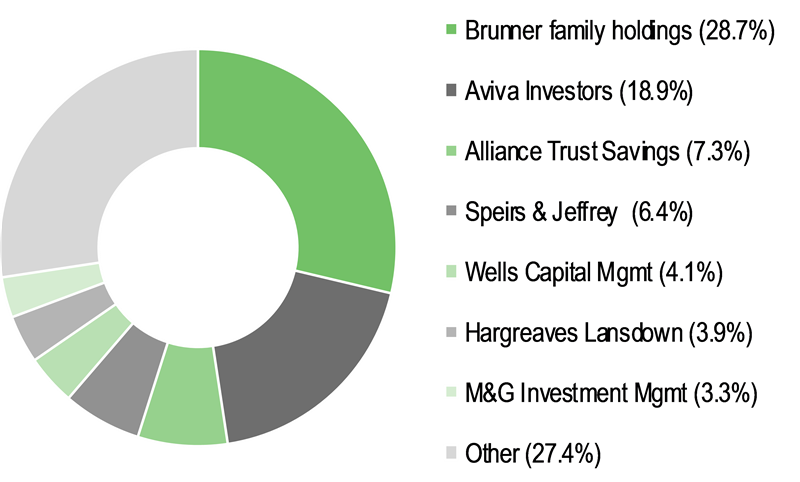
BUT was launched in 1927 to manage the wealth of the Brunner family, which still owns c 30% of the shares (Exhibit 1). The trust is a global, actively managed equity fund seeking capital and dividend growth. BUT has a 46-year record of real (above the level of UK inflation) dividend growth. Since June 2016, it has been managed solely by Lucy Macdonald, chief investment officer for global equities at Allianz Global Investors (AllianzGI), who works closely with UK fund manager Matthew Tillett. She has increased the fund’s concentration and active share (now c 85%). Previously, BUT had two lead managers, each running a distinct pool of assets: a UK equity and an overseas equity portfolio. The trust is now benchmarked against a composite measure of 70% FTSE All-World ex-UK and 30% FTSE All-Share indices (previously 50:50). This year, key developments have included the repayment of BUT’s two high-cost debentures, which have been replaced with significantly cheaper debt, resulting in a much more straightforward capital structure and increased financial flexibility. To ensure adequate diversification of risk, the trust’s portfolio must contain at least 50 holdings, spread by geography and sector; at the time of investment, a maximum 10% may be in a single position. Gearing of up to 20% of NAV, at the time of borrowing, is permitted; net gearing was 6.8% at end-September 2018.
The fund manager: Lucy Macdonald
The manager’s view: Markets playing out as expected
Macdonald says that in terms of her outlook for global stock markets at the start of the year, 2018 is playing out as expected. A decade on from the global financial crisis, it appears that liquidity, earnings growth and equity valuations have peaked, which suggest more modest share price total returns going forward. In this environment, Macdonald believes that successful stock picking will be key to generating an adequate return for investors.
Share prices have been buoyed in recent years by ample liquidity. However, this looks to have peaked in the US, where the Federal Reserve has moved away from quantitative easing, and investors are now increasingly concerned about the pace and magnitude of US interest rate rises. Macdonald believes that liquidity has been a critical support for asset prices in recent years, so will be the most important factor for equity returns as it is withdrawn. She also notes that US earnings growth in 2018 has been very strong (c +20%) because of tax reform, the benefits of which will diminish in 2019. While earnings growth was particularly strong in H118, the manager says that the negative effects of the US’s protectionist trade policies are now starting to affect corporate earnings.
In terms of valuation, looking at the cyclically adjusted P/E ratio, multiples remain high. Macdonald says that as interest rates normalise, equity valuations are likely to decline, leading to a less exciting period for asset prices. She believes that quality companies will outperform the broader stock market, and firms with low levels of debt should do relatively better in a rising interest rate environment. The manager argues that value stocks in general do not look particularly attractive, and that many cheaper companies are ‘cheap for a reason’, such as those in the telecom sector.
Asset allocation
Investment process: Bottom-up stock selection
Lead manager Macdonald selects stocks on a bottom-up basis, while taking account of the macro environment, aiming to generate long-term growth in capital and income. She is able to draw on the very deep resources of AllianzGI’s investment team, which includes a global network of fund managers and analysts. Along with fundamental company research, team members focus on the macroeconomic background; systematic research; environmental, social and governance (ESG) factors; and AllianzGI’s proprietary Grassroots market research. All of the investment team have access to Salesforce Chatter, an online investment discussion platform, which Macdonald describes as a very important, vast resource for sharing and debating investment ideas across geographies and industries.
Grassroots is a non-financial research function, used to complement financial and ESG research. It is used to investigate specific elements of the investment case. Resources include 10 internal staff, 61 reporters and more than 50,000 industry contacts. An example of a Grassroots case study relates to BUT’s holding in Richemont, where the team investigated Chinese watch inventory levels following a downturn in the luxury goods market. The team determined that there was strong underlying demand for premium watches, led by consumers trading up and a shrinking price gap between high-end watch prices in China and abroad. Another investigation centred on kitchen supplier Howden Joinery, whose share price fell following the UK’s EU referendum in 2016. The company has quality and growth attributes, with a high market share in the trade channel. The Grassroots survey showed that Howden’s fundamentals remained strong, and that it was continuing to increase market share despite a weak operating environment.
Over time, BUT’s portfolio has become more concentrated. It currently holds 65 positions, filtered down from an investible universe of c 2,300 companies. This compares with c 100 holdings in 2013, and the trust now has a higher exposure to overseas equities. Macdonald seeks reasonably priced companies with strong fundamentals, robust balance sheets, and a well-respected management team. She aims to generate excess returns of 2-3% pa on a three- to five-year view.
Current portfolio positioning
The trust’s geographic exposure is shown in Exhibit 3. The largest increase in 12 months to end-September 2018 was +9.1pp in North America, where BUT is now modestly overweight compared with the composite benchmark; the manager is also maintaining a meaningful overweight exposure to continental European equities (+11.0pp). UK exposure continues to decline, but remains above 25% of the portfolio as BUT holds some higher-yielding stocks such as HSBC, BP and Royal Dutch Shell, which contribute towards the trust’s dividend payments. However, the manager notes that there is now a greater number of dividend yield and dividend growth opportunities in overseas markets compared with history. As a result, over time, BUT’s higher-yielding UK positions may be reduced, with the proceeds recycled into higher-growth overseas companies.
Exhibit 3: Portfolio geographic exposure vs benchmark (% unless stated)
Portfolio end- |
Portfolio end- |
Change |
Benchmark |
Active weight |
Trust weight/ |
|
North America |
43.4 |
34.3 |
9.1 |
42.2 |
1.2 |
1.0 |
UK |
27.1 |
33.1 |
(6.0) |
30.0 |
(2.9) |
0.9 |
Europe ex-UK |
22.0 |
20.8 |
1.2 |
11.0 |
11.0 |
2.0 |
Pacific ex-Japan |
5.3 |
7.9 |
(2.6) |
9.0 |
(3.7) |
0.6 |
Japan |
2.2 |
2.5 |
(0.3) |
6.2 |
(4.0) |
0.4 |
Latin America |
0.0 |
1.4 |
(1.4) |
0.9 |
(0.9) |
0.0 |
Middle East & Africa |
0.0 |
0.0 |
0.0 |
0.8 |
(0.8) |
0.0 |
100.0 |
100.0 |
100.0 |
Source: The Brunner Investment Trust, Edison Investment Research, FTSE Russell. Note: Excludes cash. Benchmark is 70% FTSE All-World ex-UK Index and 30% FTSE All-Share Index.
The trust’s sector exposure is shown in Exhibit 4. There have been modest changes over the last 12 months, with higher weightings to the technology (+2.4pp) and healthcare sectors (+2.1pp) and a lower weighting to the industrials sector (-3.1pp).
Exhibit 4: Portfolio sector exposure vs benchmark (% unless stated)
Portfolio end- |
Portfolio end- |
Change |
Benchmark |
Active weight |
Trust weight/ |
|
Financials |
22.5 |
23.0 |
(0.5) |
22.4 |
0.1 |
1.0 |
Industrials |
18.7 |
21.8 |
(3.1) |
12.6 |
6.1 |
1.5 |
Healthcare |
13.8 |
11.7 |
2.1 |
10.7 |
3.1 |
1.3 |
Technology |
13.0 |
10.6 |
2.4 |
11.9 |
1.1 |
1.1 |
Consumer services |
7.9 |
8.8 |
(0.9) |
11.5 |
(3.6) |
0.7 |
Consumer goods |
7.5 |
7.5 |
0.0 |
11.6 |
(4.1) |
0.6 |
Oil & gas |
7.1 |
6.4 |
0.7 |
8.6 |
(1.5) |
0.8 |
Basic materials |
6.0 |
6.0 |
0.0 |
5.2 |
0.8 |
1.2 |
Utilities |
2.5 |
2.4 |
0.1 |
2.8 |
(0.3) |
0.9 |
Telecommunications |
1.0 |
1.9 |
(0.9) |
2.7 |
(1.7) |
0.4 |
100.0 |
100.0 |
100.0 |
Source: The Brunner Investment Trust, Edison Investment Research, FTSE Russell. Note: Excludes cash. Benchmark is 70% FTSE All-World ex-UK Index and 30% FTSE All-Share Index.
Macdonald is continuing to increase the quality/concentration of BUT’s portfolio. Recent complete disposals include higher-yielding UK telecom stock Vodafone and lower-quality UK financial services company IFG Group, along with Chinese conglomerate Tencent, which had performed particularly well, and UBM, which was taken over by UK publishing and events company Informa.
A strong theme in the portfolio is technological change, which is prevalent across a range of sectors. Macdonald and her team focus on companies that are adapting their businesses to thrive in a world of increased digitisation; those firms that can successfully change are seeing benefits in terms of incremental revenues and lower costs. The manager explains that in a digital age, a company’s annual report is becoming less useful as a guide to the underlying value of a firm’s assets or the costs incurred when doing business. She says that AllianzGI’s deep resources mean that its fund managers and analysts are able to gain a deeper understanding of a company’s changing business model. As an example, BUT has a position in US laboratory instrument firm Agilent, which is investing for its future in a digital world. Because of the cost of this increased capex, its earnings are currently depressed. However, Macdonald is confident in the company’s long-term growth prospects.
Performance: Improvement under sole manager
|
Exhibit 5: Investment trust performance to 31 October 2018 |
|
Price, NAV and benchmark total return performance, one-year rebased |
Price, NAV and benchmark total return performance (%) |
|
|
|
Source: Thomson Datastream, Edison Investment Research. Note: Three-, five- and 10-year performance figures annualised. Composite benchmark prior to 26 March 2008 was 60% FTSE All-Share/40% FTSE All-World ex-UK, from 26 March 2008 to 21 March 2017 it was 50% All-Share/50% All-World ex-UK, and 30% All-Share/70% All-World ex-UK from 22 March 2017. |
|
Exhibit 6 shows BUT’s relative performance. Its NAV total return is ahead of the benchmark over three and five years, while lagging over one and 10 years, and its share price has outperformed the benchmark over three, five and 10 years. For UK investors, it is interesting to note BUT’s much higher total returns in both NAV and share price terms compared with the FTSE All-Share index over three, five and 10 years, illustrating the potential benefits of investing in overseas rather than UK equities.
|
Exhibit 6: Share price and NAV total return performance, relative to indices (%) |
||||||||
|
One month |
Three months |
Six months |
One year |
Three years |
Five years |
10 years |
|
Price relative to benchmark |
(1.8) |
(1.8) |
(6.5) |
(4.3) |
2.1 |
3.4 |
6.7 |
|
NAV relative to benchmark |
(0.7) |
0.3 |
(2.2) |
(2.7) |
2.4 |
1.0 |
(0.9) |
|
Price relative to FTSE All-Share |
(2.0) |
0.8 |
(1.4) |
(0.4) |
15.9 |
23.4 |
28.6 |
|
NAV relative to FTSE All-Share |
(1.0) |
3.0 |
3.1 |
1.3 |
16.1 |
20.5 |
19.5 |
|
Price relative to FTSE AW ex-UK |
(1.6) |
(2.9) |
(8.6) |
(5.8) |
(6.7) |
(9.7) |
(5.5) |
|
NAV relative to FTSE AW ex-UK |
(0.5) |
(0.8) |
(4.4) |
(4.2) |
(6.5) |
(11.8) |
(12.2) |
|
|
Source: Thomson Datastream, Edison Investment Research. Note: Data to end-October 2018. Geometric calculation. |
||||||||
|
Exhibit 7: NAV total return performance relative to benchmark over three years |
||||||||
|
||||||||
|
Source: Thomson Datastream, Edison Investment Research |
||||||||
While BUT’s relative and absolute share price and NAV performance has struggled in recent months (Exhibit 5), a period which has been characterised by higher stock market volatility, Macdonald has outperformed the benchmark by c 2.5pp since becoming sole manager on 23 June 2016 (Exhibit 7).
Discount: Significantly narrower since early 2017
Following the restructuring of BUT’s high-cost debt, its discount with debt at market value is now broadly similar to its discount with debt at par (Exhibits 8 and 9). Its current 11.1% share price discount to cum-income NAV (with debt at market value) compares with the 9.9% to 12.8% range of averages over the last one, three, five and 10 years. There is scope for BUT’s discount to narrow given its simplified capital structure may hold greater investor appeal, and if Macdonald is able to build on her record of outperformance versus the benchmark since becoming sole manager.
|
Exhibit 8: Three-year discount to NAV (debt at par or book value) |
Exhibit 9: Three-year cum-income discount (debt at fair or market value) |
|
|
|
Source: Thomson Datastream, Edison Investment Research |
|
Exhibit 8: Three-year discount to NAV (debt at par or book value) |
|
|
Source: Thomson Datastream, Edison Investment Research |
|
Exhibit 9: Three-year cum-income discount (debt at fair or market value) |
|
|
Source: Thomson Datastream, Edison Investment Research |
Capital structure and fees
BUT is a conventional investment trust with one class of share; there are 42.7m ordinary shares in issue. The trust historically had a significant amount of high-cost debt, which was taken on when interest rates were much higher than current levels. A c £18m, 11.125% stepped interest rate loan was repaid on the 2 January 2018 maturity date, and the £28m, 9.25% fixed-rate loan with a 2023 maturity date was repaid early, in June 2018. While there was a modest 0.7% reduction in BUT’s NAV as a result of the early repayment, the board considered this was outweighed by the advantages of lowering the trust’s interest repayments, boosting dividend cover, and making its capital structure much more straightforward. It took advantage of prevailing low interest rates to take out a £25m, 30-year private placement note with a coupon of 2.84%. BUT also has a £10m, short-term revolving credit facility, to provide additional flexibility when required, along with £0.5m of 5% cumulative preference shares. The board believes that global equity markets should be able to generate a total annual return well in excess of 2.84%, so the debt refinancing will have long-term benefits for BUT’s shareholders. At end-September 2018, the trust had net gearing of 6.8%.
AllianzGI is paid an annual management fee of 0.45% of BUT’s net assets minus short-term liabilities, excluding any funds managed by AllianzGI. The ongoing charge in FY17 was 0.72%, which was 6bp lower than in FY16.
Dividend policy and record
BUT’s chairman says that the board works very hard to plan for real dividend growth, and the annual distribution has increased for the last 46 consecutive years. So far in FY18, three interim dividends of 4.05p per share have been declared. The board anticipates that, barring unforeseen circumstances, the final dividend will be 6.00p (in line with FY17), which will mean a total dividend of 18.15p for FY18 (+10% versus 16.50p in FY17, and a five-year compound annual growth rate of 4.6%). Any excess revenues are added to reserves, which stood at £15.4m (c 3.5p per share) at end-H118. Based on its current share price, BUT offers a dividend yield of 2.5%, which is above the average of its peers (Exhibit 10).
Peer group comparison
In Exhibit 10, we show the funds in the AIC Global sector with UK exposure between 15% and 45%. BUT’s NAV total returns, with debt at par value, are below average over the periods shown. Its discount remains one of the widest in the selected peer group, despite its simplified capital structure. Gearing is broadly average, while the trust has an above-average yield, ranking third.
Exhibit 10: Selected global peer group as at 14 November 2018*
% unless stated |
Market |
NAV TR |
NAV TR |
NAV TR |
NAV TR |
Discount |
Ongoing charge |
Perf. |
Net gearing |
Dividend yield |
Brunner |
309.1 |
(4.6) |
40.2 |
47.3 |
189.6 |
(11.1) |
0.7 |
No |
107 |
2.5 |
Bankers |
1,002.9 |
(1.7) |
48.2 |
64.2 |
226.3 |
(2.7) |
0.4 |
No |
102 |
2.4 |
BMO Global Smaller Companies |
806.4 |
0.7 |
45.6 |
71.0 |
366.7 |
(0.1) |
0.6 |
No |
104 |
1.1 |
JPMorgan Elect Managed Growth |
250.4 |
1.3 |
38.6 |
57.0 |
249.8 |
(1.1) |
0.6 |
No |
100 |
1.7 |
Law Debenture Corporation |
661.9 |
(2.3) |
35.0 |
45.7 |
216.6 |
(11.1) |
0.4 |
No |
115 |
3.1 |
Lindsell Train |
251.0 |
19.2 |
112.5 |
194.0 |
541.9 |
52.9 |
0.9 |
Yes |
100 |
1.7 |
Majedie Investments |
141.6 |
0.1 |
33.1 |
62.0 |
101.9 |
(15.8) |
1.1 |
No |
111 |
3.9 |
Scottish Investment Trust |
627.6 |
0.1 |
47.2 |
54.2 |
178.4 |
(8.2) |
0.5 |
No |
100 |
1.8 |
Witan |
1,825.1 |
(2.2) |
45.4 |
62.9 |
246.6 |
(0.9) |
0.8 |
Yes |
119 |
2.2 |
Average (9 funds) |
652.9 |
1.2 |
49.5 |
73.2 |
257.5 |
0.2 |
0.7 |
106 |
2.3 |
|
BUT rank in sector |
6 |
9 |
6 |
8 |
7 |
8 |
4 |
4 |
3 |
Source: Morningstar, Edison Investment Research. Note: *Performance to 13 November 2018. TR = total return. Net gearing is total assets less cash and equivalents as a percentage of net assets.
The board
BUT’s board has five non-executive, independent directors: Carolan Dobson (chairman since March 2016, and appointed to the board in December 2013), Vivian Bazalgette (senior independent director, who joined the board in January 2004), Ian Barlow (appointed in November 2009), Peter Maynard (appointed in October 2010) and Jim Sharp (appointed in January 2014).
|
|
Investment Companies
Lighthouse (LGT) has announced a strategic agreement with Tavistock Investments (TAVI) that will provide it with access to Tavistock’s investment solutions. This will help deliver the broader offering Lighthouse seeks for its in-house asset management arm, Luceo. In conjunction with this agreement, Lighthouse has subscribed £1m to Tavistock’s £1.25m equity fund-raising giving it a 5.3% stake. Our valuation (c 44p) and estimates are unchanged at this stage.