Last close As at 05/08/2026
—
— 0.00 (0.00%)
Market capitalisation
—
Research: Investment Companies
European Assets Trust
Written by
European Assets Trust |
Small-cap growth with high distribution policy |
Investment companies |
11 May 2016 |
Share price/discount performance
Three-year cumulative perf. graph
Gearing
Analysts
|
|||||||||||||||||||||||||||||||||||||||||||||||||||||||||||||||||||||||||||||||
European Assets Trust (EAT) invests in small- and mid-cap companies in Europe with the aim of achieving capital growth. A 6% annual distribution policy has found favour with investors in the low interest rate environment, narrowing the discount in recent years. While short-term performance has been behind the Euromoney Smaller Europe ex-UK index, largely because of a poor showing from some financial services holdings, the fund has a strong long-term track record versus both the index and its peer group. A concentrated portfolio that blends sustainably growing companies with recovery situations, but always with a keen focus on valuation, should mean EAT is capable of benefiting from a range of market conditions.
12 months ending |
EAT share price (%) |
EAT NAV |
Euromoney Smlr Eur ex UK (%) |
FTSE AW Europe ex UK (%) |
FTSE All-Share (%) |
30/04/12 |
(10.3) |
(9.8) |
(24.5) |
(19.8) |
(2.0) |
30/04/13 |
52.9 |
33.6 |
23.6 |
26.7 |
17.8 |
30/04/14 |
25.5 |
22.2 |
29.2 |
13.3 |
10.5 |
30/04/15 |
19.4 |
19.2 |
3.7 |
6.9 |
7.5 |
30/04/16 |
0.9 |
0.7 |
5.8 |
(3.8) |
(5.7) |
Note: Twelve-month rolling discrete £-adjusted total return performance.
Investment strategy: Seeking growth with value
EAT’s manager Sam Cosh works with the European equities team at BMO Global Asset Management to sift the universe (c 2,000) of small- and mid-cap stocks in Europe ex-UK, looking for those that are well financed, cash generative and able to produce high returns on capital. The manager seeks a margin of safety in valuations, and all holdings are assigned price targets. The 40-60 stock portfolio blends fast-growing companies, those offering more sustainable growth, and out-of-favour situations with potential to achieve capital growth in a variety of market conditions.
Market outlook: Caution advisable amid volatility
Equity markets around the world have been volatile in recent months, with falls at the beginning of the year largely being recouped in March and April. The causes of the more fearful climate – including slowing global growth and the looming EU referendum in the UK – have not gone away, and lower trading volumes in the summer months may mean the volatility is likely to persist. We believe a strategy of seeking soundly financed companies at attractive valuations is sensible for long-term investors in such an environment.
Valuation: High yield drives consistent premium
At 9 May 2016, EAT’s shares were trading at a 1.4% premium to net asset value. This is below the 12-month high of 3.7% reached in early February but above the 1.1% average for the past 12 months. In an environment of ultra-low interest rates EAT’s high distribution policy (current yield of 5.7%) has led to strong demand for the shares, which have traded at an average premium of 0.2% over three years. EAT has reacted to this demand by issuing new shares, raising £183.5m since 2013, more than half of which occurred in 2015.
Exhibit 1: European Assets Trust at a glance
Investment objective and fund background |
Recent developments |
||||||||||||||||||||||||||||||||||||||||||||||||||||||||||||||||||||||
European Assets Trust is an investment company incorporated in the Netherlands and listed on the LSE and Euronext Amsterdam. It targets capital growth through investment in quoted small and medium-sized companies in Europe (ex-UK), taking the Euromoney Smaller European Companies (ex-UK) index as a benchmark. It has adopted a high distribution policy; dividends have been paid from a combination of income and capital. |
■ 10 May: All resolutions passed at general meeting. ■ 16 March 2016: Annual results for the 12 months ended 31 December 2015. Sterling NAV total return of 20.5% compared with 17.2% for benchmark. Share price total return of 20.4%. ■ 7 January 2016: Dividend of €0.912 per share declared for 2016, up 20.3%. |
||||||||||||||||||||||||||||||||||||||||||||||||||||||||||||||||||||||
Forthcoming |
Capital structure |
Fund details |
|||||||||||||||||||||||||||||||||||||||||||||||||||||||||||||||||||||
AGM |
May 2016 |
Ongoing charges |
1.1% |
Group |
BMO Global Asset Mgt (formerly F&C) |
||||||||||||||||||||||||||||||||||||||||||||||||||||||||||||||||||
Interim results |
August 2016 |
Gearing |
1.28% net (31 Mar 2016) |
Managers |
Sam Cosh |
||||||||||||||||||||||||||||||||||||||||||||||||||||||||||||||||||
Year end |
31 December |
Annual mgmt fee |
0.8% of gross assets |
Address |
Exchange House, Primrose Street, London, EC2A 2NY |
||||||||||||||||||||||||||||||||||||||||||||||||||||||||||||||||||
Dividend paid |
January, May, August |
Performance fee |
None |
||||||||||||||||||||||||||||||||||||||||||||||||||||||||||||||||||||
Launch date |
1972 |
Trust life |
Indefinite |
Phone |
+44 (0)800 136420 |
||||||||||||||||||||||||||||||||||||||||||||||||||||||||||||||||||
Continuation vote |
None |
Loan facilities |
€45m with Kas Bank |
Website |
|||||||||||||||||||||||||||||||||||||||||||||||||||||||||||||||||||
Dividend policy and history |
Share buyback policy and history |
||||||||||||||||||||||||||||||||||||||||||||||||||||||||||||||||||||||
Three dividends are paid annually (January, May and August) totalling 6% of the opening NAV (in euros) at the start of the financial year. |
EAT is authorised to both repurchase and allot its ordinary shares. The chart of buybacks and issuance excludes shares issued as scrip dividends. |
||||||||||||||||||||||||||||||||||||||||||||||||||||||||||||||||||||||
|
|
||||||||||||||||||||||||||||||||||||||||||||||||||||||||||||||||||||||
Shareholder base (as at 29 February 2016) |
Portfolio exposure by geography (as at 31 March 2016) |
||||||||||||||||||||||||||||||||||||||||||||||||||||||||||||||||||||||
|
|
||||||||||||||||||||||||||||||||||||||||||||||||||||||||||||||||||||||
Top 10 holdings (as at 31 March 2016) |
|||||||||||||||||||||||||||||||||||||||||||||||||||||||||||||||||||||||
|
|||||||||||||||||||||||||||||||||||||||||||||||||||||||||||||||||||||||
Source: European Assets Trust, Edison Investment Research, Morningstar, Thomson Datastream. Note: *N/A where not in March 2015 top 10.
Market outlook: Proceed with caution
World equity markets took a dive at the start of 2015 but staged something of a recovery in March and April this year. As shown in Exhibit 2 below (left-hand chart), European markets had lagged the world index over much of the past five years, partly as a result of a series of sovereign debt and banking crises in the eurozone, and partly because the US, which dominates the world index, had enjoyed a strong run of performance. For much of this period European smaller companies had underperformed their larger brethren, but since converging in mid-2014, small-caps (as measured by the Euromoney Smaller Europe ex-UK index) have pulled ahead of large-caps (measured by the FTSE AW Europe ex-UK index) to catch up with the five-year total return of the FTSE World index.
|
Exhibit 2: Market valuation and performance |
|
European and world index total returns over five years |
Valuation metrics for European small cap, large cap and world |
|
|
|
Source: Thomson Datastream, MSCI, Edison Investment Research |
|
A side effect of this recovery has been that on a range of valuation metrics (right-hand chart), small caps arguably look less attractive at this point. Volatility is likely to continue in the face of the UK’s EU referendum, cooling global growth, fears of a hard landing in China and continued divergences in global monetary policy. In light of this, investors may be wary of committing to equity markets, particularly as the summer months (often characterised by thin trading volumes) approach. However, we believe an approach that seeks well-financed, growing companies at sensible valuations may help to overcome some of the likely pitfalls in such a market environment.
Fund profile: Targeting growth with high distributions
EAT began as a Dutch company in 1972 and is listed on the London and Amsterdam stock exchanges. It invests in small- and mid-cap companies in Europe, with the aim of achieving capital appreciation from this faster-growing segment of the market. It has been managed by the same firm since launch, though the manager has been through several name changes and is now BMO Global Asset Management (formerly F&C). The portfolio manager, Sam Cosh, (who is assisted by Lucy Morris and the BMO GAM European equities team) has been in the post since 2011.
While the European small- and mid-cap sector is not a high-yielding part of the market, the fund adopted a high distribution policy in 2001, initially as a way of distributing its reserves in a tax-efficient manner following a rule change in the Netherlands. Each year on 1 January a distribution is declared, calculated at 6% of the euro-denominated NAV at 31 December (the year-end). Depending on performance during the year, this may be funded from capital as well as income. The high yield has led to strong demand for EAT’s shares in an environment of low interest rates, and the fund has consistently traded at a premium to NAV, issuing £183.5m of new shares since 2013 to meet demand.
The fund manager: Sam Cosh
The manager’s view: Balance between quality and value
EAT’s manager Sam Cosh and his team have been taking advantage of recent market volatility to add to quality names that had become too expensive in the momentum-driven markets of 2015, although he notes that in aggregate, quality growth continues to present a challenge in terms of valuation. While March and April saw something of a recovery from the sharp falls in January and February, Cosh argues that volatility is set to continue in the near term, with fears over the impact of the UK’s EU referendum on the rest of Europe adding to the already present worries over slowing global economic growth, a hard landing in China and divergences in monetary policy.
One sector in the portfolio that has suffered in recent months is financials. However, Cosh says that EAT’s Italian financial stocks are likely to be less directly affected in the long term by current fears over the impact of non-performing loans (NPLs) on the country’s banking sector. The one Italian bank in the portfolio – Credito Emiliano – is a quality bank with conservative lending criteria, and its NPLs have been consistently low.
While the outlook for corporate earnings in Europe has deteriorated, Cosh says that broadly the portfolio has held up well in the recent earnings season, with many stocks producing results in line with or better than the market’s expectations. However, lower aggregate earnings forecasts are causing market volatility driven by investor risk aversion, and the manager argues that for Europe to look really attractive, there needs to be more evidence of a sustainable profits recovery.
With quality stocks (see Investment process, below) looking expensive, Cosh says he continues to believe that a balanced portfolio is the right way forward, with exposure to out-of-favour companies and sectors (such as financials) adding greater potential for reward alongside those where growth looks sustainable but is likely to be slower.
Asset allocation
Investment process: Finding a margin of safety
The small- and mid-cap market in Europe is large and diverse, with c 2,000 quoted companies, while EAT’s portfolio is a concentrated list of c 40-50 stocks. To arrive at his final selections, EAT’s manager Sam Cosh works with the European equities team at BMO Global Asset Management (formerly F&C) to analyse the universe. The portfolio managers and analysts in the team all undertake company meetings and research. Ideas may come from the team’s sector knowledge, quantitative screens or suggestions from brokers, with company meetings often the first stage in deciding whether to undertake more detailed fundamental research. The output of this research is a report following a standardised format; these are debated at twice-weekly team meetings and a qualitative score is assigned to each stock. EAT seeks a margin of safety in valuations and favoured stocks may go on to what the manager calls a ‘patient fishermen’ list if the team feels the current share price is too high. Several recent purchases have come from this list after the market correction brought them to more favourable levels.
The EAT portfolio is organised into four broad categories or (carrying on the fishing analogy) ‘buckets’. These are defined as follows:
■
Durable franchise – the core holdings, usually making up 40-50% of the portfolio (41.8% at the 31 December 2015 year-end). These are quality companies with robust business models, disciplined management teams and at least modest growth potential.
■
Wide moat growth – faster-growing companies that have a unique product, a strong brand or a high market share in a competitive industry. These typically make up 25-30% of the portfolio, but were slightly above this range at 34.4% at 31 December.
■
Transformation/recovery – undervalued stocks that have an identifiable catalyst for change, such as a new management team. Usually 15-20% of holdings, this category made up 16.7% of the portfolio at the year-end.
■
Deep value – a small proportion of the portfolio (typically 10-15% but only 7.1% at 31 December) is invested in companies that are out of favour with investors, but where the team feels that recovery or growth potential has not been appreciated by the market.
In broad terms, the managers see companies in the first two categories as ‘quality’ stocks, and those in the latter two as ‘value’ stocks.
Holdings are monitored against price targets and a review process is triggered when they reach those targets, or if the share price has risen or fallen by more than 25% relative to the benchmark. Stocks may also be sold if developments occur that call the original investment thesis into question.
Current portfolio positioning
At 31 March EAT had 43 holdings, the shortest stock list in its peer group. The top 10 stocks made up 35.5% of the total, up from 32.6% a year previously. This is also more concentrated than the peer-group average. In spite of the concentrated portfolio, EAT is geographically diversified, with holdings spread across more than 12 countries in Europe. The biggest change to country weightings over the past 12 months is a 4.8 percentage point fall in exposure to Switzerland, caused partly by the sale of financial services stock Partners Group after its valuation began to look stretched, but also by a difficult period for structured financial products specialist Leonteq.
Exhibit 3: Portfolio sector exposure (%)
Portfolio end March 2016 |
Portfolio end March 2015 |
Change (% pts) |
|
Industrials |
28.5 |
20.6 |
7.9 |
Consumer goods |
21.9 |
21.4 |
0.5 |
Financials |
20.4 |
31.9 |
(11.5) |
Consumer services |
17.0 |
17.1 |
(0.1) |
Healthcare |
6.1 |
4.6 |
1.5 |
Basic materials |
3.5 |
1.4 |
2.1 |
Technology |
2.6 |
3.0 |
(0.4) |
Telecommunications |
0.0 |
0.0 |
0.0 |
Oil & gas |
0.0 |
0.0 |
0.0 |
100.0 |
100.0 |
0.0 |
Source: European Assets Trust, Edison Investment Research.
The sale of Partners Group and poor performance from a number of holdings has also contributed to the largest change in sector weightings, an 11.5 percentage point drop in exposure to financials. There has been a 7.9 percentage point increase in the industrials weighting to make it the largest sector exposure at 31 March 2016. Part of the increase in industrials was the purchase of wooden window manufacturer Inwido, a Swedish company that operates in markets across Europe. As the European market leader, Inwido benefits from economies of scale and is highly cash-generative. The manager began building a position in the stock in October 2015 and was able to add more during the sell-off in January and February; it is now just outside the top 10 holdings.
Other recent additions to the industrial side of the portfolio include Dutch chemical distributor IMCD, Italian specialist food distributor MARR, and another Italian company, IMA, which makes packaging machinery for the food and pharmaceutical industries.
The manager notes that with quality growth stocks looking expensive and much of the recent recovery focused on bombed-out commodity stocks with unfavourable fundamentals, he and the team will continue to focus on finding cash-generative companies with a margin of safety in their valuations.
Performance: Short-term wobble in long-term trend
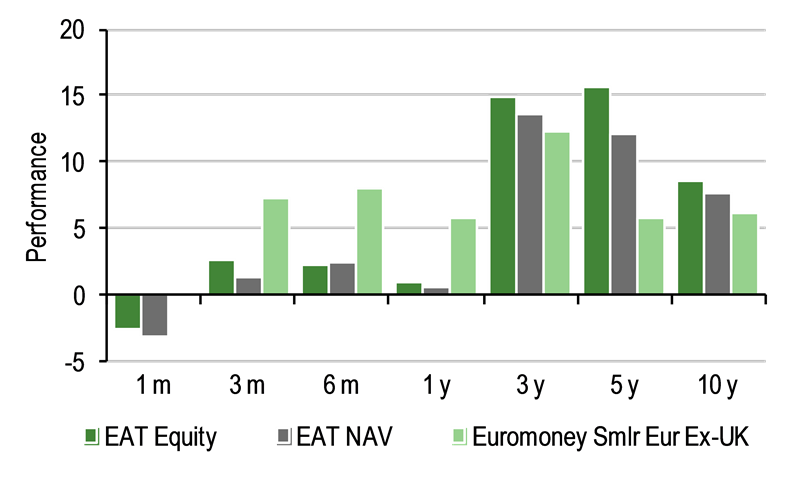
EAT has a strong longer-term performance record, outperforming the Euromoney Smaller Europe ex-UK index in both share price and NAV terms over three, five and 10 years (Exhibit 4, right-hand chart), and the large-cap FTSE AW Europe ex-UK and the FTSE All-Share over all the periods shown in Exhibit 5 except the past three months. Recent performance, while positive in absolute terms over most periods, has lagged the benchmark (Exhibit 4, left-hand chart), with the bulk of the underperformance occurring since the turn of the year. This is principally because of poor performance from the financials sector, where EAT had an overweight position versus the benchmark. March saw the beginning of a recovery in the European small-cap market, which sold off heavily at the start of 2016, and while EAT suffered something of a reversal in both absolute and relative terms during April, Exhibit 6 shows that periods of relative underperformance have historically been fairly short lived.
|
Exhibit 4: Investment trust performance to 30 April 2016 |
|||||||||
Price, NAV and benchmark total return performance, one-year rebased |
Price, NAV and benchmark total return performance (%) |
||||||||
|
|
||||||||
|
Source: Thomson Datastream, Edison Investment Research. Note: Three, five and 10-year performance figures annualised. |
|||||||||
|
Exhibit 5: Share price and NAV total return performance, relative to indices (%) |
|||||||||
|
One month |
Three months |
Six months |
One year |
Three years |
Five years |
10 years |
||
Price relative to Euromoney Smlr Eur Ex-UK |
(2.7) |
(4.3) |
(5.4) |
(4.6) |
6.7 |
56.8 |
25.6 |
||
NAV relative to Euromoney Smlr Eur Ex-UK |
(3.0) |
(5.4) |
(4.9) |
(4.7) |
3.5 |
33.7 |
16.0 |
||
Price relative to FTSE AW Europe Ex-UK |
(2.9) |
(1.8) |
(0.0) |
5.0 |
29.9 |
75.4 |
45.1 |
||
NAV relative to FTSE AW Europe Ex-UK |
(3.2) |
(2.9) |
0.5 |
4.9 |
26.0 |
49.6 |
34.0 |
||
Price relative to FTSE All-Share |
(3.6) |
(1.2) |
2.2 |
7.0 |
35.1 |
60.4 |
44.0 |
||
NAV relative to FTSE All-Share |
(3.9) |
(2.4) |
2.7 |
6.9 |
31.1 |
36.8 |
33.0 |
||
|
Source: Thomson Datastream, Edison Investment Research. Note: Data to end-April 2016, sterling adjusted. Geometric calculation. |
|||||||||
|
Exhibit 6: Five-year NAV performance relative to benchmark |
|||||||||
|
|||||||||
|
Source: Thomson Datastream, Edison Investment Research |
|||||||||
Capital structure and fees
EAT has one class of share, with 32.95m shares in issue at 9 May 2016. In response to strong demand from investors, 10m shares were issued in 2015, raising £109m. This has reduced the ongoing charges on the fund from 1.3% at FY14 to 1.1% at FY15 as a result of spreading fixed costs over a larger asset base. During 2015, EAT was granted the authority to increase the authorised share capital from 30m to 50m shares, and a prospectus was published in July 2015 to enable the issuance of 9m shares in excess of the 10% allotments allowed annually.
FCA Management BV (the Dutch management board) is paid an annual fee (€103,975 for FY15) and F&C Investment Business (the investment manager, a subsidiary of BMO Global Asset Management) receives a quarterly management fee of 0.2% of funds under management, equating to 0.8% annually. EAT has a €45m loan facility with Kas Bank, increased from €25m during 2015. At 31 December, the facility was undrawn, although gearing had varied from -2.2% (a net cash position) to 2.9% geared during the year and stood at 1.3% on 31 March 2016.
Dividend policy and record
Although its primary objective is to achieve capital growth, EAT adopted a high distribution policy in 2001. Under this policy it pays a distribution equal to 6% of the NAV on 1 January (calculated in euros). The dividend is paid in three instalments, in January, May and August, and for UK shareholders the exact amount paid will depend on the sterling/euro exchange rate at the time. Shareholders may also choose to receive their dividend in the form of further shares (a ‘scrip’ dividend). Because the distribution is paid as a fixed percentage of NAV it will vary from one year to the next. For 2016 a distribution of €0.912 per share was declared. The first instalment of this was paid on 29 January, at €0.304 or 23.4p per share in sterling. If the exchange rate were to remain constant for the remaining two distributions the total sterling dividend would amount to 70.2p per share, which represents a dividend yield of 6.5% based on the 9 May share price of 1,072.5p.
Peer group comparison
EAT is a member of the AIC European Smaller Companies peer group, a small sector of four investment companies. While absolute returns have been positive over one, three and five years, EAT’s NAV total return is behind the peer group over one and three years. Over five years it is comfortably in first place, however. Risk-adjusted performance as measured by the Sharpe ratio is in line with the average over three years and behind over one year. Charges are broadly average, as is the level of gearing. As a result of its 6% annual distribution policy, EAT’s yield is the highest by some margin. This makes the shares attractive to income-seeking investors, boosting demand and leading to a small premium to net asset value, while the rest of the peer group trades at a discount.
Exhibit 8: European Smaller Companies peer group as at 3 May 2016
% unless stated |
Market Cap £m |
TR 1 Year |
TR 3 Year |
TR 5 Year |
Ongoing Charge |
Perf. fee |
Discount (ex-par) |
Net Gearing |
Dividend yield (%) |
Sharpe 1y (NAV) |
Sharpe 3y (NAV) |
|
European Assets Trust |
350.1 |
1.4 |
46.3 |
75.4 |
1.1 |
No |
0.5 |
101.0 |
5.3 |
(0.2) |
0.9 |
|
JPMorgan European Smaller Cos |
420.4 |
12.9 |
58.6 |
38.7 |
1.3 |
No |
(11.4) |
98.0 |
1.2 |
0.5 |
1.0 |
|
Montanaro European Smaller |
93.7 |
10.2 |
21.1 |
21.6 |
1.5 |
No |
(10.0) |
112.0 |
1.3 |
0.3 |
0.4 |
|
TR European Growth |
318.8 |
5.9 |
59.6 |
43.8 |
0.8 |
Yes |
(12.0) |
111.0 |
1.5 |
0.1 |
1.1 |
|
Sector weighted average |
7.4 |
52.3 |
49.6 |
1.1 |
(7.9) |
103.5 |
1.6 |
0.2 |
1.0 |
|||
EAT rank in sector |
2 |
4 |
3 |
1 |
2 |
1 |
3 |
1 |
4 |
3 |
||
Source: Morningstar, Edison Investment Research. Note: TR=NAV total return. Sharpe ratio is a measure of risk-adjusted return. The ratios shown are calculated by Morningstar for the past 12- and 36-month periods by dividing a fund’s annualised excess returns over the risk-free rate by its annualised standard deviation. Net gearing is total assets less cash and equivalents as a percentage of net assets (100 = ungeared).
The board
As a Netherlands-incorporated company, EAT has a two-tier board structure. The management board has a single director, FCA Management BV, which is represented by Wilbert van Twuijver and Tim Koster. The supervisory board is similar to the board of directors for a UK investment trust. It currently has four non-executive directors: chairman Jack Perry (a board member since 2014 and chairman since 2015), Professor Robert van der Meer, Julia Bond and Laurence Jacquot. A fifth director, Martin Breuer, has been proposed for election at the May 2016 shareholders’ meeting. Neville Cook and former chairman Sir John Ward both stood down from the board in 2015.
|