Last close As at 05/08/2026
—
— 0.00 (0.00%)
Market capitalisation
—
Research: TMT
Riber is the global leader in molecular beam epitaxy (MBE) equipment. This is used by researchers to develop next-generation compound semiconductor materials used in fibre-optic networks, electronic device displays and sensors for autonomous vehicles as well as for commercial material production. Although the company’s revenue profile is lumpy, we believe that demand should be supported by exposure to key structural trends such as demand for faster data, next generation displays and the proliferation and evolution of sensors to support greater automation and intelligence. The company’s order book points to a recovery in FY19 following a difficult FY18. The shares trade at a substantial discount to Riber’s larger peers who share similar growth drivers.
Written by
Riber |
Enabling electronic devices of the future |
Initiation of coverage |
Tech hardware & equipment |
28 May 2019 |
Share price performance
Business description
Next event
Analysts
Riber is a research client of Edison Investment Research Limited |
||||||||||||||||||||||||||||||||||||||||||||||||
Riber is the global leader in molecular beam epitaxy (MBE) equipment. This is used by researchers to develop next-generation compound semiconductor materials used in fibre-optic networks, electronic device displays and sensors for autonomous vehicles as well as for commercial material production. Although the company’s revenue profile is lumpy, we believe that demand should be supported by exposure to key structural trends such as demand for faster data, next generation displays and the proliferation and evolution of sensors to support greater automation and intelligence. The company’s order book points to a recovery in FY19 following a difficult FY18. The shares trade at a substantial discount to Riber’s larger peers who share similar growth drivers.
Year end |
Revenue (€m) |
PBT* |
EPS* |
DPS |
P/E |
Yield |
12/17 |
30.5 |
4.0 |
0.13 |
0.05 |
10.6 |
3.6 |
12/18 |
31.3 |
2.0 |
0.07 |
0.05 |
19.7 |
3.6 |
12/19e |
37.7 |
4.6 |
0.15 |
0.05 |
9.2 |
3.6 |
12/20e |
35.9 |
4.5 |
0.15 |
0.05 |
9.1 |
3.6 |
Note: *PBT and EPS are normalised, excluding amortisation of acquired intangibles, exceptional items and share-based payments.
Key technology for compound semiconductors
MBE is used to deposit the very thin layers of material forming compound semiconductor materials. The technique enables more precise control of deposition and a wider range of elements than the metal oxide chemical vapour deposition (MOCVD) technique. It is therefore widely used in research to develop new materials. Superior control over deposition results in higher yields within a production environment though throughput is less. Riber has the dominant share in both the R&D (65% in 2018) and production (over 90%) segments.
Strong order book underpins growth
While FY18 profitability was affected by several one-off factors, management is confident of a full recovery in FY19. This is based on the strength of the end March order book, with 14 MBE machines already scheduled for delivery during FY19 and FY20 compared with deliveries of seven units in FY18 and five in FY17. Some of these are destined for volume production of fibre-optic chips in Asia and in Europe, which is rising, necessitating more capacity. Others will be used for R&D, where demand for MBE equipment is steady. Riber is engaged in programmes to develop materials for VCSELs, UV LEDs, micro-LEDs and LiDAR. If successful, these could stimulate demand for higher volumes of production equipment from 2022.
Valuation: Trading at a substantial discount to peers
The share price has halved since June 2018, and Riber is now trading at a discount to both peers with respect to all prospective multiples. While some discount for relative capitalisation and low free float is justified, the size of the discount (year one EV/Sales multiple of 0.7x for Riber vs 2.3x for our sample mean) is, in our opinion, unwarranted. This gives scope for share price appreciation as Riber coverts the strong order book into a sustainable profit recovery.
Investment summary
Company description: Global number one in MBE
Riber is the world’s leading provider of MBE equipment. MBE is a versatile and precise technique for depositing precise amounts of material onto substrates that is used to create innovative semiconductor structures deployed in many novel devices, including high frequency 4G and 5G communications chips, transmit/receive devices for fibre-optic networks and 3D sensing chips for autonomous vehicles. Riber also supplies high-quality material evaporators that are used to make inexpensive thin-film solar cells and displays for organic light-emitting diode (OLED) TVs and in the production of ultra-small silicon transistors that will lead to higher performance PCs.
Financials: Order book underpins FY19 recovery
FY18 sales were 2% higher than FY17, with more MBE system sales (seven delivered vs five in FY17) being balanced by lower evaporator sales. Stripping out one-off items, pre-exceptional operating profit halved. We note that a substantial amount of the difference would have been covered by the incremental profit that would have been realised if deliveries of the two MBE machines that slipped into Q119 had been made on schedule. Profit was also adversely affected by low margins on a complex R&D MBE machine and investment in activities in China and the US intended to support future growth. Noting that the order book at the end of March held 14 MBE systems for delivery in FY18 and FY19, management expects a significant growth in revenues and profitability during FY19 even though sales of evaporator sales have been low since Q318 and it does not expect them to pick up until end FY19. As FY19 performance will be flattered by the two MBE deliveries that slipped into Q119, a small reduction in sales and profits is likely in FY20 unless there is a substantial recovery in evaporator sales during the year or an unexpected increase in demand for either R&D or production MBE equipment ahead of historical norms.
Valuation: Trading at a substantial discount to peers
We base our valuation on a peer multiples approach. We have restricted our sample to the two listed companies that are involved in the development of equipment for manufacturing compound semiconductors since they benefit from similar growth trends to Riber, rather than the wider semiconductor industry. The share price has halved since June 2018, pulled down by the delays in shipping two MBE machines, which adversely affected FY18 performance. Riber is now trading at a discount to both peers with respect to all prospective multiples. While some discount for relative capitalisation and low free float is justified, the size of the discount (year one EV/Sales multiple of 0.7x for Riber vs 2.3x for our sample mean) is, in our opinion, unwarranted. This gives ample scope for share price appreciation as investors gain confidence that Riber can convert the strong order book into a sustainable recovery in profits.
Sensitivities: Exposure to capital equipment cycles
The key sensitivities as we see them are lumpiness of earnings, market cycles, dependence on key suppliers and customers, commodity prices and foreign exchange exposure. The first two are the most significant. Since a single production MBE system can cost €2.2–3.5m, depending on configuration (an R&D system is typically <€1m), and 90% of revenue is recognised on delivery, turnover can fluctuate substantially from quarter to quarter and the final outcome each year is very dependent on the timing of deliveries of individual units. Demand for evaporators is linked to the OLED and solar equipment cycles. Demand for MBE equipment is less dependent on individual cycles because it is deployed in more markets, each following different phasing.
Company description: Global number one in MBE
Riber develops and manufactures MBE machines and evaporators, both of which are used in the manufacture of semiconductors. It is the global market leader for MBE equipment, with the largest installed base of MBE machines in operation (over 730) and more than 50% market share. The MBE portfolio ranges from competitively priced research reactors to substantially larger production machines. Over 80% of the installed MBE base is deployed in universities, research institutes and the research labs of major global corporations. The remainder is deployed in the production facilities of electronic component manufacturers and providers of epitaxial wafers. MBE equipment is used to create compound semiconductor material for a wide range of applications including high frequency 4G and 5G communications chips, terrestrial and submarine fibre-optic networks, light detection and ranging (LiDAR) and night vision sensors. The evaporators are incorporated in equipment for processing thin-film solar cells, OLED displays for smartphones and tablets and OLED lighting. They are sold either to the equipment integrator or direct to the end-user. Riber also derives revenues from providing services to its large installed base of clients.
Exhibit 1: Customer base
Countries |
Clients |
Operational units |
Sample customers |
|
MBE for R&D |
38 |
320 |
c 620 |
Chinese Academy of Sciences, Fraunhofer Institute, Ioffe Physico-Technical Institute, Russian Academy of Sciences, The University of Tokyo, US Naval Research Laboratory |
MBE for production |
10 |
42 |
c 110 |
III-V lab, Acken Optoelectronics, Asahi Kasei, Aselsan, Coherent, IntelliEPI, IQE, Northrup Grumman Space, Phillips Photonics, QDLaser, Raytheon, Teledyne Technologies, Trumpf |
Evaporators |
4 |
9 |
1,000+ |
Canon Tokki, First Solar, Heliatek, Singulus Technologies |
Source: Company data
Riber’s development of MBE systems started in 1976, 12 years after the company was founded, when its expertise in ultra-high vacuum equipment helped academic pioneers create the first commercial MBE deposition systems. Within two years it launched the world’s first turnkey MBE system. During the 1990s, Riber introduced the world’s first high-throughput MBE production reactor. It has strengthened its market position through the acquisition of Addon in 2004, VG Semicon (from Oxford Instruments) in 2008, the assets of US-based MBE Control Systems in 2015 and the assets of SemiPro, a small company ($1.3m annual turnover) providing maintenance services to the US MBE market in February 2019 (this was for an undisclosed sum). Riber’s dominant share in the global MBE market is attributable to the breadth of its portfolio, which supports the widest range of types of alloys that can be deposited. In 2009 Riber launched its first thin-film evaporator system. It listed on NYSE-Euronext Paris in 2000.
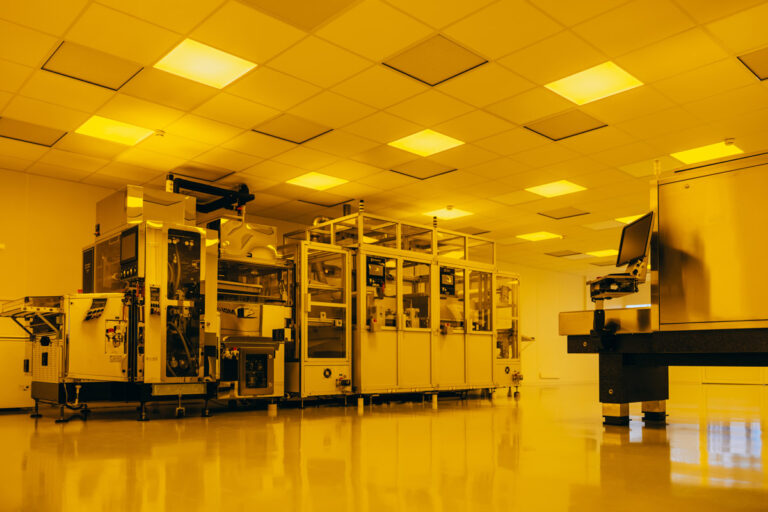
Riber’s headquarters are in Bezons in the suburbs of Paris, where it owns a 3,500m2 facility, including a 1,000m2 clean room with the capacity to output 25 MBE machines annually. The company designs and assembles equipment in Bezons, outsourcing the manufacture of individual components. It has subsidiaries in China (opened H218), Korea and the US, and a network of around 30 agents and distributors. More than 90% of revenues are generated from exports to customers elsewhere in Europe and in the US, Canada, Mexico, Japan, China and South Korea. At the end of FY18 it employed 110 people.
Technology
MBE key tool for creating multi-layer structures
Semiconductor devices consist of very thin films of compound semiconductor materials with differing electronic and optical properties stacked up like a many-layered cake. The behaviour of a device is determined by how electrons move through each layer. For example, a transistor acts as a switch by only allowing electrons to pass through a stack when a voltage is applied across the top and bottom layers of the stack. Different structures where electrons are converted to light energy as they pass through specific layers form LEDs (light-emitting diodes) and lasers. Varying the composition of the layer where electricity to light conversion takes place causes a different colour of light, including UV (ultra-violet) or IR (infra-red) wavelengths, to be produced.
|
Exhibit 2: MBE process |
|
|
Source: Edison Investment Research |
These complex structures cannot be realised using standard silicon chip fabrication technology. Specialist equipment such as MBE or MOCVD (see below) reactors are required. Device performance depends on achieving very precise control over the thickness and composition of each layer. MBE achieves this by generating individual streams of molecules by heating solid or gaseous materials, directing these beams onto a substrate material and turning the stream on and off with a computer-controlled shutter or valve with a very quick response time (typically 0.6 seconds) For example, a layer of gallium arsenide is created by directing beams of gallium (Ga) and arsenic (As) onto the substrate. When the atoms arrive on the substrate, they combine to form GaAs (gallium arsenide). Small amounts of other elements may be added to the mixture. For example, adding aluminium (Al) results in the formation of a layer of gallium aluminium arsenide (GaAlAs), which is commonly used in GaAs-based red and IR laser diodes. The entire process takes place in an ultra-high vacuum to ensure very high levels of purity.
MBE market: Size and growth
Since Riber’s MBE equipment may be used to manufacture a wide range of compound semiconductor materials, it is deployed in many markets that have different profiles. This reduces the company’s exposure to any single market but makes it more difficult to predict overall demand beyond the period covered by the order book. Typical applications are 5G/4G/Wi-fi communications, satellite transceivers, FTTH (fibre-to-the-home), LAN (local area network) and submarine fibre-optic networks, laser cutting, infrared and UV detectors used in night vision systems, thermography, medical diagnosis and vegetation mapping, LiDAR systems and magnetic sensors. One of the markets where Riber is well placed to benefit from customers expanding R&D and production capacity is optical fibre networks. According to a report from ReportLinker published in August 2018, the global FFTx (a portmanteau term encompassing fibre to the home (FTTH), fibre to the premises (FTTP) and fibre to the curb (FTTC)) market is expected to grow from US$9.7bn in 2018 to US$14.31bn by 2023, a CAGR of 8.10%. Factors driving growth include rising demand for higher bandwidth and the increased use of fibre for cloud computing services. Riber’s MBE equipment is used to deposit the vital layers that convert electricity to light in optical components.
|
Exhibit 3: Riber MBE equipment |
|
|
Source: Riber |
Emerging markets for MBE equipment include the use of GaN material for UV applications and micro-LEDs. The application areas for UV LED systems have increased steadily over the past five years. The dominant application is UV curing, which includes printing, adhesives and coatings. Other applications are disinfection and purification segments, which are driven by the rising need to stop water- and air-borne diseases. Market growth has benefitted from the worldwide ban on mercury vapour lamps after 2020, combined with reduced prices of UV LEDs and their increased adaptability, efficiency and longevity, which have been made possible by the adoption of next-generation substrates. A report from BIS Research published in February 2018 predicted that the global UV LED market will reach $1,163.5m by 2023. A report by Technavio published in November 2018 predicted that the global UV LED technology market will show a CAGR of 37% between 2017 and 2022. This report cited new applications such as treating seeds, improving the shelf life of agricultural produce and spectroscopy.
With regard to the micro-LED market, which is in its infancy, a report from Transparency Market Research predicts that this will grow from US$51.5m in 2017 to US$286.4m by 2026, a CAGR of 21.1%. The key market driver here is the development of technology that can deliver brighter pictures with less power consumption. Nearer-term near-to-eye cameras and virtual reality and mixed reality (a fusion of actual and virtual worlds) headsets for professional applications are likely to be the dominant applications, but longer-term incorporation of micro-LEDs in consumer devices such as laptops, smartphones and home theatres will become commonplace if, as assumed in the report, the price point reduces to a level where this is economically viable.
Recent independent data on the projected growth rate of the MBE market is scarce. Management notes that demand for R&D equipment is generally stable with total global sales of 10–15 units each year. Purchases are driven by new projects instigated in response to technological challenges: for example, a requirement to shift to larger diameter substrates or renewal of equipment originally purchased in the 1980s or 1990s. There is also demand from economies such as China, India and Russia, which are seeking to develop their own compound semiconductor capability. Demand for production equipment is similar to the semiconductor cycle, though linked to various types of compound semiconductor devices discussed below, so is more variable. Management notes that the global requirement is typically three to six systems each year.
MBE market: Competitive position
There are relatively few other companies globally manufacturing MBE equipment. According to a Yole Développement study published in 2012, US-listed Veeco is the only other company offering high-capacity/high-throughput MBE production tools for manufacturing. Management estimates that in 2018 Riber had over 90% share of this segment. Management believes that this dominant position is attributable to the production output, yield and cost of ownership afforded by the equipment as well as the services and maintenance provided.
There are around 10 other manufacturers offering R&D or pilot-production systems. These include DCA Instruments (Finland), Dr. Eberl MBE-Komponenten (Germany), Eiko (Japan), Scienta Omicron (Germany), SVT Associates (US) and Veeco. Riber has the dominant share of this segment (65% in 2018 according to management estimates) as well. Management believes that the company commands the dominant position in this segment because it supports production of the widest range of alloys including III-V and II-VI compound semiconductors, gallium nitrides, mercury/cadmium/telluride (MCT), SiGe and oxide alloys. As in the production segment, the technical barriers to entry are extremely high, deterring new market entrants.
Competitive epitaxial technologies
The main alternative for creating epitaxial layers is MOCVD. In this technique gases are injected into a chamber containing the substrate, which is heated. When the mixture of gases meets the surface of the hot substrate it reacts, depositing a thin layer of the desired alloy on the substrate. For example a mixture of trimethylindium (In(CH3)3) and phosphine (PH3) reacts to form indium phosphide (InP) and methane (CH4). The indium phosphide is deposited on the substrate and the methane gas is removed from the reactor. We note the following key differences between the two techniques:
■
Throughput: MOCVD can deposit material more quickly than MBE, so for structures such as LEDs, which are composed of relatively thick layers of materials, it is the preferred technology.
■
Uniformity: the MBE technique results in the deposition of a much more uniform layer across the surface of a single wafer or multiple wafers being processed simultaneously. This in turn gives superior yield.
■
Precision: as the MBE technique enables a reactor to switch between source materials more cleanly than MOCVD it is more suitable for devices with thin and alternating layers eg PHEMTs. Additionally, since MBE takes place at a lower temperature than MOCVD, mixing between layers at an interface is less, giving more precise control of the final structure. This is attractive for higher performance device structures such as 850nm vertical cavity surface emitting lasers (VCSELs) for data communications and 940nm VCSELs for high power applications.
■
Material range: MBE enables a wider range of elements to be deposited since the stream of molecules is created by simply heating a sample of the material (eg indium or phosphorus) that is to be deposited. In the MOCVD technique the active elements (indium and phosphorus) need to be converted into a gas containing other elements (hydrogen and carbon). This is not always possible. For example, it is very difficult to get stable antimonide gases. Antimonide-based infra-red detectors are key materials for aerospace sensors and systems, remote sensing, thermal imaging, infrared spectroscopy and LiDAR.
■
Cost: MBE reactors are larger and more expensive than MOCVD reactors because the former operate in an ultra-low vacuum. However, this is partly offset by the more rigorous safety measures required for MOCVD because of the toxic and flammable nature of the gases used.
We note that a high proportion of Riber’s MBE reactors are sold for R&D purposes, reflecting the wider range of materials that may deposited using this technique and the higher levels of control over the deposition process. Within the production environment, the higher throughput of MOCVD reactors has obvious attractions, but MOCVD is not suitable for all types of epitaxy. We note that reactors being installed for the first phase of IQE’s Newport facility are for volume VCSEL production and use MOCVD technology for VCSEL (opto-electronic) epitaxy, while MBE reactors are deployed at some of IQE's other locations where they are used for a variety of applications including IQE's new and emerging technologies. One of these emerging applications, cREO, uses a combination of MBE and MOCVD capabilities.
|
Exhibit 4: Nanorods created using MBE |
Exhibit 5: Quantum dot layer created with MBE |
|
|
|
Source: Riber |
Source: Riber |
|
Exhibit 4: Nanorods created using MBE |
|
|
Source: Riber |
|
Exhibit 5: Quantum dot layer created with MBE |
|
|
Source: Riber |
Diversification into evaporators
Riber has adapted the effusion cells used to generate streams of material inside MBE systems so that they can be used to deposit highly uniform, ultra-thin films of material on much larger substrates. Arrays of point source evaporators are used to deposit the aluminium forming electrical contracts, in OLED displays and lights. Riber sells evaporators to systems integrator Canon Tokii, which serves OLED manufacturers in South Korea and Chinese customers developing OLED manufacturing equipment. It also sells linear evaporators for copper indium gallium selenide (CIGS) thin-film solar cell processes to systems integrator Singulus Technologies, primarily for deployment in China.
Evaporator market
Management estimates that Riber has a 10% share of the global point source evaporator market, which is dominated by two larger Asian-based competitors, and that the market size is several thousand point source evaporators per year depending on investment cycles in the OLED and solar industries and the emergence of new applications. Riber’s principal customer stopped ordering evaporators in H218 because of weakness in its own order book but Riber expects sales to pick up towards the end of 2019. Management believes that Riber’s point source evaporators deposit films that are more uniform with respect to thickness and exhibit a lower number of defects than films deposited by competitive equipment and that RIBER is the only manufacturer to have developed a high precision linear evaporator for depositing the selenium used in CIGS type solar cells. The company is taking share in China following the establishment of a subsidiary in the country in H218 providing local sales and technical support.
Strategy
MBE: R&D
Management’s objective in this segment is to maintain Riber’s global market share above c 60%. This is partly to secure further R&D sales and partly to ensure it stays close to the projects that progress to production so it is well placed to sell production equipment with the appropriate enhancements. The company’s strategy for taking market share is to invest in innovation, typically making relatively small adjustments to components and accessories to support novel processes. For example, it is working with Harvard University to develop a variant of existing MBE technology for depositing oxide layers in micro electro-mechanical systems devices with a higher level of precision than current techniques. It is also adapting R&D equipment so it has the same level of automated process control as production models. As part of this programme it is working with LAAS-CNRS in Toulouse on enhancements to its proprietary control software that will monitor layer growth in real-time and feedback the data to control production temperatures and thus layer growth. Once finalised, this capability would be added to production equipment as well, providing a significant competitive advantage.
MBE: Production
Riber is focusing its sales resource on mainland Europe, where there is a lot of activity in the opto-electronics market, and in China, where the government is developing its own semiconductor industry so it is not dependent on products from companies such as Qorvo or Skyworks. (We note that Riber’s principal competitor, Veeco, may have issues exporting to China, being based in the US.) Riber is less active in the US where there is a lot of spare MBE capacity, for example at one of IQE’s sites, although in February it acquired a service operation in the territory (see above).
Riber is attempting to catalyse market growth higher than the historical average by working with partners to develop new MBE applications. We note that it typically takes seven to 10 years for an initial idea to pass into volume production. Three of the areas closest to commercialisation are LiDAR, VCSELs and ultra-violet light-emitting diodes (UV LEDs). Exhibit 6 shows the expected timescale for meeting major milestones on each of these programmes.
|
Exhibit 6: Timescale for commercialising new industrial markets |
|
|
Source: Riber |
LiDAR
During FY18, Riber delivered an MBE49 variant to the Belgian research institute IMEC for work on antimonide alloys that will potentially be deployed in LiDAR for autonomous vehicles. The project involves work on the stack of layers forming the laser to improve the response time and optimising the process so 4” substrates can be used instead of 2” ones, thus improving throughput. This potentially brings down the cost of production to a price point suitable for widespread adoption. MarketsandMarkets note the LiDAR market was valued at US$677.5m in 2017 and is estimated to reach US$1,809.5m by 2023, a CAGR of 17.2%. The main driver for this growth is navigation and positioning systems in autonomous vehicles.
Opto-electronics: VCSELs
In our November Outlook note on IQE we observed the widespread adoption of VCSELs had been triggered by a switch to 6” substrates, which increased MOCVD throughput, thus supporting a price-point appropriate for mass adoption. However, as noted earlier, uniformity issues with MOCVD have a deleterious impact on yield. Riber is working with IntelliEPI on a new MBE system able to process eight 6” VCSEL wafers simultaneously. In October 2018 MarketsandMarkets predicted the global VCSEL market would rise at a CAGR of 16.9% from $1.78bn in 2018 to $3.89bn by 2023. Growth was attributed mainly to the rising adoption of arrays of VCSELs in proximity sensing and medical applications, data communications, infrared illumination in automobiles for pedestrian detection, collision avoidance, parking assistance, traffic sign recognition and lane departure warning.
UV LEDs
As noted earlier, most LEDs are manufactured using MOCVD technology. However, UV LEDs need high levels of doping to create structures that emit the correct wavelength (colour) light. This is easier to achieve with MBE technology. Riber is working with the Centre de Recherches sur l’HétéroEpitaxie et ses Applications (CRHEA), part of the Université Côte d’Azur on a demonstration UV LED wafer to present to a potential commercial customer for evaluation. During FY18 it worked on an MBE49 GaN variant for fabricating the nitride alloys deployed in this project.
Micro-LEDs
Riber’s project with CRHEA also involves the fabrication of highly doped materials to create red and green coloured micro-LEDs. Here the goal is to process some layers using MOCVD technology and the highly doped active layers in MBE. CRHEA has installed MBE equipment from Riber that is capable of handling the 8” wafers commonly used in MOCVD processes to give high throughput.
Evaporators
|
Exhibit 7: Linear evaporator |
Exhibit 8: Flexible substrate with evaporated layers for CIGS PV (photo-voltaic) |
|
|
|
Source: Riber |
Source: Riber |
|
Exhibit 7: Linear evaporator |
|
|
Source: Riber |
|
Exhibit 8: Flexible substrate with evaporated layers for CIGS PV (photo-voltaic) |
|
|
Source: Riber |
The strategic focus for this product line is the development of a next-generation linear evaporator that extends the potential market. In FY18 Riber began work on a medium-temperature linear evaporator to extend the range of applications of this technology to other industrial sectors. Target markets include battery manufacturing and silicon wafer production where the technology has the potential to deliver more homogenous substrate doping.
Services and accessories
Management has identified this activity as giving potential for delivering high-margin revenue that is less dependent on the overall level of investment in compound semi-conductor, OLED display or sola cell-manufacturing equipment. Its stated objective is to grow annualised revenues to around €12m a year or higher within three years, thus providing a substantial proportion of annual fixed costs. The company has created a dedicated sales and marketing team to actively promote the offer across the company’s extensive installed base. This includes training, consultancy, retro-fit sales of hardware and software, on-site upgrades, in-factory component repairs and refurbishments and preventative or remedial operations at client sites. The recent acquisition of US-based SemiPro is supportive of this goal, as well as furthering the drive to sell MBE equipment in the region.
Management
Chairman Michel Picault: A graduate of Institut National des Sciences Appliquées Lyon, one of the Grandes Écoles, Michel Picault’s first employment was a research post with a government organisation, followed by an R&D role with a French telecom company. Between 1983 and 1997 he worked for Riber in a range of capacities including technical, after-sales service, sales and marketing and production in both the US and France. In 1997 he led a buy-out of Riber and was appointed president of the company. He stepped down from this position in 2008, while remaining member of the executive board until 2014. He left Riber in 2014, working as an adviser for small companies and on funding for start-ups. In 2016 he was invited to rejoin the executive board, to help turn the company round, and was reappointed president of the executive board in 2018.
CEO Philippe Ley: A graduate of Ecole Nationale Supérieure d’Arts et Métiers, one of the Grandes Écoles, Philippe Ley started his career at the international engineering company ASSYSTEM in 1994. He moved to Renault Automation in 1997, where he occupied different managerial positions and became head of engineering at COMAU France, an industrial automation company, in 2001. He joined Riber in 2007 where he was first production director, then operation director and member of the executive board. He left Riber in 2015 to become managing director at ERCA, which produces equipment for manufacturing containers for dairy food. He returned to Riber in 2018, as chief executive officer and member of the executive board.
The former CFO, Guillaume de Belair, resigned in November 2018 having held the position since December 2016. A replacement joined the company in early FY19 but has not yet been appointed to the board.
Sensitivities
The key sensitivities as we see them are:
■
Lumpiness of earnings: since a single production MBE system can cost €2.2–3.5m depending on configuration and 90% of revenue is recognised on delivery, turnover can fluctuate substantially from quarter to quarter and the final outcome each year is very dependent on the timing of deliveries of individual units. The high cost of a single MBE production system also means the proportion of revenues attributable to individual customers in any one year is material, but the customers involved will change from one year to the next.
■
Market cycles: as noted above, demand for evaporators is linked to the OLED and solar equipment cycles. Demand for MBE equipment is less affected by individual market cycles because it is deployed in more markets, each with different phasing.
■
Dependence on individual customers: evaporator sales also depend on the ability of individual systems integrators to secure market share.
■
Dependence on key suppliers: Riber carries out computer numerical control (CNC) milling and welding of R&D systems in-house but does not have the ability to execute these steps for larger production systems. These are outsourced to a specialist that is able to clean the surface of completed chambers so they are suitable for ultra-high vacuum deployment. We note that the slippage of two MBE deliveries from FY18 to Q119, with consequent impact on FY18 performance, was caused by late deliveries of components from suppliers.
■
Commodity prices: the purchase of stainless steel for infrastructure parts and refractory materials some mechanical components represents 2–5% of the cost price of MBE systems. Riber reduces the risk of fluctuations in the prices of these materials by holding buffer stock and diversifying its sources of supply as much as possible.
■
Foreign exchange exposure: Riber prices sales contracts in euros, except for customers in the US, who are billed in US dollars. This is partly balanced by some materials purchases which are denominated in US dollars.
Financials
Strong growth in MBE sales during FY18
In October management had expected 2018 revenues to be €35m but deliveries of two MBE machines slipped into Q119 so the final result was lower than guidance. Sales totalled €31.3m, a 2% increase year-on-year. Sales of MBE systems increased by 33% to €9.6m (Exhibit 9). Seven machines, four of which were for production, were delivered during the period compared with five machines in FY17, two of which were for production. Evaporator sales declined by 19% to €11.6m as shipments to the screen industry substantially reduced during the second half. At €10.0m, revenues from services and accessories were 12% higher than the prior year, reflecting the strategic objective to develop this activity.
Exhibit 9: Segmental revenue, order book analysis and Edison estimates
FY16 |
FY17 |
FY18 |
FY19e |
FY20e |
Q118 |
Q119 |
|
Period end order book – MBE systems (€m) |
5.5 |
12.2 |
22.3 |
20.2 |
25.3 |
||
Period end order book – Evaporators (€m) |
8.8 |
8.7 |
0.8 |
8.3 |
0.1 |
||
Period end order book – Accessories, components and services (€m) |
3.7 |
4.9 |
6.8 |
7.6 |
6.8 |
||
Period end order book – Total (€m) |
18.0 |
25.8 |
29.9 |
36.1 |
32.2 |
||
Number of industrial MBE systems |
2 |
2 |
4 |
7 |
5 |
0 |
2 |
Number of R&D MBE systems |
4 |
3 |
3 |
5 |
5 |
1 |
0 |
Revenue – Industrial MBE systems (€m) |
5.0 |
5.2 |
7.1 |
19.5 |
15.8 |
||
Revenue – R&D MBE systems (€m) |
3.8 |
2.0 |
2.5 |
4.0 |
4.0 |
||
Revenue – all MBE systems (€m) |
8.8 |
7.2 |
9.6 |
23.5 |
19.8 |
0.8 |
4.1 |
Revenue – Evaporators (€m) |
3.0 |
14.4 |
11.6 |
3.0 |
4.0 |
5.2 |
0.8 |
Revenue – Accessories, components and services (€m) |
4.6 |
8.9 |
10.0 |
11.1 |
12.1 |
1.3 |
1.7 |
Total revenues (€m) |
16.5 |
30.5 |
31.3 |
37.7 |
35.9 |
7.3 |
6.6 |
Source: Riber data, Edison Investment Research
Stripping out €0.6m one-off warranty payments from cost of sales, one of which related to an unduly extended installation phase, the other for late delivery, gross margin reduced by 7.1pp to 37.4%. This reflects the lower proportion of evaporators and low margin on a prototype production system, which required more work than is typical. Sales and marketing expenses fell 11% because of lower bonus payments and more effective use of service personnel. Stripping out a €0.4m provision for an adjustment to the research tax credit for 2013–2017, R&D expenses rose by 5% because of a decrease in tax credits following the completion of a joint project with a Belgian laboratory. Stripping out the €1.1m cost of the allocation of shares for a staff bonus scheme, administrative expenses increased by 42%, reflecting the cost of opening a subsidiary in China in H218 and strengthening the company’s presence in North America, a transactional indemnity for a former senior employee and higher directors’ fees. Pre-exceptional operating profit halved to €2.2m. We note that a substantial amount of the difference would have been covered by the incremental profit that would have been realised if deliveries of the two MBE machines that slipped into Q119 had been made on schedule. The dividend was maintained at €0.05/share.
Exhibit 10: Adjustments to FY18 operating profit
Reported |
Adjustment |
Adjustment |
Adjusted |
|
Revenue (€m) |
31.3 |
31.3 |
||
Gross profit (€m) |
11.1 |
0.6 |
Warranty payments |
11.7 |
Operating costs (€m) |
(11.0) |
0.4 |
Provision for R&D tax credits |
(9.5) |
Other charges (€m) |
(0.1) |
0.1 |
Losses on bad debts |
0 |
Operating profit (€m) |
0.0 |
2.2 |
2.2 |
Source: Company data
Strong balance sheet
Net cash reduced by €7.4m to €2.5m during the year as inventory levels rose by €5.4m, reflecting the number of MBE machines under assembly for delivery during FY19. Investment in tangible and intangible assets (software and patents) were both modest (€0.4m and €0.4m respectively). €1.0m cash was distributed as a dividend and €0.5m spent on share buy-backs. The company took on some short-term debt (€0.4m at end-FY18) to cover the cash squeeze caused by the two late deliveries. These machines were delivered during Q119 and management expects the debt to be eliminated by Q319.
Q119 revenues dominated by MBE system revenues
As anticipated, revenues from the sale of MBE systems was substantially higher in Q119 than Q118 because of the slippage of two production systems from end FY18 into the new financial year (see Exhibit 9). With segmental sales derived from the delivery of two production machines rather than a single R&D machine, revenues from MBE equipment quadrupled. Sales of evaporators were €0.8m compared to €5.2m in Q118 reflecting continued low levels of sales to a major customer. Q119 segmental revenues were at a similar level to Q418 (€1.0m) and Q318 (€0.2m). Revenues from services and spares grew by 31% year-on-year as management continued to push this activity. Since the growth in revenues from MBE systems was insufficient to fully compensate for the reduction in evaporator revenues, group sales for the quarter declined by 10% year-on-year to €6.6m.
Order book underpins positive outlook
The order book at the end of March totalled €32.2m compared with €29.9m at the end of December 2018 and €36.1m at end March 2018; €25.3m of the Q119 total related to MBE equipment, a 25% increase compared with a year previously. This was composed of 14 systems for delivery in FY18 and FY19, of which seven were production machines and seven R&D units. The order book for evaporators stood at €0.1m compared with at €8.3m a year previously. The order backlog for services was down 11% at €6.8m, because of lower demand for machine renovation. Management has good visibility of cash flow as it typically takes seven to 10 months to fulfil an MBE order and up to 12 months between receiving an MBE order and the final tranche of payment. Typically, Riber invoices 90% on delivery, 5% on installation and 5% on final commissioning. Noting the size of the order book at end-March, management expects a significant growth in revenues and profitability during FY19.
Exhibit 11: Recent MBE orders
Date announced |
Details |
October 2018 |
Production machine from an Asian customer that will be used to make opto-electronic devices for fibre-optics |
December 2018 |
R&D machine for University of Madrid to investigate III-V compound semiconductor materials on silicon substrates |
December 2018 |
Production machine for a European customer to increase its capacity for opto-electronic components |
February 2019 |
Second order for a production system from the Asian opto-electronic device manufacture |
March 2019 |
Research machine to be delivered to a new customer in the Middle East during FY20 |
April 2019 |
Production machine for delivery in 2020 to French company 3SP Technologies to increase output capacity of laser chips used in optical fibre communication networks and data centres. |
Date announced |
October 2018 |
December 2018 |
December 2018 |
February 2019 |
March 2019 |
April 2019 |
Details |
Production machine from an Asian customer that will be used to make opto-electronic devices for fibre-optics |
R&D machine for University of Madrid to investigate III-V compound semiconductor materials on silicon substrates |
Production machine for a European customer to increase its capacity for opto-electronic components |
Second order for a production system from the Asian opto-electronic device manufacture |
Research machine to be delivered to a new customer in the Middle East during FY20 |
Production machine for delivery in 2020 to French company 3SP Technologies to increase output capacity of laser chips used in optical fibre communication networks and data centres. |
Source: Company data
Our estimates are based on the following assumptions:
■
Revenues: After adjusting for the two systems where delivery slipped into Q119, we maintain MBE equipment sales at a similar level to FY18 in both FY19 and FY20. With two MBE systems already delivered in Q119 and 14 in the end Q119 order backlog, our assumption of 12 MBE deliveries during FY19 seems readily achievable. Similarly, Q119 revenues totalled €6.6m, with an order book at end March 2019 of €32.2m. This leaves four systems in the order backlog for delivery in FY20, requiring orders for another six systems to be secured within the next 12 months. This is not unreasonable given the size of the market and Riber’s market share as discussed above and does not require any underlying growth in the market. We model the average sales price of a production MBE system towards the lower bound of the price range (€3.2m), giving scope for upside depending on product mix. Our model assumes that each MBE system is ordered and delivered in the same financial year. Given the high value of an individual system, this will lead to deviation from our forecast if the phasing of deliveries differs substantially from one year end to another. We expect evaporator revenues to pick up in H219, provided the major customer starts to ship complete production systems again, although not to recover to FY18 levels. We model continued growth in service revenues as the customer-base continues to expand.
■
Gross margin: we expect gross margin to remain at levels similar to FY18 in FY19 as the benefit of improved gross margin on MBE equipment is offset by lower evaporator sales. The proportion of service revenues, which are higher margin than MBE evaporator revenues, is expected to stay at a similar level to FY18 in both FY19 and FY20.
■
Operating costs: we model only a modest increase in operating costs (excluding depreciation and amortisation) during FY19 and FY20, as FY18 costs were distorted by unusually high recruitment fees, which were not treated as exceptional costs.
■
Working capital: we model a substantial reduction in inventory during FY19 as the systems where delivery slipped into FY19 have already been shipped.
■
Investing cash-flows: we model investment in R&D and software at a similar level to amortisation in FY19 and FY20. We model investment in capital equipment in line with depreciation in FY19, but slightly ahead of depreciation in FY20, when some additional machinery may be required.
■
Debt: we model Riber completely repaying its short-term debt during FY19. Clearly there is potential for Riber to take out short-term debt again depending on the exact timing of deliveries.
Valuation: Trading at a substantial discount to peers
We base our valuation on a peer multiples approach. We have restricted our sample to the two listed companies that are involved in developing equipment for manufacturing compound semiconductors because they benefit from similar growth trends to Riber, rather than the wider semiconductor industry. The share price has halved since June 2018, pulled down by the delays in shipping two MBE machines, which adversely affected FY18 performance.
Riber is now trading at a discount to both peers for all prospective multiples. Given the volatility in EPS, reflecting the lumpiness typical of Riber’s product revenues, and also the recent one-off costs, we prefer to focus on EV/Sales, as year-to-year fluctuations in revenues are less pronounced. While some discount for relative capitalisation and low free float is justified, the size of the discount (0.7x for Riber vs 2.3x for our sample mean) is, in our opinion, unwarranted. This gives ample scope for share price appreciation as investors gain confidence that Riber can covert the strong order book into a sustainable recovery in profits.
We note a historical dividend yield of 3.6% at the current share price. Although management has note explicitly stated a dividend policy, given that it maintained the dividend at FY17 levels during FY18 despite substantially reduced profitability, it seems reasonable to assume that the dividend will be maintained at FY17/FY18 levels (as per our estimates) or potentially increased, given the expected recovery in profitability in FY19.
Exhibit 12: Compound semiconductor peers
Name |
Market cap (€m) |
EV/Sales |
EV/Sales |
EV/EBITDA 1FY (x) |
EV/EBITDA 2FY (x) |
P/E |
P/E |
Aixtron |
1,137 |
3.2 |
3.0 |
19.5 |
15.4 |
38.3 |
29.8 |
Veeco |
495 |
1.4 |
1.2 |
99.9 |
13.8 |
N/A |
18.8 |
Mean |
2.3 |
2.1 |
19.5 |
14.6 |
38.3 |
24.3 |
|
Riber |
29 |
0.7 |
0.7 |
4.9 |
5.0 |
9.2 |
9.1 |
Source: Refinitiv, Edison Investment Research. Note: Prices at 28 May 2019. Grey shading indicates exclusion from mean.
We are not supplementing the peers’ multiple approach with a DCF analysis at present since there is no clarity as yet as to what success in commercialising any one of the research programmes (VCSEL, LiDAR, UV-LED or micro-LED) might represent in terms of additional production of MBE systems. This will change as the information becomes available.
Exhibit 13: Financial summary
€m |
2016 |
2017 |
2018 |
2019e |
2020e |
||
Year end 31 December |
IFRS |
IFRS |
IFRS |
IFRS |
IFRS |
||
INCOME STATEMENT |
|||||||
Revenue |
|
|
16.5 |
30.5 |
31.3 |
37.7 |
35.9 |
Cost of Sales |
(10.4) |
(17.0) |
(19.6) |
(23.5) |
(21.7) |
||
Gross Profit |
6.0 |
13.6 |
11.7 |
14.2 |
14.2 |
||
EBITDA |
|
|
0.2 |
5.9 |
3.3 |
5.5 |
5.4 |
Normalised operating profit |
|
|
(1.3) |
4.6 |
2.2 |
4.6 |
4.5 |
Amortisation of acquired intangibles |
0.0 |
0.0 |
0.0 |
0.0 |
0.0 |
||
Exceptionals |
0.2 |
(0.9) |
(2.2) |
0.0 |
0.0 |
||
Share-based payments |
0.0 |
0.0 |
0.0 |
0.0 |
0.0 |
||
Reported operating profit |
(1.1) |
3.8 |
0.0 |
4.6 |
4.5 |
||
Net Interest |
0.0 |
(0.6) |
(0.2) |
(0.0) |
0.0 |
||
Joint ventures & associates (post tax) |
0.0 |
0.0 |
0.0 |
0.0 |
0.0 |
||
Exceptionals |
0.0 |
0.0 |
0.0 |
0.0 |
0.0 |
||
Profit Before Tax (norm) |
|
|
(1.3) |
4.0 |
2.0 |
4.6 |
4.5 |
Profit Before Tax (reported) |
|
|
(1.1) |
3.1 |
(0.2) |
4.6 |
4.5 |
Reported tax |
0.0 |
1.0 |
0.5 |
0.0 |
0.0 |
||
Profit After Tax (norm) |
(1.3) |
2.7 |
1.4 |
3.2 |
3.2 |
||
Profit After Tax (reported) |
(1.1) |
4.1 |
0.3 |
4.6 |
4.5 |
||
Minority interests |
0.0 |
0.0 |
0.0 |
0.0 |
0.0 |
||
Discontinued operations |
0.0 |
0.0 |
0.0 |
0.0 |
0.0 |
||
Net income (normalised) |
(1.3) |
2.7 |
1.4 |
3.2 |
3.2 |
||
Net income (reported) |
(1.1) |
4.1 |
0.3 |
4.6 |
4.5 |
||
Basic average number of shares outstanding (m) |
21 |
21 |
21 |
21 |
21 |
||
EPS - basic normalised (€) |
|
|
(0.06) |
0.13 |
0.07 |
0.15 |
0.15 |
EPS - diluted normalised (€) |
|
|
(0.06) |
0.13 |
0.07 |
0.15 |
0.15 |
EPS - basic reported (€) |
|
|
(0.05) |
0.19 |
0.02 |
0.22 |
0.21 |
Dividend (€) |
0.00 |
0.05 |
0.05 |
0.05 |
0.05 |
||
Revenue growth (%) |
28.9 |
85.6 |
2.5 |
20.3 |
0.0 |
||
Gross Margin (%) |
36.7 |
44.5 |
37.5 |
37.7 |
39.5 |
||
EBITDA Margin (%) |
1.4 |
19.4 |
10.4 |
14.5 |
14.9 |
||
Normalised Operating Margin |
-8.2 |
15.2 |
7.1 |
12.2 |
12.4 |
||
BALANCE SHEET |
|||||||
Fixed Assets |
|
|
8.0 |
9.0 |
9.5 |
9.6 |
9.8 |
Intangible Assets |
2.9 |
2.0 |
1.9 |
1.9 |
1.9 |
||
Tangible Assets |
4.6 |
4.9 |
4.8 |
4.9 |
5.1 |
||
Investments & other |
0.5 |
2.1 |
2.8 |
2.8 |
2.8 |
||
Current Assets |
|
|
18.4 |
28.4 |
28.2 |
29.4 |
31.9 |
Stocks |
7.3 |
9.9 |
15.3 |
12.4 |
11.8 |
||
Debtors |
7.1 |
9.1 |
8.8 |
8.3 |
7.9 |
||
Cash & cash equivalents |
2.5 |
7.4 |
3.0 |
7.6 |
11.1 |
||
Other |
1.4 |
2.1 |
1.2 |
1.2 |
1.2 |
||
Current Liabilities |
|
|
(10.3) |
(17.0) |
(17.3) |
(15.0) |
(14.3) |
Creditors |
(10.3) |
(16.7) |
(16.8) |
(15.0) |
(14.3) |
||
Tax and social security |
0.0 |
(0.2) |
0.0 |
0.0 |
0.0 |
||
Short term borrowings |
0.0 |
0.0 |
(0.4) |
0.0 |
0.0 |
||
Other |
(0.0) |
(0.0) |
(0.0) |
(0.0) |
(0.0) |
||
Long Term Liabilities |
|
|
(0.6) |
(0.7) |
(1.3) |
(1.3) |
(1.3) |
Long term borrowings |
0.0 |
0.0 |
0.0 |
0.0 |
0.0 |
||
Other long term liabilities |
(0.6) |
(0.7) |
(1.3) |
(1.3) |
(1.3) |
||
Net Assets |
|
|
15.5 |
19.8 |
19.2 |
22.7 |
26.1 |
Minority interests |
0.0 |
0.0 |
0.0 |
0.0 |
0.0 |
||
Shareholders' equity |
|
|
15.5 |
19.8 |
19.2 |
22.7 |
26.1 |
CASH FLOW |
|||||||
Op Cash Flow before WC and tax |
(0.1) |
6.7 |
4.2 |
5.5 |
5.4 |
||
Working capital |
0.1 |
1.3 |
(5.3) |
1.6 |
0.3 |
||
Exceptional & other |
0.0 |
(0.5) |
(1.7) |
0.0 |
0.0 |
||
Tax |
0.0 |
(1.0) |
0.0 |
0.0 |
0.0 |
||
Net operating cash flow |
|
|
(0.0) |
6.6 |
(2.8) |
7.0 |
5.6 |
Capex |
(0.8) |
(1.1) |
(0.8) |
(0.9) |
(1.1) |
||
Acquisitions/disposals |
0.0 |
0.0 |
0.0 |
0.0 |
0.0 |
||
Net interest |
(0.0) |
(0.0) |
(0.0) |
0.0 |
0.0 |
||
Equity financing |
1.5 |
(0.1) |
(0.5) |
0.0 |
0.0 |
||
Dividends |
0.0 |
0.0 |
(1.0) |
(1.0) |
(1.0) |
||
Other |
2.4 |
(0.5) |
0.0 |
0.0 |
0.0 |
||
Net Cash Flow |
3.0 |
4.9 |
(5.2) |
5.1 |
3.5 |
||
Opening net debt/(cash) |
|
|
0.6 |
(2.5) |
(7.4) |
(2.5) |
(7.6) |
FX |
0.0 |
0.0 |
0.0 |
0.0 |
0.0 |
||
Other non-cash movements |
0.0 |
0.0 |
0.2 |
0.0 |
0.0 |
||
Closing net debt/(cash) |
|
|
(2.5) |
(7.4) |
(2.5) |
(7.6) |
(11.0) |
Source: Riber accounts, Edison Investment Research
|
|||||||||||||||||||||||||||||||
|
|
Research: Healthcare
AFT Pharmaceuticals recently reported its FY19 results; the highlights were improving margins, as well as operating profitability for the year. Revenue grew 4.9% over 2018 while gross profit grew by 15.4% following the divestment of relatively low-margin hospital products in New Zealand and Australia. Lower SG&A and R&D spending allowed the company to report an operating profit of NZ$6.2m and the company is currently targeting an operating profit of between NZ$9m and NZ$12m for FY20.