Ringmetall’s position as a leading global packaging specialist has evolved both organically and through acquisitions, as exemplified in its 2016 results where EBITDA more than doubled, boosted by the late 2015 acquisition of Self Industries. In a challenging global macro environment with slowing Chinese growth, 2017 will be a year of more limited progress. Guidance still implies a 7.8% increase in EBITDA driven by market share gain in China, organic growth and margin expansion from internal efficiencies. The company’s valuation multiples have expanded recently, but an FY18e P/E of 14.3x represents a significant discount to its peers.
Written by
Ringmetall |
Cornerstone components with quality edge
Industrials |
Scale research report - Initiation
14 June 2017 |
Share price graph
Share details
Business description
Bull
Bear
Analysts
|
||||||||||||||||||||||||||||||
Ringmetall’s position as a leading global packaging specialist has evolved both organically and through acquisitions, as exemplified in its 2016 results where EBITDA more than doubled, boosted by the late 2015 acquisition of Self Industries. In a challenging global macro environment with slowing Chinese growth, 2017 will be a year of more limited progress. Guidance still implies a 7.8% increase in EBITDA driven by market share gain in China, organic growth and margin expansion from internal efficiencies. The company’s valuation multiples have expanded recently, but an FY18e P/E of 14.3x represents a significant discount to its peers.
The “go to” provider in a long-term growth market
Ringmetall is a world market leader in the niche segment of chemical drum clamping rings and closing systems with a market share of c 70%. The nature of its products and constant technology development points to typically close relationships with its customers, often in regulated industries (eg pharmaceuticals), which in effect creates high barriers to entry. Ringmetall provides highly specialised products, often to the point of an entire range being made to specification for a customer. While often a small component of the customer’s overall product, packaging and transport needs, these are quality products, crucial for safety and compliance, enabling Ringmetall’s premium pricing policy. There is consistent replacement demand, which underpins base revenue streams.
Structural growth with macro risk exposure
The global industrial packaging market is forecast to grow by 5.4% CAGR over the next 10 years, which Ringmetall should outpace in the long term through a combination of its speciality offering, growing position in Asia and acquisition strategy. Its exposure to steel (a key input cost) can inject a degree of cyclicality and may present a more challenging environment in 2017, in contrast to 2016, when significant margin expansion reflected favourable steel input prices. Notwithstanding uncertainly around forex and country risk (mainly China and Turkey), management guides to revenues of €98-103m in 2017.
Valuation: Significant FY18e discount to peers
After a strong share price performance over the past year, the company’s P/E multiple is 20% above the 12-month average, but still trading at a 25% FY18e P/E discount to its peers, due to recent underperformance early this year. This compares to a historic discount of 0-25%.
|
Consensus estimates
Source: Ringmetall, Bloomberg |
Edison Investment Research provides qualitative research coverage on companies in the Deutsche Börse Scale segment in accordance with section 36 subsection 3 of the General Terms and Conditions of Deutsche Börse AG for the Regulated Unofficial Market (Freiverkehr) on Frankfurter Wertpapierbörse (as of 1 March 2017). Two to three research reports will be produced per year. Research reports do not contain Edison analyst financial forecasts.
Company description: Global leader; high-quality niche
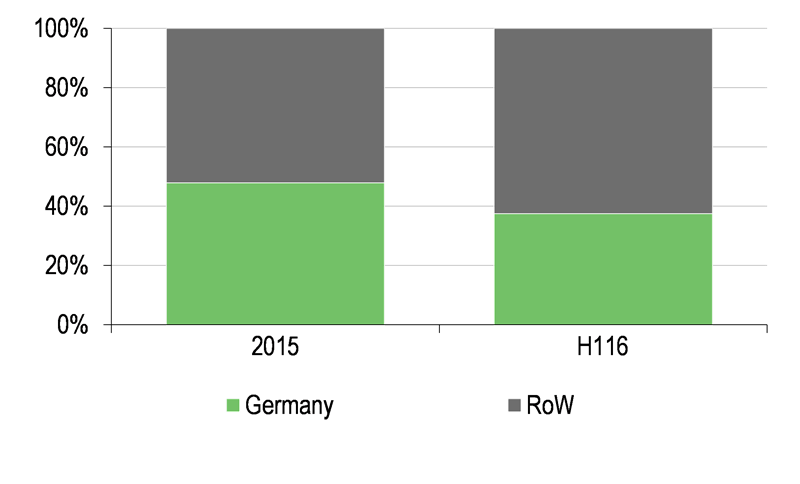
Ringmetall is a leading manufacturer of specialist packaging solutions, with sales of around €100m, split about 40% in Germany and 60% elsewhere, the bulk of which is in the US. The company has two divisions:
■
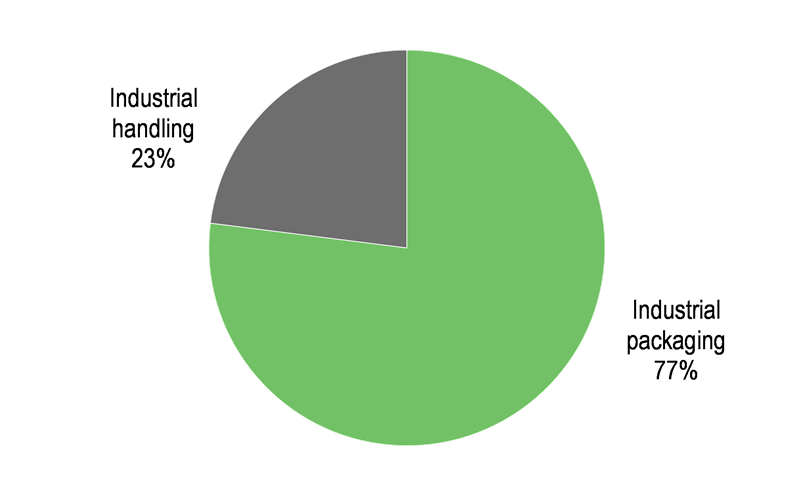
Industrial packaging (77% of 2016 sales). Ringmetall manufactures industrial drum closure systems, lids and gaskets, locking rings, handles and accessories. The company’s most important end markets are within the food, chemicals/petrochemicals and pharmaceutical sectors as well as speciality industrial equipment and agriculture. Ringmetall’s products also have applications in other sensitive industries, such as nuclear and food. It is the global market leader in locking rings and has been active in this business for 60 years. In 2015, the company entered the US market through the acquisition of market-leading drum closure manufacturer Self Industries Inc.
■
Industrial handling (23% of 2016 sales). Ringmetall manufactures forklift components and specialist components for trucks and agricultural vehicles. These are niche components, such as speciality brakes and clutch pedals, lifting masts components as well as trailer systems and hydraulic brackets.
The company was founded in 1997 under the name of HPI and listed in 2007, which was followed by a rebranding to Ringmetall in 2015. Initially HPI was a private equity investor that held industrial manufacturing companies in its portfolio. After rebranding, Ringmetall became an industrial speciality company managing a number of industrial packaging subsidiaries as core businesses. The last capital increase was in May 2016, for €5m. The funding was used to increase the company’s stake in its Italian subsidiary S.G.T. to 80% from 51%. There is authorisation from the last AGM for additional capital raising of up to €3.4m up to 2021, and it seems logical to assume that this will be used to fund further acquisitions (see below).
Ringmetall is the global market leader in drum closure systems with market shares of about 70% globally and 80% in Europe and the US. Its position is underpinned by longstanding relationships with the three leading global drum manufacturers, Greif, Mauser and Schuetz. The fact that it tailors products to its customers underpins its strong position, which effectively provides a degree of barrier to entry. In addition, Ringmetall has other blue-chip clients, notably Linde, BASF, Novartis and John Deere. Industries handling hazardous products with high safety requirements (eg chemicals, pharmaceuticals, etc) make up most of the customer base.
Organisation
The company is organised as a holding structure where Ringmetall Group provides strategy, finance and co-ordination from the centre and the regional subsidiaries operate largely independently. This allows for synergies and best practice sharing, yet adaptation to local markets and closeness to customers. Berger Group is the core of the industrial packaging segment and the origin of the industrial expertise in Germany. We assume there is a possibility that Ringmetall might contemplate a disposal of the Industrial Handling business, which as the company evolves more closely towards packaging, appears increasingly peripheral.
|
Exhibit 1: Group structure |
Exhibit 2: Global businesses |
|
|
|
Source: Eurostat, IFO, Bloomberg |
Source: Bloomberg |
|
Exhibit 1: Group structure |
|
|
Source: Eurostat, IFO, Bloomberg |
|
Exhibit 2: Global businesses |
|
|
Source: Bloomberg |
Germany 40% of sales; US boosted by acquisition in 2015
Ringmetall derives about 40% of its sales from Germany. The remainder is now heavily weighted to the US, but sales are global and include Europe and Asia. It has a well-diversified global base of production facilities, with eight sites in Europe, three in the US and two in Asia.
|
Exhibit 3: Revenues by segment, 2016 |
Exhibit 4: Revenues by geography |
|
|
|
Source: Ringmetall |
|
Exhibit 3: Revenues by segment, 2016 |
|
|
Source: Ringmetall |
|
Exhibit 4: Revenues by geography |
|
|
Source: Ringmetall |
Strategy: Consolidate lead position and extend markets
Ringmetall’s strategy consists of two components:
■
Organic: Consolidation of its position as global market leader, with further market share growth in clamping rings and margin expansion for its core products.
■
M&A: Management has stated regularly and also at the 2016 results that it looks for acquisitions. Benefiting from management experience in private equity, we also expect growth to be augmented through the acquisition of adjacent products and capabilities in packaging.
Key growth regions: Asia and North America
Asia is the most important growth region, followed by the US. Ringmetall is looking to increase market share in China from currently low levels of around 20%, as there is strong demand growth for quality clamping systems as standards and regulations tighten. Given an already high market share in the US (c 80%), the scope for market share gains in the US is now more limited, although management still sees good prospects for organic growth. Europe is a stable region where the company is also dominant, which by nature largely limits organic growth prospects. However, there is scope to gain market share in Europe and the US. Process optimisation globally to enhance efficiency and provide economies of scale is a key component of the company’s margin expansion strategy.
Core strategy: High-quality product with close customer relationships
The core business is based on a strategy of high-quality products that fulfil strict safety requirements in industries that handle sensitive and/or dangerous substances. Within the total drum and closure system, the systems and components supplied by Ringmetall are characterised by a high content of technology and quality requirement, supplied at a low overall value in the greater context of the customer’s product, transport and packaging cost, meaning the price differential to cheaper yet higher-risk, lower-quality products is very small from the perspective of the buyer. Therefore, a price vs quality trade off very much favours Ringmetall’s product, which is further reinforced by UN certification. It is also worth noting that low-cost competitors in most instances cannot meet customers’ required quality standards, and additionally that shipping clamping rings is uneconomical due to the relatively low value and high transport cost. Ringmetall further has a competitive advantage through unique industrial know-how that enables the company to respond to very specific needs and thereby foster close relationships, if not customer dependency, in effect creating mutual dependency. Due to the wide range of product capabilities within closing systems, the company is a one-stop shop for a vast multitude of systems and components, which is another competitive advantage. Ringmetall is the preferred supplier to the three largest global drum manufacturers, which often specify Ringmetall to supply entire series of systems across a whole product range. Its manufacturing is increasingly highly automated and all of its robotics are developed in house. This further reinforces barriers to entry in terms of process IP and technology. Importantly, clamping rings tend to wear out after a few uses, which means there is regular replacement demand. For the aftermarket Ringmetall tends to be the default supplier, due to being already designed in and its strong customer relationships. Also, very importantly, because the drum, ring lid etc are certified, the customer needs to use Ringmetall’s systems to avoid the need to re-certify the entire system.
Acquisition-driven growth
Since inception, acquisition-derived growth has been a key aspect of the company’s development and continues to be so. In this process it acts as an industry consolidator, targeting complementary products and expansion of its distribution reach in order to accelerate market penetration. The company’s criteria for acquisitions include market leadership, profitability, scope for synergies and a short timeline to earnings accretion. In 2015, the company acquired US-based Self Industries Inc, the market-leading manufacturer of clamping rings in the US. This was the largest acquisition in Ringmetall’s history so far (purchase price not divulged) and has led to significant earnings accretion in 2016 (see below) as the integration was successfully completed.
A fragmented market and an increasing trend towards consolidation in the industry facilitate the company’s strategy. On occasions, Ringmetall is mandated by its clients, which on their part seek to secure certain supplier relationships, be it regional or otherwise, to acquire competitors or closely related businesses. We note, however, that its high market share limits growth potential in its core markets through acquisitions. We sense that management is very aware of this issue as the company is looking to grow into adjacent areas within industrial packaging, but also in heating or air conditioning where it may see scope in pipe connections. Additionally, the company pursues margin expansion through synergy benefits as it integrates new companies. It will most likely fund acquisitions through capital increases, which management has made clear would only occur to fund acquisitions and not for any other purposes.
Unsurprisingly, as a growth company, dividend payout is on a relatively low level, at least for the foreseeable future, even though management targets a reasonable dividend.
Recent newsflow and upcoming catalysts
Ringmetall recently published Q117 results and full 2016 results, which showed strong margin expansion. While the benefits of recent acquisitions should start to come through, further M&A will likely drive expansion into related markets. Investor attention will likely focus on progress on expanding into the potentially sizeable Chinese market and on delivery of selective profit-enhancing acquisitions. Investor sentiment is always sensitive to volatility in steel pricing (currently rising) and to shifts in economic, manufacturing and growth in key market expectations.
Market overview: Structural growth with cyclical challenges
In the long term, Ringmetall is exposed to the drivers of the industrial packaging market. This is expected to grow from US$775bn in 2016 to US$975bn in 2026 (source: Markets and Markets), implying 5.4% CAGR over the next 10 years. Chemicals firstly and pharmaceuticals are the most important sectors and account for 30% of the global market. Drums make up about 20% of the global packaging market, and represent a growing proportion. Drums are expected to account for 36% of the total market by 2020 (source: Smithers Pira). That is driven by mega trends such as globalisation, demographics, emerging markets, urbanisation, as well as shifts in global manufacturing and export patterns. Importantly, increased global trade and more fragmented supply chains imply greater transportation needs and increasing packaging demand. Tightening regulations and standards also create growing demand, in particular for products such as chemicals or other sensitive materials, the core end-markets for Ringmetall’s products.
|
Exhibit 5: Global packaging market growth |
|
|
Source: Smithers Pira |
While growth in Europe is mature, there is continuous replacement demand as clamping rings wear out after a certain time, and no longer meet safety requirements. Emerging markets, particularly Asia, are the key global growth driver.
Ringmetall’s prospects are correlated with the outlook for the key export markets of the German economy, those being the eurozone, the US and Asia. The global macro-economic environment is mixed, with pockets of growth in a challenging eurozone area, prospects for reasonable US growth and a growing Chinese economy, albeit at a slowing pace. While German industrial output was strong in early 2016, there was some slow down later in the year. Germany is important as the company’s home market where it is a leader, and the single most important geographic region in terms of sales exposure. The US saw an uplift in activity in late 2016 following the presidential election. The US has increased in relevance and is now very important for the company following the acquisition of Self Industries. Chinese growth is still at the high end of emerging markets, but indicators are showing slowing rates of growth. In the greater scheme, exposure to China is still small for Ringmetall, but that weight is likely to increase due to the high growth of the market. The IMF forecasts global GDP growth of 3.4% for 2017. Early indications of Q117 point to some global recovery. The IFO world economic climate indicator rose to 2.5 from -1.2 in Q416.
|
Exhibit 6: Global growth in key end economies |
Exhibit 7: German exports |
|
|
|
Source: Euostat, IFO, Bloomberg |
Source: Bloomberg |
|
Exhibit 6: Global growth in key end economies |
|
|
Source: Euostat, IFO, Bloomberg |
|
Exhibit 7: German exports |
|
|
Source: Bloomberg |
The company’s most important end market is the chemical sector. The sector faces challenges in a low global growth macro environment, with 2016 year-on-year sales growth of just 2.1% for the global chemicals sector (source: PwC) due to lower industrial production, inventory resizing and dollar strength. Globally, the sector may look towards a flat year in 2017 according to various industry expectations. After a stagnant year and a 2.2% y-o-y decline in European chemicals exports, the EU Commission business expectation survey showed an improvement in Q416 and Q117 business expectations remained stable at high levels. On average, growth expectations are around 1.5% to 2018. In the US growth has recovered from the decline that followed the fracking boom on the back of low energy prices, as well as construction and industrial activity growth. The American Chemistry Council forecasts chemical sector production growth rates of 3-4% pa on average to 2020. There may be challenges ahead, however, if the new administration enacts policies that limit free trade, even though there may be positive domestic demand stimulation. China is likely to remain the strongest growth market, as safety and quality standards rise even in an environment of slowing growth.
Management and corporate governance
Supervisory board, management board and shareholders
The supervisory board in Germany is a separate committee that provides oversight to the executive board, broadly equivalent to a board of non-executive directors. Ringmetall’s supervisory board is chaired by Thilo von Selchow, a Düsseldorf entrepreneur who was the CEO of Dresden-based chip manufacturer ZMD until that company was sold by its owners. Other members are Markus Wenner, a lawyer, entrepreneur and corporate finance advisor; and Ralph Heuwing, who is also the CFO of Duerr AG and as such strengthens financial oversight.
Christoph Petri is the spokesperson of the management board. He is also in charge of finance and responsible for operational management and international expansion. Mr Petri comes from a consulting and private equity background. Konstantin Winterstein, with a background in the automotive sector, holds responsibility for technology, operations and investment management.
Management holds 55% of the company, the rest being free float.
Financials
Income statement: Growth and more growth
Ringmetall is a strong growth company. Over the past five years, Ringmetall has generated a revenue CAGR of 17.1% and an EBITDA CAGR of 23.5%, driven by both organic and acquired elements. In 2016, revenues grew 42% y-o-y, largely on the back of 2015 acquisitions, following a similar development in 2014. 2015 was characterised by costs of the acquisition, the positive earnings impact of which only occurred in 2016. That growth needs to be put into context by the corresponding increase in net debt as the company has acquired growth (see below) to a greater extent than generating it organically. This is reflected in large swings in ROCE (post tax), which declined from 6.9% in 2015 to 1.2% in 2016 following the Self Industries acquisition.
Exhibit 8: Financial summary
Year end 31 December |
€000s |
2012 |
2013 |
2014 |
2015 |
2016 |
|
Income statement |
|||||||
Revenue |
48,304 |
46,498 |
65,828 |
66,678 |
94,345 |
||
Profit before tax (as reported) |
(691) |
(71) |
2,346 |
718 |
5,001 |
||
Net income (as reported) |
(1,612) |
(970) |
1,528 |
(643) |
2,320 |
||
EPS (as reported) – (€) |
0.07 |
(0.03) |
0.09 |
||||
Dividend per share (€) |
0 |
0 |
0.05 |
0.05 |
0.05 |
||
Balance sheet |
|||||||
Total non-current assets |
15,362 |
26,986 |
24,942 |
36,970 |
34,027 |
||
Total current assets |
11,873 |
19,620 |
19,615 |
26,938 |
30,704 |
||
Total assets |
27,235 |
46,606 |
44,557 |
63,909 |
64,731 |
||
Total current liabilities |
6,062 |
17,195 |
16,833 |
20,726 |
22,187 |
||
Total non-current liabilities |
8,245 |
11,524 |
9,347 |
23,466 |
17,349 |
||
Total liabilities |
14,307 |
28,718 |
26,180 |
44,192 |
39,536 |
||
Net Assets |
12,928 |
17,888 |
18,377 |
19,717 |
25,195 |
||
Shareholders’ equity |
12,928 |
17,888 |
18,377 |
19,717 |
25,195 |
||
Cash flow statement |
|||||||
Net cash from operating activities |
6,263 |
3,173 |
3,827 |
5,283 |
8,935 |
||
Net cash from investing activities |
(5,628) |
(17,170) |
(1,711) |
(18,788) |
3,231 |
||
Net cash from financing activities |
1,706 |
14,238 |
(3,352) |
15,668 |
(2,615) |
||
Net cash flow |
2,341 |
241 |
(1,236) |
2,163 |
3,089 |
||
Cash & cash equivalent end of year |
2,382 |
3,268 |
2,514 |
2,950 |
5,265 |
||
Net debt |
2,958 |
12,244 |
12,361 |
24,157 |
18,962 |
||
Source: Ringmetall accounts
|
Exhibit 9: Buying growth year-on-year |
|
|
Source: Ringmetall accounts, Edison Investment Research |
For 2016, the company has reported revenues of €94.4m, +42% y-o-y and ahead of consensus as a result of the acquisition of Self Industries. EBITDA was €11m. Net income grew to €2.3m from a loss of €0.6m. 2017 revenue guidance is for €98-103m, which indicates 4-9% y-o-y growth, generating EBITDA of €11.5-13.0m. China will likely be the strongest growth contributor, but that is on a low base level of revenues currently. The US is expected to take a growing share of revenues due to solid growth in the chemicals sector and as Self Industries continues to expand.
Management targets longer-term revenues of €200m and a 15% EBITDA margin, which implies c 300bps of margin expansion vs current levels. About €3-20m of incremental revenues could come from new acquisitions, as management is looking to complete at least one acquisition in the year. That could potentially be counterbalanced by a disposal of the Industrial Handling business. For Q117, the company has also delivered strong growth, with revenues of €26m, up 19.2% y-o-y, and EBITDA growing 7.9% to €3.2m. Growth in Germany was particularly strong. However, we do note a 200bp EBITDA margin compression, which is largely the result of a lower gross margin due to higher steel prices. EBIT grew by 9.6% to €2.1m.
Profitability has not grown proportionately to revenues. The table below shows that the company’s EBITDA margin does not show a pattern of steady progression. Instead, there has been margin volatility due to steel prices, but primarily as a function of the timing and costs of acquisitions, as well as their integration and synergy generation. The 2016 EBITDA (€11m reported) is illustrative: it shows EBITDA 380bp margin expansion, largely on the back of synergies of the latest acquisition, but also thanks to more advantageous raw material purchasing. The Chinese business also contributed positively for the first time after initial quality problems were resolved. Management targets further margin improvement from efficiencies and economies of scale across the business. After streamlining, the Industrial Handling division has returned to break even. Following optimisation of the operations in Turkey, there should also be scope for growth and margin improvement there. In summary, excluding acquisitions there should be ample scope for further margin expansion over the medium term.
Exhibit 10: Profitability
2012 |
2013 |
2014 |
2015 |
2016 |
|
EBITDA margin |
6.2% |
7.5% |
10.9% |
8.2% |
12.0% |
EBIT margin |
2.2% |
1.7% |
4.8% |
2.1% |
6.3% |
ROA (EBITDA/total assets) |
10.9% |
7.5% |
16.1% |
8.6% |
16.9% |
ROCE (post tax) |
8.8% |
2.4% |
0.6% |
6.9% |
1.2% |
Source: Ringmetall accounts, Edison Investment Research
EBIT progression over time brings to light another element: As a result of acquisitions, D&A has significantly increased (eg +22% y-o-y 2016), as a result of a higher asset base, both tangible and intangible. The sharp increase in 2015 stems from fixed asset revaluation of fully depreciated machinery on the acquisition of Self Industries. Interest costs also reflect the higher debt levels arising from acquisitions, even though that has been mitigated by the lower interest rate environment.
This all contributes to strong swings in net earnings, in 2011/12 as large as €3m, including moving between positive earnings and net losses.
|
Exhibit 11: Impact of acquisitive growth on earnings |
|
|
Source: Ringmetall accounts |
Strong cash flows can drive deleveraging
Ringmetall’s acquisition strategy is reflected in the balance sheet, which shows a significant increase in leverage over the past five years from 48% in 2011 to 123% by the end of 2015 (net debt/equity). Naturally, gearing fluctuates according to acquisition activity. 2016 saw gearing decrease to 75%. However, while net debt/EBITDA was elevated at 4.4x at the end of 2015, it fell to 1.7x at the end of 2016, and interest cover appears comfortable at 4.3x (end 2016).
|
Exhibit 12: Gearing |
|
|
Source: Ringmetall accounts, Edison Investment Research |
All other things being equal, high operating cash flows with a strong cash conversion ratio should reduce leverage in a speedy fashion. Excluding potential future acquisitions, management expects operating cash generation could reduce debt to zero in 2019. The significant reduction of net debt in 2016 gives comfort that such a trajectory could be achievable.
Acquisition spend typically largely outpaces cash generation and the company tends to issue corresponding financing. With this pattern, acquisitions and capex are financed by operating cash flow and new financing. Despite strong free cash flow in recent years, there has been consistent negative net cash flow, except at times when equity has been issued. Considering the company’s statements with regard to future capital increases as a core strategy to fund acquisitions, we think it is likely that leverage will not increase further but rather decrease.
|
Exhibit 13: Cash flow |
|
|
Source: Ringmetall accounts |
Valuation
Ringmetall trades on a forward P/E of 17.4x 2017, which is 20% above the 12-month average. We interpret the multiple expansion that came with the shares outperforming peers over the past two years as growing confidence in execution following the latest acquisition, but also a reflection of still positive global growth despite challenges. The positive 2016 results also supported multiple expansion, particularly as they have returned earnings into positive territory after a 2015 net loss.
|
Exhibit 14: Valuation |
|
|
Source: Bloomberg |
Peer valuation
In order to find a meaningful valuation comparison, we have looked at a peer group of global industrial and speciality packaging names. Peer group comparison is a challenge because of Ringmetall’s niche positioning. However, we have considered comparable companies in either relevant end markets, ie chemicals/petrochemicals and food, or broader industrial packaging.
To reflect the export nature of the business and its status as a leading German Mittelstand (SME) company, we have also included a number of small and mid-cap German machinery companies that are very export oriented and leaders in their space. These have revenue derived from global export markets and thus are relevant for Ringmetall, and their shares will be considered as local small or mid-cap comparisons. Ringmetall’s shares are trading on a 25% discount to the 2018e peer group P/E and on 4% and 20% 2017e P/E discounts to the Bloomberg European Industrials Index and SDAX, respectively. Some of the discount is likely due to size given that some of the peers are larger-cap names, but likely also because of different levels of profitability, and challenges in the chemicals sector, the company’s most important end-market.
Exhibit 15: Peer group comparison
2017e |
2018e |
2017eEV/ |
2018e EV/ |
2017e |
2018e |
2017e |
2018e |
|
Ringmetall |
15.53 |
12.83 |
7.61 |
6.62 |
0.72 |
0.71 |
N/A |
N/A |
Greif Inc |
19.56 |
17.50 |
8.41 |
7.94 |
0.81 |
0.79 |
10.90 |
9.07 |
Stahl |
97.82 |
29.72 |
11.86 |
9.07 |
0.72 |
0.68 |
10.82 |
9.60 |
Norma Group |
15.22 |
14.49 |
9.82 |
9.43 |
1.55 |
1.49 |
10.73 |
10.26 |
Trimas |
15.65 |
14.30 |
9.10 |
8.27 |
1.24 |
1.19 |
9.46 |
9.03 |
Silgan |
18.86 |
16.54 |
9.15 |
8.33 |
0.85 |
0.81 |
9.44 |
8.43 |
Crown |
14.29 |
12.80 |
9.63 |
9.24 |
0.92 |
0.90 |
8.64 |
8.02 |
Jungheinrich |
19.82 |
18.05 |
8.57 |
8.69 |
1.01 |
0.95 |
12.78 |
11.23 |
Krones |
19.19 |
17.71 |
9.28 |
8.64 |
0.97 |
0.93 |
14.75 |
13.34 |
Duerr |
17.31 |
16.80 |
9.13 |
8.94 |
0.93 |
0.91 |
13.21 |
12.87 |
Bloomberg European Industrials Index |
18.80 |
16.76 |
10.22 |
9.41 |
1.16 |
1.11 |
12.41 |
11.22 |
Sdax Index |
21.75 |
18.34 |
12.22 |
11.11 |
0.90 |
0.88 |
12.26 |
10.99 |
Source: Bloomberg. Note: Priced as at 31 May 2017.
Sensitivities
■
Macro: Cyclicality and country risks. Ringmetall is heavily exposed to global economic activity, and particularly to trade and exports. Cyclicality in the chemicals sector is important. With a global business in terms of revenues but also manufacturing locations, and continuing internationalisation, country risks are important. This concerns particularly the US and China, but also Turkey where management currently highlights political risk in what is an important market.
■
Client concentration. Ringmetall is very dependent on a small number of key customers. Together, its two most important customers account for 60% of revenues in the industrial packaging services. Management asserts there is no cluster risk, yet this is a concentrated business in our view. It is worth noting though that there is mutual dependency between Ringmetall and its customers.
■
Steel prices. Steel is the company’s most important raw material in the industrial packaging business and has a significant impact on gross margins. In 2016 favourable raw materials costs boosted profitability. The company has a policy of tight steel inventories and says it is able to pass through changes in steel costs. However, that could change, in our view. The company also mitigates materials pricing risk through medium-term framework purchasing agreements.
■
Currency risk. As an exporter, the company is exposed to various currency risks, notably with regard to the Chinese renminbi and the Turkish lira. There is also particular US dollar currency risk beyond earnings translation. This is because steel prices, the key input, are in US dollars whereas revenues are in local currency.
■
Low cost competition. Ringmetall operates as a high-quality manufacturer. As such, it is naturally exposed to lower-quality, low-cost competition. We see this risk notably in China. However, given that the company’s customers operate in industries where safety is paramount (see above), that provides a certain hedge against such risk. In fact, management expects market share gain in China where the market is characterised by a lack of high-quality closure systems suppliers. The fact that it has production facilities locally should enable it to achieve a favourable quality/cost comparison against local low-cost competitors. Furthermore, shipping clamping rings over large distances is not economical, which also offers some protection against competition in low-cost regions.
Frankfurt +49 (0)69 78 8076 960 Schumannstrasse 34b 60325 Frankfurt Germany |
London +44 (0)20 3077 5700 280 High Holborn London, WC1V 7EE United Kingdom |
New York +1 646 653 7026 295 Madison Avenue, 18th Floor 10017, New York US |
Sydney +61 (0)2 8249 8342 Level 12, Office 1205 95 Pitt Street, Sydney NSW 2000, Australia |
|
Research: Industrials
Daldrup & Söhne is benefiting from the regulatory support for geothermal energy, primarily in Germany. This is evidenced by its order backlog of €65m to date, sufficient to support its full engineering capacity for all business divisions through 2018. Meanwhile, management is stepping up efforts in project development and ownership to help counterbalance the volatility of the drilling/engineering business with predictable revenue streams as an independent power producer.