Last close As at 14/08/2026
GBP12.60
▲ −2.00 (−0.16%)
Market capitalisation
GBP1,693m
Research: Investment Companies
The Law Debenture Corporation (LWDB) continued to successfully navigate challenging conditions in H123, growing its professional services business (IPS) in line with its mid to high single-digit target, while consolidating its strong, long-term performance record. This rare combination of a UK investment trust and the cash-generative IPS operating business has delivered outperformance of its broad UK equity benchmark over multiple periods with a strong record of dividend growth.
The Law Debenture Corporation |
Continuing to differentiate itself |
Investment trusts |
7 August 2023 |
Analyst
|
||||||||||||||||||||||||||||||||||||||||||||||||||||||
The Law Debenture Corporation (LWDB) continued to successfully navigate challenging conditions in H123, growing its professional services business (IPS) in line with its mid to high single-digit target, while consolidating its strong, long-term performance record. This rare combination of a UK investment trust and the cash-generative IPS operating business has delivered outperformance of its broad UK equity benchmark over multiple periods with a strong record of dividend growth.
|
Long-term outperformance of the index and peer group |
|
|
Source: Refinitiv, Edison Investment Research. Note: Total returns in sterling. |
Identifying further opportunities across the group
LWDB has outperformed its benchmark index over one, three, five and 10 years and beyond, chalking up a consistent and exceptional performance versus peers. While not the highest paying constituent in the UK Equity Income sector, it has a strong commitment to dividends, which have been held or increased in each of the past 44 years. Ten-year dividend growth of 114% or an average 7.9% pa is the strongest of its peers.
LWDB’s unique structure is a significant factor in this performance. IPS is a robust, growing, cash-generative business, relatively insensitive to short-term economic and market fluctuations. It has funded 34% of LWDB dividends in the past 10 years while accounting for 21% of NAV. This has supported the long-term portfolio performance by providing the managers with the freedom to select attractive lower- or non-yielding stocks, and avoid higher-yielding stocks they deem unattractive, while still meeting LWDB’s income objectives.
The portfolio is 84% invested in UK equities despite investment policy flexibility for overseas investment of up to 45%. The managers note that UK equities are not only lowly valued versus global markets but also at the lowest level for 30 years. They see strong opportunities across the market but particularly, in contrarian fashion, in heavily sold domestic earners, especially among smaller stocks. They note that while the UK economy faces a number of pressures, growth has held up better than had been expected and moderating inflation may soon signal a peak in interest rates. Regardless, they are focused on companies rather than the economy and identify many quality, well-managed businesses, with strong prospects that are far from reflected in their valuations.
Highly differentiated and unique business model
As we discussed in detail in our February review, there are two distinct but complementary parts to LWBD, a key differentiator from other investment trusts. Alongside its investment portfolio (79% of H123 NAV), it includes IPS, a leading provider of independent professional services (21%). IPS is a resilient, growing and cash generative business comprising a diversified range of operations and income streams, significantly based on recurring income from structurally supported sectors, and others that provide attractive returns but with increased market sensitivity. IPS generates strong margins and cash flow, and as well as creating capital growth for LWDB, it generates income for dividends well above its share of NAV. Net revenues increased by an average 10.7% pa in the five years to end-FY22 (H123: 11.2%), in an often-challenging environment, and PBT by an average 8.2% pa (H123: 8.5%). The fair value of IPS increased from c £77m at the end of 2017 to c £178m at the end of H123.
The portfolio has been consistently managed over many years by James Henderson, (lead manager since 2003) and Laura Foll (since 2011) from Janus Henderson Investors. They highlight the positive impact that IPS cash flow has on investment returns, supporting their bottom-up investment approach, highly diversified by stock, sector and, where appropriate, geography, with a strong valuation overlay.
The combined results are impressive. Despite a challenging 2022, LWDB has generated significant outperformance over multiple time periods versus its broad UK equity benchmark and its peer group within the AIC UK equity income sector. Over the 10 years to 30 June 2023, it has delivered an NAV total return of 136% versus a benchmark return of 78% and a peer group return of 79%.
H123 performance consolidated the long-term track record
During the six months to 30 June 2023 (H123), LWDB’s NAV total return (fair value cum income or ‘NAV’) was 4.0%, ahead of the broad UK equity market benchmark total return of 2.6%. With debt at par value rather than fair value, NAV total return of 2.2% was slightly below benchmark. By both measures, returns have been consistently ahead of the benchmark over one, three, five and 10 years. The cumulative 10-year NAV total return of 136.4% compares with the benchmark return of 78.0%.
Over six months and one year, the share price total return was slightly below NAV return, with the discount to NAV widening modestly.
Exhibit 1: H123 performance update
Period to 30 June 2023 (%) |
6m |
1 year |
3 years |
5 years |
10 years |
NAV total return (with debt and IPS at fair value) |
4.0 |
11.1 |
60.9 |
38.9 |
136.4 |
NAV total return (with debt at par) |
2.2 |
6.0 |
43.0 |
28.4 |
121.9 |
Broad UK equity market total return |
2.6 |
7.9 |
33.2 |
16.5 |
78.0 |
Share price total return |
1.5 |
5.0 |
67.4 |
59.2 |
129.3 |
Change in Retail Price Index |
4.1 |
10.4 |
28.2 |
33.3 |
50.3 |
Source: The Law Denture Corporation, Office of National Statistics
The 4.0% NAV total return over six months comprised a 1.9% increase in NAV and a 2.1% impact from the reinvestment of dividends. The increase in NAV was primarily driven by an earnings-driven increase in the fair value of IPS and an increase in the fair value of LWDB’s long-term fixed rate debt as market interest rates increased. Revenue earnings of 18.1p were little changed year-on-year (up versus H222) with slightly lower portfolio dividend income offset by IPS earnings of 4.8p2 versus 4.6p in the prior year. Dividend payments from portfolio companies increased by 4.9% to £19.3m compared with £18.4m in H122, higher than the investment managers had expected. The £3.4m of special dividends received in H122, which were taken to capital earnings, did not repeat in H123.
1 IPS revenue per share is calculated using the weighted average number of shares in issue during the period. If based on the H222 average number of shares, H123 EPS would be 4.91p.
Ongoing charges remained attractively low at 0.48% and the moderate gearing provided headroom for further selective portfolio investment. The trust is structurally geared through four tranches of long-term debt (par value of £165m), with maturities ranging between 2034 and 2050, at a blended interest rate of c 4.0%. Net gearing at end-H1233 was 13% versus 12% at end-2022.
2 Net borrowings as a percent of NAV.
Reflecting the premium to NAV that was in place throughout much of the period, LWDB was able to satisfy investor demand by issuing shares under its authority at an accretive average premium. Approximately 2.5m shares were issued during H123, raising gross proceeds of c £20m for ongoing investment.
Exhibit 2: Financial performance summary
Year-end 31 December |
H123 |
H122 |
H123/H122 |
2022 |
Pence per share unless stated otherwise |
|
|
|
|
Net assets |
||||
Net asset value as per balance sheet |
624.8 |
624.2 |
0.1% |
625.8 |
IPS fair value adjustment |
117.9 |
106.1 |
116.2 |
|
Debt fair value adjustment |
33.2 |
(3.6) |
19.7 |
|
Net asset value (including debt and IPS at fair value) |
775.9 |
726.7 |
6.8% |
761.7 |
Revenue return |
||||
Investment portfolio revenue return |
13.3 |
13.7 |
-2.7% |
24.1 |
IPS revenue return |
4.8 |
4.6 |
5.5% |
10.4 |
Total revenue return |
18.1 |
18.2 |
-0.7% |
34.4 |
Capital return |
(5.3) |
(100.6) |
(103.1) |
|
Total return |
12.8 |
(82.4) |
N/M |
(68.7) |
Ongoing charges |
0.48% |
0.48% |
0.49% |
|
Net gearing |
13% |
11% |
12% |
|
NAV total return |
|
|
|
|
Net asset value (including debt and IPS at fair value) at start of year |
761.7 |
787.8 |
787.8 |
|
Net asset value (including debt and IPS at fair value) at end of year |
775.9 |
726.7 |
761.7 |
|
Change in the year |
1.9% |
-7.8% |
-3.3% |
|
Impact of dividends reinvested |
2.1% |
3.8% |
3.9% |
|
Total NAV return |
4.0% |
-4.0% |
0.6% |
Source: The Law Denture Corporation data, Edison Investment Research
Versus larger (all above £500m market capitalisation) close peers in the AIC UK Equity Income sector, LWDB has been consistently strong against the sector average and the larger, close peers listed in Exhibit 3.
Exhibit 3: LWDB share NAV total return versus peers to end-H123
% |
6 months |
1 year |
3 years |
5 years |
10 years |
Law Debenture Corporation |
4.0 |
11.1 |
60.9 |
39.4 |
135.5 |
City of London |
(0.0) |
4.5 |
34.9 |
18.3 |
81.6 |
Finsbury Growth & Income |
6.3 |
14.6 |
18.6 |
27.1 |
152.3 |
Edinburgh Investment |
5.1 |
13.4 |
48.8 |
14.7 |
85.5 |
Murray Income Trust |
4.4 |
9.0 |
27.1 |
29.8 |
86.0 |
Merchants Trust |
(0.9) |
4.5 |
64.4 |
28.7 |
94.5 |
Temple Bar |
2.8 |
8.1 |
53.2 |
1.9 |
51.8 |
Simple average |
3.1 |
9.3 |
44.0 |
22.9 |
98.2 |
Broad UK Equity Income sector simple average |
1.8 |
5.9 |
31.1 |
13.4 |
79.1 |
Source: Morningstar
Strong commitment to consistent dividend growth
Dividends are paid quarterly, in July, October, January and April. On an annual basis, DPS has increased in each of the past 13 years, including through the pandemic, and has been held or increased for 44 consecutive years. LWDB’s dividend yield of 3.8% is slightly below that of close peers (4.2%), largely explained by its higher rating (a c 2% premium to NAV versus a c 4% discount for close peers). Its five-year-year dividend growth rate of 12.0% pa compares with 2.3% pa for close peers, and although the comparison is affected by LWDB’s rebasing upwards of DPS,4 its commitment to sustainable income growth is clear. The all-company sector average yield is 4.7% with five-year growth of 2.9% pa.
3 Total FY19 DPS was increased to 26.0p versus 18.9p in FY18.
The Q123 DPS of 7.625p was 5.25% up on Q122 and it is the board’s current intention that the total FY23 dividend be at least in line with the FY22 dividend of 30.5p, subject to shareholder approval.
|
Exhibit 4: Dividends continue to increase |
|
|
Source: The Law Debenture Corporation |
IPS: Continuing growth in cash flow and valuation
Despite the challenging economic and financial market environment, the IPS businesses saw continued growth in H123, with some areas benefiting directly from high inflation and volatile financial markets. Total net revenues increased by 11.2% compared with H122 and PBT by 8.5%, in line with LWDB’s mid to high single-digit target. This builds on the strong five-year performance from FY17 to FY22, corresponding to Denis Jackson’s appointment as CEO, during which the company has been given a greater strategic focus and has invested in its people, technology and platform to broaden and enhance its offering and deliver sustainable growth. Strong investment across all business lines and, more recently, inflationary cost pressures have seen the PBT margin narrow slightly, but with revenue benefits yet to be fully achieved we expect it to remain around 30% over the medium term (H123: 28.3%).
A diverse source of revenue streams, organic investment and structural trends across many business lines underpin IPS’s performance. The continuing drivers of regulatory developments and outsourcing bode well for a continuation of the business’s growth in line with its long-term mid to high single-digit growth target.
Exhibit 5: IPS performance trend
£m |
H123 |
H122 |
Y-o-y |
2017 |
2018 |
2019 |
2020 |
2021 |
2022 |
5-year compound growth to FY22 |
Pensions |
8.6 |
7.0 |
23.3% |
8.3 |
9.5 |
10.6 |
11.5 |
13.1 |
14.3 |
11.6% |
Corporate trust |
5.8 |
5.2 |
12.2% |
7.9 |
8.4 |
9.0 |
10.8 |
9.8 |
10.6 |
6.1% |
Corporate services |
9.7 |
9.5 |
1.9% |
11.0 |
11.7 |
12.2 |
12.2 |
18.8 |
20.2 |
13.0% |
Total net revenue |
24.1 |
21.7 |
11.2% |
27.1 |
29.6 |
31.8 |
34.5 |
41.6 |
45.2 |
10.7% |
PBT |
6.8 |
6.3 |
8.5% |
9.7 |
10.5 |
11.5 |
12.2 |
13.3 |
14.4 |
8.2% |
PBT margin |
28.3% |
29.0% |
35.9% |
35.4% |
36.1% |
35.4% |
32.1% |
31.9% |
|
|
EPS (p) |
4.8 |
4.5 |
5.7% |
7.2 |
7.9 |
8.5 |
9.3 |
10.0 |
10.4 |
7.5% |
Source: The Law Debenture Corporation, Edison Investment Research
The IPS businesses, pensions, corporate trusts and corporate services, are described in detail in our February review and in the following sections we provide a brief update on H123 progress.
Pensions net revenue increased strongly, to £8.6m or by 23.3% compared with H122 (£7.0m) and by 16.6% compared with H222 (£7.4m), well above the 11.6%] over the five years to end-FY22. Structurally, growth is underpinned by the need for high-quality expertise to assist pensions schemes to navigate an increasing legislative and regulatory burden and the steady move towards increased professionalism across the sector. LWDB continues to invest in the business to meet this demand. Revenues are significantly of a repeat nature, although the liability driven investment crisis in autumn 2022, triggered by the gilt market reaction to the UK government’s autumn financial statement, has created further activity during H122 and H223, with many schemes recognising the need to review their funding and investment strategies.
The majority of revenues (c two-thirds) for the Corporate Trust business are significantly recurring, and it is also showing strong net revenue momentum despite continued subdued primary debt issuance. H123 net revenues increased by 12.2% to £5.8m compared with H122 (£5.2m) and by 7.0% versus H222 (£5.4m). The fees that LWDB earns for providing its regular duties as bond trustee (acting as a bridge between the bond issuer and the investor) are generally recurring and typically benefit from annual inflation-linked increases until maturity. Additional fees may also be earned for less predictable activities, such as documentation changes. Given the sharp rise in interest rates and subdued economic growth, there are some tentative signs that the credit cycle may be turning after an extended period of calm. Although not currently the case, periods of borrower distress can generate significant additional revenues from ad-hoc additional work generated by debt restructuring or the renegotiation of payment terms, which often continues well after economic recovery is underway. Escrow Services, where LWDB sits between two (or more) parties to a transaction, continues to grow steadily, with its customer awareness and reputation growing across a widening spread of applications including support for corporate M&A transactions, litigation, real estate transactions and sporting events.
Corporate Services is itself a diverse collection of businesses, including company secretarial services (CSS), structured finance services, whistleblowing (Safecall) and service of process (SOP), the most economically sensitive activity across IPS. Net revenues increased by 1.9% to £9.7m compared with £9.5m in H122 but were 7% lower compared with H222. While most of the businesses continued to grow, SOP was negatively affected by weak global trading activity, already at subdued levels. CSS is well advanced with its significant investment in the right people, skills and systems to further exploit the growing need for outsourced governance solutions. Safecall continues its strong growth, with a tailwind from whistleblowing legislation and an increasing recognition that the provision of such services represents best business practice. Although a relatively small part of the business, the Structured Finance activities performed well as LWDB continues to successfully leverage the acknowledged quality of its offering by raising its profile with a broader universe of clients. Progress came despite challenging conditions for many of the financial institutions (asset managers, hedge funds and challenger banks) that are active in the market. In the SOP business, LWDB acts as local agent for third parties not otherwise represented in that jurisdiction. It is a high volume, economically sensitive activity with the lowest recurring contractual revenue base of all the IPS businesses. While economic conditions are currently challenging, SOP nonetheless generates highly attractive returns for LWDB over time.
Continuing to create value
The operational fair value of the IPS business5 continued to increase in H123 (+2%), driven by growth in earnings (EBITDA6) with an unchanged valuation multiple of 10.5x.
4 The IFRS consolidation of the IPS business fails to recognise the full value added by the business and to address this, from 31 December 2015, LWDB has published an operational fair value for the standalone IPS business.
5 Earnings before interest, tax, depreciation and amortisation.
|
Exhibit 6: IPS fair value change has been driven mainly by EBITDA growth |
Exhibit 7: The IPS fair value has increased by 130% since FY17 (£m) |
|
|
|
Source: LWDB data, Edison Investment Research. Note: H123 EBITDA on a trailing 12-month basis. |
Source: LWDB, Edison Investment Research |
|
Exhibit 6: IPS fair value change has been driven mainly by EBITDA growth |
|
|
Source: LWDB data, Edison Investment Research. Note: H123 EBITDA on a trailing 12-month basis. |
|
Exhibit 7: The IPS fair value has increased by 130% since FY17 (£m) |
|
|
Source: LWDB, Edison Investment Research |
Since end-FY17 the operational fair value has increased by 130%, driven by EBITDA growth (c 73%) and a steady increase in the valuation multiple from a modest 7.9x to 10.5x. The multiple is based on external professional advice from PwC, explained in detail here.
Exhibit 8: Calculation of IPS fair value
H122 |
2022 |
|||
£m |
Pence per share |
£m |
Pence per share |
|
Trailing 12m EBITDA |
17.0 |
16.6 |
||
Multiple |
10.5 |
10.5 |
||
Gross fair value of IPS business |
178.0 |
136.9 |
174.2 |
136.4 |
IPS net assets attributable to IPS valuation |
32.6 |
25.1 |
27.6 |
21.6 |
Fair valuation of IPS business |
210.6 |
162.0 |
201.7 |
158.0 |
Removal of IPS net assets included in group net assets |
(57.3) |
(44.0) |
(53.4) |
(41.8) |
Fair value uplift for IPS business |
153.4 |
117.9 |
148.4 |
116.2 |
Source: The Law Debenture Corporation
Long-term, bottom-up, diversified and valuation focused
Given that the investment focus of the portfolio is on stocks rather than index weightings, diversification of the portfolio holdings, by business activity, market capitalisation and risk profile, is deliberately targeted, to enhance the consistency of performance and protect capital over the long term. To this end, the managers run a long list of stocks (c 150), drawing support from the substantial resources of the wider Janus Henderson platform, including dedicated UK mid-cap and small-cap teams.
Exhibit 9: Top 10 holdings at 30 June 2023
Company |
Country |
Sector |
Portfolio weight (%) |
Change |
|
30 June 2023 |
31 December 2022 |
||||
Shell |
UK |
Oil & gas producers |
3.2 |
3.3 |
(0.1) |
HSBC |
UK |
Banks |
2.9 |
3.0 |
(0.1) |
BP |
UK |
Oil & gas producers |
2.8 |
1.9 |
0.9 |
Flutter Entertainment |
UK |
Travel & leisure |
2.7 |
2.0 |
0.7 |
GlaxoSmithKline |
UK |
Pharmaceuticals |
2.1 |
2.2 |
(0.1) |
Barclays |
UK |
Banks |
2.1 |
2.2 |
(0.1) |
Rolls Royce |
UJ |
Industrials |
2.1 |
1.0 |
1.1 |
RioTinto |
UK |
Mining |
2.0 |
2.4 |
(0.4) |
NatWest |
UK |
Banks |
1.7 |
1.9 |
(0.2) |
Marks & Spencer |
UK |
Consumer services |
1.7 |
1.0 |
0.7 |
Total top 10 holdings* |
23.2 |
22.8 |
0.4 |
||
Source: The Law Debenture Corporation. Note: *Held at 31 December 2022 but not in top 10. The column total reflects the actual top 10 share at 31 December 2022 rather than the sum of the stock values.
Providing a measure of the stock diversification of the portfolio, particularly among small stocks, at end-H123 the top 10 holdings represented 23% of the total portfolio and the other 147 holdings 77%.
Sector weightings represent an output from stock selection rather than being a target in themselves although it does show that the portfolio is tilted towards more cyclical stocks and the trust’s internal analysis indicates that it is more likely to outperform in a rising market. Compared with the broad UK equity market, LWDB has a larger exposure to industrials (by c 11%), matched by a lower exposure to consumer sectors. Year to date, the industrial sector has performed significantly ahead of consumer sectors.
Exhibit 10: Sector exposure at 30 June 2023
Portfolio weight (%) |
Benchmark |
LWDB vs benchmark |
|||
30 June 2023 |
31 December 2022 |
Change (pp) |
|||
Financials |
26.6 |
27.4 |
(0.8) |
25.56 |
1.0 |
Industrials |
23.1 |
21.7 |
1.4 |
11.91 |
11.2 |
Oil & gas |
10.9 |
10.9 |
0.0 |
10.73 |
0.2 |
Consumer staples |
10.3 |
9.0 |
1.3 |
11.97 |
(1.7) |
Basic materials |
6.7 |
8.7 |
(2.0) |
7.16 |
(0.5) |
Health care |
7.7 |
8.1 |
(0.4) |
11.63 |
(3.9) |
Consumer discretionary |
7.4 |
7.7 |
(0.3) |
15.01 |
(7.6) |
Utilities |
3.2 |
3.2 |
0.0 |
3.62 |
(0.4) |
Telecommunications |
2.1 |
2.0 |
0.1 |
1.25 |
0.9 |
Technology |
2.0 |
1.3 |
0.7 |
1.16 |
0.8 |
Total |
100.0 |
100.0 |
100.00 |
0.0 |
|
Source: The Law Debenture Corporation, Edison Investment Research
While the investment policy allows non-UK investment of up to 45%, the portfolio remains very concentrated on focused UK equities, and this is unlikely to change. It is in the UK that the managers can stay close to companies, a key element of the stock selection process that allows them to invest with greater conviction. More immediately, the UK market valuation is unusually low (discussed below) and the managers can identify a wide range of opportunities, particularly among domestic earners and especially in the mid- and small-cap segments. While overseas investment provides additional stock diversification opportunities, it is typically utilised where there is no compelling UK equivalent.
Exhibit 11: Portfolio geographic exposure at 30 June 2023
Portfolio weight (%) |
Change |
Allocation guideline (%) |
||
30 June 2023 |
31 December 2022 |
|||
UK |
83.8 |
83.2 |
0.6 |
55–100 |
North America |
5.5 |
5.1 |
0.4 |
0–20 |
Europe |
9.6 |
10.6 |
-1.0 |
0–20 |
Japan |
1.1 |
1.1 |
0.0 |
0–10 |
Other Asia-Pacific |
0.0 |
0.0 |
0.0 |
0–10 |
Other* |
0.0 |
0.0 |
0.0 |
0–10 |
Total |
100.0 |
100.0 |
||
Source: The Law Debenture Corporation, Edison Investment Research. Note: *Collective investment funds.
Performance drivers in H123
Compared with the highly polarised market of 2022, when from a market capitalisation perspective, the largest 20 stocks were the only area to deliver a positive total return, there are signs of a broadening out of returns in 2023. However, smaller stocks and AIM stocks in particular continue to trail the broad market index against which LWDB is benchmarked. The investment approach of the portfolio managers, to balance immediate income with capital growth and faster dividend growth over time, inevitably means an underweighting to the largest stocks and a greater focus on smaller companies with greater growth potential. During H123, portfolio selection substantially offset the headwind of larger company outperformance while positive fair value movements in IPS and debt generated outperformance for the trust.
Exhibit 12: Portfolio weightings and market performance by market cap segments
Performance by different market cap Tiers |
Performance |
Market weighting |
LWDB weighting* |
UK top 100 |
3.2 |
84.1% |
48.5% |
- of which top 20 share constituents |
1.3 |
56.0% |
22.7% |
- of which other 80 share constituents |
7.2 |
28.1% |
25.8% |
UK mid-market |
-0.6 |
13.6% |
19.6% |
UK small cap. |
0.7 |
2.2% |
5.6% |
UK broad market |
2.6 |
100.0% |
73.7% |
Junior market |
-8.5 |
N/A |
11.8% |
Overseas |
N/A |
N/A |
14.4% |
Source: The Law Debenture Corporation, Refinitiv
The top five stock contributors to the portfolio during H123 included two aerospace companies, Rolls-Royce and Senior, benefiting from the continued recovery of the aviation industry post-COVID-19. The managers expect Rolls-Royce will soon return to the dividend list and so too Marks and Spencer; its operational recovery is progressively being recognised in its share price performance. Flutter’s strong price appreciation has been supported by very strong growth in its US gaming business. Despite fears over the global banking sector following the Silicon Valley Bank failure, HSBC is a strong beneficiary of rising interest rates and the effect on margins, while being protected from sector concerns by its strong balance sheet. Since H123 it has announced a capital return in addition to dividends.
Exhibit 13: Top five contributors to H123 performance
Stock |
Share price total return (%) |
Contribution (£m) |
Flutter Entertainment |
40.0 |
7.0 |
Rolls-Royce |
88.1 |
6.8 |
Marks & Spencer |
60.5 |
5.2 |
HSBC |
20.6 |
4.6 |
Senior |
39.9 |
4.3 |
Source: The Law Debenture Corporation.
Three of the detractors from the portfolio’s performance, Anglo American, i3 Energy and Rio Tinto, are commodity producers reacting to investor concerns over economic activity and the weakness of certain commodity prices such as oil and copper. Within a diversified portfolio, the investment managers see a place for cyclical exposures such as these and expect them to recover over time. The single largest detractor was Direct Line, following a weak underwriting performance, prompting the investment managers to reduce the holding. AFC Energy suffered the fate of many smaller growth companies in current market conditions, particularly given its future needs for capital to continue the development of its fuel cell technology.
Exhibit 14: Top five detractors from H123 performance
Stock |
Share price total return (%) |
Contribution (£m) |
Direct Line Insurance |
(35.7) |
(5.1) |
Anglo American |
(30.9) |
(4.5) |
i3 Energy |
(43.5) |
(3.3) |
Rio Tinto |
(14.0) |
(3.1) |
AFC Energy |
(58.6) |
(2.3) |
Source: The Law Debenture Corporation
Buying the companies and not the economy
While the UK economy has thus far remained more robust than had generally been expected, inflation has remained elevated and is yet to signal a peak in interest rates. Risk aversion remains high among investors, and this has been most clearly seen in the performance of UK-oriented small companies and AIM in particular.
That the UK market is lowly valued compared with global markets is not new. UK equities have been strongly out of favour with investors since Brexit and remain so. Political uncertainty, widespread strike action and a wet summer have done little to change perceptions. However, the managers note that based on a wide range of measures, the valuation of the market relative to global markets has now reached 30-year lows.
Weakness outside of the largest companies has generally been broadly based, while the investment managers note that for many economically sensitive companies, earnings performance has outstripped low expectations. Meanwhile, valuations already appear to be signalling a very significant economic downturn. For many smaller companies, growth is driven by capturing market share within large end-markets or creating new markets, mitigating any impact from general economic conditions. In some cases, the managers find valuations to be extraordinarily low and more than discounting a severe recession.
|
Exhibit 15: UK forward P/E ratio versus World |
Exhibit 16: UK P/book value versus World |
|
|
|
Source: Refinitiv |
Source: Refinitiv |
|
Exhibit 15: UK forward P/E ratio versus World |
|
|
Source: Refinitiv |
|
Exhibit 16: UK P/book value versus World |
|
|
Source: Refinitiv |
Taking advantage of the weakness in UK-listed companies, the managers invested a net £31.6m in UK shares in H123, part-funded from the proceeds of LWDB share issuance (at a premium to NAV), capital recycling and a slight increase in gearing.
Investment has been across a diverse range of companies, in many cases reinforcing existing holdings. This may be where share price performance has been weak while the investment case remains intact (eg Marshalls, a building materials company) or in stronger performers where conviction in the investment case has increased (eg Marks & Spencer, with early signs of a trading improvement).
Among smaller companies, the position in alternative energy company Ceres Power has been increased, as has the exposure to Hipgnosis, the owner of a catalogue of recorded music. Other position increases include Oxford Nanopore (gene sequencing), Surface Transforms (ceramic brakes) as well as Air Products & Chemicals and Johnson Mathey within the renewable energy space.
The managers say that the common thread running through these investments is that in each case the companies have the potential to be substantially larger businesses in the future without this being recognised in the valuation.
Capital has been recycled from holdings where the investment case has fundamentally changed (eg Direct Line) or where valuations now appear relatively high. This is the case with some defensive companies such as consumer goods manufacturers Unilever., where the position was sold, and Haleon, where the holding has been reduced.
Premium and wider peer group comparison
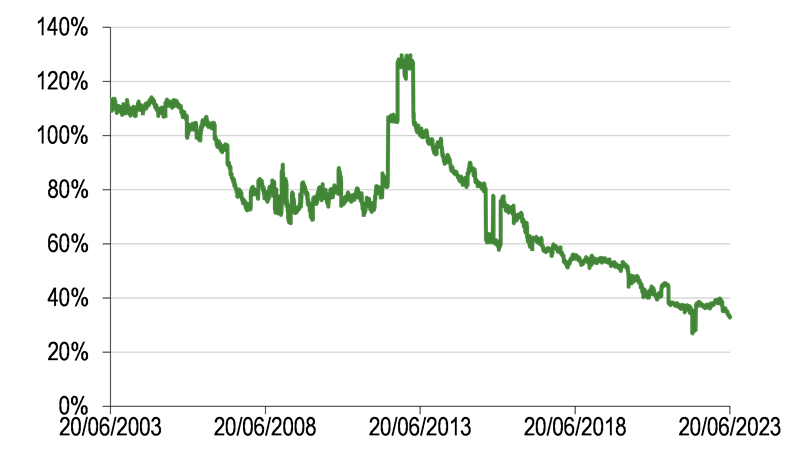
LWDB is currently trading at a premium of 1.9% to NAV at fair value (cum income), similar to its three-year average, the current valuation of close peers and the broad UK Equity Income sector (Exhibit 17).
|
Exhibit 17: 10-year price to NAV history (fair value cum income) |
|
|
Source: Refinitiv |
The table below provides an overview of the latest peer group performance and key financial metrics, as at the date of this report.
In particular we would reiterate LWDB’s consistently strong NAV total return performance versus peers, low costs and strong dividend growth.
Exhibit 18: Selected UK equity income peer group at 7 August 2023*
Percentages unless stated otherwise |
Market cap (£m) |
NAV TR |
NAV TR |
NAV TR |
NAV TR 10-years |
Premium/ (discount) |
Ongoing charge |
Net gearing |
Dividend yield |
5-year div growth |
Law Debenture Corporation |
1,048.4 |
7.4 |
68.9 |
40.6 |
123.9 |
1.9 |
0.5 |
113 |
3.8 |
12.0 |
City of London |
1,988.0 |
1.5 |
37.9 |
17.5 |
68.5 |
2.1 |
0.4 |
106 |
5.3 |
2.6 |
Finsbury Growth & Income |
1,825.8 |
4.6 |
15.8 |
22.7 |
127.4 |
(3.7) |
0.6 |
101 |
2.0 |
5.0 |
Edinburgh Investment |
1,061.9 |
12.6 |
53.2 |
15.1 |
78.8 |
(9.3) |
0.5 |
109 |
4.0 |
(0.3) |
Murray Income Trust |
933.0 |
3.2 |
28.0 |
27.0 |
73.4 |
(7.7) |
0.5 |
110 |
4.5 |
2.4 |
Merchants Trust |
792.8 |
1.3 |
78.9 |
32.6 |
80.4 |
0.7 |
0.6 |
111 |
5.1 |
2.2 |
Temple Bar |
697.0 |
10.0 |
74.9 |
9.9 |
48.6 |
(5.4) |
0.5 |
110 |
4.0 |
1.9 |
Average core |
1,216.4 |
5.5 |
48.1 |
20.8 |
79.5 |
(3.9) |
0.5 |
108 |
4.2 |
2.3 |
LWDB core position |
5 |
3 |
3 |
1 |
2 |
2 |
6 |
1 |
7 |
1 |
Dunedin Income Growth |
413.6 |
6.9 |
25.8 |
28.1 |
68.9 |
(7.9) |
0.6 |
108 |
4.7 |
1.6 |
JPMorgan Claverhouse |
392.7 |
4.2 |
37.2 |
10.2 |
71.2 |
(4.0) |
0.7 |
111 |
5.2 |
4.9 |
Lowland Ord |
318.8 |
2.7 |
49.1 |
0.1 |
47.6 |
(9.5) |
0.6 |
116 |
5.2 |
4.5 |
CT UK Capital and Income |
307.2 |
(4.5) |
32.0 |
8.5 |
65.4 |
(2.3) |
0.6 |
108 |
4.0 |
2.0 |
Diverse Income Trust |
265.0 |
(11.0) |
9.4 |
3.6 |
84.0 |
(6.2) |
1.1 |
98 |
4.7 |
5.4 |
Schroder Income Growth |
198.7 |
0.9 |
37.8 |
14.0 |
69.6 |
(3.0) |
0.7 |
110 |
4.6 |
3.3 |
Troy Income & Growth |
167.6 |
(3.3) |
7.5 |
5.0 |
58.5 |
(2.6) |
0.9 |
103 |
2.9 |
(10.4) |
abrdn Equity Income Trust |
150.6 |
(7.6) |
27.1 |
(14.5) |
26.8 |
1.3 |
0.9 |
116 |
7.2 |
5.8 |
Invesco Select UK Equity |
111.2 |
(0.8) |
39.8 |
16.9 |
82.1 |
(10.3) |
0.7 |
106 |
4.4 |
2.7 |
CT UK High Income Units |
101.9 |
(3.4) |
19.1 |
2.0 |
39.4 |
(8.4) |
1.0 |
113 |
5.1 |
2.5 |
Shires Income |
72.0 |
0.3 |
28.3 |
15.4 |
72.2 |
(7.3) |
1.0 |
123 |
6.1 |
1.8 |
BlackRock Income and Growth |
38.4 |
4.5 |
33.2 |
14.6 |
76.3 |
(9.8) |
1.2 |
103 |
4.0 |
2.0 |
Chelverton UK Dividend Trust |
34.0 |
(5.2) |
56.5 |
(11.9) |
70.3 |
4.4 |
2.4 |
157 |
7.9 |
6.8 |
Average total |
545.9 |
1.2 |
38.0 |
12.9 |
71.7 |
(4.4) |
0.8 |
112 |
4.7 |
2.9 |
LWDB total position |
4 |
3 |
3 |
1 |
2 |
4 |
18 |
5 |
18 |
1 |
Source: Morningstar, Edison Investment Research. Note: *Performance at 3 August 2023 based on cum-fair NAV. TR, total return. Net gearing is total assets less cash and equivalents as a percentage of net assets. LWDB calculates gearing as net borrowing as a percent of shareholders’ funds.
|
|
Research: Healthcare
OpGen has announced that Curetis (its German subsidiary) has signed an extended R&D collaboration agreement with FIND following the successful completion of an extended feasibility study. The revised R&D agreement advances the collaboration from feasibility assessment to the initial phases of full in vitro diagnostic (IVD) product development, where the objective is to develop an antimicrobial resistance (AMR) IVD assay on an Unyvero A30 cartridge, along with analytical testing and software development. This development phase of the arrangement, with an anticipated 10-month duration, calls for a total $0.6m in additional payments to OpGen, split in the form of an upfront payment and two milestone payments. The progression of this collaboration takes OpGen a step closer toward commercialization of a molecular microbiology testing platform designed to address the needs of low-to-middle income countries (LMICs).