Last close As at 05/08/2026
GBP0.71
— 0.00 (0.00%)
Market capitalisation
GBP176m
Research: Industrials
Building on Accsys’s established international presence the current significant investment phase (€80m+ capex) should be the catalyst for accelerated business growth. We expect Accsys to move into a group EBITDA positive position from FY19 with the significant profit potential to be progressively delivered thereafter. Our DCF analysis suggests that the share price is solidly underpinned at current levels with upside from enhanced commercial development of proprietary technology.
Accsys Technologies |
Accelerated growth |
Initiation of coverage |
General industrials |
9 July 2018 |
Share price performance
Business description
Next events
Analyst
Accsys Technologies is a research client of Edison Investment Research Limited |
|||||||||||||||||||||||||||||||||||||||||||||||||||
Building on Accsys's established international presence the current significant investment phase (€80m+ capex) should be the catalyst for accelerated business growth. We expect Accsys to move into a group EBITDA positive position from FY19 with the significant profit potential to be progressively delivered thereafter. Our DCF analysis suggests that the share price is solidly underpinned at current levels with upside from enhanced commercial development of proprietary technology.
Year end |
Revenue (€m) |
EBITDA* |
PBT* |
EPS* |
EV/Sales |
EV/EBITDA |
03/17 |
56.5 |
(1.5) |
(4.8) |
(0.06) |
1.0 |
N/A |
03/18 |
60.9 |
(3.5) |
(8.7) |
(0.07) |
1.5 |
N/A |
03/19e |
70.9 |
2.0 |
(6.0) |
(0.05) |
2.0 |
71.3 |
03/20e |
94.9 |
7.8 |
(4.0) |
(0.05) |
1.6 |
19.8 |
Note: *PBT and EPS are normalised, excluding amortisation of acquired intangibles and exceptional items.
Expansion strategy to drive sustained profitability
FY17 was a watershed year for Accsys that included, at the period end, the announcement of a fully funded expansion strategy and €80m+ capex. New capacity at the existing Accoya® (solid wood) facility is now on stream and standalone Tricoya® (wood elements) production is to be established for the first time by FY20. The business model has demonstrated healthy manufacturing gross margins and Accoya profitability, although in FY18 this was partly obscured by mix effects and other development costs. The prospect of larger commercial scale should bring group profitability more clearly into view.
Pulling through demand
Accoya and Tricoya wood have both generated good revenue streams since first commercial production (in FY08 and FY12 respectively). Accsys has a technically proven process and wide international market acceptance for its modified wood output. As well as successful capex execution, the sales and marketing challenge is to pull through demand to absorb newly available capacity and develop licence partners. The first incremental Accoya capacity is now available and that the rate of volume uptake over the next 12 months or so will be a significant marker of the trajectory of future progress.
Valuation: Solid foundation, upside potential
The Accsys share price has traded within the 70-80p range in the last last year having responded well to the funding and expansion strategy announced at the end of FY17. At this stage, the financial model does not lend itself to conventional near-term valuation metrics. We have used DCF analysis to highlight that the current share price of 79p is underpinned by the development of Accoya operations, associated tax losses and a share of the cash on hand in a new Tricoya entity. With scale market opportunities, upside is available from additional intellectual property (IP) commercialisation – most obviously through technology licences – and/or enhanced commercial performance within directly influenced operations.
Investment summary
Company description
Accsys Technologies has proprietary acetylation processes and production facilities, which enhance the durability and stability of softwood species making them suitable for a wider range of chiefly external building products applications (see page 5). The company has recently undertaken a significant investment phase to expand capacity on one site (Arnhem, the Netherlands) and is in the process of establishing a new one (at Hull, the UK) and is continuing to develop its market presence internationally both directly and through licence agreements. Note that Accoya and Tricoya are registered trademarks and this applies to all subsequent references in this report.
Valuation: Composite DCF approach
We expect Accsys to be EBITDA positive from FY19 and achieve an overall operating profit in the following year. We expect EBIT to exceed financing costs in FY21 and hence generate group PBT for the first time in that year. Our analysis shows that the current 79p equity valuation can be explained through a DCF-based approach, which identifies three distinct elements, as follows:
■
Accoya c 43p/share (fully operational Arnhem site)
■
UK tax losses c 16p/share (arising from unrelieved UK costs)
■
Tricoya c 20p/share (chiefly share of cash on hand, prior to investment up to FY20)
We also provide a sensitivity analysis to show the effect of price/cost inflation on our DCF and to illustrate by example the significant valuation upside potential from simplistic licence agreements. Given significant market opportunities, this approach aims to highlight additional value potential beyond known facilities, although new production licences are likely to be more complex than we have shown. As licences tend to be defined by region, there is scope for several of these contractual arrangements to be signed.
Financials: Fully-funded expansion phase moving forward
In FY18, Accsys reported a group EBITDA loss. Key financial drivers in the year were a lower Accoya gross margin (reflecting customer and licensing mix effects), increased Tricoya development activity (including design, hiring and construction phases) and well-controlled group and R&D costs. In March 2017, Accsys secured funding from a combination of new equity, partners co-investing and bank facilities to invest in production facilities. Our three-year estimate horizon covers this period of expansion, during which we forecast group revenues will grow from c €61m in FY18 to c €114m in FY21 – achieving a positive EBIT position during FY20 – and we anticipate that group net debt will be c €62m at the end of our forecast period. We expect the key themes that will define the group’s financial performance in the period under review are the deployment of project funding and further commercial development of Accoya/Tricoya volumes.
Sensitivities: Scaling up
Accsys already has scale and an international market presence with two established, recognised and IP-protected brands. That said, given the scale of its addressable markets, penetration is relatively low partly due to constrained capacity. The challenge for Accsys is to reaffirm (or improve upon) the current commercial proposition for its Accoya and Tricoya wood products as significant new capacity comes on stream to support volume growth. Expansion at Arnhem and newbuild at Hull carry different risk profiles in our view but completion on time and bringing the expected operational performance and levels of profitability are key to the business case. As a manufacturer and exporter, FX movements can influence local market competitiveness. The cross rates of local operating currencies (ie sterling and euro) versus US$ and the NZ$ are relevant for materials costs.
Company description: Making more from wood
Accsys is a chemical technology company focused on the commercial development of IP based on the acetylation of solid softwood and wood elements,1 making more building product market segments accessible to producers and widening the choice for end customers. We show some of the installed applications in later sections. With an established market presence and new capacity coming on stream, the company is positioned to undergo a significant growth phase.
The acetylation process significantly improves the resistance of wood to moisture and insects, enhancing dimensional stability and durability in both solid and elemental form. This gives superior performance and longer lifespans to wood products sourced from sustainable faster growing and more readily available softwoods – predominantly radiata pine – which are also fully recyclable at the end of their useful life.
Enhancing the properties of wood using proprietary technology
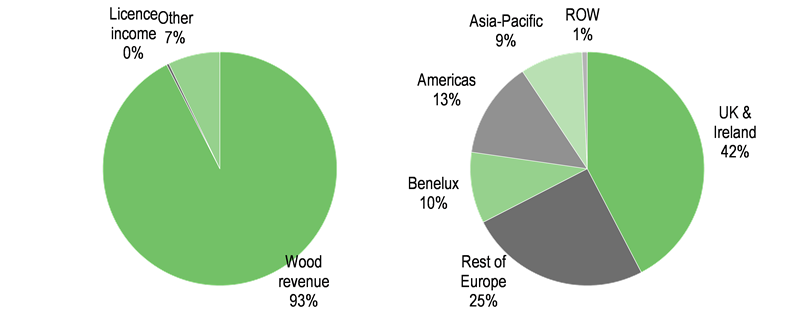
Accsys has developed proprietary, IP-protected wood acetylation processes that enhance the properties of certain softwood tree species, enabling their use in a wider range of (typically exterior building product) applications. Acetylated softwood is sold internationally under the Accoya (solid form) and Tricoya (wood elements) brands. The company has operated an acetylation plant from a single site in Arnhem since 2007 and has been operating at its current rated operating capacity of c 40,000 cubic metres. Exhibit 1 shows that the majority of revenue is currently generated from the sale of acetylated wood. Geographically, c 80% comes from a wide range of European countries and the Americas and Asia-Pacific territories are also significant end-markets.
|
Exhibit 1: Accsys Technologies FY18 revenue €60.9m – splits |
|
|
Source: Company. Note: Other includes re-chargeable sales & marketing costs and the sale of production by-product chemicals, chiefly acetic acid. |
The group strategy has been to commercialise its acetylation IP through a combination of in-house processing, licence and third-party partner arrangements. The Arnhem plant has been used to demonstrate proof of concept and also seed and supply markets directly, via distribution/agency agreements and in support of developing overseas territories. Having reached capacity at Arnhem – supporting Accoya wood sales and establishing Tricoya demand – Accsys is undertaking a phased expansion of the site and constructing a new standalone Tricoya facility near Hull, UK to facilitate further anticipated growth in both brands.
The current executive management team – along with the chairman – came together in 2010, led by CEO Paul Clegg who joined the board in 2009. At this time, the company had experienced a downturn due to licensee funding difficulties in a global recessionary climate. Building on the technical platform, management has successfully improved operating performance and increased volumes and international market penetration through the development of new customer agreements, supply chain partners and licensees. This was a necessary precursor and platform for the current funded expansionary phase.
|
Exhibit 2: Accsys Technologies– group and subsidiary company ownership structure |
|
|
Source: Company, Edison Investment Research. Note: The declarable shareholders of Accsys Technologies are shown on page 18. TTL was initially incorporated in 2012 and the current shareholding structure has been in place since March 2017. TVUK was incorporated at the same time. |
|
Exhibit 3: Barangaroo House – clad in Accoya |
Exhibit 4: Dillon Kyle Architects’ office building – Accoya facades |
|
|
|
|
|
Source: Accsys – image courtesy of Rory Gardiner and Collins & Turner |
Source: Accsys |
|
|
Exhibit 5: House of Heroes - Medite® Tricoya Extreme decorative panels |
Exhibit 6: Eccleston Place - Medite Tricoya Extreme shop fronts |
|
|
|
|
|
Source: Medite Tricoya Extreme |
|
|
Exhibit 3: Barangaroo House – clad in Accoya |
|
|
Source: Accsys – image courtesy of Rory Gardiner and Collins & Turner |
|
Exhibit 5: House of Heroes - Medite® Tricoya Extreme decorative panels |
|
|
Source: Medite Tricoya Extreme |
|
Exhibit 4: Dillon Kyle Architects’ office building – Accoya facades |
|
|
|
|
Source: Accsys |
|
|
Exhibit 6: Eccleston Place - Medite Tricoya Extreme shop fronts |
|
|
|
|
Source: Medite Tricoya Extreme |
|
Building momentum for the next growth phase
Through careful market cultivation and backed by investment and operational improvements over time, Accsys is well positioned and has a clear expansion strategy for its next phase of growth funded by cash on hand and established finance facilities. In the following sections, we identify two phases in the company’s development to date and discuss the operations as context for the significant current investment programme. We conclude with a look at the market position and prospects.
A: 1999-2009 – from pre-revenue, IP owners to Tricoya launch
A forerunner company was established in 1999 to explore acetylation chemistry technology applications on cellulose materials. Further development and incorporation with other related IP was followed by Titan Wood’s formation in 2003 to specifically pursue wood acetylation, with the company acquiring IP in its own right and a scale pilot plant in that year. When Titan Wood listed on AIM in October 2005, it did so to fund the construction, commissioning and ramp up of its process and wood acetylation production facility in Arnhem. This investment completed in March 2007, with an initial capacity of 30,000m3 per annum. Initial Accoya wood revenues were recorded in FY07 and FY08 but were dwarfed by significant upfront licence income. These payments reduced sharply as the construction of full scale third-party production facilities under licence did not proceed, with the global financial crisis as a backdrop at the time. Accsys continued to develop its market presence through an active phase of establishing overseas sales, marketing and distribution agreements, together with local approvals supported by production at Arnhem. By 2009, nameplate capacity reached 40,000m3 per annum. The other notable achievement in this year was the launch of Tricoya-based panel products in conjunction with partner, Medite. As a result of the stalled licence development referred to earlier, the financial (trading and cash flow) performance deteriorated significantly and precipitated a change in management.
B: 2010-2017 – increased focus on own production
Paul Clegg joined as NED in April 2009 and became CEO later that year. A new executive team and group chairman were in place by the end of 2010. Equity funding rounds in FY10 and FY11 (€17m and €28m net respectively) served to first, stabilise the group financial position and second, put in place sufficient cash resources to develop the business further including increasing capacity at Arnhem. Together, these steps signified an increased emphasis towards in-house production under full control to drive growth. Accoya wood volumes built steadily to FY13 reflecting the increase in sales, distribution and agency agreements and yielded improving production economies of scale, aided by a new supply/technical support agreement with BP Acetyls. Production volumes and revenues accelerated sharply over the following four years and the Arnhem plant effectively operated at its increased, 40,000m3 capacity in FY17 and is profitable as a standalone site. Having launched in FY12, Tricoya/Medite revenues reached €7.8m in FY17, which has formed the foundation to proceed with the new JV structure and standalone Tricoya facility at Hull. A number of other new licence agreements have been progressed to varying degrees, the most significant of which is with Rhodia Acetow (originally as part of Solvay) under which supply commenced in FY17 with a medium-term aim of building a third-party Accoya facility.
We summarise these achievements from FY11 to FY17 in financial terms as follows:
■
Product revenue increased from €13.6m to €50.7m (originally reported as manufacturing and subsequently wood sales).
■
Group gross margin transformed from modestly negative to c 34% in FY16, settling back at c 25% in FY17 (reflecting revenue mix and business development-led customer effects).
■
Group EBITDA approaching break-even (ie loss narrowing from -€12m to -€1.5m in FY17).
We illustrate the operational growth of the business in Exhibit 7, which shows the increase in wood volumes (both solid Accoya wood and solid Accoya wood used by Medite, which is chipped into elements for Tricoya products), increased plant utilisation at Arnhem and the associated revenue generated from wood sales.
|
Exhibit 7: Wood volumes and revenue growth |
Exhibit 8: Accsys Technologies group revenues |
|
|
|
Source: Company |
Source: Company. Note: Includes wood, licence and other income. |
|
Exhibit 7: Wood volumes and revenue growth |
|
|
Source: Company |
|
Exhibit 8: Accsys Technologies group revenues |
|
|
Source: Company. Note: Includes wood, licence and other income. |
Exhibit 8 above shows the development of group (including non-wood) revenues and the geographic spread of where that income was generated. Accoya has wide market acceptance within and outside European markets. At the end of FY18, Accsys had 64 Accoya distributor, supply and agency agreements in place and coverage territory includes North America, much of Europe and south-East Asia together with Australasia and selected countries on the South American (Brazil, Chile) and African (Morocco, South Africa) continents. This includes a handful of Accoya licensees: terms typically include defined, exclusive sales territories, sales and marketing support, volume supply agreements and usually a finite length of time to build a self-operated facility which then generates royalty flows back to Accsys. The most significant current Accoya licensee is:
■
Rhodia Acetow (territory amended to certain Council of Europe countries while excluding the UK, Republic of Ireland and Benelux): Original licence – with the then Solvay-Rhodia – became effective in December 2013 for a minimum 15-year exclusive period. This was amended in October 2015, to include:
•
Minimum 76,000m3 offtake of Accoya wood 2016-2020
•
Partial funding (through loans and fees) for the expansion of production facilities at Arnhem up to 80,000m3
•
Reduced regional exclusivity and review of timing for the licensee’s own plant construction
There are examples of licence agreements signed under previous management teams that have not progressed to the licensee’s plant construction stage, but they remain group customers, albeit at relatively low volumes. These include Diamond Wood (China, ASEAN countries)2 and Al Rajhi Holdings (Gulf Cooperation Council countries)3. The current Accsys management team’s preference is to be a co-owner in future production-based licence agreements as at the Hull facility.
Originally announced in 2007 (updated terms in 2010). Generated significant income initially (see Exhibit 8: 2009, 2010 ROW), but was unable to secure funding for a large acetylation facility under the licence following the global economic crisis. New parent Cleantech Building Materials (acquired Diamond Wood in 2016, Accsys owns 498,222 shares, carried at zero book value) is continuing to develop markets in the region and aims to build an Accoya facility in China. www.cbm-plc.com/investor-relations/investor-overview?sc_lang=en. Nasdaq First North, Copenhagen and Wiener Boise, Vienna Stock Exchange listed.
Full licence agreement was signed in March 2008, initially with exclusive regional rights, though these have since expired.
Medite Europe (part of Coillte Panel Products) was the first Tricoya licensee, having exclusivity in the UK, Republic of Ireland and the Netherlands. Following a joint development agreement, the first Tricoya MDF panel products were sold in 2011. An extended licence agreement (July 2013) included provision for a dedicated Tricoya manufacturing facility. The subsequent formation of a new Tricoya consortium includes Medite’s involvement as a co-investor in both TTL and TVUK with a minimum 40% volume offtake from the new Hull facility once it is operational. Most recently, FINSA (an established private European MDF and chipboard manufacturer) signed a user licence agreement on 16 March 2018 with exclusive rights to manufacture high-performance, wood-based panels from Tricoya in Spain and Portugal (with non-exclusive distribution rights in other territories).
C: FY18 – investment for growth
FY17 was a watershed year for Accsys as having achieved full Accoya production run rates, foundations were put in place – including secure funding – for its next phase of expansion. Ongoing market development and volume growth is a clear strategic objective and we are able to frame the scale of medium-term management aspirations in the context of the significant investment at Arnhem (to increase Accoya capacity) and underway at Hull (to build a standalone Tricoya plant).
We now provide an operational overview of these facilities noting similarities and differences. We understand that the basic acetylation chemistry is common to both Accoya and Tricoya processes; wood reacts with acetic anhydride under controlled heat and pressure cycles to change naturally occurring free hydroxyl groups – which absorb and release water – into an acetyl group, producing acetic acid as a by-product. Exhibit 9 illustrates the Accoya production process, simply described as solid soft wood fed into an acetylation reactor vessel to produce enhanced-property Accoya wood.
|
Exhibit 9: Accsys Technologies – Accoya production process |
|
|
Source: Company |
The first Tricoya facility is under construction; note the following process differences to Accoya:
Exhibit 10: Process differences between Tricoya and Accoya
Arnhem (Accoya) |
Hull (Tricoya) |
|
■ Batch production using solid wood |
■ Continuous process using wood elements |
|
■ Horizontal reactor vessel - end fed |
■ Vertical reactor vessel – top fed |
|
■ 2x vessels operational (20,000m3 each) |
■ Under construction (40,000m3 /30,000 tonnes)4 30,000 metric tonnes of chips equates to 40,000m3 of panel products including other additives such as resin. |
|
■ Expansion: Third reactor (+20,000m3) now operational. Chemical backbone infrastructure in place for fourth reactor. |
■ Expansion: No plans announced but space available |
Arnhem (Accoya) |
|
■ Batch production using solid wood |
|
■ Horizontal reactor vessel - end fed |
|
■ 2x vessels operational (20,000m3 each) |
|
■ Expansion: Third reactor (+20,000m3) now operational. Chemical backbone infrastructure in place for fourth reactor. |
Hull (Tricoya) |
|
■ Continuous process using wood elements |
|
■ Vertical reactor vessel – top fed |
|
■ Under construction (40,000m3 /30,000 tonnes)4 30,000 metric tonnes of chips equates to 40,000m3 of panel products including other additives such as resin. |
|
■ Expansion: No plans announced but space available |
Source: Company
Capacity investment to support medium-term volume growth
The sizeable capital cost of these facilities together with the accumulated know-how (ie patent protected process and equipment IP developed over an extended period) represent significant barriers to entry into this modified wood market in our view. The patent position is enforced globally – the use of territory licence agreements is a tangible example of this. Together with an established supply chain (including co-invested partners) and extensive international distribution relationships in place, we believe that Accsys is well positioned to capitalise on its market position by scaling up capacity and achieving sustainable profitability.
Engie Fabricom is the engineering, procurement and construction (EPC) contractor for both the Arnhem expansion and the new facility in Hull (having also undertaken the front-end engineering and design for the latter facility). Engie Fabricon is an integrated design through to construction and commissioning engineering contractor with extensive experience in process industries including chemicals. We summarise expected developments at the two Accsys sites, as follows:
Arnhem: installation of the third reactor vessel and ancillary equipment (including the backbone infrastructure for a fourth reactor) began in H216 and was commissioned into production in June 2018. It is expected to be operating at full run rate capacity by the end of FY19.
Hull: Located at Saltend Chemicals Park on a site adjacent to JV partner BP Acetyls’ facility, groundworks began in July 2017 and we understand that structural steelwork activity has begun and the reactor vessel has been ordered. Full commissioning and the start of commercial production is anticipated by mid-2019 and we expect Accsys to report on construction milestones as the project progresses.
Accsys capacity and volume development – a dynamic view
Arnhem reactor three coming into service represents a 50% increase in Accoya wood capacity (from 40,000m3 to 60,000m3), alleviating allocation pressure – given that Arnhem has been operating at capacity – and allowing for volume growth to re-start. (While the same or possibly better gross margin characteristics should apply to the incremental volume, opex should be relatively stable and so it would be reasonable to expect some EBIT margin improvement at Arnhem.)
For illustration, assuming that Hull is in service at the beginning of FY20 and all of the Medite Tricoya volume (FY17 c 8,300m3, say increased to 10,000m3 by that time) is transferred to Hull, this has two effects with positive margin implications:
•
Hull: begins operation with an initial volume baseload utilisation of c 25% of the new facility from day one with an existing Tricoya customer and another (FINSA) to build up also.
•
Arnhem: In effect, plant investment almost doubles available Accoya capacity (from c 30,000m3 to 60,000m3), being an initial +20,000m3 from reactor 3 for FY19, then + c 10,000 from the movement of Medite chip production to Hull in FY20.
Having been capacity constrained for the last two years, Arnhem now has a significant opportunity to capitalise on its extensively developed distribution network and to provide strong support to existing and prospective new licensees in helping to grow their markets. From an investor’s perspective, there is a clear and visible growth trajectory from an established base. Moreover, within this timescale, Accsys has the option to add a fourth Accoya reactor at Arnhem (a further 20,000m3). There is understood to be an 18-24 month development-to-commissioning cycle for this and conceivably a decision to proceed could be taken within our estimate time horizon. Overall demand levels for Accoya will be central to the business case to further expand Arnhem taken in the context of an expected shift of volume to Hull in 2019.
Market aspirations, applications, characteristics and challenges
As stated in the March 2017 Placing and Open Offer prospectus, management’s assessments of long-term achievable scale are as follows:
■
1 million m3 pa of Accoya wood against a current global solid wood market estimated to be in excess of 400 million m3
■
1.6 million+ m3 of Tricoya panel products, thought to be c 1.5% of existing global MDF manufacturing capacity
Tertiary and higher-specification sector penetration: The market sizes indicated will include segments that are not being addressed (eg interior millwork) but we believe relevant exterior and other applications are also material markets. Accsys has grown wood revenues from below €10m in FY10 to c €51m in FY17, achieving profit on a local but not yet group basis. Supplying to a wide range of projects internationally has showcased the versatility of its modified wood. End-market segments include retail, offices and leisure (eg hotels, marine, velodromes) where cladding and decking uses dominate and public spaces (eg bridges, art installations, boardwalks) with other functional and structural requirements. We believe that tertiary projects have been significant drivers of volume. There has also been higher-specification private residential newbuild (including apartments) and other restoration work, including windows and doors. Market penetration has been largely gained through specialist channels (eg specifiers, architects) and growth largely driven by repeat business. The broad Accsys distribution network already facilitates project activity; it is likely to require increasing support (eg local stock availability) in key territories for the next growth phase.
Scaling up – a multi-market, multi-channel perspective: The prospective Accoya and Tricoya capacities referred to earlier (ie 80,000m3 and 40,000m3 respectively) offer excellent medium-term volume growth from the current base. At the same time, they are clearly insufficient to deliver management’s indicated long-term volume aspirations. We expect Accsys to retain a premium positioning for its modified wood and – while unlikely to develop mass-market usage in the near term (eg retail) – we offer some growth perspectives for investors to consider.
Deeper entry into timber window and door markets (and roofline, weatherboarding etc) would enhance the company’s presence in both newbuild and secondary residential sub segments. Noting multiple and fragmented routes to market (eg merchants, fabricators, installers, specifiers, contractors) this clearly broadens supply chain servicing requirements. Consequently, Accsys will need to cultivate these channels and also maintain a significant end customer profile to pull through product demand. Increased capacity will facilitate increased demand and channel requirements and also lower unit production costs to open up more segments. Sustainability agendas are becoming increasingly important, especially in developed building markets, which are typically regional and served locally. Climactic conditions also influence markets with different material preferences (eg between timber, plastic and metal-based products) across both European countries and US states, for example. We believe that Accsys’s modified wood is capable of being deployed in a wide range of environments and applications and the range of market opportunities is broad. With finite near-term capacity available, it would be reasonable to expect Accsys to pursue a selective expansion strategy in developing these markets rather than one which is purely volume-driven.
In the medium to longer term, in order to supply 1 million+ m3 pa of (either Accoya or Tricoya) material, it is clear that a significant scaling up of facilities is required, which could be achieved directly or, more likely we feel, through international partnerships involving co-investment and the construction of new plants, which bring the added benefit of reducing transport costs in non-European markets. Announcements of significant new partners – and associated investment would represent potentially significant markers of progress towards longer-term, higher volume targets. Accsys has noted interest in developing new capacity in North America and Asia and discussions regarding potential licence arrangements with a number of large MDF manufacturers are underway.
Sensitivities
Given the expected rate of revenue growth and P&L transformation, it would be easy to view Accsys as a fledgling building products business. In reality, it already has scale and an international market presence with two established, recognised and IP-protected brands. We acknowledge that the level of penetration is relatively low as a specialist product but also due to constrained capacity.
Pricing: Market development is the key challenge and opportunity facing Accsys. Accoya is a premium product, which is positioned by reference to its performance, sustainability and lifecycle (rather than product or installed) cost. Tricoya-based products have similar or improved performance characteristics to alternative materials and price competition is likely to be influenced by demand elasticity/substitution effects as well as overall market activity levels.
Capacity: The new Arnhem reactor is now operational and our model assumes that the new capacity is substantially available throughout FY19. During annual maintenance periods, all reactors are shut down simultaneously owing to shared infrastructure at what is the sole Accoya production facility. Disruption here would immediately affect capacity availability and achievable volume/revenue. Note that we have not factored in the establishment of any third-party production (or associated royalty revenue streams) under licensing arrangements over our three-year horizon. The new Hull Tricoya facility is the first of its kind; process engineering specialist Engie Fabricom – which also undertook the Arnhem expansion – has undertaken the detailed design work and is the main engineering, procurement and construction contractor. Groundworks commenced in July 2017 with commissioning anticipated in mid-2019 and we expect Accsys to report on construction milestones over the next 12 months or so. We have assumed that two thirds of full annual capacity is available in FY20 and we have modelled volume at c 50% of this. This is equivalent to 12,000m3 and, in context, this compares to the c 8,500m3 current Medite demand. (Note that Medite also has minimum offtake agreements in place.) In the event that the opening of the Hull facility is delayed sufficiently to affect these assumptions, we would expect the volume to be supplied from Arnhem, as it is currently, albeit from a higher, fully costed, process.
FX: Most obviously, relative euro strength (reporting currency) and favourable translation effect into sterling (the share price currency) serves to compress the valuation, other things being equal. The transactional picture is more complex: euro strength compared to sterling and the NZ dollar (sources of group and timber costs respectively) is beneficial, but more than half of Accoya revenue comes from exports which are invoiced in euros (save for North American countries). Clearly, alternative wood products are available; as they are also largely imported relative sterling weakness should have a comparable competitive pricing effect (depending on suppliers’ base currency). Note that when the Hull facility comes on stream in FY20, this will broaden the group’s sterling costs but revenues are expected to be denominated in euros.
Raw materials: In the context of larger, established global markets, Accsys’s input volume requirements while growing are not significant. We consider its raw material supply chain to be stable. Radiata pine is the dominant Accoya wood feedstock sourced from New Zealand, which has an extensive plantation, harvesting and export industry in this species. While adverse events could temporarily affect supply, we would expect inventory and alternative supply options (both in New Zealand and, possibly, Chile and Australia over time) to provide a buffer. We believe that Tricoya’s species base is much wider. Acetic anhydride is manufactured globally; cigarette filter production is the dominant end-market. BP Chemicals (the largest European producer) has supplied Arnhem for some time and will be the sole supplier to Hull. While the usual risks relating to a sole source/single site supplier apply, we believe that Accsys could source elsewhere at short notice if necessary. Acetic anhydride (a combustible liquid and an irritant) and process by-product acetic acid both need specialist handling and storage, requiring robust health and safety policies.
Valuation
We expect Accsys to be EBITDA positive from FY19 and achieve an overall operating profit in the following year. However, the current investment phase to generate higher future profits is giving rise to higher finance costs, which more than offset this trading contribution on our current estimate horizon. Hence, conventional, short- to medium-term earnings valuation metrics cannot be applied here at present. Consequently, we rely on a DCF-based approach: on our calculations, the current equity value is effectively accounted for by a fully operational Arnhem site, some UK tax losses and the (group’s share of) cash in TTL/TVUK. Additional upside can come from several different areas:
■
Enhanced commercial performance in pricing and/or operational performance (including a faster attainment of higher utilisation levels on new capacity).
•
at Arnhem/Accoya.
•
at Hull/Tricoya
■
Licence agreements.
These are realistic expectations in our view and below we show how variations to our assumptions affect the valuation. We have not included any upside in our analysis for Accsys’s shareholding in Cleantech Building Materials shares (emanating from an earlier investment in Diamond Wood and carried at zero book value at the end of FY17), but we will monitor newsflow here as it occurs.
Using ROCE to provide context for DCF
Our model projects c €147m group capital employed at the end of FY21, being the first full year of expected operation of the Hull Tricoya facility. For illustration purposes, attaining a 10% ROCE yardstick would be equivalent to a c €15m EBIT outturn. This compares to our projected c €6.5m group EBIT for FY21 currently. This is not entirely representative of the group’s profit potential in our view – not least because we have not modelled the Hull facility at its full run rate – and we discuss some other potential influences on profitability and cash generation which are not currently incorporated in our earnings model.
DCF framework – some operational characteristics
Our base model is built around the known capacity profiles at Arnhem (ie 40,000m3, increasing to 60,000m3 from FY19, 80,000m3 from FY22) and Hull (ie 40,000m3 single reactor, operational from FY20). We have assumed a consistently high utilisation rate of available capacity at Arnhem and a gradual build up at Hull (to c 95% by 2026). As well as activity levels, business mix is an important determinant of group profitability and the supply partnerships with Rhodia Acetow (for Accoya) and Medite (for Tricoya) are significant, especially during our estimate horizon. For obvious reasons, the commercial terms behind these agreements are not publicly available so our model uses back-fitted assumptions versus reported results. So our DCF calculation is volume-driven, based on the end FY18 position, the three further years modelled and published here with projections out to 10 years in total and terminal growth rate. There was a c €4m group net debt position at the end of FY18 and we have allocated €39m net debt to the Accoya DCF5 and €35m net cash to the Tricoya DCF.
NB This includes c €18m (BGF and Volantis) Loan Notes; while designed to part-fund the new Hull facility, they are held at group level and Accoya is the only profit generating unit within the group at this time.
Ahead of a discussion of our DCF valuations, in the context of the ROCE points above, we note:
■
Our Accoya/Arnhem DCF projection achieves c €15m EBIT by FY28
■
Accoya and Tricoya EBIT combined approaches €15m in FY22
■
Lastly, by 2028 Tricoya EBIT is comparable to that of Accoya (and c €28m in aggregate)
Composition of current share price valuation of 79p per share
We now show our interpretation of Accsys’s current share price by breaking the valuation down into three parts, as follows:
■
Accoya c 43p per share (WACC 8.5%)
We have assumed that average pricing, opex and corporate costs all increase by c 2% pa with stable underlying gross margins. The capital cost of the fourth reactor is factored into FY21, with operational cash generation from FY22. This allows for a period of build-up of volume at Hull and migration of current Medite volume from Arnhem and, as an incremental investment, makes a valuable contribution to cash generation. Our DCF factors in c €39m net debt at end FY18 for wholly owned activities; excluding the Loan Notes the Accoya DCF is 57p per share.
We have not made any explicit valuation of the accumulated Accoya IP in the group. We take potential licence activity (see below) as a proxy for the extraction of value from this IP over and above the group’s own physical manufacturing activities as we currently understand them.
■
UK tax losses c 16p per share
The Arnhem manufacturing profit is taxed in the Netherlands at c 21%. Accsys does not generate profits in the UK but incurs significant group (corporate, sales and marketing, legal, administration) costs. TVUK is a separate trading entity and we do not believe that UK costs can be offset against profits generated elsewhere in the group. As one would expect, simply deleting these costs from the DCF would significantly raise the valuation. We have taken a UK tax rate of c 19% of this putative value increase as a proxy for UK tax losses which could be carried forward. There could be some inter group re-charges (of UK costs to the Netherlands profit centre,) but we do not have visibility of this and have not made any allowance for it in this illustration. As at the end of FY18, the annual report noted an unrecognised tax asset of €26m largely in respect of UK subsidiary trading losses. The calculation basis for this figure is not known and, conservatively, we have not included it in our calculation.
■
Tricoya c 20p per share (WACC 12%)
The March 2017 Placing and Open Offer prospectus included an implied equity valuation of c €35m for TTL (the owner of all Tricoya-related IP and majority shareholder in TVUK, the operational vehicle for the construction and operation of the new Tricoya facility at Hull). This valuation is based on the shareholders’ total funding commitments at that time. Accsys retains a 75.1% share currently and we have applied this percentage to our modelled Tricoya DCF.
Taking a similar approach to the Accoya DCF above, once Hull reaches c 80% capacity (towards the end of FY23) we thereafter assume average pricing and opex increase by c 2% pa with stable underlying gross margins. The significant upfront capital investment required to establish this plant (c €60m) is a material component of this calculation, as is the c €35m cash on hand position at the end of FY18. In order to match the €35m implied valuation above, our underlying DCF is effectively neutral. We would expect this to be a relatively conservative stance compared to management’s own projections.
It should be noted that Accsys management considers that the rate of volume increase at Hull described above is conservative, ie there is an internal expectation that the higher utilisation levels can be achieved more quickly. This would obviously have a positive effect on profitability and a favourable impact on the Tricoya DCF calculation. We should add that once the facility has been commissioned and is in production, we would expect to align the discount rate with that of Accoya (ie 10% currently). We have assumed no further capacity expansion beyond the initial 40,000m3; leveraging off an operational site as with Arnhem’s fourth reactor. Such incremental investment, cash flow and returns could disproportionately enhance our current model but we prefer to see the cash flow characteristics of the initial plant operational phase – as well as some indication from management that such investment is under active consideration – prior to making provision for this.
Additional valuation considerations
We now consider variations to the current valuation, which offer some insight into positive potential impacts of licence agreements and some pricing sensitivity analysis.
1. Licence agreements – further volume growth opportunities:
Management’s preference is to retain an economic interest in future production licence agreements, as seen at Hull (via TTL/TVUK) for example. Rhodia Acetow is the furthest forward among existing production licensees currently; in the absence of any definitive details to construct and operate its own plant at this time, we have assumed that Accsys continues to supply all volume sold by the company. Given a significant number of variables (eg ownership split, initial and subsequent cash requirements, scale, territory) we consider that we could not usefully model an indicative new licence agreement of this type. We have therefore elected to illustrate potential licence value through a more traditional royalty-based model, but acknowledge that this may not fully represent future management intentions. (Such revenue streams have high gross margins and positive cash flow; we believe that a royalty stream back into the UK is also a possible way in which to access the UK tax losses referenced earlier.) Exhibit 11 shows a range of licensee volumes against a range of WACC inputs. Taking one combination as an example, the DCF value to Accsys arising from a single licence building to 100,000m3 volume pa by 2028, discounted at 12%, equates to 26p/share.
Exhibit 11: Illustrative licence value (in p/per share)
Volume (m3) |
50,000 |
75,000 |
100,000 |
125,000 |
150,000 |
WACC |
|||||
8.0% |
20 |
28 |
36 |
44 |
52 |
10.0% |
17 |
23 |
30 |
36 |
43 |
12.0% |
15 |
20 |
26 |
32 |
37 |
14.0% |
14 |
19 |
24 |
29 |
34 |
16.0% |
13 |
17 |
22 |
26 |
31 |
Source: Edison Investment Research. Note: Core assumptions: £1m net licence income in FY19 and FY20, 3% net royalty income on sales thereafter (FY21 25,000m3, linear growth to indicated volume in 2028) using same pricing assumptions as core Accoya DCF. Terminal growth rate 2%.
(Note that our illustrations effectively assume no resulting dip in volume from Accsys operations ie no impact on the core valuations above). Exhibit 11 shows value that could accrue from a single licence under a range of volume assumptions; there is potentially scope for multiple active regional licensees in markets much larger than the current European heartland including North America and Asia. We will assess any actual new licences as they are signed, using provided information to reappraise our valuation analysis accordingly.
2. Inflation sensitivities:
As previously stated, the Accoya and Tricoya DCFs above both assume average pricing, opex and corporate costs increasing by c 2% pa (with stable underlying gross margins). The central case of Exhibit 12 shows the combined DCF value for these two business streams as 63p per share (ie consistent with Accoya 43p/share added to Tricoya 20p/share stated earlier). Exhibit 12 also shows the effect on this combined valuation if we flex the assumptions in each area.
Exhibit 12: Accoya + Tricoya valuation (p/per share) – inflation sensitivities
Accoya |
0% |
1% |
2% |
3% |
4% |
Tricoya |
|||||
0.0% |
50 |
53 |
56 |
60 |
63 |
1.0% |
53 |
56 |
60 |
63 |
66 |
2.0% |
57 |
60 |
63 |
67 |
70 |
3.0% |
61 |
64 |
67 |
70 |
74 |
4.0% |
65 |
68 |
71 |
75 |
78 |
Source: Edison Investment Research
Compared to the central +2% assumption, zero inflation for both businesses results in a 21% reduction in DCF value (to 50p/share), while 4% inflation generates a 24% increase (to 78p/share).
Financials
Accsys fully consolidates subsidiary company operations with minority adjustments for TTL (from FY16 onwards). Since 2009, financial model development has been characterised by reducing group operating losses as increasing Accoya revenue and profit contributions have narrowed the differential with group costs (including business development, R&D and central items). FY18 reported a group EBITDA loss: Accoya gross margin reduced (reflecting customer and licensing mix effects), Tricoya development activity stepped up (moving from design to hiring and construction phases), while group and R&D costs were well controlled.
Earnings pathway to sustained and growing profitability
Group revenues are currently chiefly comprised of Accoya wood sales plus licence income (from contracted licensees) and other income (a combination of commercially saleable acetic acid by-product and recharged sales and marketing costs) and mix can influence group gross profit margins. Our modelling assumes c 90% Arnhem capacity utilisation and a stable pricing environment. From FY20, we also incorporate Hull, assuming two-thirds of nameplate capacity is available and is c 40% utilised. The primary drivers of our financial model are as follows:
■
Revenue: Accoya growing from c €61m in FY18 to c €85m in FY21 with the first standalone Tricoya revenue of c €15m in FY20, almost doubling in the following year. (Note: existing Tricoya demand is being met by processing solid Accoya wood and we have factored in a step down in this activity once the Hull facility is online.) Increased Accoya capacity and a ramp up of Tricoya volume at Hull are the primary facilitators of this revenue growth profile.
■
EBITDA: moving to a c €2m positive outturn in FY19, increasing strongly in FY20 (by which time the overall group is expected to move into an operating profit for the first time) and FY21. Our blended gross margin rises from c 22% in FY18 to c 31% in FY21 which, together with higher volumes, drives our increased Accoya profitability and a firstTricoya profit in FY21.
Following major capex, higher interest costs reach c €4.7m in FY20 in our model. We anticipate the first group pre-tax profit in FY21 but note that tax is payable on profits generated in the Netherlands (at c 21% tax rate) across our estimate horizon. While Accsys is in this business development and investment phase, we do not anticipate any dividend declarations.
Investment driving business model development
At the end of March, Accsys had c €4m net debt from €18m net cash a year earlier substantially due to high levels of investment in the year, net of new equity funding and subsidiary shares in TTL issued to co-investors (as announced in March 2017, received in FY18). We expect Accsys to become modestly operating cash flow positive in FY19 with good improvement in the two following years. With our earnings profile and a period of heavy capex – particularly establishing the Hull Tricoya facility and the assumed acquisition of Arnhem land and buildings (which is subject to financing) – we anticipate that Accsys will move into a c €53m net debt position at the end of FY19. Currently, we expect this to rise further in FY20, effectively due to the tail of the Hull capex programme.
Accsys has long-term funding arrangements in place including c €27m term loans (c €17m Royal Bank of Scotland to 2023, c €10 Rhodia Acetow to 2025) and c €18m loan notes (c €12m BGF, c €7m Volantis, both 2021-23). These sources include industrial partners with aligned interests. Funding requirements for the Arnhem site purchase funding are under active consideration. While we see Accsys attaining operating profitability by FY20, the larger interest and tax effects feed into lower retained earnings and net assets by the end of this period. However, by this time, the balance sheet as modelled is transformed with a significantly higher fixed capital base and naturally higher working capital investment as business model maturity increases along with revenue development.
Exhibit 13: Financial summary
€'ms |
2012 |
2013 |
2014 |
2015 |
2016 |
2017 |
2018 |
2019e |
2020e |
2021e |
||
Year end March |
UK GAAP |
UK GAAP |
UK GAAP |
IFRS |
IFRS |
IFRS |
IFRS |
IFRS |
IFRS |
IFRS |
||
PROFIT & LOSS |
|
|
|
|
|
|
|
|
|
|
|
|
Revenue |
|
|
15.002 |
18.822 |
33.512 |
46.077 |
52.769 |
56.529 |
60.911 |
70.943 |
94.873 |
114.500 |
Cost of Sales |
|
|
(15.050) |
(15.474) |
(25.753) |
(33.842) |
(34.597) |
(42.175) |
(47.270) |
(51.339) |
(66.887) |
(78.976) |
Gross Profit |
|
|
(0.048) |
3.348 |
7.759 |
12.235 |
18.172 |
14.354 |
13.641 |
19.604 |
27.986 |
35.524 |
EBITDA |
|
|
(10.386) |
(7.944) |
(4.111) |
(1.275) |
2.384 |
(1.483) |
(3.500) |
1.989 |
7.786 |
13.451 |
Operating Profit (before GW and except.) |
(12.545) |
(10.200) |
(6.488) |
(3.750) |
(0.288) |
(4.196) |
(6.577) |
(2.625) |
0.701 |
5.416 |
||
Intangible Amortisation |
|
|
0.000 |
0.000 |
0.000 |
0.000 |
0.000 |
0.000 |
0.000 |
0.000 |
0.000 |
0.000 |
Exceptionals |
|
|
(2.281) |
0.000 |
(0.726) |
(2.670) |
0.000 |
0.292 |
(1.650) |
0.000 |
0.000 |
0.000 |
Other |
|
|
0.000 |
(0.430) |
(0.905) |
(1.098) |
0.000 |
0.000 |
0.000 |
0.000 |
0.000 |
0.000 |
Operating Profit |
|
|
(14.826) |
(10.630) |
(8.119) |
(7.518) |
(0.288) |
(3.904) |
(8.227) |
(2.625) |
0.701 |
5.416 |
Net Interest |
|
|
(0.086) |
(0.038) |
(0.071) |
(0.135) |
(0.178) |
(0.558) |
(2.115) |
(3.400) |
(4.700) |
(4.700) |
Profit Before Tax (norm) |
|
|
(12.631) |
(10.238) |
(6.559) |
(3.885) |
(0.466) |
(4.754) |
(8.692) |
(6.025) |
(3.999) |
0.716 |
Profit Before Tax (FRS 3) |
|
|
(14.912) |
(10.668) |
(8.190) |
(7.653) |
(0.466) |
(4.462) |
(10.342) |
(6.025) |
(3.999) |
0.716 |
Tax |
|
|
0.536 |
(0.355) |
(0.699) |
(0.607) |
(0.402) |
(0.666) |
0.251 |
(0.769) |
(1.231) |
(1.499) |
Profit After Tax (norm) |
|
|
(12.095) |
(11.023) |
(8.163) |
(5.590) |
(0.868) |
(5.420) |
(8.441) |
(6.794) |
(5.230) |
(0.783) |
Profit After Tax (FRS 3) |
|
|
(14.376) |
(11.023) |
(8.889) |
(8.260) |
(0.868) |
(5.128) |
(10.091) |
(6.794) |
(5.230) |
(0.783) |
|
|
|
|
|
|
|
|
|
|
|
|
|
Average Number of Shares Outstanding (m) |
|
80.7 |
83.9 |
87.5 |
88.5 |
89.6 |
90.4 |
111.2 |
111.5 |
111.7 |
111.7 |
|
EPS - normalised (€) |
|
|
(0.15) |
(0.13) |
(0.09) |
(0.06) |
(0.01) |
(0.06) |
(0.07) |
(0.05) |
(0.05) |
(0.01) |
EPS - FRS 3 (€) |
|
|
(0.18) |
(0.13) |
(0.10) |
(0.09) |
(0.01) |
(0.06) |
(0.08) |
(0.05) |
(0.05) |
(0.01) |
Dividend per share (€) |
|
|
0.0 |
0.0 |
0.0 |
0.0 |
0.0 |
0.0 |
0.00 |
0.00 |
0.00 |
0.00 |
|
|
|
|
|
|
|
|
|
|
|
|
|
Gross Margin (%) |
|
|
-0.32 |
17.8 |
23.2 |
26.6 |
34.4 |
25.4 |
22.4 |
27.6 |
29.5 |
31.0 |
EBITDA Margin (%) |
|
|
-69.2 |
-42.2 |
-12.3 |
-2.8 |
4.5 |
-2.6 |
-5.7 |
2.8 |
8.2 |
11.7 |
Operating Margin (before GW and except.) (%) |
-83.6 |
-54.2 |
-19.4 |
-8.1 |
-0.5 |
-7.4 |
-10.8 |
-3.7 |
0.7 |
4.7 |
||
|
|
|
|
|
|
|
|
|
|
|
|
|
BALANCE SHEET |
|
|
|
|
|
|
|
|
|
|
|
|
Fixed Assets |
|
|
34.715 |
31.425 |
29.413 |
29.562 |
31.252 |
32.520 |
71.488 |
112.826 |
119.659 |
117.042 |
Intangible Assets |
|
|
7.579 |
8.226 |
8.333 |
10.014 |
10.980 |
10.839 |
10.657 |
10.440 |
10.223 |
10.006 |
Tangible Assets |
|
|
25.614 |
22.271 |
20.740 |
19.548 |
20.272 |
21.681 |
60.831 |
102.386 |
109.436 |
107.036 |
Investments |
|
|
1.522 |
0.928 |
0.340 |
0.000 |
0.000 |
0.000 |
0.000 |
0.000 |
0.000 |
0.000 |
Current Assets |
|
|
32.387 |
29.638 |
26.161 |
24.066 |
22.590 |
61.268 |
63.505 |
46.326 |
45.759 |
43.349 |
Stocks |
|
|
3.120 |
4.860 |
6.053 |
7.894 |
8.345 |
11.796 |
13.125 |
14.255 |
14.572 |
13.205 |
Debtors |
|
|
3.000 |
3.439 |
4.091 |
3.912 |
4.967 |
7.402 |
9.178 |
10.275 |
14.391 |
18.347 |
Cash |
|
|
24.574 |
20.467 |
15.185 |
10.786 |
8.186 |
41.173 |
39.698 |
19.698 |
14.698 |
9.698 |
Current Liabilities |
|
|
(3.649) |
(3.621) |
(5.821) |
(10.701) |
(9.842) |
(14.599) |
(21.414) |
(23.323) |
(27.434) |
(30.943) |
Creditors |
|
|
(3.385) |
(3.357) |
(5.557) |
(10.437) |
(9.488) |
(14.144) |
(18.029) |
(19.938) |
(24.049) |
(27.558) |
Short term borrowings |
|
|
(0.264) |
(0.264) |
(0.264) |
(0.264) |
(0.354) |
(0.455) |
(3.385) |
(3.385) |
(3.385) |
(3.385) |
Long Term Liabilities |
|
|
(1.960) |
(1.924) |
(1.871) |
(1.799) |
(1.947) |
(22.718) |
(40.084) |
(69.128) |
(76.514) |
(68.760) |
Long term borrowings |
|
|
(1.960) |
(1.924) |
(1.871) |
(1.799) |
(1.947) |
(22.718) |
(40.084) |
(69.128) |
(76.514) |
(68.760) |
Other long term liabilities |
|
|
0.000 |
0.000 |
0.000 |
0.000 |
0.000 |
0.000 |
0.000 |
0.000 |
0.000 |
0.000 |
Net Assets |
|
|
61.493 |
55.518 |
47.882 |
41.128 |
42.053 |
56.471 |
73.495 |
66.701 |
61.471 |
60.688 |
|
|
|
|
|
|
|
|
|
|
|
|
|
CASH FLOW |
|
|
|
|
|
|
|
|
|
|
|
|
Operating Cash Flow |
|
|
(3.717) |
(8.938) |
(3.257) |
(3.873) |
0.452 |
(1.304) |
(1.756) |
0.877 |
7.243 |
14.149 |
Net Interest |
|
|
(0.019) |
(0.038) |
(0.102) |
(0.138) |
(0.186) |
(0.248) |
(0.671) |
(3.200) |
(4.500) |
(4.500) |
Tax |
|
|
0.000 |
0.795 |
0.344 |
0.263 |
0.229 |
(0.745) |
(2.013) |
(0.769) |
(1.231) |
(1.499) |
Capex |
|
|
0.888 |
0.501 |
(1.054) |
(1.108) |
(4.052) |
(2.608) |
(29.895) |
(59.952) |
(13.897) |
(5.397) |
Acquisitions/disposals |
|
|
0.000 |
0.000 |
0.000 |
0.000 |
0.956 |
18.317 |
0.000 |
0.000 |
0.000 |
0.000 |
Financing |
|
|
(0.178) |
3.597 |
(1.130) |
0.461 |
0.124 |
0.050 |
26.728 |
0.000 |
0.000 |
0.000 |
Dividends |
|
|
0.000 |
0.000 |
0.000 |
0.000 |
0.000 |
0.000 |
0.000 |
0.000 |
0.000 |
0.000 |
Net Cash Flow |
|
|
(3.026) |
(4.083) |
(5.199) |
(4.395) |
(2.477) |
13.462 |
(7.607) |
(63.044) |
(12.386) |
2.753 |
Opening net debt/(cash) |
|
|
(27.596) |
(22.350) |
(18.279) |
(13.050) |
(8.723) |
(5.885) |
(18.000) |
3.771 |
52.815 |
65.201 |
HP finance leases initiated |
|
|
0.000 |
0.000 |
0.000 |
0.000 |
0.000 |
0.000 |
0.000 |
0.000 |
0.000 |
0.000 |
Other |
|
|
(2.220) |
0.012 |
(0.030) |
0.068 |
(0.361) |
(1.347) |
(14.164) |
14.000 |
(0.000) |
(0.000) |
Closing net debt/(cash) |
|
|
(22.350) |
(18.279) |
(13.050) |
(8.723) |
(5.885) |
(18.000) |
3.771 |
52.815 |
65.201 |
62.447 |
Source: Company, Edison Investment Research
|
|||||||||||||||||||||||||||||||||||||||||||||||||||
|
||||||||||||
|
||||||||||||
BioLight raised NIS11.4m (gross) from the issuance of 908,540 shares in May 2018. We believe these funds should allow BioLight to fund its operations until at least H218, at which point we expect it to receive $12m from the second stage (out of four) of the IOPtima divestiture transaction. BioLight expects that upon completion of all stages (ie by mid-2021), it will receive gross proceeds of $23-27.3m for its entire holding.