Last close As at 05/08/2026
—
— 0.00 (0.00%)
Market capitalisation
—
Research: Investment Companies
Fidelity Asian Values (FAS) is managed by Nitin Bajaj. He employs a very disciplined process, seeking good businesses run by competent management, trading on attractive valuations. The polarisation in the stock market affords him many opportunities to invest in companies that fulfil his investment criteria. While the style bias against value stocks has affected the manager’s relative performance in recent years, FAS has a long-term record of outperformance versus both its previous and new benchmarks. The portfolio is trading on an average forward earnings multiple of less than 10x but has a 15% ROE, showing the manager is ‘seeking value without compromising on quality’. FAS also offers a 2.2% dividend yield, which is the highest in the three-strong AIC Asia Pacific Smaller Companies sector.
Fidelity Asian Values |
Seeking quality companies at the right price |
Investment trusts |
17 February 2020 |
Share price/discount performance
Three-year performance vs index
Gearing
Analysts
|
|||||||||||||||||||||||||||||||||||||||||||||||||||||||||||||||||||||||||||||||||
Fidelity Asian Values (FAS) is managed by Nitin Bajaj. He employs a very disciplined process, seeking good businesses run by competent management, trading on attractive valuations. The polarisation in the stock market affords him many opportunities to invest in companies that fulfil his investment criteria. While the style bias against value stocks has affected the manager’s relative performance in recent years, FAS has a long-term record of outperformance versus both its previous and new benchmarks. The portfolio is trading on an average forward earnings multiple of less than 10x but has a 15% ROE, showing the manager is ‘seeking value without compromising on quality’. FAS also offers a 2.2% dividend yield, which is the highest in the three-strong AIC Asia Pacific Smaller Companies sector.
|
Superior growth prospects in the Asia-Pacific region |
|
|
Source: International Monetary Fund, Edison Investment Research |
The market opportunity
Asia offers the prospect of higher growth versus the advanced and world economies, supported by expanding middle classes and a trend towards more premium products and services. Similar to global markets, there has been a wide dispersion between the performance of momentum and value stocks in Asia, which may provide an opportunity for investors with a longer-term view.
Why consider investing in Fidelity Asian Values?
■
Well-diversified portfolio of primarily smaller-cap Asian equities.
■
Disciplined, repeatable investment process focusing on attractively valued, high-quality businesses.
■
Focus on the preservation and long-term growth of capital.
■
Long-term outperformance versus benchmarks.
■
Material increases in the annual dividend in recent years.
Regularly trades close to NAV
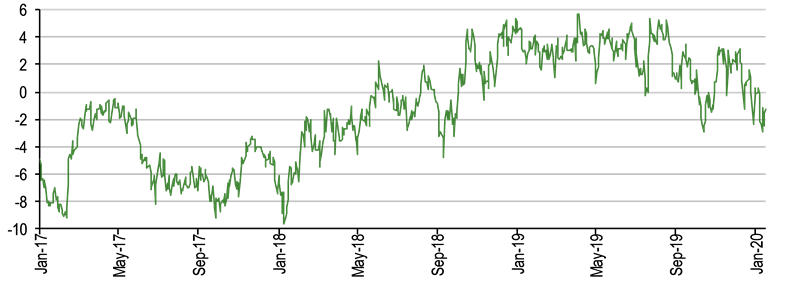
FAS is currently trading at a 1.3% discount to cum-income NAV. Over the last 12 months the valuation has ranged from a 10-year premium high of 5.7% to a 2.9% discount, averaging a 2.3% premium. Over the last three, five and 10 years, FAS has traded at average discounts of 1.2%, 5.2% and 7.6% respectively.
Exhibit 1: Trust at a glance
Investment objective and fund background |
Recent developments |
|||||||||||||||||||||||||||||||||||||||||||||||||||||||||||||||||||||||||||||||||||||||||||||||
Fidelity Asian Values aims to generate long-term capital growth principally from the stock markets in the Asia Pacific ex-Japan region. From 1 February 2020, it is benchmarked against the MSCI All Countries Asia ex-Japan Small Cap index (previously the MSCI All Countries Asia ex-Japan index). |
■ 30 January 2020: confirmation of benchmark change to the MSCI All Countries Asia ex-Japan Small Cap index, effective 1 February 2020. ■ 29 November 2019: final exercise date for subscription rights. ■ 15 October 2019: results for the year ended 31 July 2019. NAV TR +8.2% versus benchmark TR +3.9%. Share price TR +12.3%. Declaration of 8.8p per share annual dividend. ■ 18 June 2019: announcement of the appointment of Clare Brady as a non-executive director with effect from 1 August 2019. |
|||||||||||||||||||||||||||||||||||||||||||||||||||||||||||||||||||||||||||||||||||||||||||||||
Forthcoming |
Capital structure |
Fund details |
||||||||||||||||||||||||||||||||||||||||||||||||||||||||||||||||||||||||||||||||||||||||||||||
AGM |
December 2020 |
Ongoing charges |
0.98% (FY19) |
Group |
FIL Investments International |
|||||||||||||||||||||||||||||||||||||||||||||||||||||||||||||||||||||||||||||||||||||||||||
Interim results |
April 2020 |
Net market gearing |
0.9% |
Manager |
Nitin Bajaj |
|||||||||||||||||||||||||||||||||||||||||||||||||||||||||||||||||||||||||||||||||||||||||||
Year end |
31 July |
Annual mgmt fee |
Variable |
Address |
Beech Gate, Millfield Lane, Lower Kingswood, Tadworth, Surrey, KT20 6RP |
|||||||||||||||||||||||||||||||||||||||||||||||||||||||||||||||||||||||||||||||||||||||||||
Dividend paid |
December |
Performance fee |
None |
|||||||||||||||||||||||||||||||||||||||||||||||||||||||||||||||||||||||||||||||||||||||||||||
Launch date |
13 June 1996 |
Trust life |
Indefinite, subject to vote |
Phone |
0800 41 41 10 or 0800 41 41 81 (IFAs) |
|||||||||||||||||||||||||||||||||||||||||||||||||||||||||||||||||||||||||||||||||||||||||||
Continuation vote |
Five yearly, next 2021 |
Loan facilities |
None (CFDs used) |
Website |
||||||||||||||||||||||||||||||||||||||||||||||||||||||||||||||||||||||||||||||||||||||||||||
Dividend policy and history (financial years) |
Share buyback policy and history (financial years) |
|||||||||||||||||||||||||||||||||||||||||||||||||||||||||||||||||||||||||||||||||||||||||||||||
Dividends are paid annually in December. |
Renewed annually, FAS has the authority to repurchase up to 14.99% of shares and allot shares up to the equivalent of 10% of the issued share capital. Allotments in the chart below include the exercise of subscription shares. |
|||||||||||||||||||||||||||||||||||||||||||||||||||||||||||||||||||||||||||||||||||||||||||||||
|
|
|||||||||||||||||||||||||||||||||||||||||||||||||||||||||||||||||||||||||||||||||||||||||||||||
Shareholder base (at 31 January 2020) |
Portfolio exposure by geography (at 31 December 2019) |
|||||||||||||||||||||||||||||||||||||||||||||||||||||||||||||||||||||||||||||||||||||||||||||||
|
|
|||||||||||||||||||||||||||||||||||||||||||||||||||||||||||||||||||||||||||||||||||||||||||||||
Top 10 holdings (as at 31 December 2019) |
||||||||||||||||||||||||||||||||||||||||||||||||||||||||||||||||||||||||||||||||||||||||||||||||
|
||||||||||||||||||||||||||||||||||||||||||||||||||||||||||||||||||||||||||||||||||||||||||||||||
Source: FAS, Edison Investment Research, Bloomberg, Morningstar. Note: *N/A where not in end-December 2018 top 10.
The fund manager: Nitin Bajaj
The manager’s view: Extreme market polarisation
Bajaj explains that at the beginning of the year, all the ingredients looked to be in place for an emerging markets ‘risk-on’ trade – progress in the resolution of the US-China trade dispute, an accommodative Federal Reserve and potential for a weaker US dollar, benefits from Chinese fiscal and monetary stimulus in 2019 and moderate oil price inflation. However, so far this year, markets have come under pressure following the outbreak of the coronavirus. At the beginning of 2020, the base case was for moderate growth in Asia, led by Chinese consumption; economic data were expected to improve following the Chinese New Year. This has now been called into question due to the coronavirus outbreak, which is undoubtedly having a negative impact on economic activity, particularly in the travel and tourism sectors and businesses that involve human interaction.
The manager notes that in 2019 investors enjoyed above-average total returns, but markets rallied primarily due to higher valuations rather than being driven by robust earnings growth and positive estimate revisions. In 2020, there is potential for positive earnings revisions in certain sectors; for example, DRAM manufacturers are undergoing a cyclical recovery and there is robust demand for products used in the rollout of 5G networks. Bajaj also says history shows markets can rally sharply once epidemics are brought under control. Once the number of new cases trends lower, investors tend to focus on normalisation in economies and markets. Of interest, there appears to be a level of pent-up demand for equities. Despite the Chinese stock market falling by c 8% when it reopened following the new-year shutdown, there were net inflows into A shares, as investors sought companies that they considered were oversold.
The manager cites his ‘frustration’ with the style bias in the market. His relative performance has suffered in recent years as investors have continued to focus on growth and momentum rather than value; he feels he is ‘playing in the wrong stadium’. Bajaj notes the companies held in the portfolio continue to have strong fundamentals and good earnings growth prospects, despite their modest valuations. The fund has an aggregate forward P/E multiple of 9.3x, which is very close to the low end of the historical range. It is also at a 45% discount to the broad market, the widest in the last decade. The manager says that to find so many quality companies trading on multiples of less than 10x illustrates the extreme polarisation in the market between momentum and value stocks, which he suggests is not unusual late in a market cycle. However, he highlights that small-cap value stocks have led the Asian market over the long term, as these companies are often ignored, providing a high margin of safety and room for multiples to expand. Bajaj will continue with his process of buying ‘good businesses, run by good management teams, at a good price’.
The portfolio
At end-December 2019, FAS’s top 10 positions made up 22.0% of the trust, which was broadly in line with 22.2% a year earlier; three positions were common to both periods. There are currently c 135 names in the portfolio, which includes a tail of around 15–20 companies that make up less than 5% of the fund. Bajaj is looking to reduce these, bringing the total number of holdings down to around 125. Portfolio turnover over the last 12 months has been at the higher end of the typical 3040% annual range. The manager’s valuation discipline means he has been taking profits when deemed appropriate.
Exhibit 2 shows Bajaj’s small-cap bias, with just c 17% of the fund held in mid- and large-cap companies (£5bn+). The majority of the portfolio is in companies with a market cap below £1bn, which the manager considers a ‘sweet spot’; he says that some of the larger small caps are a ‘crowded trade’ affording a lower margin of safety.
Exhibit 2: Portfolio exposure by market cap (% unless stated)
Portfolio end- |
Portfolio end- |
Change |
Index |
Active weight |
Trust weight/ |
|
>£10bn |
12.4 |
21.1 |
(8.7) |
67.1 |
(54.7) |
(0.4) |
£5–10bn |
4.8 |
3.5 |
1.2 |
14.2 |
(9.5) |
(0.4) |
£1–5bn |
14.9 |
25.3 |
(10.4) |
14.1 |
0.8 |
33.6 |
£0–1bn |
63.3 |
53.2 |
10.1 |
0.6 |
62.7 |
0.8 |
Other index/unclassified* |
4.7 |
(3.2) |
7.8 |
4.0 |
0.7 |
(4.9) |
100.0 |
100.0 |
100.0 |
Source: Fidelity Asian Values, Edison Investment Research. Note: *Includes short positions.
Bajaj’s unconstrained investment approach is illustrated in Exhibits 3 and 4. Compared with the MSCI All Countries Asia ex-Japan index (FAS’s benchmark until 31 January 2020), the fund has significant overweight exposures to India (+12.2pp) and Indonesia (+7.8pp), with underweights in China (-18.9pp) and Taiwan (-7.5pp), which were particularly strong performers in 2019; the manager finds it more difficult to find attractively valued, high-quality companies in these countries.
Exhibit 3: Portfolio geographic exposure vs benchmark (% unless stated)
Portfolio end- |
Portfolio end- |
Change |
Index |
Active weight |
Trust weight/ |
|
India |
22.3 |
17.9 |
4.4 |
10.1 |
12.2 |
2.2 |
China |
21.4 |
19.6 |
1.8 |
40.4 |
(18.9) |
0.5 |
South Korea |
11.0 |
9.9 |
1.1 |
13.8 |
(2.8) |
0.8 |
Indonesia |
10.1 |
11.8 |
(1.7) |
2.3 |
7.8 |
4.4 |
Taiwan |
6.3 |
11.4 |
(5.2) |
13.8 |
(7.5) |
0.5 |
USA |
5.9 |
N/S |
N/A |
0.0 |
5.9 |
N/A |
Hong Kong |
5.3 |
6.5 |
(1.3) |
9.8 |
(4.5) |
0.5 |
Philippines |
4.5 |
5.4 |
(1.0) |
1.1 |
3.4 |
4.1 |
Singapore |
3.8 |
4.5 |
(0.7) |
3.6 |
0.2 |
1.0 |
Australia |
2.5 |
4.5 |
(2.0) |
0.0 |
2.5 |
N/A |
Thailand |
N/S |
3.2 |
N/A |
N/S |
N/A |
N/A |
Other |
7.0 |
5.1 |
1.9 |
5.2 |
1.8 |
1.4 |
100.0 |
100.0 |
100.0 |
Source: FAS, Edison Investment Research. Note: *N/S = not stated. Numbers subject to rounding.
There were only modest changes in sector exposure during 2019. Versus the index, the manager favours industrials (+6.7pp) and consumer discretionary (+6.0pp), while finding fewer attractive investment opportunities in communication services (-9.3pp), IT (-7.0pp) and financials (-6.0pp).
Exhibit 4: Portfolio sector exposure vs benchmark (% unless stated)
Portfolio end- |
Portfolio end- |
Change |
Index |
Active weight |
Trust weight/ |
|
Consumer discretionary |
21.0 |
18.1 |
2.9 |
14.9 |
6.0 |
1.4 |
Financials |
17.0 |
16.2 |
0.8 |
23.0 |
(6.0) |
0.7 |
Industrials |
13.4 |
14.3 |
(0.9) |
6.7 |
6.7 |
2.0 |
Information technology |
11.6 |
13.1 |
(1.5) |
18.5 |
(7.0) |
0.6 |
Consumer staples |
7.7 |
7.4 |
0.3 |
5.1 |
2.6 |
1.5 |
Healthcare |
7.1 |
4.9 |
2.2 |
3.0 |
4.1 |
2.4 |
Utilities |
6.3 |
7.8 |
(1.5) |
3.0 |
3.3 |
2.1 |
Materials |
5.4 |
5.4 |
0.0 |
4.3 |
1.1 |
1.2 |
Energy |
4.4 |
3.1 |
1.3 |
4.0 |
0.4 |
1.1 |
Real estate |
3.7 |
4.4 |
(0.7) |
5.8 |
(2.1) |
0.6 |
Communication services |
2.3 |
5.1 |
(2.9) |
11.5 |
(9.3) |
0.2 |
100.0 |
100.0 |
100.0 |
Source: FAS, Edison Investment Research. Note: Numbers subject to rounding.
Bajaj highlights a few new holdings in the fund. Chow Sang Sang is a Hong Kong-listed jewellery company; the majority of its sales are generated in China. The stock sold off following the social unrest in Hong Kong, which provided an attractive buying opportunity. The manager sees a lot of value in the company; it is currently trading on 6.5x forward earnings, offers a 6.2% dividend yield and has a strong balance sheet. Two Indian IT services stocks have been added to the portfolio. L&T Infotech is a well-run mid-sized company. It had an issue with its largest customer, which has been resolved, and the stock has re-valued. The manager is patiently waiting for an opportunity to add to the position. Around half of Tech Mahindra revenues are generated from the telecom sector. Robust demand for its services, supported by the rollout of 5G networks, is leading to a reacceleration in the company’s earnings growth.
Performance: Outperformance over the long term
Exhibit 5: Five-year discrete performance data
12 months ending |
Share price |
NAV |
Blended |
MSCI AC Asia |
CBOE UK All Companies (%) |
31/01/16 |
(2.9) |
(2.0) |
(13.0) |
(13.1) |
(5.3) |
31/01/17 |
54.3 |
42.1 |
37.1 |
37.1 |
20.9 |
31/01/18 |
7.4 |
8.7 |
27.3 |
27.3 |
11.3 |
31/01/19 |
10.8 |
(0.4) |
(7.4) |
(7.4) |
(3.9) |
31/01/20 |
(7.6) |
(3.4) |
5.3 |
5.3 |
10.5 |
Source: Refinitiv. Note: All % on a total-return basis in pounds sterling. *Blended benchmark is MSCI AC Far East ex-Japan index to 31 July 2015 and MSCI AC Asia ex-Japan index to 31 January 2020.
|
Exhibit 6: Investment trust performance to 31 January 2020 |
|
Price, NAV and benchmark total return performance, one-year rebased |
Price, NAV and benchmark total return performance (%) |
|
|
|
Source: Refinitiv, Edison Investment Research. Note: Three, five and 10-year performance figures annualised. Blended benchmark is MSCI AC Far East-ex Japan index to 31 July 2015 and MSCI AC Asia ex-Japan index to 31 January 2020. |
|
FAS’s relative returns are shown in Exhibit 7. The trust has outperformed the MSCI AC Asia ex-Japan index over the last 10 years in NAV terms, and the last five and 10 years in share price terms. Performance in recent years has proved trickier as large-cap technology stocks, which are not represented in the fund, have been a big driver of Asian share price returns.
Given his focus on capital preservation as well as capital growth, the manager is encouraged that there have not been many ‘blow ups’ in the portfolio and the underperformance is more a function of an absence of ‘big winners’.
FAS has outperformed its new benchmark, the MSCI AC Asia ex-Japan Small Cap index over the last three, five and 10 years, particularly so over the longer periods and of interest to UK investors, the trust has also outpaced the UK market in both NAV and share price terms over the last five and 10 years.
|
Exhibit 7: Share price and NAV total return performance, relative to indices (%) |
|||||||
|
One month |
Three months |
Six months |
One year |
Three years |
Five years |
10 years |
Price relative to MSCI AC Asia ex-Japan |
(3.5) |
(5.5) |
(11.9) |
(12.2) |
(11.4) |
11.4 |
15.0 |
NAV relative to MSCI AC Asia ex-Japan |
(0.6) |
(5.1) |
(10.1) |
(8.2) |
(15.8) |
(1.6) |
5.5 |
Price relative to MSCI AC Asia ex-Japan Small Cap |
(3.5) |
(2.5) |
(8.8) |
(6.3) |
7.3 |
39.4 |
57.2 |
NAV relative to MSCI AC Asia ex-Japan Small Cap |
(0.6) |
(2.1) |
(7.0) |
(2.0) |
2.0 |
23.2 |
44.2 |
Price relative to CBOE UK All Companies |
(4.0) |
(6.7) |
(14.7) |
(16.3) |
(6.9) |
21.9 |
19.2 |
NAV relative to CBOE UK All Companies |
(1.1) |
(6.4) |
(12.9) |
(12.5) |
(11.5) |
7.7 |
9.4 |
|
Source: Refinitiv, Edison Investment Research. Note: Data to end-January 2020. Geometric calculation. |
|||||||
Valuation: Trading close to NAV
FAS regularly trades close to NAV; its current 1.3% discount to cum-income NAV compares with the range of a 5.7% premium (a 10-year high) to a 2.9% discount over the last 12 months. Over the last year, FAS has traded at an average premium of 2.3%, compared with average discounts of 1.2%, 5.2% and 7.6% over the last three, five and 10 years respectively.
Approved annually, the board may repurchase up to 14.99% and allot up to 10% of shares in issue to manage a discount or premium.
|
Exhibit 8: Share price premium/discount to NAV (including income) over three years (%) |
|
|
Source: Refinitiv, Edison Investment Research |
Peer group comparison
Given its significant small-cap exposure, FAS is now classified as a member of the AIC Asia Pacific Smaller Companies sector, rather than the AIC Asia Pacific sector. Its NAV total returns rank first over five years, second over three years and third over the last one and 10 years. It is trading on the narrowest discount of the three funds by quite some margin. FAS has a competitive ongoing charge and no performance fee is payable. It has an average level of gearing and the highest dividend yield in the sector, 0.5pp above the mean.
Exhibit 9: AIC Asia Pacific Smaller Companies sector as at 14 February 2020*
% unless stated |
Market |
NAV TR |
NAV TR |
NAV TR |
NAV TR |
Discount |
Ongoing charge |
Perf. |
Net |
Dividend |
Fidelity Asian Values |
295.9 |
(1.7) |
7.3 |
51.5 |
144.2 |
(1.3) |
1.0 |
No |
101 |
2.2 |
Aberdeen Standard Asia Focus |
347.5 |
1.0 |
9.4 |
32.9 |
208.7 |
(11.9) |
1.2 |
No |
103 |
1.8 |
Scottish Oriental Smaller Cos |
286.8 |
0.2 |
4.4 |
29.0 |
179.4 |
(12.9) |
1.0 |
Yes |
100 |
1.2 |
Average (3 funds) |
310.1 |
(0.2) |
7.1 |
37.8 |
177.4 |
(8.7) |
1.0 |
101 |
1.7 |
|
FAS rank in sector |
2 |
3 |
2 |
1 |
3 |
1 |
3 |
2 |
1 |
Source: Morningstar, Edison Investment Research. Note: *Performance to 13 February 2020 based on ex-par NAV. TR: total return. Net gearing is total assets less cash and equivalents as a percentage of net assets.
|
|
Research: Metals & Mining
Fittingly for a coloured gemstone company, Gemfields began trading on London’s AIM market on 14 February. We continue to see significant value in this stock, which was previously under the radar, and our updated sum-of-the-parts valuation is US$522m (previously US$449m). The removal of the 15% export duty on Zambian emeralds has a significant positive impact on Kagem, which we now value at US$246m (previously US$153m). We expect Gemfields to generate US$75m in EBITDA in 2020 (previously US$59m), putting it on a 2020e EV/EBITDA of just 1.8x.