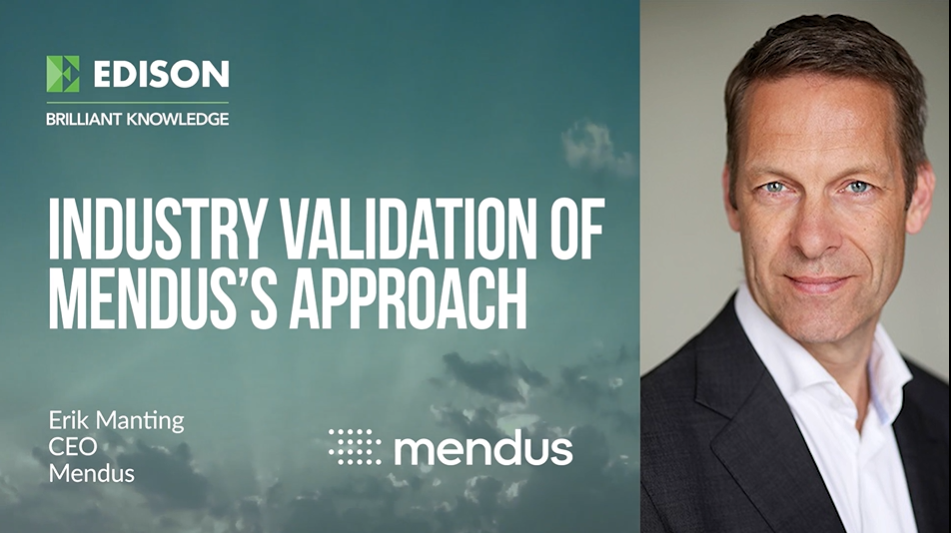
Mendus — 13 videos in collection
Erik Manting, CEO of Mendus, speaks to Arron Aatkar, director at Edison, about the company’s cancer immunotherapy strategy and the clinical development of vididencel. The discussion covers progress in acute myeloid leukaemia (AML), including the CADENCE and DIVA trials, encouraging initial results from the VITAL-CML trial in chronic myeloid leukaemia (CML) and plans to investigate treatment-free remission. Erik also discusses the importance of investor and pharmaceutical industry engagement during London Life Sciences Week.
What is Mendus’s approach to cancer immunotherapy, and how does vididencel work?
Erik Manting: There are two pillars underlying our company. One is that the immune system is capable of controlling cancer cells, and that is something which has been investigated extensively. I think we are starting to find the natural position of the immune system in the treatment of cancers.
We have seen success in solid tumours with so-called checkpoint inhibitors that activate the immune system, but that approach has not been successful in blood cancers.
We have developed a product that stimulates the immune system called vididencel. It is a whole-cell-based product that we administer as a single course of intradermal vaccinations. That gives the immune system a boost at the right moment, which is when the disease has been brought down with conventional therapy. In the case of blood cancers, that is chemotherapy.
What we are then able to do is stimulate the immune system so that it essentially prevents the cancer from coming back. That, of course, has a huge benefit for patients.
What are the latest developments in the CADENCE and DIVA trials, and how do they support the clinical strategy for vididencel in acute myeloid leukaemia?
Erik Manting: Where we were last year was that we had completed, and have now formally completed, a Phase IIa trial in acute myeloid leukaemia, or AML, showing that vididencel, when administered, triggered robust immune responses.
We have also now completed the long-term follow-up of that trial, which was called ADVANCE II.
The next step we took was to broaden the positioning of the product. The ADVANCE II trial focused on patients who, after chemotherapy, still had measurable levels of disease. That is called measurable residual disease, or MRD.
We could show that the immune system was able to bring down that residual disease and that it also led to durable survival outcomes. In fact, the majority of patients reached five-year follow-up after starting treatment with our product. That was a very good outcome.
What we are doing now is two things.
First, we are in a randomised trial called CADENCE. The CADENCE trial no longer discriminates between patients with or without measurable residual disease. It essentially allows us to enrol all patients immediately following chemotherapy.
Second, there is a drug called venetoclax, which has become a growing clinical success. Initially, it was developed and subsequently approved for patients who were not fit enough for high-intensity chemotherapy. But increasingly, we are starting to see that it can also replace or supplement high-intensity chemotherapy.
We therefore expect venetoclax to become a much more dominant first-line treatment in AML.
The DIVA trial addresses that specific tactical element, and the two trials combined allow us to position the product across the first-line treatment landscape in AML.
What have the VITAL-CML trial results shown so far, what are the next clinical steps, and what could the CML opportunity mean for Mendus?
Erik Manting: In chronic myeloid leukaemia, or CML, the challenge is similar. You want to make sure that you can train the immune system to control residual disease.
The clinical objective is different. In CML, a class of drugs called tyrosine kinase inhibitors, or TKIs, can control the disease over the long term.
But the challenge for patients is that they face lifelong therapy with these TKIs, which they have to take daily. They also come with cumulative side effects.
It is therefore important for patients to have a chance of achieving what is called treatment-free remission, or TFR, where they can safely stop taking their TKI.
What we are trying to accomplish is, first of all, to demonstrate safety and tolerability. That is very important in an indication that is, in principle, under control with current therapy.
We have completed that phase in the VITAL-CML trial. That was important in giving us the confidence that we are on the right track with the CML programme.
What we are now aiming to establish is biological activity and, ultimately, initial signs that this helps to lower the level of disease and allows patients to achieve TFR.
The objective of the VITAL-CML trial is therefore twofold. First, to establish safety and tolerability in CML as a new indication. That stage is now complete. We are now looking for signs of biological activity.
That is something we have observed and also published in a press release last week. We are starting to see changes in the immune system after patients are treated with vididencel. These changes show signs of biological activity of the product in the direction we want the immune system to evolve.
We now need longer-term follow-up at the disease level.
We will also start a second trial, called VITAL-TFR2, where we will focus on patients who actually undergo a TFR attempt and stop taking their TKIs.
We will see whether treatment with vididencel helps more patients achieve a successful long-term TFR outcome.
The VITAL-CML trial provides a basis for that Phase II trial. It also has value in its own right because it treats patients with a suboptimal response to tyrosine kinase inhibitors.
What we are now also trying to establish is whether the immune modulation we are starting to see will lead to deeper responses and get more patients into a position where they can attempt TFR. That is called a deep molecular response.
What we published last week is that we are seeing the changes in the immune system we are looking for. We also had our first patient whose disease level fell to what is considered a deep molecular response, or DMR.
The initial results are very encouraging, and we hope to have the topline data in the second half of next year from all, or at least the majority, of the 24 patients we are aiming to recruit.
What does Mendus hope to achieve from attending London Life Sciences Week in November 2026?
Erik Manting: We are part of an ecosystem, Arron, both you and I, and it is always great to see so many people come together.
Every January, there is a big conference organised by JP Morgan, which attracts a lot of people to San Francisco.
I think London is going in that direction, with the Jefferies conference taking place this week as a basis. More and more banks are now also organising their conferences during the same week.
People like yourselves and others are hosting cocktail parties and receptions. I think it is a great setting in which a lot of people from the industry can come together.
That is the main reason we are here: to make connections and to ensure that we continue to be in dialogue with investors and pharmaceutical companies.
These are a very good couple of days to accomplish that.
This transcript has been lightly edited for clarity and readability. Verbal fillers, false starts and minor repetitions have been removed from the interviewee’s responses only. Punctuation, spelling and formatting have also been standardised in line with Edison house style. No substantive changes have been made to the meaning of the discussion.