TxCell
Written by
TxCell |
Increasing CAR Treg emphasis |
H1 results and update |
Pharma & biotech |
28 October 2016 |
Share price performance
Business description
Next events
Analyst
TxCell is a research client of Edison Investment Research Limited |
|||||||||||||||||||||||||||||||||||||||||||||||||||||||||
TxCell’s new and novel CAR-modified regulatory T-cell (CAR Treg) platform has developed rapidly since June with three key academic collaborations aimed at progressing a range of indications including an important one aimed at controlling transplant rejection. CAR Treg trials may start from 2018. The Ovasave Crohn’s Phase IIb will now start in 2018, formerly H216, with faster manufacturing. We expect a cash inflow in H216 of €7m with forecast cash of €3.5m at year end after a cash burn of €12m.
Year end |
Revenue (€m) |
PBT* |
EPS* |
DPS |
P/E |
Yield |
12/14 |
1.39 |
(8.7) |
(82.6) |
0.0 |
N/A |
N/A |
12/15 |
1.61 |
(10.7) |
(87.4) |
0.0 |
N/A |
N/A |
12/16e |
0.11 |
(12.4) |
(92.8) |
0.0 |
N/A |
N/A |
12/17e |
0.00 |
(10.1) |
(70.6) |
0.0 |
N/A |
N/A |
Note: *PBT and EPS are normalised, excluding amortisation of acquired intangibles, exceptional items and share-based payments. Shares in issue rise in 2017.
Two patent protected Treg technologies
TxCell is developing two platform technologies: ENTrIA and ASTrIA. The ENTrIA platform uses chimeric antigen receptor (CAR) technology like that used in the CAR T-cell cancer area. Edison expects ENTrIA to be an excellent basis for partnering and technology licensing. A granted European patent offers broad protection; TxCell licensed the patent globally in June 2016. CAR Treg trials may start from 2018. A key academic collaboration to prevent organ rejection has been announced; this is a major market where development could be faster than in autoimmune. ASTrIA, used by the lead product, Ovasave, is based on naturally occurring Tregs that have been targeted to a specific antigen. A new manufacturing process cuts the time required to produce this autologous therapy from 12 to seven weeks. This process will be GMP-validated over 2017 allowing the planned Phase IIb study to start in 2018.
Financing and funding
In a July deal with Yorkville Advisors Global (YAG), TxCell secured up to €30m gross funding through a convertible loan note deal worth €4.96m in net cash in 2016. TxCell drew a €2.9m loan from this facility in August and expects to receive a further €2m loan by the end of December. Warrants are issued at a rate of 50% of the loan value. A further €14.7m of net cash is available before mid-2019. In August, TxCell also received €1.1m in advance research tax credits and expects to receive a further €1m by early 2017. Management is reducing the expected 2016 cash burn to about €12m; H1 operational cash use was €6.1m; June cash was €3.2m. Edison forecasts cash at year end 2016 of €3.5m.
Valuation: CAR Treg is the future, but Ovasave crucial
TxCell’s valuation still depends on Ovasave, but the Phase IIb has shifted from 2016 to 2018 while the manufacturing is validated. Deals using the CAR platform offer TxCell’s most immediate route to value generation. Due to the Ovasave trial delay and increased 2016 dilution, the indicative value is now €4.82/share, previously €6.30. By the year end, Edison estimates that the effective diluted number of shares and warrants may be 15.76m, excluding further 2017 dilution.
Regulatory T-cell specialist: Exciting and evolving
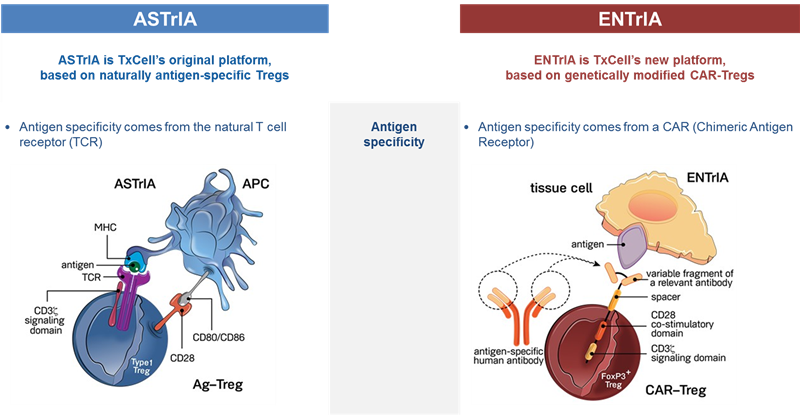
Regulatory T-cells (Tregs) naturally block autoimmune and inflammatory disorders and control the cell-killing T-cell immune response. The Treg area is underdeveloped and TxCell offers a rare investment opportunity, targeting major conditions like Crohn’s disease and, potentially in future, lupus nephritis and other immune indications through direct immune control. An indication to control transplant rejection is the basis of a new academic collaboration. TxCell has two technology platforms; Exhibit 1 shows the technology concepts and Exhibit 2 supplies additional background. The technology was reviewed in the Edison note Two valuable and versatile platforms published 31 May 2016. Management aims to enter platform and preclinical Treg deals in 2016 and 2017.
Exhibit 1: Two technology platforms
Acronym |
Technical basis |
Comments |
ASTrIA |
Tr1 antigen-specific regulatory T-cells (Ag-Treg), discovered by Groux (1997). The lead product, Ovasave, for Crohn’s disease, is activated by the antigen ovalbumin (the major egg white protein). A further antigen target (preclinical) is Collagen Type II as the Col-Treg candidate. |
Antigen Specific Treg for Inflammation and Autoimmunity (ASTrIA) is an autologous cell technology where T-cells are harvested from blood, exposed to an antigen and the resulting antigen-specific Treg cells cultured and then infused back into the patient. The process now takes about seven weeks as a key step has been vastly speeded up. Automation, refinement and validation of the process is underway. This aims to reduce the time required to five weeks and to lower the cost of goods. Manufacturing is done by MaSTherCell, a specialist Belgium based company. The Ovasave Phase I concluded in 2010 and was published in 2012 (Desreumaux 2012). |
ENTrIA |
Chimeric antigen receptor regulatory T-cells (CAR-Treg). Antigen targets need to be identified and validated. |
Engineered Tregs for Inflammation and Autoimmunity (ENTrIA) is a TxCell platform being developed for cellular immunotherapy. The approach is that autologous T-cells are removed from the patient and genetically modified using a virus. The technology is similar to the CAR T-cell approach being developed in cancer but using regulatory cells to target autoimmune and inflammatory disorders. The concept was published in 2008 by the Weizmann Institute of Sciences, Israel; a patent EP2126054 filed by the Weizmann has been granted by the European Patent Agency and was licensed by TxCell in June 2016. |
Source: Edison Investment Research based on TxCell statements and literature sources
The main feature of the last four months has been the rapid evolution of the CAR Treg platform with five indications identified and another five in the consideration. Three of the main programs already have leading academic collaborators and are therefore well placed to progress rapidly.
TxCell has a collaboration with a leading, prestigious European immunology institute, the San Raffaele Scientific Institute in Milan. The collaboration aims to develop a CAR Treg product for lupus nephritis. Lupus nephritis is a particularly severe and potentially fatal form of lupus, the systemic chronic inflammatory disease, in which the immune system causes the kidneys to fail.
A further collaboration with the Lübeck Institute of Experimental Dermatology will develop CAR-Treg approaches in bullous pemphigoid, a rare chronic skin inflammation where the lower layers of the skin are attacked by the immune system causing blistering. The condition can cause dehydration which can be fatal.
TxCell announced in October 2016 a collaboration with Professor Levings of the University of British Columbia on solid organ transplantation. This is an exciting collaboration as there is already preclinical work published showing that CAR Treg cells developed by the collaborator could control graft vs host disease (MacDonald 2016). It is planned to extend this work to develop a new CAR Treg construct to control organ rejection by the transplant host.
The academic collaborations will enable these programs to progress more rapidly. Clinical trials are still some way off but the first ones are planned by management to start from 2018 onwards.
Edison also views the CAR Treg platform as much more flexible and powerful than the established ASTrIA technology. It is therefore a better basis for multiple deals with partners interested in entering the new CAR Treg space especially as it is covered by a granted patent.
To boost its development of CAR Tregs, TxCell has appointed a leading scientist, Dr Li Zhou, PhD, as vice president, cell engineering. Dr Zhou previously worked at the Novartis Biologics Center in Cambridge, leading the discovery and engineering activities on CAR T-cells for cancer immunotherapy. He also led the preclinical development of next-generation CAR T-cells.
|
Exhibit 2: TxCell technology platforms |
|
|
Source: TxCell September 2016 |
Exhibit 3 shows the new timeline announced September 2016 by TxCell. The Ovasave Phase IIb study start is now postponed until 2018 while the faster manufacturing process is finalised and validated. This will give a better basis for partnering as it improves the economics of the product. Full automation is planned for Phase III. However, the delay means that the CAR Treg portfolio may be in Phase I/II at the same time. The Phase IIb postponement also delays any clinical validation of the Treg concept to control autoimmune disease and inflammation until 2020 or later. CAR Treg ENTrIA technology may overtake ASTrIA technology over the next few years.
|
Exhibit 3: TxCell pipeline progression |
|
|
Source: TxCell September 2016. |
Exhibit 4 gives details of the projects.
Exhibit 4: TxCell pipeline
Product |
Indication |
Stage |
Timelines |
Comments |
Ovasave |
Refractory Crohn’s |
Phase IIb (CATS29 study) |
Autologous Tr1 cells, in the CATS29, 56-patient randomised, two-arm placebo-controlled European study. Restart by 2018, data date as yet unknown but 2020 possible if trial restarts in early 2018. |
Regulatory approval received for the amended study protocol with MaSTherCell as the manufacturer. The open IND in the US could allow a US centre to participate. The trial is over 32 weeks per patient; the first six weeks are double blind. |
Col-Treg |
Uveitis |
Preclinical |
Assumed to be postponed to 2018 to use new manufacturing system. |
Tr1 cells against Type II human collagen. |
CAR Teg |
■ Lupus nephritis; ■ Bullous pemphigoid ■ Transplant of organs |
Research |
Clinical trials possible from 2018-19, multiple possible products. |
CAR Treg platform being developed. at least Two other indications are being considered. |
Source: Edison Investment Research based on TxCell corporate presentation January and September 2016
Tranche funding covers operational costs to late 2017
The funding arrangement with Yorkville Advisors Global is for up to €20m in cash from convertible loan notes (€0.1m each) plus a further €10m cash if all warrants are issued and exercised. The first tranche of 30 loan notes (€3m face value) were drawn in August. A further €2m face value of loans can be drawn in November 2016. Until mid-2019, TxCell can draw down further loan notes of up to €15m in face value. Warrants to the value of half the tranche amount will be issued at the same time. Details are in Exhibit 5.
Exhibit 5: Tranche loan note details
Aspect |
Comments |
2% discount |
The cash value of each note is 98% of the nominal value. There is no interest payment on the loan amount. |
Conversion base price |
This will be at 93% of the volume weighted average share price for the previous 10 days. YAG can convert individual tranches of €0.1m as it wishes (see discussion). |
Conversion period |
This is 14 months from draw down. YAG would normally, in Edison’s view, be expected quickly to convert and sell the shares. However, if the shares are not converted, the loan notes will be repaid after 14 months at face value. |
Warrants |
For each €100k tranche of convertible loan notes, €50k of warrants will be issued. The warrants will not be listed but they can be traded. There is a five-year exercise period. |
Warrant exercise price |
Warrants convert at 115% of the volume weighted average share price over the preceding 10 days before the loan note is issued. |
Aspect |
2% discount |
Conversion base price |
Conversion period |
Warrants |
Warrant exercise price |
Comments |
The cash value of each note is 98% of the nominal value. There is no interest payment on the loan amount. |
This will be at 93% of the volume weighted average share price for the previous 10 days. YAG can convert individual tranches of €0.1m as it wishes (see discussion). |
This is 14 months from draw down. YAG would normally, in Edison’s view, be expected quickly to convert and sell the shares. However, if the shares are not converted, the loan notes will be repaid after 14 months at face value. |
For each €100k tranche of convertible loan notes, €50k of warrants will be issued. The warrants will not be listed but they can be traded. There is a five-year exercise period. |
Warrants convert at 115% of the volume weighted average share price over the preceding 10 days before the loan note is issued. |
Source: Edison Investment Research based on TxCell announcement
The current and projected December situation is in Exhibit 6. Of the 30 tranches issued in August, five have been converted to date. Note that the conversion price will vary, so future tranches are assumed to be converted at 93% of the current share price (see Exhibit 5). The conversion timing is also controlled by YAG. This may affect future share price performance.
Exhibit 6: YAG tranche status projected to December 2016
Date |
Tranche issued (€0.1m/tranche) |
Cash to TxCell €m |
Tranche (€0.1m/tranche) |
Conversion price € |
Shares |
Warrants m |
Totals m |
|
Shares 03/08/2016 |
13.04 |
13.039 |
||||||
Tranches issued |
Aug-16 |
30 |
2.94 |
4.29 |
0.350 |
0.350 |
||
Tranches converted |
22/08/2016 |
(1) |
3.07 |
0.033 |
0.033 |
|||
15/09/2016 |
(2) |
2.85 |
0.070 |
0.070 |
||||
10/10/2016 |
(2) |
2.79 |
0.072 |
0.072 |
||||
Tranches issued but not yet converted (estimate at current price) |
(25) |
2.42 |
1.034 |
1.034 |
||||
Q4 issue |
20 |
1.96 |
2.99 |
0.334 |
0.334 |
|||
Q4 potential conversion |
(20) |
2.42 |
0.827 |
0.827 |
||||
Potential December 2016 shares |
15.074 |
0.684 |
15.758 |
|||||
Source: Edison Investment Research compiled from TxCell reports. Based on share price of €2.60/share at 26 October close
From 2017, there could be a further €15m loan drawdown. At the current price, that would mean 6.1m new shares and 2.5m warrants giving, if all were converted and exercised, possibly 24.4m shares in issue. However, conversion terms and prices are too uncertain to be definitive. In particular, a major deal that increased the share price would reduce the number of shares issued and reduce the need for additional loan tranche drawdowns. Edison notes that the warrants are currently out of the money but over the next few years, success in CAR Tregs could enable the conversion of these warrants; they have a five year life. That would yield up to €10m in cash. There are additionally management options over 1.47m shares.
Sensitivities: Early stage, but with CAR Treg concept
Previously, the major sensitivity related to the Phase IIb and TxCell’s ability to fund the €15m required for the study plus the ongoing R&D including the increasingly important CAR Treg platform. These concerns have slightly receded. The YAG facility funds the required R&D but the trial costs will require a deal by late 2017; Ovasave may not progress unless this occurs. If the CAR Treg platform proceeds well, it may supersede the older ASTrIA technology used for Ovasave.
The Crohn’s market is complex to forecast, with uncertainties in patient numbers and significant regional market differences. A core assumption is that a partner is found by the end of 2018.
Steroid resistant uveitis (eye inflammation) is a niche market of about 15,000 cases per year where TxCell could sell Col-Treg directly. However, it would need to fund the trials. The evidence here is less clear and the product is in preclinical development with no disclosed timeline to a Phase I.
Finally, the new CAR Treg opportunity appears to be potentially applicable to many indications in theory, but as a technology platform it is hard to value and clinical trials cannot start before 2018, possibly for lupus nephritis, the current lead or maybe for controlling transplant rejection, a major market.. Exercising the option over the key 2008 academic blocking patent has strengthened TxCell’s position; TxCell is filing new patents. However, the patent still has to be granted in the crucial US market. The CAR platform does have a high deal potential, probably from 2017.
The YAG funding deal introduces a higher level of uncertainty over share dilution if it is used as a major funding route from 2017. The deal minimises dilution in a rising market, but could lead to high dilution levels if market conditions prove difficult due to the high level of warrant leverage.
Valuation: Longer timescale and additional dilution
The valuation of TxCell has been adjusted for the following factors.
■
Firstly, the value depends upon Ovasave as the sole clinical-stage project. The probability of success combines two underlying success probabilities: a clinical probability of success multiplied by the probability of achieving a commercial manufacturing system by 2018. The clinical risk has been retained at 33% with the manufacturing probability increased from 85% to 90% in view of the dramatic reduction in process time. The manufacturing process still needs to be automated and validated, so although the five-week reduction in the manufacturing process time is extremely encouraging, there are still a number of hurdles to overcome. This increases the overall success probability for Ovasave from 28% to 29.7%.
■
The decision to delay the CATS29 Phase IIb study from H216 to a start sometime in 2018 has led to all sales forecasts being pushed back by two years. Launch is now expected in 2025 rather than 2023. The forecast period has therefore been extended to 2037 when biological exclusivity for Ovasave in the United States may expire.
■
The same timeline (2018 clinical trial start) has been adopted for the uveitis product.
■
The CAR Treg portfolio of potentially five indications is in early preclinical development. TxCell has made rapid progress in the last four months. Management believes that the lead CAR Treg projects will be in, or rapidly approaching, Phase I dose ranging studies around the time that the Ovasave Phase IIb study restarts in 2018. As a CAR area, this has the potential for substantive deals. The global licence to the granted European patent has strengthened this position. The nominal value of the CAR Treg portfolio was put at €20m in May 2016. Although this is a very qualitative and subjective view on a very early stage portfolio, Edison has increased this by 10% to €22m given that the portfolio now appears much more defined and that there are excellent academic collaborations on three projects. Transplant appears to be potentially robust indication as it has an analogous of proof of concept published. This value will be replaced by a probability adjusted DCF value once projects are more adequately defined.
■
The effect of delaying the clinical trial start is to extend the period of time in which TxCell will need to make development investments. As noted previously, the effect of extending the development is to increase the net present value of costs.
■
The value of potential deal milestones has also decreased in NPV terms due to the delay and also because it now appears less likely that technology licensing deals on the ASTrIA platform will be made in the next few years. Balancing this is the expectation that a more economic manufacturing process will improve the ultimate deal value on Ovasave. The expected value (by Edison) of the Ovasave partnering deal prior to Phase III deal has been retained at €25m.
■
There have been no other changes to the forecasts and assumptions made in previous notes.
■
The other major change is in the expected dilution. The likely funding need in 2017 has been trimmed to €12m in line with company cost control announced with the H116 results. However, the fall in the share price means that there is potentially much more dilution from conversion of the remaining €4.5m of loan tranches expected to be drawn in 2016. In the June 2016 note, Edison expected dilution from 13.0m shares to 14.5m shares (before management options over 1.47m shares). The expected dilution at the current share price is now expected to be at least 15.76m shares. No prediction about possible 2017 dilution is made as the funding sources are not yet clear and TxCell may obtain non-dilutive funding from deals or shareholders. The effect of the increasing potential dilution is to reduce the indicative value per share regardless of the underlying value of the company.
■
All values are now discounted to 1 January 2017. This is consistent with estimating dilution to 31 December 2016.
The changes are summarised in Exhibit 7. The pre-funding, pre-dilution value has fallen from €91m to €76m. On the expected dilution from convertible loans and warrants, the indicative value has changed from €6.30 to €4.82 per share. Including 1.47m management warrants and options, the diluted value would be €4.41/share.
An important aspect is the potential for value development. While value development for Ovasave is possible over the next few years, the majority of value gains in 2017 will probably come from the CAR Treg platform, which offers a much more flexible approach to candidate development and enables a wider range of indications to be targeted and therefore partnered.
Exhibit 7: Revised valuation
Item |
Indication |
Current values October 2016 |
Previous values from June 2016 |
|||||
Probability |
Shares and warrants m |
NPV @ 12.5% €m |
Probability |
Shares and warrants m |
NPV @ 12.5% €m |
|||
Revenues |
Crohn’s Disease NA |
29.70% |
|
95 |
28.0% |
106 |
||
Crohn’s Disease Eur |
29.70% |
|
27 |
28.0% |
29 |
|||
Crohn’s Disease JP |
29.70% |
|
17 |
28.0% |
19 |
|||
Uveitis |
7.50% |
|
9.6 |
7.50% |
10 |
|||
Total royalty NPV |
|
|
|
148 |
|
163 |
||
Upfront and milestone NPV less Trizel share |
|
|
21 |
|
22 |
|||
Costs (inc Uveitis marketing) less tax credits |
|
(80) |
(74) |
|||||
Gross Profit |
|
|
|
89 |
|
111 |
||
Tax @ 24% |
|
(28) |
(33) |
|||||
Debt NPV (@1.5%) |
|
(7) |
(7) |
|||||
CAR Treg platform |
Nominal |
|
22 |
Nominal |
20 |
|||
Pre-funding and dilution value |
|
76 |
91 |
|||||
|
|
|||||||
Value/share |
(Jan 17) |
15.76 |
€4.82 |
14.51 |
€6.30 |
|||
Management warrants |
1.47 |
|
1.47 |
|
||||
Diluted value/share |
17.23 |
€4.41 |
15.98 |
€5.71 |
||||
Source: Edison Investment Research
Financials
At year-end 2015, TxCell had €9.2m cash; cash on 31 March 2016 was €5m with a €3m tax credit due from 2015. This credit was received in Q216 making 30 June cash €3.2m, down from €9.2m in June 2015. French tax credits are expected to pay about 30% of each year’s R&D cost. The cash is normally paid in the following year, but TxCell will benefit from €2.1m of advanced payments in 2016. It is assumed that advanced payments continue in 2017, otherwise there will be a cash hole.
In H1, R&D costs were €5.6m with administration at €2.5m (excluding depreciation and provisions). The reported costs in H1 were €600k higher due to the setting up of new process industrialization laboratories and an increase in legal and consultancy fees, especially for collaboration and license agreements signed during the reporting period. There was led to a net non-cash €0.4m depreciation and provisions write back. Overall, this implies €8.5m cash costs in H1. There were also €0.4m of share-based payments. A tax credit for €1.3m plus a grant for €0.1m were claimed. Cash outflow in H1 was €7.2m before working capital gains of €1m, making a €6m cash outflow. This is after the €3m tax credit payment, so cash outflow in H1 was €9m.
Net operational cash expenditure was planned by management to rise to €15m for 2016 as a whole. This has now been curtailed to €12m. Edison assumes H2 savings of about €1.7m over H1, making cash expenditure for 2016 about €15.7m. This gives a 2016 operational cash use after tax credits, as guided by management, of €12m. The €15.7m cash need is estimated to be funded by €5.1m of cash tax credits and €4.9m net of convertible loans. This gives a net outflow of €5.7m leaving forecast year end cash of about €3.5m.
Additional capital of €12m net of tax credits in 2017 is assumed to be required. This is within the YAG agreement scope, but ideally will be partly funded by deal income to minimise dilution.
TxCell has a liquidity contract with Kepler Cheureux (formerly Oddo Finance up until 31 July) worth €200k. As of 31 July 2016, €146k had been used to buy 28,137 shares, leaving €54k in cash.
Financial estimates are in Exhibit 8.
Exhibit 8: Financial summary
€000 |
2014 |
2015 |
2016e |
2017e |
||
Year end 31 December |
IFRS |
IFRS |
IFRS |
IFRS |
||
PROFIT & LOSS |
||||||
Revenue |
|
|
1,386 |
1,614 |
107 |
0 |
Tax refund |
|
|
2,035 |
3,023 |
3,500 |
3,500 |
Cost of Sales |
0 |
0 |
0 |
0 |
||
Gross Profit |
3,421 |
4,637 |
3,607 |
3,500 |
||
EBITDA |
|
|
(8,729) |
(10,760) |
(12,417) |
(10,095) |
Operating Profit (before amort. and except.) |
|
(8,269) |
(9,625) |
(12,167) |
(9,845) |
|
Intangible Amortisation |
0 |
0 |
0 |
0 |
||
Exceptionals |
0 |
(1,189) |
7 |
0 |
||
Share based payments |
(1,615) |
(483) |
(600) |
(600) |
||
Operating Profit |
(9,884) |
(11,297) |
(12,760) |
(10,445) |
||
Net Interest |
4 |
15 |
5 |
5 |
||
Profit Before Tax (norm) |
|
|
(8,725) |
(10,745) |
(12,412) |
(10,090) |
Profit Before Tax (FRS 3) |
|
|
(8,265) |
(11,282) |
(12,755) |
(10,440) |
Tax |
0 |
0 |
0 |
0 |
||
Profit After Tax (norm) |
(8,725) |
(10,745) |
(12,412) |
(10,090) |
||
Profit After Tax (FRS 3) |
(8,265) |
(11,282) |
(12,755) |
(10,440) |
||
Average Number of Shares Outstanding (m) |
10.6 |
12.3 |
13.4 |
14.3 |
||
EPS - normalised (c) |
|
|
(82.6) |
(87.4) |
(92.8) |
(70.6) |
EPS - (IFRS) (c) |
|
|
(78.3) |
(91.8) |
(95.4) |
(73.0) |
Dividend per share (c) |
0.0 |
0.0 |
0.0 |
0.0 |
||
Gross Margin (%) |
NA |
NA |
NA |
NA |
||
EBITDA Margin (%) |
NA |
NA |
NA |
NA |
||
Operating Margin (before GW and except.) (%) |
NA |
NA |
NA |
NA |
||
BALANCE SHEET |
||||||
Fixed Assets |
|
|
1,543 |
6,938 |
6,928 |
7,078 |
Intangible Assets |
8 |
5,907 |
5,908 |
6,008 |
||
Tangible Assets |
1,404 |
876 |
836 |
886 |
||
Other |
131 |
155 |
184 |
184 |
||
Current Assets |
|
|
18,500 |
13,782 |
8,531 |
8,536 |
Stocks |
0 |
0 |
0 |
0 |
||
Debtors |
2,548 |
1,551 |
1,504 |
1,504 |
||
Cash |
13,917 |
9,208 |
3,527 |
3,532 |
||
Other |
2,035 |
3,023 |
3,500 |
3,500 |
||
Current Liabilities |
|
|
(3,341) |
(7,467) |
(9,527) |
(7,527) |
Creditors |
(1,946) |
(5,859) |
(7,416) |
(5,416) |
||
Short term borrowings |
(1,395) |
(1,608) |
(2,111) |
(2,111) |
||
Long Term Liabilities |
|
|
(1,990) |
(1,664) |
(1,667) |
(1,667) |
Long term borrowings |
(1,627) |
(1,641) |
(1,648) |
(1,648) |
||
Other long term liabilities |
(363) |
(23) |
(19) |
(19) |
||
Net Assets |
|
|
14,712 |
11,589 |
4,265 |
6,420 |
CASH FLOW |
||||||
Operating Cash Flow |
|
|
(6,937) |
(10,081) |
(10,239) |
(11,600) |
Net Interest |
4 |
15 |
(20) |
5 |
||
Tax |
0 |
0 |
2,100 |
2,100 |
||
Capex |
(590) |
(214) |
(302) |
(400) |
||
Acquisitions/disposals |
17 |
(5,879) |
0 |
0 |
||
Equity financing |
15,691 |
7,631 |
5,000 |
12,000 |
||
Other |
5,139 |
0 |
(100) |
0 |
||
Net Cash Flow |
13,324 |
(8,528) |
(5,661) |
2,105 |
||
Opening net debt/(cash) |
|
|
2,490 |
(10,895) |
(5,959) |
232 |
HP finance leases initiated |
0 |
0 |
0 |
0 |
||
Other |
61 |
3,592 |
(530) |
(2,100) |
||
Closing net debt/(cash) |
|
|
(10,895) |
(5,959) |
232 |
227 |
Source: TxCell accounts, Edison Investment Research Investment Research. Note: YAG funding is assumed to be €5m in 2016 and €12m in 2017 issued as convertible loans and converts to equity.
Edison, the investment intelligence firm, is the future of investor interaction with corporates. Our team of over 100 analysts and investment professionals work with leading companies, fund managers and investment banks worldwide to support their capital markets activity. We provide services to more than 400 retained corporate and investor clients from our offices in London, New York, Frankfurt, Sydney and Wellington. Edison is authorised and regulated by the Financial Conduct Authority (www.fsa.gov.uk/register/firmBasicDetails.do?sid=181584). Edison Investment Research (NZ) Limited (Edison NZ) is the New Zealand subsidiary of Edison. Edison NZ is registered on the New Zealand Financial Service Providers Register (FSP number 247505) and is registered to provide wholesale and/or generic financial adviser services only. Edison Investment Research Inc (Edison US) is the US subsidiary of Edison and is regulated by the Securities and Exchange Commission. Edison Investment Research Limited (Edison Aus) [46085869] is the Australian subsidiary of Edison and is not regulated by the Australian Securities and Investment Commission. Edison Germany is a branch entity of Edison Investment Research Limited [4794244]. www.edisongroup.com DISCLAIMER
|
Edison, the investment intelligence firm, is the future of investor interaction with corporates. Our team of over 100 analysts and investment professionals work with leading companies, fund managers and investment banks worldwide to support their capital markets activity. We provide services to more than 400 retained corporate and investor clients from our offices in London, New York, Frankfurt, Sydney and Wellington. Edison is authorised and regulated by the Financial Conduct Authority (www.fsa.gov.uk/register/firmBasicDetails.do?sid=181584). Edison Investment Research (NZ) Limited (Edison NZ) is the New Zealand subsidiary of Edison. Edison NZ is registered on the New Zealand Financial Service Providers Register (FSP number 247505) and is registered to provide wholesale and/or generic financial adviser services only. Edison Investment Research Inc (Edison US) is the US subsidiary of Edison and is regulated by the Securities and Exchange Commission. Edison Investment Research Limited (Edison Aus) [46085869] is the Australian subsidiary of Edison and is not regulated by the Australian Securities and Investment Commission. Edison Germany is a branch entity of Edison Investment Research Limited [4794244]. www.edisongroup.com DISCLAIMER
|