The overall picture of improving global defence spending supports a return to organic growth for UItra. This is already reflected in the uplift seen in the order book at the H118 report. The company is well positioned to leverage the growth in naval budgets and increased demand for military aircraft around the world. Ultra also has a significant role to play in commercial aerospace, energy and cyber markets. Our fair value is 1,918p.
Written by
Ultra Electronics |
Return to growth |
H118 results |
Aerospace & defence |
6 August 2018 |
Share price performance
Business description
Next events
Analysts
Ultra Electronics is a research client of Edison Investment Research Limited |
|||||||||||||||||||||||||||||||||||||||||||||||
The overall picture of improving global defence spending supports a return to organic growth for UItra. This is already reflected in the uplift seen in the order book at the H118 report. The company is well positioned to leverage the growth in naval budgets and increased demand for military aircraft around the world. Ultra also has a significant role to play in commercial aerospace, energy and cyber markets. Our fair value is 1,918p.
Year end |
Revenue (£m) |
PBT* |
EPS* |
DPS |
P/E |
Yield |
12/16 |
785.8 |
120.1 |
134.6 |
47.8 |
12.6 |
2.8 |
12/17 |
775.4 |
110.0 |
116.7 |
49.6 |
14.5 |
2.9 |
12/18e |
743.6 |
93.7 |
99.0 |
49.6 |
17.1 |
2.9 |
12/19e |
767.1 |
101.9 |
114.5 |
52.1 |
14.8 |
3.1 |
Note: *PBT and EPS are normalised, excluding amortisation of acquired intangibles, exceptional items and share-based payments.
H118 impressive order growth
Strong order book growth of 18.0% y-o-y (on an IFRS 15 basis) accompanied growth across all three divisions. Reported H118 group revenues were £350.5m (H117 £365.8m) with constant currency growth of 1.3% and a negative impact of FX of 5.5%. Reported H118 group operating profit was £47.9m (H117 £56.5m) with constant currency growth of 1.4% excluding a £6.1m impact of development contracts and a negative impact of FX of 5.8%. Reported underlying H118 EPS of 45.1p (H117 57.0p) was down 22.6% while H118 dividend was flat at 14.6p (H117 14.6p). Reported net debt at H118 was £170.1m (H117 £260.4m; FY17 £74.5m) giving an improved net debt to EBITDA ratio of 1.39x (H117 1.78x). FY18 guidance is maintained, underpinned by a strong order book and supportive end markets.
Organic growth returning
The increase in global defence spending appears to be underway, especially in the US, which is Ultra’s largest market. US Department of Defense (DOD) outlays are up 9.3% in YTD; while this may moderate as the year progresses, the fundamental direction appears to be for improved spending globally. The result should be that the return to organic growth seen in H118 should continue. The arrival of new CEO should add momentum to the restoration of confidence in the business model. While the Herley contract issue has detracted from the overall progress, the underlying prospects remain broadly unchanged following the interim results.
Valuation: Rating still depressed
We calculate our estimated fair value of the company as a simple average of the discounted cash flow (DCF) and sum-of-the-parts (SOTP) measures, currently 1,918p (previously 1,811p). Our valuations reflect the lower share count due to the £134m share buyback. The increase largely reflects improved global defence sector ratings on the back of increasing defence spend. At our fair value, Ultra’s shares would be trading on an FY19 P/E of 16.7x.
Investment summary
Company description: Built for growth
Ultra Electronics listed on the London Stock Exchange in October 1996, three years after it was subject to a management buy-out from Dowty Group with revenues of £84m. After more than 50 acquisitions, the group has matured into a global specialist defence electronics and software solutions supplier with sales of around £750m. It operates across eight market-facing segments in three divisions: Aerospace & Infrastructure (26% of FY17 sales/27% of operating profit); Communications & Security (31%/24%); and Land & Maritime (43%/49%). It is still a predominantly US- and UK-centric business, which together accounted for 73% of sales in 2017.
Returning to normality
Having started to recover its poise following the Oman airport contract issues, the company has faced several challenges over the last 12 months. An ultimately aborted $235m bid for Sparton Corporation of the US was accompanied by a £133m net equity fund raising last July. However, the CEO departed the company in the autumn, which followed a prolonged period of organic decline driven mainly by constrained defence spending. H217 was further disrupted by the deferral and cancellation of programmes by the UK Ministry of Defence (MOD) and higher than expected development investment at Herley to support the additional US Navy Surface Electronic Warfare Improvement Programme (SEWIP) modules the company had won. We think the return of Chairman Douglas Caster to his former CEO role on an interim basis underpinned the invest and grow, entrepreneurial strategy that has been the hallmark of Ultra. However, Sparton failed to overcome regulatory pushback in H118 and an ongoing share buyback was launched to return the money raised, with a further Herley contract issue affecting performance. The re-establishment of investor confidence that the model remains valid and intact has been slowly improving and the appointment of Simon Pryce, the former CEO of BBA Aviation who started on 18 June 2018, is expected to mark a return to a more normal period of trading. With defence spending beginning to improve, led by the important US market, there is a clear opportunity to establish a sound and growing investment proposition.
H1 trading sees a return to organic growth
H118 demonstrated the strength of the end markets with an 18% increase on order book y-o-y. Group H118 revenues grew by 1.3% on a constant currency basis with group operating profit up 1.4% excluding £6.1m impact of development contracts. Reported underlying H118 EPS of 45.1p (H117 57.0p) was down 22.6%, while the H118 dividend was held flat at 14.6p (H117 14.6p), as against our expectation of a 5% rise. Reported net debt at H118 was £170.1m (H117 £260.4m; FY17 £74.5m) giving an improved net debt to EBITDA ratio of 1.39x (H117 1.78x). FY18 guidance is maintained, underpinned by strong order book and supportive end markets
Valuation: Opportunity from restoring confidence
We calculate our estimated fair value of the company as a simple average of the DCF and SOTP measures, currently a value of 1,918p (previously 1,811p). Our valuations reflect the lower share count due to the £134m share buyback. Our capped DCF currently returns a value of 1,987p (1,943p previously). Our FY19 SOTP-based value is currently 1,849p (previously 1,688p). The increase largely reflects improved global defence market prospects, especially the US.
H118 results
Highlights of the H118 results are summarised as follows.
■
Strong order book growth of 18.0% (on an IFRS 15 basis), with growth across all three divisions.
■
Reported H118 group revenues were £350.5m (H117 £365.8m), constant currency growth of 1.3% with a negative impact of FX of 5.5%.
■
Reported H118 group operating profit was £47.9m (H117 £56.5m), constant currency growth of 1.4% excluding £6.1m impact of development contracts, with impact of FX of 5.8%.
■
Reported underlying H118 EPS of 45.1p (H117 57.0p) was down 22.6% while H118 dividend was held flat at 14.6p (H117 14.6p), as against our expectation of a 5% rise
■
Reported net debt at H118 was £170.1m (H117 £260.4m; FY17 £74.5m) giving an improved net debt to EBITDA ratio of 1.39x (H117 1.78x).
■
FY18 guidance maintained, underpinned by strong order book and supportive end markets.
Exhibit 1: H118 results summary on an IFRS 15 basis
£m |
H117 |
FY17 |
H118 |
H-o-h % change |
Order book by division |
||||
- Aerospace & Infrastructure |
269.6 |
294.6 |
319.1 |
18.4 |
- Communications & Security |
234.7 |
258 |
282.6 |
20.4 |
- Maritime & Land |
316.8 |
361.8 |
367.5 |
16.0 |
Total order book |
821.1 |
914.4 |
969.2 |
18.0 |
- Aerospace & Infrastructure |
94 |
202 |
91.9 |
-2.2 |
- Communications & Security |
110.5 |
243.5 |
110.2 |
-0.3 |
- Maritime & Land |
161.3 |
322.8 |
148.4 |
-8.0 |
Total revenues |
365.8 |
768.3 |
350.5 |
-4.2 |
Operating profit by division |
|
|
|
|
- Aerospace & Infrastructure |
14.4 |
-0.7 |
14.8 |
2.8 |
- Communications & Security |
13.3 |
33 |
7.9 |
-40.6 |
- Maritime & Land |
28.8 |
26.1 |
25.2 |
-12.5 |
Total operating profit |
56.5 |
117.7 |
47.9 |
-15.2 |
Operating margin by division (%) |
|
|
|
|
- Aerospace & Infrastructure |
15.3% |
-0.3% |
16.1% |
5.1 |
- Communications & Security |
12.0% |
13.6% |
7.2% |
-40.4 |
- Maritime & Land |
17.9% |
8.1% |
17.0% |
-4.9 |
Total operating margin (%) |
15.4% |
15.3% |
13.7% |
-11.5 |
Pre-tax profit (underlying) |
51.2 |
58.2 |
43.6 |
-14.8 |
EPS (p) (ongoing underlying) |
57.0 |
112.0 |
45.1 |
-20.9 |
DPS (p) |
14.6 |
49.6 |
14.6 |
0.0 |
Source: Company reports
|
Exhibit 2: Revenue by end market (H118) |
Exhibit 3: Revenue by geography (H118) |
|
|
|
Source: Company reports |
|
Exhibit 2: Revenue by end market (H118) |
|
|
Source: Company reports |
|
Exhibit 3: Revenue by geography (H118) |
|
|
Source: Company reports |
Aerospace & Infrastructure (26% of H118 group sales) reported an 18.4% (on an IFRS 15 basis) increase in its order book y-o-y. Key order wins include engine ice protection and high pressure pure air generator (HiPPAG) stores ejection systems for the F-35 Joint Strike Fighter and wing ice protection controller units for the Boeing 787. H118 revenue grew on a constant currency basis and divisional operating margin was supported by the expected lower level of R&D spend.
Communications & Safety (31% of H118 group sales) reported a 20.4% (on an IFRS 15 basis) increase in its order book y-o-y. Key order wins include an ORION radio contract in the Middle East and Strategic Deployable Terminal contract for the Canadian Armed Forces. Revenue grew on a constant currency basis although the division faced tough comps with lower crypto product sales versus H117. The division was affected by £6.1m of cost overruns on specific development contracts at Herley, as flagged early last month, and is set to complete this year. The divisional margin would have been 12.7% without the Herley impact.
Marine & Land (42% of H118 group sales) reported a 16.0% increase (on an IFRS 15 basis) in its order book y-o-y. Key order wins include the Indian Navy marine propulsion order (c £30m, won in 2017), sonobuoys to the US Navy and equipment for the UK Navy submarine fleet. Revenue declined on a constant currency basis and the division has faced some delays in its maritime programmes, which have moved into H218. Operating margin has also been affected by cost overruns from redesign work.
Outlook
Prospects for growth appear to be continuing to improve as defence spending is clearly rising, especially in the US. We have already adjusted for the Herley contract loss to completion, so the only change to our forecast results from the expectation that the dividend will be held in FY18 before starting to increase progressively from FY19, but with an element of rebuilding cover.
The result is slightly lower cash outflows this year and next with a small decline in net interest expense in FY19 improving EPS by 0.1%.
Exhibit 4: Estimate revisions
Year to December (£m) |
2018e |
|
2019e |
|
||
|
Prior |
New |
% change |
Prior |
New |
% change |
Aerospace & Infrastructure |
195.0 |
195.0 |
0.0 |
198.9 |
198.9 |
0.0 |
Communications & Security |
238.7 |
238.7 |
0.0 |
245.8 |
245.8 |
0.0 |
Maritime & Land |
309.9 |
309.9 |
0.0 |
322.3 |
322.3 |
0.0 |
Sales |
743.6 |
743.6 |
0.0 |
767.1 |
767.1 |
0.0 |
|
|
|
|
|
|
|
EBITDA |
121.2 |
121.2 |
0.0 |
131.8 |
131.8 |
0.0 |
|
|
|
|
|
|
|
Aerospace & Infrastructure |
29.3 |
29.3 |
0.0 |
29.8 |
29.8 |
0.0 |
Communications & Security |
25.1 |
25.1 |
0.0 |
32.4 |
32.4 |
0.0 |
Maritime & Land |
51.1 |
51.1 |
0.0 |
53.2 |
53.2 |
0.0 |
Underlying EBITA |
105.5 |
105.5 |
0.0 |
115.5 |
115.5 |
0.0 |
|
|
|
|
|
|
|
Underlying PTP |
93.7 |
93.7 |
0.0 |
101.8 |
101.9 |
0.1 |
|
|
|
|
|
|
|
EPS - underlying continuing (p) |
98.9 |
99.0 |
0.0 |
114.4 |
114.5 |
0.1 |
DPS (p) |
52.0 |
49.6 |
-4.7 |
54.6 |
52.1 |
-4.7 |
Net debt / (cash) |
185.3 |
183.6 |
-0.9 |
166.7 |
163.0 |
-2.2 |
Source: Edison Investment Research
As stated at the pre-close statement and reiterated at the H118 report, Ultra notes that the majority of the group has received better than anticipated order intake and is expected to deliver H218 performance in line with management’s expectations. The group’s cash performance will be more heavily weighted to H218 with FY18 cash conversion expectations of 70-75%, due to higher working capital requirements as a result of order wins.
Company description: Built for growth
Ultra Electronics Group provides products and services to the aerospace and defence, security and cyber, transport and energy sectors. The company has developed a core of critical technology expertise. Within the defence universe it operates as a predominantly Tier 3/4 supplier, although it is capable of systems integration as a Tier 2 supplier, primarily for its own solutions. Its major markets are in North America and the UK, with its two largest customers being the US DOD (19% of FY17 group sales) and the UK MOD (11% of FY17 group sales). Development of innovative solutions addressing customer needs has been key to this positioning. Common threads run through its businesses: stealth, cyber, security, power management, communications and control.
Ultra takes its roots from a management buyout of businesses from the Dowty Group in 1993 and subsequent floatation in 1996. Since then, the company has grown organically and through a series of bolt-on acquisitions.
|
Exhibit 5: Organisational chart |
|
|
Source: Company reports |
The current group structure was put in place in 2015 alongside the S-3 shared services programme, where investment should come to an end in 2018 and the benefits reach maturity in 2019.
As the new CEO assesses the business for the next phase of its development, it would not be surprising to see efforts to lean the overall business, and potential rejigging of the divisional structure with a continuing focus on operational excellence. However, we would not anticipate any review to be completed until the prelims in 2019. We do suspect that the board continues to feel that agility and operating autonomy of individual subsidiaries is a key element to serving Ultra’s end markets.
Strategy
Ultra’s strategy is framed around key areas for strengthening and growing the business:
■
Increase the group’s portfolio of specialist capability areas
■
Increase number of platforms and programmes it has exposure to
■
Extend the customer base
■
Broaden the geographic footprint
The core capabilities of the group are shown in Exhibit 6.
Exhibit 6: Businesses mapped to core capabilities
Aerospace |
Nuclear |
Infrastructure |
Underwater Warfare |
Maritime |
Land |
C2ISR |
Comms |
|
Advanced Tactical Systems |
X |
|||||||
Airport Systems |
X |
|||||||
Avalon Systems |
X |
|||||||
Command & Control Systems |
X |
X |
X |
|||||
Communications & Integrated Systems |
X |
|||||||
Controls |
X |
X |
||||||
EMS |
X |
X |
||||||
Flightline Systems |
X |
X |
||||||
Forensic Technologies |
X |
|||||||
Gigasat |
X |
|||||||
Herley |
X |
X |
||||||
Maritime Systems |
X |
|||||||
Nuclear Control Systems |
X |
|||||||
Nuclear Sensors & Process Instrumentation |
X |
|||||||
Ocean Systems |
X |
|||||||
PMES |
X |
X |
X |
|||||
Precision Air & Land Systems |
X |
|||||||
ProLogic |
X |
X |
||||||
Sonar Systems |
X |
|||||||
TCS |
X |
X |
||||||
USSI |
X |
|||||||
3eTi |
X |
X |
||||||
3 Phoenix inc |
X |
Source: Company reports
The scale and geographic reach of the group are shown in the following charts. It can be seen that North America and Europe still account for the bulk of activity. Given that the capabilities are desirable for other export markets, we would expect to the rest of the world exposure increase over time, eg the FY17 Indian Navy contract win, although renewed growth in the US may mask this.
|
Exhibit 7: FY17 revenues by destination |
Exhibit 8: FY17 revenues by market segment |
|
|
|
Source: Company reports |
|
Exhibit 7: FY17 revenues by destination |
|
|
Source: Company reports |
|
Exhibit 8: FY17 revenues by market segment |
|
|
Source: Company reports |
Despite recent strengthening of order intake, the long-term opportunities for Ultra remain significant. The current major potential programmes are listed in Exhibit 9.
Exhibit 9: Long-term growth opportunities
Segment |
Key programmes |
Value |
Status |
Underwater Warfare (UWW) |
India Naval Defence Systems |
£30m |
2017 – won |
UK T-26 S2150 Hull Mount Sonar |
£9m |
2018 – first three shipsets |
|
India IADS & ASW Shallow Water Craft |
£94m |
2019 – SWC FET complete, partnered with Mahindra |
|
Canadian Surface Combatant HMS & LFTAS |
£67m |
2020 – teaming with LM on T-26, supplier to GD |
|
US Navy FY19-23 Sonobuoy IDIQ |
£217m |
2020 – proposal submitted, award Q120 |
|
Maritime |
UK Propulsion System |
£37m |
2017 – won |
US Virginia Class – Power Conversion follow-on |
£18m |
2018 – incumbent supplier |
|
US Navy Next Gen Surface Search Radar Production |
£17m |
2020 – early development orders from 2018 |
|
Land |
US Soldier Wearable System Nett Warrior |
£30m |
2020 – funded trials successfully completed |
UK UltraLynx soldier worn power & data system |
£20m |
2020 – first trials successfully completed |
|
C2ISR (Command, Control, Intelligence, Surveillance and Reconnaissance) |
Advanced airborne surveillance system |
£50m |
2017 – won. First systems orders of £17m |
ATF IBIS bullet forensics |
£40m |
2018 – five-year support contract |
|
SEWIP Block 3 |
£100m |
2019 – initially LRIP |
|
Communications |
UK government encryption & key management |
£20m |
2018 – selected. Multiple individual orders |
US Army WIN-T ORION radio production |
£70m |
2018 – LRIP order initially |
|
UK Air force secure radio upgrade |
£15m |
2018 – production orders |
|
Middle East land border security |
£20m |
2017 – no bid. High risk |
|
Aerospace |
SAAB Gripen E/F HiPPAG - First production orders |
£9m |
2017 – won |
Cessna Hemisphere control systems |
£40m |
2018 – delayed by customer |
|
WheelTug on Boeing 737 |
£70m |
2018 – certification and entry into service 2019 |
|
Nuclear |
Chinese CPR-1000/ACC-1000 new build reactors |
£9m |
2018 – sensors for Chinese variant delayed |
US plant life extension expanded sensors and I&C |
£27m |
2018 – being bid through individual programmes |
|
AGR systems & sensors lifetime support |
£35m |
2019 – nucleonics and lifetime build of sensors |
|
Infrastructure |
London Heathrow baggage reconciliation system renewal |
£10m |
2017 – won |
Digital Trackside Power |
£10m |
2018 – evaluation trials programme |
Source: Company reports
Acquisitions have been a key part of Ultra’s strategy, typically identified and integrating bolt-on deals to expand the company’s addressable market.
We should outline how the proposed acquisition of Sparton Corporation in the US was halted by anti-trust considerations early in 2018. At the forefront of these appears to have been concerns about the ability to maintain a competitive sonobuoy market following a total merger, in what seems to be a period that will see increased requirements for sonobuoys for the US Navy. In the context of the existing joint venture, ERAPSCO, this was possible even though at present the supply agreements make this a de facto monopoly.
The announcement by Sparton in early July that it would protest a decision to exclude ERAPSCO from bidding for the GFY19-23 AN/SSQ-125A Production Sonobuoy appears to be evidence of a change. The Q125A is a follow-on programme for the Q125 (in delivery since 2012) that generates revenues of c $20m per year for Sparton. While the outcome of the protest should be decided by 17 October 2018, it would appear to be an effort to introduce a third party into the sonobuoy market for the US Navy. If unsuccessful, it will reduce production revenues from 2019. The Q125 is still likely to be available for export markets.
Both Sparton and Ultra are likely to be able to rebid independently in 2024 as a second source if an appropriate and adequate technical solution is offered.
The current IDIQ contract for sonobuoys, including another six types, expires at the end of 2018 and bids have been submitted by ERAPSCO for the IDIQ requirement for 2019–23. ERAPSCO has not been excluded from the bidding process as a sole source on four. It is thus likely that the status quo for these should be maintained for the time being, although there is a clear indication in the Sparton statement that the Navy would like to see Ultra and Sparton offer solutions outside of the ERAPSCO joint venture in future. Ultra’s management appears confident that it has the technical and physical capability to participate in a competitive bid scenario.
Although the Sparton transaction did not go to plan, it was clearly beyond Ultra’s control. This should not preclude future M&A and the company’s ability to fund this and execute upon it. A share buyback worth £134m was initiated to return the funds raised in 2017 to shareholders to part-fund the proposed deal.
Market overview
Historically, Ultra asserted that no more than 5% of group sales would be generated from one customer. However, Exhibit 10 clearly demonstrates the strength of the company’s relationship with the US DOD.
|
Exhibit 10: Ultra Electronics’ largest customers |
|
|
Source: Company reports |
Defence and aerospace (67% of FY17 group revenues)
Overall, Ultra is exposed to military programmes that have a long duration and hence provide good visibility. Around the globe, Ultra is seeing demand from the national shipbuilding strategies announced by the US, UK, Australia and Canada. Meanwhile, military aircraft demand is increasing, with the F-35 Joint Strike Fighter moving to full rate production.
Exhibit 10 demonstrates the significance of the US DOD to Ultra. Today the direction of travel of the world’s largest defence budget has reversed the declines seen earlier in the decade with reduced overseas operations. Exhibit 11 demonstrates the uplift in outlays. The FY19 DOD budget is very much focused on addressing future threats from a position of strength. Hence, the required uplift in defence spending is increasingly visible.
|
Exhibit 11: US DOD investment* budget outlays (rolling 12 months) |
|
|
Source: US Department of Defense. Note: *RDT&E and procurement. |
The UK defence market had been under considerable scrutiny. Although it is the fifth largest defence budget globally, ongoing budgetary pressures, a change in defence secretary and a new review launched in January have all kept the spotlight on the sector. Defence secretary Gavin Williamson intends for the current the Modernising Defence Programme to be completed by the summer and says it is unlikely to be ‘fiscally neutral’. However, the Public Accounts Committee has already made it clear that the current Defence Equipment Plan falls short of requirements.
Around the globe, Ultra notes that countries are ‘coming under pressure to establish an indigenous defence capability’. The company has been successful in building its international defence footprints and views technology transfer as an increasingly important factor to win work in export markets.
The long-term fundamentals for the global commercial aerospace market remain healthy. IATA expects air traffic in 2018 to stay above trend, while in the longer term both Airbus and Boeing predict aircraft fleets to double over next 20 years. We show our expectations for Airbus and Boeing aircraft deliveries in Exhibit 12.
|
Exhibit 12: Airbus and Boeing deliveries |
|
|
Source: Company reports, Edison Investment Research |
Core to Ultra’s involvement in commercial aviation programmes is investing in new technology in cooperation with major industry partners. The company is starting to see the benefit as new programmes ramp up production. These include the company’s Ice Protection system for the Boeing 787 programme and landing gear controls across the Airbus product fleet.
Security and cyber (15% of FY17 group revenues)
This area is constantly evolving and keeping pressure on countries to modernised their security systems. While Warren Buffet suggests that cyber attacks are the number one problem for mankind, cyber crime is estimated to generate damage costs worldwide of c $6trn annually by 2021, up from c $3trn in 2015. In turn, this threat is expected to drive cybersecurity spending up from c $86.4bn in 2017 up to c $1trn in 2021, according to Gartner. From a defence perspective, the FY19 US President’s budget includes $15bn of budget authority for cybersecurity-related activities. This represents a $583.4m uplift over FY18, or 4.1% growth. Within this, the US DOD was the largest contributor at $8.5bn (FY18 $8.2bn) and notes that the role of terrorism today has ‘transformed global affairs with increased capabilities of mass disruption’. Meanwhile, civilian cybersecurity within the overall budget funding is increasing in the US by a similar percentage to defence.
At the core is Ultra’s ability to cyber-harden control and security systems in mission-critical areas. In the UK there have been some delays in spending in this area, whereas the US market is stronger. This exhibits itself in Ultra winning a $16.2m contract to cyber-secure systems for the Navy. Beyond the military, Ultra has found success in the oil and gas industry, winning work in the areas of multi-layered surveillance and security.
Transport and energy (18% of FY17 group revenues)
Ultra has a strong position in the nuclear energy sector, with capability in the area of sensors, process instrumentation and control systems. The backdrop for the nuclear market is relatively robust, with 445 nuclear power reactors in operation in 29 countries in 2017. Looking forward, c 150 power reactors with c 160,000MWe gross capacity are on order or planned, with a further 300 proposed. Exhibit 13 demonstrates that nuclear new build is largely skewed to emerging markets. Ultra recognises that the focus in Western markets has largely shifted to safety system upgrades, life extensions, emergency management and plant sustainment. The barriers to entry are high in this sector and the opportunities for Ultra in new and aftermarket business areas remain strong.
|
Exhibit 13: Global planned nuclear reactors for construction between 2018-26e |
|
|
Source: World Nuclear Association |
The transport opportunity for Ultra is broad. The airport sector should leverage air traffic growth, while at the same time requiring more efficient and secure operating systems. In rail, the focus continues to be on power conversion and control markets. The UK market is not without price pressures. However, the drive towards controls and smart digital solutions continues. Once again, the geographic divide is visible with more developed countries working towards upgrading and maintaining networks, whereas the emerging market opportunity is focused on growth and building national capacity.
Overall, Ultra’s order book includes long-duration contracts, from winning programmes on aircraft or marine programmes to working on nuclear systems. This adds visibility into the order book and underpins future performance. Exhibit 14 demonstrates order cover in terms of value and composition.
|
Exhibit 14: 2018 liquidation of mid-term orders from long-term positions |
|
|
Source: Company reports |
Divisional overview
Exhibit 15: Divisional progression
Year to Dec (£m) |
2011 |
2012 |
2013 |
2014 |
2015 |
2016 |
2017 |
2018e |
2019e |
Revenue |
|||||||||
Aerospace & Infrastructure |
229.3 |
226.6 |
230.4 |
198.6 |
193.2 |
204.7 |
203.2 |
195.0 |
198.9 |
Communications & Security |
228.7 |
268.9 |
237.7 |
224.4 |
239.3 |
259.0 |
242.7 |
238.7 |
245.8 |
Maritime & Land |
273.7 |
265.3 |
277.1 |
290.7 |
293.8 |
322.1 |
329.5 |
309.9 |
322.3 |
Group revenues |
731.7 |
760.8 |
745.2 |
713.7 |
726.3 |
785.8 |
775.4 |
743.6 |
767.1 |
EBIT |
|
|
|
|
|
|
|
||
Aerospace & Infrastructure |
37.2 |
45.1 |
46.2 |
29.6 |
28.6 |
32.4 |
32.6 |
29.3 |
29.8 |
Communications & Security |
41.7 |
32.9 |
27.5 |
37 |
40.4 |
39.7 |
28.2 |
25.1 |
32.4 |
Maritime & Land |
42.8 |
43.8 |
48 |
51.5 |
50.9 |
59.1 |
59.3 |
51.1 |
53.2 |
Group EBIT |
121.7 |
121.8 |
121.7 |
118.1 |
120.0 |
131.1 |
120.1 |
105.5 |
115.5 |
EBIT margin |
|
|
|
|
|
|
|
||
Aerospace & Infrastructure |
16.2% |
19.9% |
20.1% |
14.9% |
14.8% |
15.8% |
16.1% |
15.0% |
15.0% |
Communications & Security |
18.2% |
12.2% |
11.6% |
16.5% |
16.9% |
15.3% |
11.6% |
10.5% |
13.2% |
Maritime & Land |
15.6% |
16.5% |
17.3% |
17.7% |
17.3% |
18.3% |
18.0% |
16.5% |
16.5% |
Group EBIT margin |
16.6% |
16.0% |
16.3% |
16.5% |
16.5% |
16.7% |
15.5% |
14.2% |
15.1% |
Source: Company reports, Edison Investment Research
Aerospace and infrastructure
Exhibit 16 gives an overview of the principal exposures and products of the business units. The variety of activities encompassed by a simple divisional title is extensive. The complexity within each division arises as a result of the chosen status of Ultra as predominantly a Tier 3/Tier 4 supplier to over 350 platforms.
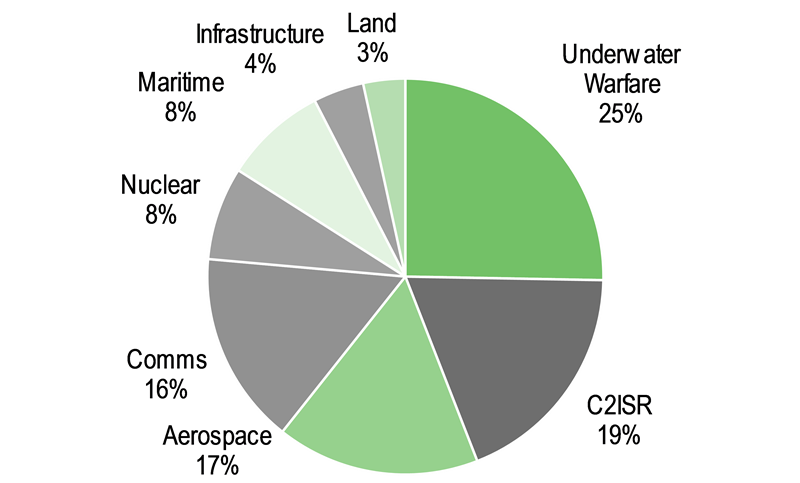
The aerospace domain, which accounted for 17% of FY17 group sales, has established strengths in a variety of mission-critical electronic systems, control and instrumentation solutions, as well as more niche aviation technologies such as ice protection. It operates across both civil and military aircraft programmes, establishing long-term positions by providing innovative, low-cost and safety-compliant solutions to platform manufacturers. Civil output is set to continue to ramp up in the large commercial aircraft market and Ultra has positions on regional jet and turboprop programmes such as the Mitsubishi Regional Jet and the Chinese MA700. It has gained share in the large business jet market with Gulfstream and Cessna. Commercial sales growth is thus underpinned by aircraft production schedules. In the military market, exposure to the F-35 programme combined with growth in new transport programmes such as the KC390 and A400M should also drive sales. The company recently won first production orders on the SAAB Gripen E/F for its HiPPAG system for weapon ejection.
Infrastructure accounted for just 4% of FY17 group sales, with Ultra providing critical systems and software for the safe operation and security of transport and energy infrastructure. Transport investment remains in a growth phase with tier 2 airport systems experiencing growth in South America, the Middle East and Asia. That said, the most recent win for this business was for the renewal of the London Heathrow baggage reconciliation system. Rail investment is also expected to grow, although pricing is becoming increasingly competitive in export markets for Ultra’s range of power management solutions. Smart grid technologies also look set to benefit from the continuing constraint of energy networks, combined with increasing power demand.
Nuclear accounted for 8% of FY17 group sales. Its qualified sensors and safety systems support the growing market in reactor licensing, delivery, security and safe operation of reactors. With equipment on more than 190 reactors in 16 countries as well as on 32 new build reactors worldwide, Ultra has a well-established presence. While nuclear is a notoriously long-cycle business, Ultra should be able to access an increasing demand for plant life extensions and upgrades, as well as exploiting opportunities for new build growth on Generation 3 and NuScale’s Small Modular Reactor. The cyber protection and physical security of infrastructure is also now an increasing requirement.
Exhibit 16: Aerospace and infrastructure - business activities
Business |
Products and activities |
HQ |
Airport systems |
Provides IT services and solutions for airlines and airports including master systems integration; common use check-in; local departure control; weight & balance management systems; central database; flight information; management information; passenger bag matching; resource management; data acquisition and control. |
Wythenshawe, Manchester, UK |
Nuclear control systems |
Provides a full suite of capabilities to the nuclear industry including: high integrity reactor instrumentation and control; life extensions and upgrades; nuclear emergency management systems; radiation monitoring solutions. |
Wimborne, Dorset, UK |
Nuclear sensors & process instrumentation |
Designs and manufactures high integrity instrumentation for the civil nuclear and other industries, specialising in temperature and pressure sensors; fibre-optic converters; switches. |
Round Rock, Texas, US |
Precision control systems |
Provider of high integrity control products for aerospace, military vehicle and soldier applications. Aerospace solutions include position sensing and control; airframe ice protection systems; active noise and vibration control; propeller balance monitoring systems; cockpit controls such as joysticks, throttles, selector handles and switches; lighting systems; high-pressure pure air generators for sensor cooling and for pneumatic ejection of aircraft munitions; ruggedized cable harnesses and ground service panels. For fighting vehicles and dismounted soldiers, Ultra PCS provides generic architectures, data management and local situational awareness systems. |
Cheltenham, UK |
Source: Company reports
Communications and security
Communications accounted for 16% of FY17 group sales and provides advanced, interoperable secure communications and systems for voice, video and data transfer. This includes the provision of scalable and low-risk radio, encryption, satellite and specialist systems to military government, law enforcement, industry and commercial customers around the globe.
The demand for faster, lower-cost, more mobile yet secure links are increasingly in demand in the command and control environment to improve situational awareness through efficient transfer of voice, data and video. In turn this should drive increased bandwidth demand and higher capacity requirements on High Throughput Satellites operating on the higher frequency Ka-band over the next five years. Demand for secure key management and increasingly IP-based encrypted system continues to drive demand in the military market, and Ultra has presence in both the UK and the US encryption programmes.
Command & Control, Intelligence, Surveillance & Reconnaissance (C2ISR) accounted for 19% of FY17 group sales and is driven by growing requirement to secure and protect critical national infrastructure (CNI) and national borders. Increasing precision targeting and range of strikes continues to be a key demand in the military market, requiring improved and secure intelligence and surveillance data capture and analysis, increasingly in a real-time environment. ISTAR is being developed for both manned and unmanned air platforms.
The Herley acquisition forms part of this division and was acquired on 21 August 2015 for £164.7m. This business extended Ultra’s electronic warfare (EW) capabilities; however, it has also captured recent headlines. Historically, issues with the business have included work on the SEWIP and an EW contract for the F-15 aircraft platform. The business has been very successful in winning new business, but this has required financial support to deliver and there have been project cost overruns. It appears now that the continued additional cost is at least partly due to changes in scope, some of which may be recoverable from the customer, although negotiations on such issues tend to be protracted.
Exhibit 17: Communications & Security - business activities
Business |
Products and activities |
HQ |
3eTI |
A leading cyber-technology company with products and systems that secure critical infrastructure and improve operational efficiency. 3eTI helps preserve operational investments through advanced M2M security, secure wireless networks and sensor network applications, leveraging new and legacy systems while complying with highest government and industry standards. |
Rockville, Maryland, US |
Advanced Technical Systems |
A leading supplier of tactical command and control systems, communication gateways, data fusion and display systems. It also provides software-based applications that deliver enhanced situational awareness in military command, control, communications, computers, intelligence, surveillance and reconnaissance (C4ISR) systems. |
Austin, Texas, US |
Communication & Integrated Systems |
Key supplier of communications and security solutions to both defence and commercial markets. Key capabilities include: |
Greenford, UK |
|
■ Data security – tactical and network encryption accredited to the highest standards, hardware security modules and key management and distribution. |
||
|
■ EW simulation and test. |
||
|
■ Military communications & ISTAR – airborne surveillance and targeting, tactical, video and C2 data links, deployed communications networks and satcom terminals. |
||
|
■ Surveillance & security – border, port and harbour security, CNI protection, covert surveillance and recording systems. |
||
|
■ Commercial communications – telemetry and RF mesh networking, flexible voice and data routing and fixed, mobile and transportable satcom terminals. |
||
Forensic Technology |
Provides automated firearm ballistics identification and forensic analysis systems for the criminal justice and border security communities. A world leader in its field, the company works with hundreds of law enforcement agencies across the globe, providing cost-effective and sustainable solutions. |
Cote St-Luc, QC, Canada |
Herley |
Industry leader in the design, manufacture and support of advanced integrated RF subsystems and components for high performance EW, radar and communications systems and flight test and instrumentation systems and subsystems. |
Lancaster, PA, US |
TCS |
Designs and manufactures high capacity, multi-channel line-of-sight radios and multiplexers; EW and electronic counter-countermeasure radio systems; military network communications equipment for voice, data and video information; high speed protocol converters and modems. |
Montreal, Canada |
Source: Company reports
Maritime and land
Underwater warfare accounted for 25% of FY17 group sales and represents the historical core of Ultra. By virtue of foresight and investment, Ultra’s products and systems in this area remain as relevant to global naval fleets as ever. Contract sizes in this area reach into hundreds of millions and add visibility to the portfolio. A recent win here is the £30m India Naval Defence Systems contract.
Maritime accounted for 8% of FY17 group sales, providing advanced warfighting systems and power management equipment to naval surface ships, submarines and unmanned vehicles. Contract sizes tend to be smaller; however, there is a drive to increase capability and hence deliver cost-effective upgrades to existing platforms. Ultra provides a suite of products to address signature management and degaussing to counter more sophisticated threats such as influenced mines.
Land accounted for just 3% of FY17 group sales and through this business Ultra provides power systems and electronic solutions. Army funding, especially around development and production of new armoured vehicles, has reduced in recent years with a step back in operational activity. Hence, as new build quantities have fallen, the focus has switched to a more integrated battlespace. Ultra is working on system connectivity and power supplies.
Exhibit 18: Maritime & Land – business activities
Business |
Products & activities |
HQ |
Command & Sonar Systems |
Operates in the maritime, land, underwater warfare and C2ISR market segments. In the Maritime segment, products and capabilities include naval ship modernisation, EO Tracking and Fire Control Systems, Surface Ship Combat Management Systems, naval data distribution systems, Graytronics RIB intercoms, servo control systems, TV cameras and submarine weapon fire control. In the underwater warfare market segment the company leads in the design and development of integrated naval sonar systems; torpedo defence systems and countermeasures; mine disposal systems; submarine communication systems and sensor to display distributed anti-submarine warfare systems, including multi-static active technologies. In the C2ISR market segment, solutions include Deployable Air C2 and maritime and border security solutions. In the land segment, products and capabilities include vision systems and turret servo control for armoured fighting vehicles. The business operates primarily at Tier 2 and Tier 3 and also offers comprehensive support services for all of the above products and systems, supporting its own and third-party equipment worldwide. |
Loudwater, UK |
EMS |
An established supplier of specialist power supplies and degaussing systems for the electromagnetic silencing of naval vessels. It also provides transformer rectifier units, high voltage power conversion sub-systems and a wide variety of magnetic and power components. It also provides specialist military and civil human-machine interface solutions, including displacement and force joysticks; hand grip controls; trackballs; encoders and simulation equipment; cockpit equipment. |
Yaphank, New York, US |
Flightline Systems |
Provides advanced anti-submarine warfare (ASW) sonobuoy telemetry receivers for maritime patrol aircraft and helicopters; AuRACLE digital engine power management systems; checkpoint intelligent engine monitoring system; mechanical gyroscopes; specialist military test equipment solutions for aircraft fuel systems; Mil-Std 1553 databus; EMC filter and sonobuoys. |
Victor, New York, US |
Maritime Systems |
World leader in the development and manufacture of solutions for undersea surveillance including: passive sonobuoys; bathythermal buoys; towed array sonars; high power sonar transducers. It also supplies magneto inductive communication and signalling for military, government and commercial applications. |
Dartmouth, Nova Scotia, Canada |
Ocean Systems |
A leader in the design, development, manufacture and support of undersea defence electronics equipment including: submarine communications; acoustic countermeasures; torpedo defence, ASW; transducers and special purpose arrays. |
Braintree, Massachusetts, US |
PMES |
Provides innovative high technology power solutions including solid state power conversion and control equipment; naval data processing and distribution systems; transit system power conversion and control; multi-influence measurement and control systems for the management of naval vessels signatures; magnetic and electric field sensors. |
Rugeley, Staffordshire, UK |
USSI |
A trusted supplier of active and passive sonobuoys; advanced autonomous sensor systems; acoustic hailing and voice projection equipment. It also designs and manufactures portable power solutions in the 50–300W range. Its solid oxide fuel cells run on propane and provide more power in less space than competing technologies. |
Columbia City, Indiana, US |
Ultra Electronics Australia |
Provides specialised electronic systems integration, and through-life support of Ultra Group capabilities in Australia and New Zealand. The core focus of the business is the design and manufacture of Electronic Warfare (EW) systems, complemented by specialised maritime/underwater warfare and communications support capabilities. |
Mawson Lakes, Adelaide, Australia |
Avalon Systems |
Specialises in the field of EW, undertaking the design and manufacture of EW subsystems and providing engineering consultancy services and through-life support. |
Mawson Lakes, Adelaide, Australia |
Source: Company reports
Management
While there has been a significant change in Ultra’s management, there is considerable strength and depth in the current team to drive the strategy. The parting of the ways with the now former CEO Rakesh Sharma certainly came as a surprise to us in November 2017 and followed a ‘period of reflection’ by the board. The incoming CEO, Simon Pryce, formerly Group CEO at BBA Aviation, takes over at an interesting time in Ultra’s development. If he can restore the market confidence that has been dented by events over the last six months, we would expect a significant re-rating of the shares. He brings considerable experience in operational performance and business portfolio management, with 10 years of sector experience. The board benefits greatly from the chairman Douglas Caster, who recently assumed the executive CEO role while the search for a CEO was underway. Douglas’s connection with Ultra dates back to 1988 when he worked for Dowty. After the management buyout, Douglas took on senior roles until assuming the CEO role in 2005. The Bbard benefits also from the continuity of group finance director Ami Sharma and the non-executives.
Sensitivities
Ultra is exposed to the following sensitivities and risks
■
Brexit impact: while Brexit negotiations are ongoing, we see little impact on Ultra. There is certainly some medium-term risk to UK defence spending if GDP falls against previous expectations, as this would allow the 2% of GDP spending commitment to NATO to be met at lower levels. However, most major equipment programmes are long term and committed.
■
UK defence market: the UK defence secretary Gavin Williamson said recently ‘In order to secure competitive advantage over our potential adversaries, we need to ensure we can move quickly to further strengthen our capabilities’. In addition, he said the outcome would not be ‘fiscally neutral’. The pressures on the UK defence budget have had an impact on Ultra. However, there is a key role for the company to deliver unique, best-in-class technology to the UK MOD to ensure it can address current and future threats.
■
Programme management: ongoing cost overruns at Herley have made headlines and the fiscal impact was noticeable in H118. Management needs to ensure it has the right project management teams in place to deliver current and future contracts.
■
Management change: the company acted swiftly to replace Rakesh Sharma in the CEO role with Simon Pryce from BBA. We believe the return of the dhairman Douglas Caster to his former CEO role on an interim basis underpinned the invest-and-grow, entrepreneurial strategy that has been the hallmark of Ultra. As such, Simon takes over a company that is well positioned to leverage end markets and deliver growth.
■
Currency movements: translation sensitivity of revenues to a 1 cent movement in the $/£ rate is £3.3m and £0.7m for adjusted operating profit. Ultra has budgeted at $1.45/£1 and typically hedges fully its transactional exposure. However, FX is a likely headwind in H218.
■
M&A: the Sparton deal had made strategic sense. However, the US Department of Justice ruling prompted a mutual decision between Ultra and Sparton to terminate the merger. Ultra continues to supply into the growing demand in this field. Ultra has a very strong background in bolt-on M&A and we expect this to continue. Given the size of the company today, a bolt-on deal will need to be larger to move the needle; however, access to the right technology and markets at the right price is key.
Valuation
We calculate our estimated fair value of the company as a simple average of the DCF and SOTP measures, currently 1,918p (previously 1,811p). Our valuations reflect the lower share count due to the £134m share buyback. Our capped DCF returns a value of 1,987p (1,943p previously). Our FY19 SOTP-based value is 1,849p (previously 1,688p). The increase largely reflects improved global defence market prospects, especially in the US.
DCF
In our view, our cash-based capped DCF valuation basis is a conservative basis for estimating cash flow values as it does not assume any growth in the terminal value. While we normalise working capital to zero and capex to equal depreciation, it still eliminates some element of the potential tail value. The DCF on a calculated WACC of 7.3% currently delivers a value of 1,997p.
The sensitivity of our DCF to differing WACC and terminal growth assumptions is shown in the table below.
Exhibit 19: Ultra Electronics capped DCF sensitivity analysis to WACC and terminal growth
WACC |
5.0% |
6.0% |
7.0% |
8.0% |
9.0% |
10.0% |
Terminal growth rate |
||||||
0% |
3,133 |
2,532 |
2,103 |
1,782 |
1,533 |
1,334 |
1% |
3,161 |
2,554 |
2,121 |
1,797 |
1,546 |
1,345 |
2% |
3,189 |
2,576 |
2,139 |
1,812 |
1,559 |
1,356 |
3% |
3,217 |
2,598 |
2,157 |
1,827 |
1,571 |
1,367 |
Source: Edison Investment Research
SOTP
Our SOTP valuation uses domestic and international peer comparators whose principal activities service the defence and security markets. Year-to-date performance has varied within this group as company-specific issues continued for some, but the sector rating has improved. The rise reflects the clear increase in US DOD spending and improving prospects in the UK and elsewhere.
Due to the upwards rerating of the UK peer group we have removed the premium of 20% from Maritime & Land although we believe this conservative due to the prospect of renewed high margin growth in anti-submarine warfare (ASW) and underwater warfare. We base our SOP assumptions on FY19 estimates and the results are presented in Exhibit 20 below. It returns a value per share of 1,849p.
Exhibit 20: SOTP valuation (FY19 basis)
£m |
FY19e EBITA |
Tax rate |
FY19e NOPAT |
P/E |
Value (£m) |
Basis |
Aerospace & Infrastructure |
29.8 |
21.5% |
23.4 |
18.7x |
439 |
US peers (Raytheon, Rockwell Collins) + prem to Thales & BAE - Civil Aviation |
Communications & Security |
53.2 |
21.5% |
41.8 |
15.3x |
639 |
UK sector (15.3x) - improving order book, high margins, underwater ASW growth |
Maritime & Land |
32.4 |
21.5% |
25.5 |
16.1x |
411 |
Rating in line with UK sector, Leonardo and US peers (Rockwell Collins, L-3) |
Enterprise value |
1,489 |
|||||
Net debt |
-217 |
Forecast December 2018 net debt, adjusted for completion of share buyback |
||||
Equity value |
1,272 |
|||||
Shares in issue (m) |
69 |
Adjusted for the share buyback |
||||
Implied fair value per share (p) |
|
|
|
|
1,849 |
|
Source: Bloomberg and Edison Investment Research
Exhibit 21: Peer group valuation
Company |
Ticker |
Fiscal YE |
Market cap |
Share price |
FX |
FY1 PE |
FY2 PE |
FY1 EV/ EBITDA |
FY2 EV/ EBITDA |
FY1 EV/ Sales |
FY2 EV/ Sales |
FY1 Div yield |
FY2 Div yield |
Ultra Electronics (BBG) |
ULE LN |
12/17 |
1,248.4 |
1,690 |
GBP |
15.4X |
13.8X |
10.5X |
9.8X |
1.76X |
1.65X |
3.0% |
3.1% |
BAE Systems |
BA/ LN |
12/17 |
19,960.3 |
625 |
GBP |
14.5X |
13.3X |
10.1X |
9.4X |
1.19X |
1.14X |
3.6% |
3.7% |
Chemring |
CHG LN |
10/17 |
633.9 |
226.5 |
GBP |
17.6X |
16.1X |
9.0X |
8.4X |
1.42X |
1.45X |
1.4% |
1.6% |
Cobham |
COB LN |
12/17 |
3,072.4 |
128.5 |
GBP |
27.3X |
19.5X |
11.2X |
10.2X |
1.64X |
1.62X |
0.5% |
1.7% |
Cohort |
CHRT LN |
04/18 |
155.6 |
380 |
GBP |
12.2X |
11.6X |
8.5X |
8.0X |
1.26X |
1.19X |
2.4% |
2.6% |
Meggitt |
MGGT LN |
12/17 |
4,387.2 |
565 |
GBP |
17.3X |
16.0X |
11.8X |
10.9X |
2.67X |
2.55X |
3.0% |
3.1% |
QinetiQ |
QQ/ LN |
03/18 |
1,529.5 |
269.3 |
GBP |
15.7X |
15.4X |
8.6X |
8.2X |
1.48X |
1.44X |
2.5% |
2.6% |
Rolls-Royce |
RR/ LN |
12/17 |
20,453.3 |
1,094 |
GBP |
81.6X |
41.9X |
15.8X |
11.8X |
1.38X |
1.34X |
1.1% |
1.3% |
UK Average |
26.6X |
19.1X |
10.7X |
9.6X |
1.6X |
1.5X |
2.1% |
2.4% |
|||||
Airbus |
AIR FP |
12/17 |
83,608.1 |
107.8 |
GBP |
24.1X |
19.3X |
10.1X |
8.5X |
1.17X |
1.07X |
1.6% |
2.0% |
FACC |
FACC AV |
02/18 |
873.7 |
19.1 |
GBP |
22.2X |
17.9X |
10.9X |
9.5X |
1.32X |
1.19X |
1.3% |
1.8% |
Latecoere |
LAT FP |
12/17 |
388.5 |
4.1 |
GBP |
30.8X |
14.6X |
10.1X |
6.2X |
0.57X |
0.55X |
0.0% |
0.7% |
Leonardo |
LDO IM |
12/17 |
6,059.0 |
10.5 |
GBP |
13.2X |
10.3X |
6.0X |
5.7X |
0.82X |
0.78X |
1.4% |
1.5% |
MTU Aero Engines |
MTX GR |
12/17 |
9,531.6 |
183.3 |
GBP |
22.1X |
20.3X |
13.4X |
12.5X |
2.49X |
2.26X |
1.5% |
1.7% |
Rheinmetall |
RHM GR |
12/17 |
4,386.4 |
100.7 |
GBP |
16.0X |
14.0X |
6.9X |
6.4X |
0.77X |
0.72X |
2.0% |
2.2% |
Saab |
SAABB SS |
12/17 |
44,609.7 |
408.7 |
GBP |
26.6X |
20.3X |
14.1X |
11.8X |
1.45X |
1.35X |
1.5% |
1.7% |
Safran |
SAF FP |
12/17 |
46,808.3 |
105.5 |
GBP |
23.5X |
19.6X |
12.6X |
11.0X |
2.25X |
2.08X |
1.7% |
2.0% |
Thales |
HO FP |
12/17 |
24,460.6 |
114.8 |
GBP |
21.8X |
18.2X |
10.7X |
9.3X |
1.40X |
1.25X |
1.7% |
2.1% |
European Average |
22.3X |
17.2X |
10.5X |
9.0X |
1.4X |
1.3X |
1.4% |
1.7% |
|||||
Boeing |
BA US |
12/17 |
200,181.7 |
348.4 |
GBP |
23.8X |
20.1X |
14.5X |
13.3X |
2.06X |
1.954X |
2.0% |
2.2% |
Harris Corp |
HRS US |
06/18 |
19,279.2 |
162.4 |
GBP |
20.7X |
18.1X |
14.6X |
13.4X |
3.44X |
3.19X |
1.5% |
1.6% |
Honeywell |
HON US |
12/17 |
115,134.3 |
155.0 |
GBP |
19.1X |
17.6X |
13.3X |
12.3X |
2.83X |
2.75X |
2.0% |
2.2% |
L-3 |
LLL US |
12/17 |
16,559.5 |
211.4 |
GBP |
21.3X |
18.5X |
14.0X |
12.5X |
1.89X |
1.79X |
1.5% |
1.6% |
Lockheed Martin |
LMT US |
12/17 |
91,286.6 |
320.6 |
GBP |
19.2X |
17.0X |
12.4X |
11.6X |
2.00X |
1.91X |
2.6% |
2.8% |
Northrop Grumman |
NOC US |
12/17 |
51,758.2 |
297.3 |
17.6X |
15.7X |
14.9X |
13.1X |
2.18X |
1.92X |
1.6% |
1.7% |
|
Raytheon |
RTN US |
12/17 |
55,853.9 |
195.8 |
GBP |
19.7X |
17.1X |
11.6X |
11.1X |
2.17X |
2.06X |
1.7% |
1.9% |
Rockwell Automation |
ROK US |
09/17 |
22,205.6 |
179.5 |
GBP |
22.4X |
20.0X |
14.6X |
13.4X |
3.26X |
3.10X |
1.9% |
2.1% |
United Technologies |
UTX US |
12/17 |
107,124.5 |
133.9 |
GBP |
18.5X |
17.0X |
11.2X |
10.5X |
1.95X |
1.84X |
2.2% |
2.3% |
US Average |
20.3X |
17.9X |
13.5X |
12.4X |
2.4X |
2.3X |
1.9% |
2.0% |
Source: Bloomberg. Note: Priced at 3 August 2018.
Financials
Revenue during H118 continued to be adversely affected by FX, but the return to organic growth was welcome, albeit at still-modest levels. We feel that as indicated by rising US defence spending rates, the organic rate is likely to develop positively as volumes continue to ramp up (eg civil and F-35) and programmes move from development into production phases next year (eg at Herley).
Ultra’s S3 (standardisation and share services) programme remains on track to deliver £20m of cost savings by the end of 2018, when the programme should be completed. In H118 Ultra spent £0.4m, bringing total expenditure to £19.7m, with £8.6m of savings already realised. Six ERP implementations have started and are on track for completion during H218 and H119, and a further 2% reduction in the property footprint has also been delivered,
Following completion of the S-3 investment we fully anticipate additional ongoing operational excellence and efficiency programmes will be implemented.
Ultra continues to invest for growth, with total R&D spending in H118 of £72.8m (H117 £76.6m of the total Ultra funded £12.6m or 3.6% of revenues (H117 £16.6m, 4.5%). Including the £6.1m of Herley development contract cost overruns, customer funding was £60.2m or 17.2% of revenues (H117 £60.0m, 16.4%).
Operating cash conversion at the half year was 14% (2017 53%; IFRS 15: 54%) with operating cash flow of £6.5m (2017 £30.5m). The reduction of £24m compared to H117 was caused by faster payments to secure a constrained supply chain; increased inventories against higher sales and H2 expectations; and increased capex. Management expects stronger performance in H218, leaving full-year cash conversion in the range of 70–75%. The company spent £50m on the share buyback programme in the first half, leaving period end net debt at £170.1m, compared to £74.5m at the start of the year.
While management held the dividend payment at the half year, we believe this reflects a prudent approach rather than a concern. As growth returns in 2019 we expect to see increased payments, although probably lower than the rate of earnings progression as the company seeks to raise levels of cover.
Exhibit 22: Financial summary
£m |
2016 |
2017 |
2018e |
2019e |
||
Year end 31 December |
IFRS |
IFRS |
IFRS |
IFRS |
||
PROFIT & LOSS |
||||||
Revenue |
|
|
785.8 |
775.4 |
743.6 |
767.1 |
Cost of Sales |
(580.9) |
(609.9) |
(640.4) |
(672.5) |
||
Gross Profit |
204.9 |
165.5 |
103.2 |
94.6 |
||
EBITDA |
|
|
148.0 |
133.8 |
121.2 |
131.8 |
Operating Profit (before amort. and except.) |
|
|
131.1 |
120.1 |
105.5 |
115.5 |
Intangible Amortisation |
(5.4) |
(3.5) |
(3.8) |
(4.3) |
||
Exceptionals |
(52.4) |
(49.4) |
(35.4) |
(24.6) |
||
Other |
0.0 |
0.0 |
0.0 |
0.0 |
||
Operating Profit |
73.3 |
67.2 |
66.2 |
86.6 |
||
Net Interest |
(11.1) |
(10.1) |
(11.7) |
(13.6) |
||
Profit Before Tax (norm) |
|
|
120.1 |
110.0 |
93.7 |
101.9 |
Profit Before Tax (FRS 3) |
|
|
67.6 |
60.6 |
58.3 |
77.3 |
Tax |
(9.4) |
(11.7) |
(12.5) |
(16.6) |
||
Profit After Tax (norm) |
94.7 |
86.3 |
73.6 |
80.0 |
||
Profit After Tax (FRS 3) |
52.9 |
45.4 |
41.9 |
56.4 |
||
Average Number of Shares Outstanding (m) |
70.3 |
74.0 |
74.4 |
69.9 |
||
EPS - normalised (p) |
|
|
134.6 |
116.7 |
99.0 |
114.5 |
EPS |
|
|
134.5 |
116.6 |
98.9 |
114.4 |
EPS - (IFRS) (p) |
|
|
75.2 |
61.4 |
56.4 |
80.7 |
Dividend per share (p) |
47.8 |
49.6 |
49.6 |
52.1 |
||
Gross Margin (%) |
26.1 |
21.3 |
13.9 |
12.3 |
||
EBITDA Margin (%) |
18.8 |
17.3 |
16.3 |
17.2 |
||
Operating Margin (before GW and except.) (%) |
16.7 |
15.5 |
14.2 |
15.1 |
||
BALANCE SHEET |
||||||
Fixed Assets |
|
|
655.4 |
590.6 |
566.3 |
544.5 |
Intangible Assets |
589.2 |
531.4 |
508.6 |
488.1 |
||
Tangible Assets |
66.2 |
59.2 |
57.7 |
56.4 |
||
Investments |
0.0 |
0.0 |
0.0 |
0.0 |
||
Current Assets |
|
|
364.9 |
454.5 |
442.2 |
451.9 |
Stocks |
78.2 |
76.6 |
81.8 |
80.5 |
||
Debtors |
142.5 |
147.2 |
148.0 |
148.0 |
||
Cash |
74.6 |
149.5 |
132.5 |
142.5 |
||
Other |
69.6 |
81.2 |
79.9 |
80.8 |
||
Current Liabilities |
|
|
(178.6) |
(250.2) |
(176.9) |
(183.3) |
Creditors |
(178.6) |
(198.4) |
(176.9) |
(183.3) |
||
Short term borrowings |
0.0 |
(51.8) |
0.0 |
0.0 |
||
Long Term Liabilities |
|
|
(478.1) |
(282.7) |
(427.3) |
(417.5) |
Long term borrowings |
(331.3) |
(172.2) |
(316.1) |
(305.6) |
||
Other long term liabilities |
(146.8) |
(110.4) |
(111.2) |
(111.9) |
||
Net Assets |
|
|
363.6 |
512.2 |
404.3 |
395.6 |
CASH FLOW |
||||||
Operating Cash Flow |
|
|
117.8 |
100.8 |
86.1 |
135.6 |
Net Interest |
(7.5) |
(11.1) |
(10.1) |
(11.7) |
||
Tax |
(17.3) |
(11.7) |
(12.5) |
(16.6) |
||
Capex |
(7.4) |
(12.8) |
(16.1) |
(16.4) |
||
Acquisitions/disposals |
16.8 |
0.0 |
(18.0) |
0.0 |
||
Financing |
3.0 |
137.3 |
(100.5) |
(33.5) |
||
Dividends |
(32.6) |
(35.0) |
(38.0) |
(36.7) |
||
Other |
(34.0) |
14.7 |
0.0 |
0.0 |
||
Net Cash Flow |
38.9 |
182.2 |
(109.1) |
20.5 |
||
Opening net debt/(cash) |
|
|
295.6 |
256.7 |
74.5 |
183.6 |
HP finance leases initiated |
0.0 |
0.0 |
0.0 |
0.0 |
||
Other |
0.0 |
0.0 |
0.0 |
0.0 |
||
Closing net debt/(cash) |
|
|
256.7 |
74.5 |
183.6 |
163.0 |
Source: Company reports, Edison Investment Research
|
|||||||||||||||||||||||||||||||||||||||||||||||||
|
|
Despite the continued challenging consumer environment in Italy and across Western Europe during H118, Centrale del Latte d’Italia’s (CLI’s) business continued to perform well, in part due to the price increases implemented during Q217. Vegetable-based drinks and the export business remained stand-out performers, albeit from a low base, and fresh milk also performed well. We leave our FY18 revenue forecasts unchanged, but we adjust our estimates for the sale of the prepared salads plant. Our EBITDA forecast increases as labour costs are reduced thanks to the new agreement and our fair value nudges up to €3.35 per share (from €3.30).