Last close As at 06/08/2026
—
— 0.00 (0.00%)
Market capitalisation
—
Research: Financials
An extensive restructuring programme, completed in 2015, has repositioned MPC as an asset and investment manager for real assets, targeting selected niche strategies in the shipping, real estate, and infrastructure sectors, for institutional clients. The new model is asset light and driven by recurring revenue streams across the investment lifecycle. New business margins are substantially higher and management sees scope to considerably grow AUM off a scalable platform.
MPC Capital |
Repositioned for real asset growth
Financial services |
Scale research report - Initiation
31 May 2017 |
Share price graph
Share details
Business description
Bull
Bear
Analyst
|
||||||||||||||||||||||||||||
An extensive restructuring programme, completed in 2015, has repositioned MPC as an asset and investment manager for real assets, targeting selected niche strategies in the shipping, real estate, and infrastructure sectors, for institutional clients. The new model is asset light and driven by recurring revenue streams across the investment lifecycle. New business margins are substantially higher and management sees scope to considerably grow AUM off a scalable platform.
Progress towards ambitious targets
2016 represented the third consecutive year of increasing revenues and profits with the group achieving all of the financial targets set by management. A positive Q1 trading statement confirmed guidance of at least 10% revenue growth and faster profit growth this year. MPC targets substantial medium-term growth (AUM of c €10bn with higher margin business increasing to c 90% versus c 45% in 2016, driving revenues and even stronger growth in profits) based on its own initiatives with support from strong investor demand for real assets, encouraged by currently low interest rates. Almost €50m in new equity raised in 2016 has pre-funded these ambitious growth plans, freeing future cash flow for dividend distributions, expected to resume in respect of the current year.
Asset sourcing and institutional franchise key
The medium-term keys to success are sourcing sufficient new real assets and matching those assets to institutional investors at a pace that will more than off-set the decline in legacy retail funds (c 55% of the total). MPC benefits from an experienced asset sourcing team and external partnerships that have been built over many years, targeting attractive niche assets where competition is not as strong. Once suitable assets are identified MPC seeks investors from its global network of over 2,000 client contacts. FY17 began with a strong (€6.5bn) pipeline of potential real asset investments, a third of which were at the stage of due diligence or were under negotiation.
Valuation: Market cautious on growth delivery
Based on consensus forecasts for FY18, MPC trades at a P/E discount of 9-14% versus peers despite expected strong earnings growth. The market does not appear to be pricing in delivery of near-term consensus and is certainly not discounting management’s medium-term targets.
|
Consensus estimates
Source: MPC (historic), Bloomberg (prospective), as at 29 May 2017 |
Edison Investment Research provides qualitative research coverage on companies in the Deutsche Börse Scale segment in accordance with section 36 subsection 3 of the General Terms and Conditions of Deutsche Börse AG for the Regulated Unofficial Market (Freiverkehr) on Frankfurter Wertpapierbörse (as of 1 March 2017). Two to three research reports will be produced per year. Research reports do not contain Edison analyst financial forecasts.
Company description: Full service real asset manager
MPC is an independent asset and investment manager for real assets in the shipping, real estate, and infrastructure sectors. Working closely with its network of partners it initiates, structures, finances and manages investments in alternative assets for institutional investors and professional private investors including family offices (Exhibit 2). Assets under management (AUM) were €5.1bn at 31 December 2016 and during its more than 20-year history of operations, MPC has launched more than 300 investment products and raised in excess of €6bn in fund equity to support cumulative total investment volume (including debt) of c €18.5bn.
|
Exhibit 1: Breakdown of assets under management |
Exhibit 2: Breakdown of client base |
|
|
|
Source: MPC. AUM as at 31 December 2016 |
Source: MPC |
|
Exhibit 1: Breakdown of assets under management |
|
|
Source: MPC. AUM as at 31 December 2016 |
|
Exhibit 2: Breakdown of client base |
|
|
Source: MPC |
The company was founded in 1994 as a subsidiary of the MPC Group, an international, family-owned company dating back more than 160 years with interests in capital investment, shipping and ship building, as well as commodities and machinery. MPC Group remains the largest shareholder, exercising control with a stake of c 50%. It became a listed company in 2000.
|
Exhibit 3: Revenue & earnings before tax (EBT) history |
Exhibit 4: Breakdown of revenue (2016) |
|
|
|
Source: MPC |
Source: MPC |
|
Exhibit 3: Revenue & earnings before tax (EBT) history |
|
|
Source: MPC |
|
Exhibit 4: Breakdown of revenue (2016) |
|
|
Source: MPC |
Prior to the financial crisis MPC was highly reliant on fees earned by the issuance of retail closed end funds, particularly shipping and real estate funds. As discussed below, a significant restructuring effort to reposition the business for changed market and regulatory conditions since the financial crisis was completed in 2015 when all legacy financial obligations to banks and creditors were settled.
Key elements of the new strategy are the refocusing towards institutional investors and increased vertical integration so as to capture more of the value chain. The vertical integration has taken MPC into areas that were previously sub-contracted to third-parties (eg technical and commercial ship management and real estate development). On the one hand it increases the share of recurring income, breaking the reliance on issuance fees, while at the same time it positions MPC to provide a single source offering to investors in real assets. Fees on assets managed since the repositioning are significantly higher than those still earned on the legacy retail assets that date from before the financial crisis. MPC expects to benefit from operational gearing as AUM grows without any material need for investment or matching cost growth. Co-investment to align the interests of MPC with those of investors is targeted at 2-3% on average. This represents a much reduced capital intensity compared with the old model, when assets were often acquired or committed to upfront, prior to refinancing via fund issuance, limiting capital investment needs and MPC’s exposure to fluctuations in asset values.
Low interest rates continue to stimulate demand from investors searching for sustainable yields and this particularly applies to pension fund investors with long-term liabilities. In this environment, alternative assets (private equity, real assets, hedge funds) have been growing at twice the rate of traditional investments over the past decade and a report produced by PwC (‘’Alternative Asset Management 2020: fast forward to centre stage’’) in 2015 forecast further strong growth for the alternative assets (c 8% compound annual growth to 2020). Within this, PwC expects faster than average growth (c 9% annual compound growth) from real assets. The shipping markets have remained depressed over a number of years since the global financial crisis and while awaiting a recovery MPC sees its main opportunity from increasing its share of the value opportunity through its vertical integration into a broader range of shipping services. The stable income potential from real estate remains in favour with investors and this continues to be the main area of asset growth for MPC currently.
A brief overview of the divisions and assets managed
MPC operates three core divisions: shipping, real estate and infrastructure. The assets managed by division are shown in Exhibit 1. Of the €5.1bn of AUM at end FY16, €0.7bn represents discontinued activities such as fund of fund structures and life assurance funds. The remaining assets can be further sub-divided between what MPC refers to as legacy assets that are closed ended retail products sold before the strategic repositioning, and institutional assets, the new focus. There were €2.8bn of legacy assets at the end of FY16 and these continue to be actively managed but will run off over a number of years (Exhibit 6). MPC seeks to replace these assets with new, higher margin institutional assets and grow overall AUM by 8-10% pa to c €10bn over the medium term.
Real estate is the largest division in terms of AUM, representing 44% of the total. It includes teams in Hamburg as well as Amsterdam, through the subsidiary Cairn Real Estate, a full service real estate manager with strong local positioning. MPC real estate has provided low risk ‘core’ and more opportunistic ‘core plus’ real estate strategies for office properties for a number of years. More recently it has become active in more specialist sectors of the real estate market such as light industrial and logistics as well as the recently-launched Staytoo micro living concept. The micro living concept caters for a growing demand from students, younger professionals, and others for affordable living space in or around city centres. It provides small, generally one room, units of up to 25sqm, with integrated living/kitchen space and a separate bathroom.
Shipping funds are the historical core of MPC and the division is the second largest in terms of assets under management with 35% of the total. The division has increasingly strengthened its asset management footprint to complement its traditional strength in sourcing and structuring maritime investment. Following the Ahrenkiel Steamship and Contchart acquisitions in 2015 MPC can now provide services across the entire life-cycle and value chain of the investment, comprising technical and commercial ship management, and chartering.
The infrastructure activities are MPC’s most recent asset class diversification, where it is focused on renewable energy as well as industrial and infrastructure projects. In a strongly competitive market for assets, especially larger projects, MPC works closely with third-party industrial enterprises to secure assets and, significantly, it has partnered with Ferrostaal, a global provider of industrial services. Like MPC, Ferrostaal’s main shareholder (with 84%) is the MPC Group. MPC has exclusive access to Ferrostal’s pipeline of infrastructure projects globally, with a current focus on emerging markets. The arrangement should be a key advantage to MPC in terms of sourcing investment opportunities, providing MPC with preferred access to the financing of Ferrostaal projects which in turn benefit from the latter’s experience and project appraisal skills.
Strategic reposition since the global financial crisis
The global financial crisis hit MPC hard along with other issuers of closed end funds in Germany. The economic and financial impacts of the financial crisis brought to an end the boom in the shipping market that had enabled MPC and others to earn high fees from the issue of closed end ship funds to predominantly retail investors, primarily through bank partners and other financial intermediaries. Closed end fund issuers were particularly squeezed by ship order pipelines placed before the crisis for which fund investors could no longer be sourced. The scale of the crisis can perhaps best be seen in the fall in MPC’s share price from over €400 in mid-2007 to only a little over €1 by mid-2013.
The financial crisis also brought about new regulatory arrangements and Germany’s adoption of the AIFM Directive in 2013 brought the closed end fund sector (issuance and management) under regulatory control and subject to a similar regulatory regime as the open ended fund sector. The new regulations have encouraged changes in business models, including that of MPC, with a move away from reliance on predominantly retail customer based issuance fees towards a greater focus on traditional fund and asset management and on institutional customers.
MPC’s transformation is aimed at growing the business to become a leading asset manager for alternative assets in selected markets. In our view, the ability to source attractively yielding new assets, and the ability to access investors are key factors for the success of the strategy adopted by MPC since the global financial crisis. Investor interest in real assets has been given added impetus by persistently low interest rates but competition for attractive assets is also fierce.
Strength in sourcing assets…
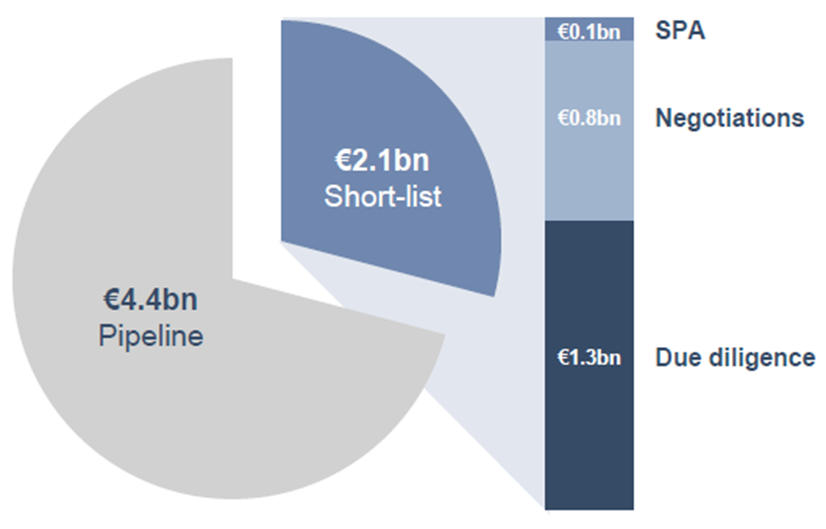
MPC has an experienced asset sourcing team consisting of 25 professionals, and its activities undoubtedly benefit from strong in-house know-how and external partnerships that have been built over many years. Given the competition for attractive real assets it is giving increased focus to niche assets where competition is less strong and where it will be able to build a dominant position. Examples of this niche approach are the ‘micro living’ concept within the real estate division, and emerging markets infrastructure projects, working with a growing network of industry partners such as Ferrostaal (in which MPC Group has a controlling stake). In 2016 MPC added c €1.0bn in new assets and brought forward a strong pipeline of potential investment amounting to €6.5bn, of which €2.1bn had advanced to the stage of due diligence or negotiations (Exhibit 5).
|
Exhibit 5: Currently identified asset pipeline |
|
|
Source: MPC 2016 results presentation |
Real estate (c €1.1bn) represents the largest part of the pipeline short-list but conversion of the €0.7bn of infrastructure short-list assets would represent a meaningful increase on the €0.5bn of current AUM.
…and investors to fund them
Typically, once a suitably attractive investment has been identified the MPC sales team will seek to find appropriate investors from the company’s global network of client contacts, numbering more than 2,000. We show a breakdown of these investor contacts in Exhibit 2 and note the diversity of institutional investor and professional investor types. Management indicates that it is in regular discussion with around 10% of the contacts and is typically seeking a small number of benchmark or seed investors in new initiatives (as was the case with the launch of the micro-living concept) to provide a base on which to grow. The 2017 US$100m launch of a shipping fund aimed at small-sized container ships, a more established investment proposition, attracted more than 60 institutional and family office investors.
Diversified income stream with increased revenue margin
MPC has invested to increase its vertical integration and its fee earning capacity across the complete lifecycle and value chain of the investments. The most tangible difference is apparent within the shipping division where in 2015 MPC acquired the shipping company, Ahrenkiel Steamship and increased its capability within ship chartering with the acquisition of Contchart. Ahrenkiel Steamship is a ship managing company and MPC can now provide services across the entire life-cycle and value chain of shipping investments internally without the revenue leakage of outsourcing. Ahrenkiel is amongst the top 20 non-operating ship owners in the world and now provides the largest portion of divisional revenues, generated from ships owned by MPC managed funds as well as third-party ship owners. Management expects it to continue to benefit from industry consolidation. In real estate, MPC is increasingly taking on design and project management functions in addition to letting and tenant servicing. The current intention is to continue to outsource the facilities management aspect of the property portfolio. In infrastructure, as well as working closely with partners, MPC has been building up a team internally to work on the technical and design aspects of potential renewables projects.
Exhibit 6 illustrates how group income is derived from a number of sources over the life-span of an investment.
|
Exhibit 6: Diversified income across the value chain |
|
|
Source: MPC. Note: (1) 1-2% co-investment per project, up to 10%; (2) income from participations; (3) other operating income. |
Fee income includes recurring fees from both the management of the fund (eg trustee services) and management of the assets within the fund, as well as fees that are one-off (eg fees for asset acquisitions or disposals, or asset management fees such as those generated by Ahrenkiel) or variable (performance fees). In 2016, management fees represented 75% of total revenues and transaction fees the vast majority of the balance (Exhibit 4). In addition to fee revenues, MPC also recognises its share of the returns (dividends, value increases) from co-investments.
MPC indicates that average revenue margin on the institutional business that has become its focus falls in the range of 70-120bp, depending on the product. This is substantially higher than the 40-60bp that it earns on the legacy retail assets. Over the medium term, which we would interpret to be anything up to 10 years, MPC targets substantial growth in institutional AUM and growth in total AUM to around €10bn from the current €5.1bn despite an expected run-off of the legacy retail business assets over time (Exhibit 7).
|
Exhibit 7: Medium-term management targets for AUM growth |
|
|
Source: MPC |
If it can be achieved successfully, the targeted combination of increased AUM, an increasing share of higher margin institutional business, and the potential for operational gearing has obvious and significantly positive implications for future revenues and profits.
Valuation
In this section we comment on the valuation of MPC shares in the context of a broad peer group of listed asset managers, including private equity, specialist and conventional asset managers in Europe and North America, using consensus data sourced from Bloomberg.
The average of the consensus P/E multiples for each of the groups is surprisingly similar given the significant difference in business models that are represented. However, the spread within groups is larger. The consensus expectation for earnings growth for MPC, between the current year and next, of c 30% is the highest of all the companies listed and well above the c 10% average of all sectors. Yet MPC’s prospective P/E of 10.9x is at a 9% discount to the specialist group average and towards the bottom of a fairly wide range, and a 14% discount to the all sector average.
Similarly, there is a high degree of similarity in terms of the average prospective ROEs for the groups, with the exception of conventional asset managers. This may reflect the obvious competitive pressures from lower costs passive fund managers as well as the burden of regulatory change. MPC’s ROE, though increasing, is still below the specialist sector average, although Apollo has significant impact on increasing the average. Nevertheless, the prospective MPC ROE is below the all sector average and this is reflected in a lower P/BV multiple.
Based on historic data, there is no dividend yield for MPC although the prospective dividend yield based on the consensus dividend forecast is 3% and dividends are forecast to follow earnings higher in the coming years.
The relatively low market capitalisation of MPC may be a contributor to MPC’s lower than average valuation, and we also note some remaining legal risks in respect of the legacy funds in the sensitivities section below. However, the valuation does appear to build in a level of caution with respect to the likelihood of the group meeting consensus expectations, and certainly regarding its ability to meet management’s medium-term targets. Confirmation that near-term consensus is likely to be met should also improve investor confidence in medium-term prospects and would likely have a very positive impact on its relative valuation. At the average prospective (next year) multiple for the specialist group, MPC shares would trade at c €6.4 but the real upside opportunity would come from the market beginning to discount a successful medium-term outlook which could see a re-rating to above the peer average with share price performance further supported by above average earnings growth.
Exhibit 10: Peer valuation data
Share price (local currency) |
Market cap (m) (in US$) |
Current year P/E (x) |
Next year P/E (x) |
Current year ROE (%) |
Next year ROE (%) |
Price/BV (x) |
Dividend yield (%) |
|
Private equity group |
||||||||
Partners Group |
600 |
164,000 |
28.3 |
25.8 |
35.3 |
34.5 |
9.6 |
2.6% |
Blackstone |
32.58 |
38,952 |
11.2 |
10.3 |
25.6 |
32.8 |
5.7 |
5.1% |
Fortress |
7.96 |
3,082 |
7.9 |
7.8 |
N/A |
N/A |
N/A |
5.8% |
KKR |
18.67 |
15,173 |
8.4 |
7.6 |
16.4 |
17.9 |
1.4 |
3.4% |
3i Group |
8.685 |
10,907 |
10.5 |
10.0 |
14.7 |
14.0 |
1.3 |
3.1% |
Specialist group |
||||||||
Apollo |
27.56 |
11,202 |
10.8 |
9.9 |
33.8 |
69.1 |
7.0 |
4.5% |
Ashmore |
3.532 |
3,229 |
16.8 |
17.0 |
22.2 |
19.2 |
3.4 |
4.7% |
Man Group |
1.571 |
3,353 |
10.5 |
8.3 |
13.8 |
18.5 |
1.5 |
5.7% |
Patrizia |
16.98 |
1,587 |
22.1 |
17.6 |
8.2 |
9.5 |
1.7 |
0.0% |
Lloyd Fonds |
3.72 |
38 |
9.1 |
8.1 |
16.6 |
15.7 |
1.4 |
4.3% |
MPC |
5.801 |
200 |
14.5 |
10.9 |
12.8 |
15.1 |
1.8 |
0.0% |
Conventional group |
||||||||
Aberdeen |
2.927 |
4,962 |
13.5 |
13.0 |
13.1 |
12.4 |
2.4 |
6.7% |
Azimut |
18.38 |
2,924 |
14.0 |
13.2 |
28.8 |
28.5 |
3.6 |
5.4% |
Henderson |
2.337 |
3,401 |
15.8 |
14.3 |
16.4 |
16.8 |
2.4 |
4.5% |
Jupiter |
4.935 |
2,894 |
14.7 |
14.3 |
24.4 |
22.7 |
3.5 |
3.0% |
Schroders |
31.65 |
10,870 |
16.0 |
15.2 |
17.0 |
16.5 |
2.6 |
2.9% |
Averages |
||||||||
Private equity |
13.2 |
12.3 |
23.0 |
24.8 |
4.5 |
4.0% |
||
Specialist |
14.0 |
12.0 |
17.9 |
24.5 |
2.8 |
3.2% |
||
Conventional |
14.8 |
14.0 |
19.9 |
19.4 |
2.9 |
4.5% |
||
All |
14.0 |
12.7 |
19.9 |
22.9 |
3.3 |
3.9% |
Source: Bloomberg data as at 29 May 2017
Sensitivities
MPC anticipates that the majority of its c €2.8bn of legacy retail AUM (c 55% of the current total AUM) will have run-off over the medium term. The exact timing is uncertain as it depends on the opportunities to sell mature assets and the decisions of investors. Management is focused on optimising the returns that can be realised from these assets meanwhile but for longer-term growth, and to meet the targets that management has set as well as market expectations, it is crucial that MPC is able to source a sufficient quantity of attractive assets and investors for these assets. We review above MCP’s sourcing, asset management and distribution strengths and additionally note a number of external factors that may impact its ability to achieve this as listed below:
■
An increase in interest rates could be expected to have a dampening effect on investor demand for real assets and negatively impact MPC’s ability to grow its assets under management, although the spread of assets types offered by MPC is likely to offer some protection.
■
An economic slowdown would be likely to reduce the returns available on real assets, limiting returns on existing funds and investor appetite for new investments.
■
Currency risks are a feature of shipping assets in particular (where revenues are typically US$ denominated) but are a factor for most international real assets. To hedge against currency risks, currency options have been taken out on a portion of the contractually fixed US$ revenues for 2017. Based on the remaining US$ exposure, an increase of 10% in the EUR/USD exchange rate assumed by the MPC Capital Group would have an effect of roughly 1.3 % on the forecast revenue for the 2017 financial year (Source: 2016 annual report).
■
Competition for real assets is strong from large, well resourced, asset managers and investors alike, and an inability to source attractive assets would negatively impact MPC’s ability to grow assets under management. As described above, its strategy is to seek niche assets where competition is less intense, using its partner network to source projects.
Frankfurt +49 (0)69 78 8076 960 Schumannstrasse 34b 60325 Frankfurt Germany |
London +44 (0)20 3077 5700 280 High Holborn London, WC1V 7EE United Kingdom |
New York +1 646 653 7026 245 Park Avenue, 39th Floor 10167, New York US |
Sydney +61 (0)2 8249 8342 Level 12, Office 1205 95 Pitt Street, Sydney NSW 2000, Australia |
|
Research: Healthcare
AFT Pharma recently reported its FY17 results. Operating revenue grew 8.1% compared to FY16, mainly due to 19% growth in the Australian market, which currently comprises 53% of company revenue. New Zealand was weak due to Metoprolol issues and weak pharmacy demand. Maxigesic continues to do well internationally and is now launched in eight countries. Additionally, a licence agreement was recently announced in France, the world’s second largest market for similar products.