Last close As at 05/08/2026
GBP8.17
▲ 7.00 (0.86%)
Market capitalisation
GBP819m
Research: Investment Companies
Finsbury Growth & Income Trust (FGT) has been managed by Nick Train since the beginning of 2001. He has a reputation for investing with a long-term view, willing to take the ups and downs in performance, primarily in consumer branded goods companies. However, the manager is keen to stress that FGT also has important holdings in other businesses with strong franchises and brands, whose shares may be more volatile. Of note, the trust’s three best-performing stocks in 2019 were not consumer goods companies – London Stock Exchange (+91%), Daily Mail & General Trust (+48%) and Schroders (+36%). Despite a pullback in relative performance in recent months as UK stocks with domestic operations have rallied due to a less uncertain political backdrop, FGT has outperformed the FTSE All-Share Index over the last one, three, five and 10 years.
Finsbury Growth & Income Trust |
PZ Cussons is first new UK holding since 2010 |
Investment trusts |
30 January 2020 |
Share price/discount performance
Three-year performance vs index
Gearing
Analysts
|
|||||||||||||||||||||||||||||||||||||||||||||||||||||||||||||||||||||||||||||||||||||
Finsbury Growth & Income Trust (FGT) has been managed by Nick Train since the beginning of 2001. He has a reputation for investing with a long-term view, willing to take the ups and downs in performance, primarily in consumer branded goods companies. However, the manager is keen to stress that FGT also has important holdings in other businesses with strong franchises and brands, whose shares may be more volatile. Of note, the trust’s three best-performing stocks in 2019 were not consumer goods companies – London Stock Exchange (+91%), Daily Mail & General Trust (+48%) and Schroders (+36%). Despite a pullback in relative performance in recent months as UK stocks with domestic operations have rallied due to a less uncertain political backdrop, FGT has outperformed the FTSE All-Share Index over the last one, three, five and 10 years.
|
Long-term NAV outperformance vs the benchmark, despite near-term blip |
|
|
Source: Refinitiv, Edison Investment Research |
The market backdrop
Global stocks had a banner year in 2019, as equities re-rated meaningfully; this was despite macro uncertainties, which kept a lid on corporate earnings growth. On a forward P/E multiple basis, the UK market is trading at a 5% premium to its 10-year average, while the world market is on an 18% premium. This valuation backdrop suggests a more selective approach to equity investing may be warranted.
Why consider investing in FGT?
■
Long-term record of outperformance versus peers and the FTSE All-Share Index. NAV and share price total returns of 16.1% and 16.8% pa respectively over the last decade, versus 8.1% pa for the index.
■
Concentrated, high-conviction portfolio, with turnover of less than 5% pa.
■
History of growing dividends – the annual distribution has compounded at a rate of 8.0% pa over the last five years.
Now trading at a discount
FGT’s shares typically trade close to NAV, but in recent weeks have moved to trading at a discount (the 2.7% discount on 17 January 2020 was a five-year high). The current 0.9% discount to cum-income NAV compares with a range of 0.2% to 0.5% premiums over the last one, three, five and 10 years. FGT has a progressive dividend policy and currently yields 1.9%.
Exhibit 1: Trust at a glance
Investment objective and fund background |
Recent developments |
||||||||||||||||||||||||||||||||||||||||||||||||||||||||||||||||||||||
FGT’s investment objective is to achieve capital and income growth and provide shareholders with a total return above that of the FTSE All-Share Index. It invests principally in the securities of UK-quoted companies, but up to a maximum of 20%, at the time of acquisition, can be invested in non-UK quoted companies. |
■ 17 December 2019: Annual results to 30 September 2019. NAV TR +17.4% versus benchmark TR +2.7%. Share price TR +17.4%. ■ 9 October 2019: Announcement of the appointment of Sandra Kelly as an independent non-executive director, with immediate effect. ■ 17 September 2019: Announcement of second interim dividend of 8.6p (+6.2% year-on-year). ■ 26 July 2019: Announcement of change in the fee structure (see page 8). |
||||||||||||||||||||||||||||||||||||||||||||||||||||||||||||||||||||||
Forthcoming |
Capital structure |
Fund details |
|||||||||||||||||||||||||||||||||||||||||||||||||||||||||||||||||||||
AGM |
February 2020 |
Ongoing charges |
0.66% (FY19) |
Group |
Frostrow Capital |
||||||||||||||||||||||||||||||||||||||||||||||||||||||||||||||||||
Interim results |
May 2020 |
Net gearing |
0.6% |
Manager |
Lindsell Train |
||||||||||||||||||||||||||||||||||||||||||||||||||||||||||||||||||
Year end |
30 September |
Annual mgmt fee |
Tiered (see page 8) |
Address |
25 Southampton Buildings, London, WC2A 1AL |
||||||||||||||||||||||||||||||||||||||||||||||||||||||||||||||||||
Dividend paid |
May, November |
Performance fee |
None |
||||||||||||||||||||||||||||||||||||||||||||||||||||||||||||||||||||
Launch date |
January 1926 |
Trust life |
Indefinite |
Phone |
+44 (0)20 3008 4910 |
||||||||||||||||||||||||||||||||||||||||||||||||||||||||||||||||||
Continuation vote |
None |
Loan facilities |
£50m (see page 8) |
Website |
|||||||||||||||||||||||||||||||||||||||||||||||||||||||||||||||||||
Dividend policy and history (financial years) |
Share buyback policy and history (financial years) |
||||||||||||||||||||||||||||||||||||||||||||||||||||||||||||||||||||||
Two dividends paid annually in May and November. The dividend is expected to rise over the longer term. |
Renewed annually, the trust has the authority to purchase up to 14.99% and allot up to 10% of issued share capital. |
||||||||||||||||||||||||||||||||||||||||||||||||||||||||||||||||||||||
|
|
||||||||||||||||||||||||||||||||||||||||||||||||||||||||||||||||||||||
Shareholder base (as at 31 December 2020) |
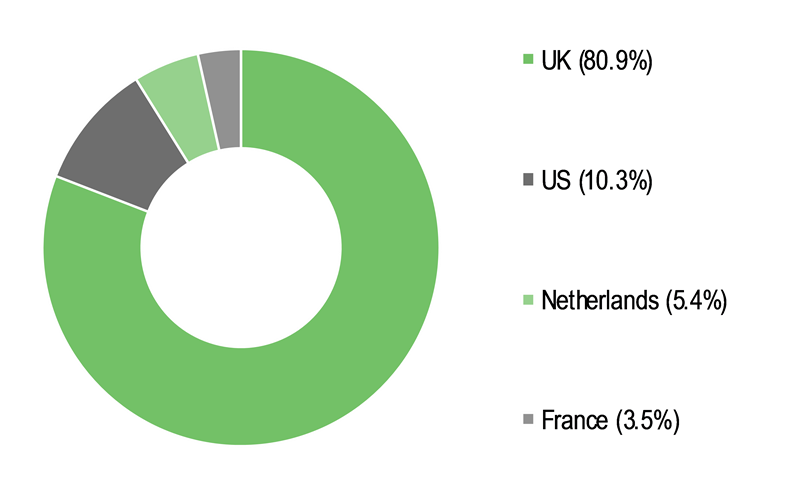
Portfolio exposure by geography (as at 30 September 2019) |
||||||||||||||||||||||||||||||||||||||||||||||||||||||||||||||||||||||
|
|
||||||||||||||||||||||||||||||||||||||||||||||||||||||||||||||||||||||
Top 10 holdings (as at 31 December 2019) |
|||||||||||||||||||||||||||||||||||||||||||||||||||||||||||||||||||||||
|
|||||||||||||||||||||||||||||||||||||||||||||||||||||||||||||||||||||||
Source: Finsbury Growth & Income Trust, Edison Investment Research, Bloomberg, Morningstar. Note: *N/A where not in end-December 2018 top 10.
Market outlook: Importance of remaining selective
UK shares have failed to keep pace with the global market over the last five years (Exhibit 2, LHS). Arguably, an important contributing factor has been political uncertainty and sterling weakness following the UK’s EU referendum in June 2016. However, given the resounding Conservative Party victory in the December 2019 general election, there is perhaps potential for the UK market to perform relatively better.
Despite low corporate earnings growth in 2019, shareholders across the globe enjoyed above-average returns as shares re-rated meaningfully. The negative effects of the dispute between the US and its trading partners, and its impact on global growth, were outweighed by positive sentiment following central bank actions; the US Federal Reserve moved from a tightening to an easing bias and the European Central Bank restarted quantitative easing. As a result, equities are now not looking particularly attractively valued. On a forward P/E multiple basis, the Datastream UK Index is trading at a 5% premium to its 10-year average, while the world market (which is dominated by the US) is trading at an even larger 18% premium, and close to its 10-year high. This valuation backdrop suggests that investors may benefit from being more selective in their approach, rather than just ‘buying the market’.
|
Exhibit 2: Market performance and valuation |
|||||||||||||||||||||||||||||||||||||||||||||||||||||||||||||||||||
Performance of indices (last five years – £ adjusted) |
Valuation metrics (as at 29 January 2020) |
||||||||||||||||||||||||||||||||||||||||||||||||||||||||||||||||||
|
|
||||||||||||||||||||||||||||||||||||||||||||||||||||||||||||||||||
|
Source: Refinitiv, Edison Investment Research |
|||||||||||||||||||||||||||||||||||||||||||||||||||||||||||||||||||
Fund profile: Concentrated UK equity portfolio
FGT was launched on 15 January 1926 and is listed on the Main Market of the London Stock Exchange. Lindsell Train was appointed as portfolio manager in December 2000; co-founder Nick Train, who started managing the fund in January 2001, aims to generate capital and income growth and a total return in excess of that of the FTSE All-Share Index. While the majority of the portfolio is invested in UK-listed companies, up to 20% of the fund, at the time of investment, may be held in companies listed overseas. FGT has a concentrated portfolio, typically holding 25–30 investments, which means that its performance can vary significantly from that of its benchmark. Other investment guidelines state that ordinarily, 50–100% of the fund will be invested in FTSE 100 companies or comparable companies listed on overseas stock exchanges, and at least 70% will be invested in FTSE 350 companies or their overseas equivalents. Up to 10% may be held in cash, although the manager prefers to remain fully invested. Gearing of up to 25% of NAV is permitted (net gearing was 0.6% at end-December 2019).
Data from FGT show that £1,000 invested in the trust at the end of FY09 would have appreciated to £4,747 by the end of FY19, which compares to £2,210 from an equivalent investment in the FTSE All-Share Index. Train regularly invests his own money in the trust, illustrating the importance to him of having ‘skin in the game’. He has been buying more FGT shares in 2020, saying ‘the right thing for me to do is to invest more in the company’.
The fund manager: Nick Train
The manager’s view: Positive backdrop for long-term investors
Train suggests that the investment backdrop remains extremely favourable for long-term equity investors, although recent history offers no predictive value of future returns. He is impressed by the performance of markets in 2019: ‘it was an excellent year for investors, despite obvious political issues in the UK and globally’. He notes that markets rallied despite the continuation of the US-China trade stand-off, a possible trade war between the US and Europe, severe civil unrest in Hong Kong, and a spike in the oil price due to disturbances in the Middle East.
The manager was very interested in merger and acquisition (M&A) activity in 2019. On a global basis, the year saw the second highest value of announced deals in history, and the last five years have witnessed the largest five-year volumes ever. Train understands that sometimes rising markets with large amounts of M&A can indicate signs of a market peak; however, from his perspective, it is encouraging to see firms making opportune deals to pursue their own business strategies. The manager expects 2020 to be ‘another big year for M&A’; he suggests this could include UK companies, as many deals may have been delayed due to Brexit uncertainty. Train comments that valuations in the UK are definitely more attractive than in some other markets, and while there is no absolute clarity on Brexit, the manager says the UK’s new-found political stability could lead to an uptick in M&A activity.
Train believes that the forward-looking indicators for positive equity returns are undeniable – interest rates remain extremely low and technological change is accelerating. He says that ‘pretty much every company is having more and more ideas about working to improve their businesses by the use of technology’. The manager suggests there are ‘clear positives despite localised issues’, such as in emerging markets, where wealth improvement continues, especially in Asia, which is providing interesting investment opportunities. While Train says he is always optimistic about markets and FGT, he argues that there are very good reasons for his enthusiasm.
Asset allocation
Investment process: Bottom-up stock selection
The manager invests with a long-term perspective; portfolio turnover is less than 5% pa, implying a holding period of more than 20 years. He aims to buy growth businesses, with high-quality management teams, that are trading at a discount to their intrinsic value. A potential investee company will likely have the following attributes: durability (firms that can grow over the long term regardless of the economic cycle); high return on equity; low capital intensity and high cash flow generation that can support sustained dividend growth. FGT’s portfolio has a high active share of greater than 90% (this is a measure of how a portfolio differs from its benchmark, with 0% representing full index replication, and 100% no commonality).
FGT is invested in just four out of the 10 broad industry sectors (consumer goods, consumer services, financials and technology) and there are three broad themes within the portfolio: global consumer brands, owners of media/software intellectual property, and capital market proxies. Train favours well-established businesses; the average age of portfolio companies is more than 150 years, and the majority of the fund’s positions have a large family ownership.
The manager highlights the value of global brands. In late 2019, LVMH made a bid for Tiffany & Co; while this was not a particularly large transaction, Train says that it is important for FGT as it reinforces the scarcity and value of truly global luxury brands. Elsewhere in the portfolio, Manchester United’s shares have rallied recently due to a number of transactions for sports businesses. These include private equity firm Silver Lake taking a stake in arch-rival Manchester City Football Club, which has underlined the value of the Manchester United franchise.
Current portfolio positioning
FGT’s concentrated nature is illustrated in Exhibit 1. At end-December 2019, the top 10 positions made up 83.7% of the fund, even higher than 80.1% a year earlier; all 10 names were common to both periods.
Unsurprisingly, given the trust’s low portfolio turnover, its sector exposure changed very little during 2019 (Exhibit 3); the largest changes were a 2.9pp higher weighting in financials and a 2.2pp lower exposure to consumer services. Train continues to invest in just four sectors, avoiding the other six, which in aggregate make up c 46% of the FTSE All-Share Index.
Exhibit 3: Portfolio sector exposure vs FTSE All-Share Index (% unless stated)
Portfolio end- |
Portfolio end- |
Change |
Index |
Active weight |
Trust weight/ |
|
Consumer goods |
45.7 |
47.0 |
(1.3) |
14.0 |
31.7 |
3.3 |
Financials |
28.8 |
25.9 |
2.9 |
27.1 |
1.7 |
1.1 |
Consumer services |
19.0 |
21.2 |
(2.2) |
12.0 |
7.0 |
1.6 |
Technology |
6.5 |
5.9 |
0.6 |
1.1 |
5.4 |
5.9 |
Telecommunications |
0.0 |
0.0 |
0.0 |
2.5 |
(2.5) |
0.0 |
Utilities |
0.0 |
0.0 |
0.0 |
3.0 |
(3.0) |
0.0 |
Basic materials |
0.0 |
0.0 |
0.0 |
7.5 |
(7.5) |
0.0 |
Healthcare |
0.0 |
0.0 |
0.0 |
9.3 |
(9.3) |
0.0 |
Industrials |
0.0 |
0.0 |
0.0 |
11.6 |
(11.6) |
0.0 |
Oil & gas |
0.0 |
0.0 |
0.0 |
11.8 |
(11.8) |
0.0 |
100.0 |
100.0 |
100.0 |
Source: Finsbury Growth & Income Trust, Edison Investment Research
FGT has a new holding, PZ Cussons, which the manager describes as a ‘very slow burn investment’ and is the first new UK-listed position since 2010. It is currently a small part of the fund as Train is very price sensitive; he will remain disciplined and buy more shares opportunistically when there are willing sellers. PZ Cussons’ shares have performed very poorly in recent years, which the manager argues is perfectly understandable given its Nigerian operation has deteriorated from generating more than 40% of the company’s operating profits to an anticipated small loss in 2019. While Train says he can offer no insight into the prospects for Nigeria, he notes that talking to companies with exposure there, ‘things are going from bad to worse’. However, he believes that from a demographic perspective, there are long-term opportunities in the country. In the meantime, the manager is impressed with PZ Cussons’ portfolio of global brands, including Carex, Cussons Baby, Imperial Leather, Morning Fresh, Original Source, Sanctuary Spa and St Tropez. Train says he is ‘almost embarrassed by this new holding’ as it is such a stereotypical investment for Lindsell Train – it is a 140-year-old business, with a big family shareholding, a portfolio of consumer brands and significant operations in emerging markets.
The manager highlights that FGT’s largest holding, London Stock Exchange (LSE), was the fund’s best performing stock in 2019, appreciating by more than 90%. During the year, the company made a bid for data provider Refinitiv; if the deal goes through, it will significantly increase the amount of proprietary data LSE can offer its clients, and make its operations more global. The company also received a takeover bid from the Hong Kong Stock Exchange. While the deal was not consummated, it nevertheless reinforces the strategic value of LSE's position in the global financial markets. Train says that the company has been ‘a wonderful investment for FGT’; he initiated the position around 15 years ago when the share price was c £4, and it is now approaching £80. Although there have been times when LSE underperformed the UK market, the manager says the company is a very good example of the benefits of investing with a long-term perspective.
A less successful position in the portfolio is Pearson, which was the worst-performing stock in the fund in 2019, declining by more than 30%. The company has announced a series of profit warnings as its shift to a digital business model has not been smooth. Pearson’s CEO will be leaving the company this year, and the final piece of publisher Penguin Random House will be sold. Train says that it will be fascinating to see who the new CEO will be, and what the firm will do with the Penguin proceeds. He suggests that 2020 is a pivotal year for Pearson; investors need some indication that the hundreds of millions of dollars spent on its technology platform can generate growth and a decent return on investment. The manager says that this new global platform should deliver significant efficiency improvements to students, with a meaningful reduction in costs; however, he comments that it is ‘mortifying to have owned the company for so long and not delivered a return for shareholders’.
Performance: Long-term record of outperformance
Exhibit 4: Five-year discrete performance data
12 months ending |
Share price |
NAV |
FTSE All-Share |
FTSE 350 |
MSCI World |
31/12/15 |
12.4 |
11.6 |
1.0 |
0.7 |
5.5 |
31/12/16 |
12.6 |
12.5 |
16.8 |
16.8 |
29.0 |
31/12/17 |
21.5 |
21.7 |
13.1 |
12.9 |
12.4 |
31/12/18 |
(0.9) |
(0.8) |
(9.5) |
(9.5) |
(2.5) |
31/12/19 |
21.8 |
23.1 |
19.2 |
19.2 |
23.4 |
Source: Refinitiv. Note: All % on a total return basis in pounds sterling.
In FY19 (ending 30 September), FGT’s NAV and share price total returns of 17.4% were considerably higher than the 2.7% total return of the FTSE All-Share index. The largest positive contributions were London Stock Exchange, Mondelēz International and Diageo, while the largest detractors were Manchester United, Pearson and AG Barr. FGT benefited from its bias towards global companies and its lower exposure to UK companies with domestic operations.
|
Exhibit 5: Investment trust performance to 31 December 2019 |
|
Price, NAV and benchmark total return performance, one-year rebased |
Price, NAV and benchmark total return performance (%) |
|
|
|
Source: Refinitiv, Edison Investment Research. Note: Three-, five- and 10-year performance figures annualised. |
|
FGT’s relative returns are shown in Exhibit 6. It has outperformed its benchmark over the last one, three, five and 10 years in both NAV and share price terms. The trust’s performance in recent months has been trickier. Train explains that the portfolio contains companies that he believes will generate the best investment returns over the long term; however, shorter-term results have been negatively affected by swings in sentiment about UK politics. Developments viewed as positive for sterling and the domestic economy have been detrimental to FGT’s performance.
The manager also highlights the trust’s large position in Unilever, which had been weak since early September and had another leg down in December following an unscheduled trading update – the company will not meet its 3% 2019 revenue growth target due to weaker than expected trends in the fourth quarter. There were three problem areas: North American hair care, where there is tough competition from Procter & Gamble; Africa, including Nigeria; and India, although Train suggests this business is ‘probably the single most valuable part of the company’.
|
Exhibit 6: Share price and NAV total return performance, relative to indices (%) |
||||||||
|
One month |
Three months |
Six months |
One year |
Three years |
Five years |
10 years |
|
Price relative to FTSE All-Share |
(2.6) |
(7.4) |
(5.3) |
2.2 |
20.2 |
29.0 |
113.7 |
|
NAV relative to FTSE All-Share |
(1.4) |
(6.3) |
(4.2) |
3.3 |
21.8 |
29.7 |
104.2 |
|
Price relative to FTSE 350 |
(2.5) |
(7.2) |
(5.2) |
2.2 |
20.4 |
29.5 |
115.3 |
|
NAV relative to FTSE 350 |
(1.3) |
(6.2) |
(4.1) |
3.3 |
21.9 |
30.1 |
105.7 |
|
Price relative to MSCI World |
0.1 |
(4.6) |
(5.0) |
(1.3) |
8.4 |
0.8 |
46.4 |
|
NAV relative to MSCI World |
1.2 |
(3.5) |
(3.8) |
(0.3) |
9.8 |
1.3 |
39.9 |
|
|
Source: Refinitiv, Edison Investment Research. Note: Data to end-December 2019. Geometric calculation. |
||||||||
|
Exhibit 7: NAV total return performance relative to benchmark over three years |
||||||||
|
||||||||
|
Source: Refinitiv, Edison Investment Research |
||||||||
Discount: Devaluation providing an opportunity?
For many years, FGT’s shares have traded close to NAV; however, they have recently moved to a small discount, perhaps reflecting the trust’s recent period of underperformance. The current 0.9% discount to cum-income NAV compares with the range of a 1.2% premium to a 2.7% discount (a five-year widest point) over the last 12 months. Over the last one, three, five and 10 years, the trust has traded at average premiums of 0.4%, 0.5%, 0.5% and 0.2% respectively.
|
Exhibit 8: Share price premium/discount to NAV (including income) over three years (%) |
|
|
Source: Refinitiv, Edison Investment Research |
The board has actively managed the discount/premium since 2004, purchasing shares when the discount exceeds 5% (no shares have been bought back since FY10), and issuing shares at a small premium when there are unfulfilled buy orders in the market. During FY19, 27.1m shares (c 16% of the share base) were issued, raising £226.3m.
Capital structure and fees
FGT is a conventional investment trust with one class of share. There are currently 207.9m ordinary shares outstanding. On 4 October 2019, the board renegotiated its multicurrency revolving credit facility with Scotiabank Europe. It was reorganised from £75m (with an option of an additional £25m) to £50m (with the option of an additional £50m) at a rate of Libor +1.05%. At end-December 2019, net gearing was 0.6%. The manager continues to employ modest levels of debt given the portfolio’s concentrated nature already brings an element of risk.
On 26 July 2019, the board announced amendments to FGT’s fee arrangements. Manager Lindsell Train will now receive an annual fee of 0.450% of the trust’s market cap up to £1bn, 0.405% between £1bn and £2bn, and 0.360% above £2bn (previously 0.450% up to £1bn and 0.405% above £1bn). No performance fee is payable. Frostrow Capital, the trust’s Alternative Investment Fund Manager, provides company management, secretarial, administrative and marketing services, and receives an annual fee of 0.150% of FGT’s market cap up to £1bn, 0.135% between £1bn and £2bn, and 0.120% above £2bn (previously 0.150% up to £1bn, and 0.135% above £1bn).
In FY19, ongoing charges declined by 1bp to 0.66% (FY18: 0.67%).
Dividend policy and record
FGT has a progressive dividend policy, aiming to grow its annual distribution at a rate higher than UK inflation. Dividends are paid twice a year in May and November out of revenue reserves. The FY19 total dividend of 16.6p per share was 8.5% higher year-on-year, and was 1.1x covered by revenue. Over the last five years, the annual dividend has compounded at a rate of 8.0% pa. Based on its current share price, FGT offers a 1.9% dividend yield.
Peer group comparison
Exhibit 9: Selected peer group as at 28 January 2020*
% unless stated |
Market |
NAV TR |
NAV TR |
NAV TR |
NAV TR |
Discount |
Ongoing |
Perf. |
Net |
Dividend |
Finsbury Growth & Income |
1,843.8 |
20.1 |
46.1 |
73.2 |
345.1 |
(1.1) |
0.7 |
No |
101 |
1.9 |
BMO Capital & Income |
362.9 |
21.7 |
33.4 |
60.0 |
154.1 |
0.7 |
0.6 |
No |
103 |
3.2 |
City of London |
1,731.7 |
16.6 |
21.5 |
34.5 |
161.7 |
1.3 |
0.4 |
No |
108 |
4.4 |
Diverse Income Trust |
350.3 |
7.4 |
19.0 |
42.9 |
|
(5.4) |
1.2 |
No |
100 |
3.9 |
Dunedin Income Growth |
449.0 |
27.5 |
32.4 |
40.1 |
148.6 |
(5.1) |
0.6 |
No |
107 |
4.1 |
Edinburgh Investment |
1,085.4 |
6.3 |
5.1 |
19.9 |
152.9 |
(12.0) |
0.6 |
No |
104 |
4.2 |
JPMorgan Claverhouse |
439.6 |
20.4 |
23.1 |
41.9 |
155.0 |
(1.2) |
0.7 |
No |
117 |
3.6 |
Law Debenture Corporation |
750.8 |
14.4 |
24.5 |
47.9 |
193.6 |
(9.2) |
0.5 |
No |
109 |
3.1 |
Lowland |
386.4 |
11.6 |
11.5 |
32.3 |
217.5 |
(5.3) |
0.6 |
Yes |
112 |
4.2 |
Merchants Trust |
618.6 |
21.7 |
24.8 |
35.2 |
142.1 |
0.7 |
0.6 |
No |
114 |
4.9 |
Murray Income Trust |
604.2 |
25.4 |
33.4 |
46.4 |
158.7 |
(4.3) |
0.7 |
No |
102 |
3.6 |
Perpetual Income & Growth |
700.7 |
6.6 |
4.7 |
10.5 |
140.1 |
(13.0) |
0.7 |
No |
117 |
4.6 |
Temple Bar |
914.8 |
13.2 |
17.4 |
34.8 |
151.4 |
(2.7) |
0.5 |
No |
109 |
3.9 |
Average (13 funds) |
787.6 |
16.4 |
22.8 |
40.0 |
176.7 |
(4.4) |
0.6 |
108 |
3.8 |
|
Trust rank in selected peer group |
1 |
6 |
1 |
1 |
1 |
4 |
4 |
12 |
13 |
Source: Morningstar, Edison Investment Research. Note: *Performance data to 27 January 2020 based on ex-par NAV. TR=total return. Net gearing is total assets less cash and equivalents as a percentage of net assets.
The AIC UK Equity Income sector is a relatively large pool of 25 funds. In Exhibit 9, we show the 13 largest, with market caps greater than £350m. Despite a period of trickier performance, FGT’s NAV total return is above average over the last 12 months, and it continues to rank first over three, five and 10 years (by a wide margin). The trust’s discount is narrower than average, its ongoing charge is modestly above the mean and it has a lower than average level of gearing. FGT’s focus on total return rather than income is reflected in its below-average dividend yield.
The board
FGT’s board currently has seven directors, all of whom are non-executive and independent of the manager. The chairman is Anthony Townsend, who re-joined the board on 1 February 2005 and assumed his current role on 30 January 2008. David Hunt was appointed on 6 July 2006, Neil Collins on 30 January 2008, Simon Hayes on 29 June 2015, and Kate Cornish-Bowden and Lorna Tilbian both on 26 October 2017.
The most recently appointed director is Sandra Kelly, who joined the board on 9 October 2019. She is a chartered accountant who has recently retired from her role as finance director at the Canal & River Trust. Kelly’s prior roles include eight years as finance director at the National House-Building Council. She has been a governor of Headington School in Oxford since 2013, serving as chair since 2016.
Kelly’s appointment is part of the board’s succession planning to replace directors who have served for more than nine years (in accordance with the UK Corporate Governance Code). To minimise disruption, there will be a rolling programme of retirements: Collins at the February 2020 AGM, Hunt after the release of the H120 accounts and Townsend at the 2021 AGM, at which time Hayes will become chairman. Kelly will become chairman of the Audit Committee following Hunt’s retirement.
|
|
Investment Companies
Research: Industrials
Two significant contracts in the last week continue to support the growth potential of AAC Clyde despite a variety of challenges it faced during 2019, from which we expect the company to recover in 2020. We are reducing our FY19 estimates following Q319 results that did not meet the CEO’s expectations, and an apparent absence of platform deliveries and launches in Q419 that was below our own assumption. The company is expected to announce FY19 preliminary results on 20 February and we will update our estimates again then.