Last close As at 05/08/2026
GBP0.93
▲ 0.20 (0.22%)
Market capitalisation
GBP527m
Research: Investment Companies
Gresham House Energy Storage Fund (GRID) invests in utility-scale battery energy storage systems (BESS) in Great Britain and Ireland. The company seeks to capitalise on the growing intraday imbalances in electricity supply and demand caused by the UK and Ireland’s ever-increasing reliance on renewable energy, by accessing multiple revenue sources available in the power market. GRID targets an NAV total return of 8.0% + per annum and it has significantly overshot this target since its inception in November 2018, having delivered an NAV total return of 84.1% and a share price total return of 100.5%, compared to an 11.8% rise in the broad UK market in the period to end-September 2022. Further NAV uplifts are expected in 2023 and 2024 as the fund’s pipeline of projects is commissioned and revalued accordingly. And manager Ben Guest has plans for further rapid expansion of the fund’s operational capacity, including in Europe, the US, Canada and Australia, over the longer term. GRID pays an attractive dividend, which is set to rise in line with revenues.
Gresham House Energy Storage Fund |
Powering on |
Investment trusts |
21 February 2023 |
Analysts
|
||||||||||||||||||||||||||||||||||||||||||||||||||||||||||||||||||||||||||||||||||||||||||||||||||||||||||||||||||||
Gresham House Energy Storage Fund (GRID) invests in utility-scale battery energy storage systems (BESS) in Great Britain and Ireland. The company seeks to capitalise on the growing intraday imbalances in electricity supply and demand caused by the UK and Ireland’s ever-increasing reliance on renewable energy, by accessing multiple revenue sources available in the power market. GRID targets an NAV total return of 8.0% + per annum and it has significantly overshot this target since its inception in November 2018, having delivered an NAV total return of 84.1% and a share price total return of 100.5%, compared to an 11.8% rise in the broad UK market in the period to end-September 2022. Further NAV uplifts are expected in 2023 and 2024 as the fund’s pipeline of projects is commissioned and revalued accordingly. And manager Ben Guest has plans for further rapid expansion of the fund’s operational capacity, including in Europe, the US, Canada and Australia, over the longer term. GRID pays an attractive dividend, which is set to rise in line with revenues.
|
Price, NAV and benchmark total return performance* |
|
|
Source: Refinitiv, Edison Investment Research Note: One-year and three-year figures annualised. *As at end-January 2023. |
Why invest in GRID now?
GRID invests in BESS, which are an integral part of the global transition to renewable energy. Wind and solar power generation is inherently intermittent and BESS facilitate the capture and storage of energy from these sources until it is required. Demand for BESS will grow rapidly over coming years in the UK and elsewhere as countries strive to meet net zero targets. As the UK’s largest listed BESS fund, and the largest operator in the UK market, GRID is well-placed to benefit and has ambitious growth plans to further capitalise on the expanding BESS market.
The analyst’s view
■
GRID offers the opportunity to invest in real assets, which are often difficult to access, especially for retail investors.
■
Some investors may be attracted by the manager’s strong performance and execution track record and by his ambitious growth plans, which will underpin further revenue growth and NAV uplifts over the near and more medium term.
Gresham House Energy Storage Fund is a research client of Edison Investment Research Limited
The fund manager: Ben Guest
The manager’s view: Very positive on outlook for sector & GRID
GRID’s manager, Ben Guest, remains convinced that on both technical and financial grounds, batteries are the most credible renewable energy storage technology compared with less proven, more costly and less efficient alternatives such as hydrogen or ‘CO2-abated’ gas-fired generation (which reduces the carbon emissions of conventional gas-powered energy production). And he is very positive on the outlook for BESS generally, and for GRID specifically, for a number of reasons.
War in Ukraine has given fresh impetus to switch to renewables
The market backdrop is very healthy. The war in Ukraine has triggered concerns about energy security. This has provided fresh impetus to the global transition to renewable energy sources. As investment in renewable power generation increases, so too will demand for the BESS that facilitate the capture, storage and subsequent distribution of renewable energy. The International Energy Agency (IEA) estimates that global energy storage capacity needs to grow from 16GW at the end of 2021 to 680GW by 2030 to meet global net zero targets. This amounts to an average annual increase in battery storage of 80GW between 2021 and 2030, more than 10x the rate at which BESS are currently being brought on line around the world. In Great Britain, National Grid, the utility company responsible for the transmission of electricity and gas across the country, forecasts that the UK’s current battery storage capacity of 1.6GW will rise to 15GW by 2030 to meet national demand. See Edison’s recent thematic report on battery energy storage for more detail.
BESS integral to energy supply continuity in uncertain times
Recent developments in the European energy market have focused additional attention on the important role renewable energy and BESS have to play in ensuring supply continuity, when other sources of energy fail. Europe’s regional market is highly interconnected, with countries usually supplying electricity to each other over the year, in response to their individual needs. However, during 2022, concerns arose about the region’s capacity to maintain these mutually beneficial arrangements, due to low water levels in the reservoirs that drive Norway’s hydro-electric power generation system and power outages in France, triggered by maintenance issues at several nuclear power plants. The UK, as one of the world’s largest offshore wind markets, was well-positioned to export electricity to France during its power outages, for the first time in at least a decade. Guest is keen to stress that GRID does not seek to exploit such short-term supply failures, but the company, and other BESS owners, nonetheless benefit.
Recent energy price volatility supports revenues
The unexpected, sharp rise in wholesale energy prices over the past year has also had a beneficial impact on GRID’s revenues, as providing power to National Grid has been more lucrative than expected, and more remunerative than other potential sources of revenue, including energy trading. Over the past year, National Grid has been prepared to pay record prices for short-term, frequency response energy supplies when needed to ensure stability in the network’s operating frequency. Although cash flows from this source are likely to fall over time – indeed, this is already starting to happen – Guest is confident this income will be replaced with higher revenues from energy trading. Energy trading has been a core element of GRID’s strategy since inception. It is, according to Guest, inherently profitable, as, unlike perishable commodities, energy can be purchased when prices are low and sold when volatility, and prices, are high. As the system’s reliance on renewable energy increases over time, intermittency and hence price volatility will inevitably increase, creating more trading opportunities. Trading income has increased in recent months and the manager expects this trend to gather pace over time, until trading becomes GRID’s main source of revenue.
Funding in place to finance majority of GRID’s existing pipeline
Another important development for GRID in recent months was the closure of its £155m incremental term debt facility. Scope to exercise this accordion facility was part of the fund’s senior debt facility secured in September 2021. The incremental debt, together with the original £180m arranged in 2021, provides GRID with access to a total of £335m of debt. The interest rate on this whole facility remains unchanged at 300 basis points over SONIA, while the term of the facility has been extended by two years, and now matures in September 2028.
These funds, combined with GRID’s May 2022 £150m debt raising, create a ‘runway’ for GRID, according to Guest, ensuring it has the means to fund ‘the majority’ of its pipeline, even if market conditions become challenging, thus significantly reducing the fund’s execution risk.
As at 30 June 2022, GRID had drawn £10m of its £180m debt facility to part fund the construction of existing pipeline projects, and the manager expects to fully utilise the existing £150m capex facility before end Q123. Once these funds are fully utilised, GRID is likely to draw further on its debt facilities, but once these are exhausted GRID will need to seek further funding in order to fully finance all its existing pipeline projects, and any additional projects it acquires beyond those already announced (as listed in Exhibit 1).
UK regulatory environment stabilising
In addition to these factors supporting near- and longer-term demand for BESS, and GRID’s prospects more specifically, Guest welcomes the recent improvement in the UK’s energy market regulatory environment, after a period of uncertainty and instability. Rising energy prices and higher inflation more generally led to calls for the government to take measures to address the nation’s cost-of-living crisis and re-coup at least some of the windfall gains accruing to oil and gas producers and electricity companies, as fuel prices rose. However, a series of political scandals during H122, a protracted Conservative Party leadership contest and two subsequent changes in prime minister in rapid succession resulted in a hiatus in government decision-making that only ended when the current Sunak government announced several key policy changes in its November 2022 Autumn Statement. Announcements included an increase in the Energy Profits Levy on oil and gas companies, introduced in May 2022, from 25% to 35%, from 1 January 2023 until March 2028. The statement also imposed an additional, temporary Electricity Generator Levy of 45% on the extraordinary profits of electricity suppliers, effective from 1 January 2023, with details to be announced in the Finance Bill due in March 2023. Guest believes these decisions have provided much-needed certainty to the sector, enabling energy producers and suppliers to make investment plans with greater confidence.
The UK government has also reiterated its commitment to renewable energy. In July 2022, the UK department of Business, Energy and Industrial Strategy (BEIS) commissioned a Review of Electricity Market Arrangements (REMA) consultation, to identify the reforms needed to ensure the UK achieves its target of net zero energy by 2035, and achieves this goal in a cost-effective manner. At the time, BEIS re-iterated the government’s view that it is ‘essential for low carbon flexibility to be prioritised’. Perhaps in part as a reflection of this position, companies investing in carbon emission-reducing technology, including battery operators, are exempt from the recent levies imposed on fossil-based fuel and electricity suppliers outlined above.
Connectivity delays slowing access to revenue streams
However, while the market backdrop is favourable and government policy is supportive, BESS suppliers nonetheless face some challenges. Foremost among these are increasing delays connecting new projects to the national and local grids. Guest uses a ‘sluice gate’ analogy to describe the impact of new battery connections on the grid. Just as when water is released from a sluice, releasing energy into the system creates surges, overloads and quality issues, and grid connections need to be designed to the satisfaction of grid companies, to ensure each new battery does not negatively impact the grid to which it is being connected. Guest liaises with grid operators and other stakeholders to try to mitigate delays, but it is a reality that delays to connectivity of six months or more are now standard across the sector. The reasons for these delays are not all clear, but they are most likely due to a combination of increased demand for connections, caution on the part of regulators in the face of advancing technology and a lack of expertise among grid operator personnel, as well as longer lead times for certain items that can only be ordered once designs have been agreed with the network companies. Whatever the causes, these commissioning delays are affecting all participants in the market and are, unsurprisingly, a source of great frustration for Guest, as they delay the start of revenue streams generated by newly commissioned projects. The manager is factoring these delays into GRID’s construction programmes and he is ‘hopeful that further delays at most projects can be avoided’. He also notes that GRID has ‘two key mitigants’ against further connectivity delays, but as these are commercially sensitive, he is not willing to disclose further details. The further good news is that other delays, including some COVID-19 related supply chain bottlenecks, have eased and shipping costs have declined.
Guest’s other main concern relates to a lack of infrastructure to support the generation and distribution of renewable energy. He cites in particular the lack of cables to carry power from offshore wind generators in the North Sea to the grid. Building this capacity takes time, and the political will to face down powerful vested interests in the conventional energy sector, but Guest is concerned that a lack of will, planning and action on the part of government and suppliers will significantly hamper the UK’s transition to renewable energy. Concerns about connectivity and a lack of supportive infrastructure are not, however, sufficient to dampen Guest’s enthusiasm for the sector’s medium- to longer-term prospects or for GRID’s growth potential.
Asset allocation
Current portfolio positioning
There have been some positive developments in relation to GRID’s pipeline of projects since our April 2022 update. Three previously announced pipeline projects have been commissioned in recent months, and the manager has added one new project (Shilton Lane, located in Scotland) to its pipeline. So, by the end of 2022, operational capacity had risen to 550MW, up from 425MW at the time of our April 2022 update, thanks to the commissioning of Enderby, Arbroath and Stairfoot during Q3. All these projects were somewhat delayed compared to the target commissioning dates included in our last report.
This takes the number of GRID’s operational projects to 20, all located in the UK, while Coupar Angus, in Scotland, is due to be commissioned imminently (previously expected to become operational in Q222), which will bring another 40MW into operation. Several other projects will follow, as previously announced (see Exhibit 1 for details). Including Coupar Angus and Shilton Lane, and allowing for the fact that the 150MW Eiland project listed in our last note has now been split into two projects – Eiland (50MW), due to commission in Q223, and Eiland 2 (100MW), which is expected to come on line in Q424 – GRID now has 14 projects in its pipeline, of which 11 are located in England, two in Scotland and one in the Republic of Ireland. The forecast commissioning dates for most of these projects have slipped by six months or more since our last report, due in part to COVID-19 related supply constraints and the connectivity issues discussed above, but once they all come on line, GRID’s total storage capacity will rise from 550MW at present to around 1.6GW.
GRID’s current operational capacity of 550MW makes it the largest BESS operator in the UK market. GRID’s closest direct competitor is Gore Street Energy Storage Fund (GSF), another UK-listed investment trust whose operational capacity is presently around 300MW, and of this, only 110MW is operational in Great Britain. GSF’s project pipeline totals a further 407MW of capacity, less than half the capacity of GRID’s pipeline of 1,047MW (see Exhibit 1). GRID is also the largest UK-listed BESS fund by market cap. At over £890m, its valuation is significantly higher than GSF’s valuation of £530m. (For a more comprehensive comparison between GRID and GSF, see our GRID initiation note.)
Despite GRID’s leading market position, the trust’s manager is not content to rest on his laurels. GRID’s portfolio is set to expand well beyond its currently announced 34 projects in coming years. Guest is planning a very rapid expansion of the company’s operational capacity to meet the anticipated increase in demand for BESS as renewable energy generation capacity rises. He is working on a number of ‘significant’ new deals, in Great Britain, Ireland and other as yet unspecified countries, which are likely to be announced in coming months.
Exhibit 1: Investment portfolio (as at 31 December 2022)
Existing assets |
Location |
Capacity* |
Battery size* |
Site type |
Commissioning status |
Ownership status |
1. Staunch |
Staffordshire |
20 |
3 |
Battery & generators, 0.5MW import |
Operational |
100% owned |
2. Rufford |
Nottinghamshire |
7 |
10 |
Battery & generators, symmetrical |
Operational |
100% owned |
3. Lockleaze |
Bristol |
15 |
22 |
Battery, symmetrical |
Operational |
100% owned |
4. Littlebrook |
Kent |
8 |
6 |
Battery, symmetrical |
Operational |
100% owned |
5. Roundponds |
Wiltshire |
20 |
26 |
Battery & generators, 16MW import |
Operational |
100% owned |
6. Wolverhampton |
West Midlands |
5 |
8 |
Battery, symmetrical |
Operational |
100% owned |
7. Glassenbury |
Kent |
40 |
28 |
Battery, symmetrical |
Operational |
100% owned |
8. Cleator |
Cumbria |
10 |
7 |
Battery, symmetrical |
Operational |
100% owned |
9. Red Scar |
Lancashire |
49 |
74 |
Battery, symmetrical |
Operational |
100% owned |
10. Bloxwich |
West Midlands |
41 |
47 |
Battery, symmetrical |
Operational |
100% owned |
11. Thurcroft |
South Yorkshire |
50 |
75 |
Battery, symmetrical |
Operational |
100% owned |
12. Wickham |
Suffolk |
50 |
74 |
Battery, 40MW import |
Operational |
100% owned |
13. Tynemouth |
Tyne & Wear |
25 |
17 |
Battery, symmetrical |
Operational |
100% owned |
14. Glassenbury Extension |
Kent |
10 |
10 |
Battery, symmetrical |
Operational |
100% owned |
15. Nevendon |
Basildon |
10 |
7 |
Battery, symmetrical |
Operational |
100% owned |
No, 16. Port of Tyne |
Tyne & Wear |
35 |
28 |
Battery, symmetrical |
Operational |
100% owned |
17. Byers Brae |
West Lothian |
30 |
31 |
Battery, symmetrical |
Operational |
100% owned |
18. Enderby |
Leicestershire |
50 |
50 |
Battery, symmetrical |
Operational |
100% owned |
19.Arbroath |
Scotland |
35 |
35 |
Battery, symmetrical |
Operational |
100% acquired subject to satisfaction of conditions, not revalued |
20. Stairfoot |
North Yorkshire |
40 |
40 |
Battery, symmetrical |
Operational |
Exclusive to GRID, not revalued |
Operational portfolio (A) |
550 |
598 |
||||
21. West Didsbury |
Manchester |
50 |
50 |
Battery, symmetrical |
Target COD: Q322 |
100% owned, revalued |
22. Melksham |
Wiltshire |
100 |
100 |
Battery, symmetrical |
Target COD: Q123 |
100% owned, revalued |
23. Coupar Angus |
Scotland |
40 |
40 |
Battery, symmetrical |
Target COD: Q123 |
100% acquired subject to satisfaction of conditions, not revalued |
24. Penwortham |
Preston |
50 |
50 |
Battery, symmetrical |
Target COD: Q422 |
100% owned, revalued |
25. Grendon |
Northampton |
100 |
200 |
Battery, symmetrical |
Target COD: Q123 |
100% owned, partially revalued** |
26. York |
York |
50 |
75 |
Battery, symmetrical |
Target COD: Q123 |
Exclusive to GRID, revalued |
27. Bradford West |
West Yorkshire |
87 |
174 |
Battery, symmetrical |
Target COD: Q123 |
Exclusive to GRID, revalued |
28. Elland |
West Yorkshire |
50 |
100 |
Battery, symmetrical |
Target COD: Q223 |
Exclusive to GRID, revalued |
29. Elland 2 |
West Yorkshire |
100 |
200 |
Battery, symmetrical |
Target COD: Q424 |
Not owned exclusively |
30. Monet's Garden |
North Yorkshire |
50 |
50 |
Battery, symmetrical |
Target COD: Q423 |
Not owned exclusively |
31. Lister Drive |
Merseyside |
50 |
50 |
Battery, symmetrical |
Target COD: Q423 |
Not owned exclusively |
32. Bradford West 2 |
West Yorkshire |
100 |
200 |
Battery, symmetrical |
Target COD: H223 |
Not owned exclusively |
33. Monvalet |
Rep of Ireland |
180 |
180 |
Battery, symmetrical |
Target COD: H124 |
Not owned exclusively |
34. Shilton Lane |
Scotland |
40 |
40 |
Battery, symmetrical |
Target COD: H124 |
Not owned exclusively |
Pipeline (B) |
1,047 |
1,509 |
||||
Total Portfolio (A) + (B) |
1,597 |
2,107 |
Source: Gresham House Energy Storage Fund. Note: *Capacity in MW is the flow rate of energy, while MWH is battery size, ie storage capacity. A 1MW connection with a 1MWh battery takes one hour to discharge. **Grendon 1 (50MW) expected to be operational Q123 and was revalued at 30 June 2022; Grendon 2 (50MW) expected to become operational H223 and is not yet valued.
Performance: Remains impressive
Exhibit 2: Five-year discrete performance data
12 months ending |
Total share price return (%) |
Total NAV return |
CBOE UK All Companies |
MSCI World High Dividend Yield Index (%) |
World Renewable Energy Index (%) |
31/01/19 |
-- |
-- |
(3.9) |
(1.3) |
4.3 |
31/01/20 |
10.4 |
-- |
10.5 |
9.6 |
44.4 |
31/01/21 |
7.8 |
2.2 |
(8.6) |
(5.5) |
197.9 |
31/01/22 |
25.7 |
13.5 |
19.3 |
16.0 |
(35.3) |
31/01/23 |
26.2 |
29.4 |
5.3 |
4.5 |
17.6 |
Source: Refinitiv. Note: All % on a total return basis in pounds sterling. NAV return based on end September 2022 NAV, the latest available.
GRID targets an NAV total return of 8.0% + per annum before leverage, and it has achieved this target since its inception in November 2018. At the end of September 2022 (latest available information), the fund’s NAV was £818m, or 151.18p per share, up 6.07p (+4.2%) during the quarter and +35.1% in the year to end September. No dividend was paid in Q322, as the dividend in respect of the quarter ended 30 June 2022 was paid in October 2022. After deducting the Q222 dividend, the adjusted Q322 ex div NAV was 149.43p/share, representing a like-for-like increase of 2.98p over the Q222 NAV.
In notable contrast to the performance of most other UK-listed investment trusts, GRID’s share price has performed strongly over the past year, rising 3.8% during Q322 and 29.9% over the year to end-September 2022, although it declined slightly during Q422, finishing the calendar year up c 29%, and has not changed significantly since. Since the IPO in November 2018, to end September 2022, GRID has delivered an NAV total return of 84.1%, and a share price total return of 100.5%, compared to an 11.8% rise in the broad UK market.
The increase in GRID’s NAV during the first nine months of calendar year 2022 was driven by several factors. Upward revaluations to GRID’s portfolio assets accounted for a significant part of the rise, as projects moved from being valued at cost during construction, to being valued at fair value as they approached commissioning. (See our initiation report for details of GRID’s conservative valuation policy.) The fund was also awarded several new long-term capacity mechanism (CM) contracts and these also contributed significantly to the NAV uplift during Q2. During Q322, NAV was further boosted by a substantial uplift from third-party (National Grid) revenue forecasts, and from cash flow generation from GRID’s operational assets, which, as discussed above, was higher than previously forecast. GRID’s operational revenues and EBITDA were significantly above budget in both H122 and Q322, supported by higher energy prices and price volatility. An increase in GRID’s 2022 RPI inflation assumption to 9% also contributed, but this was mostly offset by the adverse NAV impact of cost increases related to weaker sterling and commissioning delays in several projects.
|
Exhibit 3: Investment trust performance to 31 January 2023* |
|
Price, NAV and benchmark total return performance, one-year rebased (%) |
Price, NAV and benchmark total return performance (%) |
|
|
|
Source: Refinitiv, Edison Investment Research. Note: *All NAV performance calculations use end-September 2022 NAV of 151.18p/share, the latest figure currently available. End December 2022 NAV is due to be published in February 2023 and any increase will improve the NAV performance calculations for the period to end January 2023. One-year and since inception performance figures annualised. |
|
While GRID does not have a formal benchmark and its assets are very different from conventional financial instruments, it is nonetheless useful to compare the fund’s performance to a number of broad indices. Exhibit 4 uses the CBOE UK All Companies Index as a proxy for the UK market, and the MSCI AC World Index as a broad international comparator. Exhibit 4 also includes the MSCI World High Dividend Yield Index, given GRID’s focus on providing investors with an attractive dividend. As can be seen from Exhibits 3 (right-hand side) and 4, GRID outperformed the UK market, the World Index and World High Dividend Index in the year to end January 2023, and over the past three years, on both an NAV and share price basis. (As the Q422 NAV is not yet available, the NAV performance calculations in Exhibits 3 and 4 use the end-September 2022 NAV.)
Exhibit 4: Share price and NAV total return performance, relative to indices (%) as at 31 January 2023
|
One month |
Three months |
Six months |
One year |
3 years |
Price relative to CBOE UK All Companies Index |
(5.0) |
(9.6) |
(3.3) |
18.7 |
47.6 |
NAV relative to CBOE UK All Companies Index |
(4.1) |
(9.4) |
(1.4) |
21.7 |
29.4 |
Price relative to MSCI AC World Index |
(5.4) |
(3.9) |
0.7 |
25.3 |
29.2 |
NAV relative to MSCI AC World Index |
(4.5) |
(3.7) |
2.7 |
28.4 |
13.3 |
Price relative to MSCI World High Dividend Yield Index |
(1.2) |
(2.0) |
0.3 |
20.8 |
49.4 |
NAV relative to MSCI World High Dividend Yield Index |
(0.3) |
(1.8) |
2.3 |
23.8 |
31.0 |
Source: Refinitiv, Edison Investment Research. Note: Share price and benchmark data to end-January 2023, NAV at end-September 2022. Geometric calculation.
GRID has also significantly outperformed its main competitor, GSF, on both a share price and NAV basis over one and three years, according to figures provided by the Association of Investment Companies (AIC) (Exhibit 5).
Exhibit 5: Share price and NAV total return performance, as at 16 January 2023
|
One year, % |
3 years, % |
GRID share price total return |
29.8 |
73.5 |
GRID NAV total return |
34.6 |
77.7 |
GSF Share price total return |
0.9 |
38.4 |
GSF NAV total return |
11.8 |
42.6 |
Renewable Energy Infrastructure AIC sector share price TR |
6.8 |
15.2 |
Renewable Energy Infrastructure AIC sector NAV TR |
18.8 |
42.6 |
Source: The Association of Investment Companies
As shown in Exhibit 6, revenues at end September 2022 continued to be dominated by the contracts to provide energy to National Grid. Together, Dynamic Containment (DC), Enhanced Frequency Response (EFR) and Firm Frequency Response (FFR) contributed c 85% of revenues (see initiation note for definitions). National Grid’s demand for these services has increased, as discussed above. Capacity market contracts comprised a further 6% of revenues. These contracts are awarded to dispatchable energy sources, such as gas-fired power plants, which can be switched on and off in response to demand. Renewables are therefore not eligible for these contracts. Trading income accounted for the remaining 9% of total revenues, slightly lower than at end December 2021, as providing frequency response services has proved more profitable than trading. However, as discussed above, the manager expects trading income to increase significantly over time, more than offsetting an anticipated contraction in income earned from the provision of frequency response services.
|
Exhibit 6: GRID portfolio revenue split, September 2022 |
|
|
Source: Gresham House Energy Storage Fund |
GRID’s manager expects further substantial increases in the fund’s NAV in the near term and beyond. He has not provided any recent guidance on the likely extent of NAV increases over Q422 and 2023, on a per share basis. However, he has signalled that GRID’s NAV will be favourably affected in 2023 and beyond by project valuation uplifts. Specifically, the Arbroath project, which became operational in Q322, will be revalued upwards at end December 2022, in accordance with GRID’s usual practice, and other projects are expected to follow from Q123. As new, yet to be announced projects come on stream, they too will support growth in GRID’s NAV, revenues and dividends over the medium term. The fund’s NAV is also likely to receive a more modest boost during 2023 from increases in inflation forecasts for 2023 and beyond.
Dividends: Set to increase as revenue rises
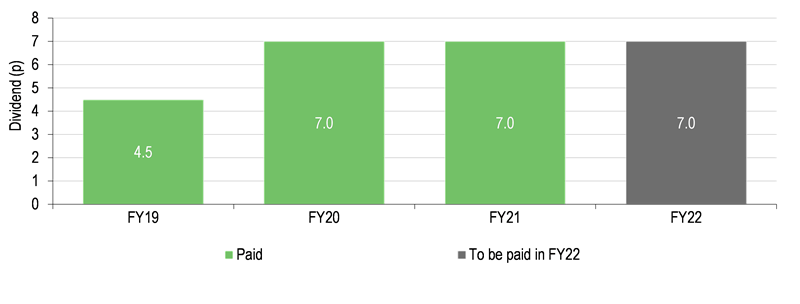
GRID has paid a dividend of 7.0p per share for the past two financial years, and the board has confirmed a target dividend of 7.0p per share dividend again in FY22 (Exhibit 6). Dividends are paid in four quarterly payments covering the periods to end June, September, December and March, in the form of interim dividends. No final dividend is paid. The fourth quarterly dividend payment in respect of the current fiscal year will be paid in March 2023. The fund offers a current dividend yield of 4.3%.
GRID’s dividend cover is a key focus for the board. In the first half of FY22, the portfolio generated earnings sufficient to provide operational dividend cover of 1.18x, and this rose to 1.3x in Q322 – close to FY21’s cover of 1.32x, and substantially higher that FY20’s cover of 0.78x. The dividend is expected to be fully covered over 2022 as a whole.
Looking ahead, the board expects dividend cover to improve further in the medium term, as more projects are commissioned and revenues rise accordingly. GRID’s half-year results stated the board’s aim to ‘balance’ future dividend targets with increases in operational dividend cover. We interpret this to mean that it is the board’s intention to direct the fund’s rising income towards increasing the dividend over time. This decision would reflect the board’s recognition of shareholders’ desire for high and growing income, especially in the wake of recent cost of living increases.
|
Exhibit 7: Dividend history since inception |
|
|
Source: Gresham House Energy Storage Fund, Edison Investment Research |
Investment Companies
Research: Healthcare
Oryzon Genomics has presented headline FY22 financial results, which reflect continued progress on its clinical activities for key assets iadademstat (oncology) and vafidemstat (central nervous system; CNS) across different programmes. Total operating expenses for the year were US$22.9m, up by 13.5% from US$20.2m in FY21 and slightly higher than our estimate of US$20.1m. As expected, the bulk of these costs (c 80%) related to R&D expenses (US$18.1m) as the company continues to focus on advancing its clinical pipeline. The period-end gross cash balance was US$22.7m, which at historical burn rates (€6.92m/US$7.3m in H122) should fund the company into H225, past key clinical readouts. Looking ahead, we see the start of patient enrolment in the FRIDA study for relapsed/refractory (r/r) FLT3+ acute myeloid leukaemia (AML) patients and top-line data from the PORTICO study for borderline personality (BPD) disorder in Q123 as key upcoming catalysts.