Last close As at 05/08/2026
GBP1.30
▲ 4.00 (3.17%)
Market capitalisation
GBP137m
Research: Investment Companies
Baker Steel Resources Trust (BSRT) offers the potential for regular dividend and royalty income, as well as realisation proceeds, from its maturing portfolio of natural resources companies. Despite the multiple headwinds recently affecting junior mining projects, its largest holding (Futura Resources) was able to successfully close a financing round in September and advance one of its coking coal mines to production. Moreover, Cemos Group is eyeing the deployment of a second grinding line and clinker plant to significantly increase its earnings. Despite the recent share price rally, BSRT’s shares trade at a 33% discount to NAV.
Baker Steel Resources Trust |
Potential to generate a 20%+ yield |
Investment trusts |
14 May 2024 |
Analyst
|
|||||||||||||||||||||||||||||||||||||||||||||||||||||||||||||||||
Baker Steel Resources Trust (BSRT) offers the potential for regular dividend and royalty income, as well as realisation proceeds, from its maturing portfolio of natural resources companies. Despite the multiple headwinds recently affecting junior mining projects, its largest holding (Futura Resources) was able to successfully close a financing round in September and advance one of its coking coal mines to production. Moreover, Cemos Group is eyeing the deployment of a second grinding line and clinker plant to significantly increase its earnings. Despite the recent share price rally, BSRT’s shares trade at a 33% discount to NAV.
|
BSRT’s portfolio at end-April 2024 |
|
|
Source: Baker Steel Resources Trust |
Cyclical challenges, secular growth drivers
Junior mining projects worldwide have been affected by a combination of high interest rates, elevated inflation and geopolitical headwinds, which in many cases triggered budget revisions and translated into more difficult fund-raising. That said, we note that the potential peak in the interest rate cycle (at still relatively moderate real interest rates) could support precious metals prices and drive a recovery in global M&A activity in the natural resources sector (as illustrated by BHP’s recent bid for Anglo American). Moreover, secular drivers such as the green energy transition and the resulting high demand for certain industrial/specialty metals, coupled with supply constraints for some of the commodities, could prove supportive for the sector.
High long-term income potential
BSRT’s portfolio does not simply offer geared exposure to a basket of commodities, but provides the potential to generate returns from bringing junior mining projects up the development curve. Its current portfolio includes several maturing assets, many of which are already in production. BSRT’s manager estimates that upon full production ramp-up of its major projects, its portfolio could potentially generate total royalty and dividend income of £11–17m pa. This would represent a very healthy 19–30% annual yield on its current share price, though we note that this is still subject to project execution risks. Most of this potential comes from Futura Resources and Cemos Group, which plan to complete their production ramp-up/expansion in the next 12–24 months.
BSRT’s value proposition
Actively riding the development curve
The core of BSRT’s bottom-up, value-focused strategy is to invest in a concentrated portfolio of 10–20 unlisted junior mining companies. For the purpose of its investment policy, natural resources companies are defined as those involved in the exploration for and production of base metals, precious metals, bulk commodities, thermal and metallurgical coal, industrial minerals, oil and gas and uranium, and include single-asset as well as diversified natural resources companies. Its current portfolio primarily offers exposure to steelmaking coal (through its investment in Futura Resources), cement (Cemos) and gold (Caledonia Mining Corporation (CMCL), Bilboes Gold royalty and Metals Exploration), with the remaining portfolio offering a combination of commodities, including silver and industrial/specialty metals (see Exhibit 1).
|
Exhibit 1: BSRT’s portfolio by commodity as at end-December 2023 |
Exhibit 2: BSRT’s portfolio by geography as at end-December 2023 |
|
|
|
Source: Baker Steel Resources Trust |
|
Exhibit 1: BSRT’s portfolio by commodity as at end-December 2023 |
|
|
Source: Baker Steel Resources Trust |
|
Exhibit 2: BSRT’s portfolio by geography as at end-December 2023 |
|
|
Source: Baker Steel Resources Trust |
Rather than merely providing geared exposure to rising commodity prices, the manager focuses on capturing the alpha arising from the development progress made by these businesses as they move from a pre-feasibility stage to completion of a definitive feasibility study (DFS) and then towards mine construction. BSRT’s portfolio holdings are normally valued based on long-term forward curve prices. In many cases, the company seeks to mitigate the risks arising from investing in early-stage mining businesses by investing through convertible loan notes, as well as providing funding in stages as development milestones are met. The share of convertible loans in its current portfolio is 21% (see Exhibit 3) as several holdings matured and BSRT converted into straight equity in recent years (eg Futura Resources, Silver X). The trust also invests through royalties, which offer the potential for regular income once projects come on stream.
|
Exhibit 3: BSRT’s end-2023 portfolio by type of investment |
|
|
Source: Baker Steel Resources Trust |
BSRT’s manager is a natural resources specialist
BSRT’s investment manager is Baker Steel Capital Managers (BSCM), a specialist natural resources asset management and advisory firm, which has headquarters in London, with a branch office in Sydney, Australia. The firm has an experienced team of fund managers covering the precious metals, base metals and minerals sectors worldwide, including equity markets and underlying commodity markets. Investment opportunities are mainly sourced from the investment and advisory team’s extensive proprietary network of industry contacts. BSCM’s managing partner, Trevor Steel, has acted as BSRT’s lead manager since its launch. He is supported by Francis Johnstone (investment adviser), with David Baker and Mark Burridge (managing partners) also sitting on BSRT’s investment committee. BSCM is actively involved in supporting the development of BSRT’s portfolio companies, which often involves having a board seat.
Maturing portfolio offers income and/or exit prospects
BSRT’s portfolio has matured in recent years (see Exhibit 4) and now contains several holdings that have operating mines or projects that have just launched production (Cemos, Futura Resources, CMCL, Metals Exploration, Silver X, Polar Acquisition). As a result, it offers the prospect of potentially significant income. BSRT’s manager estimates that upon full production ramp-up of its major projects (Futura Resources, Cemos, Bilboes Gold) and Polar Acquisition by 2025–26, the trust’s portfolio could potentially generate total royalty and dividend income of £11–17m pa. This represents a very healthy 19–30% annual yield on its current market cap of £57m. That said, this is subject to some project execution risks, and we believe that Bilboes Gold is likely to move to production later than 2026 (see below for details). Finally, BSRT has been receiving dividends on its holdings in CMCL (currently a 2.4% stake after being partially sold down from 4.2%). The latter has been paying a quarterly dividend since 2012, which has remained stable since October 2021 at US$0.14, representing an annualised yield of c 5.6% based on CMCL’s current share price. This represents an annual income for BSRT of c US$0.25m based on the stake it currently holds. BSRT also has some projects that are at an advanced development stage and are now in negotiations regarding financing or project sale (eg Nussir, Kanga Investments).
|
Exhibit 4: BSRT’s end-2023 portfolio by development stage |
|
|
Source: Baker Steel Resources Trust |
Available at a c 33% discount to NAV
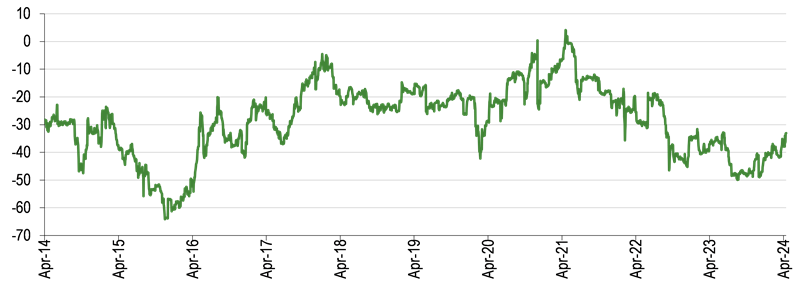
Despite the c 58% share price rally since late November 2023, BSRT’s shares still trade at a c 33% discount to last reported NAV (compared to a 10-year average of 29%, see Exhibit 5). We believe this may be due to a combination of the following factors: 1) a broader trend of widening discounts across the UK-listed investment trusts since 2022, especially alternative trusts; 2) the recent market headwinds for junior mining projects in terms of cost inflation and limited investor appetite leading to a difficult financing environment; and 3) the modest liquidity of BSRT’s shares.
|
Exhibit 5: BSRT’s historical discount to NAV |
|
|
Source: LSEG |
We also note that the combined £52.7m fair value of BSRT’s investment in Futura Resources (the owner of two coking coal mines in Australia) and Cemos (a Moroccan-based cement producer), which represented c 62% of end-April 2024 NAV, is roughly equal to BSRT’s current market capitalisation (BSRT has no holding-level debt at present). A further 19% of its end-April 2024 NAV is attributable to listed holdings (CMCL, Silver X, Metals Exploration, Tungsten West and First Tin). While the fair values of BSRT’s holdings (especially pre-production assets) may be volatile at times, we note that Cemos’s cement plant has been operational for several years and one of Futura’s coking coal mines has just moved to production.
|
Exhibit 6: Edison TV interview with Trevor Steel (November 2023) |
|
|
Source: Edison Investment Research |
Performance affected by macroeconomic headwinds
The junior mining sector has recently experienced multiple headwinds. Higher interest rates, coupled with high inflation and geopolitical headwinds, as well as less demanding valuations of more established mining companies, translated into a more challenging funding environment for development projects, especially for single-asset junior mining companies. For instance, these factors might have had an impact on Tungsten West, one of BSRT’s portfolio holdings (4.6% of BSRT’s end-April 2024 NAV) developing the Hemerdon tungsten mine in the UK. The project was affected by cost inflation, most notably with respect to electricity and diesel prices. Furthermore, it had to carry out an interim fund-raising at a depressed valuation in early 2023 (after its earlier fund-raising efforts failed). The above-mentioned headwinds have reduced global appetite for M&A and IPOs, also in the natural resources industry, which has made it difficult to sell junior mining projects to larger, more established trade buyers or float them on public markets.
BSRT posted a one-year NAV total return (TR) to end-April 2024 in sterling terms of 8.6%, ahead of the S&P/TSX Global Mining Index at 5.9%. Major positive contributors include BSRT’s two largest private holdings (Futura Resources and Cemos) as well as the listed Metals Exploration and Tungsten West. Futura was revalued upwards by c 47% following BSRT’s year-end portfolio valuations to reflect the successful financing (see our previous note for details), which more than offset some earlier downward fair value adjustments during 2023. The positive revaluation of Cemos was assisted, among other things, by the partial recognition of the future benefits from a planned clinker line. These positive valuation effects were partly offset by the decline in the share prices of several of BSRT’s listed holdings (CMCL, First Tin and Silver X), as well as a downward revaluation of the private holding Kanga Potash.
BSRT’s five-year NAV TR stands at 7.0% pa, while its 10-year return was a modest 2.8% pa, respectively (versus to the S&P/TSX Global Mining Index of 14.4% and 8.3% pa, respectively, see Exhibit 7). This is also below the average returns posted by BSRT’s peers included in the AIC Commodities & Natural Resources group (see Exhibit 8). This underperformance comes from the focus on early-stage mining companies (whose valuations are mostly driven by the timeline of achieving major milestones), but is also due to issues of selected assets, such as Tungsten West (which at its peak in March 2022 made up 17.2% of BSRT’s NAV), as well as BSRT’s exposure to assets in Russia (Polar Acquisition and Azarga Metals), which were heavily written down after Russia’s invasion of Ukraine.
|
Exhibit 7: BSRT’s performance to 30 April 2024 in sterling terms |
|
Price, NAV and benchmark total return performance, one-year rebased |
Price, NAV and benchmark total return performance (%) |
|
|
|
Source: LSEG, Edison Investment Research. Note: Three-, five- and 10-year performance figures annualised. |
|
Exhibit 8: Selected peer group at 14 May 2024*
% unless stated |
Market cap £m |
NAV TR |
NAV TR |
NAV TR |
NAV TR |
Ongoing charges ratio |
Perf |
Discount |
Net |
Dividend yield |
Baker Steel Resources Trust |
57.3 |
8.6 |
(17.5) |
40.6 |
32.4 |
2.0 |
Yes |
(33.1) |
100 |
0.0 |
BlackRock Energy and Resources Inc Trust |
153.8 |
6.2 |
54.4 |
109.5 |
108.9 |
1.2 |
No |
(11.3) |
114 |
3.7 |
BlackRock World Mining Trust |
1,177.7 |
(0.6) |
17.3 |
96.1 |
113.4 |
0.9 |
No |
(0.9) |
114 |
5.4 |
CQS Natural Resources Growth & Income |
126.5 |
11.0 |
38.5 |
134.4 |
117.7 |
1.7 |
No |
(13.5) |
108 |
2.9 |
Geiger Counter |
73.1 |
73.6 |
90.5 |
267.0 |
136.7 |
2.4 |
No |
(24.6) |
116 |
0.0 |
Golden Prospect Precious Metals |
30.8 |
6.9 |
(29.0) |
57.8 |
(4.9) |
2.2 |
No |
(16.6) |
112 |
0.0 |
Riverstone Energy |
250.6 |
14.2 |
119.1 |
6.9 |
30.5 |
2.2 |
Yes |
(26.3) |
100 |
0.0 |
Simple average |
302.1 |
18.5 |
48.5 |
112.0 |
83.7 |
1.8 |
(15.5) |
111 |
2.0 |
|
BSRT’s rank in peer group |
6 |
4 |
6 |
6 |
5 |
4 |
7 |
6 |
4 |
Source: Morningstar, Edison Investment Research. Note: Net gearing is total assets less cash and equivalents as a percentage of net assets, 100 = ungeared. *NAV performance in sterling terms based on end-April 2024 NAV, or latest earlier available NAV.
Exhibit 9: BSRT’s discrete performance versus selected indices in total return, sterling terms (%)
12 months ending |
BSRT’s NAV |
BSRT’s share price |
S&P/TSX Global Mining Index |
MSCI World All-Country Index |
30/04/20 |
22.1 |
4.3 |
13.3 |
(1.2) |
30/04/21 |
39.5 |
83.8 |
39.9 |
33.4 |
30/04/22 |
(5.0) |
(24.3) |
20.0 |
4.7 |
30/04/23 |
(20.0) |
(32.4) |
(2.8) |
2.5 |
30/04/24 |
8.6 |
8.0 |
5.9 |
18.5 |
Source: LSEG, Edison Investment Research
Futura Resources: Wilton has just come on stream
Futura Resources (33.9% of end-April 2024 NAV) is the owner of two coking coal mines in Australia (Wilton and Fairhill). BSRT’s investment in Futura is a combination of equity and an unsecured convertible note with a coupon of 21% pa (representing a 24.3% stake on a fully diluted basis as at end-2023), as well as a 1.5% gross revenue royalty. BSRT’s convertible note investment is part of the c A$35m financing (A$30m convertible note and A$5m in-kind commitments from contractors and suppliers) that Futura successfully closed in September 2023. This was a major milestone for the business, as it fully funded the advancement of the Wilton coking coal mine to production.
Futura has access to the nearby Gregory Crinum site for its coal processing and associated handling infrastructure (secured by 15-year binding agreements), and to the existing local port and rail infrastructure. The open-pit nature of the operations should allow for a quick advancement to production, within three months of securing funding. Wilton already launched production earlier this year, with first coal shipped to the Gregory Crinum site for processing and inaugural coal sales. BSRT expects Fairhill to be advanced to production based on cash generated by the Wilton mine within c 24 months. That said, Futura is now in advanced negotiations for a A$35m pre-payment debt offtake and marketing facility with a major coal trading company to fund the Fairhill development to production (which would allow mining to commence in September 2024).
Project’s AISC offers good earnings potential at current prices
Futura’s all-in sustaining cost (AISC) stands at c US$85/tonne, with BSRT management highlighting that this represents a second quartile cash cost, benefiting from low strip ratios. This compares with the current spot price for premium coking coal of c US$326/tonne, which has remained broadly stable since autumn last year. In its resources and energy quarterly report in March 2024, the Office of the Chief Economist of the Australian government indicated that prime coking coal prices are falling slowly and that it expects prices to moderate from the average US$294 a tonne in 2023 to US$277 in 2024 and $185 (in real terms) by 2029. This is due to a recovering supply (as recent constraints from, among other things, weather disruptions such as the recent Cyclone Jasper have started to ease) and weaker demand (amid a softening outlook for growth in global steelmaking, most notably in China). However, weather events (including the current La Niña cycle) and the conflict in the Black Sea region add to upside risks. The above price outlook is captured by Futura’s fair value reflected in BSRT’s NAV, as it is based on a price of around US$180/tonne.
Futura’s potential EBITDA upon the full ramp-up in 2025 of both projects (at a production rate of 1.5–2.0m tonnes of saleable product after washing and processing) stands at A$80–90m, which compares with total project development costs of A$35m, translating into a short payback period (see Exhibit 10). We note that this already accounts for certain price discounts related to offtake agreements. Futura has the potential to further increase production, subject to additional licences and available processing capacity. BSRT also highlighted that the overall extensive mineral reserve could sustain a mine life well beyond the currently planned term (Futura’s measured and indicated JORC resources for both mines are 200m and 644m metric tonnes, respectively). That said, the recovering global supply of coking coal (as highlighted above) may potentially impact the pace of Futura’s production ramp-up.
|
Exhibit 10: Base case scenario for unlevered Futura Resources cash flows (real terms) |
|
|
Source: Baker Steel Resources Trust |
Solid income potential from royalties and dividends
Successful production and sales ramp-up of both Futura projects would likely translate into solid dividend and royalty income for BSRT. The production start at Wilton (and later at Fairhill) will trigger first payments to BSRT from its 1.5% gross revenue royalty, which BSRT’s manager expects to be c A$4–6m (£2–3m) pa upon full project ramp-up, based on the above-mentioned long-term coking coal price assumption. Moreover, BSRT’s management estimates that Futura’s dividend potential to BSRT is c A$10–15m (c £5–8m) per year. The trust will also earn the coupon on its convertible note holdings (resulting in interest income of c A$1m or £0.5m pa). In aggregate, we calculate that this represents a potential pre-tax income yield on BSRT’s current market capitalisation of c 14–20% pa.
Based on Futura’s end-December 2023 fair value, the mid-point of BSRT’s manager’s above-mentioned EBITDA expectations by 2025 implies an EV/EBITDA multiple of c 1.5x (or c 1.9x if we theoretically assume that Fairhill’s A$35m financing will be in the form of regular financial debt rather than an off-take agreement). This compares with FY25e EV/EBITDA ratios for listed peers of c 1.0–3.9x (based on LSEG consensus), with the median multiple at 2.2x. BSRT noted that an 85% stake in the neighbouring Ensham coal mine was acquired by Thungela in 2023 for c A$340m (plus royalties), a price per annual tonne of saleable product that would imply a A$270m valuation for Futura (on full production ramp-up).
Cemos: New investments should drive earnings up
Cemos (28.1% of end-April 2024 NAV) is a Moroccan-based cement producer, in which BSRT holds a combination of equity and a convertible loan (translating into a 31.3% stake on a fully diluted basis). Its first production (grinding) line has been operational for several years and reached its full production capacity of 250k tonnes per year in H220 (though recent capacity utilisation was lower, with 203k in 2022 and 185k in 2023). The company recently decided to build a clinker manufacturing plant next to the cement plant, which will make Cemos vertically integrated, and this is scheduled for commissioning in H224 with the full benefit in 2025.
Management estimates the annual EBITDA run-rate for the company’s current production line at c €8–10m, though the 2023 figure was lower at €6.0m, due to bottlenecks with respect to third-party tracking companies, as well as lower cement purchases from one large customer. That said, Cemos’ management expects performance in 2024 to rebound to 2022 levels and anticipates that major Moroccan government and foreign investment initiatives should support the southern Moroccan cement market in the coming years. The new clinker line (which will cost c €10m) should reduce clinker costs by c 40–50% (ie €5–6m pa per grinding line) and in turn bring the annual EBITDA run-rate of the project to nearly €15m. Cemos acquired a second cement production line in 2022, which it holds in a warehouse, but plans to bring on stream within 12–18 months. This would require an investment of c €7m, which could be financed internally.
While the near-term cash flows of Cemos may be affected by the cyclical macroeconomic slowdown and the start-up costs of the clinker line and second production line, it should become an important earnings contributor for BSRT and a potential source of dividend income in two to three years. BSRT’s management estimates the dividend potential of Cemos at €3–5m (c £2.6–4.3m) per year upon full ramp-up of the clinker line and the second production line.
Gold: Potential for a continued bull run
We note that the gold price (which is up c 14% y-o-y) has recently been supported by a combination of geopolitical uncertainty (war in Ukraine, tensions over Taiwan, instability in the Middle East), expectations of a turn in the interest rate cycle in the US, as well as economic woes in China. Interestingly, gold prices rebounded quite quickly after the sell-off during the monetary tightening in 2022. Moreover, we note that, according to the World Gold Council, central bank purchases of 1,037.4 tonnes in 2023 were the second highest in history (with People’s Bank of China being the largest buyer) and close to the all-time high of 1,081.9 tonnes in 2022. These net inflows were much higher than the net outflows from ETFs and similar products at 244.4 tonnes in 2023 (vs net outflows of 109.5 tonnes in 2022).
In our Shades of the 1970s gold report published in September 2023, we highlighted that the recent Federal Reserve rate tightening cycle created a real interest rate profile that is almost directly analogous to October 1979. Back then, the gold price did not peak until real interest rates attained a level of 4% on a sustainable basis in November 1980. As this level of real interest rates has not been reached yet and the Fed has now seemingly paused its tightening cycle, we believe that the gold bull market remains intact. While it is possible to predict a lower gold price in the next few years (down to US$1,126/oz if latent inflationary forces fail to come through and 2029 becomes the analogue of 1985), in the shorter term, a number of our analyses demonstrate that a price in excess of US$3,000/oz is a realistic possibility and that one of US$4,500/oz is an outside possibility.
We note that, so far, the positive price action in gold has not fully benefited gold mining equities, with the S&P Commodity Producers Gold Index up only c 4% in TR terms over the last 12 months to 13 May 2024. CMCL’s shares were down c 22% on a net TR basis over that period, which we believe may be at least partly due to weaker FY23 results, with gross profit down 33% y-o-y to US$41.5m due to higher production costs at the Blanket Mine and operating costs associated with the temporary Bilboes oxide mine.
Caledonia Mining Corporation/Bilboes Gold royalty
CMCL (4.4% of end-April 2024 NAV) is a multi-asset, listed Zimbabwean gold producer operating the Blanket Mine, which in 2023 produced 75.4k ounces (oz) and has 2024 guidance of 74–78k oz at an AISC of US$1,370-1,470/oz. Furthermore, it holds Bilboes Gold, a development project acquired from BSRT in January 2023 for 800k CMCL shares and a 1% net smelter royalty from Bilboes Gold (the latter making up 7.1% of BSRT’s end-April 2024 NAV). It also holds one pre-development project (Maligreen) and one early-stage exploration project (Motapa, adjacent to Bilboes). CMCL currently trades at an FY24e P/E ratio of c 14.1x (based on LSEG consensus EPS of US$0.71).
A DFS on Bilboes Gold completed before the acquisition by CMCL indicated a life of mine of 10 years, with an average production rate of c 167koz per year and a peak funding requirement of US$250m. The AISC of the project was estimated at US$826/oz at a gold price of US$1,650/oz (vs US$2,350/oz currently), translating into a post-tax net present value (NPV) (at a 10% discount rate) of US$323.3m and a post-tax internal rate of return (IRR) of 33.4%. BSRT’s management estimates the income potential from its net smelter royalty at c US$3m (c £2.4m) pa upon full production ramp-up.
We note that CMCL commissioned a new feasibility study to investigate a phased approach to the development of the mine to reduce the peak upfront capital expenditure. The company expects to receive the initial results (a preliminary economic analysis, PEA) in 2024. Therefore, the potential time of production launch and ramp-up path at the Bilboes mine is uncertain.
Metals Exploration
Metals Exploration (ticker: MTL; which made up 4.0% of BSRT’s end-April 2024 NAV) is AIM-listed and owns the Runruno gold mine in the Philippines. The company posted record-high gold production of c 85.2k oz in FY23 at an AISC of US$1,126/oz. This translated into FY23 gold revenues and free cash flow of US$166.7m and US$72.3m, respectively, supporting the company’s deleveraging efforts (it is now debt free). Company guidance is for gold production in FY24 of 74–80k oz and an AISC of US$1,175–1,275/oz. The company expects that the resources of the Runruno mine will be exhausted within the next two to three years. Therefore, the company looks for local M&A opportunities and has acquired a 72.5% stake in Yamang Mineral Corporation and a 100% stake in Yamang Mineral Corporate Pte, which are part of the exploration business YMC Group. This will provide the company with access to the Abra Tenement covering c 16,200 hectares with multiple prospective targets in both gold and copper. Metals Exploration’s share price rallied by c 140% over the last 12 months and by 75% year-to-date.
Silver: A blended industrial and precious metal story
BSRT’s investment manager believes that demand for silver will be supported by the required 3.5x increase in global solar capacity by 2030 to remain on track for net zero (as estimated by BloombergNEF). As a result, the manager expects a silver market deficit of 300m oz by 2030 and believes that current prices are not high enough to incentivise the production growth required to meet the rising industrial demand for silver. Given that silver is also considered a precious metal, it may benefit from a turn in the Fed’s interest rate cycle, much like gold.
Silver X Mining Corporation
Silver X Mining Corporation (ticker: AGX; which made up 2.9% of BSRT’s end-April 2024 NAV) is a TSX-V listed business and holds the Recuperada project in Peru. Its Tangana silver mine (which also mines gold, zinc and lead in the process) restarted production in September 2023 following the cessation of operations in July 2023 ordered by the new CEO to implement a new operational plan to address the mine’s underperformance versus expectations. The CEO highlighted that this allowed the company to streamline operations, improve performance and run the mine at a more competitive cost. The project produced c 918.9k oz of silver in 2023 (up c 2.8% y-o-y), of which 292.4k oz was in Q423. Moreover, the company successfully completed a debt transaction (6m shares for US$2.18m) with an arm’s length creditor in October 2023, to strengthen the company’s balance sheet. In February 2023, the company released the results of a PEA for the expansion of the Tangana mine with potential to treble its annual production to 4.2moz of silver equivalent per year by constructing an additional recovery plant at a cost of US$61m, which would translate into an NPV (at a 10% discount rate) of US$175m, according to the PEA.
Polar Acquisition
With respect to BSRT’s holdings with income potential, BSRT holds a 1.8% to 0.9% net smelter royalty (reducing over 10 years) in the Prognoz silver mine in Russia through Polar Acquisition , which is now outside of BSRT’s top 10 holdings. The mine was until recently owned and developed by Polymetal International, which is registered in Kazakhstan (following the re-domiciliation from Jersey in 2023). The company’s shareholders approved the sale of Polymetal’s Russian business to Mangazeya Plus on 7 March 2024. We note that the obligation to make the royalty payments from the Prognoz silver mine to BSRT remains with Polymetal, which BSRT estimates at potentially c US$1–2m (c £0.8–1.6m) pa upon full production ramp-up. According to Reuters, the owner of the mine highlighted that it will start selling silver concentrate in Q324 and upon full ramp-up will sell 5–7m oz of silver in silver concentrate on average per year. BSRT acknowledged its 2022 annual report that the sanctions regime may change and there is a risk that financial institutions may not be willing to process bank transfers with contractual parties, which could lead to the royalty payments being delayed, frozen or never received. Still, Polar Acquisition is a potential additional NAV catalyst, which bears limited downside risk given that BSRT has largely written down the asset (by c 90% since Russia’s invasion of Ukraine), with the end-December 2023 fair value (last available) at only c £0.8m.
Industrial/specialty metals: Driven by ‘net zero’ agenda
Demand for several industrial and specialty metals should be driven by the green transition. For instance, BSRT’s managers highlighted recently that demand for copper should increase by 23% by 2030. This includes demand from China (which consumes 57% of the global copper supply and produces 45% of supply) and from outside of China, which should grow at an even faster pace and surpass Chinese demand in the coming years. As this is coupled with supply issues, BSRT’s investment manager expects a deficit for 2024 (which should deepen over the coming years to 9% of global copper supply by 2030). Demand for tin should also be driven by the transition to ‘net zero’, as well as its use in electronics. The commodity is defined as a critical material in the US, Germany and Indonesia.
Nussir
Nussir is a copper project in Northern Norway (which made up 3.7% of BSRT’s end-April 2024 NAV). It is designed to become the world’s first fully electrified mine and is at an advanced development stage (ie ready for construction subject to securing funding). The company completed its DFS in early April 2023, indicating an NPV (based on an 8% discount rate) of US$191m and an IRR of 22%, assuming production of 14,000 tonnes of copper per year over a 14-year mine life and a copper price at US$8,000 (currently at c US$10,000). The company is currently undergoing a formal process to investigate a sale or merger with an existing producer.
First Tin
First Tin (ticker: 1SN; which represented 2.7% of BSRT’s end-April 2024 NAV) is LSE-listed and holds three tin assets: the Tellerhäuser and Gottesburg projects in Germany and the Taronga project in Australia, with combined contained tin of 143k tonnes. Meanwhile, it released an updated mineral resource estimate, according to which the total indicated plus inferred tin resources increased by 35% to 138.6k tonnes compared to the previous estimate. The company recently announced the DFS results for the Taronga mine, which at a tin price of US$30,000 (vs close to US$33,000 currently) and an 8% discount rate indicate a pre-tax NPV and IRR of US$160m and 34% (or 28% post tax), respectively. The project’s AISC are estimated at A$24,005 (US$15,843) per tonne which, according to First Tin’s management, positions the project in the lower half of the global cost curve. The Gottesburg project offers further exploration potential.
Tungsten West
Tungsten West (ticker: TUN; which made up 4.6% of BSRT’s end-April 2024 NAV) is an AIM-listed developer of the tungsten and tin Hemerdon Mine in the UK. In December 2023, the company’s section 73 application was approved, while in February 2024 it received a draft permit from the UK Environment Agency for the operation of the Mineral Processing Facility (MPF) at Hemerdon. At the end of March 2024, Tungsten West announced that the agency commenced the public consultation period regarding the MPF, which is the final step before it can issue the permit.
Tungsten West recently increased its convertible loan notes programme by raising an additional £1.6m tranche and extended the maturity of all notes to 31 January 2025. The new proceeds will be used to fund to an updated feasibility study (to be completed in Q324), which would be followed by an attempt to raise funding in H224. The company seeks to bring the mine to production by early 2026.
Other top 10 holdings
The only other top 10 holding is Kanga Investments, which made up 3.6% of BSRT’s end-April 2024 NAV and holds the Kanga Potash project in the Republic of the Congo. The company completed a DFS for the project in 2020 for a mine producing 600,000 tonnes of muriate of phosphate (MOP) per year, which gives it an NPV (at a 10% discount rate) of US$511m and a 22% IRR based on an MOP price of US$282 per tonne (vs current free on board Vancouver spot price of c US$305). The DFS indicates potential to expand the mine on a modular basis to 2.4m tonnes per year over 30 years. Kanga Investments obtained an exploitation/mining licence in H222 and plans to update its feasibility study in 2024 before finding a partner to develop the project.
Gearing: Modest net cash position
BSRT’s net cash, equivalents and accruals stood at 1.9% of end-April 2024 NAV (or c £1.6m according to our calculations). This leaves little room for new or follow-on investments, as the company also needs to pay the management fee to its investment manager (see below for details). However, as mentioned above, BSRT generates regular dividend income from its stake in CMCL, and has prospects for additional dividend/royalty income from other holdings. BSRT is permitted to borrow up to 10% of its NAV to meet short-term cash flow requirements but remains ungeared at present.
Fees and charges
The company pays Baker Steel Capital Managers a monthly management fee, which equals one-12th of 1.75% of BSRT’s average market cap during the month. The manager is also entitled to a performance fee of 15% of the total increase in NAV in each financial year above an 8.0% per year compound hurdle since inception, relative to the highest previously recorded NAV for which a performance fee has been paid (ie subject to the highwater mark). However, we note that no performance fee has been earned since FY11, as it only becomes payable following sufficient net realised gains and the company’s NAV has not exceeded the hurdle, which was 177p per share as at end-2023. Similar to other ongoing expenses, 100% of management fees are charged to the revenue account.
Approach to ESG
The investment manager believes ESG considerations are key for creating and maintaining shareholder value through enhanced risk management and instilling a progressive standard of best practices. At the same time, it acknowledges that ESG issues in mining companies can pose reputational costs and create a negative perception of the sector among its stakeholders. To address the potential sustainability challenges and opportunities, the manager has implemented an ESG policy that includes a comprehensive ESG assessment framework, which it uses in the investment process. The process comprises:
■
Pre-screening of potential investment targets (ie companies must meet some non-negotiable sustainability metrics, for example, have policies in place on ethics, anti-bribery, corruption, human rights and anti-child labour).
■
Calculation of ESG scores that are developed internally by weighting 20 sustainability metrics that are most relevant for the manager’s strategy and cross-checking with third-party ratings.
■
Incorporation of ESG scores into investment decision making.
■
The ongoing monitoring of portfolio companies’ ESG progress (primarily through meetings and site visits).
Its commitment to supporting an industrywide ESG progress is reflected in BSRT becoming the signatory of the United Nations Principles for Responsible Investing in January 2020. The manager also highlights the mining sector’s contribution to the technological revolution in the field of electric vehicle production, battery development and renewable energy, as they all require the use of specialty metals (see more detail above).
Capital structure
BSRT’s capital consists of 107.2m ordinary shares (of which c 9k management ordinary shares in issue are held by BSRT’s investment manager) including 700k (ordinary shares only) held in treasury. BSRT has the authority to make market purchases up to 14.99% and to allot up to 10% of its ordinary shares in issue, renewed annually at the AGM. The management currently holds a c 23.6% stake in the company (through Sonya Trust and Northcliffe Holdings) with a further 4.6% of BSRT’s shares in issue held by another fund managed by its investment manager, Baker Steel Capital Managers.
|
Exhibit 11: Major shareholders |
Exhibit 12: Average daily volume |
|
|
|
Source: Company data, LSEG at 14 May 2024 |
Source: LSEG. Note: 12 months to 14 May 2024. |
|
Exhibit 11: Major shareholders |
|
|
Source: Company data, LSEG at 14 May 2024 |
|
Exhibit 12: Average daily volume |
|
|
Source: LSEG. Note: 12 months to 14 May 2024. |
Board
BSRT’s management board consist of four non-executive directors, two of whom have served on the board since the company’s incorporation in March 2010.
The board is chaired by Howard Myles, who was a partner at Ernst & Young from 2001 to 2007 and was responsible for the investment funds corporate advisory team, having previously spent 14 years at UBS Warburg. He has served on the boards of several investment trusts and is currently director of Chelverton UK Dividend Trust and The Forest Company. Howard Myles recently announced that he will step down from the board at the end of the year and that Fiona Perrott-Humphrey (see below) will take the chair.
Charles Hansard has over 30 years of experience in the investment industry, formerly serving as a director of Apex Silver Mines and chairman of African Platinum. He is currently a director and senior advisor on several boards, including the Moore Capital group of funds. He has also served as a director of several mining companies.
Fiona Perrott-Humphrey, who is also a member of the company's Audit Committee, was formerly head of European Mining Research at Citigroup, and also worked as mining analyst at James Capel and Cazenove. She is now a director of AIM Mining Research, founding director of a strategic mining consulting business and an adviser on the mining sector to Rothschild and Co.
John Falla, who is also a member of the company's Audit Committee, was formerly corporate finance director at Edmond de Rothschild between 2000 and 2015, where he provided corporate finance advice to international clients including open and closed-ended funds, and institutions with significant property interests. He was also a director of a number of Edmond de Rothschild operating and investment companies. Previously, he worked for an international bank before joining The International Stock Exchange (formerly the Channel Islands Stock Exchange) on its launch in 1998 as a member of the Market Authority. Before that, he qualified as a chartered accountant with Ernst and Young in London where he was working in the corporate finance department, specialising in the valuation of unquoted shares and securities.
Exhibit 13: BSRT’s board of directors
Board member |
Date of appointment |
Remuneration in FY23 (£) |
Shareholdings at end-FY23 |
Howard Myles (chair) |
March 2010 |
42,500 |
0 |
Charles Hansard |
March 2010 |
32,500 |
0 |
Fiona Perrott-Humphrey |
September 2020 |
32,500 |
0 |
John Falla |
October 2022 |
37,500 |
100,000 |
Source: Company data
|
|
Research: Metals & Mining
Pan American Silver (PAAS) has seen an encouraging start to the year with Q124 silver and gold production in line with management expectations and costs for both segments below its quarterly guidance. Q1 is typically one of the slowest quarters for PAAS and the company’s maintained guidance points to significant improvements in production and costs in H224. This should be supported by the current strength in commodity prices. We have increased our FY24 EBITDA estimate by 25% and upgraded our valuation from US$22.2/share to US$23.4. We believe there could be further upside to the share price if commodity prices remain at elevated levels and the company delivers on its operational guidance in FY24.