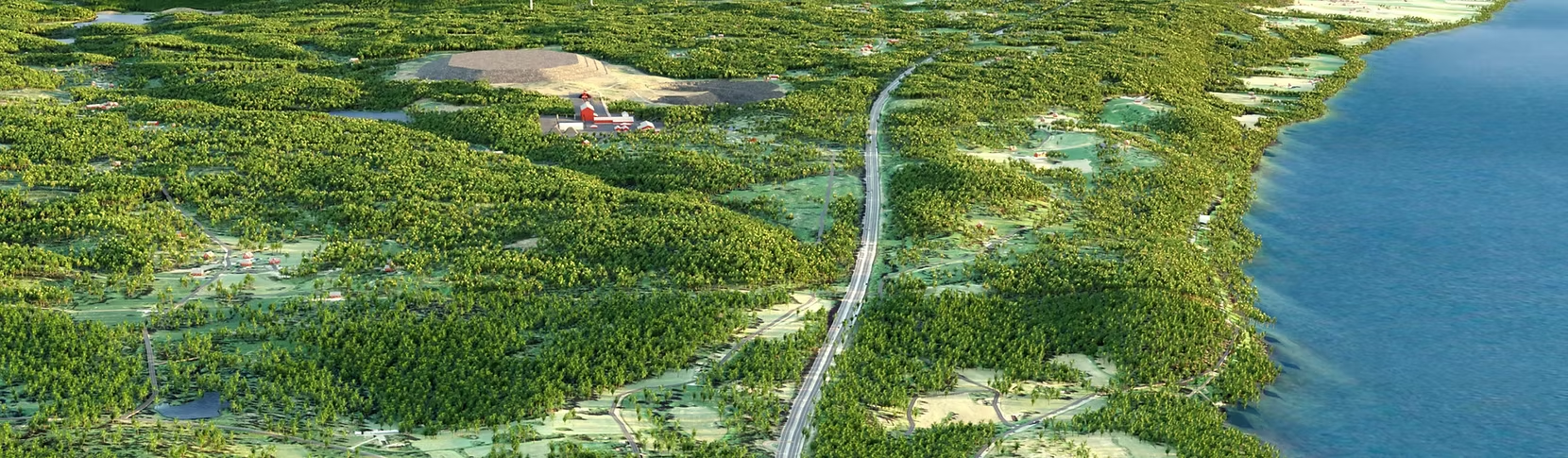
Cascades project (southern Burkina Faso)
Cascades is DFR’s flagship asset, located in the Banfora greenstone belt of the West African Birimian Supergroup in south-west Burkina Faso (one of the three major mineralised belts in western Burkina Faso). It is approximately 370km west-southwest of Burkina Faso’s capital, Ouagadougou, and comprises two exploration licence areas, denoted Wuo Land (c 61.6km2) and Wuo Land 2 (c 243km2) in Comoe province in the stable southern region of the country. While there are no active large-scale gold mines operating within this belt, the 3.8Moz Yaoure gold deposit (discovered by Cluff Mining/Amara and now operated by Perseus) is located within extensions of this belt approximately 450km to the south in Ivory Coast, while the 4.5Moz Banfora gold mine (now renamed Wahgnion and operated by Endeavour/Lilium) is located about 100km to the south-west in an adjacent belt. In fact, when looking at exploration discoveries in Africa over the 10-year period between 2012 and 2021, two of the top 10 discoveries are located near the southern Burkina Faso border on Birimian belts parallel to the Banfora belt that hosts the Cascades deposit. To the south-east is Centamin’s 5.5Moz Doropo project, while to the south-west is Cardinal Resources’ 7Moz Namdini project. As such, there can be little doubt that DFR’s ground is within a highly prospective post code.
Exhibit 4: DFR Gold’s Cascades project location
|

|
|
|
Pursuant to its acquisition of Moydow, DFR has the right to an 80% interest in the Cascades project, while Panthera Resources will own a carried 20% interest on the condition that DFR invests US$18.0m in the project by 30 September 2026. Thereafter, all interests are participating. However, Panthera has the right to acquire an additional 10% interest in Cascades by making a payment of up to US$7.2m. This ‘Back-In’ right is exercisable on the earlier of US$18m in expenditure by DFR or five years from 2021. Given the level of its expenditure, we understand that DFR’s interest in Cascades is currently at its minimum of 65%, regardless of Panthera’s Back-In right (the exercise of which we therefore consider unlikely under the circumstances). In addition, DFR has to pay the licence holder US$1.0m and US$0.3m (in 2024) upon exercising the options for the Wuo Land and Wuo Land 2 licences. A further payment of US$1.0m will be made to the licence holder on the successful definition and reporting of a JORC-compliant resource of at least 1Moz. In addition, the licence holder has retained a 1% net smelter return royalty on all gold produced up to a total aggregate payment of US$4.0m over the Wuo Land and Wuo Land 2 licence areas.
The current Cascades project area had previously enveloped multiple different projects with the likes of High River Gold (later acquired by Nordgold) and Taurus Gold the main players, but with smaller local companies also holding ground. Prior to Moydow commencing exploration, more than 65,500m of historical diamond (c 38% of the total) and reverse circulation (c 62%) drilling over 541 holes (average 121m per hole) had been completed by High River and Taurus. These included:
■
2m at 130.6g/t Au from 66m in hole WNDD15,
■
11m at 8.2g/t Au from 147m in hole WNDD24, and
■
6.5m at 7.26g/t Au from 318m in hole WNDD58.
However, these two parties ultimately walked away from the project and Panthera selectively consolidated the best of both High River’s and Taurus’s ground into a single project entity.
The Moydow team identified the project as having significant potential and following the combination of Moydow and Panthera in 2020, Moydow’s decision to fast-track the project started to pay dividends immediately. Recognising the potential value of the historical drilling databases of previous licences in the area, Moydow used its industry network to secure all pertinent data such as original laboratory assay sheets. In the three years since, significant progress has been made:
■
July 2020: Moydow and Panthera announced a proposal for a merger of their West African assets. At Labola, multiple historical projects were combined for the first time and valuable historical exploration databases acquired (from High River Gold and Taurus Gold).
■
August 2021: from his position at Moydow, Brian Kiernan believed that the Labola deposit could host a mineral endowment of c 2–3Moz gold. He knew Jean-Raymond Boulle socially and professionally and, at the time of Panthera’s reorganisation of its assets in August 2021, the two provided new equity funding in Moydow and DFR totalling US$2.75m in order to eliminate existing debt in DFR and fund a 5,000m exploration programme. Combined, the restructuring and equity funding resulted in both Mr Boulle and Mr Kiernan becoming the two largest single shareholders in DFR Gold, each with a near 40% interest in the company. The 5,000 metre validation reverse circulation drilling programme was completed at Labola the same month by Moydow.
■
October 2021: A maiden mineral resource was declared at Labola (subsequently renamed Cascades) as follows:
•
indicated 5.41Mt at a grade of 1.52g/t Au (264k oz), and
•
inferred 6.93 Mt at a grade of 1.67g/t Au (371k oz).
■
March 2022: Acquisition of the 243km2 Wuo Land 2 licence area – thereby increasing its land position by c five times – and renaming the project ‘Cascades’. At the same time, a large mineralised system was delineated within a 30km x 5km corridor containing multiple structures highlighted by geochemistry, geophysics, drilling and artisanal activity.
■
May–July 2022: first exploration drilling on the new Wuo Land 2 licence area.
■
September 2022: DFR announced the discovery drilling results of a significant new zone at the TT-13 target.
■
March–May 2023: second exploration drilling programme undertaken by DFR.
■
May 2023: DFR announced another new discovery at Sina Yar with 34 metres at 1.83g/t, some 6km south-east of Daramandougou. Simultaneously, a wide mineralised zone was intersected at Far East target, including 48 metres at 0.42g/t Au. Resource potential was also confirmed at TT13.
The announcement of the maiden resource estimate in particular in October 2021 – having completed just 5,000 metres of its own drilling – was a significant achievement for the DFR Gold team. The bulk of the resource was delineated at the Daramandougou and Wuo Ne targets, which are located approximately 1km apart along the same shear structure.
Exhibit 5: Cascades licence area and drilling
|

|
|
|
At both Daramandougou and Wuo Ne there was sufficient drilling to extend the resource shell to depths of c 150m but, for the most part, there is not enough deep drilling to confirm resources below that. However, during the past two drilling seasons, exploration drilling has focused more on demonstrating the ultimate potential size of this large mineralised system by targeting some of the many satellite prospects identified by the exploration team. As such, DFR’s management believes that Daramandougou/Wuo Ne is just the tip of the proverbial gold iceberg.
The new discoveries at Sina Yar, TT13 and Far East each seem to confirm management’s view of the enormous potential of the project area. Big mineralised intersections at Sina Yar from the recently reported 2023 drilling results, in particular, leave no doubt about the potential for resource ounce addition. Within this context, there have inevitably been a couple of disappointments where the DFR technical team has been trying to get to grips with geological complexity. For example, drilling across very large artisanal workings at Big South in 2022 hit significant mineralisation but not enough to animate management. Likewise drill testing a very strong combined chargeability/resistivity anomaly along strike from the Western Zone of Daramandougou has yielded inconsistent results that have proved difficult to interpret.
In general, however, it appears that DFR’s strategy is paying off, not least on account of its commitment to a systematic approach that has contributed to keeping DFR’s discovery costs low. Based on expenditures to date, we estimate a potential incremental discovery cost at Cascades of a mere US$2.46/oz (ie exceptionally low by industry standards). If the next round of drilling delivers on the promise of the last one, then this pattern should continue.
Gold mineralisation at Cascades is spatially associated with sulphides and quartz sericite alteration. The host rocks are a clastic sedimentary sequence dominantly composed of mudstones, siltstones and sandstones intruded locally by felsic bodies of variable widths and more rarely by thin mafic dykes. Weakly graphitic shales are present particularly at or near the centre of the individual structures. Alteration is greenschist facies. Historically the rocks would have been referred to as quartz sericite schists.
This sedimentary sequence has undergone regional ESE-WNW oriented compression resulting in a sub-vertical NNE-SSW trending regional foliation, upright tight to isoclinal folds, and possibly high-angle reverse faults.
The currently delineated DFR resource is largely hosted in three parallel NNE-SSW trending shear structures, denoted as the Western, Central and Eastern zones in the Daramandougou and Wuo Ne target areas. The distance across strike from the western edge of the Western zone to the eastern edge of the Eastern zone is some 700m. However DFR has now delineated a 5km wide shear corridor using satellite imagery and aeromagnetic and radiometric data interpretations. The combined Wuo Land and Wuo Land 2 concessions cover more than 15km of the corridor and historical and current artisanal mining activity has demonstrated widespread mineralisation across and along the corridor. At the same time, drone surveys completed during 2023 clearly demarcate the multiple shear structures that have been exploited by artisanal gold miners over at least 9km of strike along the corridor. Field observations confirm that, while mining is generally shallow (around 10–30m) at locations like Daramandougou and Wuo Ne where mining has been ongoing for many years, the miners have penetrated as deep as 65m from surface.
Exhibit 6: Cascades project vein systems
|

|
|
|
The highest grade (>1g/t) gold mineralisation is associated with 1–2m wide graphitic sub-vertical fault zones that contain 10–50cm wide laminated fault-fill veins and are characterised by arsenopyrite and/or fine-grained pyrite mineralisation. Mineralised zones usually comprise numerous discrete fault planes that formed along igneous-sedimentary contacts or solely within sedimentary rocks. These structural and hydrothermal features appear to post-date regional deformation.
Oxidation in the Daramandougou and Wuo Ne targets typically extends to a depth of approximately 50m from surface.
While the presence of large numbers of artisanal workings shows the significant size and tenor of the mineralised system, the orpaillage (ie artisanal – or galamsey – gold panning) may represent a future challenge for DFR. At Daramandougou, it is thought that there has been some form of orpaillage on the Central zone since 2006. In recent years, the ever-increasing volumes of fresh rock material on the mine dumps confirm the deep penetration of the miners on some of the high-grade shoots. On the Western zone, the discovery of a new high-grade shoot near surface by the miners caused a massive influx of thousands of orpailleurs and the ensuing frenetic mining activity resulted in a ground collapse in which some of the miners reportedly lost their lives.
Historical geophysical work conducted on the property includes induced polarisation (IP) and resistivity surveys. For the most part at Daramandougou and Wuo Ne, combined resistivity and chargeability anomalies mimic the mineralised zones well. High resistivity reflects quartz veined zones and high chargeability reflects an abundance of sulphides (ie pyrite and arsenopyrite). Typically, gold is observed at the confluence of the two. Where before this had been the basis of exploration, however, DFR’s geologists have now recognised that higher-grade gold mineralisation has been introduced along veins with fine-grained pyrite and is associated with later, sometimes cross-cutting veins, introduced along the mineralised zone. Visually the later fine sulphide is distinguishable from an earlier euhedral cubic pyrite.
A number of these combined chargeability/resistivity anomalies have yet to be tested by drilling but an example of one that was drilled by DFR in 2023 was the anomaly that represents the extrapolated southerly continuation of the Western zone at Daramandougou. As mentioned above, reverse circulation drilling on a long and strong linear anomaly here over a strike length of some 700m failed to intersect any significant widths of mineralisation. As a result of that particular drilling exercise, DFR’s geologists are now looking at ways to better discriminate between anomalies representing mineralised versus non-mineralised zones. A complicating factor in the Western zone appears to be the regular presence of pyrite bearing and auriferous WSW-ENE trending cross-cutting fault structures, which can be associated with bonanza gold grades.
During the past 12 months, DFR has completed a lot of the groundwork that management believes is essential to embark on a resource delineation campaign. Specific geological projects include regolith mapping, orpaillage mapping from the high-resolution drone surveys, relogging of historical cores and XRF analysis of acquired pulps from historical drilling and surface sampling. SEMS Exploration, a well-regarded Accra-based consultancy, was engaged to carry out a thorough re-examination of the historical core from the drilling performed by Taurus Gold at Daramandougou and Wuo Ne that had been acquired by Moydow in 2021 and 2022. This report, in particular, seems to have made good progress in the understanding of the lithological controls on the mineralisation and consequently the DFR team is moving ahead confidently with its new target testing drill programme.
In this context, February 2023 witnessed the start of a 10,000m exploration drilling campaign. The first part of the programme aimed to start to unlock the potential of the project area, including the new Wuo Land 2 concession. The intention of the second phase (now planned to start when the rainy season subsides in Q4) is then to upgrade the current resource from its maiden level of 635koz.
The first phase was completed in May and involved 5,641m of reverse circulation drilling. Of this, 2,080m was targeted at possible extensions of the already delineated resource along strike including the geophysics targets, in this case being (1) the southerly extension of the Western zone at Daramandougou as mentioned above and (2) the northerly extension of the Western Zone.
None of the drilling targeted depth extensions of the known resource and this remains a likely source of significant resource ounces in future. The remaining 3,557m tested new target areas in the newly acquired Wuo Land 2 concession area. Inter alia, this resulted in an important new discovery at Sina Yar, while confirmation of ore-grade widths and grades at Far East and TT13 appear to have given plenty to follow up in the planned second phase.
The Sina Yar target is approximately 1,700m north-east of the northern end of the TT13 target. The area was reportedly the site of an artisanal gold rush in the early 2000s before the intense mining operations at Daramandougou and Wuo Ne began. The area has reportedly seen a resurgence of activity in the past 12 months with shallow workings covering an area of c 0.42km2 and deep shafts exploiting hard rock mineralisation concentrated along a 400m long linear zone towards the southern end of the area.
DFR’s 2023 first-pass reverse circulation drilling programme at Sina Yar has demonstrated promising results. Ten drillholes totalling 903m have been completed and significant mineralisation was intersected in each hole drilled. In particular, three consecutive holes testing 250m of strike length of the main north-south trending structure in metasediments intersected significant widths of mineralisation, including 34m (from 50m downhole depth) at a grade of 1.83g/t plus 6m (from 23m) at a grade of 1.14 g/t in hole CS23-RC077.
In general, the drilling confirmed that mineralisation is hosted by narrow quartz veins within a north-south trending mineralised envelope hosted by a banded greywacke and sandstone metasedimentary sequence. Mineralisation appears open to the north of the drill tested area. In the more southerly holes mineralisation was weaker and patchier although artisanal activity remains intense. A highly altered felsitic intrusion has been mapped towards the southern end of the Sina Yar workings, similar in nature to the intrusions mapped at both the Daramandougou and Wuo Ne mineral resource areas. Given these results, DFR plans follow-up drilling at Sina Yar, starting with stepping out to the north of hole CS23-RC077 (see above).
The Far East target lies 2.5km to the east of Daramandougou. High River Gold drilled six holes at the northern end of the target between 2005 and 2010 based on geophysics anomalies and artisanal workings. Results from the High River Gold drilling were mixed, with continuity of mineralisation not established over any significant strike length. However, drill intercepts included both short, high-grade and wider, low-grade intersections, some of which were quite significant (eg 1.0m at 8.41g/t Au from 51m downhole plus 39m at 2.02g/t Au from 60m downhole in hole LBR05-016, including an intersection as high as 56g/t at 71m downhole). Reconnaissance rock sampling by DFR in 2022 also confirmed the high-grade possibilities here, including recorded values as high as 9.3g/t Au.
The five holes drilled at Far East North in the recent DFR first pass RC drilling campaign each intersected persistent anomalous gold mineralisation. In particular, each of the three northernmost holes of the current campaign, to the north of the historical High River Gold drilling, intersected long anomalous gold intercepts. The mineralisation is associated with multiple thin quartz veins and veinlets, usually with significant associated pyrite and sometime arsenopyrite. Most noteworthy was CS23-RC066, which returned 48m at 0.42g/t from 30m downhole depth. The wide mineralised zone is open to the north and given the higher grades from the previous drilling and rock sampling, there is a good chance of defining an economic zone here.
It appears as if DFR’s exploration strategy is paying off in the form of its commitment to a systematic approach that has been instrumental in keeping DFR’s discovery costs so low. Based on expenditures to date, we estimate that the incremental discovery costs at Cascades have been an impressive US$2.46 per ounce – ie exceptionally low by recent industry standards. If the next round of drilling delivers on the promise of the last one, then we would expect this pattern to continue.
A summary of the characteristics of the mineralisation at Cascades thus far established is as follows:
■
Significant strike length – at least seven large shear structures identified but only a fraction historically drill tested.
■
Significant shows of gold.
■
Generally drilled to only 100m to date (which is to double).
■
Four to five new discoveries would give the project critical mass.
■
To date, it is interpreted to be very similar in type and style to the mineralisation of the Wahgnion mine, 100km to the south-west, operated by Endeavour/Lilium Mining.
Thus far, Cascades has declared a maiden resource of 635koz gold and management estimates that subsequent resource upgrades could add anything from a further 350koz to 4.4Moz to take the deposit to 1.0–5.0Moz gold in total.
On 25 October 2021, Moydow declared a maiden mineral resource estimate for the Daramandougou area of the Labola gold project in accordance with National Instrument 43-101 (NI 43-101), as follows:
Exhibit 7: Labola gold project mineral resource
Category |
Tonnes
(Mt) |
Grade
(g/t) |
Contained gold
(koz) |
DFR interest
(%) |
Attributable resource
(koz) |
Indicated |
5.41 |
1.52 |
264 |
65.0 |
172 |
Inferred |
6.93 |
1.67 |
371 |
65.0 |
241 |
Total |
12.34 |
1.60 |
635 |
65.0 |
413 |
Source: DFR Gold. Note: Report dated 3 December 2021 (effective date 25 October 2021). Reported using CIM (2014) Standards on Mineral Resources and Reserves, Definitions and Guidelines and adopted by CIM Council. Report prepared by Ivor Jones, an independent qualified person under NI 43-191 for Aurum Consulting. The mineral resource has been constrained by an open pit evaluation using a gold price of US$1,900/oz and then reported at a cut-off of 0.5g/t Au. Totals may not add up owing to rounding.
Only preliminary metallurgical test work has been conducted on the Cascades mineralisation to date. Despite the presence of a graphite layer between the gold-bearing veins (a potential source of refractory ore), the work that has been done suggests that the gold present in the licence area is treatable by conventional cyanide leaching. Historical recoveries of 90–98% in the oxide zone and 82–93% in the transitional and sulphide zone were reported by High River Gold and Taurus Gold. Subsequent LeachWell bottle roll accelerated cyanide leach testing in conjunction with fire assay analysis of drill samples conducted by Moydow supports the earlier findings that the gold mineralisation is essentially free milling in line with historical and regional metallurgical results.
The Kalaka gold project is located 260km south-east of Bamako in southern Mali. Kalaka is a large gold system where multiple intersections exceeding 150m at in excess of 0.5g/t have been identified by previous diamond and RC drilling. The project is 80km south of the 8Moz Morila gold mine owned by Barrick/AngloGold and 85km north-west of the 6Moz Syama gold mine owned by Resolute. It is also approximately five hours’ travelling time from DFR’s Cascades project in southern Burkina Faso, with Wahgnion approximately in between, and equidistant from, the two. DFR has a 40% interest in Kalaka, with Panthera also owning 40% and a local participant holding the remaining 20% interest. All project interests are participating.
Exhibit 8: Kalaka project location
|

|
|
|
Previous exploration work includes 7,349 soil samples, airborne geophysics comprising 909 line kilometres of magnetics and electromagnetics, ground induced polarisation (IP) and 20,952m of drilling (all types) in 372 holes (average 56m per hole). This work indicates a large, moderate grade zone of mineralisation with multiple drill intersections exceeding 150m at the 0.5 g/t Au level at the K1A prospect (see Exhibit 9). The K1A prospect is just one of several similar targets within the 62.5km2 permit area along an interpreted 47km combined strike length. Similarities between the mineralisation at K1A and Morila have been noted, including, in particular, the early intrusion hosted mineralisation at Morila.
Mineralisation is reported to be visibly distinct at Kalaka and contained within alternating bands of metasediments and granites, with mineralisation broadly disseminated and occurring in both. As such, this looks like a large, bulk mineable deposit with a large, lower grade halo encompassing thinner, higher-grade zones. As at Cascades, it will require a similar exploration exercise to delineate a resource.
Exhibit 9: Kalaka prospect exploration targets
|

|
|
|
Notable mineralisation identified so far at the K1A prospect includes a deposit about 750m long, 150m wide and open to at least a 200m depth at a grade of 0.4–0.6g/t Au. Drill intercepts from previous explorers include:
■
249.3m at 0.54g/t Au from 52m (to end of hole) including 8m at 3.17g/t Au from 107m;
■
176.4m at 0.49g/t Au from 24m (to end of hole) including 8m at 1.83g/t Au from 52m; and
■
191.8m at 0.52g/t Au from 9m (to end of hole) including 6m at 1.47g/t Au and 4m at 2.47g/t Au.
Potential also exists for higher-grade zones of mineralisation to the south of the licence area, where extensive artisanal workings exist, and high-grade (eg 10g/t) rock chip samples have been reported.
An ongoing exploration programme includes a recently completed gradient array IP survey over the southern part of the Kalaka licence area, which extended the previous IP survey and defined the large, low-grade K1A mineralisation. The latest survey has enhanced the definition of existing targets as well as identifying several additional targets, in particular, in the east of the survey area.
A short drilling programme in July 2023 included approximately 1,500m of RC drilling to complement existing diamond and reverse circulation drilling at the K1A target, with it intended to be utilised to define a maiden mineral resource estimate.
Exhibit 10: Kalaka K1A prospect cross-section
|

|
|
|
All told, DFR’s management believes that there is immediate potential for a resource of c 0.5–1.0Moz gold at the K1A target at Kalaka at a 0.3g/t cut-off, but with notable sweet spots of c 0.8–0.9g/t. That potential would increase significantly with any new discovery zones.
Historically, relatively little metallurgical test-work has been performed on samples from Kalaka. DFR and Panthera are addressing this now via the current drilling campaign. However, such test work as has been completed is reported to indicate that the mineralisation there could be amenable to a small-scale, low grade, heap leach-type project.
Gurara joint venture (Nigeria)
DFR holds a 25.5% indirect interest in various gold exploration projects in Nigeria, where historically very little systematic, modern exploration has been undertaken. The projects are located within the gold-bearing Schist Belt terrain of the Benin-Nigeria Shield, which has broad similarities to the Birimian terrain of the Man Shield in West Africa, which has become one of the most prolific gold provinces globally over the past 35 years. Pursuant to its restructuring, Moydow and Panthera each hold an indirect 25.5% interest in these projects. The remaining interest is held by a local joint venture participant.
The Gurara joint venture is a gold project in an unexplored province on the Benin-Nigeria Shield, comprising four licences in two projects areas (Dagma and Paimasa) lying at the southern end of the Kushaka belt.
Exhibit 11: DFR Nigeria project locations
|

|
|
|
Somewhat akin to Saudi Arabia, Nigeria is a country with a rich tradition in oil, but very little in hard rock mining. This is a state of affairs that the government of Nigeria has been attempting to rectify since at least 2016 with, among other things, the introduction of a cadastral system for mineral exploration and mining licence administration and a series of collaborations with, among others, the British Geological Society to conduct geophysical and geochemical surveys within the country. As a consequence, management describes the operating environment in Nigeria as ‘very favourable’ with a ‘supportive’ government and a ‘good’ mining code and fiscal regime.
Notwithstanding the lack of modern exploration and the relative absence of any large-scale, mechanised mines in the country (a notable exception being Thor Exploration’s Segilola mine in Osun State, which poured its first gold in 2021), there are hundreds of examples of quartz vein hosted deposits exploited by small-scale, artisanal mining operations in western Nigeria, which, in general, occur in paleoproterozoic schist belts.
DFR’s Nigerian partner on the Gurara joint venture is PW Nigeria Limited. DFR views PW as an ideal partner in the project, providing an excellent platform for all in-country operations. PW has, for four decades, been successfully engaged in industrial minerals quarrying in Nigeria, in particular in recent years as contract miners at some of the country’s largest limestone quarry operations for the cement industry (NB Nigeria has the second-largest cement production capacity in Africa at 45Mt per annum). In 2016, PW Nigeria embarked on a journey to evaluate and promote the vast metals mineral potential of the country.
Following reconnaissance and remote sensing studies in 2017, PW applied for – and was granted – three licences in two projects areas (Dagma and Paimasa) lying at the southern end of the Kushaka belt. PW duly converted its former Niger state operational base (a substantial 20ha site in the city of Minna) into an exploration camp and, after a relatively quiet couple of years on the project, plans are again ramping up on the joint venture with aggressive drill planning currently under way.
Initial geochemical surveys and mapping discovered a number of quartz-rich zones and, in 2019, a first-pass 1,500m of drilling at Dagma tested a newly discovered auriferous vein (vein DV1-1) where a 140kg bulk sample returned a grade of 22.2g/t. Drilling confirmed the down dip extension of the vein swarm intersecting, for example, 3m at 8.6g/t within a lower-grade mineralised halo of 45m at 0.9g/t Au. That drill intercept was a mere 200m from the southern boundary of the Dagma licence so, rather than continue drilling, the partners focused attention instead on trying to acquire the adjacent ground to the south. The grant of EL35373 in October 2021 opened the way for systematic exploration of the mineralised shear to the south of Dagma. The subsequent delineation in 2022 of a 2km long gold-in-soil geochemical anomaly that now has several coincident artisanal mines vindicated the partners’ patient approach and the in-country exploration team has high hopes that the now planned systematic drill testing of the anomaly along strike will start to build towards a maiden NI 43-101 compliant resource.
A short, first-pass programme at Paimasa in 2021 tested a series of veins exposed in artisanal workings and DFR views the results as something of a mixed bag. Significant zones of quartz veining were intersected and high-grade gold intercepts were returned in several holes. The highest grade assay interval was 1m at 15.5g/t from 48m in hole PM93RCH-014 plus 9m at 1.23g/t Au from 67m and a further 1m at 2.48g/t Au from 75m, showing that the team has plenty on which to follow up.
At the nearby Mint prospect, mineralisation has been described by the Gurara joint venture technical team as ‘thin’ and ‘sometimes discontinuous’ at surface but that the spectacular grades of the mapped quartz-tourmaline veins make for a fascinating target. Typical individual vein widths of 30–50cm at grades of up to 20–30g/t point to clear economic potential if the team can delineate a sufficiently well-developed zone within the vein swarm that has already been mapped over a strike length of 2,300m. Similar to the Dagma target, a 140kg bulk sample in 2019 from one of the mineralised quartz-tourmaline veins at Mint (vein MV11) returned an average value of 23g/t averaged over 12 assays. The Gurara technical team is currently planning an IP survey ahead of (or perhaps alongside) a significant drilling programme with a view to delineating a maiden open-pitable resource.
Following the successful start-up of Thor’s Segilola project, it will be no surprise if the Nigerian gold sector is the subject of much more interest from international miners in future and, within this context, DFR’s Gurara joint venture certainly looks like one to keep an eye on.
Working with partners PW, DFR management’s plan for its Nigerian assets is to take a big ground position and develop its exploration prospects into mines in the classical manner. At Paimasa and Dagma, DFR has immediate exploration targets of 500koz and 200koz, respectively, which it believes would support a small mobile plant exploring a high-grade ore body (note that Dagma was converted to a mining licence in 2021, so that no further permitting will be required before production). Sizeable drilling grids have been designed by the geological team for both the Paimasa and Dagma deposits for the 2023–2024 field season. DFR's Nigerian partner PW Mining Nigeria has RC and diamond coring drill rigs at its disposal and we expect to hear more about its Nigerian exploration in the coming months.
In the meantime, the Nigerian government has already invested substantial sums in order to seed a hard rock mining industry and is supportive of quality exploration programmes such as the Gurara JV.