Orexo
Written by
Orexo |
The highs and lows of 2016 |
FY16 results |
Pharma & biotech |
21 February 2017 |
Share price performance
Business description
Next events
Analysts
Orexo is a research client of Edison Investment Research Limited |
|||||||||||||||||||||||||||||||||||||||||||||||||||||
Orexo made significant progress in 2016 towards becoming a sustainable speciality pharma company, with continued Zubsolv revenue growth contributing to a first full year of profitability. Key achievements included the ex-US global Mundipharma licence deal for Zubsolv (EMA filing in Q4), and the first large exclusive Medicaid FFS contract in Maryland. Despite this, and ahead of major newsflow in 2017, IP infringement litigation remains a stock overhang with Orexo trading near 52-week lows. We believe the market’s view of Zubsolv’s prospects is too pessimistic. Our new assumptions, updated for evolving market dynamics, generate a SEK3.16bn or SEK91/share valuation (vs SEK4.54bn or SEK131/share).
Year |
Revenue (SEKm) |
PBT* |
EPS* |
DPS |
P/E |
Yield |
12/15** |
646.2 |
(203.6) |
(6.1) |
0.0 |
N/A |
N/A |
12/16 |
705.9 |
35.6 |
0.8 |
0.0 |
N/A |
N/A |
12/17e |
693.4 |
42.3 |
1.0 |
0.0 |
32.5 |
N/A |
12/18e |
738.1 |
67.1 |
1.6 |
0.0 |
20.3 |
N/A |
Note: *PBT and EPS are normalised, excluding amortisation of acquired intangibles, exceptional items and share-based payments. **Restated.
FY16 operational review
FY16 delivered the Mundipharma deal and Europe filing (potential approval Q417), completion of the RESOLV study, approval of the lowest Zubsolv dose strength and grant of two new patents. Disproportionate share of growth with C275 physicians is being captured by Zubsolv as new legislation is implemented. The outcome of the first IP challenge precludes Actavis from generic launch pre-2019; Orexo has appealed the invalidity of the ’330 patent (ruling late 2017/early 2018).
FY17: Zubsolv and new product opportunities
Key FY17 catalysts include potential European Zubsolv approval and unveiling of new product opportunities, which could unlock valuation upside. Product opportunities comprise new pipeline project(s), expected to be disclosed H217, and commercial product acquisition, for promotion by the existing US salesforce.
Financials: Maiden positive EBITDA for FY16
FY16 was Orexo’s first year of positive EBITDA and operating cash flow, resulting in an improved capital structure with SEK99m bond repurchases. FY17 guidance is for SEK500-510m Opex and positive EBITDA (at current FX). Our revised FY17 estimates include lower US Zubsolv sales and US Abstral royalty expectations.
Valuation: SEK3.16bn or SEK91/share
Our valuation of SEK3.16bn or SEK91/share (vs SEK4.54bn; SEK131/share) is based on new assumptions that better capture the potential impact of US legislative change, explicitly breaking down US Zubsolv forecasts into existing markets and new patients. It results in lower peak market share and thus peak sales (2021e revenue of $250m gross/c $140m net vs $580m gross/c $300m net previously). Evolution in the competitive landscape and overall market since Zubsolv launch has changed the profile of the US opportunity. Europe assumptions are unchanged.
Investment summary
Company description: Specialist focus on addiction
Orexo, a Swedish speciality pharmaceutical company founded in 1995, is a product-based drug delivery company with a focus on addiction and pain and expertise in reformulation technologies (in particular sublingual formulations). It has three marketed proprietary drugs; core drug Zubsolv (opioid dependence) has been sold by Orexo through a dedicated US contract field force since launch in September 2013. Mundipharma holds the licence to ex-US global rights. Abstral (cancer breakthrough pain) and Edluar (insomnia) are sold by partners. Orexo also has an undisclosed pipeline of reformulations of approved compounds as well as OX-CLI (a preclinical respiratory programme licensed to Astra Zeneca) and OX-51 (a Phase III-ready acute pain programme for which Orexo is seeking a partner). It adopted the name Orexo in 2003 and listed on NASDAQ-OMX Stockholm in November 2005, raising SEK333m gross (3.7m shares at SEK90). Subsequent equity raises include SEK250m in June 2011 (6.6m shares at SEK38) and SEK346.3m in September 2014 (2.5m shares at SEK139). Orexo has 100 employees (excluding the c 50-strong inVentiv salesforce), US commercial operations in New Jersey and a Swedish R&D facility.
Valuation: SEK3.16bn or SEK91/share
Our new valuation (vs SEK4.54bn or SEK131/share previously) is based on a lower US peak market share and peak sales following our breakdown into existing markets and new patients. Evolution in market share, competitive landscape and overall market trends since launch have altered the profile of the opportunity for Zubsolv. We extend our explicit DCF-based valuation to 2032 (expiry of latest patents) and update the long-term tax rate to 22%. We continue to assume 10% WACC, no terminal value and a long-term gross margin of 80% on Zubsolv by 2025, driven by manufacturing improvements and higher production volumes, with the operating margin gradually trending to c 45% in the long term. Our valuation includes potential European Zubsolv revenues (assuming late 2018 launch, €100m peak sales, 10% net royalty) but no potential milestones.
Financials: Positive FY17 EBITDA, SEK500-510m Opex guidance
Zubsolv and Abstral revenue growth and ongoing cost control generated a positive FY16 EBITDA (SEK76.7m). US Zubsolv revenues grew 16% to SEK481.8m despite loss of CVS Caremark exclusive status (January 2016); ex-US, SEK65.9m in milestones was received from Mundipharma. FY17 guidance includes year-on-year Zubsolv net revenue growth due (market growth and share gains), lower operating expenses of SEK500-510m and positive EBITDA (on current FX rates); we have revised our forecasts accordingly. FY16 operating profit and improved working capital generated positive operating cash flow (SEK156.2m). In Q416, a SEK99m bond repurchase lowered net debt at end December 2016 to SEK115.4m, with SEK282.4m of cash and equivalents.
Sensitivities: Reimbursement and competition
Recent legislation should steadily expand the evolving US opioid dependence market, but continued pricing/rebating pressures and increased competition will impact Zubsolv market share gains, peak sales potential and the long-term gross-to-net. Key near-term sensitivities include the outcome of reimbursement discussions, and patent litigation regarding Zubsolv and Suboxone Film. Various factors could affect our valuation, either through their influence on Zubsolv’s market penetration (pricing, reimbursement and branded/generic competition) or on operating margins (cost of promotion, revenue split between commercial and public plans, rebating). At this point, the technology platforms and early-stage R&D pipeline (including OX-51) represent pure upside.
Outlook: Litigation casts shadows over achievements
2016 was a year of achievement for Orexo, both financially and operationally; however, this has not been reflected by company share performance. Undeniably IP infringement litigation remains a stock overhang, although with shares trading near 52-week lows and the market assuming limited potential for Zubsolv, it could represent a buying opportunity ahead of a numerous catalysts.
The most significant news flow anticipated over the next 12 months includes potential EMA approval of Zubsolv (Q417) with first European launches in 2018, and the prospect of new product opportunities which could represent valuation upside. There are two potential opportunities:
■
new pipeline products: these are currently undisclosed internal projects. Disclosures are possible in H217 once IP has been secured;
■
new commercial products: to further improve profitability, Orexo is seeking to add one or more products (via licensing, co-promotion) or acquisition, for near-term commercialisation by the existing US Zubsolv salesforce.
Market share gains since Zubsolv’s launch in 2013 coupled with evolution of the competitive landscape and overall market trends (growing importance of public segment, pricing/rebating pressure) have changed the profile of the opportunity for Zubsolv. Hence, we have revisited our US Zubsolv assumptions to better capture the potential impact of recent US legislative changes and Orexo’s aim of securing a disproportionate share of new patients. We have also carried out a scenario analysis that suggests the downside risk of genericisation is largely priced in.
According to our model, the current share price (SEK32.5) is supported by a scenario whereby Zubsolv does not improve its current market share (6% overall market, 10% new patients), rebating remains high and it loses 80% of peak revenues to generics (and/or other competition) from 2019. However, this does not factor in a commensurate and likely significant decrease in sales costs as Orexo switches to a branded generic strategy and implies ‘996 is the only patent Orexo is able to defend and no settlement is reached with Actavis.
Key achievements in 2016
Orexo emerged from 2016 on a sound financial footing, delivering continued Zubsolv and Abstral revenue growth, a maiden year of positive EBITDA, a fifth consecutive quarter of positive operating cash flow and an improved balance sheet following repurchase of SEK99m of corporate bonds. These financial achievements support Orexo’s aim of becoming a sustainable specialty pharma company and FY17 guidance suggests that profitability will be recurring. Management expects continued Zubsolv US net revenue growth and is guiding to operating expenses of SEK500-510m, resulting in positive EBITDA and positive cash flow for FY17.
From an operational perspective, major achievements during 2016 include the ex-US global licensing agreement for Zubsolv with Mundipharma followed soon after by regulatory filing in Europe (potential approval in Q417) and securing a first large exclusive agreement in fee for service (FFS) Medicaid in Maryland. Maryland is the largest fee for service Medicaid state in the US with c 1.3% overall market share by value. Other important milestones include completion of the real world RESOLV study, the approval of a lowest Zubsolv dose strength (0.7mg buprenorphine) , the grant of two additional Zubsolv patents and continued improvement of the market access position (largely recovering from the loss of CVS Caremark excusive status in January 2016). Importantly, Zubsolv has shown early traction with C275 physicians (which have been certified to expand their prescriber base to 275 from the previous 100 patient cap), with a disproportionate share of growth captured. Legislation to improve access to treatment is a key growth driver for Zubsolv as Orexo is targeting a disproportionate share in new patients, continuing a trend whereby Zubsolv has been more successful in winning a higher share of new patients than in switching existing patients. Behind the scenes, Orexo has also been working on the supply chain and manufacturing with a ‘substantial improvement’ in Zubsolv COGS expected to start to show an impact in 2018.
Zubsolv operational review
Net Zubsolv revenues for FY16 were SEK481.8m, up 15.6% on FY15, demonstrating a recovery in market share following the negative impact early in the year from the loss of the CVS Caremark agreement (effective 1 January 2016). On a quarterly basis, underlying demand was flat between Q316 and Q416, with growth of market share in the more profitable commercial segment (+0.1 percentage points) offsetting loss in the higher rebate public segment (-0.6 percentage points). However, Q416 revenues (SEK128.2m) were 10% lower than Q316 largely due to loss of share in Medicaid and the impact of significant stocking (at both wholesalers and pharmacies) associated with Maryland FFS in the earlier quarter. As previously flagged by Orexo, a proportion of patients under Maryland FFS reverted to their original treatment option (which requires prior authorisation) during Q4, although this decline has now stopped. At end-FY16, Zubsolv had c 40% of volume of Maryland FFS market share, with c 16% lower Rx for Q416 vs Q316. In addition, there was a decline in the WellCare Managed Medicaid business as SelfRefind clinics in Kentucky left WellCare plans in December, which will have an impact into early 2017.
Exhibits 1 and 2 show the progression of growth in both Zubsolv net revenue and market share since launch. Average market share by volume (rolling four weeks) was 5.8% (Q416) vs 6.1% (Q316), with average market share by dollar value of 6.0% (Q416) vs 6.2% (Q316).
|
Exhibit 1: Zubsolv tablet volumes (four-week average) |
Exhibit 2: Zubsolv market share (four-week average) |
|
|
|
Source: Symphony, Bloomberg. Note: Gridlines separate quarters. |
|
Exhibit 1: Zubsolv tablet volumes (four-week average) |
|
|
Source: Symphony, Bloomberg. Note: Gridlines separate quarters. |
|
Exhibit 2: Zubsolv market share (four-week average) |
|
|
Source: Symphony, Bloomberg. Note: Gridlines separate quarters. |
Orexo expects continued year-on-year growth in Zubsolv net revenues as it gains share in a growing market. However, the gross to net in FY17 will continue to come under pressure due to a changing payer mix (Zubsolv’s increasing share of volume in the public segment) and overall competitive pricing pressure. A 5-6% price rise across all Zubsolv doses, effective 1 January 2017, will provide a partial offset. In our view, three of the main factors determining Zubsolv revenue dynamics (other than new legislation and completion, discussed in subsequent sections) are:
■
Improvements in market share: Zubsolv market share gains are driven by the market access position, which is better entering 2017 than it was a year ago. This is in spite of the WellCare/SelfRefind separation in December, and United Health Group (where Zubsolv is the exclusive preferred product) exiting most Affordable Care Act health exchanges on 1 January. However, 1 January also saw an improving position in the public sector, with Zubsolv moving from non-covered to preferred status (with parity to one or more branded competitors) with large contracts in both Managed Medicaid (CareSource and some regional plans) and Medicare Part D (HealthSpring and MedImpact).
■
New patient capture: Zubsolv has shown a trend of more success in winning a higher share of new patients than in switching existing patients. In October and November 2016, IMS data indicated that Zubsolv’s naive patient share was 10.7% of total prescriptions vs an overall average share of 6.0%. Orexo is continuing to target a disproportionate share of the new patients in the market, which should gather momentum as C275 physicians as expand their prescriber base.
■
Public segment: the public segment, accounting for c 44% of the current opioid dependence market by volume, is the fastest-growing segment supported by increased access (including through C275 physicians). Consequently Orexo is focusing its efforts in winning market share here, as shown by new contracts. However, as it is associated with high rebates (Managed Medicaid and FFS Medicaid typically base their agreements on the best price in commercial plans plus an additional discount), increased public share for Zubsolv will increase overall gross to net rebates.
New legislation: Impetus to accelerate access to treatment
In line with management guidance, we expect year-on-year growth in Zubsolv US revenues for FY17, based on both market share gains and implementation of new legislation (C275 certification and the Comprehensive Addiction and Recovery Act of 2016, CARA 2016), which will steadily expand the overall market for medically assisted opioid dependence treatment. The new Trump administration has created uncertainty regarding broad US healthcare policy with plans to repeal the Affordable Care Act (so-called Obamacare); there is ambiguity around what will replace it. Nevertheless, we are not unduly concerned about the impact on opioid dependence treatment and believe it will be limited. Recognition that the opioid epidemic represents a public health crisis, the overwhelming bipartisan support for CARA 2016 and public comments from the new president prior to assuming office, all indicate strong backing for improved access to treatment.
As C275 and CARA are put into practice (see bullets below for current status) we forecast increased momentum in Zubsolv revenue, although it will take time for physicians to grow their practices to the higher patient cap and the ramp up in Zubsolv market share is likely to build in tandem.
■
C275 certification: the first C275 physician waivers were issued in late August 2016; to date c 2,900 physicians have been waivered to increase their limit.
■
CARA 2016: in addition to increasing the patient cap, CARA legislates for an expansion of buprenorphine prescribing rights to nurse practitioners and physicians’ assistants. Training and wavering was expected to start in H217, but have been brought forward to early 2017.
As more patients are able to access treatment, there is an expectation that increasing numbers of new patients would seek therapy. Orexo is targeting a disproportionally higher share of new patients enabled by continued salesforce optimisation. The principal determinants of salesforce deployment and potential expansion are a favourable market access position and the regional distribution of C275 physicians. At end-December 2016, 78% of C275 physicians were accessible to the existing Zubsolv field force with coverage of 60%.
Over the August to December 2016 period, Orexo confirmed higher market share capture (TRx) with C275 physicians compared with the overall market across all segments. In the commercial and cash segments this was 3.5 percentage points higher, and 5.6 percentage points higher for Medicaid. The latter is particularly relevant as the public segment accounted for 70% of the initial growth C275 physicians and over the same period, 7.7% growth was seen with C275 physicians vs 4% in the overall market.
Competition to intensify, but timeline and impact unclear
The direct (and indirect) threat from generics has suppressed Orexo’s share price over the past year. The timing of the introduction of the first lower-priced generics into the US opioid dependence market will be determined by the outcome of IP infringement suits filed by Orexo (Zubsolv) and Indivior (Suboxone Film), although there may not be clarity for some time.
Aside from the prospect of a Zubsolv generic, which we discuss below, competition in the opioid dependence market will intensify in the coming years with the potential launches of the first long-acting buprenorphine depot products in 2018 and Suboxone Film generics after 2024. Long-acting monthly subcutaneous depot injections from Indivior (RBP-6000) and Camurus/Braeburn (CAM2038, once-weekly formulation also in development) will broaden the treatment options available to physicians. These have clear benefits in relation to adherence and limiting diversion, but several critical hurdles need to be negotiated (including but not limited to physician education, supply chain/logistics, patient preference for oral/injectable delivery), which will determine their ultimate market share. In comparison, Suboxone Film generics are likely to have a greater impact on market dynamics; unlike premium-priced Suboxone tablet generics, the Suboxone Film generics will be priced at a discount, further increasing existing pressure on pricing and rebating.
Actavis IP litigation: A continued overhang
The November 2016 court ruling on Orexo’s 8,454,996 Zubsolv patent precludes Actavis generic launch before September 2019; however, Zubsolv’s IP portfolio also includes the newly granted 9,259,421 and 9,439,900 patents, which extend to 2032. These patents, coupled with an appeal ruling on the invalidity of the 8,940,330 patent (also 2032 expiry) represent significant hurdles ahead of generic launch.
Exhibit 3 summarises the litigation situation and the buprenorphine doses and patents affected. Actavis is the only company to file ANDAs (abbreviated new drug applications) for Zubsolv generics to date. Since Actavis’s first ANDA filing, four additional Zubsolv strengths have been FDA approved (0.7mg, 2.9mg, 8.6mg and 11.4mg) and two new Zubsolv patents issued (‘421 and ‘900). Actavis has filed additional ANDAs covering the new dose strengths (except the 0.7mg dose approved in October 2016), with Orexo responding by initiating separate litigation processes.
Exhibit 3: Ongoing Actavis Zubsolv IP litigation
ANDA submission/ |
Doses covered (buprenorphine element) |
Relevant patents |
Comment |
May 2014/June 2014 |
1.4mg and 5.7mg |
‘996 and ‘330 |
The court ruled in November 2016 (following June 2016 trial) that ‘996 is valid and infringed and ‘330 is invalid (on the basis of obviousness). In December 2016, Orexo appeal lodged re ‘330; appeal ruling expected from late 2017. |
July 2015 |
2.9mg, 8.6mg and 11.4mg |
‘996 and ‘330 |
Trial date: October 2017. |
June 2014/July 2015 |
1.4mg, 2.9mg, 5.7mg, 8.6mg and 11.4mg |
‘421 |
Filed: February 2016. Pending trial date. |
‘900 |
Filed: December 2016. Pending trial date. |
Source: Edison Investment Research, Orexo
The first Paragraph IV IP infringement suit was heard in June 2016, with the court upholding the validity of Orexo’s ‘996 US patent but not of ‘330. Orexo has appealed the decision on the ‘330 patent (which has a 2032 expiry) and is expecting a decision in late Q417 or early 2018. Overlap of the various ANDA filings and patents challenged by Actavis means the final court decision in this first case is likely to affect the process/outcome of the subsequent suits. An appeal outcome, plus rulings on subsequent suits is expected from 2018 onwards.
The current date range of potential Actavis generic launch is from 2019 to 2032, with the worst case scenario assuming that all IP falls except patent ‘996. Our sensitivity analysis models a downside range of SEK1.29bn to SEK2.84bn (SEK37 to 82/share) vs our SEK3.29bn (SEK95/share) valuation depending on peak market share achieved before genericisation and the magnitude of generic erosion. However, this simple analysis does not factor in the following:
■
Lower sales expenditure: should Orexo switch to a branded generic marketing strategy, lower peak sales would be partially offset by lower cost of promotion.
■
Potential for settlement: depending on the outcome of the appeal/future trials, Actavis may seek a settlement. Cost of litigation, intensifying pricing pressure post-2024 (assuming Suboxone Film genericisation) and ownership of multiple generics (two for Suboxone tablets, including via parent Teva; with ANDAs filed for Zubsolv and Suboxone Film) may tip the risk/reward equation to Orexo’s benefit.
Ex-US: Potential Mundipharma launch in 2018
Access to the global opioid dependence market is a key growth driver for Orexo; the licensing deal with Mundipharma, struck in June 2016, opens up the ex-US global opportunity for Zubsolv. In exchange for out-licensing exclusive global ex-US Zubsolv rights, Orexo received a €7m upfront payment and is eligible for further undisclosed economics, which are understood to include regulatory and commercial milestones and up to low double-digit net sales royalties.
Mundipharma made its first Zubsolv regulatory submission in October 2016, filing an MAA with the EMA. European approval is expected by end 2017 and we anticipate first launches in 2018, although timing would be contingent on completion of reimbursement decisions, which have varied timelines in different EU member states. We also note that either existing US or European bioequivalence data could be used to support regulatory filings in other jurisdictions. However, given limited disclosure on Mundipharma’s plans, at this point we only include a modest Zubsolv contribution for Europe. More detail on our assessment of the potential Europe opportunity is provided in our August 2016 update note, Margins, Maryland and Mundipharma.
New products: Seeking operational leverage
Zubsolv is Orexo’s single commercial product, sold through a dedicated field force. Management has a stated intention of leveraging this commercial organisation, selling additional complementary products through the same channels. Prospects are under evaluation and centred on co-morbidities addressed by addiction specialists, such as psychiatric conditions (including anxiety, depression and non-opioid addiction), sleep disorder and pain. The profile of the opportunity, competitive landscape and potential economics would inform deal structure (co-promotion/co-distribution, in-licensing, product acquisition); however, no guidance has been provided on the timeframe in which the first deal(s) is expected to be secured.
New products: An expanding R&D pipeline
Beyond Zubsolv, Orexo’s R&D pipeline consists of two disclosed programmes (OX-51 and OX-CLI) and a series of undisclosed early-stage drug delivery opportunities in addiction medicine. These programmes represent pure valuation upside as we do not ascribe any value to the pipeline given the lack of visibility on development timelines.
■
OX-51: Orexo continues discussions with several companies on potential development and commercialisation agreement(s) for OX-51, a Phase III-ready sublingual tablet formulation of short-acting IV analgesic alfentanil. OX-51 has a broad range of potential applications in procedure-related acute pain and, as such, Orexo is focused on finding the optimal partner to exploit these opportunities. We note that a proposal was recently turned down by the Orexo board based on the risk-reward profile to the company.
■
OX-CLI: in March 2016, under a 2013 collaboration agreement, AstraZeneca exercised its option to all rights to OX-CLI in exchange for a $5m payment to Orexo. OX-CLI is a preclinical leukotriene C4 synthase inhibitor programme under evaluation for respiratory diseases such as asthma and chronic obstructive pulmonary disease (COPD). Orexo is eligible for undisclosed future development and commercial milestones and a tired single-digit royalty on net sales.
■
Undisclosed projects: Orexo has made modest investment into establishing technical proof of principle in a number of preclinical drug delivery programmes; the nature of these projects is undisclosed while Orexo secures its IP position, but is understood to include addiction medicine. Management has indicated that further details may be forthcoming in H217.
Sensitivities
Orexo is subject to various sensitivities common to speciality pharmaceutical companies, including commercialisation (pricing, reimbursement, uptake and competition), manufacturing and financing risks. Key sensitivities relate to Orexo’s main value driver, Zubsolv. The US market for opioid dependence treatment continues to evolve, and recent legislative changes are expected to steadily expand this market. Nevertheless, the pace of market share gains by Zubsolv and the long-term gross-to-net ratio will be affected by continued pricing/rebating pressures and increased competition as various players (including those with potential new generics or buprenorphine depot products) seek to maintain or win favourable commercial or public formulary status.
Our valuation is based on our estimates for Zubsolv’s net price (after co-pay or other discounts) and penetration in the US and Europe, which we believe are reasonable. Key sensitivities include the outcome of ongoing reimbursement discussions with payers, and ongoing patent litigation regarding Zubsolv and Suboxone Film, which will determine when the first lower-priced generics can enter the market. Both have a significant bearing on Zubsolv’s sales trajectory and peak sales potential in the US.
Various factors could have an impact on our valuation, either through their influence on Zubsolv’s market penetration (eg reimbursement, pricing, branded/generic competition) or on operating margins (cost of promotion, revenue split between commercial and public plans, rebating). Fluctuations in the US$/SEK FX rate may also impact profitability and valuation as the majority of revenues are US-dollar denominated while costs include a SEK component. We also highlight that, ex-US, we only explicitly value the European opportunity as there is limited disclosed information on potential regulatory timelines in other regions. Exhibit 4 outlines our Zubsolv SWOT analysis.
Non-Zubsolv related sensitivities include the performance of Abstral in Europe and the US, and potential approvals and launches in other regions. Also, we do not value the technology platforms and R&D pipeline, including OX-51, which could represent upside.
Exhibit 4: Zubsolv SWOT analysis
Strengths |
Weaknesses |
|
■ Bioequivalent to Suboxone, but at a 29% lower buprenorphine dose. ■ Broadest dose range on market: six Zubsolv doses (11.4mg, 8.6mg, 5.7mg, 2.9mg, 1.4mg or 0.7mg) vs four for Suboxone (12mg, 8mg, 4mg or 2mg), three for Bunavail and two for generics; approved for both induction and maintenance therapy, enables intended once daily use and improves dosing flexibility (up and down), allows tapering to the lowest effective maintenance dose without compromising tablet/packaging integrity through ‘dose splitting’, potential to minimise diversion. ■ Lower abuse potential than alternatives: contains less buprenorphine than Suboxone Film (12mg, 8mg, 4mg or 2mg) and has a higher class of child-resistant packaging (F1 vs F2). Generic tablets have highest abuse potential (supplied in a bulk tablet bottle). Diversion with Suboxone could be payer driver for reimbursement. ■ Preference data: comparator data vs Suboxone (tablet and film) presented at the American Society of Addiction Medicine 2013; further supportive data from the ISTART and 007 studies. ■ New clinical data: confirms no clinical or pharmacological disadvantage to using Zubsolv instead of the incumbent buprenorphine-based therapies. ■ Solid reimbursement position in commercial and cash segments: Zubsolv has unrestricted access to 81% of the business in the commercial segment, 100% of cash business and an improving position in the public segment (access to 45% of business) due to Maryland FFS Medicaid. ■ Formulation expertise: accelerated disintegration time, reduced tablet size, improved taste (menthol) and mouth feel. Generics have similar composition to Suboxone tablet and the same actively disliked citrus taste. ■ Global ex-US partnership with Mundipharma: Zubsolv approval in Europe expected by end 2017. |
■ Current co-pay assistance levels: reimbursement parity with Suboxone Film but while co-pay levels are dropping, use of co-pay assistance programmes remains high. Level of patient co-pay (ie the out-of-pocket expense paid by a patient) is important. ■ Ongoing need for infrastructure investment: further investment needed into sales reps in new regions following market access wins and also to improve coverage of C275 physicians where possible. ■ Patient and physician loyalty to Suboxone (and Indivior): Reckitt Benckiser (Indivior’s forerunner) was instrumental in building awareness, developing and initially funding the opioid dependence treatment market. ■ Prescriber caution: patient experience is key. Physicians want to get own experience and prescribe initially to a small number of patients. ■ Resistance to switching by doctors: there is little switching, particularly in the case of well-treated patients. Clinical data on switching collected by Orexo may increase physician confidence in switching to Zubsolv. ■ Patient influence: unlike other pharmaceutical segments, there are non-medical drivers behind choice of treatment. Flow back from Zubsolv to early treatment options may be due to one or a combination of: prior positive experience, brand loyalty or re-sale value on the black market. ■ Different dosing to Suboxone: despite identical bioavailability, the perception barrier needs to be overcome for patients to accept switching and be confident in efficacy (it may be overcome by dose range). ■ Pricing: currently at a c 20% lower price to generics and on par with Suboxone Film; 5-6% price rise implemented January 2017. |
Opportunities |
Threats |
|
■ Underserved and dynamic market: only two million of the estimated five million opioid-dependent individuals in the US are currently diagnosed and, of these, 750,000 are treated. 25% patient turnover by quarter; average six months on therapy. ■ Government policy: addiction medicine is a key focus area. Recent legislation includes C275 certification and CARA 2016. Expansion of prescribing rights to nurse practitioners is pending (potentially H217). Implementation of legislation will improve access to treatment and steadily expand medically assisted opioid dependence therapy market. ■ Ability to win a greater share of new patients: Orexo aims to capture a disproportionally higher share of new patients. IMS data indicate success with this strategy: naive patient share was 10.7% vs overall market share of 6% in Q416. C275 physicians are an important source of new patients. ■ Other territories (in particular Europe and China): opioid addiction is a developed-country problem. Growth is driven by increased/liberal prescription of opioids for pain relief and illegal opioid abuse. Partner Mundipharma has a presence in 48 countries and existing US and/or EU bioequivalence data can be leveraged in regulatory filings in other regions. ■ Potential to develop treatment paradigm: research into treatment guidelines/documentation; tapering off (lowering dose); early identification of pain patients likely to become opioid dependent. ■ RESOLV study: insights from >1,000pt retrospective registry study into factors (treatment and psychosocial) affecting clinical outcomes are being leveraged to inform guidelines for treatment practice. ■ Addressing the cause: dependence predominantly results from high-dose pain relief; buprenorphine is an effective analgesic, thus has the potential to assist in decreasing the dose of other opioids, helping dependence issues to be bypassed; potential to improve documentation for Zubsolv to address the continuing pain part of the market. |
■ Increased pressure on pricing and rebate levels: the gross-to-net ratio is being pushed downwards by competitive pressures to maintain or win favourable commercial formulary status. Additionally, a significant proportion of new patients treated by C275 physicians will be covered by public plans (typically lower gross-to-net vs commercial programmes). ■ Strength of Suboxone brand: high brand recognition with Suboxone and this brand name is used interchangeably with generics. ■ Competitor rebating strategies: loss of CVS Caremark was based on a financial decision with competitors offering more aggressive rebating. Volume is an important part of the equation. ■ Broader focus on addiction medicine by Indivior: spun-off from RB Pharmaceuticals (Indivior) Dec 2014, with renewed focus on investment in promotion of Suboxone and the development of complementary products, including the depot formulation RB-6000. ■ Increased direct competition: sole branded competitor, BDIS’s Bunavail launched in November 2014, has only captured <1% market share. Generic threat is greater. Actavis has filed ANDAs for generic Zubsolv and is one of six companies that have filed ANDAs for generic Suboxone Film. Both originators have sued for patent infringement. Zubsolv patents run to 2032 while Suboxone Film US patents expire 2024-2030. Approval of a lower priced Suboxone Film generic could impact ultimate market share/gains as the market becomes increasingly generic. ■ Long-term dosing – injectable/implantable formulations: Indivior and Camurus/Braeburn are developing once-monthly injectable buprenorphine depot formulations that could reach the market in 2018+. These have potential patient adherence and diversion benefits. Other development stage products include a once weekly formulation (Camurus) and a Biodelivery Sciences International (BDSI) depot. Braeburn/Titan’s Probuphine buprenorphine implant was FDA approved in May 2016. |
Strengths |
|
■ Bioequivalent to Suboxone, but at a 29% lower buprenorphine dose. ■ Broadest dose range on market: six Zubsolv doses (11.4mg, 8.6mg, 5.7mg, 2.9mg, 1.4mg or 0.7mg) vs four for Suboxone (12mg, 8mg, 4mg or 2mg), three for Bunavail and two for generics; approved for both induction and maintenance therapy, enables intended once daily use and improves dosing flexibility (up and down), allows tapering to the lowest effective maintenance dose without compromising tablet/packaging integrity through ‘dose splitting’, potential to minimise diversion. ■ Lower abuse potential than alternatives: contains less buprenorphine than Suboxone Film (12mg, 8mg, 4mg or 2mg) and has a higher class of child-resistant packaging (F1 vs F2). Generic tablets have highest abuse potential (supplied in a bulk tablet bottle). Diversion with Suboxone could be payer driver for reimbursement. ■ Preference data: comparator data vs Suboxone (tablet and film) presented at the American Society of Addiction Medicine 2013; further supportive data from the ISTART and 007 studies. ■ New clinical data: confirms no clinical or pharmacological disadvantage to using Zubsolv instead of the incumbent buprenorphine-based therapies. ■ Solid reimbursement position in commercial and cash segments: Zubsolv has unrestricted access to 81% of the business in the commercial segment, 100% of cash business and an improving position in the public segment (access to 45% of business) due to Maryland FFS Medicaid. ■ Formulation expertise: accelerated disintegration time, reduced tablet size, improved taste (menthol) and mouth feel. Generics have similar composition to Suboxone tablet and the same actively disliked citrus taste. ■ Global ex-US partnership with Mundipharma: Zubsolv approval in Europe expected by end 2017. |
Weaknesses |
|
■ Current co-pay assistance levels: reimbursement parity with Suboxone Film but while co-pay levels are dropping, use of co-pay assistance programmes remains high. Level of patient co-pay (ie the out-of-pocket expense paid by a patient) is important. ■ Ongoing need for infrastructure investment: further investment needed into sales reps in new regions following market access wins and also to improve coverage of C275 physicians where possible. ■ Patient and physician loyalty to Suboxone (and Indivior): Reckitt Benckiser (Indivior’s forerunner) was instrumental in building awareness, developing and initially funding the opioid dependence treatment market. ■ Prescriber caution: patient experience is key. Physicians want to get own experience and prescribe initially to a small number of patients. ■ Resistance to switching by doctors: there is little switching, particularly in the case of well-treated patients. Clinical data on switching collected by Orexo may increase physician confidence in switching to Zubsolv. ■ Patient influence: unlike other pharmaceutical segments, there are non-medical drivers behind choice of treatment. Flow back from Zubsolv to early treatment options may be due to one or a combination of: prior positive experience, brand loyalty or re-sale value on the black market. ■ Different dosing to Suboxone: despite identical bioavailability, the perception barrier needs to be overcome for patients to accept switching and be confident in efficacy (it may be overcome by dose range). ■ Pricing: currently at a c 20% lower price to generics and on par with Suboxone Film; 5-6% price rise implemented January 2017. |
Opportunities |
|
■ Underserved and dynamic market: only two million of the estimated five million opioid-dependent individuals in the US are currently diagnosed and, of these, 750,000 are treated. 25% patient turnover by quarter; average six months on therapy. ■ Government policy: addiction medicine is a key focus area. Recent legislation includes C275 certification and CARA 2016. Expansion of prescribing rights to nurse practitioners is pending (potentially H217). Implementation of legislation will improve access to treatment and steadily expand medically assisted opioid dependence therapy market. ■ Ability to win a greater share of new patients: Orexo aims to capture a disproportionally higher share of new patients. IMS data indicate success with this strategy: naive patient share was 10.7% vs overall market share of 6% in Q416. C275 physicians are an important source of new patients. ■ Other territories (in particular Europe and China): opioid addiction is a developed-country problem. Growth is driven by increased/liberal prescription of opioids for pain relief and illegal opioid abuse. Partner Mundipharma has a presence in 48 countries and existing US and/or EU bioequivalence data can be leveraged in regulatory filings in other regions. ■ Potential to develop treatment paradigm: research into treatment guidelines/documentation; tapering off (lowering dose); early identification of pain patients likely to become opioid dependent. ■ RESOLV study: insights from >1,000pt retrospective registry study into factors (treatment and psychosocial) affecting clinical outcomes are being leveraged to inform guidelines for treatment practice. ■ Addressing the cause: dependence predominantly results from high-dose pain relief; buprenorphine is an effective analgesic, thus has the potential to assist in decreasing the dose of other opioids, helping dependence issues to be bypassed; potential to improve documentation for Zubsolv to address the continuing pain part of the market. |
Threats |
|
■ Increased pressure on pricing and rebate levels: the gross-to-net ratio is being pushed downwards by competitive pressures to maintain or win favourable commercial formulary status. Additionally, a significant proportion of new patients treated by C275 physicians will be covered by public plans (typically lower gross-to-net vs commercial programmes). ■ Strength of Suboxone brand: high brand recognition with Suboxone and this brand name is used interchangeably with generics. ■ Competitor rebating strategies: loss of CVS Caremark was based on a financial decision with competitors offering more aggressive rebating. Volume is an important part of the equation. ■ Broader focus on addiction medicine by Indivior: spun-off from RB Pharmaceuticals (Indivior) Dec 2014, with renewed focus on investment in promotion of Suboxone and the development of complementary products, including the depot formulation RB-6000. ■ Increased direct competition: sole branded competitor, BDIS’s Bunavail launched in November 2014, has only captured <1% market share. Generic threat is greater. Actavis has filed ANDAs for generic Zubsolv and is one of six companies that have filed ANDAs for generic Suboxone Film. Both originators have sued for patent infringement. Zubsolv patents run to 2032 while Suboxone Film US patents expire 2024-2030. Approval of a lower priced Suboxone Film generic could impact ultimate market share/gains as the market becomes increasingly generic. ■ Long-term dosing – injectable/implantable formulations: Indivior and Camurus/Braeburn are developing once-monthly injectable buprenorphine depot formulations that could reach the market in 2018+. These have potential patient adherence and diversion benefits. Other development stage products include a once weekly formulation (Camurus) and a Biodelivery Sciences International (BDSI) depot. Braeburn/Titan’s Probuphine buprenorphine implant was FDA approved in May 2016. |
Source: Edison Investment Research, company data
Valuation
We have revisited our valuation methodology for Orexo to better capture the potential impact of recent legislative changes in the US. We now explicitly break down our US Zubsolv forecasts into two parts: the existing market and new patients. Orexo’s aim of securing a disproportionate share of new patients means these forecasts are subject to certain differing dynamics. Our new Orexo valuation is SEK3.16bn or SEK91/share (vs SEK4.54bn or SEK131/share previously).
In addition to the change in methodology (and associated assumptions that we outline below), we have made a number of housekeeping adjustments, rolling forward our model and updating our forecast with FY17 guidance and the prevailing FX rates (now SEK8.82/US$ from SEK8.84/US$; SEK9.46/€ from SEK9.69/€).
We extend our explicit DCF-based valuation to 2032 (previously to 2030) in line with expiry of the longest dated Zubsolv patents, and update the long-term tax rate of 22% from 2017 (in line with the current Swedish corporate tax rate vs our previous 30% assumption), but continue to assume a WACC of 10% and no terminal value. We also continue to estimate a long-term gross margin of 80% on Zubsolv by 2025, driven by manufacturing improvements and higher production volumes, with the operating margin gradually trending to c 45% in the long term.
We include a modest revenue contribution from global Abstral and Edluar royalties until 2020, at which point we assume for simplicity that all revenues relate to Zubsolv, Orexo’s main value driver. Following FY16 results, we have lowered our US Abstral forecasts from 2017 onward, modelling a slower relaunch trajectory and lower peak sales given progress made so far by Sentynl Therapeutics (and impending genericisation in 2018); we also lower our Edluar revenue expectation from 2017 due to prospect of first generics this year.
In the absence of information regarding Orexo’s R&D pipeline, we ascribe no value to this. Securing a partner and defining the indication for OX-51 could unlock valuation upside, as would pipeline expansion (first disclosures are anticipated later this year). Finally, acquisition of new product(s) for commercialisation by the Zubsolv US sales infrastructure would also represent upside.
New US Zubsolv assumptions
Exhibit 5 summarises our Zubsolv revenue assumptions to 2022, broken down into three segments: the US current market, US new patients, and the European market.
We have substantially revisited our assumptions in the US. Market share gains since Zubsolv launched in 2013, coupled with evolution of the competitive landscape and overall market trends (growing importance of public segment, pricing/rebating pressure), have changed the profile of the opportunity for Zubsolv. Our more detailed model results in both lower peak market share (from an aggregate 25%) and overall peak sales, which underpin our lower Orexo valuation. Our previous 2021e sales assumption of c $580m gross (c $300m net) is reduced to c $250m gross ($140m net). The key base case assumptions behind our new model are:
■
Current market: peak market share of 10% reached in 2022 (net revenue of c $145m). Long-term rebate level of 45% (from 2019).
■
New patients: peak market share of 15% (disproportionate share of new patients) achieved in 2024 (net revenue of $53m). Slower ramp-up to peak reflecting initial lag period as the number of C275 physicians increases as well as the time for each to expand their patient practice. Higher long-term rebate of 50% due to the relative importance of the public segment to C275 physicians.
■
Common assumptions: launch of depot formulation(s) – Indivior’s RBP-6000 and Braeburn/Camurus’s CAM2038 – from 2018 does not result in a paradigm shift in opioid dependence treatment, but does slow the rate of growth of oral formulations, affected by Indivior’s marketing strength and focus. Growth in Zubsolv and its market share declines from 2024 with potential entry of Suboxone Film generics (US patent 8,603,514, recently upheld by the courts, expires in April 2024).
In Europe we continue to assume launch by late 2018, subject to reimbursement decisions from various national authorities, with European sales of c €60m in year six, peak sales of €100m (20% share of a conservative €500m market growing at 2% pa); and a net royalty of 10%. We model a long-term average rebate of 20% from 2022. As the magnitude and timing of milestones from Mundipharma are undisclosed, these are not captured in Exhibit 5 or our full model; nevertheless, we would expect milestones to become due on approval/launch in key territories. In addition, we do not explicitly value the RoW opportunity (ex-US, ex-Europe) until Mundipharma discloses its intention and there is more clarity on timelines; we recognise this could provide upside to our forecasts.
Exhibit 5: Zubsolv revenue assumptions to 2022
Assumption |
2016 |
2017e |
2018e |
2019e |
2020e |
2021e |
2022e |
US current market |
|||||||
US Zubsolv sales (current) – pre-rebates ($m) |
115.9 |
129.1 |
148.3 |
167.6 |
199.3 |
230.9 |
263.0 |
US Zubsolv sales (current) – post-rebates ($m) |
54.5 |
59.4 |
73.8 |
89.7 |
109.6 |
127.0 |
144.6 |
US Zubsolv sales (current) – post-rebates (SEKm) |
481.8 |
524.1 |
650.9 |
791.4 |
967.1 |
1,120.6 |
1,276.2 |
US new patients |
|||||||
US Zubsolv sales (new) – pre-rebates ($m) |
4.6 |
6.3 |
8.3 |
13.0 |
22.8 |
33.5 |
|
US Zubsolv sales (new) – post-rebates ($m) |
2.1 |
3.0 |
4.0 |
6.4 |
11.4 |
16.8 |
|
US Zubsolv sales (new) – post-rebates (SEKm) |
18.6 |
26.7 |
35.4 |
56.3 |
100.6 |
147.9 |
|
Total US Zubsolv sales – post-rebates (SEKm) |
481.8 |
542.7 |
677.6 |
826.9 |
1,023.4 |
1,221.2 |
1,424.1 |
Europe |
|||||||
European Zubsolv sales – pre-rebates (€m) |
1.0 |
5.2 |
10.6 |
16.2 |
22.1 |
||
European Zubsolv sales – post-rebates (€m) |
0.6 |
3.4 |
7.4 |
12.2 |
17.7 |
||
European Zubsolv sales – post-rebates (SEKm) |
5.8 |
32.0 |
70.3 |
115.3 |
167.2 |
||
Total European Zubsolv net royalty (SEKm) |
0.6 |
3.2 |
7.0 |
11.5 |
16.7 |
||
Total Zubsolv revenues – post-rebates (SEKm) |
481.8 |
542.7 |
678.1 |
830.1 |
1,030.4 |
1,232.7 |
1,440.8 |
Total product sales (SEKm) ** |
598.2 |
693.4 |
738.1 |
870.3 |
1,046.2 |
1,232.7 |
1,440.8 |
Source: Edison Investment Research, Orexo. Note: In the US, assumes SEK8.82/$ FX rate, peak market share of 10% (current market) and 15% (new patients) with long-term rebate of 45% (current market) and 50% (new patients). In Europe, SEK9.46/€, peak market share of 20% and average 20% rebate. **Total product sales includes revenues from products other than Zubsolv until 2020.
Zubsolv scenarios: What might the market be pricing in?
The uncertainty regarding the generic threat (both direct and indirect, ie Suboxone Film generics) has weighed heavily on the share price over the past year. The outcome of IP infringement suits filed by Orexo (Zubsolv) and Suboxone Film (Indivior) will determine launch timing of the first lower priced generics into the US opioid dependence market, and like continued pricing/rebating pressures, are a downside risk to our forecasts. Consequently we explore various scenarios centred on penetration/rebating levels (Exhibit 6) and the worst case scenario of Zubsolv generic entry in 2019 (Exhibit 7), which indicate that the market views limited prospects for Zubsolv.
Exhibit 6: Scenario analysis – penetration/pricing
Scenario |
Assumptions* |
Per share valuation |
Company valuation |
|
Current market |
New patients |
|||
Base case |
Rebate: 45% Penetration: 10% |
Rebate: 50% Penetration: 15% |
91 |
3.16 |
Higher rebate |
50% |
55% |
86 |
2.98 |
Lower penetration |
6% |
10% |
51 |
1.76 |
Higher rebate & lower penetration |
Rebate: 50% Penetration: 6% |
Rebate: 55% Penetration: 10% |
47 |
1.63 |
Source: Edison Investment Research. Note: *All other assumptions unchanged.
Exhibit 7: Sensitivity analysis – generic entry in 2019
Zubsolv peak market share |
Loss of 50% revenues to generic(s) |
Loss of 80% revenues to generic(s) |
|||
Current market |
New patients |
Implied per share value (SEK) |
Implied company valuation (SEKbn) |
Implied per share value (SEK) |
Implied company valuation (SEKbn) |
6% |
10% |
50 |
1.74 |
50 |
1.72 |
10% |
15% |
91 |
3.14 |
90.5 |
3.13 |
Source: Edison Investment Research. Note: All other assumptions unchanged.
According to our model, the current share price (SEK32.5) is supported by a scenario whereby Zubsolv does not improve its current market share (6% overall market, 10% new patients), rebating remains high and it loses 80% of peak revenues in the first year post-genericisation (ie in 2020). However, this does not factor in a commensurate and likely significant decrease in sales costs as Orexo switches to a branded generic strategy. Additionally, it implies that Orexo loses its appeal on ‘330, is unable to defend other approved patents, and/or does not reach a settlement with Actavis.
We have not explored potential upside scenarios but highlight there are several circumstances that could lead us to upgrade our Zubsolv forecasts. More certainty regarding the increasing genericisation of the opioid dependence market is one. Others include evidence of a growth step up/increased market share stimulated by improved market access (new contract wins with insurers) and also higher underlying market growth driven by implementation of new US legalisation to increase access to treatment. Our model indicates that market share gains (penetration) in the next couple of years are the most important determinant of valuation.
Financials
2016 was the first year in which Orexo achieved a positive EBITDA (SEK76.7m), supported by growth in Zubsolv and Abstral revenues coupled with a continued focus on managing costs. Total FY16 revenues of SEK705.9m were 9% higher than FY15 revenue of SEK646.2m (restated1), despite a 19% decline in revenue over the last quarter (Q416: SEK184.7m vs SEK228.3m in Q415) due to non-recurring Abstral milestone recognised in Q415.
FY15 financial figures, as well as those for January to September 2016, have been restated following the appointment of new auditors and subsequent upgrade of financial consolidation and reconciliation models.
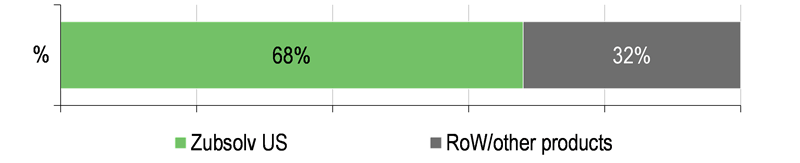
US Zubsolv revenues grew 16% to SEK481.8m (vs SEK416.7m). Ex-US, SEK65.9m in Zubsolv-associated milestones was received from Mundipharma. Abstral royalty receipts of SEK100.4m were up 30% on FY15, due to strong growth in Europe and the rest of the world, although total Abstral revenues were lower (FY16: SEK102.6m vs FY15: SEK203.1m) due to non-recurring revenues booked in FY15. These comprised the final SEK59.9m of the fixed royalty payment and SEK66m in milestones. Exhibit 8 summarises the FY16 revenue breakdown and our full-year FY17 product forecasts. Management expects continued year-on-year growth in Zubsolv net revenues due to both growth in the underlying market and also market share gains. No material income is expected from Mundipharma. Our new FY17e revenue forecasts are lower than in our last note due to a refined Zubsolv model, lower US Abstral royalties and generic competition for Edluar as described in the Valuation section above.
Exhibit 8: Actual and forecast revenue breakdown per product (SEKm)
Edison FY16e |
Actual FY16 |
Change on FY15* |
Old FY17e |
New FY17e |
Notes |
|
Zubsolv US |
504.7 |
481.8 |
+15.6% |
720.4 |
542.7 |
Increase on FY15 despite loss of the CVS Caremark agreement from 1 January 2016. Q416 total demand unchanged vs Q316. Maryland FFS Medicaid agreement has increased overall market share but depressed the gross-to-net. Main patent to 2032. |
Zubsolv ROW |
65.4 |
65.9 |
N/A |
- |
- |
€7m received in June 2016 from Mundipharma in exchange for exclusive ex-US global licence. SEK0.4m milestone earned in Q3. |
Abstral royalties |
103.3 |
100.4 |
+15.6% |
164.2 |
139.1 |
US generic entry (Actavis) from June 2018 (or earlier under certain undisclosed conditions), ahead of September 2019 patent expiry. Partnered with ProStrakan (Europe): 15% royalty on net sales >€42.5m; Sentynl (acquired US rights from Galena in Nov 2015): low double-digit royalty; Kyowa Hakko Kirin (Japan) single-digit royalty. |
Abstral milestones |
- |
2.2 |
-96.7% |
- |
- |
|
Edluar royalties |
13.9 |
14.8 |
8.8% |
14.2 |
11.7 |
Sold by Mylan (acquired Meda in August 2016) in the US, Canada and EU. Generic competition in North America expected in 2017. |
Total product revenue |
687.3 |
665.1 |
3.0% |
898.8 |
693.4 |
|
Other revenue |
40.8 |
40.8 |
N/A |
- |
- |
$5m AZ upfront for OX-CLI. |
Total revenue |
728.1 |
705.9 |
9.0% |
898.8 |
693.4 |
Source: Edison Investment Research, Orexo. Note: *Restated FY15 figures.
Increased manufacturing efficiencies resulted in a further improvement in COGS to SEK149.6m in FY16 (vs SEK150.2m in FY15), despite the SEK6.5m additional cost in Q416 associated with the re-packaging of Zubsolv tablets following FDA approval of a longer shelf life. This re-packing project, which lowers the risk of inventory write offs, did not complete by end-2016 as intended; an additional spend of c SEK5m is anticipated during H117.
Full-year operating costs were SEK534.5m (FY15: SEK611.3m). Field force optimisation from late 2015 onwards resulted in a 19% decrease in sales expenditure (FY16: SEK240.6m vs SEK297.5m in FY15), although Q416 costs were higher than guided due to US$ strengthening vs SEK. R&D spend of SEK132.2m was also lower than FY15 (down 23% from SEK172.6m) reflecting costs incurred in relation to RESOLV in FY15 vs the early stage of undisclosed internal pipeline projects and Mundipharma bearing the costs associated with the completion of the regulatory bio-equivalence study for EU submission under the Zubsolv ex-US global licence in FY16. Costs associated with the Actavis Zubsolv IP infringement suit drove the 14% increase in admin expenses to SEK161.5m (FY15: SEK141.5m); almost half of total admin spend was linked to IP litigation. Orexo has guided to lower operating expenses of SEK500-510m for FY17; we have revised our forecasts and now expect total Opex of SEK506.2m for FY17. This is comprised a modest increase in sales costs vs FY16 to SEK249.1m, a slight decrease in R&D spend to SEK131.2m, and lower admin costs of SEK125.9m reflecting an anticipated decrease in legal expenses.
Other income of SEK29m in FY16 included FX gains from balance sheet revaluation and also the final earn out in relation to the Kibion disposal in April 2015. For FY15, other expenses of SEK65m included the SEK62m write-down of OX-MPI.
FY16 operating profit was SEK51.7m (FY15: loss of SEK180.6 m), with a PBT of SEK35.6m vs SEK203.6m loss for FY15 and EBITDA of SEK76.7m (FY15: loss of SEK99.9m). Based on current FX rates, Orexo is guiding for positive EBITDA for FY17. However, H1 EBITDA is expected to be negative due to the weighting of Abstral royalties to H2 (in the EU, sales need to exceed €42.5m to trigger the 15% royalty). Coupled with working capital improvements (reduced receivables), the FY16 operating profit generated positive operating cash flow (including interest payment) of SEK156.2m (FY15: negative SEK109.2m). Q416 was the fifth consecutive quarter of positive operating cash flow. Overall cash flow was SEK71m (pre-FX), with Orexo repurchasing SEK99m of corporate bonds during Q416. As a result, net debt at end December 2016 stood at SEK115.4m, with SEK282.4m of cash and equivalents. A further SEK59m of bonds were repurchased in February; the remaining SEK342m corporate bond loan outstanding comes due on 9 May 2018.
We have updated our financial model with our revised Zubsolv and Abstral forecasts, new FY17 guidance and latest FX rates. Exhibit 10 provides a detailed summary, as well as full FY18e financial forecasts for the first time. Key forecast changes to FY17e are presented in Exhibit 9.
Exhibit 9: Changes to estimates
Revenue (SEKm) |
PBT (SEKm) |
EPS (SEK) |
|||||||
Old |
New |
Change |
Old |
New |
Change |
Old |
New |
Change |
|
2017e |
899 |
693 |
-23% |
154 |
42 |
-73% |
2.5 |
1.0 |
-60% |
Source: Edison Investment Research. Note: SEK/US$ rate updated to 8.82 from 8.84.
Exhibit 10: Financial summary
SEKm |
2014 |
2015 |
2016 |
2017e |
2018e |
||
Year end 31 December |
IFRS |
IFRS |
IFRS |
IFRS |
IFRS |
||
PROFIT & LOSS |
|||||||
Revenue |
|
|
570.3 |
646.2 |
705.9 |
693.4 |
738.1 |
Cost of Sales |
(107.4) |
(150.2) |
(149.6) |
(126.9) |
(143.3) |
||
Gross Profit |
462.9 |
496.0 |
556.3 |
566.5 |
594.9 |
||
R&D Expenses |
(197.8) |
(172.6) |
(132.3) |
(131.2) |
(137.8) |
||
Sales Expenses |
(193.6) |
(297.5) |
(240.6) |
(249.1) |
(257.8) |
||
General and Administrative Expenses |
(113.0) |
(141.5) |
(161.6) |
(125.9) |
(129.7) |
||
EBITDA |
|
|
(12.5) |
(99.9) |
76.7 |
78.1 |
90.2 |
Operating Profit (before GW and except.) |
|
(25.0) |
(180.6) |
51.7 |
60.3 |
69.6 |
|
Intangible Amortisation |
0.0 |
0.0 |
0.0 |
0.0 |
0.0 |
||
Other |
16.5 |
(65.0) |
29.9 |
0.0 |
0.0 |
||
Exceptionals |
0.0 |
0.0 |
0.0 |
0.0 |
0.0 |
||
Operating Profit |
(25.0) |
(180.6) |
51.7 |
60.3 |
69.6 |
||
Net Interest |
(27.6) |
(23.0) |
(16.1) |
(18.0) |
(2.5) |
||
Other |
0.0 |
0.0 |
0.0 |
0.0 |
0.0 |
||
Profit Before Tax (norm) |
|
|
(52.6) |
(203.6) |
35.6 |
42.3 |
67.1 |
Profit Before Tax (IFRS) |
|
|
(52.6) |
(203.6) |
35.6 |
42.3 |
67.1 |
Tax |
(4.0) |
(6.4) |
(6.5) |
(8.5) |
(13.4) |
||
Deferred tax |
0.0 |
0.0 |
0.0 |
0.0 |
0.0 |
||
Profit After Tax (norm) |
(56.6) |
(210.0) |
29.1 |
33.8 |
53.6 |
||
Profit After Tax (IFRS) |
(56.6) |
(210.0) |
29.1 |
33.8 |
53.6 |
||
Average Number of Shares Outstanding (m) |
34.3 |
34.6 |
34.5 |
34.5 |
34.5 |
||
EPS - normalised (ore) |
|
|
(165) |
(607) |
84 |
98 |
155 |
EPS - IFRS (SEK) |
|
|
(1.6) |
(6.1) |
0.8 |
1.0 |
1.6 |
Dividend per share (SEK) |
0.0 |
0.0 |
0.0 |
0.0 |
0.0 |
||
Gross Margin (%) |
81.2 |
76.8 |
78.8 |
81.7 |
80.6 |
||
EBITDA Margin (%) |
(2.2) |
(15.5) |
10.9 |
11.3 |
12.2 |
||
Operating Margin (before GW and except.) (%) |
(4.4) |
(27.9) |
7.3 |
8.7 |
9.4 |
||
BALANCE SHEET |
|||||||
Fixed Assets |
|
|
289.5 |
200.3 |
185.1 |
168.0 |
148.5 |
Intangible Assets |
259.2 |
155.5 |
138.2 |
120.3 |
99.7 |
||
Tangible Assets |
29.1 |
24.7 |
22.1 |
22.9 |
24.1 |
||
Other |
1.2 |
20.1 |
24.8 |
24.8 |
24.8 |
||
Current Assets |
|
|
936.4 |
819.7 |
833.7 |
834.5 |
580.7 |
Stocks |
478.1 |
402.6 |
344.2 |
260.8 |
255.1 |
||
Debtors |
173.8 |
219.0 |
207.1 |
190.0 |
202.2 |
||
Cash |
284.5 |
198.1 |
282.4 |
383.7 |
123.3 |
||
Other |
0.0 |
0.0 |
0.0 |
0.0 |
0.0 |
||
Current Liabilities |
|
|
(268.1) |
(251.6) |
(309.5) |
(653.6) |
(322.9) |
Creditors |
(265.6) |
(251.6) |
(309.5) |
(314.8) |
(322.9) |
||
Short term borrowings |
(2.5) |
0.0 |
0.0 |
(338.8) |
0.0 |
||
Long Term Liabilities |
|
|
(502.8) |
(498.3) |
(399.0) |
(1.3) |
(1.3) |
Long term borrowings |
(493.8) |
(494.4) |
(397.8) |
0.0 |
0.0 |
||
Other long term liabilities |
(9.0) |
(3.9) |
(1.3) |
(1.3) |
(1.3) |
||
Net Assets |
|
|
455.0 |
270.1 |
310.3 |
347.7 |
405.1 |
CASH FLOW |
|||||||
Operating Cash Flow |
|
|
(455.7) |
(84.1) |
184.5 |
182.3 |
87.4 |
Net Interest |
(31.6) |
(25.1) |
(28.3) |
(18.0) |
(2.5) |
||
Tax |
0.0 |
0.0 |
0.0 |
(3.2) |
(5.3) |
||
Capex |
(71.7) |
(4.1) |
(1.4) |
(0.8) |
(1.1) |
||
Acquisitions/disposals |
0.0 |
21.8 |
6.8 |
0.0 |
0.0 |
||
Financing |
341.7 |
3.8 |
2.1 |
0.0 |
0.0 |
||
Dividends |
0.0 |
0.0 |
0.0 |
0.0 |
0.0 |
||
Other |
0.0 |
0.0 |
0.0 |
0.0 |
0.0 |
||
Net Cash Flow |
(217.3) |
(87.7) |
163.7 |
160.4 |
78.4 |
||
Opening net debt/(cash) |
|
|
135.4 |
211.8 |
296.3 |
115.4 |
(44.9) |
HP finance leases initiated |
0.0 |
0.0 |
0.0 |
0.0 |
0.0 |
||
Exchange rate movements |
1.5 |
(2.5) |
(13.3) |
0.0 |
0.0 |
||
Other |
139.4 |
5.7 |
30.5 |
(0.1) |
0.0 |
||
Closing net debt/(cash) |
|
|
211.8 |
296.3 |
115.4 |
(44.9) |
(123.3) |
Source: Edison Investment Research, Orexo accounts. Note: FY15 figures restated at FY16 results
|
|||||||||||||||||||||||||||||||||||||||||||||
|
|