Last close As at 05/08/2026
GBP3.78
▲ 4.00 (1.07%)
Market capitalisation
GBP1,342m
Research: Investment Companies
Worldwide Healthcare Trust (WWH) is managed by Sven Borho and Trevor Polischuk at OrbiMed. They remain very constructive on the prospects for the global healthcare sector – despite headline risk ahead of the 2020 US presidential election – citing industry innovation, which they suggest is at ‘unparalleled’ levels, and has historically been an important driver of the sector’s performance. Although investor concerns about drug pricing in the US remain, Borho and Polischuk say that pharma and biotech companies are ‘still getting paid and are generating attractive returns’. In addition to opportunities in developed markets, they are also finding interesting investment ideas in China, due to higher product approval standards and a relaxation of listing requirements for fledgling companies.
Worldwide Healthcare Trust |
Managers remain optimistic on sector’s prospects |
Investment trusts |
7 January 2020 |
Share price/discount performance
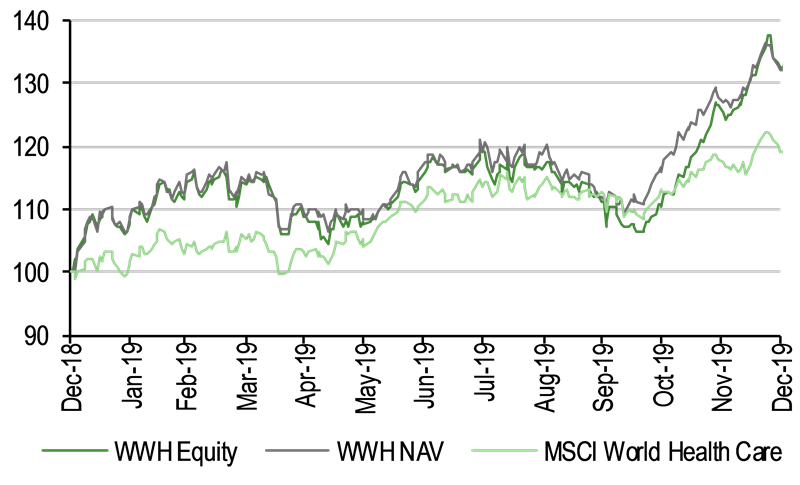
Three-year performance vs index
Gearing
Analysts
|
|||||||||||||||||||||||||||||||||||||||||||||||||||||||||||||||||||||||||||||||||||||||||
Worldwide Healthcare Trust (WWH) is managed by Sven Borho and Trevor Polischuk at OrbiMed. They remain very constructive on the prospects for the global healthcare sector – despite headline risk ahead of the 2020 US presidential election – citing industry innovation, which they suggest is at ‘unparalleled’ levels, and has historically been an important driver of the sector’s performance. Although investor concerns about drug pricing in the US remain, Borho and Polischuk say that pharma and biotech companies are ‘still getting paid and are generating attractive returns’. In addition to opportunities in developed markets, they are also finding interesting investment ideas in China, due to higher product approval standards and a relaxation of listing requirements for fledgling companies.
|
WWH’s NAV is well ahead of the benchmark over the long term |
|
|
Source: Refinitiv, Edison Investment Research |
The market opportunity
In aggregate, healthcare shares have generated above-average total returns over the long term. Industry fundamentals remain very favourable, helped by secular demand growth, high levels of innovation and a supportive regulatory environment. In addition, the sector’s valuation is undemanding, offering longer-term investors favourable prospects in terms of both growth and value.
Why consider investing in WWH?
■
The trust offers liquid exposure to the global healthcare sector.
■
Investment in multiple subsectors across the market cap spectrum.
■
Experienced managers, able to draw on the broad experience of OrbiMed’s well-resourced, specialist investment team.
■
NAV and share price total returns approaching 20% pa over the last 10 years, and long-term outperformance versus the benchmark.
Trading close to NAV
WWH’s shares regularly trade close to NAV (the board targets a maximum discount of 6%). The trust’s current 0.4% premium to cum-income NAV compares with an average premium of 0.1% over the last three years, and average discounts of 0.1%, 2.0% and 4.3% over the last one, five and 10 years respectively. While WWH is managed for capital growth, it also pays regular six-monthly dividends, and currently yields 0.9%.
Exhibit 1: Trust at a glance
Investment objective and fund background |
Recent developments |
||||||||||||||||||||||||||||||||||||||||||||||||||||||||||||||||||||||
Worldwide Healthcare Trust’s investment objective is to invest worldwide in pharmaceutical, biotechnology and related securities in the healthcare sector to achieve a high level of capital growth. Gearing and derivative transactions are used to mitigate risk and enhance capital returns. |
■ 20 November 2019: Six-month results to 30 September 2019. NAV TR -2.7% versus benchmark TR +6.0%, share price TR -2.7%. ■ 14 November 2019: Announcement of first interim dividend of 6.5p per share (unchanged year-on-year). ■ 16 August 2019: Announcement of the appointment of Dr Bandhana (Bina) Rawal as an independent non-executive director, with effect from 1 November 2019. |
||||||||||||||||||||||||||||||||||||||||||||||||||||||||||||||||||||||
Forthcoming |
Capital structure |
Fund details |
|||||||||||||||||||||||||||||||||||||||||||||||||||||||||||||||||||||
AGM |
July 2020 |
Ongoing charges |
0.9% |
Group |
Frostrow Capital LLP (AIFM) |
||||||||||||||||||||||||||||||||||||||||||||||||||||||||||||||||||
Final results |
June 2020 |
Net gearing |
6.4% |
Manager |
OrbiMed Advisors LLC |
||||||||||||||||||||||||||||||||||||||||||||||||||||||||||||||||||
Year end |
31 March |
Annual mgmt fee |
See page 8 |
Address |
25 Southampton Buildings, London, WC2A 1AL, UK |
||||||||||||||||||||||||||||||||||||||||||||||||||||||||||||||||||
Dividend paid |
January, July |
Performance fee |
See page 8 |
||||||||||||||||||||||||||||||||||||||||||||||||||||||||||||||||||||
Launch date |
April 1995 |
Trust life |
Indefinite |
Phone |
+44 (0)20 3008 4910 |
||||||||||||||||||||||||||||||||||||||||||||||||||||||||||||||||||
Continuation vote |
Five-yearly, next in 2024 |
Loan facilities |
Up to 20% of net assets |
Website |
|||||||||||||||||||||||||||||||||||||||||||||||||||||||||||||||||||
Dividend policy and history (financial years) |
Share buyback policy and history (financial years) |
||||||||||||||||||||||||||||||||||||||||||||||||||||||||||||||||||||||
In line with the requirement for investment trusts to pay out 85% of their income net of expenses, two interim dividends a year are paid in January and July. |
The trust has authority to purchase up to 14.99% and allot up to 10% of issued share capital. |
||||||||||||||||||||||||||||||||||||||||||||||||||||||||||||||||||||||
|
|
||||||||||||||||||||||||||||||||||||||||||||||||||||||||||||||||||||||
Shareholder base (as at 30 November 2019) |
Portfolio exposure by geography (as at 30 November 2019) |
||||||||||||||||||||||||||||||||||||||||||||||||||||||||||||||||||||||
|
|
||||||||||||||||||||||||||||||||||||||||||||||||||||||||||||||||||||||
Top 10 holdings (as at 30 November 2019) |
|||||||||||||||||||||||||||||||||||||||||||||||||||||||||||||||||||||||
|
|||||||||||||||||||||||||||||||||||||||||||||||||||||||||||||||||||||||
Source: Worldwide Healthcare Trust, Edison Investment Research, Morningstar. Note: *N/A where not in end-November 2018 top 10.
Market outlook: Positive industry fundamentals
As shown in Exhibit 2 (LHS), over the long term, despite periods of volatility, healthcare investors have enjoyed above-average total returns. While rhetoric ahead of the November 2020 US presidential election may cause some short-term pullbacks in the sector, industry fundamentals remain very favourable, which is supportive for the long-term performance of healthcare stocks. Secular demand remains robust, with a growing number of patients (helped by an ageing global population and rising incomes in developing countries); innovation in areas including gene therapy, immunotherapy and robotic surgery; a favourable regulatory environment (with a high number of drug approvals); and increased healthcare spending as a percentage of global GDP. Historically, mergers and acquisitions (M&A) have been an important driver of healthcare performance; it is encouraging to note the robust levels of deal activity last year, which could continue into 2020.
Exhibit 2 (RHS) shows the valuation of global pharma stocks, which are by far the most dominant subsector of the healthcare industry. The Datastream World Pharma index is trading on a forward P/E multiple of 16.0x, which is broadly in line with its five-year average. Pharma stocks are trading in line with the world market, which compares with a 6.1% average premium over the last five years. Taken together, the backdrop of favourable industry fundamentals, robust levels of M&A and undemanding valuations suggest that investors with a longer-term view may benefit from exposure to the healthcare sector.
|
Exhibit 2: Market performance and valuation |
|
MSCI World Health Care and MSCI World indices total returns (£) |
Absolute and relative forward P/E multiple for DS World Pharma index |
|
|
|
Source: Refinitiv, Edison Investment Research. Note: Valuation data as at 6 January 2020. |
|
Fund profile: Global healthcare exposure
WWH was launched in 1995 and is traded on the Main Market of the London Stock Exchange. It is managed by OrbiMed, one of the largest global specialist healthcare investors, with c $13bn of assets under management (c $5bn in public equities). The firm has six regional offices and a team of more than 80 investment professionals, of whom 25 hold PhD or MD qualifications and 15 are former CEOs or company founders. Managers Sven Borho and Trevor Polischuk aim to generate long-term capital growth from a diversified portfolio of global healthcare equities. Investment guidelines stipulate that a maximum 15% of the fund (at the time of acquisition) may be in a single holding; at least 50% must be in larger companies (market cap above $10bn); at least 20% should be in smaller companies (market cap below $10bn); a maximum 10% may be held in unquoted companies; up to 5% is permitted in each of debt instruments, convertible bonds and royalty bonds issued by pharma and biotech companies; and a maximum 30% may be held in each of the following subsectors – healthcare equipment & supplies, and healthcare providers & services.
WWH’s performance is benchmarked against the MSCI World Health Care Index (sterling adjusted). The use of derivatives is permitted to enhance returns and mitigate risk, and the managers can gear up to 20% of net assets; at end-November 2019, net gearing was 6.4%.
The fund managers: Sven Borho and Trevor Polischuk
The manager’s view: Very positive on the 2020 outlook
In what was a very strong year for the performance of US equities, during 2019, healthcare had the second lowest total return of the 11 Global Industry Classification Standard (GICS) sectors. Manager Polischuk explains that this was due to headwinds ahead of the 2020 presidential election, which led to share price volatility. While fundamentals in the healthcare sector remain very favourable, September 2019 proved to be a particularly tricky month for investors as there was a significant sell-off in the healthcare stocks that had performed well year to date; Polischuk says these share price moves were exacerbated by the actions of algorithmic traders and a turn in sentiment against biotech companies. November saw an improvement in the performance of healthcare stocks as left-wing Democratic candidate Bernie Sanders faded in contention, and while Elizabeth Warren’s standing in the polls increased, she backed away from supporting ‘Medicare for All’. Investors were also encouraged by M&A announcements, and positive industry newsflow that followed on from a very strong Q319 healthcare earnings season. The manager has been impressed by the quality of pharma and biotech companies’ earnings in 2019, particularly given the scrutiny around drug price increases; their revenues and margins have remained robust due to higher volumes.
Polischuk suggests that if Warren becomes the Democratic nominee, there is a greater chance of Donald Trump retaining the presidency, which would be positive for the US healthcare sector as the status quo would be maintained and he has moderated his focus on drug pricing; Trump’s talking points have shifted more towards reducing out-of-pocket expenses, especially for seniors. The manager says it is unlikely that there will be any laws passed on US drug pricing ahead of the election (a contributing factor is that the president is having to deal with the distraction of impeachment threats against him), but if a law change were to occur, he would expect it to be a benign outcome for the healthcare industry.
Considering the outlook for the healthcare sector in 2020, Polischuk remains very optimistic, despite it being a US presidential election year. He cites undemanding company valuations and ‘the best innovation cycle I have seen in my career, especially in therapeutic products and medical devices’. While the number of novel drug approvals by the US Food & Drug Administration (FDA) in 2019 was modestly lower than in the prior record year (48 versus 59 in 2018 and 46 in 2017), Polischuk is very encouraged by the total number over the last three years. He says this illustrates that the FDA is industry-friendly, having reduced the requirements for and speeded up the approval process of drug trials. It now engages with drug companies earlier in the development process, and the higher number of approvals has led to more positive outcomes for patients.
The manager remains encouraged by the level of M&A in the healthcare industry, which historically has been a positive driver of the sector’s performance. He notes that healthcare is one of the most fragmented industries, with even the major pharma companies having only modest market shares, so he believes consolidation in the sector will continue. He argues that the level of innovation and the complexity of healthcare is so vast that even the largest research and development (R&D) budgets ‘cannot do it all’, so M&A is required from an innovation perspective. Polischuk believes that many emerging biotech companies, which are well represented in WWH’s portfolio, look ripe for acquisition bids from larger players in the sector, and notes that the number of industry M&A transactions has increased in recent months. There was a flurry of activity in H118, but this faded in the second half of the year against a backdrop of a high number of initial public and secondary offerings, whereby immature companies had ready access to capital and therefore did not have to put themselves up for sale to fund their operations. However, there has been an uptick in M&A in 2019, particularly in the second half. The manager highlights a few recent notable bids: Synthorx (by Sanofi) for a c 170% premium; Audentes (by Astellas) for a c 110% premium; and ArQule (by Merck) for a c 100% premium.
Asset allocation
Investment process: Bottom-up stock selection
Managers Borho and Polischuk select stocks on a bottom-up basis, aiming to generate long-term capital growth, and are able to draw on the broad resources of healthcare specialist OrbiMed’s investment team. Company meetings are a key element of the investment process. WWH’s portfolio is diversified by geography, subsector and market cap; stocks are selected from an investible universe of around 1,000 companies, from early-stage preclinical businesses through to multinational biopharmaceutical firms. The managers seek companies with underappreciated product pipelines, robust balance sheets, strong management teams, and which are trading on reasonable valuations.
OrbiMed has employed a Public Equity Portfolio Review process since 2009; the team meets five times a week to discuss WWH’s portfolio structure and individual holdings. Topics include clinical events, which have historically been the largest source of biotech and pharma share price volatility; regulatory events; new drug launches; doctor surveys; key opinion leader consultations; and other field research.
In recent quarters, Borho and Polischuk have concentrated WWH’s portfolio; at end-November 2019, it had 69 holdings compared to 89 a year earlier, with a higher allocation to small and mid-cap companies with potential positive catalysts. These businesses have historically generated a large proportion of the trust’s outperformance.
Current portfolio positioning
At end-November 2019, WWH’s top 10 positions made up 39.9% of the portfolio, broadly in line with 40.5% a year earlier; four positions were common to both periods. The trust’s sector and geographic exposures are shown in Exhibit 3. The notable changes in the 12 months to end-November are a higher weighting in healthcare equipment/supplies (+5.1pp) and lower exposure to healthcare providers/services (-3.0pp), along with a lower weighting in North America (-10.5pp), broadly offset by higher exposures to developed Asia (+4.4pp) and emerging markets (+4.3pp) following Chinese stock market weakness.
Exhibit 3: Portfolio sector and geographic exposure (%)
Sector |
End-Nov 2019 |
End-Nov 2018 |
Diff. (pp) |
Region |
End-Nov 2019 |
End-Nov 2018 |
Diff. (pp) |
|
Pharmaceuticals |
31.6 |
30.6 |
1.0 |
North America |
64.9 |
75.4 |
(10.5) |
|
Biotechnology |
30.4 |
30.0 |
0.4 |
Emerging markets |
14.1 |
9.8 |
4.3 |
|
Healthcare equip/supplies |
19.5 |
14.4 |
5.1 |
Europe |
10.8 |
9.0 |
1.8 |
|
Healthcare providers/services |
12.6 |
15.6 |
(3.0) |
Developed Asia |
10.2 |
5.8 |
4.4 |
|
Life science tools & services |
5.0 |
4.9 |
0.1 |
|||||
Fixed & variable interest |
0.9 |
1.6 |
(0.7) |
|||||
Emerging markets baskets |
0.0 |
2.7 |
(2.7) |
|||||
Gene baskets |
0.0 |
0.3 |
(0.3) |
|||||
100.0 |
100.0 |
100.0 |
100.0 |
Source: Worldwide Healthcare Trust, Edison Investment Research
The OrbiMed team is finding attractive opportunities in China due to higher product approval standards and a relaxation of listing requirements for fledgling companies (the exchanges now allow companies that are not yet profitable to list, including biotech firms). Polischuk says that WWH has participated in several Asian initial public offerings (IPOs) including CanSino Biologics (vaccines); Frontage (commercial stage biotechnology); Hansoh Pharmaceutical Group (integrated pharma); and Jinxin Fertility Group (a chain of fertility clinics and services across China).
The managers remain generally cautious on large-cap pharma names, which make up a large percentage of the benchmark MSCI World Health Care index. Polischuk says there are ‘a lot of have and have nots’ in the subsector in terms of growth, and current and new product pipelines. He says that investors have been ‘hiding’ in European large-cap pharma names as a partial defence against a US election cycle, while Brexit uncertainty has proved to be a tailwind for UK-based AstraZeneca and GlaxoSmithKline, whose revenues are largely derived from overseas.
Takeda Pharmaceutical (Japan) is WWH’s largest holding by quite some margin (8.5% of the fund at end-November 2019). Polischuk says that it is ‘one of the most significantly mispriced large-cap stocks that I have known in my career’. Takeda’s share price was very weak following its takeover bid for UK-listed Shire, but the company has been delivering strong results and has raised earnings guidance. Its share price has rallied significantly in recent months, but the WWH manager believes the stock still has ‘enormous upside potential, driven by its own fundamentals and the acquisition of Shire’. Mirati Therapeutics is also one of WWH’s top 10 holdings. Polischuk says this emerging biotech company is a ‘classic example of a sweet-spot name’; he is very excited about the firm’s multiple product opportunities, which are predominantly in oncology, while the company could also become a takeover target. Another top 10 holding is US healthcare services provider Humana. The manager explains that it is a pure-play, market-leading Medicare Advantage insurer, which enjoys outsized exposure to the fastest-growing segment of US health insurance. The WWH team has successfully reduced and increased Humana’s position size in response to election headlines.
Performance: Good relative bounce in recent months
Exhibit 4: Five-year discrete performance data
12 months ending |
Share price |
NAV |
MSCI World |
DS World Pharma and Biotech (%) |
FTSE All-Share |
31/12/15 |
13.9 |
19.2 |
13.3 |
13.5 |
1.0 |
31/12/16 |
10.1 |
5.2 |
11.7 |
6.9 |
16.8 |
31/12/17 |
20.7 |
16.5 |
10.0 |
9.3 |
13.1 |
31/12/18 |
(5.0) |
(3.9) |
9.4 |
6.5 |
(9.5) |
31/12/19 |
32.3 |
31.9 |
19.1 |
15.8 |
19.2 |
Source: Refinitiv. Note: All % on a total return basis in pounds sterling.
In H120 (ended 30 September), WWH’s NAV and share price total returns were both -2.7%, which was somewhat disappointing compared with the +6.0% total return of the MSCI World Health Care index. The underperformance was primarily due to asset allocation rather than stock selection; the trust is overweight biotech stocks, which performed relatively poorly, unlike large-cap pharma stocks, where the fund is under-represented. In terms of stock-specific attribution, the best contributors to performance were Boston Scientific (US medtech – higher growth prospects), Deciphera Pharmaceuticals (US biotech – positive trial data), and Hansoh Pharmaceutical Group (China pharma – successful IPO). The largest detractors were Alexion Pharmaceuticals (US pharma – patent concerns around its largest product), Wright Medical (Netherlands-registered, US-based medtech – poor results and reduced earnings guidance, subsequently bid for by Stryker for a c 40% premium), and Puma Biotechnology (US biotech – disappointing sales). WWH’s exposure to emerging markets proved beneficial in H120, adding more than 250bp of absolute and relative returns (emerging markets has a zero weighting in the benchmark).
|
Exhibit 5: Investment trust performance to 31 December 2019 |
|
Price, NAV and benchmark total return performance, one-year rebased |
Price, NAV and benchmark total return performance (%) |
|
|
|
Source: Refinitiv, Edison Investment Research. Note: Three-, five- and 10-year performance figures annualised. Benchmark is DS World Pharma & Biotech index until 30 September 2010 and MSCI World Health Care index thereafter. |
|
WWH’s relative total returns are shown in Exhibit 6; helped by outperformance in recent months, its NAV and share price have outpaced the benchmark over all of the periods shown. Of interest to UK shareholders, the trust has significantly outperformed the FTSE All-Share index over one, three, five and 10 years.
Polischuk provides some colour on WWH’s strong absolute and relative performance in Q419: in terms of subsectors, the largest positive contributor was biotech, while the trust’s medical devices, Japanese and emerging markets exposure also added to performance. At the stock level, positive contributors included Mirati Therapeutics (positive trial data); eHealth and Takeda Pharmaceutical (strong quarterly results); and ArQule and Wright Medical (both received acquisition bids).
|
Exhibit 6: Share price and NAV total return performance, relative to indices (%) |
||||||||
|
One month |
Three months |
Six months |
One year |
Three years |
Five years |
10 years |
|
Price relative to MSCI World Health Care |
3.6 |
12.5 |
7.1 |
11.1 |
5.8 |
4.9 |
40.7 |
|
NAV relative to MSCI World Health Care |
2.2 |
11.2 |
5.4 |
10.7 |
3.0 |
2.0 |
29.6 |
|
Price relative to World-DS Pharm & Bio |
3.2 |
12.3 |
7.4 |
14.2 |
12.6 |
16.4 |
56.0 |
|
NAV relative to World -DS Pharm & Bio |
1.8 |
11.0 |
5.7 |
13.9 |
9.7 |
13.3 |
43.7 |
|
Price relative to FTSE All-Share |
1.3 |
14.3 |
9.7 |
11.0 |
24.3 |
32.3 |
164.9 |
|
NAV relative to FTSE All-Share |
(0.1) |
13.0 |
7.9 |
10.7 |
21.1 |
28.7 |
144.0 |
|
|
Source: Refinitiv, Edison Investment Research. Note: Data to end-December 2019. Geometric calculation. |
||||||||
|
Exhibit 7: NAV total return performance relative to benchmark over three years |
||||||||
|
||||||||
|
Source: Refinitiv, Edison Investment Research |
||||||||
Capital structure and fees
WWH is a conventional investment trust with one class of share; there are currently 53.3m ordinary shares in issue. The trust has an overdraft facility with JP Morgan Securities and gearing of up to 20% of NAV is permitted; at end-November 2019, net gearing was 6.4%. The level of debt is actively increased or reduced depending on the managers’ shorter-term outlook for healthcare shares. WWH pays OrbiMed a base management fee of 0.65% of NAV, and a 15% performance fee for outperformance versus the benchmark (on incremental outperformance since launch, if it has been maintained for a 12-month period). WWH’s alternative investment fund manager Frostrow Capital, is paid a tiered fee of 0.3% of the trust’s market cap up to £150m, 0.2% on £150m to £500m, 0.15% on £500m to £1bn, 0.125% on £1bn to £1.5bn, and 0.075% over £1.5bn, along with a £57,500 pa fixed fee. In H120, WWH’s ongoing charge was 0.9%, which was in line with FY19; there were no performance fees, unlike in FY19, where the ongoing charge including the performance fee element was 1.1%.
Dividend policy and record
WWH pays dividends twice a year, in January and July. So far, in respect of FY20, the board has declared an interim dividend of 6.5p per share, which is unchanged year-on-year. At end-H120, the trust had revenue reserves of £13.9m, which after allowing for the first interim dividend payment of c £3.5m, is equivalent to c 0.7x the total FY19 payment. Based on its current share price, WWH offers a 0.9% dividend yield.
Peer group comparison
WWH is one of six well-established funds in the AIC Biotechnology and Healthcare sector. In Exhibit 9, we include these along with two Switzerland-listed funds, BB Biotech and HBM Healthcare Investments, to enable a broader comparison. WWH’s NAV total returns are above average over one year (ranking second out of eight funds), three years (ranking fourth out of eight) and five years (ranking third out of seven), while lagging over the last decade (ranking third out of five). WWH is currently one of four funds trading at a premium to NAV. The trust’s ongoing charge is the lowest in the selected peer group, although a performance fee may be payable. WWH has an above-average level of gearing, ranking fourth, and its dividend yield is 1.4pp below the mean (the four peers with the highest yields pay dividends out of capital).
Exhibit 9: Selected peer group as at 6 January 2020*
% unless stated |
Market cap £m |
NAV TR |
NAV TR |
NAV TR |
NAV TR |
Discount (cum-fair) |
Ongoing charge |
Perf. |
Net |
Dividend yield (%) |
Worldwide Healthcare Trust |
1,656.2 |
32.6 |
46.0 |
83.1 |
438.7 |
0.5 |
0.9 |
Yes |
106 |
0.9 |
BB Biotech |
2,883.3 |
18.4 |
25.0 |
47.6 |
548.3 |
9.9 |
1.3 |
No |
103 |
4.6 |
BB Healthcare Trust |
627.1 |
28.7 |
51.3 |
|
|
(1.1) |
1.2 |
No |
101 |
3.1 |
Biotech Growth Trust |
385.1 |
42.7 |
34.5 |
44.2 |
562.2 |
(8.6) |
1.0 |
Yes |
104 |
0.0 |
HBM Healthcare Investments |
1,203.3 |
30.5 |
78.3 |
120.1 |
402.7 |
12.1 |
1.4 |
Yes |
100 |
3.4 |
International Biotechnology Trust |
236.0 |
17.4 |
20.2 |
46.7 |
382.0 |
(3.7) |
1.3 |
Yes |
107 |
4.3 |
Polar Capital Global Healthcare |
286.2 |
22.9 |
30.7 |
57.4 |
|
(8.4) |
1.1 |
Yes |
108 |
0.9 |
Syncona |
1,464.8 |
3.4 |
58.5 |
84.5 |
|
11.1 |
1.8 |
No |
100 |
1.0 |
Average (eight funds) |
1,092.7 |
24.6 |
43.1 |
69.1 |
466.8 |
1.5 |
1.3 |
104 |
2.3 |
|
WWH rank in peer group |
2 |
2 |
4 |
3 |
3 |
4 |
8 |
3 |
7 |
Source: Morningstar, Edison Investment Research. Note: *Performance data to 3 January 2020 based on ex-par NAV. TR = total return. Net gearing is total assets less cash and equivalents as a percentage of net assets (100 = ungeared).
The board
WWH’s board has seven directors, six of whom are independent of the manager. The chairman, Sir Martin Smith, joined the board in 2007 and assumed his current role in 2008. Dr David Holbrook was appointed in 2007, Doug McCutcheon in 2012, Sarah Bates in 2013, Humphrey van der Klugt in 2016 and Sven Borho in 2018. Borho is considered a non-independent director as he is a founder and managing partner of OrbiMed, and one of WWH’s lead managers.
The newest member of the board is Dr Bandhana (Bina) Rawal, who was appointed on 1 November 2019. Rawal is a physician with 25 years’ experience in life sciences research and development. Her previous roles include drug development and scientific evaluation at four global pharma companies and two medical research funding organisations (The Wellcome Trust and Cancer Research UK). Rawal is currently a non-executive director of the Innovation Agency (Northwest Coast Academic Health Science Network), supporting the adoption and spread of innovation within the NHS, and is a trustee of two educational charities (the Social Mobility Foundation and the Children’s University Trust) and a member of the Council of St George’s, University of London.
|
|
Research: Healthcare
Basilea Pharmaceutica is a revenue-generating biotech company that is on the cusp of breaking even (2021e) and sustainable profitability thereafter. It has successfully brought two anti-infective drugs to the market: Cresemba (severe mould infections) and Zevtera (bacterial infections). Combined revenue contributions (as reported by Basilea, both assets are commercialised through partners) are expected to exceed CHF105m in FY19. Longer-term value creation is also dependent on crystallising the mid/late-stage oncology portfolio. Basilea is investing for future growth; multiple datapoints on derazantinib are expected in 2020. If data from the registrational FIDES-01 are particularly positive, they could form the basis of an accelerated approval in iCCA. We value Basilea at CHF1.18bn.