Lifewatch
Written by
LifeWatch |
A leading remote cardiac monitoring player |
Initiation of coverage |
Healthcare equipment |
9 January 2017 |
Share price performance
Business description
Next events
Analysts
LifeWatch is a research client of Edison Investment Research Limited |
|||||||||||||||||||||||||||||||||||||||||||||||||
LifeWatch specialises in ECG-based remote cardiac monitoring services and is one of the leading companies in this space in the US, with around four million patients monitored to date. The company had a solid FY15, with 8.3% adjusted revenue growth and its strongest EBITDA in six years. However, 2016 was turbulent, mainly as a result of costly but one-off legal settlements. Having streamlined its cost base and left the legacy issues behind it, LifeWatch is now well placed to capitalise on healthy market growth, returning to profitability in FY17; we value it at CHF258m ($250m).
Year |
Revenue ($m) |
PBT* |
EPS* |
DPS |
P/E |
Yield |
12/14 |
98.5 |
0.3 |
(0.17) |
0.0 |
N/A |
N/A |
12/15 |
88.6 |
(11.7) |
(0.60) |
0.0 |
N/A |
N/A |
12/16e |
113.3 |
(5.0) |
(0.44) |
0.0 |
N/A |
N/A |
12/17e |
123.3 |
5.5 |
0.19 |
0.0 |
53.2 |
N/A |
Note: *PBT and EPS are normalised, excluding amortisation of acquired intangibles and exceptional items.
Remote cardiac monitoring specialist
LifeWatch offers ambulatory ECG (AECG) services that include the full range from traditional Holter monitoring to the most sophisticated, high-end, near real-time mobile cardiac telemetry (MCT) requiring live data centres. MCT is the most recent advance in cardiac telemetry and, according to multiple studies, it has higher diagnostic yield compared to traditional Holter or event monitoring.
Putting legacy issues behind it
LifeWatch has experienced a rather turbulent 2016 following several unfortunate events coinciding over a period of just a few months and weighing on the share price. These included costly outcomes from the settlements of two lawsuits revolving around the company’s billing practices several years ago under the supervision of previous management. This led to a significant equity raise of CHF43.7m net in July with 83% of the shares subscribed by existing shareholders.
Brighter 2017 with potential new revenue sources
LifeWatch’s H116 revenues of $57m were up 8.6% y-o-y, which compares to FY15 adjusted revenue growth of 8.3%. Due to one-off costs during H116 and some market tailwinds, LifeWatch expects a negative EBIT in 2016 vs $6.3m in 2015 (adjusted for legal settlement). Prospects for 2017 look brighter, with the legacy legal cases now settled, which eliminates uncertainty.
Valuation: CHF258m or CHF13.9/share
We value LifeWatch at CHF258m ($250m) or CHF13.9/share ($13.5/share), based on a DCF model with financial forecasts to 2025 and estimated net cash of $22.6m at end-2016 (with $13.0m expected to be paid in qui tam settlement). Additional potential revenue sources presenting upside to our valuation include the launch of the high-end MCT 1-lead patch and expansion into Turkey, which was somewhat delayed but the management expects full launch in 2017.
Investment summary
Company description: Cardiac monitoring services in the US
LifeWatch’s primary market is the US, where it is one of the leaders in mobile cardiac monitoring (MCT) services, second only to its closest peer BioTelemetry. LifeWatch has set up a joint venture in Turkey, which will be its first step outside the US with material sales expected already in 2017. LifeWatch has a range of ECG-based cardiac monitoring services; it can provide up to 30 days of near real-time ECG monitoring and allows physicians to understand the early symptoms and aetiology of arrhythmias and therefore determine the best therapeutic options. LifeWatch was founded in 1993 and some four million patients have been monitored with LifeWatch products since then. It is listed on the Swiss stock exchange, but reports its financial results in US dollars.
Valuation: CHF258m ($250m) or CHF13.9/share ($13.5/share)
We value LifeWatch at CHF258m ($250m) or CHF13.9/share ($13.5/share) based on a DCF model with financial forecasts to 2025 and residual EV calculated using a long-term 2.0% growth rate. We model long-term sales growth at around 9-10%. Potential other growth drivers that could provide an additional boost to sales and upside to our valuation include:
■
LifeWatch is carrying out a number of service improvement initiatives, which will upgrade the company’s offering.
■
Introduction of the MCT 1-lead patch, the latest addition to the MCT offering. While this may cannibalise some of the existing MCT services sales, it could potentially open a new market.
■
Full launch of services in Turkey in 2017 with the focus on the currently available range of MCT products (novel MCT-patch to follow later).
Financials: One-offs affect H116, but 2017 looks brighter
LifeWatch’s adjusted (for arbitration payment) FY15 revenues rose 8.3% to $106.6m, while the turnaround efforts led to lower R&D and S&M costs, which boosted the adjusted EBITDA margin from 11.2% in 2014 to 14.6% in 2015, the highest since 2009. LifeWatch’s H116 revenues of $57m were up 8.6% y-o-y. Due to substantial one-off costs ($9.6m in total, mainly legal settlements) LifeWatch expects negative EBIT in 2016 vs $6.3m in 2015 (adjusted for legal settlement). The company noted that sales growth in Q116 was 12.3%, while it slowed down to 5% in Q216, partially explained by the very strong Q116. Management expects single-digit total revenue growth in FY16 with a likely pick-up afterwards closer to the historical average (CAGR of 9.1% for 2012-16e).
Sensitivities: Servicing patients, invoicing payers
LifeWatch is a services company therefore the main sensitivities are concentrated around growing patient numbers, who are served with the company’s offering. While the US is a competitive market, LifeWatch enjoys a leading position. The company has been involved in several lawsuits for incorrect billing practices several years ago. Notably, LifeWatch was supervised under the previous management at that time. LifeWatch revenues come from third-party payers in the US, and therefore depend on their policies regarding MCT services. While more traditional cardiac monitoring services are covered widely, some of the payers still recognise MCT (high-end cardiac monitoring) as investigational and may not reimburse.
Outlook: Back to the rhythm in 2017
Against the background of ageing populations, increasing incidence/prevalence of acute/chronic diseases, rising healthcare costs and the need to select the appropriate treatment at the appropriate time, there is a compelling need for remote monitoring devices/systems and third-party service providers, which allow hospitals to outsource ambulatory cardiac monitoring. LifeWatch is operating in this area, offering a number of services and potential solutions to some of these issues.
A short history of ECG and types of ambulatory ECG methods
LifeWatch offers ambulatory ECG (AECG) services that include the full range from traditional Holter monitoring to the most sophisticated, high-end, near real-time mobile cardiac telemetry (MCT). The 12-lead ECG has been around for more than 100 years, aiding arrhythmia diagnosis. While it was a major advance in the diagnosis of cardiac diseases in the hospital setting, the main limitation was the increasing inefficacy when the frequency of arrhythmias decreases or they are asymptomatic. The first ambulatory cardiovascular monitor was developed by American biophysicist Norman Jefferis Holter in the 1940s; it could record a single ECG lead for several hours.1 Later generations included three to five electrode 24-48h Holter monitors followed by patient-activated loop event monitors in the 1980s and auto-detect event monitors as the sophistication of the algorithm recognition of ECG patterns improved.
P. Zimetbaum and A. Goldman. Ambulatory Arrhythmia Monitoring: choosing the Right Device. Circulation. 2010;122:1629-1636.
In the late 1990s, next-generation MCT monitors were developed to address the limitations of earlier devices, namely the need for longer monitoring of patients outside the hospital and the ability to detect symptomatic and asymptomatic events. These devices can monitor for six hours to 30 days and transmit near-real-time data regularly, thereby overcoming storage memory constraints. The MCT device continuously monitors a patient’s ECG and if an event is auto-detected or activated by the patient, the data is then transferred through cellular communication to data centres. This provides feedback to the cardiologist, while the patient is still being monitored. According to multiple studies MCT has higher diagnostic yield compared to traditional Holter or event monitoring (Exhibit 2).
LifeWatch’s offering does not include implantable AECGs, although this is a somewhat different area and includes the patient being hospitalised for the procedure. Implantable AECGs can be kept for up to three years. Similar to event monitors, they record ECG data, when triggered by a patient or on a continuous loop basis with an auto-detect function.
|
Exhibit 1: LifeWatch’s mobile cardiac technology (ACT device) |
|
|
Source: BruceBlaus, LifeWatch |
The many forms of arrhythmia and its burden
Cardiac arrhythmia describes changes in the normal sequence of the heart’s electrical impulses. This occurs when the heart’s natural pacemaker (sinus node) develops an abnormal rate or rhythm, the normal electrical impulse conduction pathways are interrupted or another part of the heart takes over as pacemaker (see the American Heart Association’s page About Arrhythmia). This results in the heart beating too fast (tachycardia, >100 beats/minute), too slow (bradycardia, <60 beats/minute) or erratically (atrial fibrillation or ventricular fibrillation – ‘tachy’, ‘brady’ or ‘normo’ forms). In general, there is a wide variety of cardiac rhythm disturbances that can be identified more precisely from a standard 12-lead ECG at a hospital. Their main issue is that arrhythmias can be episodic or even asymptomatic, which makes the diagnosis especially complicated, as it would be practically impossible to keep patients in the hospital for extended periods of time, hooked to an ECG device all the time. This was the unmet need behind the invention of the original Holter monitor and continues to drive innovation and growth in ambulatory ECG, which otherwise would be a mature hospital-based ECG testing industry.
From the perspective of the clinical practice of managing cardiac patients, AECG became popular to determine the cause of paroxysmal (episodic) palpitations, syncope (loss of consciousness) and other less common conditions that can cause sudden cardiac death. Atrial fibrillation (AF) in its various forms and with different treatment strategies is now among the most common indications where AECG is prescribed. According to the American Heart Association, there could be around 6m AF cases (which is the most common arrhythmia) in the US, with asymptomatic or undiagnosed patients representing one third of that. More than 750k hospitalisations occur each year in the US, with the condition contributing to c 130k deaths a year and costing an estimated $6bn a year (CDC data).
How to choose the right device
Besides the fact that AECG devices can capture episodes of arrhythmia, they can also provide additional insights, including what triggered the episode (physical activity, food intake, stress), through to how often the episodes occur, whether there is a pattern, how long the episode lasts on average and what physical symptoms occur. Exhibit 2 provides a comparison of AECG device types.
Exhibit 2: Comparison of ambulatory ECG device types
Device |
Frequency of symptoms |
Typical device characteristics |
Usual period of test |
Diagnostic yield* |
Holter monitor |
Daily (mainly palpitations) |
External device worn constantly, with continuous recording, which is retrieved and interpreted once the device is returned. Only suitable for patients with symptoms occurring within the monitoring period, or when establishing risk/response to therapy. |
24/48 hours Can be long-term up to two weeks |
Arrhythmia 12-35% Syncope 6-22% |
Cardiac event monitor (CEM) |
Weekly to monthly |
One type of these devices provides continuous monitoring, stores data when activated by patient during an event (not suitable when investigating syncope or asymptomatic arrhythmias). Other types of these devices have memory loop recording capability and auto-detect function with no need for patient’s input. |
Up to a month |
Arrhythmia 23-66% Syncope 24-47% |
Mobile cardiac telemetry (MCT) |
Weekly to monthly |
External device worn constantly that provides continuous monitoring and near real-time event data transmission (eg via GSM) to data centres. The ability for medical professionals to receive reports during the monitoring period is a key differentiating point and reflects the high end of AECG. |
Up to a month |
Arrhythmia 50-88% Syncope 41-61% |
Implantable cardiac monitor (ICM) |
Less than monthly |
Device is subcutaneously implanted, with a loop memory recording that stores data once it is manually activated by the patient or auto-detects the event. Provides the highest diagnostic yield, but also most invasive. |
Up to three years |
Arrhythmia 73-88% Syncope 43-78% |
Source: Subbiah et al, Hoefman et al, Mittal et al, Zimetbaum and Goldman. Note: *Diagnostic yield is the percentage of tests when the cause of arrhythmia was identified.
Holter monitoring
Holter monitoring is still the most often used method overall with low pricing despite its efficacy limitation versus the newer generation devices. The device is attached to the patient’s chest, and the data is continuously recorded for 24-48 hours and analysed once the device is returned. In order to increase the correlation between the symptoms and changes in the heart rhythm, the patient is asked to keep a diary and record their symptoms. Holter monitors are the preferred option for short-term monitoring, as they continuously record the ECG and the patient’s input is not critical for diagnostic purposes. The major drawback of this method is the short duration of monitoring, which may not be sufficient if the arrhythmia episodes are less frequent. This results in a low diagnostic yield (the percentage of tests when the cause of arrhythmia was identified), with 35% in arrhythmias in general and even lower in syncope patients. While the newer Holter monitor versions can continuously record and store data for up to two weeks, this results in large amounts of retrieved data that need to be analysed. In addition, Holter monitoring does not provide real-time data analysis. This type of monitoring also has among the lowest diagnostic yields for arrhythmia (12-35%, Exhibit 2).
Event monitoring
Cardiac event monitoring (CEM) is a diverse category of devices with the common feature being the goal to extend monitoring time (usually two to four weeks) by recoding only episodes of arrhythmia. Patients wear a continuously looping device that monitors the ECG. Some devices need to be activated by the patient, while others can auto-detect events, in which case the device records and stores the data for a defined period of time. Some of these devices have the functionality to transfer the data to a processing centre, providing a near real-time functionality. A certain degree of technological sophistication is required, which not all patients possess. Studies reported higher diagnostic yields (23-66%) with CEM compared to Holter, but still lower than MCT.
Mobile cardiac telemetry
Mobile cardiac telemetry (MCT) is the newest form of AECG, enabling near real-time, attended cardiac monitoring that aims to overcome the limitations of Holter and CEM. A key feature is the ability to automatically detect arrhythmia (the patient can also manually activate) and send this information to the data centre via the GSM network. The sensor, which is attached to the patient, continuously tracks the cardiac rhythm (Exhibit 1) and sends the ECG data to a portable monitor that has a built-in mobile phone. The monitor, which has to be near to the patient, is equipped with the software that continuously analyses the data and if arrhythmia is detected, it automatically send the findings to the data centre. Technicians at the data centre prepare reports for cardiologists who request this service. Studies have reported that MCT delivers a higher diagnostic yield (73-88%) compared to traditional Holter or CEM.
Implantable loop recorders
In cases where the patient needs to be monitored over prolonged periods (up to three years), implantable loop recorders can be used. The device can be triggered automatically or by the patient by placing an activator over the device. The device can be scanned to retrieve the data. Due to the need for surgery (minimally invasive), the cost of this monitoring is higher than other methods, and therefore is reserved for patients with infrequent symptoms, such as rare unexplained syncope.
Which device when
Owing to the diverse nature of arrhythmias, the selection of the most appropriate method for each individual case is also highly dependent on specific circumstances. In general, Holter monitoring is most commonly used as the first line of ambulatory ECG when investigating a patient with frequent symptoms or with other arrhythmia-related conditions where relatively short durations of monitoring are sufficient. If symptoms are less frequent, then devices such as CEM or MCT can be used. Implantable devices are considered when the symptoms occur less than monthly. In practice, however, this may not be straightforward and the method of AECG is often selected based on a trade-off between expected benefit (diagnostic yield) and cost/patient inconvenience (the latter could lead to reduced compliance). For example patients with unexplained palpitations, syncope or AF represent a significant portion of the population who can benefit from AECG. In AF a monitoring period of up to 30 days is usually sufficient, therefore Holter, CEM or MCT are suitable. Unexplained syncope on the other hand can present occasionally or very infrequently, therefore MCT or implantable loop recorders are more appropriate options.
Business model
LifeWatch’s MCT offering is both the highest priced and highest margin test in its portfolio. However, LifeWatch does offer a full range of service including basic Holter monitoring and CEM. This is beneficial as the company is able to provide a ‘one-stop shop’ AECG solution. On the low end of the range, some hospitals choose to purchase Holter or CEM monitors (the leading players are GE Healthcare and Philips) and manage the monitoring in-house. However, LifeWatch also benefits from the trend of hospitals increasingly outsourcing cardiac monitoring. Sophistication of the technology and costs to maintain it (live data centres) means that MCT testing is mainly performed by third parties, such as LifeWatch. LifeWatch does not offer implantable loop recorders; this is a more niche market within ambulatory ECG monitoring and dominated by large players (Medtronic with its Reveal LINNQ, St Jude and Biotronik).
MCT work flow
The business process is shown in Exhibit 3, describing LifeWatch’s MCT service. When a physician prescribes a system with a monitoring service, the patient is enrolled by LifeWatch and receives a device package. A LifeWatch technician calls the patient to help set up the system and takes a baseline recording. Monitoring then takes place 24/7 for the agreed duration (up to 30 days) during which ECG and other data are transmitted to one of LifeWatch’s three monitoring centres. The ordering physician receives daily, episode-dependent, urgent or end-of session reports, which are used for making a treatment decision. Clinical reports include 24-hour heart rate trend, daily arrhythmia burden, number and duration of episodes and ECG recordings. The physician can access the reports anytime via a secure web portal called LifeWatch Connect. At the end of the session the patient sends the device back to LifeWatch for reprocessing and LifeWatch invoices the patient or their insurance company.
|
Exhibit 3: Workflow with LifeWatch’s MCT device |
|
|
Source: LifeWatch |
LifeWatch’s offering
Exhibit 4 lists LifeWatch’s core offering. The MCT devices (ACT III, ACT Ex and ACT Elite) can also be used as auto-detect/auto-send 24-48 hour Holter monitors for patients whose insurance does not cover telemetry services, or extended to 30-day use as MCT service. The latest addition to the cardiac portfolio is the MCT 1-lead patch, which gained CE marking and FDA 510k clearance in January 2016 and launched in Q316. The disposable patch (with a reusable chip) is a discrete, lightweight and completely wireless device designed for use when three-lead technology is not required and is aimed at increasing patient compliance. Multiple ECG leads give a more comprehensive view of the electrical activity of the heart, but more electrodes need to be placed on the chest, eg 10 electrodes to record 12-lead ECG. In three-lead ECG, four electrodes are used: three in a triangle around the heart and one below.
The reports generated by LifeWatch are a key differentiator of its MCT service. Physicians receive episodic, urgent, daily and end of session reports with clinically significant data, such as charts of the time a patient experiences AF (AF burden), patient symptoms and activities at the time of an event, correlated to arrhythmia and heart rate. The data assist the physician in determining the best treatment options for the patient. In 2016 LifeWatch has been working to update the web portal, improve algorithms, reduce delivery times for clinical reports and make the reporting system more customisable by the physician.
Exhibit 4: LifeWatch’s product portfolio of cardiac monitoring devices
Device |
Main usage |
Launch |
Auto-detect |
Auto-send |
Recording time |
Data transmission |
Number of leads |
Other features |
Monitor only |
||||||||
DigiTrak XT Holter |
48h continuous |
1960+ |
No |
No |
48 hour |
Via ‘flash memory’ (manual) |
3-lead ECG |
Lightweight, compact. Continuous recording plus patient event button |
Explorer |
Event monitoring |
1999 |
No |
No |
5-8 min |
Landline (manual) |
1-lead ECG |
Manual trigger, looping memory |
LifeStar AF Express |
Event monitoring |
2001 |
Yes |
No |
10 min |
Landline (manual) |
1-lead ECG |
Programmable triggers; records 45s pre- and 15s post-trigger |
MCT |
||||||||
ACT III |
Continuous monitoring |
2008 |
Yes |
Yes |
30 days |
Via GSM (auto) |
3-lead ECG |
Remotely reprogrammable triggers according to needs |
ACT Ex |
Continuous monitoring |
2009 |
Yes |
Yes |
30 days |
Via GSM (auto) |
3-lead ECG |
24-48hr Holter optionality or MCT to 30 days. Remotely programmable triggers. Autodetects abnormalities |
ACT Elite |
Continuous monitoring |
2012 |
Yes |
Yes |
30 days |
Via GSM (auto) |
3-lead ECG |
Autodetects asymptomatic arrhythmia, manual button for symptomatic events |
MCT 1-lead patch (new gen) |
Continuous monitoring |
3Q 2016 |
Yes |
Yes |
30 days |
Via GSM (auto) |
1-lead ECG |
Completely wireless, disposable patch (removable reusable ‘chip’); FDA 510k clearance January 2016 |
Source: LifeWatch, Edison Investment Research. Note: MCT/ACT = Mobile/ambulatory cardiac telemetry.
Product portfolio development
While the ambulatory cardiac monitoring represents the core services, LifeWatch constantly evaluates opportunities to expand its portfolio. New ventures are inherently risky and some new initiatives have been discontinued due to lack of traction. However, LifeWatch has reiterated its intention to seek innovative technologies, adding that the focus will be on partnering, therefore keeping R&D costs down. Some recent R&D portfolio developments include:
■
In January 2016 LifeWatch signed an agreement with AliveCor to use its FDA-approved Mobile ECG technology. The AliveCor device attaches to a mobile phone, records an ECG in 30 seconds, is easy to use (readings from finger or chest) and has been demonstrated as being able to detect AF. LifeWatch is yet to provide an update on the status of this project.
■
In November 2015, LifeWatch acquired FlexLife Health ($1.5m in cash and $0.32m earn-out), a company offering INR (international normalised ratio) monitoring services via a proprietary web-based platform. Monitoring of INR is essential for patients taking oral anticoagulants (such as Coumadin [warfarin]), which are commonly taken by AF patients. Currently, a patient prescribed with anticoagulants has to visit a GP office on a regular basis in order to check INR levels. The ability to check it at home via a finger prick provides convenience for both the physician and the patient. This represents LifeWatch’s first move into comorbidities and beyond cardiac monitoring.
■
In October 2016, LifeWatch signed a letter of intent (LOI) with GE Healthcare. While not many details were revealed, the two parties will explore opportunities for synergies between their product portfolios. GE Healthcare has a broad range of patient monitoring products, mostly in the hospital setting, but also sells a traditional Holter monitor, SEER 1000.
■
The internally developed Vital Signs Patch was discontinued in 2016. The patch, cleared by the FDA in January 2016, is a wireless sensor worn on the chest to monitor ECG, heart rate, respiration rate, surface temperature, arterial blood oxygen saturation and body position. The product was intended for hospital use, which was a new market for LifeWatch, and an equivalent product did not exist, which led to sales not materialising and a subsequent discontinuation of the patch.
Expansion to Turkey
Besides developing its product portfolio, LifeWatch is also looking to expand into new geographical markets. So far, the company has been focused on the US, with virtually all sales coming from this territory. In July 2015, LifeWatch announced a joint venture (55% owned by LifeWatch) with a group of Turkey-based entrepreneurs to develop a cardiac monitoring business in Turkey. The Turkish entrepreneurs will provide access to infrastructure and the staff necessary for the set-up and running of a call centre, while LifeWatch will supply its know-how and technology. Although at this stage the visibility of the market potential is low, in our view, a significant opportunity could exist given the large population of c 79 million people and the fact that mobile cardiac telemetry as a service is non-existent, with the current ambulatory ECG need mainly met using the traditional Holter or CEM methods. Much will depend on achieved reimbursement levels, in our view. Turkey’s healthcare system is dominated by public spending with close to 80% (c $30bn) covered by the Social Security Institution. According to the latest update, management expects to carry out a full launch in 2017.
Regulatory and reimbursement
In early 2016 LifeWatch announced its intention to become a pure-play service provider. Software development will remain in-house but hardware development and manufacturing will be discontinued and outsourced or in-licensed instead. LifeWatch is regulated as an Independent Diagnostic Testing Facility (IDTFs). The company principally receives payments from third-party payers, such as Medicare, and various medical insurance providers rather than individual customers. In 2015, LifeWatch received 38% of revenues from Medicare and around 61% from insurers (Exhibit 5). In 2015, LifeWatch signed 81 new or amended agreements and now has over 600 managed care contracts with provider networks covered more than 300m lives (federal program c 100m).
|
Exhibit 5: Payer breakdown in 2015 |
|
|
Source: LifeWatch |
MCT devices were first recognised under separate billing codes for commercial insurance and Medicare reimbursement in the US in 2009, though declining Medicare reimbursement rates in 2009-14 hampered market expansion. However, in 2015 Medicare reversed the rate cut for MCT services with a rise of approximately 8% in reimbursement rates from January 2016. The technical cardiac monitoring services provided by LifeWatch are reimbursed under one of three procedure codes, with monitored MCT being by far the most valuable (Centers for Medicare & Medicaid [CMS]):
■
CPT 93226: Holter monitors (up to 48 hours, up to twice every six months). Covers scanning analysis with report.
■
CPT 93271: Loop event monitors (up to 30 days, no defined frequency limit). Covers transmission download and analysis.
■
CPT 93229: Mobile cardiovascular telemetry (>24 hours and up to 30 days, once every six months). Cardiac event monitoring must be 24 hours a day, seven days a week attended surveillance, analysis and physician prescribed transmission of daily and emergent data reports.
Competitive landscape
Due to the fragmented nature of the market and variations in product features, exact market size calculations are limited. Overall, the AECG market is dominated by a few leading companies followed by a number of smaller players. LifeWatch’s competitive advantages include technology know-how, existing wide reimbursement coverage and live data centres, which all represent relatively high barriers of entry to the market. According to several sources, including LifeWatch’s own estimates, the leading player specifically in MCT is BioTelemetry, listed on NASDAQ, with LifeWatch following closely. CardiacMonitoring.com, an online information source specialising in AECG, estimates that BioTelemetry had around 41% share of the MCT market, while LifeWatch had 31%. BioTelemetry’s 2015 revenues from its Healthcare segment (AECG services) were $146m, while LifeWatch has booked $107m (unadjusted). As mentioned, the Holter monitoring market is very fragmented with several multinationals selling the device directly to hospitals. LifeWatch, however, has a differentiated position, offering Holter monitoring as a service, which may be a benefit given the outsourcing trend.
More recently, considerable interest and effort has been put into patch-based devices aimed at improving convenience for the patient and therefore achieving better compliance. LifeWatch is rolling out its MCT 1-lead patch, while other recent introductions include Medtronic’s SEEQ device, BioTelemetry’s CardioNet MCOT and Preventice BodyGuardian Heart. While the newer patch-based devices rely on MCT technology, iRhythm, a US-based AECG specialist, is selling a somewhat differentiated patch, Zio XT. Similar to Holter monitoring, the device can record up to 14 days of continuous data, which is retrieved after completion of the monitoring, ie not live transmission like in MCT. Cardiologists would hardly be able to handle such large amounts of data, therefore iRhythm has developed proprietary algorithms, which provide summary reports. BioTelemetry also is developing a similar ePatch, but we do not see these types of patches as direct competitors to MCT technology.
Sensitivities
LifeWatch is a services company, therefore the main sensitivities are concentrated around growing patient numbers, who are served with the company’s offering. LifeWatch enjoys a leading position in the US, although it is a competitive market. The company has been involved in several lawsuits for incorrect billing practices several years ago. Notably, LifeWatch was supervised under the previous management at that time. While the settlements were costly (around $26m) LifeWatch believes that the bulk of these issues have now been resolved, settlement in the qui tam case is awaiting final approval from the US government. LifeWatch revenues come from third-party payers, and therefore depend on their policy regarding MCT services. While more traditional AECG services are covered widely, some of the payers still recognised MCT as investigational and may not reimburse. LifeWatch’s expansion into Turkey may provide a significant uplift to future sales; however, at this point in time there is little visibility as to the potential of the venture.
Financials
Turbulent 2016
LifeWatch has experienced a rather turbulent 2016 following several unfortunate events coinciding over a period of just a few months and weighing on the financial results and the share price. These include costly outcomes from the settlement of two lawsuits and several one-off costs pressuring margins.
In the first legal case, LifeWatch’s billing practices in 2009-10 under the supervision of previous management were questioned. Private health insurer Highmark Blue Cross Blue Shield was awarded $18m plus interest (around $22m in total) in arbitration with LifeWatch to settle the dispute; the award was later reduced to $13m after LifeWatch agreed to release the private health insurer from the antitrust case the company had pending. In a second instance a qui tam action (a type of lawsuit when whistle-blowers are rewarded if their qui tam case recovers funds for the government) was filed against LifeWatch in 2013, also under the supervision of previous management. The case contained allegations related to billing processes for clinical services provided offshore. Although LifeWatch denied any wrongdoing, ultimately it agreed to settle with the counterparty, paying $12.8m; this is now awaiting approval from the US Department of Justice. Although this affects near-term cash flows, we view it as one-off, legacy issue that should not affect LifeWatch’s performance in the longer term. The total cost of the legal settlements amounted to around $26m, which led to a significant issue of c 5m new shares (37% of outstanding shares at the time) raising CHF43.7m net in July 2016. 83% of the new shares were subscribed by the existing shareholders, which demonstrates strong support for the current management, in our view.
2015 financial performance
Under US GAAP rules, LifeWatch had to restate its 2015 annual results, which resulted in $18m being deducted from revenues (Highmark reward). The interest due to Highmark Blue Cross Blue Shield has been recognised as a financial expense. Adjusting the results for this, 2015 revenues were the second highest in the company’s history, rising 8.3% to $106.6m. Over 2014-15 LifeWatch aimed to streamlined the cost base, which led to a significantly improved adjusted EBITDA of $15.6m, boosting the adjusted EBITDA margin from 11.2% in 2014 to 14.6% in 2015, the highest since 2009.
H116 financial performance
LifeWatch’s H116 revenues of $57m were up 8.6% y-o-y. Due to one-off costs, LifeWatch expects a negative EBIT in 2016 vs $6.3m in 2015 (adjusted for legal settlement). LifeWatch noted that sales growth in Q116 was 12.3%, while it slowed down to 5% in Q216, partially explained by a very strong Q116. The management expects single-digit total revenue growth in FY16 with a likely pick up afterwards closer to historical average. LifeWatch booked a total of $9.6m in one-offs in H116 (Exhibit 6) with the most significant being:
■
the write-down of Vital Signs Patch assets (-$3.6),
■
the provision of the funds to pay the qui tam settlement (-$13.0m), and
■
the reduction in Highmark settlement (+$9.0m).
Exhibit 6: EBITDA adjustment for one-off items in H116 ($m)
Reported EBITDA |
(2.957) |
Adjustments and one-off items: |
|
Vital Signs Patch development/inventory write off |
(3.612) |
Qui tam settlement |
(12.975) |
Reduction in Highmark settlement |
8.973 |
Pharmalife recovery net of employee settlement |
0.248 |
Professional fees related to legal settlements |
(0.964) |
Automation of bad debt provision calculation |
(1.247) |
Total adjustments |
(9.577) |
Adjusted EBITDA |
6.620 |
Adjusted EBITDA margin |
11.6% |
Source: Edison Investment Research, LifeWatch
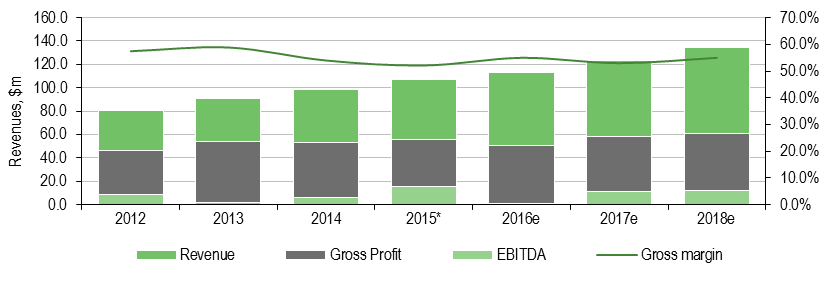
H116 gross margin was 49.1% vs 52.8% a year ago, while adjusted for one-offs the gross margin would have been 55.5% and in line with the 2012-15 average. Reported EBITDA was a loss of $3.0m, while adjusted EBITDA was $6.6m. H116 total operating costs were $35.6m, but if adjusted for one-offs this would have been $26.6m compared to $23.9m in H115. Notably, with effect from January 2016 Medicare reversed the 8% price cut for telemetry services, which was implemented in 2014. This should add around $4m in 2016, all else being equal.
|
Exhibit 7: LifeWatch revenues and profitability |
|
|
Source: LifeWatch accounts, Edison Investment Research. Note: *Adjusted for the Highmark award and the write-off the obsolete LifeWatch V inventory amounting to $1.2m. Historically around 98-99% of revenues came from cardiac monitoring revenues, while the rest was from device sales. |
Financial forecasts
We estimate FY16 sales of $113.3m, up 6.3% y-o-y, with the growth picking up to around 9% in 2017 and 2018 (vs a calculated sales CAGR of 9.1% for 2012-16e). We forecast total unadjusted FY16, FY17 and FY18 operating costs at $55.6m (versus $49.3m in 2015), $52.0m and $54.3m respectively. We calculate FY16 EBITDA of $0.2m ($9.8m if adjusted), rising to $11.5m and $12.4m in FY17 and FY18, respectively. Our estimated cash position by end-2016 is $34.7m; however, this should be reduced by the $13m for the qui tam settlement once the anticipated approval by the government is received. As of end-June 2016, LifeWatch had total debt of $11.5m, of which short-term debt was $10.1m.
We base our long-term sales forecasts on how many patients are serviced with LifeWatch tests for each of the product classes (Holter, CEM and MCT), corresponding to each reimbursement code. LifeWatch publishes achieved average selling price (ASP) for each service. Exhibits 8 and 9 show recent trends. Holter and CEM ASPs were relatively flat over the past several years with the ASP for MCT somewhat fluctuating. In 2017 Medicare cut the MCT reimbursement rate by 2.8%, CEM by 2.6% and Holter by 2.6% and management expects that pricing pressure in the public sector might play a role going forward. However, we keep the future overall ASP flat for the time being due to Medicare being just one of the payers in the mix (albeit the largest one), the prevailing macro trend of outsourcing cardiac monitoring services, LifeWatch’s leading position in the market and its established product portfolio. Holter and MCT patient numbers increased with a CAGR of 12% and 9% pa over 2011-16 respectively, while CEM was flat. We retain similar growth rates in our model and, based on our calculations as described above, we model long-term total sales growth to remain at around 9-10% (2012-16e revenue CAGR of 9.1%). Our long-term gross margin remains stable at 55% in line with the historical average, while our EBITDA margin increases gradually to c 23% by 2025. Other macro trends supportive to LifeWatch’s investment case include:
■
Demographics: Ageing population; rise in prevalence of cardiovascular disorders; rise in private institutional nursing and home care.
■
Healthcare spend control: Pressure from reimbursement and US healthcare reforms favour a shift towards outpatient (ambulatory) care; CMS is moving towards value-based payment structures from the current fee-for-service payment model; the Affordable Care Act 2010 (ACA) encourages outcomes-based approaches and a reduction in hospital re-admission.
■
Digital health revolution: Growing use of remote patient monitoring and real-time data; improved connectivity; trend towards wireless devices; advantages over standard monitoring devices; patient empowerment.
|
Exhibit 8: Average selling price |
Exhibit 9: Patient numbers per test type |
|
|
|
Source: LifeWatch |
Source: LifeWatch |
|
Exhibit 8: Average selling price |
|
|
Source: LifeWatch |
|
Exhibit 9: Patient numbers per test type |
|
|
Source: LifeWatch |
Valuation
We value LifeWatch at CHF258m ($250m) or CHF13.9/share ($13.5/share), based on a DCF model with financial forecasts to 2025, assuming a discount rate of 10.0%, terminal growth of 2.0%, a long-term tax rate of 40% in the US (although LifeWatch’s US subsidiary had $37m in carry-forward tax losses at end-2015, which we expect to offset corporate tax to 2023) and estimated net cash of $22.6m ($13.0m is expected to be paid in qui tam settlement) at end-2016. The breakdown of our valuation is shown in Exhibit 10, while Exhibit 11 shows the sensitivity of the valuation to our assumed 2017-25 average sales growth of 9.4%. As described above, our long-term forecasts include 9-10% sales growth rates for 2017-25 and gradual margin expansion. Other potential growth drivers that could provide an additional boost to sales and valuation include:
■
LifeWatch is carrying out a number of service improvement initiatives, which will improve the company’s offering.
■
Introduction of the MCT 1-lead patch; while this may cannibalise some of the existing MCT services sales, it could potentially open a new market. For example, the MCT 1-lead patch can be used for patients who prefer the comfort of a completely wireless device as well as in situations where the additional information provided by a three-lead device is not required.
■
Full launch of services in Turkey with the focus on the currently available MCT products (MCT-patch to follow later). In H116 LifeWatch invested around $1m in building up the infrastructure in Turkey, hiring employees and obtaining regulatory approvals. We do not include potential additional revenues from Turkey or any other geography in our model. Although we can see a high potential in this untapped market, the visibility remains low. LifeWatch does not provide guidance on this venture, but during our discussions with the company, management suggested the market size could be as high as $40-50m. As progress is achieved, we will revisit the model and valuation.
Exhibit 10: Assumptions, projected cash flow and DCF valuation
2017 |
2018 |
2019 |
2020 |
2021 |
2022 |
2023 |
2024 |
2025 |
|||||
Average selling price, $ |
|||||||||||||
- Holter |
40 |
||||||||||||
- CEM |
220 |
||||||||||||
- MCT |
820 |
||||||||||||
# of patients, ‘000s |
|||||||||||||
- Holter |
176 |
197 |
221 |
247 |
277 |
310 |
347 |
389 |
435 |
||||
- CEM |
86 |
88 |
92 |
96 |
102 |
108 |
115 |
122 |
129 |
||||
- MCT |
119 |
131 |
144 |
158 |
174 |
191 |
210 |
232 |
255 |
||||
EBIT |
6.0 |
6.2 |
9.3 |
12.9 |
17.1 |
23.3 |
30.5 |
38.5 |
47.3 |
||||
Tax |
0.0 |
0.0 |
0.0 |
0.0 |
0.0 |
0.0 |
0.0 |
(15.4) |
(18.9) |
||||
D&A |
5.5 |
6.2 |
6.9 |
7.6 |
8.3 |
9.0 |
9.7 |
10.4 |
11.1 |
||||
Change in WC |
(1.7) |
(0.9) |
(1.8) |
(1.7) |
(1.8) |
(2.5) |
(2.7) |
(2.9) |
(3.3) |
||||
Capex |
(6.9) |
(7.2) |
(6.8) |
(7.0) |
(7.0) |
(6.9) |
(7.0) |
(7.0) |
(7.0) |
||||
Operating FCF |
2.8 |
4.2 |
7.6 |
11.8 |
16.5 |
22.9 |
30.5 |
23.5 |
29.3 |
||||
NPV ($m) |
NPV (CHFm) |
||||||||||||
Free cash flows FY17-25e |
82.1 |
84.6 |
|||||||||||
Terminal value (2% growth rate assumed) |
158.3 |
163.1 |
|||||||||||
Total NPV |
240.4 |
247.6 |
|||||||||||
Net cash (FY16e) |
22.6 |
23.3 |
|||||||||||
Provision for qui tam settlement |
-13.0 |
-13.4 |
|||||||||||
Valuation |
250.1 |
257.6 |
|||||||||||
Valuation/share ($ or CHF) |
13.5 |
13.9 |
|||||||||||
Discount rate |
10% |
10% |
|||||||||||
Tax rate (long term) |
40% |
40% |
|||||||||||
Source: Edison Investment Research
Exhibit 11: Valuation sensitivity to assumed average sales growth rate over 2017-25e
Average growth |
6.4% |
7.4% |
8.4% |
9.4% |
10.4% |
11.4% |
12.4% |
NPV (CHFm) |
136.6 |
174.5 |
214.8 |
257.6 |
302.9 |
351.0 |
402.0 |
Per share (CHF) |
7.4 |
9.5 |
11.6 |
13.9 |
16.4 |
19.0 |
21.8 |
Change from base case |
-47% |
-32% |
-17% |
0% |
18% |
36% |
56% |
Source: Edison Investment Research
Exhibit 12: Financial summary
$'000s |
2013 |
2014 |
2015 |
2016e |
2017e |
2018e |
||
December |
IFRS |
IFRS |
IFRS |
IFRS |
IFRS |
IFRS |
||
PROFIT & LOSS |
||||||||
Revenue |
|
|
91,063 |
98,471 |
88,628 |
113,320 |
123,299 |
134,450 |
Cost of Sales |
(37,456) |
(45,287) |
(51,037) |
(62,326) |
(65,349) |
(73,948) |
||
Gross Profit |
53,607 |
53,184 |
37,591 |
50,994 |
57,951 |
60,503 |
||
Research and development |
(7,751) |
(5,562) |
(4,140) |
(2,706) |
(4,600) |
(4,600) |
||
EBITDA |
|
|
1,560 |
5,949 |
(3,620) |
186 |
11,472 |
12,363 |
Operating Profit (before amort. and except.) |
(2,089) |
300 |
(11,661) |
(4,643) |
5,983 |
6,166 |
||
Intangible Amortisation |
0 |
0 |
0 |
0 |
0 |
0 |
||
Exceptionals |
40 |
(4) |
(32) |
0 |
0 |
0 |
||
Other |
(2) |
(1) |
0 |
0 |
0 |
0 |
||
Operating Profit |
(2,051) |
295 |
(11,693) |
(4,643) |
5,983 |
6,166 |
||
Net Interest |
0 |
0 |
0 |
(405) |
(458) |
(280) |
||
Profit Before Tax (norm) |
|
|
(2,089) |
300 |
(11,661) |
(5,048) |
5,525 |
5,886 |
Profit Before Tax (reported) |
|
|
(2,051) |
295 |
(11,693) |
(5,048) |
5,525 |
5,886 |
Tax |
5,444 |
(2,540) |
4,459 |
0 |
0 |
0 |
||
Profit After Tax (norm) |
3,353 |
(2,241) |
(7,202) |
(5,048) |
5,525 |
5,886 |
||
Profit After Tax (reported) |
3,393 |
(2,245) |
(7,234) |
(5,048) |
5,525 |
5,886 |
||
Average Number of Shares Outstanding (m) |
13.1 |
13.3 |
13.4 |
16.0 |
18.5 |
18.5 |
||
EPS - normalised ($) |
|
|
0.26 |
(0.17) |
(0.60) |
(0.44) |
0.19 |
0.21 |
EPS - normalised and fully diluted ($) |
|
0.25 |
(0.17) |
(0.60) |
(0.44) |
0.19 |
0.21 |
|
EPS - (reported) ($) |
|
|
0.26 |
(0.17) |
(0.60) |
(0.44) |
0.19 |
0.21 |
Dividend per share ($) |
0.0 |
0.0 |
0.0 |
0.0 |
0.0 |
0.0 |
||
Gross Margin (%) |
58.9 |
54.0 |
42.4 |
45.0 |
47.0 |
45.0 |
||
EBITDA Margin (%) |
1.7 |
6.0 |
N/A |
0.2 |
9.3 |
9.2 |
||
Operating Margin (before GW and except.) (%) |
N/A |
0.3 |
N/A |
N/A |
4.9 |
4.6 |
||
BALANCE SHEET |
||||||||
Fixed Assets |
|
|
34,842 |
37,411 |
43,753 |
45,182 |
46,637 |
47,641 |
Intangible Assets |
14,999 |
16,332 |
20,440 |
20,440 |
20,440 |
20,440 |
||
Tangible Assets |
12,053 |
14,922 |
16,348 |
17,777 |
19,232 |
20,236 |
||
Investments |
7,790 |
6,157 |
6,965 |
6,965 |
6,965 |
6,965 |
||
Current Assets |
|
|
35,805 |
30,793 |
35,567 |
53,376 |
55,138 |
58,822 |
Stocks |
2,010 |
1,973 |
1,750 |
2,137 |
2,241 |
2,536 |
||
Debtors |
20,293 |
18,680 |
24,722 |
14,806 |
16,110 |
17,567 |
||
Cash |
10,136 |
7,087 |
7,400 |
34,738 |
35,092 |
37,025 |
||
Other |
3,366 |
3,053 |
1,695 |
1,695 |
1,695 |
1,695 |
||
Current Liabilities |
|
|
(22,222) |
(22,562) |
(50,211) |
(45,951) |
(45,643) |
(46,446) |
Creditors |
(21,065) |
(20,266) |
(43,703) |
(35,443) |
(35,135) |
(35,938) |
||
Short term borrowings |
(1,157) |
(2,296) |
(6,508) |
(10,508) |
(10,508) |
(10,508) |
||
Long Term Liabilities |
|
|
(10,791) |
(9,539) |
(3,344) |
(3,344) |
(3,344) |
(3,344) |
Long term borrowings |
(2,491) |
(3,047) |
(1,616) |
(1,616) |
(1,616) |
(1,616) |
||
Other long term liabilities |
(8,300) |
(6,492) |
(1,728) |
(1,728) |
(1,728) |
(1,728) |
||
Net Assets |
|
|
37,634 |
36,103 |
25,765 |
49,263 |
52,788 |
56,674 |
CASH FLOW |
||||||||
Operating Cash Flow |
|
|
8,263 |
4,089 |
9,966 |
(13,687) |
7,756 |
9,414 |
Net Interest |
0 |
0 |
0 |
(405) |
(458) |
(280) |
||
Tax |
0 |
0 |
0 |
0 |
0 |
0 |
||
Capex |
(4,198) |
(6,174) |
(8,402) |
(6,258) |
(6,945) |
(7,202) |
||
Acquisitions/disposals |
0 |
0 |
(2,135) |
0 |
0 |
0 |
||
Financing |
421 |
1,140 |
625 |
43,688 |
0 |
0 |
||
Other |
(3,653) |
(3,799) |
(2,522) |
0 |
0 |
(0) |
||
Dividends |
0 |
0 |
0 |
0 |
0 |
0 |
||
Net Cash Flow |
833 |
(4,744) |
(2,468) |
23,338 |
354 |
1,933 |
||
Opening net debt/(cash) |
|
|
(5,655) |
(6,488) |
(1,744) |
724 |
(22,614) |
(22,968) |
HP finance leases initiated |
0 |
0 |
0 |
0 |
0 |
0 |
||
Other |
0 |
0 |
0 |
0 |
(0) |
0 |
||
Closing net debt/(cash) |
|
|
(6,488) |
(1,744) |
724 |
(22,614) |
(22,968) |
(24,901) |
Source: Edison Investment Research, LifeWatch accounts
|
|||||||||||||||||||||||||||||||||||||||||||||||
|
|
Celyad has enrolled the first patient the Phase Ib THINK study. The THINK Phase Ib trial is a major expansion of CAR therapy with five solid tumors plus AML and MM being explored. The first patient has colorectal cancer, a key move into solid tumors, and will be dosed at 3 x 10⁸ autologous cells. In the previous Phase I study, one patient at the highest 3 x 10⁷ dose showed unexpected signs of efficacy. The US allogenic CAR patent has been confirmed. Our interim indicative value remains at $50 per share.