Last close As at 05/08/2026
—
— 0.00 (0.00%)
Market capitalisation
—
Research: Healthcare
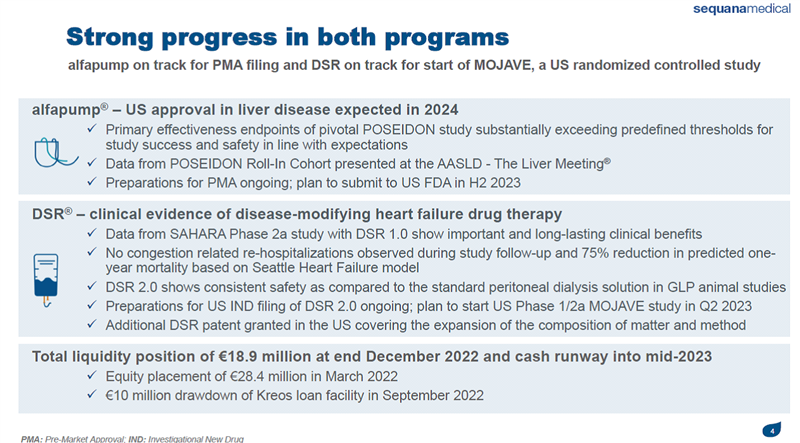
Sequana recently reported FY22 results and essentially confirmed its development guidance trajectory for its two key programmes, the implantable alfapump device in patients with recurrent and refractory ascites (RRA) and its direct sodium removal (DSR) 2.0 programme for diuretic-resistant chronic heart failure (CHF). The company remains on track to file a US premarketing approval (PMA) application with the FDA for its alfapump in H223, which we assume could lead to US market launch in mid-2024. Having recently reported positive Good Laboratory Practice (GLP) animal studies for DSR 2.0, the company continues to aim to start the US MOJAVE Phase I/IIa study for DSR 2.0 in Q223, with interim data still planned in H223. Top-line MOJAVE data are now guided for H224, a minor shift from mid-2024 previously, but this does not affect our launch timing forecasts for DSR 2.0. After making the minor adjustments to our valuation discussed below, we now have an rNPV valuation to €344.3m (previously €345.0m).
Sequana Medical |
Key programmes advancing as expected |
FY22 results update |
Pharma and biotech |
16 February 2023 |
Share price performance
Business description
Next events
Analyst
Sequana Medical is a research client of Edison Investment Research Limited |
|||||||||||||||||||||||||||||||||||||||||||||||
Sequana recently reported FY22 results and essentially confirmed its development guidance trajectory for its two key programmes, the implantable alfapump device in patients with recurrent and refractory ascites (RRA) and its direct sodium removal (DSR) 2.0 programme for diuretic-resistant chronic heart failure (CHF). The company remains on track to file a US premarketing approval (PMA) application with the FDA for its alfapump in H223, which we assume could lead to US market launch in mid-2024. Having recently reported positive Good Laboratory Practice (GLP) animal studies for DSR 2.0, the company continues to aim to start the US MOJAVE Phase I/IIa study for DSR 2.0 in Q223, with interim data still planned in H223. Top-line MOJAVE data are now guided for H224, a minor shift from mid-2024 previously, but this does not affect our launch timing forecasts for DSR 2.0. After making the minor adjustments to our valuation discussed below, we now have an rNPV valuation to €344.3m (previously €345.0m).
Year end |
Revenue |
PBT* |
EPS* |
DPS |
P/E |
Yield |
12/21 |
0.4 |
(24.4) |
(1.36) |
0.0 |
N/A |
N/A |
12/22 |
0.9 |
(30.9) |
(1.37) |
0.0 |
N/A |
N/A |
12/23e |
0.8 |
(28.1) |
(1.18) |
0.0 |
N/A |
N/A |
12/24e |
3.0 |
(30.0) |
(1.26) |
0.0 |
N/A |
N/A |
Note: *PBT and EPS are normalised, excluding amortisation of acquired intangibles, exceptional items and share-based payments. EPS are fully diluted.
FY22 expenses above forecasts
Sequana’s net FY22 operating cash burn rate of €27.5m (+16% y-o-y) is above our €25.1m estimate. R&D costs of €20.4m were higher than our €17.2m forecast and the majority of costs were due to the POSEIDON study and other preparations for the planned US PMA submissions for the alfapump. We expect FY23 and future R&D costs will be driven increasingly by the DSR 2.0 programme.
Cash runway to mid-2023
The company finished FY22 with €18.9m in gross cash and €16.7m in debt and expects its cash on hand to last into mid-2023 (a slight variance from its prior guidance of Q323). We have raised our R&D cost estimates and now expect the company will need to raise €120m (vs €100m previously) in the coming years (including €15m in H123), until it starts to generate sustained positive operating cash flows (expected in H128), all modelled as illustrative debt.
Valuation: Minor adjustment to rNPV
We have rolled our estimates forward, but this favourable effect on our valuation is offset by new currency rate assumptions ($1.07/€, up from parity previously), and mildly increased development cost estimates for the alfapump and DSR 2.0 programmes. The net result of these changes is that we now obtain a pipeline rNPV of €344.3m vs €345.0m previously. After adding €2.2m net cash (excluding lease liabilities), we obtain an equity valuation of €346.5m, or €14.59/share (€13.09 fully diluted given options outstanding), vs €15.21/share (€13.65 fully diluted previously).
FY22 update affirm key programmes on track
Sequana recently reported FY22 results and essentially confirmed its development guidance trajectory for its two key programmes, the implantable alfapump device in patients with RRA and its DSR 2.0 programme for diuretic-resistant CHF. The company remains on track to file a US PMA application with the FDA in H223, in line with prior guidance, which we continue to estimate could lead to US market launch in mid-2024. For the CHF programme, the company maintained its guidance for starting the multi-centre randomised US MOJAVE Phase I/IIa study in DSR 2.0 in Q223, potentially reporting interim results in H223 and slightly nudged its guidance for top-line MOJAVE results in H224 (versus its prior guidance of mid-2024).
|
Exhibit 1: Company highlights of key alfapump and DSR 2.0 events and catalysts |
|
|
Source: Company presentation, 9 February 2023 |
Favourable preclinical data pave way for MOJAVE start in Q223
Sequana recently announced that it has successfully completed its GLP animal studies for its second-generation DSR product, DSR 2.0, following chronic exposure. The GLP studies were conducted on 30 healthy mice (exposed for 30 days) and 18 healthy sheep (exposed for up to 45 days). Each animal study consisted of three groups, including two test groups using DSR 2.0 and a control group using standard peritoneal dialysis (PD) solution. For each study, one of the test groups reflected the anticipated maximum standard dose and the other was double that dose. Data from both studies showed no difference in systemic and local toxic effects in animals treated repeatedly with DSR 2.0 vs animals in the control (PD solution) group.
We had anticipated that these GLP studies would be successful, given the first-generation DSR formulation (DSR 1.0) was already shown to demonstrate positive results in the SAHARA and RED DESERT human study results in HF, and that DSR 2.0 (a proprietary formulation of icodextrin and dextrose sugars) is designed to provide improved therapeutic and more favourable safety profile compared to DSR 1.0. Compared to DSR 1.0, which is essentially a 10% dextrose solution, DSR 2.0 is designed to provide a longer dwelling time with slower sodium removal.
|
Exhibit 2: Highlights of DSR 2.0 differentiation (vs DSR 1.0) and upcoming catalysts |
|
|
Source: Company presentation, 9 February 2023 |
As explained in our prior note, the SAHARA Phase IIa study of DSR 1.0, involving 10 evaluable patients with diuretic-resistant HF, showed that after intensive DSR therapy, the need for loop diuretics medication was substantially reduced for many months (at least six to 15), with nine out of 10 patients having had a reduction of more than 90% of their required dosing.
The company successfully dosed the first patient with DSR 2.0 in the Canadian Phase I study (YUKON) in Q422, and recently began enrolment in a similar Phase I study, CHIHUAHUA, in Mexico. Both YUKON and CHIHUAHUA are single-arm open-label studies that will provide a single treatment of DSR 2.0 in patients on PD and are designed to enrol 10 patients each. The completed GLP animal studies and CHIHUAHUA are intended to support the US Investigational New Drug (IND) application for MOJAVE, which the company expects to submit in Q123 (hence we expect CHIHUAHUA to be completed by the end of March). Sequana anticipates receiving IND approval and starting MOJAVE in Q223.
|
Exhibit 3: Outline of upcoming DSR 2.0 studies |
|
|
Source: Company presentation, 9 February 2023 |
The MOJAVE study will have two cohorts. In the safety cohort, three heart failure patients will receive DSR 2.0 via a peritoneal catheter on top of usual care for up to four weeks. An independent data safety monitoring board will then determine whether the study can proceed to the efficacy cohort. The efficacy cohort is then designed to enrol 30 diuretic-resistant CHF patients with persistent congestion, with 20 patients randomised to DSR 2.0 administered via a peritoneal catheter on top of usual care for congestive heart failure for up to four weeks, and 10 patients randomised to usual care (including intravenous loop diuretics) alone. There will also be a three-month safety follow-up period after the four weeks of DSR therapy. Sequana expects to report interim data from MOJAVE in H223 and top-line results are now expected in H224 (vs mid-2024, previously). If results are positive, we believe the company could be in a position to seek favourable terms for commercial partnership or licensing transactions.
Patient preference study to support alfapump RRA rationale
A key development for Sequana in FY22 was the positive results from the POSEIDON North American pivotal study of the alfapump device in patients with RRA due to liver cirrhosis. We believe the results convincingly met the primary efficacy endpoints and, given that no unanticipated adverse device effects were observed, de-risked the likelihood of US market approval and commercialisation as the company continues to target the PMA submission in H223. In POSEIDON, The alfapump significantly reduced the need for RRA patients to undergo burdensome therapeutic paracentesis (TP) procedures, which should lead to improved patient independence and quality of life (QoL), given the limitations of current treatments. Within the 40-patient pivotal cohort, there was a 100% median per-patient reduction in TP in the post-implant observation period (reflecting months four to six) versus the three-month pre-implant observation period implantation (p<0.001). This compares to the study’s aim of showing at least a 50% reduction. Further, 77% of these 40 patients experienced at least a 50% reduction in the frequency of TP in the post-implant observation period versus the pre-implant observation period (p<0.001); the study’s aim was to show at least 50% of patients having a 50% reduction.
To bolster the case for the alfapump in RRA and strengthen the rationale with regulators, in late 2022 the company started a patient preference study in the US, with results expected in H223 (in time for the expected PMA filing). The patient preference study aims to enrol approximately 150 subjects with RRA who would normally fit the profile of candidates who would be considered for alfapump implantation. This study is a non-interventional study (ie, no clinical treatment is being performed) that is designed to gather feedback from RRA patients in terms of how they would perceive or weigh the potential benefit of alfapump implantation (namely, a significantly reduced need for TP and improved QoL) against the requirement to undergo a surgical procedure (for its implantation) and the level of risk for complications or infections they would be willing to accept. The company anticipates that the patient preference study will demonstrate that RRA patients will respond very favourably to the alfapump’s risk-benefit proposition, in terms of improving independence and QoL, which will be supportive of the PMA application overall and subsequent discussions with reimbursement agencies. Because the patient preference study is not a clinical study in itself, the overall cost is expected to be relatively minor (c €1m).
Altogether, we expect the rising prevalence of non-alcoholic steatohepatitis (NASH) will result in the target market for RRA patients in North America increasing at an upper single-digit CAGR over the next decade, providing a robust commercialisation opportunity for alfapump in RRA.
FY22 expenses above estimates; cash runway to mid-2023
Sequana reported an operating loss of €28.1m in FY22 (+24% y-o-y) and a net operating cash burn rate of €27.5m (+16% y-o-y), above our estimates of €24.8m and €25.1m, respectively. The main driver for the FY22 variance was R&D costs that came in at €20.4m, above our €17.2m forecast. The majority of R&D expenses were due to the POSEIDON North American pivotal study and other preparations for the planned 2023 US marketing approval submissions for the alfapump.
The company reported FY22 revenue of €0.9m (+149% y-o-y), slightly above our €0.8m estimate, due to increased commercial activity for alfapump sales in Europe as the impact of COVID-19 declined. However, we only expect modest European growth for the alfapump and continue to expect the opportunity for alfapump in North America to be much more robust than in Europe, given the rising prevalence of NASH in this region.
The company finished FY22 with €18.9m in gross cash and €16.7m in debt (including €4.5m in short-term borrowings and the drawing of a €10m loan from the Kreos financing facility in H222), excluding €0.9m in lease liabilities. The company expects its cash on hand to last into mid-2023 (a slight variance from its prior guidance of Q323).
Financials and valuation
We continue to expect the rising prevalence of NASH to result in the target market for RRA patients in North America increasing at an upper single-digit CAGR over the next decade, providing a robust commercialisation opportunity for alfapump in RRA. Our local-currency revenue and launch timing estimates are unchanged. We have rolled our estimates forward, adjusted our forecasts for new currency rate assumptions ($1.07/€, up from parity previously), and mildly increased development cost estimates for the alfapump and DSR 2.0 programmes. The net result of these changes is that we now obtain a pipeline rNPV of €344.3m, vs €345.0m previously. After adding €2.2m net cash (excluding lease liabilities), we obtain an equity valuation of €346.5m, or €14.59/share (€13.09 fully diluted), versus €15.21 per share (€13.65 fully diluted) previously.
|
Exhibit 4: Sequana Medical rNPV assumptions |
|||||||||||||||||||||||||||||||||||||||||||||||||||||||||||||||||||||||||||||||||||||||||||||||||||
|
|||||||||||||||||||||||||||||||||||||||||||||||||||||||||||||||||||||||||||||||||||||||||||||||||||
|
Source: Edison Investment Research. Note: *Reflects estimate of projected royalty revenue to Sequana Medical rather than end-market commercial sales. |
Given the completion of POSEIDON’s primary efficacy readout, we expect related costs for the study to decline in FY23 but continue to expect the company to spend on regulatory and pre-commercialisation activities for alfapump over the coming months. We also expect FY23 R&D costs will be driven increasingly by the DSR 2.0 programme, given the company’s expected start of MOJAVE in Q223.
Given that FY22 R&D costs exceeded our estimates and to allow for higher expenditures in future DSR 2.0 trials, we have raised our FY23 and FY24 R&D expense estimates to €17.0m and €13.1m, respectively, up from €14.9m and €9.3m, previously. We now expect FY23 and FY24 net operating cash burn rates of €28.0m and €29.8m, respectively, up from our prior estimates of €24.4m and €25.7m, respectively.
Following the increase in our FY23 and FY24 expenditure estimates, along with modest increases for DSR 2.0 development costs afterwards, we now expect the company will require an additional €120m, up from €100m previously, over the next few years until it starts to generate sustained positive operating cash flows (which we continue to expect in H128). We highlight that the company has an imminent financing need, given that its current runway is to mid-2023, and our model assumes a €15m raise in H123. As per the usual Edison policy, we model all future fund-raising requirements as illustrative debt. As a sensitivity, our equity valuation per basic share would be adjusted to €10.24/share if we assume that our total assumed future funding need (€120m) is met through equity issuances at the current share price (approx. €5.50/share).
Exhibit 5: Financial summary
€(000) |
2018 |
2019 |
2020 |
2021 |
2022e |
2023e |
2024e |
||
31-December |
IFRS |
IFRS |
IFRS |
IFRS |
IFRS |
IFRS |
IFRS |
||
PROFIT & LOSS |
|||||||||
Revenue |
|
|
1,029 |
971 |
963 |
371 |
923 |
795 |
3,022 |
Cost of Sales |
(158) |
(198) |
(202) |
(77) |
(205) |
(159) |
(604) |
||
Gross Profit |
871 |
773 |
761 |
294 |
718 |
636 |
2,417 |
||
General & Administrative |
(8,206) |
(7,102) |
(6,738) |
(7,177) |
(8,927) |
(9,965) |
(15,644) |
||
Net Research & Development |
(5,816) |
(7,652) |
(11,835) |
(16,935) |
(20,416) |
(17,000) |
(13,050) |
||
Operating profit before exceptionals |
(13,150) |
(13,981) |
(17,813) |
(23,818) |
(28,625) |
(26,329) |
(26,277) |
||
EBITDA |
|
|
(13,070) |
(13,737) |
(17,506) |
(23,409) |
(28,313) |
(25,619) |
(25,699) |
Depreciation & other |
(81) |
(244) |
(307) |
(409) |
(312) |
(710) |
(578) |
||
Operating Profit (before amort. and except.) |
|
(13,150) |
(13,981) |
(17,813) |
(23,818) |
(28,625) |
(26,329) |
(26,277) |
|
Exceptionals including asset impairment |
74 |
18 |
41 |
1,205 |
530 |
0 |
0 |
||
Operating Profit |
(13,077) |
(13,964) |
(17,771) |
(22,613) |
(28,095) |
(26,329) |
(26,277) |
||
Net Interest |
(883) |
(878) |
(1,178) |
(608) |
(2,282) |
(1,764) |
(3,761) |
||
Profit Before Tax (norm) |
|
|
(14,033) |
(14,859) |
(18,991) |
(24,426) |
(30,907) |
(28,093) |
(30,038) |
Profit Before Tax (FRS 3) |
|
|
(13,960) |
(14,841) |
(18,949) |
(23,221) |
(30,377) |
(28,093) |
(30,038) |
Tax |
(24) |
(136) |
(157) |
(393) |
(387) |
0 |
0 |
||
Profit After Tax and minority interests (norm) |
(14,057) |
(14,995) |
(19,148) |
(24,819) |
(31,294) |
(28,093) |
(30,038) |
||
Profit After Tax and minority interests (FRS 3) |
(13,983) |
(14,977) |
(19,106) |
(23,614) |
(30,764) |
(28,093) |
(30,038) |
||
Average Number of Shares Outstanding (m) |
10.0 |
12.3 |
15.3 |
18.2 |
22.8 |
23.8 |
23.9 |
||
EPS - normalised (€) |
|
|
(1.41) |
(1.22) |
(1.25) |
(1.36) |
(1.37) |
(1.18) |
(1.26) |
EPS - normalised and fully diluted (€) |
|
|
(1.41) |
(1.22) |
(1.25) |
(1.36) |
(1.37) |
(1.18) |
(1.26) |
EPS - (IFRS) (€) |
|
|
(1.40) |
(1.22) |
(1.25) |
(1.30) |
(1.35) |
(1.18) |
(1.26) |
Dividend per share (€) |
0.0 |
0.0 |
0.0 |
0.0 |
0.0 |
0.0 |
0.0 |
||
BALANCE SHEET |
|||||||||
Fixed Assets |
|
|
242 |
829 |
772 |
1,814 |
2,936 |
2,544 |
2,650 |
Tangible Assets |
184 |
765 |
705 |
1,732 |
2,850 |
2,458 |
2,564 |
||
Investments in long-term financial assets |
58 |
63 |
67 |
82 |
86 |
86 |
86 |
||
Current Assets |
|
|
3,099 |
8,522 |
13,441 |
12,890 |
23,089 |
5,912 |
6,779 |
Short-term investments |
0 |
0 |
0 |
0 |
0 |
0 |
0 |
||
Cash |
1,318 |
5,586 |
11,016 |
9,600 |
18,875 |
5,605 |
5,165 |
||
Other |
1,782 |
2,935 |
2,425 |
3,290 |
4,214 |
307 |
1,613 |
||
Current Liabilities |
|
|
(18,727) |
(5,315) |
(5,966) |
(7,180) |
(15,149) |
(10,096) |
(10,520) |
Creditors |
(6,654) |
(4,855) |
(5,966) |
(7,180) |
(10,666) |
(5,613) |
(6,037) |
||
Short term borrowings |
(12,073) |
(459) |
0 |
0 |
(4,483) |
(4,483) |
(4,483) |
||
Long Term Liabilities |
|
|
(3,374) |
(3,110) |
(8,135) |
(8,312) |
(13,030) |
(28,030) |
(58,030) |
Long term borrowings |
(2,582) |
(2,261) |
(7,473) |
(7,325) |
(12,193) |
(27,193) |
(57,193) |
||
Other long term liabilities |
(792) |
(849) |
(662) |
(987) |
(837) |
(837) |
(837) |
||
Net Assets |
|
|
(18,760) |
926 |
113 |
(788) |
(2,154) |
(29,670) |
(59,121) |
CASH FLOW |
|||||||||
Operating Cash Flow |
|
|
(8,987) |
(17,596) |
(15,791) |
(22,786) |
(24,822) |
(26,189) |
(25,995) |
Net interest and financing income (expense) |
(883) |
(878) |
(1,178) |
(608) |
(2,282) |
(1,764) |
(3,761) |
||
Tax |
(5) |
(9) |
(36) |
(222) |
(378) |
0 |
0 |
||
Net Operating Cash Flow |
|
|
(9,875) |
(18,482) |
(17,005) |
(23,616) |
(27,482) |
(27,953) |
(29,756) |
Capex |
(39) |
(106) |
(138) |
(326) |
(677) |
(318) |
(684) |
||
Acquisitions/disposals |
0 |
0 |
0 |
0 |
0 |
0 |
0 |
||
Financing (net of costs) |
2 |
26,165 |
19,000 |
22,771 |
28,420 |
0 |
0 |
||
Dividends |
0 |
0 |
0 |
0 |
0 |
0 |
0 |
||
Other |
0 |
0 |
0 |
0 |
0 |
0 |
0 |
||
Net Cash Flow |
(9,912) |
7,576 |
1,857 |
(1,171) |
261 |
(28,271) |
(30,440) |
||
Opening net debt/(cash) |
|
|
0 |
13,337 |
(2,866) |
(3,543) |
(2,275) |
(2,199) |
26,072 |
HP finance leases initiated |
0 |
0 |
0 |
0 |
0 |
0 |
0 |
||
Other |
(3,425) |
8,627 |
(1,179) |
(97) |
(337) |
0 |
0 |
||
Closing net debt/(cash) |
|
|
13,337 |
(2,866) |
(3,543) |
(2,275) |
(2,199) |
26,072 |
56,511 |
Lease debt |
na |
504 |
387 |
760 |
916 |
916 |
916 |
||
Closing net debt/(cash) inclusive of IFRS16 lease debt |
13,337 |
(2,362) |
(3,157) |
(1,515) |
(1,283) |
26,988 |
57,427 |
||
Source: Edison Investment Research, company reports
|
|
Research: Healthcare
OSE has announced that it has received positive recommendations from its ‘type C’ meeting with the FDA for the planned confirmatory Phase III trial design for Tedopi (neoepitope cancer vaccine), as a second-line treatment in advanced or metastatic non-small cell lung cancer (NSCLC) after checkpoint inhibitor failure. This follows similar advice from the European Medicines Agency (EMA). The company will now undertake the pivotal trial as monotherapy (against standard of care) under this protocol, for patients with HLA-A2+ tumours (c 45% of total population). As a reminder, OSE reported positive data from the previous Phase III ATALANTE-1 trial as second/third-line treatment, although enrolment had to be terminated prematurely due to the COVID-19 pandemic.