AEX Gold (AEX) has a large land position in Greenland where it is exploring for gold. Its extensive licence holding includes an exploitation licence that hosts the previously operating high-grade underground Nalunaq Gold Mine. AEX is in-fill drilling to expand the resource with the aim of re-starting gold production. The company’s second field season is underway, with a resource update planned for the end of the year. AEX is also evaluating the potential of the underexplored district to host another Nalunaq-style deposit.
Written by
Phil Swinfen
AEX Gold |
High-grade gold in Greenland |
Mining prospects |
Metals & mining |
11 October 2018 |
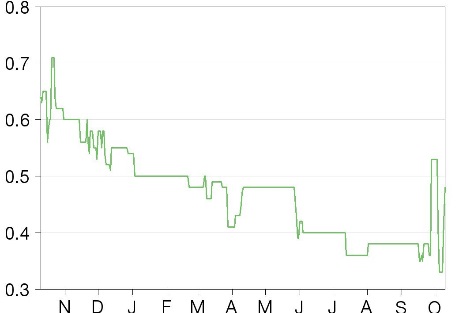
Share price performance
Business description
Next events
Analysts
AEX Gold is a research client of Edison Investment Research Limited |
|||||||||||||||||||||||||||||||||||||||||||||
AEX Gold (AEX) has a large land position in Greenland where it is exploring for gold. Its extensive licence holding includes an exploitation licence that hosts the previously operating high-grade underground Nalunaq Gold Mine. AEX is in-fill drilling to expand the resource with the aim of re-starting gold production. The company’s second field season is underway, with a resource update planned for the end of the year. AEX is also evaluating the potential of the underexplored district to host another Nalunaq-style deposit. AEX completed a C$1m placement in October.
A high-grade, previously operating gold mine
AEX holds a 100% interest in the Nalunaq, Vagar and Tartoq licences in Greenland. The company’s primary focus is the advanced-stage Nalunaq property, which includes the Nalunaq Mine. Nalunaq was previously operated by Crew Development Corp between 2004 and 2009, and by Angel Mining between 2011 and 2013, producing 367koz of gold in total. Production peaked at 71koz in 2007. The deposit is exceptionally high grade, with the average historical head-grade of 15g/t Au, as evidenced by Crew shipping ore directly to Newfoundland and Spain for processing. The deposit has an existing NI 43-101 resource of 263koz at 18.7g/t Au, which AEX plans to expand and upgrade during Q418.
Existing infrastructure provides head-start
Greenland has highly prospective geology, with vast potential but the country is remote. AEX’s plan to re-start gold production will be assisted by the significant infrastructure on site including an access road from port to mine and an exploration camp. The existing underground processing plant remains in place and, although not currently operational, it could be either rehabilitated or provide the footprint for a new plant. AEX believes there are significant opportunities to materially improve on the mining operation that was run under the previous operator’s tenure.
2018 exploration focused on resource expansion
AEX’s maiden field season in 2017 successfully provided key information to confirm the continuity and structure of the main gold-hosting vein at Nalunaq including a down-dip extension in the South Block. Previous operators undertook minimal exploration, yet AEX has determined that the Main Vein (MV) pinches and swells and can be identified at numerous locations within the Mountain at both depth and high up in the mountain. The 2018 programme has been completed and included almost 4000m of infill drilling. Subject to drilling results and the planned resource update (Q4), AEX plans to commence a PEA in late 2018.
District play: Nalunaq is just the start
AEX’s overarching strategy is to develop a potentially cash-generating asset at Nalunaq to fund exploration of the wider district. Historical data and recent work by AEX indicate that other licences it holds are prospective for the discovery of further Nalunaq-style, high-grade gold deposits. AEX has an exploration target of between 80koz and 1.2Moz in the Nalunaq area alone.
AEX Gold: Rejuvenating gold in Greenland
Corporate overview
AEX Gold Inc. is an exploration company focused on the development of gold projects in Greenland. AEX holds a 100% interest in the Nalunaq, Vagar and Tartoq properties through its wholly-owned Greenlandic subsidiary Nalunaq A/S. The company successfully completed an IPO on the TSX Venture Exchange in July 2017 and is listed under the symbol “AEX”. In conjunction with the IPO, AEX placed 13.6m shares to raise gross proceeds of C$6.8m, with the funds used for exploration. In May 2018, the company raised a further C$2.5m to fund the 2018 programme.
The company’s focus is on the advanced-stage Nalunaq property where AEX holds an exploitation licence (valid until 2033) which includes the previously operating Nalunaq Gold Mine which closed in 2013. AEX is also conducting early-stage exploration on the nearby Vagar and Tartoq licence areas. The company’s objective is to re-start gold production at Nalunaq and take advantage of the significant mine infrastructure already in place and to pursue ways to improve on the previous mining operation. AEX plans to commence a PEA in late 2018, subject to the latest drilling results.
Recent events
■
February 2017: Independent Technical Report on Tartoq Project, SRK
■
March 2017: Independent Technical Report on Nalunaq Project, SRK
■
13 July 2017: Alopex Gold Inc. completes IPO on the TSX Venture Exchange. 13.6m shares for gross proceeds of $6.8m.
■
11 August 2017: Commencement of 2017 Summer Work Programme at Nalunaq, Vagar and Tartoq projects and surrounding licence area. Multi-stage exploration and appraisal.
■
16 October 2017. Completion of summer work programme. Work included diamond drilling at Nalunaq, point sampling at Vagar and channel sampling at Tartoq.
■
30 November 2017: Summer work programme results, continuity of Main Vein successfully demonstrated
■
14 May 2018: Non-brokered Private Placement. 5.6m shares for gross proceeds of C$2.5m.
■
6 June 2018: Alopex files Articles of Amendment to change its name to AEX Gold Inc.
■
23 July 2018: Commencement of 2018 summer work programme.
■
9 October 2018: Non-brokered private placement of 2.6m shares for gross proceeds of C$1m.
|
Exhibit 1: Key milestones since IPO |
|
|
Source: Edison Investment Research, company reports, SEDAR disclosures |
Location: Southern tip of Greenland
■
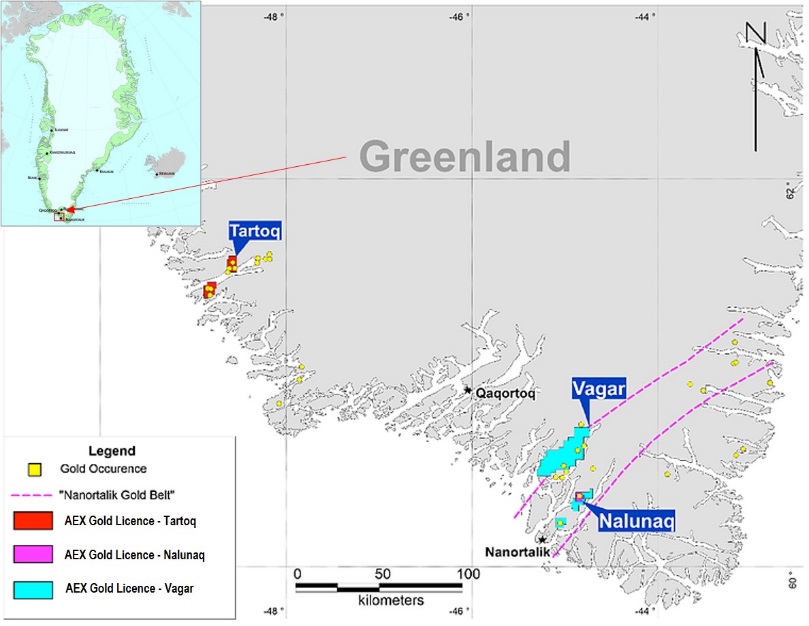
Location. AEX’s three primary properties, Nalunaq, Tartoq and Vagar are located in South Greenland, a previously active mining region. Nalunaq is located 33km northeast of the town of Nanortalik and along with Vagar is situated within the Nanortalik Gold Belt (pink dotted line in map below), generally considered to be an extension of the prolific gold producing Swedish Gold Line. The Tartoq property flanks the Sermilgaarsuk Fjord to the northwest of AEX’s other projects.
■
Licences: AEX’s total landholding in Greenland is 690km2:
Nalunaq - an advanced property (22km2) covered by an Exploitation Licence (valid until April 2033) which hosts the former operating Nalunaq Gold Mine. An Exploitation Licence confers the exclusive right to undertake exploration and exploitation, subject to various approvals.
Vagar - 420km2 Exploration Licence, expiry December 2018 with the ability to apply for three further 3-year extensions providing up to 9-years in total.
Tartoq - 78km2 Exploration Licence, expiry Dec 2019, with the ability to extend the term for an additional 5-year period and to apply for four further 3-year extensions up to 12 years in total.
■
Accessibility. South Greenland is accessible from the international airport at Narsarsuaq with regular flights from Iceland and Denmark and helicopter flights to Nanortalik. AEX’s project areas can also be accessed by scheduled boat services; Nalunaq and Vagar from Nanortalik, and Tartoq from Paamiut, with final access via fjords, or 4x4 vehicles from the jetty. The climate of South Greenland is relatively mild; the fjords at Nalunaq are ice-free all year-round, and access to Tartoq is possible via the sea-port at Paamuit which is also free from ice year-round.
■
Infrastructure. Nalunaq has significant infrastructure developed on site, reflecting the presence of the former operating mine. This includes a pier, 9km access road, mine camp, workshops and a dismantled CIP processing plant. The plant would require rehabilitation or could provide a foot print for a new plant if AEX decides to process ore on site. The power distribution system that remains underground is in reasonable condition according to SRK, and power will be sourced from gensets. Owing to its close proximity to Nalunaq, Vagar will benefit from the infrastructure in place there. Tartoq, an early-stage property is more remote, with no infrastructure within the licence area.
|
Exhibit 2: Location of AEX’s licences in south-west Greenland |
|
|
Source: AEX Gold |
Nalunaq: A previously operating gold mine
Nalunaq is an advanced exploration project and AEX’s main focus, with the licence area encompassing the previously operating Nalunaq gold mine, which hosts a NI 43-101 resource estimate. AEX’s strategy is to identify gold mineralisation and delineate new additional resources adjacent to and beyond the former mine area. Work by AEX so far has focused on gathering data and increasing understanding of the Nalunaq deposit and tracing the continuity of the Main Vein “MV” structure, which hosts the gold mineralisation in the area.
Geology and mineralisation: High-grade vein-hosted gold
The Nalunaq deposit project lies within the ‘Psammite Zone’ in south Greenland, host to the Nanortalik Gold Belt, postulated to be a continuation of the Swedish Gold Line. The geology of the Nalunaq mine area is dominated by fine- to medium-grained tholeiitic basalt flows, which have been metamorphosed to amphibolite facies, forming part of a nappe complex that has been thrust over metasediments.
Gold mineralisation at Nalunaq is classified as high-grade, narrow-vein orogenic gold lode type and is hosted in a feature known as the MV. The vein varies in thickness from 0.1m to 2m but significant continuity has been demonstrated for a strike length of over 1,000m and up and down dip for 2,000m. The key focus of AEX’s exploration programme is to investigate extensions of the MV in the wider licence area.
|
Exhibit 3: MV structure at Nalunaq (left) and high-grade quartz vein sample from Nalunaq MV (right) |
|
|
Source: Cross section AEX Gold; photograph SRK, after Crew Gold Corporation. |
NI 43-101 resource
In 2016, SRK Exploration Services compiled an NI 43-101 compliant mineral resource estimate on behalf of AEX at Nalunaq. The total inferred resource amounts to 446kt at 18.7g/t Au for 263koz contained gold, with the resource calculated at a gold price of US$1,300/oz and a cut-off grade of 5.5g/t Au in the mine area. The resource is split into the area surrounding the current mine layout, and in-situ remnant material comprised of material within the mine that could practically and safely be mined as part of a larger exploration or mining operation. Gold mineralisation is high-grade, but erratic as befitting a vein-type deposit with a high nugget effect. The company believes that the magnitude of the gold resource may have been previously underestimated due to the challenges of resource estimation inherent in high nugget-effect deposits such as this.
|
Exhibit 4: Nalunaq diluted mineral resource estimate |
||||||||||||||||||||
|
||||||||||||||||||||
|
Source: SRK Exploration (Nalunaq NI 43-101, March 2017) |
Exploration target: in addition to the updated resource estimate, SRK generated an exploration target range of between 80koz and 1.2Moz of gold contained within 1-2Mt grading between 2.5 and 19g/t Au. SRK’s estimate is based on extrapolating data from the mine area across the rest of the known MV structure as well as down-dip below the South Block. This is based on surface diamond drilling and channel and surface samples from 2015–2016. Investigating the potential of this exploration target was a priority of AEX’s initial 2017 exploration programme.
|
Exhibit 5: Schematic view of Nalunaq Mountain |
|
|
Source: AEX Gold |
Nalunaq’s exploration and gold production history
Gold was first discovered at Nalunaq in 1986 and the main quartz-vein was discovered in 1992 by NunaOil prompting further exploration. NunaOil entered into a JV with Mindex in 1997 and a major exploration programme was undertaken in 1998 and 1999 including significant surface drilling and an underground drive. Mindex merged with Crew Development Corporation in 1999 and became the operator, completing a PFS later in 1999. An underground development programme commenced in 2000 (managed by Strathcona), which included 1,902m of lateral development, bulk sampling and a pilot plant operation. The MV has been subject to over 30,000m of surface drilling and 5,572m of underground development.
|
Exhibit 6: Exploration and mining history of Nalunaq |
|
|
Source: Company reports |
Two periods of gold production. After a feasibility study in 2002, Crew Gold Corporation commenced mining in 2004. No processing was carried out on site and from 2004 to 2006, ore was transported to a processing plant in Spain. Then from 2006 until 2009, it was shipped to Crew’s Nugget Pond processing plant in Newfoundland. Crew produced a total of 352koz gold from 654kt of processed ore during. Production peaked at c 71koz in 2007. The mine was put on care and maintenance in February 2009, being a non-core asset for Crew.
Angel Mining acquired the mine in 2009 and spent $35m on an underground processing plant, pouring first gold in May 2011 with a target of 24koz pa, although this was never reached due to challenging logistics and production delays as a result of pump and generator failures. Production averaged 600oz per month during Angel Mining’s tenure, below the targeted 2,000oz/m. Due to financial difficulties and the company’s inability to repay loans, Angel Mining went into administration in February 2013 and the mine operated until August 2013. In 2015, Angel Mining concluded a sale agreement and the licence was transferred to Nalunaq A/S. AEX believes there is considerable scope to optimise and improve on the previous mining and processing operation run by Angel Mining (see next page).
|
Exhibit 7: Nalunaq – historical gold production |
|
|
Source: Company reports |
Nalunaq development strategy
The key cogs of AEX’s development strategy are:
■
Resource growth. The majority of historical (non-compliant) reserves have already been mined out and SRK and AEX believe a future mining operation requires ‘the identification of substantial new resources in the wider area of Nalunaq Mountain’. This drives the current in-fill drilling strategy to expand the resource, starting with the areas of the mountain that are the most cost effective to drill and have the potential to add resources.
■
Refocus on exploration. Previous operators undertook very little in the way of forward-looking exploration once Nalunaq was in production, instead focusing on operations. Latterly, Angel Mining went into administration before it could fully evaluate the area (again being focused on remedying operational issues). AEX will be the first group to step back and evaluate the potential for extensions to mineralisation in light of new geological and structural thinking.
■
Grade driven. The Nalunaq asset was acquired by AEX as a compelling development opportunity versus other projects globally, driven primarily by the extremely high-grade potential of the resource, which was demonstrated by the high head-grade during the mine’s operation.
■
Nalunaq and beyond. The main gold-hosting vein at Nalunaq pinches and swells. AEX has made good progress in understanding the structure and continuity and believes there is good potential to trace the mineralised vein throughout the mountain. Further afield, the wider Nalunaq shear zone continues through the company’s Vagar licence, and AEX believes the ground is prospective for the discovery of further Nalunaq-type deposits.
■
Targeting a cash-generative asset. AEX’s overarching strategy is to develop a potentially cash-generative operation at Nalunaq, which could provide funds to subsidise the exploration of the wider licence area in Greenland, and new licence acquisitions.
■
Footprint in place. The project benefits from existing infrastructure and extensive underground development. The footprint of the existing processing plant remains in place and could either form the base for a new plant, or the existing plant could be rehabilitated or potentially be cannibalised (depending on condition) to build a new plant if ore is processed on site.
■
Future optimisation. Angel Mining’s previous processing plant was subject to technical and operating issues that affected production during 2011–2013. SRK believes significant gold loss occurred as a result of various process issues such as the plant receiving ROM ore with a gold grade significantly higher than design, resulting in low gold recoveries from leachate. Many of the issues under Angel Mining’s tenure were also related to operating issues (pump failures) and power problems (mainly generator failures), in addition to difficulties in optimising the flowsheet. AEX believes it may be possible to remedy historical issues and operate Nalunaq more efficiently.
■
Gravity potential. Testwork (SGS 2011) on Nalunaq ore estimated the amount of gravity recoverable gold to be approximately 22%. Despite this, Angel Mining opted for direct cyanide leach only, we speculate due to cost and simplicity reasons. Work by Nalunaq A/S in 2016 indicates that a much higher gravity recovery may be possible, based on the quantities of coarse gold, although final separation of the gold from heavy arsenic-bearing minerals is more challenging according to SRK. Furthermore, the 2002 feasibility study (Kvaener) indicated that 80% of the free gold is recoverable with gravity methods, but further testwork is required.
■
Development optionality. It is early stage, but AEX believes there are several possible development scenarios including a start-up based on small-scale mining. Given the high-grade nature of the ore, this could involve selective mining with ore processed in a mobile processing plant, or even a direct-ship ore option as previously practised at the mine (Crew operated a DSO operation). Significant amounts of ore in mine workings, mineralised tailings and underground sweepings remain underground and could be processed quickly upon re-start. This would represent a simple, low-capex option to re-start production. If AEX’s resource expansion plan is successful, then a transition back to a full-scale processing plant could be investigated. We understand from discussions with management that a small-scale operation could be of the magnitude of 10–20koz pa and a full-scale operation could support production of 50–100koz pa. Clearly, this is dependent on converting a portion of the company’s 1.2Moz exploration target into compliant resources and appropriate economic studies.
Next steps: Resource update followed by PEA
AEX’s exploration as part of the 2018 work programme has focused on drilling around the South Block area to update the NI 43-101 resource estimate (Q418). In combination with upgrading the site infrastructure and equipment, this will support AEX’s aim of advancing the project towards commencing a PEA in late 2018. If the current exploration programme indicates that more drilling is required, AEX will undertake a PEA after the next round of drilling. The target resource required to justify development will depend on whether AEX opts for a DSO operation, mobile plant, or full-scale plant. We believe that increasing the resource to >500koz will be key to incentivise capital investment to a full-scale plant.
The district-scale play
For the reasons outlined above, AEX views its licence holdings as a district-scale play. Nalunaq is a high-grade gold deposit (average head-grade during Crew’s tenure was 15g/t Au) and AEX believes there is potential to discover additional mineralisation of the same style in the area. AEX has a 1.2Moz exploration target and a two-pronged strategy:
■
Demonstrate extensions to the MV along strike and down-dip of the Nalunaq mine to expand on the current NI 43-101 inferred resource estimate, i.e. drilling the South Block zone. An updated geological model suggests the MV extends to a strike length of 1km and remains open down-dip.
■
Explore the rest of the Nalunaq licence for similar MV-type mineralisation. Numerous gold occurrences have been identified within 17km of a 175km long structural break at the boundary of the Psammite Zone.
|
Exhibit 8: Nalunaq district potential |
|
|
Source: AEX Gold |
Other licences: Vagar and Tartoq
Vagar: Continuation of the gold belt?
The 420km2 licence that composes the Vagar project is split into three sub-areas proximal to the Nalunaq mine. Vagar covers key areas of the Nanortalik gold belt. The Nalunaq East and Lake 410 areas are close to the Nalunaq Mine licence and contain similar geology. The Niaqornaarsuk licence is geologically different but work by previous companies has identified a number of gold prospects. The Vagar licence was granted in January 2018 and AEX initially plans to conduct desk-based work to evaluate the inherited historic data, which suggest a continuation of the main Nalunaq vein. The licence has not been systematically drilled and AEX believes that existing exploration has only scratched the surface of the area.
|
|
|
|
Source: AEX Gold |
Tartoq: Early-stage high-grade narrow vein
The Tartoq project is situated to the northwest of Nalunaq, on the northern edge of the North Atlantic craton and is split into two sub-areas (Interlak and Nuuluk) either side of the Sermiligaarsuk Fjord. Tartoq is an early-stage exploration project covering an area that AEX generally considers to be unexplored, yet the geology resembles the prolific Abitibi Greenstone belt in Canada. The results of the 2017 work programme (next page) suggest the geology is prospective for narrow high-grade mineralisation hosted in quartz veins and sulphide lenses. Exploration was carried out in the area between the 1970s and 1990s and historical sampling has returned grades of up to 106g/t Au in veins and 20g/t in massive sulphide. The erratic nature of the gold mineralisation means the current strategy is focused on defining the continuity of the high-grade vein sets.
|
|
|
|
Source: AEX Gold |
Work programmes
2017 exploration programme aims
AEX restarted exploration at Nalunaq in summer 2017, a multi-stage programme focused on three:
■
Appraisal at Nalunaq. Drilling was planned in the upper mid-section of the mountain and valley floor including helicopter supported drilling and sampling of vein outcrop to further delineate the extension of the MV through the mountain and start to evaluate SRK’s 1.2Moz exploration target. A key focus was to understand the structure and continuity of mineralisation.
■
Exploration. Investigating the potential for further MV-type mineralisation over the 20km gold corridor within the Nanortalik gold belt across the Nalunaq and Vagar licences, and a channel sampling at Tartoq.
■
Infrastructure upgrade to support exploration and allow quicker mobilisation for future programmes.
2017 programme results
AEX reported results from the first field programme in November 2017, which was completed under budget. In total, $2m was spent on Nalunaq exploration, $140k on Tartoq and $192k on camp and equipment upgrades. A total of 2,445m of diamond core drilling was completed from 14 drill holes, which confirmed the strike continuity of the MV across the mountain, reinforcing the structural interpretation outlined in the NI 43-101 report.
■
High Mountain drilling. Five holes were drilled between 663m and 830m to test the geology between the last historic drilling and surface outcrop, the highest and most westerly ever drilled at Nalunaq. The drilling intersected alteration zones and lithologies that correlate with the interpreted 3D position of the MV.
■
South Block drilling. Seven holes were drilled in locations closer to the mine and the MV was identified in three holes. The results suggest a potential down-dip extension of the MV in the South Block and that mineralisation occurs 100m along strike from the South Block workings. AEX believes this has the potential to increase the boundary of the current inferred resource.
■
Tartoq channel sampling. Overall, 255m of channel sampling was undertaken, with the results suggesting that gold mineralisation is restricted to quartz veins or their close proximity, and that the host schist is only weakly mineralised. Thus, AEX concluded there is no potential for a high-tonnage, low-grade deposit away from the sulphide rich, quartz vein containing schist. As such, AEX now views Tartoq as a potentially high-grade, low tonnage target, where the potential for underground mining will be evaluated in future programmes.
■
Vagar. 95 point samples were obtained from Ship Mountain within the Vagar Licence intersecting multiple quartz veins.
|
|
|
|
Source: AEX Gold |
2018 programme
In July 2018, AEX commenced its 2018 summer work programme at Nalunaq after completing a C$2.5m fund raise in May 2018. The exploration programme ran until early September and comprised almost 4,000m of core drilling. The aim of the 2018 programme was to generate an updated resource estimate prior to commencing a PEA. The programme comprised:
■
Infill resource drilling: Almost 4,000m of infill drilling aimed at increasing the current resource base. The focus was on the South Block area of the Nalunaq mine, adjacent to the mine workings where mineralisation remains open down-dip. This follows the 2017 results, with the objective of adding inferred resources and upgrading the current NI 43-101 resource estimate.
AEX has paved the way for the 2018 programme by investing in infrastructure. A 20-person containerised camp has been constructed and the mobile equipment fleet has been expanded. The company has also rehabilitated the 9km access road from the camp to the mine through the constructing a bridge across the main river to help facilitate current and future exploration work. The drilling was completed in early September and once assays have been received, work on a new resource estimate will begin.
|
|
|
|
Source: AEX Gold |
Directors and management
Eldur Olafsson, founder, director and CEO. A geologist with eight years’ experience in the geothermal, oil & gas and mining industries. Eldur was previously business development lead at Geysir Green Energy (2008–2010) and technical director of Enex China (2009–2010). He has founded several natural resource businesses including Orka Energy (2010–2012) focused on geothermal assets in China and the Philippines and Iceland Petroleum, later being Arctic Resources Capital 2012–2016, focused on acquiring integrated mining projects in Greenland.
George Fowlie, chairman. Currently chairman of Crown Capital Partners. Numerous senior roles including MD at First Marathon Securities, head of investment banking of Westwind Partners and chairman of Maudore Minerals.
Ingrid Martin, chief financial officer, CPA, CA. Accountant with extensive experience in the junior mining sector. Currently chief financial officer of Midland Exploration, Sphinx Resources, Geomega Resources, Hinterland Metals and Kintavar Exploration.
Graham Stewart, director, has over 25 years’ experience in oil and gas technical and commercial affairs. He founded Faroe Petroleum in 2008 and has been CEO since 2002.
Robert Menard, director. Professional engineer in the province of Quebec with extensive experience in the mining sector; most recently director of engineering and construction for Newmont Mining’s Surgold Merian gold project in Suriname.
William Kellaway, VP of exploration. Experienced geologist with over 36 years’ experience, working in 40 countries within the petroleum, mining and exploration sectors. Previously chief mine geologist at Gold Fields, and director and practice leader at SRK Exploration Services.
Georgia Quenby - Director. Experienced UK and US qualified commercial lawyer. Ms. Quenby has worked extensively on cross-border M&A and financing transactions across the oil and gas, defence and mining industries.
Justinas Matusevicius - VP of Operations and logistics. Degree in Economics, MSc in Finance and Strategic Management. Previously worked for EY Audit and Consulting and participated in the founding of Iceland Petroleum in 2012 which was later reorganised into ARC, where he has been a Manager since 2014. Mr Matusevicius oversees operations and administration.
Joan Plant – Corporate Secretary. Experienced Corporate Secretary. Currently Corporate Secretary of FBC Group and previously Operations Manager of Angel Mining PLC (2010 – 2013).
Financial position
As of the end of June 2018, the last reporting date, the company had C$1.8m in cash on the balance sheet. This follows the non-brokered private placement of C$2.5m completed in May 2018, with the June 2018 cash figure reflecting ongoing exploration expenditure. Subsequent to the last balance sheet date, AEX completed a C$1m non-brokered private placement in October 2018. The funds will support ongoing exploration activities and desk top geological work which will be the focus over the coming months.
Appendix: Greenland, a supportive jurisdiction
Greenland has consistently ranked as an attractive jurisdiction for mining. In the 2017 edition of the Fraser Institute Annual Survey of Mining Companies, Greenland ranks 34 out of 91 jurisdictions in terms of investment attractiveness and over the last five years, the country has typically ranked in the upper third of the index. The scores are based on a variety of detailed rankings, with the overall Investment Attractiveness Index constructed by combining the Best Practices Mineral Potential index, which rates regions based on their geological attractiveness, and the Policy Perception Index, a composite index that measures the effects of government policy on attitudes toward exploration investment, eg onerous regulations, taxation levels or the quality of infrastructure.
Greenland has a stable, European-style democracy, being an autonomous country within the Danish realm. The government of Greenland is becoming increasingly proactive in terms of attracting investment in the mining sector, given that the only other primary industries are hunting, fishing and tourism. With a very small population of c 56,000, the government remains keen to diversify and build the economy and create employment opportunities.
While the country remains relatively remote and three-quarters covered by ice sheets, the south-west coast where AEX’s projects are located is relatively accessible, being free of pack ice and with a year-round shipping season. Exploration is still challenging, however the AEX team has extensive experience of operating in Arctic conditions. Whilst the summer field season for surface drilling can be short, AEX's next phase of development involves work underground which can be performed all year round. Nalunaq Mine also previously operated 365 days a year. We view Greenland as relatively under explored compared to other jurisdictions.
|
Exhibit: 13 Fraser Institute Investment Attractiveness rankings – Greenland #7 |
|
|
Source: Fraser Institute (2017 survey data) |
|
|
Research: Financials
German Startups Group (GSG) opened its secondary shares trading platform on schedule as a first step in the transition to an asset manager and market place. The next steps in the development of the platform include the launch of the G|S Tech50 Fund and planned co-operation with SharesPost to open the US market to German investors. The platform has yet to prove its success and grow in scale, but a successful transformation could potentially create value beyond the existing NAV per share. After accounting for post-balance sheet events (a share buyback and transaction yielding a €1.6m revaluation gain), we estimate the current discount to NAV at 42%.