Genticel
Written by
Genticel |
Mixed fortunes |
Phase II data |
Pharma & biotech |
10 February 2016 |
Share price performance
Business description
Next events
Analysts
Genticel is a research client of Edison Investment Research Limited |
|||||||||||||||||||||||||||||||||||||||||||||||||
Genticel has announced the Phase II results of its GTL001 vaccine to treat early-stage human papillomavirus 16 and 18 (HPV 16 and 18) infections. The primary 12-month endpoint, focused on women with early cervical cellular abnormalities, was not achieved. Positively, in the subgroup of women with normal cytology, a significant clearance rate was seen. Further clearance data after 18 months are expected by Q316 and management expects this to enable Phase III preparations and partnering.
Year end |
Revenue (€m) |
PBT* |
EPS* |
DPS |
P/E |
Yield |
12/14 |
0.00 |
(10.66) |
(77) |
0.0 |
N/A |
N/A |
12/15e |
0.09 |
(11.26) |
(73) |
0.0 |
N/A |
N/A |
12/16e |
0.00 |
(8.71) |
(56) |
0.0 |
N/A |
N/A |
12/17e |
0.00 |
(6.31) |
(41) |
0.0 |
N/A |
N/A |
Note: *PBT and EPS are normalised, excluding intangible amortisation, exceptional items and share-based payments. The IPO was in Q214.
Next steps: moving towards partnering and Phase III
The aim of the Phase II was to gain sufficient data to enable a partnering deal. Genticel is confident of finding a partner but may need 18-month (Q316) and possibly 24-month data (Q117) to close a deal. Management estimates that a two-trial Phase III programme could cost €100 to €150m and take least three years with 1,200 patients per study. A US 20-patient safety Phase I for GTL001 has treated the first patient. GTL002 (a multivalent vaccine) could enter trials in 2017.
GTL001 Phase II data
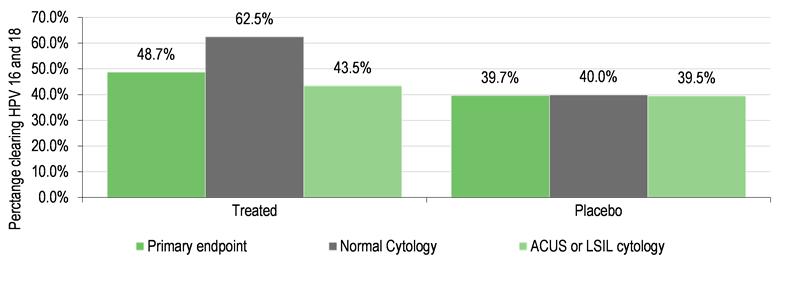
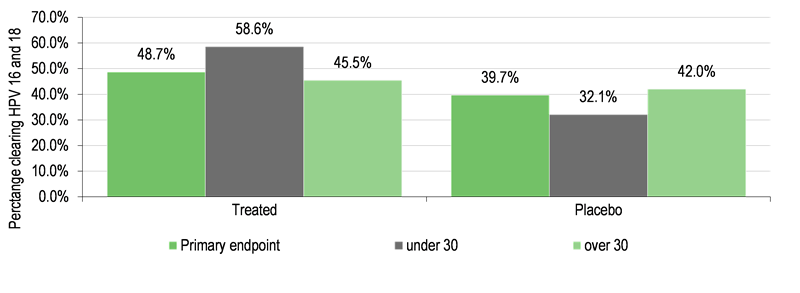
GTL001 activates a specific T-Cell immune response to destroy cervical cells infected with HPV 16 and/or 18. The double blind, placebo-controlled Phase II study reported on 233 patients of whom 73% had ASCUS/LSIL cytology with 27% normal. The 12-month primary endpoint was a significantly higher viral clearance measured using a highly sensitive PCR test. This showed no significant difference to placebo (48.7% vs 39.7%, a 23% difference, p=0.110). There were two subgroup signals: firstly, in cytology negative women (62.5% clearance vs 40%, p=0.018); and, secondly, in women under 30 (58.6% vs 32.1%, p=0.049).
Valuation: Further data and deal prospects needed
The need for further data may postpone a partnering deal until H217 so a 2022 launch now looks realistic (2021 previously); a 15% royalty is assumed. The market is mainly women with no cytology who need to be identified by primary HPV screening, assumed to become standard by 2022. Some patients with cellular abnormalities are assumed to receive therapy. The assumption that older women might gain extra benefit from vaccination has been removed. The Phase II probability for women with normal cytology has been reduced from 45% to 40% as the move to Phase III now rests on achieving an overall higher clearance at 18 or 24 months. The partnering probability has been adjusted from 60% to 55%. On this basis, we estimate a risk-adjusted indicative value of about €89m, or €5.75 per share before dilution (€5.26 inc dilution). Genticel had year-end cash of €21.7m.
Investment summary
Genticel has two products: GTL001 and GTL002 (Exhibit 1). GTL001 is in Phase II (12-month initial data released) testing HPV 16 or 18 infected women with either no or only low-grade cervical abnormalities. Infected women are at risk of progressing to high-risk, pre-cancerous cervical lesions. Genticel aims to find a partner to run the two Phase III studies needed for EMA and FDA approvals and to market globally; this will need a successful 18-month data outcome. GTL002, in preclinical, could expand the market by treating up to six HPV types including HPV 16 and 18. GTL001 was developed using CyA vaccine technology licensed from Institut Pasteur in 2002; GTL002 uses enhanced CyA technology (Vaxiclase).
Exhibit 1: Genticel’s product portfolio
Product |
HPV types |
Status |
Potential launch |
Other |
GTL001 |
16 and 18 |
Phase II, data released |
2022 |
Primary endpoint not met at 12 months but 18- and 24-month clearance data being accumulated with viral load data to be released. Two pre-specified secondary endpoints did show significant clearance differences in normal cytology women and in women under 30. |
Phase II US |
Safety study, first patient treated. |
|||
GTL002 |
16 and 18 and four other HPV types |
Late preclinical |
2026 |
Assume to be bundled with GTL001. |
Source: Edison Investment Research based on Genticel announcements
Human papillomavirus (HPV)
All invasive cervical cancer (ICC) is caused by HPV, a sexually transmitted infection. Note that terminology is fully discussed in the January 2015 Edison initiation note with a detailed market overview.1
In summary, women (and men) are infected by HPV by sex, the rate is estimated in Holland at 6.9% per contact. In women, the virus can cause cellular abnormalities in the cervix. These can be detected by a cervical swab test, now normally done using a small brush to collect cells: Liquid based cytology (LBC). Abnormal cells are classed as abnormal cells of unknown significance (ASCUS, or low-grade (LSIL) or high-grade (HSIL) lesions. All these are precancerous. On microscopic histological examination, cells can be classed as CIN (cervical intraepithelial neoplasia) grades 1-3. Grade 1 equates roughly to LSIL and grades 2 and 3 to HSIL. ASCUS is a broad class, mostly harmless but can contain some CIN 2 and CIN3 cases on detailed examination. The direct examination of the cervix is called colposcopy. HPV can also be detected by a PCR diagnostic done on a vaginal swab sample. If HPV 16 or 18 is found, a colposcopy examination with any lesions referred to histology is recommended. Only CIN3 must be treated by local surgical removal of lesions to stop progression to cancer. Some CIN2 cases many also be treated. HPV 16 and 18 normal cases or with ASCUS or/CIN1 are watched but not currently treated. Most HPV infections clear naturally. Lesions due to persistent infection develop slowly in most cases although there are some tragedies when aggressive lesions are missed.
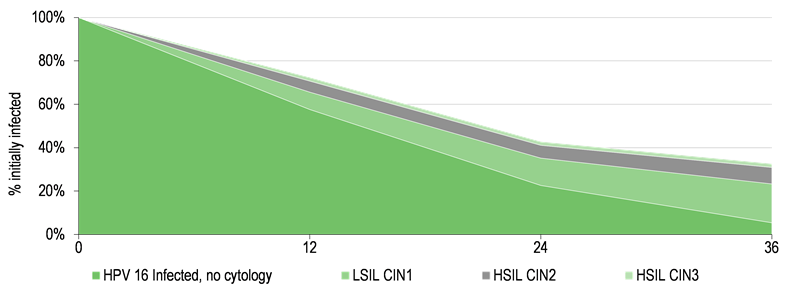
Studies (Rositch 2013) show that persistent high-risk HPV infections lead to a higher risk of developing precancerous cervical abnormalities (lesions) with a risk of ICC. In women aged 27 or under, the weighted median HPV 16 infection period was just under 12 months. Insinga (2011) found over 36 months that 9.3% of HPV 16 +ve cases developed high-risk CIN2/3 but 67% of women naturally cleared the virus, Exhibit 2. However, this data was in women aged 27 or under.
In a Dutch study (Coupé 2009) using primary HPV screening, the prevalence rate of HPV16 peaked at age 22 with 8% of women infected. The rate drops quickly to about 3% by age 30 then falls further to under 1% by age 40. A model of HPV acquired immunity (Matthijsse 2015) (based on the well-studied Dutch population) indicates that half of HPV cases resolve in a year and that by age 30, about 20% of women retain immunity to HPV 16. The model also suggests that 50% of people who clear the virus lose their immunity within a year and so are vulnerable to reinfection.
Natural clearance rates by HPV type were studied in the 44,100 patient POBASCAM trial, reported in Bulkmans 2007. This found that 49% of HPV16 and 55% of HPV 18 infections cleared naturally within a year in women with normal cytology. The clearance was much lower if abnormal cells were present: 19% and 45% respectively at 18 months. Given that one would expect a high level of HPV16 infections in women with ASCUSA/LSIL cytology and that these women have low clearance rates (based on POBASCAM data) and that only 25% of patients were normal with higher clearance rates, the observed placebo clearance rate seems high.
Genticel expected from its Phase I data to have 40-50% natural clearance rates in cytological normal women; no women with ASCUS or LSIL were included in the Phase I.
|
Exhibit 2: HPV 16 infection clearance in women aged 27 or younger |
|
|
Source: Insinga et al (2011), Edison Investment Research |
Phase II endpoints and data so far
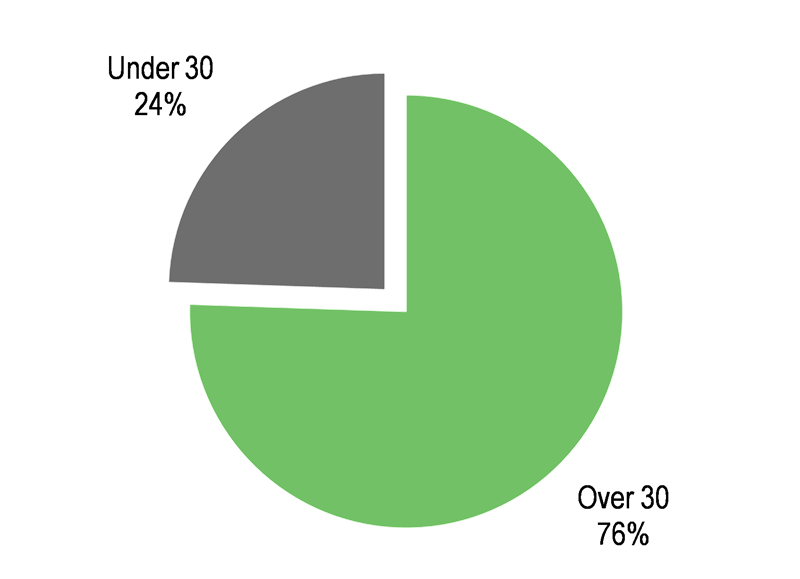
The Phase II (NCT01957878) had 73% of women with ACUS or LSIL, Exhibit 3. Genticel comments this is because clinicians felt these had a higher treatment priority but it might also be that they are also easier to identify since routine cervical cancer screening in Europe is currently liquid-based cytology based with follow up HPV triage. This group will be a key target for Phase III recruitment if the aim is to show reduced progression to higher-grade lesions. The population was also biased (over 75%) to women over 30, who tend to have a lower HPV prevalence and a higher rate of cytology, Exhibit 4; see the January note for an epidemiological discussion. The trial used a different population to the Phase I group; the Phase I patients all had normal cytology.
|
Exhibit 3: Trial population by cytology |
Exhibit 4: Trial, population by age |
|
|
|
Source: Genticel data |
|
Exhibit 3: Trial population by cytology |
|
|
Source: Genticel data |
|
Exhibit 4: Trial, population by age |
|
|
Source: Genticel data |
The primary endpoint in Phase II, based on 233 reported patients, was a statistically significant increase in clearance rate at 12 months. Secondary endpoints were 6, 15, 18 and 24-month clearance rates. To achieve the primary endpoint, a relative increase in clearance of about 40% was needed (to 55.6%); the outcome was a 23% increase to 48.7%, p=0.11.
A key piece of data not yet disclosed is the breakdown of results by HPV type. The literature indicates about 65% HPV 16 and 35% HPV 18 in normal cytology cases.
Subgroup analysis by cellular status
The Phase I data comparing the primary endpoint with the cellular status subgroups is in Exhibit 5.
|
Exhibit 5: Primary endpoint compared to cytology-based subgroup analysis |
|
|
Source: Edison Investment Research based on Genticel Data |
A puzzle in this data is that given that ASCUS and LSIL patients with HPV 16 are expected to have much lower clearance rates, see above, the placebo rate is the same as in normal patients. Normal patients show 40% clearance (12/30 cases) – about what one expect. If the rate in ASCUS patients had been closer to 30%, which one might have expected based on a 66% HPV 16 share and the POBASCAM data, the placebo group could have had a clearance rate of well under 40% so the gap to the treated group could have been much greater. Genticel does not yet have the breakdown by cytology grade or viral load and these might be important factors in further analysis.
Younger women (under 30)
Interestingly, there was also a subgroup signal (Exhibit 6) showing that younger women treated with GTL001 cleared the virus faster than those given a placebo. This was statistically significant p=0.048 but the numbers are small (17 treated vs nine placebo). The subgroup cytology was not disclosed but may have had an impact. The placebo rate is much lower than seen otherwise. There is no data on the cellular or HPV type status.
|
Exhibit 6: Primary endpoint compared to subgroups of women aged under 30 and over 30 |
|
|
Source: Edison Investment Research based on Genticel Data |
A Columbian paper (Munoz 2009) observed that younger women cleared HPV 16 more slowly (median clearance 16.6 months) relative to women over 30 (median clearance 9.5 months). There was no difference for HPV 18. Note that as with any subgroup analysis, the numbers being analysed can become small (41 HPV 16 vs 75 HPV 18 patients in the Munoz study) and there is a risk of bias when selecting interesting results that may have occurred by small number fluctuation.
Viral load – new potential insights
Genticel has indicated that it will release viral load data when available. Quantitative Polymerase Chain reaction (qPCR) experiments can measure how much viral DNA is present. One would expect that patients with higher viral loads are more likely to have cytological abnormalities and take longer to clear naturally. In a large longitudinal Dutch study (Hesselink 2009) higher viral loads were indeed correlated with a higher risk of progression to CIN2 or CIN3 (the higher-risk precancerous stages) although this was not a reliable predictive diagnostic marker for screening. Xi et al (2009) concluded that: “Higher viral load of prevalent HPV 16 or HPV 18 infection was associated with short- but not long-term persistence”. The Munoz 2009 study cited earlier showed that patients with a top fifth quartile viral load cleared more slowly (median about 12 months) than those with the lowest quartile load (median about eight months).
At present, viral load data is not available but it might help to clarify some the of the Phase II data and be crucial to gaining a partner for Phase III. Investors should note that such data is more technical than a simple yes/no clearance test and in a small trial, could lead to over analysis. Genticel also used a very sensitive PCR assay in Phase II. For Phase III, Genticel is evaluating the Roche Cobas 4800 system, FDA approved for primary screening,
Next stages – partnering and progression to Phase III
Phase II is an exploratory stage to gain valuable additional data and not a pivotal study. It will achieve its objective once it enables a partnering deal. The Phase II will continue and will collect patient data at 15, 18 and 24 months. Genticel expects that 18-month data will trigger Phase III preparation. Numerically, looking at the cytology subgroups, if the placebo rate at 18 months rises to 50% (this could be in the 50-60% range, Exhibit 2), the clearance rate in the ASCUS/LSIL group needs to increase further from the 12-month result by at least 60% for ASCUS/LSIL and by over 25% for normal: this would take the values to 70% and 78% vs 50% placebo. Such an ASCUS/LSIL response would be a major advance in a six-month period with no further treatment.
Given the non-achievement of the primary endpoint, the probability has been reduced marginally to 40% (from 45%) for normal cytology infected women where the subgroup data is still supportive of an effect. In women with low-grade cytology, the probability has been reduced to 20% (from 45%).
Phase III has been assessed by Genticel management as costing between €100m and €150m to run with two 1,200 patient Phase III trials required. This depends on the exact design and patient monitoring programme required. The Phase III will use a clinical endpoint, probably based on reducing the incidence of higher-grade lesions. Phase II is therefore indicative of the Phase III outcome, but not necessarily predictive. This strategy is similar to the development route used to gain approval of prophylactic vaccines.
The Phase III design envisaged by management might change if the indication is limited to treatment of cytology-normal HPV 16 and 18 infections. Recruitment of these patients will require extensive primary HPV screening, which does not routinely exist currently in Europe or the US.
Market forecast adjustments
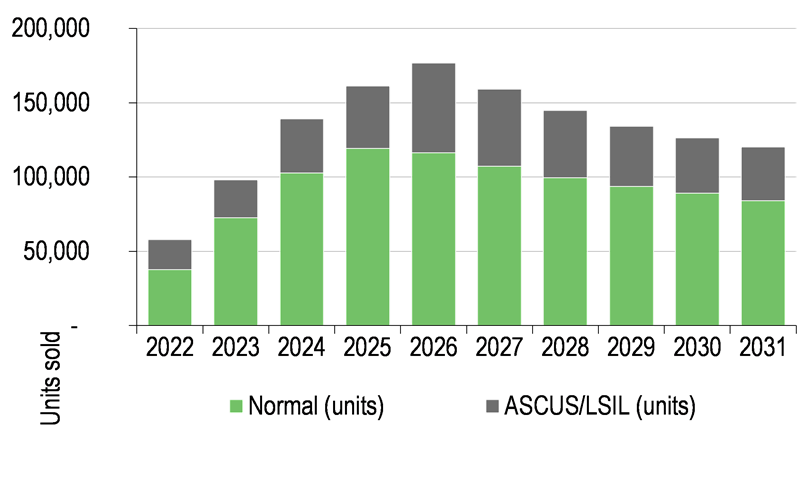
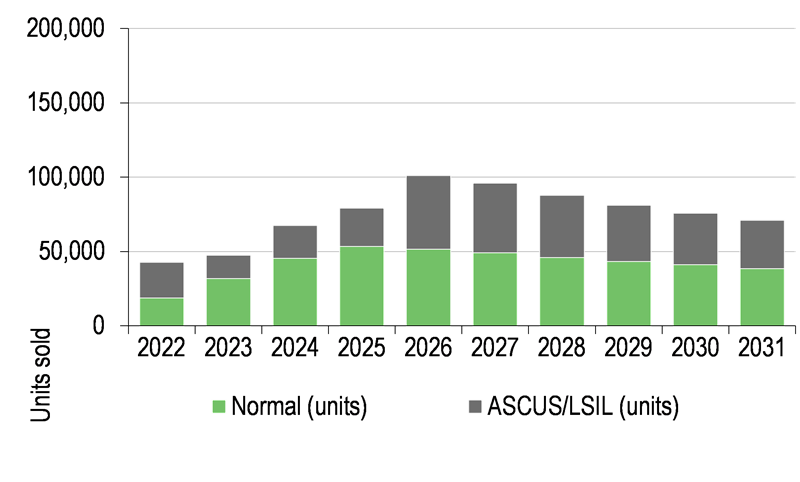
We have moved the expected GTL001 launch date back by a year from 2021 to 2022 as partnering is now more likely in H217, implying a later start to the Phase III programme. It was expected that the low-grade cytology segment, although fewer in number, would gain a higher market share than the normal cytology segment. Since it is not now certain that low-grade cytology patients will benefit, this has been altered to match the 40% market share of cytology normal. The original model envisaged a need for vaccination to treat persistent infections in older women at risk of progression. This need is still apparent but the Phase II data to date indicates better performance in women under 30 so the market share is assumed to be level across age cohorts, whereas before there was an assumption of higher use in more mature cohorts with more persistent infections. Exhibit 7 shows the revised, non-risk adjusted market projection for Europe and Exhibit 8 the US forecast. The US is higher despite a lower population as it has a higher rate of screening than Europe and is also assumed to be more likely to treat normal cytology infected women.
|
Exhibit 7: Forecast leading European markets by unit sales and cellular status (non-risk adjusted) |
Exhibit 8: Forecast US market by unit sales and cellular status (non-risk adjusted) |
|
|
|
Source: Edison Investment Research |
|
Exhibit 7: Forecast leading European markets by unit sales and cellular status (non-risk adjusted) |
|
|
Source: Edison Investment Research |
|
Exhibit 8: Forecast US market by unit sales and cellular status (non-risk adjusted) |
|
|
Source: Edison Investment Research |
Sensitivities
2014 prophylactic HPV vaccine sales by Merck and GSK were $2bn, showing the demand for treatments to manage HPV infections. GTL001 could develop a strong new market as an ‘active’ therapeutic vaccine that proves to be more socially acceptable than the prophylactic HPV vaccination of teenage girls. This could enable a premium price. For cytology-negative women, the new Phase II data supports this. Under current LBC screening systems, most of this market is invisible so a key assumption is that primary HPV screening is standard by 2022. GTL002 will expand the market further. A heightened sensitivity is on a deal: Genticel remains confident but 18 and/or 24-month data needs to be very supportive of the clinical and commercial case given the Phase III investment needed. In younger women, with a positive Phase II subgroup result, the HPV prevalence will progressively reduce due to on-going prophylactic vaccination. Treatment guidelines after GTL001 approval will need revising and then adoption, which can take time.
Valuation
Our valuation is based on the current two projects and a partnering deal in H217. This partnering assumption means that the likely launch date might now be 2022, formerly 2021; a 15% royalty is still assumed. Genticel aims to develop other projects targeting other viruses and cancer (a patent was granted in H115), but these are not included in the NPV as they are early preclinical. Hence, only a basic cost level is assumed after the potential deal in 2017. In reality, Genticel will have admin and R&D costs on other projects, but these expenses are not included as no revenues are attributed to them. The forecasts and valuation run to 2037 when GTL002 exclusivity expires. There is a royalty and deal fee share to the Institut Pasteur, which is undisclosed but we assume is 5%.
The valuation at a 12.5% discount rate is shown in Exhibit 9. The value is heavily affected by French corporate tax (33.3%), but this might be reclaimed by investment in new projects so 24% is assumed. There are cash repayments of financial advances from government agencies totalling €2.3m, paid in instalments between 2016 and 2020; these are discounted at 2.5% to €2.2m. Note that debt rose by €0.9m (before discounting) due to a repayable advance received in late 2015.
The market is mainly women with no cytology who need to be identified by primary HPV screening, assumed to become standard by 2022. Some ASCUS patients are assumed to receive therapy. The Phase II probability of normal cytology cases has been reduced from 45% to 40% as the move to Phase III and partnering now rests on achieving an overall higher clearance at 18 or 24 months, which is less certain in our view. The ASCUS/LSIL probability was reduced from 45% to 20%, that is, to an early Phase II probability based on the data presented to date. The predicted market shares of normal and ASCUS/LSIL cases are assumed to be the same at 40% peak penetration with no increased use with age. The partnering probability was adjusted from 60% to 55% due to the delay in entering formal negotiations and the data to date. On this basis, we estimate a risk-adjusted indicative value of about €89.4m, or €5.75 per share before dilution (€5.26 inc dilution). Cash is not included in the valuation, as this is required to fund the company through until 2017.
Exhibit 9: Valuation
NPV @ 12.5% |
Value (€m) |
GTL001 |
76.5 |
GTL002 |
14.7 |
RoW |
27.5 |
Total royalty NPV |
119 |
Deal value NPV |
46.2 |
Institute Pasteur royalty |
-7.0 |
NPV GTL001 costs |
-38.8 |
Debt (2.5% discount rate) |
-2.2 |
Tax @ 24% |
-27.5 |
Total DCF value |
89.4 |
Shares m |
15.54 |
Value/share |
€5.75 |
Warrants m |
1.44 |
Diluted value/share |
€5.26 |
NPV @ 12.5% |
Value (€m) |
GTL001 |
76.5 |
GTL002 |
14.7 |
RoW |
27.5 |
Total royalty NPV |
119 |
Deal value NPV |
46.2 |
Institute Pasteur royalty |
-7.0 |
NPV GTL001 costs |
-38.8 |
Debt (2.5% discount rate) |
-2.2 |
Tax @ 24% |
-27.5 |
Total DCF value |
89.4 |
Shares m |
15.54 |
Value/share |
€5.75 |
Warrants m |
1.44 |
Diluted value/share |
€5.26 |
Source: Edison Investment Research
Financials
The loss should reduce in 2016 and 2017 as the Phase II study is now in the follow-up phase. The new assumption is that partner development funding is from 2018. However, preclinical work on GTL002 might intensify and other development projects, for example in cancer, are ongoing and may gain a higher priority. Genticel had year-end cash of €21.7m, about €0.9m more than expected due to receipt of a BpiFrance repayable advance. The cash is probably sufficient to last till late 2017 but a deal with substantial upfront or a further funding will then be needed.
Genticel has a liquidity contract with Bank Oddo & Cie to trade Genticel shares to stimulate the liquidity and regular listing of its shares and avoid share price discrepancies not justified by market trends. The cash deposit made in 2014 was €200k. As of 31 December 2015, the arrangement had acquired 15,108 Genticel treasury shares.
Our financial forecast is summarised in Exhibit 10. This has been updated to reflect the disclosed cash position and amended debt level.
Exhibit 10: Financial summary
€ 000 |
2014 |
2015e |
2016e |
2017e |
Year End December |
IFRS |
IFRS |
IFRS |
IFRS |
PROFIT & LOSS |
||||
Revenue |
0 |
88 |
0 |
0 |
Cost of Sales |
0 |
0 |
0 |
0 |
Gross Profit |
0 |
88 |
0 |
0 |
EBITDA |
(10,736) |
(11,365) |
(8,813) |
(6,413) |
Operating Profit (before amort. and except.) |
(10,764) |
(11,415) |
(8,863) |
(6,463) |
Intangible Amortisation |
(8) |
(4) |
(4) |
(4) |
Exceptionals |
0 |
0 |
0 |
0 |
Other |
0 |
0 |
0 |
0 |
Operating Profit |
(10,771) |
(11,418) |
(8,867) |
(6,467) |
Net Interest |
105 |
156 |
156 |
156 |
Profit Before Tax (norm) |
(10,659) |
(11,259) |
(8,707) |
(6,307) |
Profit Before Tax (FRS 3) |
(10,667) |
(11,262) |
(8,711) |
(6,311) |
Tax |
0 |
0 |
0 |
0 |
Profit After Tax (norm) |
(10,631) |
(11,209) |
(8,657) |
(6,257) |
Profit After Tax (FRS 3) |
(10,667) |
(11,262) |
(8,711) |
(6,311) |
Average Number of Shares Outstanding (m) |
13.8 |
15.4 |
15.4 |
15.4 |
EPS - normalised (c) |
(77.0) |
(72.6) |
(56.1) |
(40.5) |
|
|
|
|
|
EPS - (IFRS) (c) |
(77.3) |
(72.9) |
(56.4) |
(40.9) |
Dividend per share (p) |
0.0 |
0.0 |
0.0 |
0.0 |
Gross Margin (%) |
NA |
NA |
NA |
NA |
EBITDA Margin (%) |
NA |
NA |
NA |
NA |
Operating Margin (before GW and except.) (%) |
NA |
NA |
NA |
NA |
BALANCE SHEET |
||||
Fixed Assets |
228 |
293 |
339 |
386 |
Intangible Assets |
19 |
14 |
10 |
7 |
Tangible Assets |
95 |
145 |
195 |
245 |
Fixed term investments |
10,076 |
10,301 |
10,526 |
0 |
Other |
114 |
134 |
134 |
134 |
Current Assets |
25,911 |
15,560 |
6,694 |
10,421 |
Stocks |
31 |
60 |
60 |
60 |
Debtors |
552 |
600 |
600 |
600 |
Cash |
22,727 |
11,400 |
3,034 |
7,261 |
Other |
2,600 |
3,500 |
3,000 |
2,500 |
Current Liabilities |
(4,000) |
(4,032) |
(3,840) |
(3,632) |
Creditors |
(3,488) |
(3,382) |
(3,382) |
(3,382) |
Short term borrowings |
(512) |
(650) |
(457) |
(250) |
Long Term Liabilities |
(2,026) |
(2,430) |
(1,796) |
(1,562) |
Long term borrowings |
(1,646) |
(2,050) |
(1,416) |
(1,183) |
Other long term liabilities |
(380) |
(380) |
(380) |
(380) |
Net Assets |
20,113 |
9,391 |
1,398 |
5,612 |
CASH FLOW |
||||
Operating Cash Flow |
(9,952) |
(11,922) |
(7,788) |
(5,388) |
Net Interest |
105 |
156 |
156 |
156 |
Tax |
0 |
0 |
0 |
0 |
Capex |
(73) |
(100) |
(100) |
(100) |
Acquisitions/disposals |
0 |
0 |
0 |
0 |
Financing |
38,752 |
(429) |
(634) |
(441) |
Dividends |
0 |
0 |
0 |
0 |
Net Cash Flow |
28,831 |
(12,295) |
(8,366) |
(5,773) |
Opening net debt/(cash) |
(2,125) |
(30,645) |
(19,001) |
(11,686) |
HP finance leases initiated |
0 |
0 |
0 |
0 |
Other |
(311) |
650 |
1,052 |
(85) |
Closing net debt/(cash) |
(30,645) |
(19,001) |
(11,686) |
(5,828) |
Source: Genticel accounts, Edison Investment Research forecasts
|