Prima BioMed has changed its name to Immutep Limited following shareholder approval in November. It reported an encouraging 33% preliminary response rate from the first two cohorts of the TACTI-mel trial of IMP321 (eftilagimod alpha) in combination with Keytruda in melanoma patients who had not achieved a meaningful therapeutic benefit from Keytruda monotherapy. The 33% response rate is double the rate we would have anticipated had these patients continued on Keytruda alone, and suggests that IMP321 is working as expected to boost immune responses when combined with immune checkpoint inhibitors (ICIs). The final cohort is expected to be fully recruited by Q417, and efficacy data from all three cohorts are expected in Q218. Our valuation is unchanged at A$272m (12c per share).
Written by
Immutep |
Encouraging LAG-3 combo data at SITC |
Initial TACTI-mel data |
Pharma & biotech |
11 December 2017 |
Share price performance
Business description
Next events
Analysts
|
||||||||||||||||||||||||||||||||||||||||||||||||||||
Prima BioMed has changed its name to Immutep Limited following shareholder approval in November. It reported an encouraging 33% preliminary response rate from the first two cohorts of the TACTI-mel trial of IMP321 (eftilagimod alpha) in combination with Keytruda in melanoma patients who had not achieved a meaningful therapeutic benefit from Keytruda monotherapy. The 33% response rate is double the rate we would have anticipated had these patients continued on Keytruda alone, and suggests that IMP321 is working as expected to boost immune responses when combined with immune checkpoint inhibitors (ICIs). The final cohort is expected to be fully recruited by Q417, and efficacy data from all three cohorts are expected in Q218. Our valuation is unchanged at A$272m (12c per share).
Year |
Revenue |
PBT* |
EPS* |
DPS* |
P/E |
Yield |
06/16 |
1.9 |
(13.7) |
(0.6) |
0.0 |
N/A |
N/A |
06/17 |
4.1 |
(8.4) |
(0.4) |
0.0 |
N/A |
N/A |
06/18e |
3.5 |
(8.4) |
(0.4) |
0.0 |
N/A |
N/A |
06/19e |
10.5 |
(0.0) |
(0.0) |
0.0 |
N/A |
N/A |
Note: *PBT and EPS are normalised, excluding amortisation of acquired intangibles, exceptional items and share-based payments.
Encouraging preliminary response rate in TACTI-mel
The TACTI-mel trial is using IMP321 (eftilagimod alpha, Immutep’s LAG-3-based antigen presenting cell activator) to enhance efficacy in melanoma patients who have had a suboptimal initial response to the PD1 immune checkpoint inhibitor Keytruda. A poster presentation to the Society for Immunotherapy of Cancer (SITC) conference reported that 58% (7/12) of subjects in cohorts 1 and 2 have experienced a reduction in tumour burden, including 33% (4/12) achieving a tumour response (at least a 50% reduction in tumour burden). The combination has been well tolerated so far. Recruitment in the third and highest dose cohort is expected to complete in Q417, so we expect efficacy data from all three cohorts in Q218.
News from other projects anticipated in CY18
Final results from the 15-patient safety run-in phase of the AIPAC Phase II study of IMP321 plus paclitaxel in breast cancer are expected in Q417, although the previously reported 47% preliminary response rate is not expected to change. The 226-patient AIPAC study is expected to fully recruit in H118 and report first results by mid-2019. News is also expected from the ongoing LAG-3 programmes partnered with Novartis and GlaxoSmithKline (GSK).
Valuation: Unchanged at A$272m, 12c per share
Our valuation is unchanged at A$272m, which is equal to 12c per share on an undiluted basis or 8c per share after accounting for dilution from options, warrants and convertible notes. The cash balance at 30 September was A$16.9m. Company guidance is that cash reserves will be sufficient to fund operations to Q4 CY18, excluding any further milestone payments from partners Novartis and GSK. Milestone revenue would extend the cash runway (we model ~A$8m of milestone revenue in FY19).
Encouraging response rate in first TACTI-mel cohorts
Immutep’s chief medical and scientific officer, Dr Frédéric Triebel, reported an encouraging 33% preliminary response rate from the first two cohorts of the Phase I TACTI-mel trial, at the SITC 2017 Annual Meeting in National Harbor, Maryland, on 10-12 November. This study is testing three doses of IMP321 (1, 6 and 30mg/kg) in combination with the anti-PD-1 immune checkpoint inhibitor Keytruda (pembrolizumab, Merck) in 18 patients with advanced melanoma, as shown in Exhibit 1.
|
Exhibit 1: TACTI-mel Phase I status and preliminary results |
|
|
Source: Immutep presentation at SITC 2017 Annual Meeting, National Harbor, Maryland |
The trial is investigating IMP321 in subjects who have had a suboptimal response to initial treatment with Keytruda. Subjects are assessed after they have undergone a screening period of three cycles (nine weeks) of treatment with Keytruda; patients with stable disease or progressive disease not requiring urgent intervention are eligible to participate in the trial and receive IMP321, starting with the fifth Keytruda cycle at week 13. The green triangle at the left-hand side of Exhibit 2 gives an indication of the typical changes in tumour size in the screening period in patients who would be eligible to participate in the combination immunotherapy trial.
In Exhibit 2, the spider plot of changes in tumour burden shows that 4/12 (33%) of the patients who were treated with IMP321 combination therapy in the first two TACTI-mel cohorts experienced at least a 50% reduction in tumour burden, including three partial responses and one complete response. Exhibit 2 also shows that 7/12 (58%) of patients had at least some tumour shrinkage after IPM321/Keytruda combination therapy.
|
Exhibit 2: Spider plots of tumour responses from TACTI-mel cohorts 1 and 2 |
|
|
Source: Immutep presentation at SITC 2017 Annual Meeting, National Harbor, Maryland |
The design of the TACTI-mel study is unique, as far as we are aware, so we are unable to directly compare the results of this study to any previous study. We have therefore drawn some tentative conclusions by looking at data from two separate studies to estimate the response rate that we might have expected to see if the patients had continued to receive Keytruda monotherapy.
While bearing in mind the small number of patients who have been evaluated to date, and the usual provisos about the limitations of cross-trial comparisons, our analysis suggests that the 33% response rate in the TACTI-mel study in patients who had not gained meaningful therapeutic benefit from Keytruda monotherapy might be double the response rate that would have been expected had these patients continued on Keytruda monotherapy, as outlined below.
Firstly, to understand how quickly melanoma patients typically respond to Keytruda we examined spider plots of individual patient responses over time from a study by Nishino et al1 of 96 melanoma patients treated with Keytruda at the Dana-Farber Cancer Institute and Brigham and Women's Hospital, Boston, Massachusetts. We estimate that in the Nishino study about 75% of the responders had achieved at least a partial response within 12 weeks of commencing treatment with Keytruda.
Nishino et al. Clin Cancer Res. 2017 Aug 15;23(16):4671-4679. doi: 10.1158/1078-0432.
Secondly, applying this breakdown to the 33% response rate reported for the Keytruda melanoma registration study suggests that, on average, about 25% of melanoma patients would be expected to have responded (significant tumour shrinkage) by 12 weeks, and 8% would achieve a response during the subsequent period of treatment.
Furthermore, in the Nishino study, about 12% of subjects had progressed rapidly during the first 12 weeks of treatment. If the pattern of responses in patient population in TACTI-mel is similar to that in the two studies above, then we would expect that 37% of subjects would be excluded from the study at the end of the screening period because they either progressed rapidly (12%) or achieved at least a partial tumour response within the first 12 weeks (25%), thus leaving about 63% of the screening population eligible to participate in the main study. Therefore, if 8% of the screening population was expected to have a delayed tumour response (ie after 12 weeks), this would be equivalent to 13% of subjects eligible for the main study (ie eight delayed responders per 100 subjects screened, divided by ~63% of subjects eligible to participate in the combination therapy arm).
The response rate of 33% reported for the first two TACTI-mel cohorts is double the predicted 13% response rate based on the calculation outlined above. However, we emphasise that there is considerable uncertainty about the predicted response rate which is based on assumptions derived from two separate studies.
Furthermore, looking at Exhibit 2 we can see that there is a potential for additional patients from cohort 2 to eventually achieve a partial response at future assessment points if their tumours continue to shrink at the current rate, which would boost the overall response rate.
Complete response in a patient who progressed on Keytruda
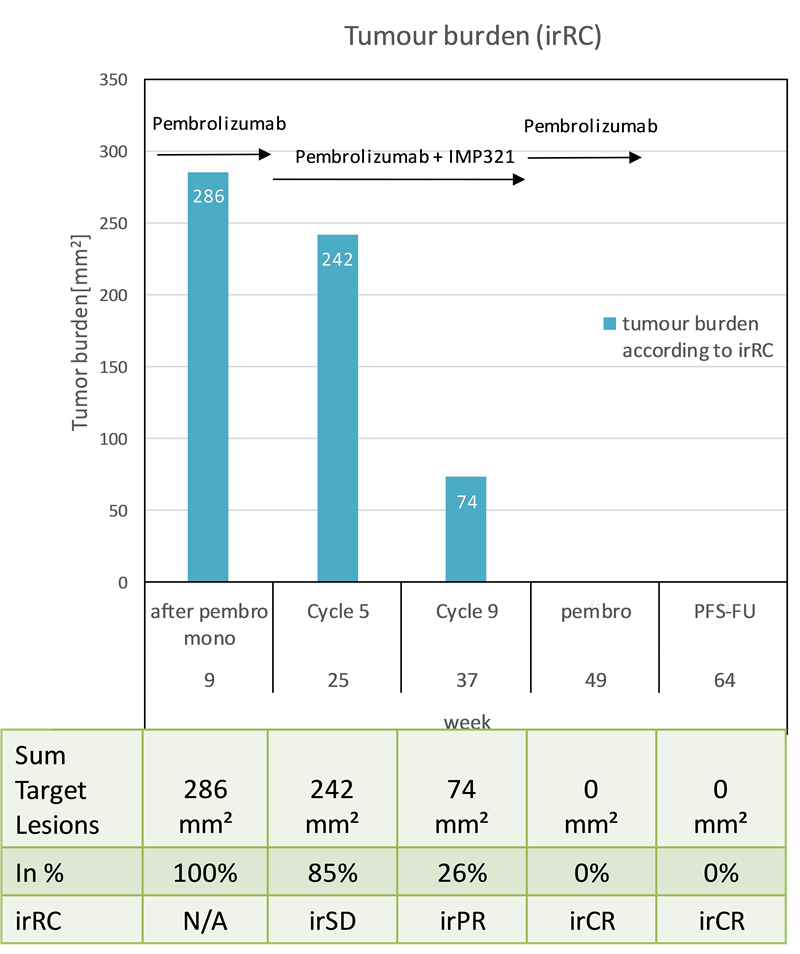
Exhibit 3 shows that a patient whose disease had progressed on Keytruda monotherapy subsequently experienced a complete response (tumours disappeared altogether) after being treated with the lowest (1 mg/kg) dose of IMP321 in combination with Keytruda.
While delayed responses are a well-recognised (though relatively uncommon) feature of therapy with ICI, this complete response suggests that IMP321 is having the desired effect of boosting immune responses and providing a clinical benefit over ICI monotherapy.
|
Exhibit 3: TACTI-mel first cohort (1mg/kg IMP321) complete responder |
|
|
|
|
Source: Immutep presentation at SITC 2017 Annual Meeting, National Harbor, Maryland |
|
|
Exhibit 3: TACTI-mel first cohort (1mg/kg IMP321) complete responder |
|
|
|
|
|
|
Source: Immutep presentation at SITC 2017 Annual Meeting, National Harbor, Maryland |
No serious adverse events related to IMP321 or the combination of IMP321 with Keytruda have been reported so far; the combination was considered to be safe and well tolerated in advanced metastatic melanoma patients. Recruitment in the third and highest (30mg) dose cohort is well advanced and is expected to be completed in Q417.
Overall response rate among patients entering screening will be an important metric
At this stage Immutep has not reported details of the outcome of post-screening assessments, so we do not know how many patients achieved tumour responses or experienced rapid progression during the screening period. Based on our analysis above, and assuming that subjects are not excluded from the study for reasons other than response or rapid progression, we estimate that the overall response rate (ORR) among patients entering screening could be around 50%, including the patients who responded during screening monotherapy and those who responded to IMP321 combination therapy. However, we emphasise the uncertainty surrounding this estimate which is driven by assumptions drawn from two separate studies.
The low toxicity associated with IMP321 so far could, if confirmed at the therapeutic dose, give it a competitive advantage compared to some of the other combination therapies. The trial design potentially positions IMP321 as an add-on therapy in patients with suboptimal responses in first-line immunotherapy with ICI drugs such as Keytruda and Opdivo.
If the efficacy of combination immunotherapy with IMP321 is confirmed in melanoma, there is the potential to extend its use to other diseases where ICI drugs have been approved, including lung, liver, kidney, bladder, stomach and colon cancers.
Forecasts and valuation maintained
We leave our forecasts and valuation unchanged as we await updated TACTI-mel efficacy data in Q218, and potential news from Novartis and GSK on partnered LAG3 programmes.
Exhibit 4: Financial summary
A$'000s |
2015 |
2016 |
2017 |
2018e |
2019e |
||
Year end 30 June |
IFRS |
IFRS |
IFRS |
IFRS |
IFRS |
||
PROFIT & LOSS |
|||||||
Revenue |
|
|
1,336 |
1,949 |
4,117 |
3,500 |
10,495 |
R&D expenses |
(8,952) |
(7,060) |
(7,526) |
(7,752) |
(6,201) |
||
SG&A expenses |
(5,723) |
(6,983) |
(4,347) |
(4,477) |
(4,612) |
||
EBITDA |
|
|
(13,345) |
(12,093) |
(7,756) |
(8,729) |
(318) |
Operating Profit (before GW and except.) |
|
(13,671) |
(12,275) |
(7,770) |
(8,732) |
(321) |
|
Intangible Amortisation |
(1,015) |
(1,993) |
(1,688) |
(1,712) |
(1,558) |
||
Exceptionals |
(18,338) |
(47,468) |
0 |
0 |
0 |
||
Operating Profit |
(33,024) |
(61,736) |
(9,458) |
(10,444) |
(1,879) |
||
Other |
538 |
(1,716) |
(752) |
0 |
0 |
||
Net Interest |
192 |
256 |
104 |
367 |
286 |
||
Profit Before Tax (norm) |
|
|
(12,940) |
(13,735) |
(8,417) |
(8,365) |
(35) |
Profit Before Tax (IFRS) |
|
|
(32,294) |
(63,196) |
(10,105) |
(10,077) |
(1,593) |
Tax |
142 |
1,181 |
737 |
0 |
0 |
||
Profit After Tax (norm) |
(12,798) |
(12,554) |
(7,680) |
(8,365) |
(35) |
||
Profit After Tax (IFRS) |
(32,152) |
(62,015) |
(9,368) |
(10,077) |
(1,593) |
||
Average Number of Shares Outstanding (m) |
1,490.1 |
2,016.6 |
2,072.5 |
2,079.7 |
2,358.4 |
||
EPS - normalised (c) |
|
|
(0.9) |
(0.6) |
(0.4) |
(0.4) |
(0.0) |
EPS - IFRS (c) |
|
|
(2.2) |
(3.1) |
(0.5) |
(0.5) |
(0.1) |
Dividend per share (c) |
0.0 |
0.0 |
0.0 |
0.0 |
0.0 |
||
Gross Margin (%) |
N/A |
N/A |
N/A |
N/A |
N/A |
||
EBITDA Margin (%) |
N/A |
N/A |
N/A |
N/A |
N/A |
||
Operating Margin (before GW and except.) (%) |
N/A |
N/A |
N/A |
N/A |
N/A |
||
BALANCE SHEET |
|||||||
Fixed Assets |
|
|
22,960 |
20,883 |
19,045 |
17,337 |
15,783 |
Intangible Assets |
22,662 |
20,852 |
19,020 |
17,309 |
15,751 |
||
Tangible Assets |
298 |
32 |
24 |
28 |
32 |
||
Other |
0 |
0 |
0 |
0 |
0 |
||
Current Assets |
|
|
8,023 |
21,671 |
15,919 |
13,204 |
13,165 |
Stocks |
0 |
0 |
0 |
0 |
0 |
||
Debtors |
315 |
168 |
2,194 |
2,194 |
2,194 |
||
Cash |
6,760 |
20,880 |
12,237 |
9,522 |
9,483 |
||
Other |
948 |
623 |
1,488 |
1,488 |
1,488 |
||
Current Liabilities |
|
|
(4,380) |
(1,472) |
(2,632) |
(2,632) |
(2,632) |
Creditors |
(2,791) |
(1,444) |
(2,589) |
(2,589) |
(2,589) |
||
Short term borrowings |
(1,508) |
(0) |
(0) |
(0) |
(0) |
||
Short term leases |
0 |
0 |
0 |
0 |
0 |
||
Other |
(80) |
(28) |
(43) |
(43) |
(43) |
||
Long Term Liabilities |
|
|
(1,914) |
(5,765) |
(5,799) |
(5,799) |
(5,799) |
Long term borrowings incl. conv. note |
0 |
(5,027) |
(5,779) |
(5,779) |
(5,779) |
||
Long term leases |
0 |
0 |
0 |
0 |
0 |
||
Other long term liabilities |
(1,914) |
(737) |
(20) |
(20) |
(20) |
||
Net Assets |
|
|
24,690 |
35,317 |
26,532 |
22,109 |
20,516 |
CASH FLOW |
|||||||
Operating Cash Flow |
|
|
(7,785) |
(11,594) |
(8,611) |
(8,729) |
(318) |
Net Interest |
0 |
284 |
104 |
367 |
286 |
||
Tax |
(2) |
0 |
0 |
0 |
0 |
||
Capex |
(49) |
(27) |
(7) |
(7) |
(7) |
||
Acquisitions/disposals |
(20,913) |
130 |
0 |
0 |
0 |
||
Financing |
7,745 |
27,229 |
(9) |
5,654 |
0 |
||
Dividends |
0 |
0 |
0 |
0 |
0 |
||
Other |
(164) |
0 |
0 |
0 |
0 |
||
Net Cash Flow |
(21,168) |
16,022 |
(8,522) |
(2,715) |
(39) |
||
Opening net debt/(cash) |
|
|
(23,200) |
(5,251) |
(15,852) |
(6,458) |
(3,743) |
HP finance leases initiated |
0 |
0 |
0 |
0 |
0 |
||
Other |
3,220 |
(5,421) |
(872) |
(0) |
0 |
||
Closing net debt/(cash) |
|
|
(5,251) |
(15,852) |
(6,458) |
(3,743) |
(3,703) |
Source: Company accounts, Edison Investment Research
|
|
Research: Industrials
Strong H118 results and positive order book development cause us to raise estimates, especially for the current year with better dividend prospects also. UK economic uncertainty will provide challenges but we believe that Severfield’s sector diversity and some pipeline project opportunities should allow the company to continue to grow. Further order book gains and the application of surplus cash balances (via investment or distribution) can be catalysts for further share price recovery.