Last close As at 17/08/2026
—
— 0.00 (0.00%)
Market capitalisation
—
Research: Metals & Mining
On 30 October, Lepidico announced the updated economics of its 2020 definitive feasibility study (DFS) on its integrated lithium hydroxide mine and chemical plant to show a base case NPV8 of US$457m post-tax, which equates to 9.4 Australian cents per share on a pre-funding basis. In our January 2019 report Gold stars and black holes, we calculated that companies with completed DFSs typically have an EV/NPV ratio of 30.9%, which would imply a pre-funding valuation for Lepidico of 2.9c/share, to which its shares are currently trading at a significant 69.0% discount.
Lepidico |
Development plan evolves |
Updated economics |
Metals and mining |
31 October 2023 |
Share price performance
Business description
Next events
Analyst
Lepidico is a research client of Edison Investment Research Limited |
|||||||||||||||||||||||||||||||||||||||||||||||||
On 30 October, Lepidico announced the updated economics of its 2020 definitive feasibility study (DFS) on its integrated lithium hydroxide mine and chemical plant to show a base case NPV8 of US$457m post-tax, which equates to 9.4 Australian cents per share on a pre-funding basis. In our January 2019 report Gold stars and black holes, we calculated that companies with completed DFSs typically have an EV/NPV ratio of 30.9%, which would imply a pre-funding valuation for Lepidico of 2.9c/share, to which its shares are currently trading at a significant 69.0% discount.
Year end |
Total revenues |
PBT |
Cash from operations (A$m) |
Net cash/(debt)* |
Capex |
06/22 |
0.0 |
(7.9) |
(5.5) |
1.0 |
(8.6) |
06/23 |
6.4 |
(3.0) |
(6.8) |
**3.1 |
(9.8) |
06/24e |
0.0 |
(3.7) |
(4.3) |
(34.4) |
(33.2) |
06/25e |
0.0 |
(6.9) |
(6.3) |
(90.4) |
(49.8) |
Note: *Includes lease liabilities. **Subject to rounding.
Phased development leads to lower net debt forecast
In deference to its desire to generate positive free cash flow as quickly as possible, we believe that Lepidico could pivot its strategy to fast-track the mine and concentrator in Namibia, shipping a high-grade concentrate from Walvis Bay to China. One way to achieve this, as well as avoiding additional dilution, we believe, would be via a pre-payment for concentrate to fund the equity component of the development capital or, alternatively, Lepidico could partner with a strategic investor. Among other things, this would allow it to defer any subsequent ‘HeadCo’ equity raise to a time when the share price is higher.
Valuation: 499% premium to the share price
Our assumptions are more conservative than both Benchmark Mineral Intelligence’s (BMI’s) and Lepidico’s, including a long-term lithium hydroxide price that is 24.1% lower than BMI’s. Given this, plus our assumption of mining revenues delayed by one year and chemical plant revenues delayed by three years, our headline valuation of Lepidico has declined from 8.61c/share at the time of our last note in February to 5.39c/share, plus a potential additional risk-adjusted 0.68–1.66c/share (fully diluted) for a conceptual 20,000tpa lithium carbonate equivalent (LCE) Phase 2 Plant to take our total aggregate conceptual valuation of the company to 6.07–7.05c/share. However, our 5.39c/share valuation nevertheless rises back to 9.84c/share in FY31 and to 10.17c/share currently if BMI’s lithium hydroxide price deck is applied to our model rather than our own, rather conservative, prices.
Updated economics and development plan
In its announcement of 30 October, Lepidico updated the operating costs and economics of its 2020 DFS relating to its integrated lithium hydroxide mine and chemical plant. The main features of the announcement were as follows:
■
An integrated project base case post-tax NPV8 of US$457m (cf US$221m in the 2020 DFS), with an operating life of 19 years (now including Helikon 4 and stockpiled ore reserves) compared to 15 years previously. Note that this brings Lepidico’s mine plan substantially into line with the one outlined in our last note on the company (see Everything moving all at once, published on 14 February 2023). The long-term lithium hydroxide price forecast used to generate this NPV8 was US$30,980/t (cf US$22,840/t in September 2022), as per BMI’s latest base case lithium hydroxide price analysis. Note, however, that our long-term lithium price remains (for the moment) unchanged at US$23,500/t. Variations from this price are considered in the ‘Sensitivities’ section, below).
■
A post-tax NPV8 for the Karibib mine operation alone of US$100m, with an internal rate of return (IRR) of 27%.
■
A post-tax NPV8 for the chemical plant alone of US$357m, with an IRR of 24%.
■
An (integrated) all-in sustaining cost (AISC) of US$8,730/t LCE and C1 costs of US$5,891/t LCE, after by-product credits.
The company notes that project funding commitments continue to be sought for this quarter. However, it also states that ‘Karibib concentrate is being marketed to support a potential alternative, sequential development strategy with the low capital mine-concentrator prioritised and free cash flow employed for chemical plant equity’, and that, in this context, ‘A beneficiated ore and concentrate tender process is in progress with promising responses already received and a review planned for November once face-to-face meetings have concluded.’
Karibib’s lepidolite/mica concentrate grades are noticeably high at c 2.5–3.5% Li2O compared to typical Chinese metals market lepidolite concentrate specifications of 1.5–2.5% and anecdotal evidence that concentrate grades at existing Chinese mica operations are now below 2.0%. In deference to its desire to generate positive free cash flow as quickly as possible therefore, we believe that management could pivot its strategy – if full funding for the integrated project is not forthcoming in the near term – to fast-track the mine and concentrator in Namibia, shipping a high-grade, beneficiated concentrate from Namibia to China. To achieve this, as well as to avoid additional dilution at the corporate level, we believe that it may enter into a pre-payment arrangement and/or pull in a strategic partner to the Karibib operation.
Project timing
Lepidico reports that public and private sector due diligence processes are continuing for both equity and debt funding into the integrated project. As is often the case in partnering with governmental and parastatal organisations, talks have proceeded at a pace that is not necessarily sensitive to equity market demands. At the time of our last note, we had hoped to have a final investment decision and a simultaneous equity raise for the integrated project in Q1 CY23, followed by the start of mining in Q3 CY23 and the commissioning of the chemical plant in late CY24 after an expedited construction period. This timetable has clearly proven to be over-optimistic however, with the added effect that Lepidico’s share price has fallen, instead of risen, as development stage milestones have passed. As a result, we have pushed back our assumption regarding a final investment decision by a year, from Q1 CY23 to Q1 CY24; however, we note that Lepidico has advised that ‘project funding commitments continue to be sought for this quarter’. As Lepidico’s share price has declined moreover, so has the attractiveness of equity funding at ‘HeadCo’ and we have therefore also re-phased our assumptions regarding the development of the project (see ‘Project phasing’ below).
Project phasing
As noted previously, in deference to its desire to generate positive free cash flow as quickly as possible, we believe there is real merit in Lepidico pivoting its strategy to fast-track the mine and concentrator in Namibia, shipping a high-grade, beneficiated concentrate from Walvis Bay to China. To achieve this, as well as avoiding additional dilution at the corporate level, we assume that Lepidico will enter into a pre-payment for concentrate as a source of equity capital. However, it may be more desirable to sell a percentage interest in its Karibib mining and concentrating operation in Namibia along with securing debt to fund the upstream project. This would also have the effect of allowing Lepidico to defer a subsequent equity raise to a time when funding negotiations with its various strategic partners have been concluded and profitable – albeit reduced scale – production from the mine and concentrator is imminent, such that it is not unreasonable to assume that this equity raising could be performed at a higher price. An analysis of such a transaction is as follows:
■
Previously the subset of a larger, integrated project, we now assess Lepidico’s Namibian mine and concentrator as an independent profit centre in its own right, selling concentrate to either its chemical plant in Abu Dhabi or a third party on an arm’s length basis, as an interim measure. While the lithium mica concentrate market is in its relative infancy, it is possible to estimate the price at which the Karibib operation would sell its concentrate to the chemical plant with reference to the price of high-grade lithium mica concentrate on the Shanghai Metals Market. In this case, the price of lithium mica concentrate 2.0–2.5% Li2O in China is currently US$609/t on a cost, insurance and freight (CIF) basis at a time when the price for battery grade lithium hydroxide is US$21,250/t, or a VAT adjusted US$18,806/t. Adjusting for Karibib’s concentrate grade of c 3% (cf the specified 2.0–2.5%) would imply a price for Lepidico’s mica concentrate of US$813/t CIF China. Adjusting it further for our long-term lithium hydroxide price of US$23,500/t (cf US$18,806/t) implies a price of US$1,015/t and netting off an estimated US$116/t in freight costs implies a long-term price of US$899/t free on board (FOB) Walvis Bay.
After a final investment decision in Q1 CY24, we assume that mining at Karibib will commence in Q3 CY24 (cf Q3 CY23 previously), but that only a small amount of ore will be mined in FY25 and that most of this will be stockpiled ahead of full production being achieved in FY26. By contrast, we do not now expect chemical plant capex to be incurred before FY26, once all other funding arrangements with partners have been concluded; however, we note that it could be sooner, depending on the outcome of concentrate offtake negotiations with both Chinese and non-Chinese groups. After construction in FY26 and FY27, we forecast that the chemical plant will start commissioning in H2 CY27 (cf late CY24 previously) and will not begin to contribute meaningfully to revenue before FY28 (cf FY25 previously).
Valuation
Project valuation
Lepidico’s updated NPV8 for the integrated Karibib mining and chemical plant operation of US$457m equates to A$720m at current forex rates, or 9.4c/share on a pre-funding basis.
In our report Gold stars and black holes, published in January 2019, we calculated a mean enterprise value for companies with completed DFSs of 30.9% of project NPV, ranging up to 133.5%. Even excluding net cash, this range would imply a minimum pre-funding valuation for Lepidico of at least 2.9c/share and a maximum pre-funding valuation of 12.5c/share.
Company valuation
Our valuation of Lepidico’s shares differs from Lepidico’s valuation of the integrated Karibib mining and chemical plant project, among other things, on account of the following:
■
Different lithium hydroxide prices. Whereas Lepidico has adopted updated BMI prices for its valuation (including a long-term price of US$30,980/t), Edison has retained its forecasts from its report earlier this year (see Lithium’s adolescence, published on 1 February 2023), including a long-term price for lithium hydroxide from 2028 of US$23,500/t. Note that variations from this scenario – including one based on BMI’s pricing – are provided in the ‘Sensitivities’ section, below.
■
Whereas Lepidico valued its project on the basis of future cash flows, discounted at a rate of 8% on a pre-funding basis, our valuation of the company itself is based on the present value of future dividends potentially payable to shareholders (in Australian dollars) using a discount rate of 10%.
■
Finally, our valuation of the company also now assumes the phased development of the project as set out above, with first mining revenue in FY26, but first chemical plant revenues deferred until FY30.
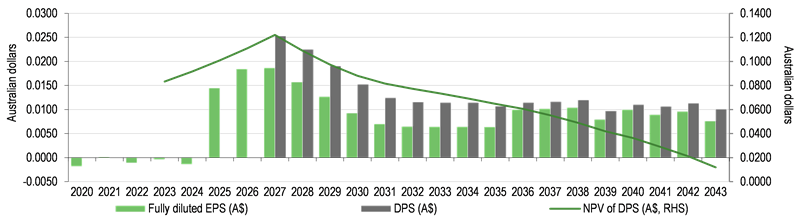
In our last note on the company, we calculated a value for Lepidico’s shares of 8.34c, plus 0.28c for the value of an envisaged loan to the minority shareholders in the upstream Namibian operation, to give a total valuation for the company of 8.61c/share. In the wake of the changes discussed above, our discounted valuation of Lepidico’s future (maximum potential) dividend stream to shareholders has reduced to 5.39c/share, rising to 9.84c/share in FY31, as shown in the chart below:
|
Exhibit 1: Edison’s estimate of future Lepidico EPS and (maximum potential) DPS |
|
|
Source: Edison Investment Research |
This may be compared and contrasted with our prior estimates shown at the time of our last note (see Everything moving all at once, published on 14 February 2023), shown below.
|
Exhibit 2: Edison’s prior estimate of future Lepidico EPS and (maximum potential) DPS |
|
|
Source: Edison Investment Research. Note: See Everything moving all at once, published on 14 February 2023. |
The table below shows the major components in the evolution of the valuation from 8.61c/share to 5.39c/share.
Exhibit 3: Lepidico valuation bridge, February 2023 to October 2023
Valuation (Australian c/share) |
Change in valuation (Australian c/share) |
Change in valuation (%) |
Comment |
|
February 2023 valuation |
8.61 |
See our February 2023 note |
||
LPD share price (1.05c cf 2.80c) |
6.84 |
(1.77) |
-20.6 |
Future equity funding assumption now removed |
Forex |
7.26 |
0.42 |
6.1 |
11.4% decline in the value of the A$ versus the US$ |
Overall one-year delay |
6.56 |
(0.70) |
-9.6 |
10% discount rate effect |
Chemical plant deferral, pre-pay and other |
5.39 |
(1.17) |
-17.8 |
As above, plus production pushed back into a lower price environment and the fact that the chemical plant accounts for the majority of revenues and costs |
Source: Edison Investment Research
To this valuation of 5.39c/share may then be added a potential risk-adjusted 0.68–1.66c/share (fully diluted) for a conceptual 20,000tpa LCE Phase 2 Plant (see Phase 2 coming into view, published on 18 June 2021), to take our total aggregate conceptual valuation of Lepidico to 6.07–7.05c/share.
Sensitivities
As before, the principal quantitative risk to which our valuation of Lepidico is exposed is the long-term price of lithium hydroxide. The effects of the lithium hydroxide price stabilising at an alternative level to the currently assumed US$23,500/t are as follows:
Exhibit 4: Lepidico valuation sensitivity to the long-term price of lithium hydroxide (US$/t)
Long-term lithium hydroxide price (US$/t) |
20,000 |
23,500 |
24,250 |
27,500 |
32,500 |
37,500 |
43,000 |
48,500 |
Lepidico valuation (Australian cents per share) |
4.23 |
5.39 |
5.64 |
6.87 |
9.02 |
11.46 |
14.48 |
17.50 |
Change cf ‘base case’ (%) |
-21.5 |
u/c |
+4.6 |
+27.5 |
+67.3 |
+112.6 |
+168.6 |
+224.7 |
Source: Edison Investment Research
As an alternative however, if we were to adopt BMI’s (real) lithium hydroxide price forecasts in their entirety over the period of Lepidico’s Phase 1 project, then our valuation would rise from 5.39c/share to 10.17c/share (ie in excess of where it was at the time of our last note, namely 8.61c/share).
Exhibit 5: Financial summary
IFRS, June year end, A$’000 |
|
2022 |
2023 |
2024e |
2025e |
2026e |
2027e |
2028e |
Profit and loss |
||||||||
Total revenues |
|
10 |
6,448 |
0 |
0 |
77,064 |
81,828 |
333,112 |
Cost of sales |
|
0 |
0 |
0 |
0 |
(38,182) |
(40,543) |
(108,654) |
Gross profit |
|
10 |
6,448 |
0 |
0 |
38,882 |
41,286 |
224,458 |
SG&A (expenses) |
|
(4,796) |
(7,609) |
(3,146) |
(3,146) |
(3,146) |
(3,146) |
(3,146) |
Exceptionals and adjustments |
(2,275) |
(870) |
0 |
0 |
0 |
0 |
0 |
|
Depreciation and amortisation |
|
(411) |
(571) |
(571) |
(571) |
(9,952) |
(10,064) |
(10,175) |
Reported EBIT |
|
(7,472) |
(2,602) |
(3,718) |
(3,718) |
25,784 |
28,076 |
211,137 |
Finance income/(expense) |
|
(392) |
(358) |
15 |
(3,143) |
(14,079) |
(9,386) |
(4,693) |
Reported PBT |
|
(7,863) |
(2,960) |
(3,702) |
(6,860) |
11,705 |
18,690 |
206,444 |
Income tax expense (includes exceptionals) |
|
(78) |
(644) |
0 |
0 |
(10,849) |
(11,708) |
(11,867) |
Reported net income |
|
(7,941) |
(3,604) |
(3,702) |
(6,860) |
856 |
6,982 |
194,577 |
Basic average number of shares, m |
|
6,247 |
7,251 |
7,638 |
7,638 |
7,638 |
7,638 |
7,638 |
Basic EPS (c) |
|
(0.0) |
(0.0) |
(0.0) |
(0.0) |
(0.0) |
0.0 |
0.0 |
|
|
|
|
|
|
|
|
|
Balance sheet |
|
|||||||
Property, plant and equipment |
|
8,591 |
17,062 |
49,664 |
98,853 |
212,148 |
363,188 |
407,457 |
Intangible assets |
|
29,065 |
28,773 |
28,773 |
28,773 |
28,773 |
28,773 |
28,773 |
Other non-current assets |
|
47,396 |
49,085 |
49,085 |
49,085 |
49,085 |
49,085 |
49,085 |
Total non-current assets |
|
85,052 |
94,920 |
127,522 |
176,712 |
290,006 |
441,046 |
485,316 |
Cash and equivalents |
|
8,043 |
10,829 |
28,470 |
0 |
0 |
0 |
95,941 |
Inventories |
|
0 |
0 |
0 |
0 |
6,422 |
6,819 |
27,759 |
Trade and other receivables |
|
2,204 |
703 |
0 |
0 |
6,334 |
6,726 |
27,379 |
Total current assets |
|
10,247 |
11,532 |
28,470 |
0 |
12,756 |
13,545 |
151,079 |
Non-current loans and borrowings |
|
6,744 |
7,137 |
62,251 |
89,830 |
211,886 |
356,539 |
338,168 |
Other non-current liabilities |
|
9,669 |
3,863 |
3,863 |
3,863 |
3,863 |
3,863 |
3,863 |
Total non-current liabilities |
|
16,413 |
11,000 |
66,114 |
93,694 |
215,749 |
360,402 |
342,031 |
Trade and other payables |
|
1,986 |
2,131 |
259 |
259 |
3,397 |
3,591 |
9,189 |
Current loans and borrowings |
|
280 |
595 |
595 |
595 |
595 |
595 |
595 |
Other current liabilities |
|
179 |
268 |
268 |
268 |
268 |
268 |
268 |
Total current liabilities |
|
2,445 |
2,994 |
1,122 |
1,122 |
4,260 |
4,454 |
10,052 |
Equity attributable to company |
|
70,037 |
85,346 |
81,644 |
74,784 |
72,024 |
75,103 |
265,725 |
Non-controlling interest |
|
6,404 |
7,112 |
7,112 |
7,112 |
10,728 |
14,631 |
18,587 |
|
|
|
|
|
|
|
|
|
Cashflow statement |
|
|||||||
Profit for the year |
|
(7,941) |
(3,604) |
(3,702) |
(6,860) |
856 |
6,982 |
194,577 |
Taxation expenses |
|
78 |
644 |
0 |
0 |
10,849 |
11,708 |
11,867 |
Depreciation and amortisation |
|
411 |
571 |
571 |
571 |
9,952 |
10,064 |
10,175 |
Share based payments |
|
1,823 |
767 |
0 |
0 |
0 |
0 |
0 |
Other adjustments |
|
837 |
(5,875) |
0 |
0 |
0 |
0 |
0 |
Movements in working capital |
|
(689) |
736 |
(1,169) |
0 |
(9,618) |
(595) |
(35,996) |
Income taxes paid |
|
0 |
0 |
0 |
0 |
(10,849) |
(11,708) |
(11,867) |
Cash from operations (CFO) |
|
(5,483) |
(6,761) |
(4,300) |
(6,289) |
1,191 |
16,451 |
168,756 |
Capex |
|
(8,631) |
(9,822) |
(33,174) |
(49,761) |
(123,247) |
(161,104) |
(54,444) |
Acquisitions & disposals net |
|
0 |
0 |
0 |
0 |
0 |
0 |
0 |
Cash used in investing activities (CFIA) |
|
(8,631) |
(9,822) |
(33,174) |
(49,761) |
(123,247) |
(161,104) |
(54,444) |
Net proceeds from issue of shares |
|
7,432 |
19,522 |
0 |
0 |
0 |
0 |
0 |
Movements in debt |
|
0 |
162 |
55,115 |
27,579 |
122,056 |
144,653 |
(18,372) |
Cash from financing activities (CFF) |
|
7,432 |
19,684 |
55,115 |
27,579 |
122,056 |
144,653 |
(18,372) |
Increase/(decrease) in cash and equivalents |
|
(6,681) |
3,101 |
17,641 |
(28,470) |
(0) |
(0) |
95,941 |
Currency translation differences and other |
|
(14) |
(315) |
0 |
0 |
0 |
0 |
0 |
Cash and equivalents at end of period |
|
8,043 |
10,829 |
28,470 |
0 |
0 |
0 |
95,941 |
Net (debt) cash |
|
1,019 |
3,097 |
(34,376) |
(90,426) |
(212,481) |
(357,134) |
(242,822) |
Movement in net (debt) cash over period |
|
(13,719) |
2,078 |
(37,473) |
(56,049) |
(122,056) |
(144,653) |
114,312 |
Source: Company accounts, Edison Investment Research
|
|
Research: Industrials
Solid State has made an excellent start to FY24 with strong continuing organic growth in H124 enhanced by a full period contribution from Custom Power. As a result, management anticipates better-than-expected revenues and PBT for the full year with market consensus rising by c 5% to £155m and £12.5m, respectively.