Last close As at 05/08/2026
GBP1.15
— 0.00 (0.00%)
Market capitalisation
—
Research: Investment Companies
The energy developers segment of Premier Miton Global Renewables Trust’s (PMGR’s) holdings accounts for 30.2% of its portfolio (at 29 February 2024). These developers can generate significantly higher returns than other sections of the portfolio (eg yield plays and investment trusts) due to higher initial capital investment and development risk. PMGR’s portfolio remains a diversified approach to renewable energy asset investing, with a mix across technologies, geographies and corporate structures. Asset values in renewables have been under some pressure of late due to rising bond yields and, in some sectors, falling forward power price curves, though these are two trends that have arguably run their course.
Premier Miton Global Renewables Trust |
Deep dive on developers |
Investment trusts |
9 April 2024 |
Share price/discount performance
Fund objective
Analysts
|
|||||||||||||||||||||||||||||||||||||||||||||||||||||||||||||||||||||||||||||||||||||||||||||||||||||||||||||||||||||||||||||||||||||||||||||||||||||||||||||||||||||||||||||||||||||||||||||||||||
The energy developers segment of Premier Miton Global Renewables Trust’s (PMGR’s) holdings accounts for 30.2% of its portfolio (at 29 February 2024). These developers can generate significantly higher returns than other sections of the portfolio (eg yield plays and investment trusts) due to higher initial capital investment and development risk. PMGR’s portfolio remains a diversified approach to renewable energy asset investing, with a mix across technologies, geographies and corporate structures. Asset values in renewables have been under some pressure of late due to rising bond yields and, in some sectors, falling forward power price curves, though these are two trends that have arguably run their course.
|
Three-year cumulative performance |
|
|
Source: LSEG, Edison investment Research |
FY23’s financial highlights
In its FY23 results, PMGR raised its dividend by 5.7% to 7.40p (being fully covered by net revenue earnings), representing a yield of 7.6%. NAV per ordinary share fell by 17.7% y-o-y to 146.86p and PMGR is currently trading at a discount to NAV of 12.0%. Earnings per ordinary share was 8.11p, an 11.2% increase year-on-year, due to increased dividends within the portfolio holdings. Gearing stood at 61.7% for FY23 (44.6% at 29 February 2024) calculated based on PMGR’s zero dividend preference (ZDP) shares divided by equity attributable to ordinary shareholders at year-end. The ZDP share cover at FY23 was 2.26x (FY22: 2.51x).
2024 market outlook
Bond yields appear to be nearing their cyclical peak and have started to decline. We expect a reversal in the trend seen in 2023 where higher discount rates exerted downward pressures on asset valuations. This should provide PMGR with a tailwind, which, coupled with its portfolio companies delivering strong organic growth and earnings, points to a promising outlook for 2024. PMGR is wellpositioned to capitalise on the macroeconomic shift in global aims to further increase, enhance and speed up renewable energy production in 2024.
Portfolio deep dive: Renewable energy developers
The geographical and sector composition of PMGR’s portfolio remains largely unchanged and continues to be highly weighted towards the UK and Europe, allowing it to benefit from the fundamental and structural shift away from traditional oil and gas energy production to renewable energies.
|
Exhibit 1: Sector and geographical portfolio breakdown as at 29 February 2024 |
|
|
|
|
Source: PMGR, Edison Investment Research |
|
|
Exhibit 1: Sector and geographical portfolio breakdown as at 29 February 2024 |
|
|
|
|
|
|
Source: PMGR, Edison Investment Research |
Exhibit 2: Top 11 holdings at 29 February 2024
Company |
Sector |
Region |
Portfolio weighting (%) |
Greencoat UK Wind |
Yield companies and funds |
United Kingdom |
7.7 |
NextEnergy Solar Fund |
Yield companies and funds |
United Kingdom |
6.2 |
Octopus Renewables Infrastructure Trust |
Yield companies and funds |
Europe (ex UK) |
6.0 |
Clearway Energy A Class |
Renewable energy developers |
United States |
6.0 |
Drax Group |
Biomass generation and production |
United Kingdom |
5.5 |
Aquila European Renewables Income Fund |
Yield companies and funds |
Europe (ex UK) |
5.1 |
Bonheur |
Renewable energy developers |
Europe (ex UK) |
4.3 |
SSE |
Renewable focused utilities |
United Kingdom |
4.3 |
RWE |
Renewable energy developers |
Europe (ex UK) |
4.3 |
Foresight Solar Fund |
Yield companies and funds |
United Kingdon |
4.1 |
Grenergy Renovables |
Renewable energy developers |
Global |
3.7 |
Top 11 (% of holdings) |
|
|
57.2 |
Source: PMGR, Edison Investment Research
Renewable energy developers have the second highest weighting within PMGR’s portfolio, accounting for 30.2% of assets (at 29 February 2024). The smaller developers in the portfolio are held for the prospect of growth rather than a yield. Throughout 2023, many of these developers continued to grow their businesses, performing well operationally. However, this was not always reflected in share prices, partly due to the high power prices seen in 2022, effectively disguising underlying growth.
Below, we take a closer look at some of PMGR’s renewable energy developer holdings and their percentage of portfolio value at 29 February 2024.
Bonheur (4.3%)
Bonheur is a Norway-listed renewable energy company operating under the Fred. Olsen Renewable brand. Under its Windcarrier and Cruise Lines businesses, it owns three offshore wind turbine installation vessels and operates four cruise ships, respectively. At September 2023, Bonheur’s Renewables segment operated 788MW of wind farms, primarily in Scotland but also in Sweden and Norway. Bonheur also has 17MW of wind farms under construction and a further 530MW consented to and awaiting construction. Its offshore installation vessels are close to fully contracted for the coming years and its cruise business is recovering well from the losses incurred during the COVID-19 pandemic. Despite the encouraging outlook, Bonheur’s shares fell by 15.7% in 2023. In Q423, the company recorded reduced earnings in its renewable energy business, due to the lower power prices (compared to the previous year, which saw record highs). Both Bonheur’s Windcarrier and Cruise Lines businesses, however, significantly increased earnings year-on-year, outweighing the reduction in its Renewables business.
RWE (4.3%)
RWE is a German multi-national energy company that has rapidly expanded its renewable energy over recent years with aim of removing coal from its business by 2030. The company has continued to increase its growth ambitions by setting a target of 65GW of net capacity by 2030 across a diversified group of renewable technologies and geographies. This is to be achieved through €55bn of net cash investments between 2024 and 2030 and it has already invested €20bn between 2021 and 2023. RWE’s FY23 financial results were exceptionally strong, benefiting from its ownership of flexible electricity generation (ie gas turbines and hydroelectricity), as well as from a profitable trading business. Management has forecast a CAGR for adjusted EBITDA and net income growth from 2021 levels (14%) to 2030 of 12%, while targeting future dividend growth of 5–10% per annum. Despite its enormous growth ambitions and strong financial results, RWE’s share price fell by 1% in 2023.
Grenergy Renovables (3.7%)
Grenergy Renovables is a Spain-listed international solar developer. Its largest solar platform is in Europe, with 5.1GW of solar capacity and a 3.1GWh battery energy storage system (BESS) pipeline. Its second-largest solar platform is in Chile (2.9GW). Chile also has Grenergy Renovables’ largest BESS pipeline, totalling 5.2GWh. The company has grown steadily and, according to its FY23 results, Grenergy Renovables increased its EBITDA by 108% y-o-y to €105m and its net income fivefold to €51m. Grenergy Renovables’ share price rose by 23.5% over 2023. Operational highlights consist of 1.7GW of assets in operation, 1GW under construction and a large 15.3GW pipeline of solar photovoltaic (PV) farms and 11.3GWh of BESS. Much of its equity funding for new assets arises from select asset sales in its global portfolio. Throughout 2023, Grenergy Renovables sold several Spanish solar farms, generating sales revenue of roughly 50% greater than the capital it invested into the projects. The proceeds from these asset sales are being used to build sizable new solar-plus-battery storage assets in Chile. Chile is an attractive market due to its significant investment in clean energy, with the goal of having 70% of the country’s electricity coming from renewable sources by 2030.
Enefit Green (2.7%)
Enefit Green, listed in Estonia, is a renewable energy producer and developer. Its production portfolio includes 24 wind farms, 42 solar power plants, a cogeneration plant and a hydroelectric plant, across Estonia, Latvia, Lithuania, Finland and Poland. Enefit Green has a total power generation capability of more than 500MW. The company has six wind and four solar farms, with a total capacity of 612MW and 97MW, respectively, under construction. In the last three years, Enefit Green has made 14 investment decisions worth almost €1bn and it has strong short- and long-term development portfolios of onshore and offshore wind and solar farms totalling roughly 4.9GW. The company commissioned several new solar and wind assets in 2023 and is aiming to increase its renewable energy capacity fourfold by the end of 2026.
Cloudberry Clean Energy (1.5%)
Cloudberry Clean Energy is a Nordic renewable energy company that owns, develops and operates hydropower plants and wind farms in Norway, Sweden and Denmark. The company has 267MW of assets in operation, 27MW in construction, 200MW awaiting construction permits and a 625MW backlog as well as a pipeline of over 2.5GW. Over the last year, Cloudberry Clean Energy almost tripled its revenue and nearly doubled its production (520GWh). Including the company’s under construction projects, its estimated annualised production equates to 905GWh. Throughout 2023 Cloudberry Clean Energy created value across the entire lifecycle of its assets through the sale of three hydropower plants for record prices to a private infrastructure investor. The capital obtained can be recycled back into new renewable projects at potentially higher rates of return. Cloudberry Clean Energy, like many other renewable companies in the space, is trading below its NAV and has started to buy back shares to take advantage of this disconnect in market valuations as part of maximising shareholder returns. Its share price fell c 11% over 2023.
Polaris Renewable Energy (1.4%)
Polaris Renewable Energy is a Canada-listed company that engages in the acquisition, development and operation of renewable energy projects in Latin America (whose power grid continues to expand by roughly 3–6% per year, according to Polaris management). Polaris Renewable Energy operates across five countries in Latin America with seven projects in operation, including a geothermal plant (82MW), four run-of-river hydroelectric plants (39MW) and three solar PV projects (35MW). 98% of the company’s revenues are fully contracted with government entities, which provides Polaris Renewable Energy with little-to-no counterparty risk. The company’s growth plan (from February 2024) involves reaching $100m in EBITDA by 2028 (FY23: $57.7m) and suggests there is no need for new equity to be raised to achieve its organic targets. Polaris Renewable Energy’s share price fell c 6% over 2023.
Solaria Energia y Medio Ambiente (1.1%)
Solaria Energia y Medio Ambiente is based in Spain and primarily focuses on solar PV technology. It operates mostly in Spain, but also in Portugal, Italy and Germany. FY23 saw record results, with the company increasing revenue and EBITDA by 37% and 36%, respectively, year-on-year, and increasing its net profit by 19% to €107.5m. Solaria Energia y Medio Ambiente also grew its capacity of assets in operation by 66% to 1,658MW, with 1,530MW under construction. In 2023 the company focused on securing further growth for FY24 by obtaining 1GW of ready-to-build assets. Civil works also began on its Garoña flagship project, which increased its capacity from 595MW to 700MW, as well as the hybridisation of an additional 186MW. Over the past five years, Solaria Energia y Medio Ambiente has grown 100% organically, while being completely self-funded and increasing its operating capacity 22 times from 75MW to 1,658MW. The company stated in its FY23 results that it is targeting 18GW of capacity by 2030 with one-third of this being represented by its flagship projects. Solaria Energia y Medio Ambiente’s stock only rose by 8% in 2023. However, since the beginning of 2024, it has fallen c 46% despite its strong financial results and significant growth prospects.
OPD Energy
OPD Energy, listed in Spain, is a developer that received a takeover offer from a private equity buyer in 2023. While the offer process was not completed by the end of the year, the holding was sold to the highest post offer market price. This equated to a price 48.2% higher than the level at which the shares started the year, highlighting the disconnect between the private and public market valuations for assets held by renewable energy stocks.
FY23 performance
PMGR’s asset total return (TR) for FY23, including all income and costs, was negative 7.5%. This, however, was substantially better than the company’s benchmark, the S&P Global Clean Energy Index, which recorded a negative TR of 20.1%. This performance reflects the general negative sentiment and backdrop surrounding global renewable energy markets rather than the results of the companies in PMGR’s portfolio (many of its holdings displayed strong business growth and robust financial results).
As we discussed in our previous note, in our view renewable energy equities continue to be treated as bond proxies, showing a high degree of correlation to bond prices, with share prices falling as interest rates and bonds yields increased. This is because the market views cash flows from renewables as relatively static and, thus, assumes valuations are particularly sensitive to higher discount rates. This can be seen in the Renewable Energy Infrastructure AIC sector, which has an average discount rate of 24% (as at 18 March 2023). There appears to be a disconnect between the valuations the market is implying on these types of assets and the valuations that companies are using in their NAVs. Asset sales are continually increasing in the market, with many of these transactions being executed at premiums to asset holding values. For example, in November 2023, Foresight Solar Fund sold a 50% stake in its 99MW Lorca portfolio in Spain at a 21% premium to its previous period holding value. Furthermore, in August 2023, the Renewable infrastructure Group (TRIG) exchanged contracts to sell three wind farms in the Republic of Ireland at a 26% premium to TRIG’s valuation at 31 December 2022.
|
Exhibit 3: Price, NAV and benchmark TR cumulative performance |
Exhibit 4: 10-year TR performance annualised (%) |
|
|
|
Source: LSEG, Edison Investment Research. Note: S&P Global Clean Energy is PMGR’s formal benchmark. |
|
|
Exhibit 3: Price, NAV and benchmark TR cumulative performance |
|
|
|
|
Exhibit 4: 10-year TR performance annualised (%) |
|
|
|
|
Source: LSEG, Edison Investment Research. Note: S&P Global Clean Energy is PMGR’s formal benchmark. |
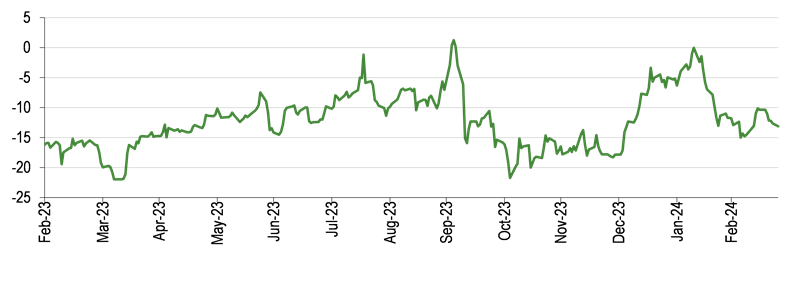
Like 2022, 2023 saw discounts to NAV in the renewable energy investment trust sector generally widen. At year-end 2023, PMGR’s discount to NAV stood at 19.3% (2022: 12.9%). Its discount to NAV recovered well in the last two months of 2023 with a gain of ordinary share NAV of 28.4%. However, the beginning of 2024 proved difficult for the renewable sector due to weakening energy markets with an increase in bond yields. PMGR’s current discount to NAV stands at 12.0%. The Renewable Energy Infrastructure AIC sector average discount to NAV is currently 25.6%.
|
Exhibit 5: One-year discount to NAV excluding income |
|
|
Source: LSEG, Edison Investment Research |
Market outlook
The renewable energy sector presented a reasonably unattractive proposition for investors in 2023. This is because European power prices fell and have continued to fall in 2024, while capital costs for new projects increased. Therefore, at a time when investors are demanding higher returns due to increased interest rates, returns on new projects are, in theory, lower. Higher interest rates could also have a negative effect on net earnings of renewable energy companies, as these types of companies tend to have higher-than-average gearing.
Although power prices have fallen from historic highs in 2022, they remain significantly above pre-Ukraine’s invasion prices and this drawing back to a more stable and predictable price environment can only be seen as a positive. Power purchase agreements have also adapted to navigate the new environment, flexing upwards to account for higher costs. Government-sponsored renewable energy auctions continue at inflated prices and these levels are expected to continue throughout 2024. Therefore, there is no real evidence to suggest that returns on new renewable energy projects have suffered any permanent reduction, meaning companies should still be able to produce returns in excess of capital costs.
The US energy market (which has a weighting in PMGR’s portfolio of c 12%) is relatively stable compared to Europe, due to the fact it is generally self-sufficient in regard to fossil fuel supply. The demand for renewable energy, however, is lower than Europe. Yet, due to the size of the US, as and when demand for clean energy increases, it will benefit from economies of scale in regard to building large-scale renewable energy plants without needing to resort to higher-cost options (ie offshore wind farms). One key change in the US renewable energy market (to speed up production in 2023) was the introduction of the Inflation Reduction Act, which includes a series of incentives extending the lives of existing tax credits while also offering new valuable benefits to incentivise local supply chains.
|
|
Research: Real Estate
Picton Property Income has agreed the sale of Angel Gate, its second largest office asset, and largest portfolio void, with an agreed consideration above the Q323 valuation. The sale is part of its strategy to repurpose selective office assets and accretively recycle the capital. This sale supports NAV, and we expect a positive impact on earnings. Further repurposing asset management initiatives are being progressed.