Last close As at 05/08/2026
GBP1.15
— 0.00 (0.00%)
Market capitalisation
—
Since its launch in March 2012 to end-September 2022, Premier Miton Global Renewables Trust’s (PMGR) share price has returned over 250%. During the past 12 months the performance has been very volatile, and the manager, James Smith, has responded by restructuring the portfolio away from Chinese holdings towards higher-yielding UK and European companies. Smith believes that as energy security concerns will result in governments and companies signing long-term contracts with renewable energy producers in the UK and Europe, the share prices of renewable companies should start to stabilise.
Written by
Premier Miton Global Renewables Trust |
Compounding over the years |
Investment trusts |
24 October 2022 |
Analyst
|
||||||||||||||||||||||||||||||||||||||||||||||||||||||||||||||||||||||||||||||||||||||||||||||||||||||
Since its launch in March 2012 to end-September 2022, Premier Miton Global Renewables Trust’s (PMGR) share price has returned over 250%. During the past 12 months the performance has been very volatile, and the manager, James Smith, has responded by restructuring the portfolio away from Chinese holdings towards higher-yielding UK and European companies. Smith believes that as energy security concerns will result in governments and companies signing long-term contracts with renewable energy producers in the UK and Europe, the share prices of renewable companies should start to stabilise.
|
Making money for investors over the long term |
|
|
Source: Refinitiv, Edison Investment Research. Note: Total returns in sterling. *Net of dividends. |
Why invest in PMGR now?
Elevated energy prices over the course of 2022 have resulted in renewable energy companies generating higher revenues while marginal production costs remain largely unchanged, thereby increasing their returns. This is particularly relevant in the UK and Europe, where companies secure a sizeable proportion of their revenues using merchant pricing. As inflation becomes entrenched, renewable energy generators, with largely inflation linked revenues, can provide investors with stable (and often growing) dividends. In an environment of high commodity prices, assets that are already operational (a key area of focus for PMGR) are arguably better placed than those in construction, as component prices are also higher.
The analyst’s view
PMGR’s switch from a broad utilities mandate to a focus on renewable energy has been beneficial for shareholders in the past three years, with performance improving. The dividend was rebased to a lower level due to the smaller pool of total assets following the ZDP rollover in late 2020, but the net effect was marginally positive for shareholders, as the company pays less interest on ZDPs. FY21 and H122 dividends were fully covered by income and, given ample revenue reserves (of 6.9p per share, or almost 1.0x the historical annual dividend), have scope to grow. The fund is small and highly geared (which may be seen in a negative light by potential investors), but the discount to NAV has narrowed to the current 10.7%, reflecting an improvement in investor sentiment towards PMGR’s refreshed mandate.
The fund manager: James Smith
The manager’s view: Financial markets’ myopia
Smith believes that the recent fall in listed renewable companies’ share prices has been overdone. He argues that the market has discounted the higher yields of the renewable energy companies correctly (higher yields reduce these companies’ valuations and, hence, their share prices), but ignored sticky high power prices and the benefits of inflation on government feed-in tariffs and historical subsidy schemes. The manager believes power prices will stay relatively high for some time, which should fully compensate investors for higher discount rates, as share prices across the renewable infrastructure sector will bounce back and continue to rise. Smith notes that whatever the deal that is struck between the UK government and renewable energy companies, it will largely define the near-term moves of the renewable generators’ share prices.
Russia’s invasion of Ukraine in late February and the continuing conflict in the region have prompted the European and UK governments to focus on energy security and self-sufficiency. Gas-fired electricity generation tends to be the highest marginal cost producer in Europe, and therefore has a key role in setting electricity prices for the entire market. With gas prices remaining high, other sellers of energy, including renewable companies, continue to benefit from higher revenues and largely unchanged input costs.
The UK electricity baseload one-month forward contract, which was £222/MWh on 24 October 2022 (source: Bloomberg), has been very volatile over the past 12 months, and has seen a significant increase versus the historical level of c £50–60/MWh prior to 2022. The higher rate of inflation will also benefit UK producers with index-linked supply contracts; producers in the United States tend to sell their power on long-term fixed-price contracts, so are less well positioned.
The UK government wants to diversify away from gas into renewable technologies and secure primarily home-based energy supply. Ongoing negotiations will most likely result in fixed-price, but inflation-linked long-term contracts. Smith argues that there is a high likelihood of a win-win resolution as the government will want a mutually agreeable deal to reduce pressure on consumers’ electricity bills. At the same time, the government will maintain incentives for the large-scale investment in renewable energy required in coming years, says Smith.
The EU has proposed a cap on revenue to be received by ‘infra-marginal’ generation, ie generators such as renewables and nuclear with low to zero marginal cost, of €180/MWh. Smith believes this is an acceptable compromise between capping excessive prices while maintaining investment incentives. The UK government has also stated that it is aiming for a short-term price cap while it progressively shifts renewable generators onto longer-term contracts. At the time of writing, the precise level of this cap is unknown.
Smith believes that the situation in the United States is also favourable, as the government provides tax credits to various renewable subsectors as part of its broader inflation reduction plan. However, he has turned negative towards Chinese equities over the past 12 months as despite the strong Chinese fundamentals, the equity performance of Chinese renewable energy companies will be dampened by weak sentiment, poor macroeconomic news, the overhang from COVID-19 lockdowns and geopolitical risks.
Over the longer term, Smith expects the large-scale expansion of LNG and renewable energy capacity in Europe, the United States and globally, but this will take time and is unlikely to reduce prices in the near future. Smith believes that due to the complexity, scale and lengthy construction periods of LNG infrastructure, energy prices are likely to remain elevated until a price-supply equilibrium is achieved.
Asset allocation
Current portfolio positioning
PMGR invests across a broad range of renewable energy-focused market areas (see Exhibit 3), with a particular focus on renewable energy developers and yield companies (or yieldcos) and funds. While both these categories broadly cover businesses that own and operate renewable energy generation facilities, the principal difference is that the developers take on construction risk, while the yieldcos (which, as the name suggests, have a focus on providing income to investors) buy pre-existing assets.
The major portfolio shift over the past 12 months was the c 19pp reduction in Chinese holdings from 22.3% at end-September 2021 to just 3.5% at end-September 2022 (Exhibit 1). Chinese companies were a good contributor to the FY21 performance, but in the current environment the manager finds better risk/reward opportunities elsewhere.
Exhibit 1: Portfolio geographic exposure (% unless stated)
Portfolio end-September 2022 |
Portfolio end-September 2021 |
Change (pp) |
|
United Kingdom |
34.7 |
27.6 |
7.1 |
Europe (ex UK) |
27.8 |
19.2 |
8.5 |
Global |
19.0 |
11.3 |
7.7 |
North America |
11.8 |
14.2 |
(2.3) |
China |
3.5 |
22.3 |
(18.8) |
Latin America |
2.1 |
2.3 |
(0.2) |
India |
0.0 |
1.8 |
(1.8) |
Cash |
1.1 |
1.4 |
(0.3) |
100.0 |
100.0 |
Source: Premier Miton Global Renewables Trust, Edison Investment Research
Simultaneously, the manager has added to UK and European assets, particularly within the yieldcos and funds space. This segment was up 11.4pp over the past 12 months (see Exhibit 3). Four UK listed companies (three of which are yieldcos) are currently in the top 10 holdings. The largest two are Greencoat UK Wind (UKW) and NextEnergy Solar (NESF), which both performed strongly, and Smith also added to these on the recent weakness of their share prices. Drax Group, a UK-based former coal-fired power generator that has switched to using wood pellets (biomass) for electricity production, has attracted negative publicity, but Smith believes biomass has a key role to play in the energy transition, and that Drax operates in compliance with all relevant legislation. Drax Group and Gresham House Energy Storage Fund (GRID, an Edison client) are the remaining two UK holdings in the top-10. At 30 September 2022, PMGR’s top 10 holdings (Exhibit 2) accounted for about half of total assets, a slight decrease from 53.5% a year earlier.
Exhibit 2: Top 10 holdings (as at 30 September 2022)
Company |
Sector |
Country |
Portfolio weight % |
|
30 September 2022 |
30 September 2021 |
|||
Greencoat UK Wind |
Yieldcos & funds |
United Kingdom |
6.1 |
4.6 |
NextEnergy Solar Fund |
Yieldcos & funds |
United Kingdom |
5.9 |
4.6 |
Drax Group |
Biomass generation and production |
United Kingdom |
5.7 |
5.6 |
RWE |
Renewable energy developers |
Europe (ex UK) |
5.4 |
4.1 |
Gresham House Energy Storage Fund |
Energy storage |
United Kingdom |
5.3 |
4.6 |
Octopus Renewables Infrastructure Trust |
Yieldcos & funds |
Europe (ex UK) |
5.0 |
N/A |
Atlantica Sustainable Infrastructure |
Yieldcos & funds |
Global |
4.8 |
3.7 |
Grenergy Renovables |
Renewable energy developers |
Global |
4.2 |
2.6 |
Clearway Energy A Class |
Yieldcos & funds |
North America |
4.0 |
N/A |
Aquila European Renewables Income Fund |
Yieldcos & funds |
Europe (ex UK) |
3.8 |
N/A |
Top 10 (% of holdings) |
50.3 |
53.5 |
||
Source: Premier Miton Global Renewables Trust, Edison Investment Research. Note: N/A when not in the top 10 holdings at 30 September 2021.
Three European companies are represented in the top 10, namely RWE and two new additions to the portfolio, Octopus Renewables Infrastructure Trust (ORIT) and Aquila European Renewables Income Fund (AERI). While listed in the UK, the new additions operate in Europe, and also add to the yielcos and funds segment of PMGR.
Exhibit 3: Portfolio sector exposure (% unless stated)
Portfolio end-September 2022 |
Portfolio end-September 2021 |
Change (pp) |
|
Yieldcos & funds |
39.8 |
28.4 |
11.4 |
Renewable energy developers |
29.6 |
27.8 |
1.8 |
Renewable focused utilities |
9.2 |
13.4 |
(4.2) |
Energy storage |
9.1 |
6.4 |
2.7 |
Biomass generation and production |
5.7 |
6.7 |
(1.0) |
Electricity networks |
2.1 |
4.2 |
(2.1) |
Renewable technology and service |
1.9 |
2.3 |
(0.5) |
Waste to energy |
1.5 |
6.2 |
(4.7) |
Carbon markets |
0.0 |
1.3 |
(1.3) |
Liquidation portfolio |
0.0 |
1.8 |
(1.8) |
Cash |
1.1 |
1.4 |
(0.3) |
100.0 |
100.0 |
Source: Premier Miton Global Renewables Trust, Edison Investment Research
Yieldcos and funds is the largest segment and Smith expects these companies to continue to generate stable income for PMGR, despite the current uncertain environment. Renewable-focused utilities, energy storage and biomass generation and production remain sizeable segments of the portfolio, jointly accounting for 24.0% of the fund.
Performance and discount
Following PMGR’s strong performance in the 12 months to end-September 2021, the year to end-September 2022 has been more challenging, with NAV and share price total returns lagging the MSCI AC World Index (Exhibit 4).
Exhibit 4: Five-year discrete performance data
12 months ending |
Share price |
NAV |
Benchmark* |
MSCI AC World |
CBOE UK All Cos (%) |
30/09/18 |
(22.7) |
(25.3) |
2.4 |
13.5 |
5.9 |
30/09/19 |
21.4 |
34.0 |
25.4 |
7.9 |
2.7 |
30/09/20 |
2.4 |
4.8 |
(11.9) |
5.8 |
(17.9) |
30/09/21 |
63.0 |
56.0 |
(18.7) |
22.7 |
28.5 |
30/09/22 |
(5.1) |
(8.0) |
9.0 |
(3.7) |
(3.4) |
Source: Refinitiv. Note: All % on a total return basis in pounds sterling. *Benchmark is S&P Global Clean Energy Index; prior to FY21 it was a broad global infrastructure index.
While the fund does not construct its portfolio with reference to any index, during 2021 it adopted a new performance benchmark, the S&P Global Clean Energy Index. Over the past 12 months and shorter periods, shown in Exhibit 5 to end-September 2022, PMGR has underperformed the index.
|
Exhibit 5: Investment trust performance to 30 September 2022 |
|
Price, NAV and benchmark total return performance, one-year rebased |
Price, NAV and benchmark total return performance (%) |
|
|
|
Source: Refinitiv, Edison Investment Research. Note: Three-, five- and 10-year performance figures annualised. |
|
Note that the index returns for periods of more than one year in Exhibits 5, 6 and 7 also include the trust’s benchmark prior to FY21, which was a broad global infrastructure index. The index, like PMGR’s portfolio, consists of listed companies involved in the generation and supply of renewable energy, although in terms of constituents the two are very different, with the index having higher exposure to the United States and to companies at the technology/components end of the renewables value chain.
There are two main reasons for PMGR’s underperformance over the past 12 months relative to the (new) benchmark and MSCI AC World Index: Chinese positions detracted materially and the holding in the Finnish generator Fortum was sold in the period at a substantial discount to the level at which it started the calendar year. Fortum’s Russian investments, accounting for approximately 20% of profits, caused its share price to fall sharply. Following the Fortum sale, PMGR’s portfolio has no investment exposure to Russia.
Chinese holdings are now 3.5% of the portfolio (at end-September 2022) versus 22.3% at end-September 2021, and the manager intends to reduce this to less than 3% of the portfolio. Smith has switched to developed markets, which he believes offer better rewards versus their risks.
During the first three quarters of FY22 (to 30 September), PMGR benefited from the strong performance of its UK holdings.
Exhibit 6: Share price and NAV total return performance, relative to indices (%)
|
One month |
Three months |
Six months |
One year |
Three years |
Five years |
10 years |
Price relative to benchmark |
(3.1) |
(12.6) |
(6.5) |
(14.1) |
80.4 |
48.4 |
184.3 |
NAV relative to benchmark |
(4.6) |
(18.3) |
(16.2) |
(17.0) |
72.4 |
50.3 |
127.0 |
Price relative to MSCI AC World |
(7.5) |
(3.8) |
6.5 |
(1.4) |
33.4 |
(4.5) |
51.3 |
NAV relative to MSCI AC World |
(8.9) |
(9.5) |
(3.2) |
(4.3) |
25.4 |
(2.5) |
(6.0) |
Price relative to CBOE UK All Cos |
(7.3) |
1.1 |
7.5 |
(1.7) |
56.5 |
37.9 |
179.1 |
NAV relative to CBOE UK All Cos |
(8.8) |
(4.6) |
(2.2) |
(4.6) |
48.6 |
39.8 |
121.8 |
Source: Refinitiv, Edison Investment Research. Note: Data to end-September 2022. Geometric calculation.
|
Exhibit 7: NAV performance versus benchmark over three years |
|
|
Source: Refinitiv, Edison Investment Research |
In Exhibit 8 we present PMGR alongside a group of peers drawn from several AIC sectors, all focused to some extent on renewable energy, utilities and/or infrastructure.
Although the smallest fund in the peer group (as measured by market capitalisation; by total assets including ZDPs it is of a similar size to Jupiter Green), PMGR ranks second by NAV total return performance over three years (out of 15 funds). This strong relative performance has been achieved by the manager following the mandate’s switch in late 2020 from infrastructure to global renewable infrastructure companies. The lower relative ranking over five years (nine of 12 funds) arguably reflects a period underperformance for the trust in 2018, and the environmental funds’ greater exposure to renewable energy technology over the entire five-year period, as PMGR lags the likes of Ecofin Global Utilities & Infrastructure, Bluefield Solar Income Fund, Foresight Solar Fund and JLEN Environmental Assets Group – all of which are focused renewable energy trusts.
PMGR ranks 13th (of 16 peers) by NAV total return performance over the past year. During this period. the Chinese holdings and the subsequent repositioning of the portfolio away from China affected the relative performance. The manager has purchased a number of new holdings, and added to existing ones on lower valuations, by using dips in their share prices during volatile periods in FY22. Smith is confident that the portfolio is well positioned to capture the upside, should the cautious market sentiment turn due to the robust industry fundamentals. In addition, he expects the c 40% weighting of yieldcos to add to the total return and provide stable income to the fund.
Ongoing charges (1.65% for FY21) are above average, while the 4.2% dividend yield is around the average for the group as a whole, and the highest among the equity funds by some margin. PMGR’s gearing, at c 28% of net assets, is the highest in the table below, although we note that it is hard to make a meaningful comparison given that, particularly among the yieldcos, companies can either carry debt at the parent company or project level, and this is not always consolidated.
Exhibit 8: Selected peer group as at 30 September 2022*
% unless stated |
Market cap £m |
NAV TR |
NAV TR |
NAV TR |
NAV TR |
Ongoing |
Perf. |
Discount |
Net |
Dividend |
Premier Miton Glbl Renewables Trust |
27.4 |
(7.3) |
53.8 |
55.0 |
219.0 |
1.7 |
No |
(10.7) |
128 |
4.7 |
Impax Environmental Markets |
1,178.6 |
(14.7) |
37.4 |
59.4 |
272.1 |
0.8 |
No |
(5.1) |
102 |
0.7 |
Jupiter Green |
38.6 |
(15.4) |
17.9 |
25.6 |
137.3 |
1.6 |
No |
(22.5) |
100 |
0.0 |
Menhaden Resource Efficiency |
75.0 |
(14.6) |
15.4 |
49.3 |
|
1.8 |
Yes |
(30.3) |
100 |
0.2 |
Ecofin Global Utilities & Infra |
229.9 |
10.5 |
32.8 |
77.6 |
|
1.4 |
No |
0.6 |
111 |
3.5 |
Bluefield Solar Income Fund |
794.9 |
28.2 |
45.9 |
79.7 |
|
1.0 |
No |
(6.4) |
100 |
5.9 |
Foresight Solar Fund |
661.2 |
26.9 |
39.2 |
66.8 |
|
1.1 |
No |
(12.8) |
100 |
5.7 |
Gore Street Energy Storage Fund |
536.3 |
13.6 |
45.3 |
|
|
1.6 |
Yes |
2.9 |
100 |
6.5 |
Greencoat UK Wind |
3,360.9 |
8.4 |
27.9 |
61.6 |
|
1.0 |
No |
(5.9) |
127 |
5.7 |
Gresham House Energy Storage |
844.4 |
36.0 |
72.5 |
|
|
1.2 |
No |
7.1 |
100 |
3.7 |
JLEN Environmental Assets Group |
775.3 |
33.7 |
44.2 |
73.5 |
|
1.2 |
No |
(5.1) |
100 |
5.7 |
NextEnergy Solar |
613.3 |
26.5 |
34.4 |
60.9 |
|
1.0 |
No |
(14.9) |
122 |
6.0 |
Octopus Renewables Infrastructure |
536.7 |
17.9 |
|
|
|
1.2 |
No |
(14.8) |
100 |
4.7 |
Renewables Infrastructure Grp |
3,163.1 |
24.5 |
39.2 |
80.2 |
|
0.9 |
No |
(5.4) |
100 |
5.1 |
SDCL Energy Efficiency Income |
1,103.2 |
9.5 |
31.8 |
|
|
0.9 |
No |
(8.4) |
100 |
5.3 |
Utilico Emerging Markets |
428.5 |
0.5 |
(1.0) |
12.6 |
92.0 |
1.4 |
No |
(15.1) |
103 |
3.3 |
Simple average (16 funds) |
898.0 |
11.5 |
35.8 |
58.5 |
180.1 |
1.2 |
(9.2) |
105.9 |
4.2 |
|
PMGR rank in peer group |
16 |
13 |
2 |
9 |
2 |
2 |
10 |
1 |
9 |
Source: Morningstar, Edison Investment Research. Note: *Performance as at 30 September 2022 based on ex-par NAV. TR = total return. Net gearing is total assets less cash and equivalents as a percentage of net assets (100=ungeared).
To an extent reflecting its smaller size, relative to most peers, PMGR has the tenth widest discount to NAV, versus a peer group average discount of 9.2%. At 24 October 2022, PMGR’s shares traded at a 10.7% discount to cum-income NAV. In a volatile 2022, with governments’ actions to tackle persistent inflation, stubbornly high energy prices, the war in Ukraine and slowing global growth, the discount has fluctuated from virtually zero to c 19%. The current discount is slightly above the one-year average (10.0%) and above the three-year average of 8.5%.
|
Exhibit 9: Three-year % discount to NAV at par (diluted) |
|
|
Source: Refinitiv, Edison Investment Research |
If, as Smith expects, the renewed focus on energy security causes a reassessment of the renewable energy sector (which has sold off due to uncertainty about how governments will deal with this crisis), PMGR’s discount could return to the lower end of the 0–10% range that persisted for most of 2021.
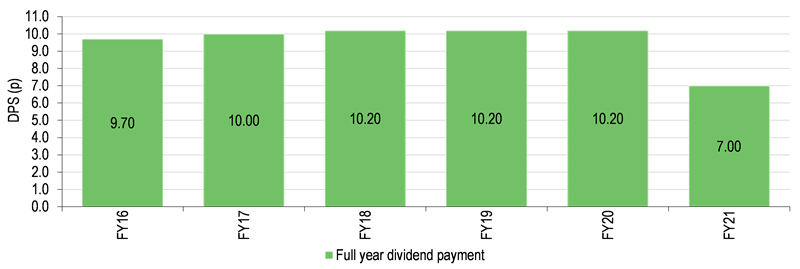
Dividends: Rebased but covered, with scope to grow
|
Exhibit 10: Dividend history since FY16 |
|
|
Source: Bloomberg, Edison Investment Research |
PMGR aims to reward its shareholders with a high income in the form of dividend payments in addition to long-term capital growth. Dividends are paid quarterly, in broadly equal amounts.
On 30 June and 30 September, the trust paid a first and a second interim dividend of 1.75p per share each (3.5p in total). These dividends are consistent with those paid in FY21. For FY21, four equal dividends of 1.75p have been paid, totalling 7.0p (FY20: three dividends at 2.5p and a fourth at 2.7p, totalling 10.2p). Although the total dividend per share for FY21 is 3.2p below the prior year, ZDP financing costs also fell, from 7.3p to 3.9p per share. While the financing costs are charged to capital rather than income, the overall outcome for shareholders of the dividend cut and cost reduction was therefore slightly positive (+0.2p per share).
The H122 dividends were fully covered by income (3.95p per share). At end-H122, PMGR’s revenue reserve stood at c £1.3m, sufficient to cover the FY21 annual dividend by c 0.9x (c £1.2m at end-FY21). The company also has £7.5m of special distributable reserves (c 5.2x cover of FY21 dividend). Based on the current share price and the FY21 total dividends, PMGR currently yields 4.7%.
Fund profile: Unique focus on listed renewables
Premier Miton Global Renewables Trust has been part of the Premier (now Premier Miton) stable for almost 20 years, ever since the 2003 rollover of the Legg Mason International Utilities Trust. Initially known as Premier Utilities Trust, it changed its name to Premier Energy & Water Trust (PEWT) in 2008 and subsequently to Premier Global Infrastructure Trust (PGIT) in late 2017. PGIT’s mandate built on that of PEWT, investing in equity and equity-related securities of companies operating in the energy and water sectors generally, as well as other generic infrastructure investments. In October 2020, reflecting a gradual shift in focus towards the renewable energy segment of the infrastructure universe, PGIT’s shareholders voted in favour of proposals to change its name to Premier Miton Global Renewables Trust (PMGR) and its investment remit to a more targeted investment proposition dedicated to renewable energy and sustainable infrastructure investments. The trust has been managed since 2012 by James Smith.
PMGR sits in the AIC’s Infrastructure Securities sector, a peer group for funds that invest in infrastructure shares. There is currently no sector for funds investing in renewable energy shares, underlining the differentiation of the trust’s approach. While it is hard to find an equity benchmark to reflect PMGR’s diversified global approach, since FY21 the trust has measured its performance against the S&P Global Clean Energy Index (previously it used a broad global index of infrastructure shares).
The trust’s official investment objective is to achieve a high income and to realise long-term growth in the capital value of its portfolio. PMGR pays dividends quarterly. The trust is geared (net gearing of 28% at end-August 2022) via ZDPs (see below).
Gearing: Structural use of ZDPs
PMGR’s use of ZDPs as gearing (see our initiation note for more details) has the advantage of eliminating annual interest coupons, with the redemption value of the ZDPs instead hopefully being covered by the trust’s higher investment returns (as a result of the gearing effect) over the life of the ZDP issue, although it also carries the potential risk of being highly geared in a falling market. The 2025 ZDP issue was smaller than previous issues, with £14.2m shares issued at 100p – equivalent to c 50% gearing – on 30 November 2020. The 2025 ZDPs have a redemption price of 127.61p, equivalent to a gross redemption yield of 5.0% at issue. Based on the NAV of both the ZDPs and the ordinary shares (cum income) at 31 August 2022, PMGR’s gearing represents 28.2% of net assets. Given the ZDPs are a sterling liability, the manager may use currency hedging to offset any sterling underweight in the portfolio and is currently substantially hedged on the portfolio’s euro exposure.
Capital structure, life of the company and ownership
PMGR is an investment trust with two classes of share: ordinary shares and ZDPs, which it has used throughout its existence to provide gearing.
PMGR has an indefinite life, subject to a five-yearly continuation vote, the next of which is due in 2025. At the March 2020 vote, more than 99% of votes cast were in favour of continuation. As shown in Exhibit 11, PMGR’s ordinary shares have a high level of retail ownership on platforms such as Hargreaves Lansdown, Interactive Investor, AJ Bell and Halifax Share Dealing (which together account for around half of the share base). Average daily trading volume on the London Stock Exchange over the past 12 months (Exhibit 12) was c 30.1k ordinary shares, or c 0.2% of the share base.
|
Exhibit 11: Major shareholders |
Exhibit 12: Average daily volume |
|
|
|
Source: Bloomberg, as at 4 October 2022 |
Source: Refinitiv. Note: 12 months to 30 September 2022. |
|
Exhibit 11: Major shareholders |
|
|
Source: Bloomberg, as at 4 October 2022 |
|
Exhibit 12: Average daily volume |
|
|
Source: Refinitiv. Note: 12 months to 30 September 2022. |
|
|
Wheaton’s Q322 results are scheduled for 3 November after the market closes in Toronto. Ahead of their release, we have updated our forecasts to reflect recent moves in precious metals prices, forex, Wheaton’s share price and Vale’s Q322 production report (released on 17 October), which gives an indication of possible gold production at Salobo.