Last close As at 05/08/2026
EUR21.35
▲ 0.05 (0.23%)
Market capitalisation
EUR376m
Research: Investment Companies
Deutsche Beteiligungs (DBAG) is proceeding to deploy the capital commitments of DBAG Fund VII (€1,010m including top-up fund), with 71% of the main fund and 59% of the top-up fund already allocated. The fund should complete its investment phase soon and subsequently DBAG should launch its successor. This would considerably drive fees, as they are based on committed capital. Meanwhile, DBAG’s portfolio is influenced by weaker economic and trading conditions in some sectors (eg automotive). In this context, it is encouraging that DBAG continues diversifying its portfolio into other sectors, including TMT, which contributed positively to its NAV in 9M19.
Deutsche Beteiligungs |
Continued sector diversification |
Investment trusts |
10 September 2019 |
Share price/discount performance
Three-year performance vs index
Gearing
Analyst
|
|||||||||||||||||||||||||||||||||||||||||||||||||||||||||||||||||||||||||||||||||||
Deutsche Beteiligungs (DBAG) is proceeding to deploy the capital commitments of DBAG Fund VII (€1,010m including top-up fund), with 71% of the main fund and 59% of the top-up fund already allocated. The fund should complete its investment phase soon and subsequently DBAG should launch its successor. This would considerably drive fees, as they are based on committed capital. Meanwhile, DBAG’s portfolio is influenced by weaker economic and trading conditions in some sectors (eg automotive). In this context, it is encouraging that DBAG continues diversifying its portfolio into other sectors, including TMT, which contributed positively to its NAV in 9M19.
|
Low premium to NAV at levels unseen since early 2016 |
|
|
Source: Refinitiv, Edison Investment Research |
The German mid-market opportunity
DBAG is a well-positioned play on the German private mid-market segment. The company has shown its ability to benefit from higher market valuations both before the onset of the 2008/09 crisis and more recently in 2017, with a high number of exits at that time (see the analysis included in our recent Outlook note). Having said that, its two recent disposals also show that it is able to realise value in a less favourable environment. Growing exposure to digital transformation and recurring income from fund services provide a degree of stability.
Why consider investing in Deutsche Beteiligungs?
■
Solid long-term track record, with average exit multiple at 2.8x since 1998.
■
Steady income from the fund services segment on top of portfolio developments.
■
Dividend yield of 4.6%, ahead of its closest peers.
■
DBAG’s premium to NAV recently narrowed to historically low levels.
Valuation: Premium to NAV narrowed to c 9%
DBAG’s shares continue to trade at a premium to NAV, which in our view comes from the market-implied value of the fund services business. The premium to end-June NAV narrowed to c 9% from 10–30% over the prior 12 months, which implies an LTM earnings multiple of the fund services business at 24.9x (if we assume a discount of the broader market represented by the LPX Europe Index). DBAG’s shares currently offer a dividend yield of c 4.6% vs the peer average of 3.1%.
Exhibit 1: Deutsche Beteiligungs at a glance
Investment objective and fund background |
Recent developments |
||||
Deutsche Beteiligungs is a Germany-based and listed private equity investment and fund management company that invests in mid-sized companies in Germany and neighbouring German-speaking countries via MBO transactions and growth capital financings. There is a focus on growth-driven profitable businesses valued between €50m and €250m. DBAG’s core objective is to sustainably increase net asset value. |
■ 23 August 2019: DBAG invests €26m in Cartonplast alongside DBAG Fund VII ■ 8 August 2019: Q319 results – NAV 1Y TR 3.3% vs LPX Europe NAV TR 5.1%. ■ 11 July 2019: DBAG ECF sold its investment in Novopress at a double-digit multiple. ■ 10 July 2019: DBAG reduced its FY19 net income guidance – now expects it to be over 40% lower than the five-year average (from 20–40% lower previously). ■ 8 July 2019: DBAG Fund VI sold its investment in Infiana at multiple of over 2x. |
||||
Forthcoming |
Capital structure |
Fund details |
|||
AGM |
February 2020 |
FY18 net expense ratio* |
0.0% |
Group |
Deutsche Beteiligungs |
FY19 results |
10 December 2019 |
Net cash |
9.0% |
Manager |
Team managed |
Year end |
30 September |
Annual mgmt fee |
N/A (self-managed) |
Address |
Boersenstrasse 1 60313 Frankfurt am Main, Germany |
Dividend paid |
Following the AGM |
Performance fee |
N/A (self-managed) |
||
Launch date |
December 1985 |
Company life |
Indefinite |
Phone |
+49 69 95787-01 |
Continuation vote |
N/A |
Loan facilities |
€50m (undrawn) |
Website |
|
Dividend policy and history (financial years) |
Share buyback policy and history (financial years) |
||||
DBAG’s policy is to pay a stable or rising annual dividend. Prior to FY16, a base dividend was paid, supplemented by a surplus dividend based on realised gains. |
Share buybacks and capital increases are used to manage longer-term capital requirements. In FY16, €38.6m was raised through a 10% capital increase. |
||||
|
|
||||
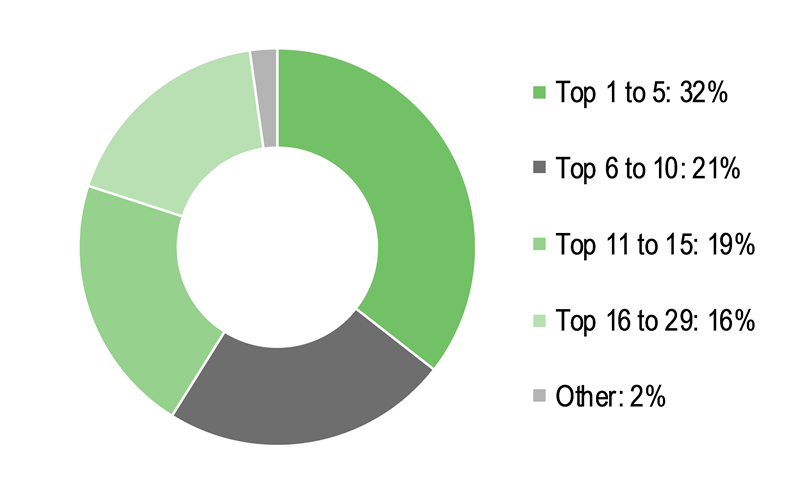
Concentration of DBAG’s portfolio value by size (as at 30 June 2019) |
DBAG’s portfolio exposure by sector (as at 30 June 2019) |
||||
|
|
||||
Shareholder base (as at 16 August 2019) |
Concentration of DBAG’s portfolio value by age (as at 30 June 2019) |
||||
|
|
||||
Source: DBAG, Edison Investment Research, Bloomberg, Thomson Reuters. Note: *Based on expenses net of fee income; adjusted for non-recurring items.
Results highlights: Solid value contribution from exits
DBAG reported a net result on investment activity of €16.9m in 9M19, which represents a 41% yoy decline. This was coupled with higher operating expenses of €5.9m (up 18% y-o-y). Consequently, the private equity investments segment reported a pre-tax profit of €11.0m (down 53% y-o-y). At end June-2019, around 56% of DBAG’s portfolio was exposed to the German industrials sector, and part of it is experiencing headwinds from the economic slowdown and ongoing US-China trade war, as well as sector-specific challenges. The latter include weak order intake in the automotive sector, slow new capacity additions in the wind energy sector and higher commodity prices. Within DBAG’s portfolio, there are several holdings exposed to the automotive industry, for example Karl Eugen Fischer (€22.6m capital invested by DBAG), Frimo (€18.1m), Oechsler (€11.2m), Sero (€10.7m), Dieter Braun (€5.9m) and Gienanth (€3.9m). The company’s exposure to automotive suppliers (Sero, Oechsler and Dieter Braun) was 9% of its portfolio at end-June 2019. The wind energy business in Germany is affected by extended regulatory requirements, lengthy project approval times and a deficit of approved regional plans, as well as resistance from local residents and environmentalists. DBAG’s portfolio companies exposed to wind farm construction are Sjølund (€4.5m invested by DBAG), and Silbitz (€4.3m). At the same time, we note that DBAG’s industrial companies provide various products and services, mostly with more than one sector as a buyer.
Despite the above limiting factors, the overall change in value of DBAG’s carried portfolio reached a positive c €23.6m in 9M19 (see Exhibit 2), of which €11.5m was delivered in Q319 alone. We note that earnings multiples for peers used to value DBAG’s portfolio holdings have now rebounded to levels seen at the end of DBAG’s previous fiscal year (ie September 2018), while the uplift on disposals in 9M19 had a positive impact of €13.7m. These include exits performed after the reporting date (Infiana and Novopress) at prices above Q219 valuations. In the case of these transactions, the valuation uplifts to agreed prices were already reflected in end-June 2019 results. These had a positive impact on DBAG’s NAV of €5.8m (or €0.39 per share) in Q319.
Moreover, the earnings prospects of a number of companies (for instance in the technology, media and telecommunications (TMT) sector, especially with a focus on high-speed internet) assisted DBAG’s portfolio valuation as well. We appreciate the fact that TMT has been a focus area of DBAG’s recent investments, with four out of 10 last acquisitions. Again, we note that a high proportion of relatively new investments at the moment calls for a more medium-term perspective when examining DBAG’s performance.
Exhibit 2: Change in carried portfolio value (€m)
9M19 |
9M18 |
Q319 |
Q318 |
|
Change in earnings |
20.1 |
39.9 |
14.1 |
(4.4) |
Change in debt |
(14.0) |
(26.6) |
(11.8) |
(16.6) |
Change in multiples |
13.6 |
6.3 |
9.1 |
24.3 |
Change in exchange rates |
1.7 |
(0.1) |
(0.1) |
1.3 |
Change, other |
2.1 |
7.6 |
0.3 |
6.7 |
Total |
23.6 |
27.2 |
11.5 |
11.4 |
Source: DBAG
The fund services segment reported a 5% y-o-y decline in income to €21.2m and a pre-tax profit of €1.6m (down 61% y-o-y). The fall in fee income was already expected, as 1) DBAG Fund V entered a phase when it no longer collects management fees, 2) assets of DBAG Fund VI went down following the disposal of CleanPart and deconsolidation of Unser Heimatbäcker, and 3) DBAG ECF generated higher transaction-based fees last year. In Q319, the results were also influenced by some unplanned expenses, as well as costs incurred in conjunction with transactions that were not completed as of the reporting date, including in particular higher transaction-based remuneration of the investment team. This translated into 7% y-o-y higher net operating costs at €19.6m.
Personnel costs at group level amounted to €16.7m in 9M19 (27% higher y-o-y), while other income/expenses contributed a negative €7.9m (€9.5m in 9M18). Consequently, DBAG’s 9M19 EPS declined 54% yoy to €0.84. We note, however, that DBAG’s business model provides for limited comparability of achieved net results in consequent reporting periods. Prior to publishing the results and based on preliminary numbers, DBAG management lowered its FY19 net income guidance and now expects it to be at least positive. We understand that the guidance downgrade is largely a function of worsened economic conditions, in particular in automotive- and wind energy-related companies.
Exhibit 3: Income statement by segments (€m)
9M19 |
9M18 |
y-o-y |
Q319 |
Q318 |
y-o-y |
|
Net result of investment activity |
16.9 |
28.5 |
(41%) |
7.4 |
8.4 |
(12%) |
Other income/expenses |
(5.9) |
(5.0) |
18% |
(2.2) |
(1.2) |
84% |
Private equity investments profit |
11.0 |
23.5 |
(53%) |
5.2 |
7.2 |
(28%) |
Fund services income |
21.2 |
22.4 |
(5%) |
6.9 |
7.7 |
(11%) |
Other income/expenses |
(19.6) |
(18.2) |
7% |
(7.0) |
(5.8) |
23% |
Fund services profit |
1.6 |
4.2 |
(61%) |
(0.2) |
2.0 |
N/M |
Consolidated net profit |
12.6 |
27.7 |
(54%) |
5.0 |
9.1 |
(45%) |
Source: DBAG
During 9M19, DBAG’s NAV decreased 2.0% ytd to €28.9 on a per share basis, reaching €434.9m in total (+1.2% q-o-q). We refer to the balance sheet value of equity, rather than DBAG’s approach, which excludes assets and liabilities other than directly related to the portfolio and amounted to €445m after a 5.5% ytd decrease (+0.6% q-o-q). DBAG distributed €1.45 dividend per share, which reduced the NAV by 4.9%. Fee income contributed €1.35 per share (7% less than in 9M18). The developments within the portfolio (including change in value of carried portfolio and valuation gain on disposals as discussed above) added a total of €1.82 per share (29% lower year-on-year). The higher expenses (+12% y-o-y net of other operating income) reduced NAV per share by €2.06. DBAG’s LTM NAV total return came in at 3.3%.
|
Exhibit 4: DBAG’s NAV performance nine months to end-June 2019 (€/share) |
|
|
Source: DBAG, Edison Investment Research. Note: *Including disposals after reporting date. |
The gross portfolio value amounted to €421.8m, up 21% from €348.7m at end-September 2018. The increase was driven mostly by investments (€77.1m) and valuation uplift on agreed disposals. DBAG made limited contributions to existing holdings in 9M19, but the companies continued with their development agenda, financing growth and acquisitions externally. This led to an increase in debt and reduced the portfolio valuation by €14.0m in Q319 (vs €26.6m in 9M18).
Following the above-mentioned disposals, DBAG’s assets under management (AUM) decreased to €1.7bn from €1.8bn at end-June 2018. These include outstanding capital commitments of third-party investors and DBAG’s financial resources. The capital deployed into its portfolio amounted to €1.2bn, up 26% y-o-y, reflecting primarily steady investments of DBAG Fund VII. The undrawn capital commitments towards DBAG Fund VII and new vintage of DBAG ECF amounted to €130m (FY18: €198m). Financial resources covered 30% of these commitments (down from 60% at end-FY18), with additional liquidity secured by the currently open and undrawn €50m credit line. The remaining €41m should be funded by disposal proceeds. At end-June 2019, this represents 9% of DBAG’s NAV (7% at end-FY18) and does not reflect the cash inflows from disposals finalised after reporting date.
Portfolio development: Proceeding with diversification
During 9M19 (beginning October 2018), DBAG proceeded with its portfolio diversification. The company completed five new additions to the portfolio, deploying €77.1m of capital including follow-on investments. A further eight acquisitions were performed by portfolio companies. At the same time, five companies left the portfolio, following four disposals (where DBAG realised a €13.7m gain on valuation uplift to agreed prices during 9M19) and Unser Heimatbäcker filing for insolvency. The acquisitions of Kraft & Bauer, Sero and FLS completed in Q119, and another two transactions: blikk radiology group (agreed in Q217) and Cloudflight (agreed Q219) were completed during Q319. The disposals included successful transactions on Cleanpart and PSS, which were completed in Q119 and Q219 respectively, and two transactions concluded after the reporting date: Infiana and Novopress. After the reporting date DBAG announced the investment in Cartonplast alongside DBAG Fund VII, which is however not expected to close in the current fiscal year. For a detailed discussion of transactions completed prior to Q319, see our previous notes.
In Q319 DBAG finalised the investment in blikk radiology group, its fifth investment of FY19. During the quarter DBAG deployed a total of €20.9m, including follow-on investments in duagon, DNS:Net and Kraft&Bauer. The investment in Cloudflight, described in our previous note, was also concluded with DBAG deploying €8.0m alongside DBAG Fund VII for a 13.5% stake in the provider of data-driven and cloud-native applications. Its portfolio was also expanded by two add-on acquisitions concluded by BTV Multimedia. The disposals of Infiana and Novopress were completed after the reporting date, but agreed prices were reflected in end-Q319 portfolio value. We appreciate the fact that DBAG continues to diversify its portfolio into sectors expected to be more defensive in an event of economic downturn while still offering good growth prospects. DBAG Fund VII will have already allocated 71% of its investment commitments of €808m (with 59% out of the further €202m from the top-up fund allocated as well) on finalising the acquisition of Cartonplast. DBAG plans to launch a successor fund as soon as DBAG Fund VII completes its investment phase and we believe that the new fund could be launched in 2020. DBAG Fund VII is expected to allocate c 80% of its capital before closing, leaving room for further follow-on investments in its portfolio companies.
blikk Holding GmbH
In May 2019, DBAG invested a total of €15.2m in blikk and will hold 12.1% of the shares in the entity. The investment was realised alongside DBAG Fund VII, marking its seventh transaction. In total, DBAG and its fund invested c €90m, acquiring a majority stake of approximately 68% in the formed group.
blikk Group merges radiology, nuclear medicine and kidney practices/dialysis, thus making a major contribution towards ensuring top-class medical care. Currently 20 practices act as innovative partners for patients, physicians and co-operating hospitals. DBAG agreed upon the transaction as early as in March 2017 committing to acquiring a new group formed from Radiologische Gemeinschaftspraxis Herne GbR and Ranova Überörtliche Gemeinschaftspraxis für Radiologie und Nuklearmedizin GbR, which was subject to regulatory approvals. Since then DBAG has provided funding and actively supported the expansion of the network, including two add-ons earlier this year. The group has grown substantially since the initial agreement, with revenues increasing to €75m in 2018. DBAG intends to further develop the group in Germany by acquiring additional practices.
Cartonplast Group GmbH
In August 2019, DBAG agreed to invest €26m alongside DBAG Fund VII, acquiring a 17% stake in Cartonplast. This will be the eighth investment of the fund since inception in December 2016. DBAG and its fund will take over a majority stake in the company from Stirling Square Capital Partners, while Cartonplast management will retain a stake in the business. The MBO is subject to regulatory approvals and is not expected to close before the end of FY19.
Cartonplast predominantly rents out reusable and recyclable plastic layers used for transportation of eg glass bottles or cans. It conducts its business in 16 locations around the world with a closed logistics cycle – including collection, sorting and cleaning of the layers. In 2018, the company generated c €80m revenues, with around 75% coming from rental services.
M&A and follow-on investments in the existing portfolio
During Q319, DBAG provided funds for its portfolio companies’ development in the amount of €5.9m. Within the DBAG ECF portfolio, DNS:Net was provided a further €5.0m for its fibreoptic network expansion. Also, within this portfolio, BTV Multimedia performed two acquisitions, although using exclusively its own funds. It acquired a wholesaler of network components, Holm (which was a longstanding customer of BTV), with c €9m of annual revenues. Moreover, BTV also concluded a takeover agreed in Q219 of Danish broadband network equipment manufacturer DKT A/S, with €15m of annual revenues. This marks the third acquisition by BTV in the current financial year as part of its buy-and-build strategy, following the takeover of Anedis, a major competitor on the German market (DBAG contributed €2.2m to the deal).
Within DBAG Fund VI portfolio, two ‘add-on’ acquisitions were completed. Telio, a provider of communications and media systems for correctional facilities, expanded its product range by acquiring KEAS, a French company developing systems that detect and interfere with mobile communication. duagon, a provider of network components for data communication in railway vehicles, acquired OEM Technology Solutions, an Australian supplier of control and automation solutions for the global railway industry. This has not only broadened its product offering and technological know-how, but also added a global sales chain. DBAG contributed €0.9m to the former deal, while the latter acquisition was funded entirely by its portfolio company.
Disposals
During Q319, DBAG agreed to sell its stakes in Infiana and Novopress. DBAG invested €4.5m in Infiana (€23.7m including DBAG Fund VI) in December 2014 and realised a money multiple above 2x upon disposal. Infiana is a manufacturer of specialised films for the consumer goods market and for industrial applications. During the 4.5-year long holding period, the company sold its subsidiaries in Brazil and Thailand, and focused on organic growth in Germany and the US, expanding production capacity and product range. Novopress was a significantly smaller investment, as DBAG invested €2.3m for an 18.9% stake in 2015 (€4.8m and 39.8% including DBAG ECF, respectively). DBG Fonds I acquired a minority shareholding in Novopress in 1990. In 2015, this investment resulted in a commitment by DBAG ECF – since then, DBAG has held a stake in Novopress through the Fund. DBAG implemented an internationalisation strategy in the company with the latter reaching 53% of revenue generated outside of Germany upon realisation. DBAG realised a €5.8m gain from uplift on valuation to agreed prices of both companies in Q319 results, with the cash inflow expected in Q419.
Valuation: Developments reflected in valuation
DBAG’s reported NAV is exclusively attributable to the value of its private equity investment portfolio and does not account for the fair value of its fund services business, which currently represents third-party assets under management of c €1.4bn and generates considerable recurring fee income. On the LTM basis the segment generated €28.2m in fees, translating to €3.5m EBT (39% lower y-o-y). Consequently, there is an inherent premium when comparing DBAG’s share price with its reported NAV, which disguises any underlying premium or discount that the market may be applying to the value of DBAG’s private equity investment portfolio. We believe that this is the primary reason why the company’s shares have traded at a premium to NAV for all of the last three years, as illustrated in Exhibit 5. For the last year DBAG traded in a broad 10–30% premium corridor, which narrowed visibly to the current c 9%. We believe this may reflect the macroeconomic and sector headwinds in DBAG’s private equity portfolio. Moreover, it may also be a function of the decline in fee income in the fund services segment (despite a new fund launch on the horizon), although this has already been anticipated and communicated by DBAG’s management earlier.
|
Exhibit 5: Share price premium to NAV over three years (%) |
|
|
Source: Refinitiv, Edison Investment Research. Note: Positive numbers indicate a premium, negative numbers a discount. |
DBAG’s reported equity (which we treat as an equivalent of NAV, as discussed above) as at end-June 2019 stood at €434.9m, which compares to the current market capitalisation of €474m. We estimate the price tag on the fund services segment implied by DBAG’s market capitalisation in two scenarios. If we assume that the private equity investments business is valued at a discount to NAV in line with the current discount of the LPX Europe index (11.2%), the value of the fund services business amounts to €87.6m and translates into an earnings multiple of 24.9x. This compares to our last estimate from May, when the LPX discount amounted to 10% implying a multiple of 26.4x. Alternatively, if we assume that the market is valuing the company’s private equity business in line with its last reported NAV, this implies a value attached to the fund services business of around €39.0m (8% of the market cap). Based on the LTM earnings before tax of the latter segment, this translates into an earnings multiple of 11.1x. This compares to our previous calculations as at the Q219 results of an 18.6x earnings multiple based on similar assumptions.
We note that these LTM multiples reflect the increased personnel costs (including variable deal-driven remuneration) described earlier in the note. Moreover, DBAG plans to launch a new fund around 2020, which would assist fee income from fund services. In this context, it is also important to note that 11% of DBAG’s current portfolio is valued at acquisition cost and will be moved to the multiples method basis 12 months after the acquisition date, and that we have not adjusted the multiple for the transaction-based fees earned by DBAG over the last 12 months.
Peer group comparison
We have compared DBAG with other listed private equity investment companies with a prime focus on Europe in Exhibit 6. However, we acknowledge that DBAG is the only company in the group that targets mid-sized companies in German-speaking countries. Moreover, unlike all the peers except 3i in the UK, DBAG also manages third-party funds. As discussed earlier, we see the value of DBAG’s fund service business as the main reason that its shares trade at a premium to its reported NAV. This contrasts with its peers that do not manage third-party funds, some of which are trading at a wide discount to NAV. DBAG’s 4.6% dividend yield is among the highest in the peer group (the average is 3.1%).
Exhibit 6: Listed private equity investment companies peer group as at 9 September 2019*
% unless stated |
Region |
Market cap £m |
NAV TR 1 year |
NAV TR 3 years |
NAV TR 5 years |
NAV TR 10 years |
Price TR 1 year |
Price TR 3 years |
Price TR 5 years |
Price TR 10 years |
Premium/(discount) |
Dividend yield |
Deutsche Beteiligungs |
Europe |
424.1 |
4.5 |
56.0 |
107.5 |
216.7 |
2.2 |
50.3 |
107.7 |
356.9 |
9.0 |
4.6 |
3i |
Global |
10.932.0 |
18.6 |
88.7 |
202.5 |
215.2 |
28.5 |
125.1 |
233.5 |
541.7 |
30.3 |
3.1 |
HgCapital Trust |
UK |
950.1 |
7.5 |
49.3 |
103.4 |
210.3 |
13.9 |
95.1 |
151.5 |
260.8 |
9.9 |
1.9 |
ICG Enterprise Trust |
UK |
603.3 |
11.7 |
52.5 |
70.2 |
207.4 |
4.2 |
70.1 |
68.9 |
277.2 |
(17.6) |
2.5 |
Oakley Capital Investments |
Europe |
481.4 |
10.4 |
37.2 |
54.4 |
135.9 |
27.0 |
96.3 |
54.1 |
234.2 |
(15.5) |
1.9 |
Princess Private Equity |
Global |
605.2 |
9.4 |
46.1 |
103.8 |
172.5 |
(0.2) |
63.8 |
116.6 |
678.6 |
(17.1) |
5.8 |
Standard Life Private Equity |
Europe |
556.2 |
4.5 |
39.6 |
82.6 |
226.5 |
7.9 |
67.3 |
85.1 |
343.3 |
(17.2) |
3.5 |
Average |
2,354.7 |
10.3 |
52.2 |
102.8 |
194.6 |
13.5 |
86.3 |
118.3 |
389.3 |
(4.5) |
3.1 |
|
Rank in peer group |
7 |
7 |
2 |
2 |
2 |
6 |
7 |
4 |
3 |
3 |
2 |
Source: Morningstar, Edison Investment Research. Note: *Performance to end-June 2019. TR=total return in sterling terms.
DBAG’s 4.5% NAV total return in sterling terms over one year to 30 June 2019 underperformed the peer group, which had an average of 10.3%. This can be attributed to DBAG’s higher exposure to the German industrial market, which experiences more intense headwinds from the slowing economy and trade war threats than other sectors. However, the longer-term performance remains intact, as the company posted NAV returns ahead of average. Over three and five years, DBAG ranked second, posting total returns of 56.0% and 107.5%, slightly ahead of the peer averages of 52.2% and 102.8%, respectively.
|
|
Euromoney has announced a strategic review of its Asset Management business. This division accounted for 39% of FY18 revenues and 44% of FY18 operating profit before central costs. It has been under structural and cyclical pressure as its clients (primarily sell-side providers) have struggled with the dual impacts of MiFID II and the growth of passive asset management. A sale is not necessarily the only outcome of the review and, if that is the route chosen, management has a record of strong discipline in M&A pricing. A disposal would naturally result in the growing Price Reporting segment being a greater proportion of the continuing business. The valuation implications depend on how the proceeds were reinvested.