Last close As at 05/08/2026
GBP8.17
▲ 7.00 (0.86%)
Market capitalisation
GBP819m
Research: Investment Companies
4SC’s new core strategy revealed earlier this year has focused on dermato-oncological indications, while its assets for other indications are partnered. The sharp focus will allow 4SC to become an expert in the field and to accumulate commercial know-how, as the company intends to market the core assets (resminostat, 4SC-202 and 4SC-208) in orphan indications on its own. A successful fund-raise in July means that the company now has sufficient funds until 2020 and past several important R&D events. We have overhauled our model to reflect 4SC’s new strategy and our new valuation is €344m or €11.2/share.
Written by
4SC |
Becoming a dermato-oncology expert |
Fund-raising |
Pharma & biotech |
30 October 2017 |
Share price performance
Business description
Next events
Analyst
|
||||||||||||||||||||||||||||||||||||||||||||||||||||||||||||||||||||
4SC’s new core strategy revealed earlier this year has focused on dermato-oncological indications, while its assets for other indications are partnered. The sharp focus will allow 4SC to become an expert in the field and to accumulate commercial know-how, as the company intends to market the core assets (resminostat, 4SC-202 and 4SC-208) in orphan indications on its own. A successful fund-raise in July means that the company now has sufficient funds until 2020 and past several important R&D events. We have overhauled our model to reflect 4SC’s new strategy and our new valuation is €344m or €11.2/share.
Year end |
Revenue (€m) |
PBT* |
EPS* |
DPS |
P/E |
Yield |
12/15 |
3.3 |
(8.4) |
(0.59) |
0.0 |
N/A |
N/A |
12/16 |
2.1 |
(10.9) |
(0.54) |
0.0 |
N/A |
N/A |
12/17e |
2.4 |
(14.5) |
(0.56) |
0.0 |
N/A |
N/A |
12/18e |
2.7 |
(17.1) |
(0.54) |
0.0 |
N/A |
N/A |
Note: *PBT and EPS are normalised, excluding amortisation of acquired intangibles, exceptional items and share-based payments.
Resminostat – lead asset, HDAC inhibitor
Resminostat is an orally administered histone deacetylase (HDAC) inhibitor, which could act as a monotherapy or in combination with other anti-cancer drugs. 4SC’s pivotal trial RESMAIN is evaluating resminostat in a novel indication – maintenance treatment of patients with advanced-stage cutaneous T-cell lymphoma (CTCL) who have achieved disease control with prior therapy. Top-line results are expected in H119 and if positive it could be the first HDAC inhibitor available for CTCL in Europe, but more importantly the maintenance treatment indication would be unique, potentially offering a competitive edge in Europe and the US. Resminostat is partnered with Yakult Honsha in Japan, where most recently a Phase II study in first-line HCC and a Phase I study in biliary tract cancer have been completed.
4SC-202 and 4SC-208 complete core portfolio
4SC-202 and 4SC-208 are 4SC’s two other core portfolio assets in earlier stages, also for dermatological cancers: melanoma (Phase II ready, 4SC-202), Merkel-cell carcinoma (MCC, pivotal stage after melanoma study, 4SC-202) and Basal cell carcinoma (BCC, preclinical stage, 4SC-208). 4SC-202 is a specific HDAC Class I inhibitor positioned to be used in combination with checkpoint inhibitors. 4SC-208 specifically targets two kinases that are crucial for Hedgehog/GLI signalling pathway and acts more downstream than other agents. In indications like BCC, 4SC-208 has the potential to address the key issue of relapse after currently approved therapies. 4SC plans to complete preclinical development and start clinical trials in 2019.
Valuation: €344m or €11.2/share
Our updated rNPV stands at €344m (vs €124m previously) after revising our model in accordance with the new 4SC strategy enabled by the substantial fund-raise in July. We forecast cash reach into 2020 and expect a number of potential inflection points over the next three years, including data read-out of its CTCL resminostat trial and application for marketing authorisation; data read-outs from several Phase II 4SC-202 trials and initiation of a pivotal trial in MCC.
Investment summary
Company description: Fund-raising enables strategy execution
4SC is a Munich-based biotech company focused on developing small-molecule drugs for cancer. Together with the successful fund-raise, the company announced earlier this year a refocused R&D strategy, which centres the development of its assets for dermatological cancers. 4SC’s lead product resminostat is in a pivotal study in CTCL, which was initiated in Q416 with the results expected in H119. Resminostat is partnered with Yakult Honsha in Japan, where most recently a Phase II study in first-line HCC and a Phase I study in biliary tract cancer have been completed. Yakult indicated that it plans to continue the development in biliary tract cancer with a Phase II study to be initiated shortly. 4SC-202 and 4SC-208 are the two other core portfolio assets in earlier stages, also for dermatological cancers, Melanoma (Phase II ready), MCC (pivotal stage after melanoma study) and BCC (preclinical), respectively. 4SC was founded in 1997, listed on the Frankfurt stock exchange in December 2005, and has 47 full-time employees.
Valuation: €344m or €11.2/share
Our updated rNPV-based valuation stands at €344m or €11.2/share, compared to €124m previously, including estimated cash of €43.4m after the fund-raising. To reflect 4SC’s updated strategy we have overhauled our model, making substantial changes. The core portfolio includes resminostat for CTCL, 4SC-202 for MCC and 4SC-208 for BCC. We assume that 4SC will develop and market the products in these indications itself. Out-licensed assets or indications include resminostat for biliary tract cancer in Japan developed and marketed by Yakult (our scenario), and two of 4SC’s other out-licensing deals that have disclosed financials (Link Health and Maruho).
Financials: Well-funded to several R&D events
Following the recent €41m gross (estimated €40m net) capital raise, we forecast cash reach into FY20 and have increased our R&D forecasts to €14.0m, €16.8m and €12.6m in 2017, 2018 and 2019, respectively. This will enable 4SC to advance its clinical programmes for resminostat, 4SC-202 and 4SC-208 significantly. We do not include potential milestones from any ongoing development of resminostat with its partner Yakult or other milestones from non-core assets. As such, if the partnerships progress, there is potential for additional injections of non-dilutive cash.
Sensitivities: Typical biotech risks apply
4SC is subject to sensitivities typical of biotech drug development, including the unpredictable nature of clinical trials, the success or failure of competitors and changing market dynamics. The company has reduced its financial risk with its recent fund-raising (estimated €40m net), enabling it to progress its lead product resminostat (ex Japan) in pivotal development for CTCL alongside earlier-stage products 4SC-202 and 4SC-208.
Accelerating the clinical programme
The fresh funds enable 4SC to fund an accelerated development of its leading drug candidates resminostat, 4SC-202 and 4SC-208, which could prove transformational for 4SC (see Exhibit 2 for an outline of the company’s vision for 2020). Specifically, it has indicated that it will use the funds to accelerate development of its clinical pipeline and potentially reach a number of value drivers. This includes:
■
Resminostat – 4SC expects to file for a marketing authorisation application (MAA) for resminostat in CTCL in Europe and the US by 2019.
■
4SC-202 – Two Phase II studies are planned to be initiated in melanoma and in gastrointestinal cancer in Q317 and Q118, respectively. 4SC believes that the insights from these studies will allow it to initiate a pivotal study for MCC in early 2019.
■
4SC-208 – 4SC expects to complete pre-clinical development of 4SC-208 and potentially start a Phase I/II clinical trial in early 2019.
■
Partnerships – 4SC has several out-licensing deals, where the partners are financially responsible for further development of the assets. If any of these progress, 4SC could receive milestone payments in the short term and royalties over the long run. The most advanced partnered asset/indication is with Yakult Honsha for resminostat in various indications in Japan.
Exhibit 1 below outlines 4SC’s pipeline, expected value drivers and timings.
Exhibit 1: 4SC’s pipeline and timings
Drug |
Study |
Indication |
Status/plan |
Study initiation |
Data read-out |
Resminostat |
RESMAIN |
CTCL |
Pivotal study; maintenance therapy – theoretically all surviving patients after any line of therapy would qualify to receive resminostat for a maintenance therapy, subject to proven efficacy in RESMAIN. Patients often receive up to 10 lines of therapy for progressive disease. |
Q416 |
H119 |
Partner |
Biliary tract cancer |
Most recently Yakult indicated that it will proceed to Phase II with resminostat in biliary tract cancer based on Phase I findings. |
Our estimate H118 |
tbd |
|
4SC-202 |
SENSITIZE |
Melanoma |
Phase II. If the data are promising, this could lead to out-licensing. |
Q317 |
H218 |
EMERGE* |
Gastro-intestinal cancers |
Phase II. If the data are promising, this could lead to out-licensing. |
Q118 |
H219 |
|
Merkel-cell carcinoma |
Pivotal study; 4SC plans to leverage the insights from the SENSITIZE and EMERGE studies and to conduct a pivotal trial in MCC as a speedy route to market. |
Q119 |
Q121 |
||
4SC-208 |
Basal cell carcinoma |
Pre-clinical. Phase I/II clinical trial could start in early 2019. |
Q119 |
Q120 |
Source: 4SC presentation. Note: *Investigator initiated trial.
|
Exhibit 2: 2020 vision: 4SC’s three-year strategic plan goals |
|
|
Source: 4SC presentation |
Core portfolio focused on dermato-oncology
4SC’s core focus is on dermato-oncology utilising discrete and potentially effective therapeutic mechanisms to target certain cancers (CTCL, MCC and BCC), which the company believes represent the fastest opportunities to reach the market. For the time being, assets or indications that are beyond dermato-oncology are being considered for out-licensing. Notably, the company’s assets are well suited for use in various combinations, especially with cancer immunotherapies.
|
Exhibit 3: Clinical development focus – ongoing and planned studies |
|
|
Source: 4SC presentation |
Resminostat – lead asset, HDAC inhibitor
Resminostat is an orally administered histone deacetylase (HDAC) inhibitor with potential to act as a monotherapy and/or in combination therapy with other anti-cancer drugs. Resminostat inhibits HDAC classes I, IIb and IV, but has alongside pronounced activity against HDAC 6, which could potentially facilitate inhibition of tumour growth, cause regression and bolster the innate immune response. In short, it has the ability to re-programme cancer cells.
Resminostat has shown encouraging anti-tumour activity with good tolerability in patients with advanced cancers in Phase I and Phase II studies. It has been tested in patients in a range of blood and solid tumours, both as a monotherapy and in combination with chemotherapies in the EU and Asia. It was generally well tolerated, with adverse effects in line with or better than other HDACs, principally GI effects (nausea and diarrhoea), fatigue and thrombocytopenia. Importantly, there were no severe liver, cardiovascular or GI bleeding side effects. Exhibit 4 below outlines the body of data (>300 patients to date) that has been built around Resminostat in Phase I and II studies.
Exhibit 4: Overview of completed resminostat clinical studies
Study |
Study phase |
Number of patients |
Study design |
Publication |
Resminostat in combination with sorafenib in advanced hepatocellular carcinoma (HCC) |
II |
170 |
A multinational, multicentre, randomised, double-blind, placebo-controlled Phase II study to evaluate resminostat in combination with sorafenib for the first-line treatment of advanced HCC, conducted by partner Yakult Honsha. |
|
4SC’s resminostat in combination with S-1 chemotherapy in pre-treated biliary tract cancer. |
I |
27 |
A multicentre, open-label Phase I study of 4SC’s resminostat in combination with S-1 chemotherapy in 27 Japanese patients with pre-treated biliary tract or pancreatic cancer. |
Presented at the European Society for Medical Oncology (ESMO) conference in September 2017 |
SHELTER – Combination of sorafenib and resminostat in hepatocellular carcinoma (HCC) |
II |
57 |
A multinational, multicentre, single-arm Phase II study to evaluate efficacy, safety and pharmacokinetics of resminostat and the treatment combination of sorafenib and resminostat in patients with HCC exhibiting progressive disease (PD) under sorafenib treatment. |
|
SAPHIRE – Resminostat in Hodgkin’s LYMPHOMA |
II |
37 |
A multinational, multicentre, single-arm Phase II study to evaluate the efficacy, safety and pharmacokinetics of resminostat in patients with relapsed or refractory HL. |
|
NSCLC |
I/II |
9/108 |
Dose escalation in patients with advanced, metastatic, or recurrent NSCLC who have previously received one platinum-based chemotherapy treatment. The resminostat/docetaxel combination proved to be safe and well tolerated in all dose levels tested. |
|
SHORE – Combination of Resminostat and FOLFIRI in Colorectal Cancer (CRC) |
I/II |
17 |
A national, multicentre Phase I/II study to evaluate safety, tolerability, pharmacokinetics and efficacy of resminostat in combination with a second-line treatment in patients with K-ras mutated advanced CRC. The Phase II part of the study was not conducted. |
|
Resminostat in advanced solid tumours |
I |
12 |
A mono-centre, single-arm Phase I study of resminostat in Japanese patients with solid tumours, conducted by Yakult Honsha. |
A phase I study of resminostat in Japanese patients with advanced solid tumours. |
First-in-human study of resminostat in advanced solid tumours |
I |
19 |
A first-in-human, mono-centre, single-arm, open-label, dose-escalation study of resminostat in patients with advanced solid tumours. |
Source: 4SC and clinical trials.gov
Resminostat next steps
CTCL – resminostat could be the first HDACi approved for CTCL in Europe
Currently 4SC is running a pivotal trial (the RESMAIN study) with resminostat to evaluate it for maintenance treatment in patients with advanced-stage CTCL who have achieved disease control with prior systemic therapy. Exhibit 5 summarises the details. Resminostat is focused on patients with late stage, incurable disease. Such patients typically receive many different lines of therapy over their lifetime as none of the current therapeutic options achieve stable disease for long periods, with virtually all patients progressing after three to four months on average. Should resminostat show efficacy as a maintenance therapy – prolonging the period patients are stable and not progressing – it means that the target population for resminostat is virtually all late stage patients who have received at least one line of therapy.
Overall 10-year survival rates vary from 98% if diagnosed at stage IA to 20% if diagnosed at clinical stage IVB. Theoretically, this means that patients could receive multiple cycles of therapy-resminostat-therapy-resminostat and so on. Because of the unique positioning as a maintenance therapy, the company believes this would clearly differentiate resminostat against two other HDAC inhibitors approved in the US ,vorinostat (Zolinza, Merck & Co) and romidepsin (Istodax, Celgene), which are indicated for patients with progressive disease in second or later lines and are typically used only once as a single line of therapy. Notably, no HDAC inhibitors have been approved for this indication in Europe.
Top-line results for resminostat in CTCL are expected in H119, and if they are positive, 4SC has indicated that it would submit the data as soon as possible to the regulatory authorities for market approval. The company expects efficacy data from the ongoing RESMAIN study in Europe to be sufficient for the FDA as well, but there might be smaller and shorter bridging safety studies required to file for the approval in the US. This could be resolved while the RESMAIN study is ongoing and 4SC expects to submit resminostat for market approval in the US and Europe at the same time. If approved, resminostat would be the first HDAC inhibitor approved for CTCL in Europe and the first and only therapy approved for maintenance in the US and Europe. The company is targeting orphan drug designation in CTCL in Europe and the US, which would provide 10 years’ market exclusivity in Europe and seven years in the US.
Exhibit 5: Overview of the RESMAIN clinical study
Aim |
To determine whether resminostat will be able to delay worsening of disease in patients with advanced stage mycosis fungoides (the most common form of CTCL) or Sézary syndrome (about 5% of all cases of CTCL) who have recently achieved disease control with previous systemic therapy. |
Summary design |
Multicentre, double-blind, randomised, placebo-controlled Phase II trial |
Design details |
150 patients, two-arm study. Active arm: 3 tablets, 5 days’ treatment followed by 9 days’ rest (cycles until progress or unacceptable to toxicity). |
Inclusion criteria |
Patients with histologically confirmed mycosis fungoides (Stage IIB-IVB) or Sézary syndrome with a complete response, partial response or stable disease after at least one prior systemic therapy according to local standards, adequate haematological, hepatic and renal function |
Exclusion criteria |
Patients with progressive disease, elongated baseline corrected QT interval, concurrent use of any other specific anti-tumour therapy |
Primary endpoint |
Progression-free survival (PFS) |
Secondary endpoints |
Time to symptom worsening (TTSW), specifically pruritus |
Start date |
End 2016 |
Completion dates |
Final data collection early 2019 |
Source: clinicaltrials.gov
HCC and biliary tract cancer in Japan – in the hands of Yakult
As summarised in Exhibit 4, resminostat has shown efficacy and safety in combination with sorafenib (current standard first-line medication) in a subset of patients with advanced HCC in a Phase II trial conducted by 4SC’s partner Yakult and may support continued development in this indication. One possible option, although not confirmed yet, is a pivotal study with a subgroup of HCC patients who have higher baseline platelet levels. Yakult’s Phase II HCC study showed a 40% reduction in risk of death for those with higher baseline platelet levels. The company has indicated that it sees the future of resminostat in HCC in China and is actively looking to partner the drug in this, the largest market for HCC globally. We also note that 4SC has orphan drug designation in the EU and US for resminostat use in HCC with patent protection until late 2026 in Europe and until mid-2027 in the US. Therefore, the company is able to partner the development of resminostat outside Japan for non-core indications as well.
The most recent data from Yakult is from a Phase I trial with patients with biliary tract cancer, which was presented at the ESMO conference in September 2017. Resminostat was given in combination with S-1 chemotherapy to 27 Japanese patients with pre-treated biliary tract or pancreatic cancer (Exhibit 6). While primarily a safety (well-tolerated regimen identified) and dose finding study, secondary endpoints provided early insights in potential efficacy:
■
Tumour shrinkage/disease stabilisation has been observed in all patients with biliary tract cancer.
■
Median overall survival (OS) was 10.2 months, while median progression free survival (PFS) was 5.5 months in biliary tract cancer patients.
Due to low patient numbers, any evaluation of efficacy should be cautious; however, reported historical OS and PFS in biliary cancer patients after second-line treatment have been very poor at 6.6 months (OS) and 3.0 months (PFS) with a very low response rate (3.4%). Following the publication of the new data, Yakult indicated that it is planning to conduct a Phase II trial in the near future in biliary tract cancer.
Exhibit 6: Design of the Phase I trial with biliary tract cancer patients (Yakult)
Aim |
To evaluate resminostat monotherapy and S-1/resminostat combination therapy in biliary tract or pancreatic cancer |
Design details |
Phase I, open-label, dose-escalation study to evaluate the dose-limiting toxicities of resminostat monotherapy and S-1/resminostat combination therapy in Japanese patients with unresectable/recurrent biliary tract or pancreatic cancer to determine the recommended dose regimen/s to be used in subsequent Phase II trials conducted by partner Yakult Honsha. |
Primary endpoint |
Dose-limiting toxicities of resminostat monotherapy and S-1/resminostat combination therapy. |
Secondary endpoints |
Assess safety and pharmacokinetics, assess efficacy endpoints – overall response, progression free survival, overall survival. |
Source: 4SC
4SC-202 – promising combination partner for checkpoint inhibitors, HDAC inhibitor
4SC-202 is 4SC’s second epigenetic drug; that selectively inhibits HDAC isoforms 1, 2 and 3 – for more details regarding its mechanism of action please see 4SC’s website. 4SC-202 is once daily and orally administered.
A relatively recent focus in solid tumour indications is the use of checkpoint inhibitors (CPI); however, there remain a majority of patients who neither respond to therapy nor experience durable responses. Data presented by 4SC indicate that there is significant potential for 4SC-202 in combination with anti-PD-L-1 antibodies to expand the treatable patient population. Exhibits 7 and 8 below outline data where 4SC-202 was used alone and appear to indicate it reduces the tumour burden as a monotherapy more effectively than anti-PD-L1 alone and that this anti-tumour effect was also improved when used in combination with anti-PD-L1 therapy in a murine colon carcinoma model.
|
Exhibit 7: 4SC-202 synergises with anti-PD-L1 therapy – tumour size |
Exhibit 8: 4SC-202 synergises with anti-PD-L1 therapy – tumour volume |
|
|
|
Source: 4SC presentation |
|
Exhibit 7: 4SC-202 synergises with anti-PD-L1 therapy – tumour size |
|
|
Source: 4SC presentation |
|
Exhibit 8: 4SC-202 synergises with anti-PD-L1 therapy – tumour volume |
|
|
Source: 4SC presentation |
4SC-202 has completed a Phase I study (see Exhibit 9 for an overview), where most importantly it proved to be safe and well tolerated by patients. In particular, the compound demonstrated promising indications of anti-tumour efficacy, both in terms of long-term stabilisation of the disease and in shrinking the actual tumour itself. Alongside this there is preclinical evidence that 4SC-202 strengthens the endogenous immune response to cancer cells.
Exhibit 9: Overview of completed Phase I study 4SC-202
Study title |
Stage |
N |
Study design |
Publication |
TOPAS – First-in-human study of 4SC-202 in hematologic malignancies |
Phase I |
24 |
The TOPAS study was a first-in-human, multicentre, single-arm, open-label, dose-escalation study of 4SC-202 in patients with advanced hematologic malignancies. |
For academic publications click here |
Source: 4SC and clinicaltrials.gov
4SC-202 next steps: Two Phase II trials and a pivotal study
4SC intends to initiate two Phase II studies of 4SC-202: firstly, in Q417 in combination with checkpoint inhibitors in patients with advanced melanoma who are refractory to treatment with checkpoint inhibitors, followed in Q118 in an investigator-initiated study in non-responding patients with microsatellite-stable gastrointestinal cancers. The company expects that the two studies are a sensible strategy because the accumulated data will allow it to assess the safety profile of 4SC-202 in combination with both anti-PD-1 and anti-PD-L1 checkpoint inhibitors and in the two patient populations with the greatest medical need; relapsed and non-responding patients. This data set would form the basis for potential partnering discussions for indications outside 4SC’s core focus and establish the recommended dose for a subsequent pivotal study in MCC, an orphan indication. If the data are sufficiently positive, 4SC-202 could be the first drug to market in a checkpoint inhibition refractory MCC population, which could prove a significant commercial opportunity.
MCC is a rare, aggressive form of skin cancer. Around 1,600 people in the US are diagnosed with MCC every year. If diagnosed early, surgical treatment is an option, but overall, approximately half of all cases will relapse. Avelumab (Bavencio, anti-PD-L1, Pfizer) was the first checkpoint inhibitor (and first therapy specifically for MCC) to be approved by the FDA in March 2017. The accelerated approval was based on a relatively small clinical trial with 88 patients with metastatic MCC. 33% of patients achieved overall response (i.e. complete or partial) and the response lasted for more than 12 months in 45% of responding patients, meaning that the majority of the patients ultimately progress after checkpoint inhibition or do not respond to CPI monotherapy. Exhibit 10 outlines the three planned studies and timelines. We note there is patent protection until late 2029 in Europe and early 2030 in the US, but MCC would qualify as an orphan disease and orphan drug designation would allow for market exclusivity for seven years in the US and ten years in Europe.
|
Exhibit 10: Clinical development strategy for 4SC-202 |
|
|
Source: 4SC presentation |
4SC-208: Downstream Hedgehog signalling pathway inhibitor
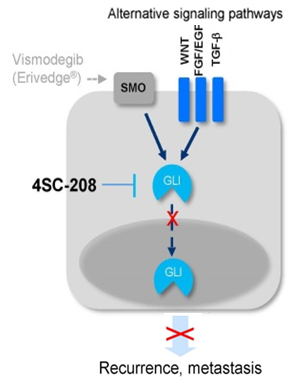
4SC-208 is a small molecule specifically targeting two kinases that are integral for Hedgehog/GLI signalling. Pre-clinical data have indicated efficacy of 4SC-208 in inhibiting this signalling pathway in a pancreatic cancer in vivo model (Exhibit 12). 4SC-208 acts further downstream to other small molecule drugs such as vismodegib (SMO inhibitor, Exhibit 11), which if demonstrated to be true could have the potential to prevent cancer stem cells from developing into tumours, causing metastases and tumour recurrence. 4SC believes that BCC could be the fastest route to market with 4SC-208 and a good first target indication for 4SC-208 since dysregulation of the Hedgehog/GLI signalling pathway is very prevalent in this disease.
BCC is the most common form of skin cancer with incidence of around 2.8m cases a year in the US alone. It rarely metastasizes (less than 0.1%) and in the majority of cases can be well managed with a range of therapeutic options, including, for example, surgical treatment. Significant problems arise if BCC is diagnosed late, which is when it causes significant morbidity and cosmetic disfigurement. Vismodegib (Erivedge, Roche) was the first Hedgehog signalling pathway targeting drug approved in 2012 for BCC, while sonidegib (Odomzo, Novartis) followed in July 2015. Both are so called SMO inhibitors indicated for recurrent locally advanced BCC in patients who cannot be treated with surgery or radiation. Notably, such advanced cases with no curative options are rare, estimated within a range of 1-10%. Patients also typically relapse after the treatment with vismodegib or sonidegib.
4SC plans to position 4SC-208 for patients who have relapsed after treatment with SMO inhibitors, but since it acts further downstream (to SMO inhibitors), it will theoretically prevent the cancer from recurring by utilising alternative GLI activating pathways (Exhibit 11). A first-line positioning in advanced BCC is also possible, depending on the pivotal trial data.
4SC has indicated that it intends to complete formal development of 4SC-208 and start a Phase I/II clinical trial early in 2019, with an early potential outline of the study shown in Exhibit 13.
|
Exhibit 11: 4SC-208 mechanism of action |
Exhibit 12: 4SC-208 efficacy data |
|
|
|
|
|
Source: 4SC presentation. Note: SMO – smoothened receptor. |
Source: 4SC presentation |
|
|
Exhibit 13: Clinical development strategy for 4SC-208 |
||
|
||
|
Source: 4SC presentation |
||
Non-core assets and multiple partnerships
While not a core focus of 4SC’s three-year strategy, it is worth noting 4SC also has 4SC-205, an oral, small molecule inhibitor of Kinesin spindle protein (Eg5; most advanced stage – Phase I), which has a key role in cell division and tumour growth. 4SC entered into a licensing and development partnership with Link Health for this asset in May 2016 in China, Hong Kong, Taiwan and Macao. Link Health will undertake clinical development and the regulatory process, while 4SC will receive development and commercialisation milestones up to (€76m) and double-digit royalties.
In July 2017, Maruho in-licensed 4SC’s preclinical stage voltage-gated ion channel Kv1.3 inhibitors. Kv1.3 has diverse functions in various cell types and cellular mechanisms but plays an essential role in the activation and proliferation of T cells, and therefore potentially has a role in autoimmune diseases. 4SC is eligible to receive milestone payments up to €103m, commercial milestones up to an additional €105m and single-digit royalties.
4SC also has several other early stage assets out-licensed to partners. While financial details of those deals have not been disclosed, these partnerships represent upside should the assets succeed in development. These partnerships include:
■
In September 2016 Immunic, a privately owned German biotech, in-licensed small molecules IMU-366, an inhibitor of RORγt (a nuclear receptor responsible for gene expression of key cytokines involved in various immune or autoimmune diseases), and IMU-838, a next-generation inhibitor of dihydroorotate dehydrogenase (DHODH), which plays a role in the metabolism of activated T and B cells.
■
In September 2013, Panoptes Pharma took over a patent for PP-001. PP-001 is a highly specific inhibitor of an essential enzyme of the de novo pyrimidine pathway, therefore inhibition of expression of IFN-γ and IL-17 – two key cytokines active in inflammatory diseases.
■
In December 2012, BioNTech in-licensed 4SC’s toll-like receptor 7 (TLR-7) agonists as an anti-cancer immunotherapy.
Sensitivities
4SC is subject to the risks typically associated with drug development, including the unpredictable outcomes of clinical trials, the risks of development or regulatory delays, unexpected changes in clinical practice (e.g. as a result of competitor breakthrough products being developed), an altered reimbursement environment and success of competitors (for details, please see our March 2016 outlook note on 4SC) and commercial decisions by partners or potential partners. The company has reduced its financial risk with its recent fund-raising (estimated €40m net), enabling it to progress its lead product resminostat (ex Japan) in pivotal development for CTCL, alongside earlier-stage products 4SC-202 and 4SC-208.
Valuation
To reflect 4SC’s updated strategy we have overhauled our model, making substantial changes. The core portfolio includes resminostat for CTCL, 4SC-202 for MCC and 4SC-208 for BCC. We assume that 4SC will develop and market the products in these indications itself. Out-licensed assets or indications include resminostat for biliary tract cancer in Japan, developed and marketed by Yakult (our scenario), and two of 4SC’s other out-licensing deals that have disclosed financials (Link Health and Maruho). Exhibits 14 and 15 detail our valuation and assumptions. Key changes from our previous valuation include:
■
We have removed US and Europe launches for resminostat in HCC as this is not currently part of the strategic focus over the next three years (this would offer upside).
■
The most recent indication from Yakult is that it will proceed with the biliary tract cancer indication, while it is also considering hepatocellular carcinoma, based on previous trials and could expand into other indications. We have removed HCC and NSCLC from our valuation and now include biliary tract cancer in Japan (should Yakult confirm further plans in other indications we would add this into our model). The assumptions are detailed in Exhibit 14.
■
We have increased the probability of success for resminostat in CTCL from 30% to 50% in Europe. This is because the trial that started in December 2016 is a pivotal trial and if successful would likely be sufficient to file for marketing approval. In addition, there is a solid base of safety and efficacy data. We also now assume launch in both Europe and the US (previously assumed only in Europe). We also revised the positioning of resminostat in CTCL from second line to maintenance, which increased the target population.
■
We have changed the indication for 4SC-202 from acute myeloid leukaemia to MCC in line with the company’s updated strategy (details in Exhibit 14).
■
We added 4SC-208 to our valuation, which is now a part of the core portfolio (details in Exhibit 14).
■
We now reflect the value of 4SC’s out-licensing deals where financial details have been provided, namely Link Health and Maruho. For that, we have included milestone payments over a period of time in the future and discounted with 12.5% rate (Exhibit 14).
Our updated rNPV-based valuation stands at €344m or €11.2/share compared to €124m previously. We use a 12.5% cost of capital and include estimated cash of €43.4m after the fund-raising (Exhibit 15).
Exhibit 14: Assumptions for valuation of R&D projects
Product/stage/indication |
Comments |
Core assets/indications |
|
Resminostat ■ HDAC inhibitor ■ Pivotal ■ Maintenance CTCL |
Target population c 8,000 (prevalence) patients in target markets (EU28+US). Calculated based on incidence of 6.4/1,000,000. Around 30% are diagnosed in advanced stages (>=II). Median survival in advanced stages is less than 5 years. This gives a prevalence of c 8,000 cases as target population for maintenance therapy. Pricing*: $72k per patient per year. Based on Zolinza pricing. The price assumes that patients will be treated for 5 months on average per year. Peak sales in six years. Assumed 50% market penetration at peak due to small patient population. Margins: COGS 5%, SG&A 15% (R&D costs shown separately, see Exhibit 15). Rights: Patent protection until 2025-29, but 4SC plans to apply for orphan drug designation (7 years’ market exclusivity in the US and 10 years in Europe). |
4SC-202 ■ HDAC inhibitor ■ Phase II ready ■ r/r MCC |
Target population c 2,100. Calculated based on incidence of MCC of c 4,100 in Europe and the US. Around 50% with relapse after surgical treatment. Virtually all alive patients will relapse after frontline treatments. Pricing*: $140k per patient per year. In line with average orphan drug cost per year per patient (EvaluatePharma). Peak sales in six years. Assumed high 70% market penetration at peak due to small patient population. Margins: COGS 5%, SG&A 15% (R&D costs shown separately, see Exhibit 15). Rights: Patent protection until 2029-30. |
4SC-208 ■ Hedgehog signalling pathway ■ Preclinical ■ Advanced BCC |
Target population of c 18,000. Calculated using 0.25% prevalence rate of locally advanced BCC not amenable to surgery or radiotherapy. Pricing: $53k per patient per year based on vismodegib cost of $7,500 per month. Assumed average treatment period of 5 months. Peak sales in six years. Assumed 30% market penetration at peak. Margins: COGS 5%, SG&A 15% (R&D costs shown separately, see Exhibit 15). Rights: Patent protection until 2033-34 (pending in some of the regions) |
Out-licensed assets/indications |
|
Resminostat (biliary tract cancer, Yakult Honsha) |
In April 2011, 4SC out-licensed rights to resminostat in Japan to Yakult Honsha for an upfront payment of €6m, up to €127m payable upon achieving specified milestones and double-digit royalties. According to latest indications, Yakult appears to be proceeding with the biliary tract cancer indication, but is also considering hepatocellular carcinoma, based on previous trials. We currently model the biliary tract carcinoma indication assuming a target population of 70% of the total incidence of c 5,000 (excludes patients eligible for curative surgery or not fit for chemotherapy). Launch date 2024. 50% peak market penetration. 17.5% royalty rate and that €25m in milestones will be triggered (remaining milestones could be associated with other indications). Pricing same as in CTCL indication. |
4SC-205 (Link Health) |
Due to the early stage and lack of details about the assets, we only value the disclosed milestones. €76m are spread from 2020 until the patent expiry in 2029 and discounted with a 12.5% rate. |
Kv1.3 inhibitors (Maruho) |
Due to the early stage and lack of details about the assets, we only value the disclosed milestones. €208m are spread from 2022 until the patent expiry in 2034 and discounted with a 12.5% rate. |
Source: Edison Investment Research. Note: Target geographies used in the model are the US plus EU28. *Pricing in US; 30% discount applied in Europe.
Exhibit 15: Risked NPV valuation
Product |
Indication |
Partner |
Launch |
Peak sales, €m |
NPV |
Probability of success |
rNPV |
rNPV/ |
|||||||||
Core assets/indications |
|||||||||||||||||
Resminostat |
Maintenance CTCL |
2021 |
216 |
517.1 |
50% |
258.5 |
8.4 |
||||||||||
4SC-202 |
r/r MCC |
2022 |
237 |
211.7 |
20% |
42.3 |
1.4 |
||||||||||
4SC-208 |
Advanced BCC |
2023 |
386 |
367.6 |
5% |
18.4 |
0.6 |
||||||||||
Out-licensed assets/indications |
|||||||||||||||||
Resminostat |
Biliary tract cancer |
Yakult Honsha |
2024 |
149 |
34.1 |
20% |
15.0 |
0.5 |
|||||||||
4SC-205 |
Link Health |
30.8 |
3% |
10.7 |
0.4 |
||||||||||||
Kv1.3 inhibitors |
Maruho |
55.6 |
3% |
10.0 |
0.3 |
||||||||||||
R&D expenses |
(46.5) |
(46.5) |
(1.5) |
||||||||||||||
Admin expenses |
(9.3) |
(9.3) |
(0.3) |
||||||||||||||
Net cash (Q216) + fundraise |
44.6 |
44.6 |
1.5 |
||||||||||||||
Total |
|
|
|
|
1,205.9 |
343.8 |
11.2 |
||||||||||
Source: Edison Investment Research
Financials
4SC’s Q317 update released last week indicated that cash burn was in line with the company’s expectations, while the cash position was €43.4m. Following the recent €41m gross (estimated €40m net) capital raise, we expect 4SC to accelerate its investment in operating activities, particularly in R&D, given the proposed clinical programmes for resminostat, 4SC-202 and 4SC-208. We note that the fund-raising was among the largest equity offerings in the sector in Europe so far in 2017 and was well supported by its existing shareholders. We have increased our R&D forecasts to €14.0m, €16.8m and €12.6m in 2017, 2018 and 2019, respectively. Notably, we do not include any potential income from milestone payments from the various partnerships 4SC has established. If these progress, the additional income would extend the cash reach.
4SC is well-funded (into FY20 on current forecasts), which should enable it to execute on progressing its pipeline and to execute its strategy. A number of potential key inflection points over the next three years are expected, including:
■
CTCL RESMAIN study data read-out in H119 (resminostat),
■
Initiation of the next trial in biliary tract cancer by Yakult (resminostat),
■
starting Phase II study (first patient in) in Q417 in melanoma, data read-out H218 (4SC-202),
■
starting Phase II study (first patient in) in Q118 in GI cancer (investigator-led), data-read out H219 (4SC-202),
■
pivotal study following on from melanoma and GI cancer study in MCC in Q119, data read-out 2021 (4SC-202), and
■
4SC-208 entering the clinic in Q119, data read-out 2020.
Exhibit 16: Financial summary
€000s |
2013 |
2014 |
2015 |
2016 |
2017e |
2018e |
2019e |
||
Year end 31 December |
IFRS |
IFRS |
IFRS |
IFRS |
IFRS |
IFRS |
IFRS |
||
PROFIT & LOSS |
|||||||||
Revenue |
|
|
4,904 |
7,055 |
3,266 |
2,060 |
2,369 |
2,724 |
3,133 |
Cost of sales |
(1,474) |
(4,080) |
(1,763) |
(76) |
(948) |
(954) |
(1,097) |
||
Gross profit |
3,430 |
2,975 |
1,503 |
1,984 |
1,421 |
1,771 |
2,036 |
||
R&D expenditure |
(10,243) |
(8,504) |
(7,255) |
(10,601) |
(14,000) |
(16,800) |
(12,600) |
||
Administrative, distribution and other |
(3,779) |
(3,908) |
(3,163) |
(3,175) |
(3,022) |
(3,113) |
(3,206) |
||
Operating profit |
(10,592) |
(9,437) |
(8,915) |
(11,792) |
(15,601) |
(18,142) |
(13,770) |
||
Intangible amortisation |
(1,593) |
(819) |
(827) |
(892) |
(892) |
(892) |
(892) |
||
Exceptionals (impairment / restructuring costs) |
(862) |
0 |
0 |
0 |
0 |
0 |
0 |
||
Share-based payments |
(53) |
(3) |
2 |
0 |
(20) |
(20) |
(20) |
||
EBITDA |
|
|
(7,804) |
(8,339) |
(7,914) |
(10,900) |
(14,464) |
(17,005) |
(12,633) |
Operating profit (before GW and except.) |
|
(8,084) |
(8,615) |
(8,090) |
(10,900) |
(14,689) |
(17,230) |
(12,858) |
|
Net interest |
48 |
(228) |
(331) |
(14) |
150 |
100 |
100 |
||
Other (profit/loss from associates) |
19 |
39 |
58 |
711 |
711 |
711 |
711 |
||
Profit before tax (norm) |
|
|
(8,036) |
(8,843) |
(8,421) |
(10,914) |
(14,539) |
(17,130) |
(12,758) |
Profit before tax (FRS 3) |
|
|
(10,525) |
(9,626) |
(9,188) |
(11,095) |
(14,740) |
(17,331) |
(12,959) |
Tax |
0 |
(70) |
(40) |
(71) |
0 |
0 |
0 |
||
Profit after tax (norm) |
(8,017) |
(8,874) |
(8,403) |
(10,274) |
(13,828) |
(16,419) |
(12,047) |
||
Profit after tax (FRS 3) |
(10,525) |
(9,696) |
(9,228) |
(11,166) |
(14,740) |
(17,331) |
(12,959) |
||
Average number of shares outstanding (m) |
10.1 |
10.1 |
14.3 |
19.0 |
24.8 |
30.6 |
30.6 |
||
EPS - normalised (€) |
|
|
(0.80) |
(0.88) |
(0.59) |
(0.54) |
(0.56) |
(0.54) |
(0.39) |
EPS - FRS 3 (€) |
|
|
(1.04) |
(0.96) |
(0.64) |
(0.59) |
(0.59) |
(0.57) |
(0.42) |
Dividend per share (€) |
0.0 |
0.0 |
0.0 |
0.0 |
0.0 |
0.0 |
0.0 |
||
BALANCE SHEET |
|||||||||
Fixed assets |
|
|
11,591 |
10,639 |
11,077 |
7,096 |
6,214 |
5,357 |
4,500 |
Intangible assets |
10,651 |
9,836 |
9,123 |
6,499 |
5,667 |
4,835 |
4,003 |
||
Tangible assets |
602 |
425 |
357 |
222 |
172 |
147 |
122 |
||
Investments and other |
338 |
378 |
1,597 |
375 |
375 |
375 |
375 |
||
Current assets |
|
|
6,114 |
4,295 |
22,415 |
11,959 |
37,203 |
19,763 |
6,668 |
Stocks |
23 |
25 |
20 |
0 |
0 |
0 |
0 |
||
Debtors |
346 |
652 |
94 |
95 |
95 |
95 |
95 |
||
Cash |
4,899 |
3,202 |
21,476 |
10,048 |
35,292 |
17,852 |
4,757 |
||
Other current assets |
846 |
393 |
817 |
1,816 |
1,816 |
1,816 |
1,816 |
||
Current liabilities |
|
|
(3,587) |
(4,842) |
(5,593) |
(3,257) |
(3,011) |
(3,188) |
(3,393) |
Creditors |
(675) |
(993) |
(688) |
(834) |
(834) |
(834) |
(834) |
||
Short-term borrowings |
0 |
(317) |
(1,962) |
0 |
0 |
0 |
0 |
||
Deferred revenue (short term) |
(1,589) |
(2,638) |
(1,779) |
(1,431) |
(1,185) |
(1,362) |
(1,567) |
||
Other current liabilities |
(1,323) |
(894) |
(1,164) |
(992) |
(992) |
(992) |
(992) |
||
Long-term liabilities |
|
|
(2,836) |
(8,042) |
(1,471) |
(525) |
(32) |
(32) |
(32) |
Long-term borrowings |
0 |
(6,131) |
0 |
0 |
0 |
0 |
0 |
||
Deferred revenue (long term) |
(2,682) |
(1,788) |
(1,433) |
(493) |
0 |
0 |
0 |
||
Other long-term liabilities |
(154) |
(123) |
(38) |
(32) |
(32) |
(32) |
(32) |
||
Net assets |
|
|
11,282 |
2,050 |
26,428 |
15,273 |
40,375 |
21,900 |
7,744 |
CASH FLOW |
|||||||||
Operating cash flow |
|
|
(7,052) |
(8,302) |
(8,916) |
(12,320) |
(13,724) |
(17,183) |
(12,837) |
Net interest |
66 |
0 |
(2) |
(531) |
4 |
3 |
3 |
||
Tax |
0 |
(70) |
(40) |
(71) |
0 |
0 |
0 |
||
Capex |
(99) |
(100) |
(109) |
(404) |
(175) |
(200) |
(200) |
||
Expenditure on intangibles |
(21) |
(3) |
(114) |
(60) |
(60) |
(60) |
(60) |
||
Acquisitions/disposals |
10 |
0 |
0 |
2,808 |
0 |
0 |
0 |
||
Financing |
0 |
477 |
27,608 |
0 |
39,200 |
0 |
0 |
||
Other |
0 |
0 |
4,333 |
650 |
0 |
0 |
0 |
||
Net cash flow |
(7,096) |
(7,998) |
22,760 |
(9,928) |
25,244 |
(17,440) |
(13,095) |
||
Opening net debt/(cash) |
|
|
(12,064) |
(4,899) |
3,246 |
(19,514) |
(10,048) |
(35,292) |
(17,852) |
HP finance leases initiated |
0 |
0 |
0 |
0 |
0 |
0 |
0 |
||
Other |
(69) |
(147) |
0 |
462 |
0 |
0 |
0 |
||
Closing net debt/(cash) |
|
|
(4,899) |
3,246 |
(19,514) |
(10,048) |
(35,292) |
(17,852) |
(4,757) |
Source: Edison Investment Research, 4SC accounts
|
|||||||||||||||||||||||||||||||||||||||||
|
|
Investment Companies
Celyad has reported a complete morphological leukaemia-free status (MFLS) response in acute myeloid leukaemia (AML) in the NKR CAR T-cell THINK study. Spontaneous remission in refractory/relapsed AML is extremely rare, so this is a significant result. Importantly, the response was achieved with no toxic preconditioning. CYAD-01 has shown limited toxicities to date. The clinical strategy has been updated to focus on AML and colorectal cancer. Additionally, with the approvals of Yescarta (Gilead) at a price of $373k and Kymirah (Novartis) at $475k, we have increased our expected price for NRK CAR T-cell therapy to $200k, formerly $150k. The revised strategy and price assumption change moves the indicative value to €103 per share, formerly €51.6 per share.