Last close As at 05/08/2026
PLN2.58
— 0.00 (−0.19%)
Market capitalisation
PLN472m
Research: TMT
CI Games is a European video game developer and publisher known for AAA franchises Sniper Ghost Warrior and Lords of the Fallen (LotF). In October, the company launched the latest LotF iteration, its largest title to date, which we expect to drive scalable growth. Despite some initial issues relating to gamers’ legacy hardware, post-launch fixes have driven sales of 1.2m units by end-November. LotF is the first of CI Games’ strategic pillars aimed at increasing new intellectual property and release frequency. In the near term, maintaining LotF’s momentum and generating cash are key. In the longer term, delivering on strategic plans targeting smoother revenue and reduced execution risk could drive a re-rating of the stock.
Written by
CI Games |
Back on track following headline launch |
Milestone reached |
Software and comp services |
15 January 2024 |
Share price performance
Business description
Next events
Analysts
CI Games is a research client of Edison Investment Research Limited |
|||||||||||||||||||||||||||||||||||||||||||||||
CI Games is a European video game developer and publisher known for AAA franchises Sniper Ghost Warrior and Lords of the Fallen (LotF). In October, the company launched the latest LotF iteration, its largest title to date, which we expect to drive scalable growth. Despite some initial issues relating to gamers’ legacy hardware, post-launch fixes have driven sales of 1.2m units by end-November. LotF is the first of CI Games’ strategic pillars aimed at increasing new intellectual property and release frequency. In the near term, maintaining LotF’s momentum and generating cash are key. In the longer term, delivering on strategic plans targeting smoother revenue and reduced execution risk could drive a rerating of the stock.
Year end |
Revenue* (PLNm) |
EBITDA* |
PBT** |
EPS** |
EV/EBITDA |
P/E (x) |
12/21 |
105.5 |
62.5 |
44.9 |
0.16 |
6.7 |
12.8 |
12/22 |
56.7 |
16.1 |
11.4 |
0.05 |
26.1 |
40.9 |
12/23e |
242.5 |
104.3 |
46.1 |
0.20 |
4.0 |
10.3 |
12/24e |
140.3 |
80.1 |
23.3 |
0.10 |
5.2 |
20.4 |
Note: *Estimates based on sales forecasts in US dollars and therefore vary with exchange rate movements to the Polish zloty. **Normalised, excluding amortisation of acquired intangibles, exceptional items and share-based payments.
Strategic journey underway following LotF launch
Following LotF’s launch, management has greater visibility on potential sales and is guiding for lifetime net reported revenue of US$100m, a 34% margin over the US$69m production and marketing costs, which would make it CI Games’ most successful game to date. The company is continuing to optimise LotF’s performance and gameplay, lifting sentiment globally, which underpinned momentum into the key trading period with Black Friday and Christmas. Project III and Project Survive are the next two releases in the pipeline, focusing on ambitious gameplay and revitalising the popular genres with AAA capabilities. Like LotF, both will utilise Unreal Engine 5 (UE5). As an early adopter, CI Games can leverage firstmover lessons to ensure high quality and reliability for these titles.
LotF to ignite scalable growth trajectory
We expect LotF’s launch to drive a 328% y-o-y increase in FY23 revenue to PLN242m. With no planned FY24 releases, we forecast PLN140m in sales primarily from LotF. We expect FY23 margins to be affected by LotF marketing and price protection and forecast opex to remain relatively high given the pipeline of releases, and we reduce the FY24 EBIT margin 3pp y-o-y on lower revenue. Forecast FY23 net debt of PLN23.8m reflects extended debtor days on boxed sales and PLN93m capitalised costs, before PLN26m FY24 free cash flow enables a swing to PLN1.2m net cash by year end, based on our estimates.
Valuation: Roadmap to drive re-rating
Maintaining LotF momentum and cash generation in FY24 are key, but, in the longer term, delivering on the strategic roadmap (enabling increased release frequency and decreased IP concentration) has greater re-rating potential. Compared to peers, CI Games trades at average discounts of 48% and 76% on EV/sales and EV/EBITDA across FY23 and 24, highlighting upside if pipeline execution drives scalable growth.
Investment summary
Company description: Growing AAA video games player
CI Games is a Pan-European video game developer and publisher, best known for its AAA franchises Sniper Ghost Warrior and LotF. In October, the company launched the latest iteration of LotF, which we expect to drive scalable growth. With c US$69m invested into production and marketing, LotF is the company’s largest title to date and one of the first games globally to be developed using UE5, enabling next-generation graphics and realistic physics simulation (physics). Since launch, the company has sold 1.2m units to end-November 2023 and LotF was one of the best performing games in the US and Europe in October. On launch, UE5 compatibility issues with legacy hardware drove negative sentiment. Management quickly responded with a patch fix and is working continuously on UE5 optimisation with NVIDIA/Advanced Micro Devices (AMD), lifting sentiment globally. This provided strong momentum into the Black Friday and Christmas sales. LotF represents the first pillar in the group’s strategic roadmap to increase new premium intellectual property (IP) and release frequency. Other pillars include: Project Survive (2025), Project Scorpio utilising a games-as-a-service model (2026), plans to expand into new media and a Sniper Ghost Warrior release. The strategy aligns with supportive market tailwinds, as multiplying monetisation channels and growing technology capabilities expand the sector’s potential.
Financials: Clear path to generating cash
Despite moderating from previous expectations, our revenue forecast still shows strong 328% y-o-y growth to PLN242m in FY23, driven by LotF’s launch following a hiatus between new releases. For FY24, we forecast revenue of PLN140m, down 42% versus FY23 reflecting no planned releases in the year. We indicate a gross margin decline of 10pp to 55% in FY23 versus our prior forecast due to expanded LotF marketing and price protection, rebounding to 57% in FY24 as we expect a higher proportion of digital sales than FY23 given the typical decline in physical sales post launch. Extended debtor days on boxed sales revenue drive our FY23 net debt position of PLN23.8m, alongside our assumed PLN93m capitalised development costs. We forecast PLN26m free cash flow for FY24, reflecting the cash received from FY23 sales. This should enable management to pay down the rest of its debt and supports our forecast swing to a PLN1.2m net cash position by FY24 year-end.
Valuation: Several milestones that could drive a re-rating
Sustaining LotF’s momentum, generating cash and paying down debt are key milestones for CI Games’ near-term re-rating. Over the long term, executing the product roadmap to enable more frequent releases and diversify from its key franchises offer greater upside potential. Relative to peers, CI trades at average discounts of 48% and 76% on EV/sales and EV/EBITDA multiples across FY23 and FY24, signalling room for improvement if the product pipeline can deliver scalable growth through high-quality, recurring title launches. Realising the strategic vision provides a clear path towards stable expansion and stronger cash generation being priced into the shares over time.
Sensitivities: Executing on strategic roadmap key
Execution risks remain given that CI Games is still in the early stages of its strategic roadmap. The investment case now requires strategic pillars be delivered on time, on budget and to a high AAA quality. Creating hit titles is crucial for a re-rating during potentially sustained recession periods, as shown in our market section. With a relatively narrow title portfolio, any single failure would likely have a material financial impact. However, CI Games has a clear strategy to broaden its portfolio, which, as it grows, will reduce exposure to individual titles. Though portfolio concentration remains a near-term sensitivity, expansion plans help mitigate longer-term risk.
Company description: A global video games player
CI Games was founded in 2002 in Warsaw and listed on the Warsaw Stock Exchange. Over the years the company has become a global player, with over 190 employees spread across offices in Poland (headquarters), the UK, the United States, Spain and Romania, with its games selling worldwide. Since 2018, the company has focused on developing premium, multi-platform AAA games, representing the pinnacle of quality, scale and budget, with greater revenue and margin potential compared to other tiers. CI Games’ subsidiary publishing label, United Label, publishes non-mainstream indie titles, adding diversification benefits to the group’s strategy.
Sniper Ghost Warrior (first-person shooter) and LotF (a soulslike action-driven role-playing game (RPG)), have been CI Games’ flagship franchises, collectively selling over 25m copies. On 24 October 2022, management outlined its strategy to increase the frequency of new game releases and expand its IP portfolio, providing greater revenue visibility and reducing reliance on key titles.
|
Exhibit 1: CI Games timeline of key milestones delivered |
|
|
Source: CI Games |
CI Games recently delivered the first pillar of its strategy: LotF, a sequel building on one of the company’s core franchises originally released in 2014. The game was released on 13 October, generating 1m unit sales in the first eight days, despite technical issues that were quickly resolved. Of those sales, 55% were of the higher-priced deluxe version and 54% were from consoles. As one of the first games globally using Epic’s next-generation UE5, LotF features cutting-edge graphics, art and physics.
As a first mover, CI Games is better placed than its peers to develop future titles using UE5, learning from the pain points it experienced following LotF’s launch. At its Q323 results, management updated its strategy to ensure that all other pillars are developed to a similar standard as LotF, which could reduce execution risk but could cause delays to its current pipeline.
Project Survive, the next release in its pipeline targeted for a 2025 release, seeks to capitalise on the high-growth survival genre and broaden its IP portfolio. Project Scorpio, another strategic pillar, will be in a games as a service (GaaS) format, another company first, offering a recurring subscription model, as opposed to generating most revenue upfront.
Management has also identified opportunities across media, licensing its IP in new formats (eg mobile, virtual reality), new media (eg film, TV) and other entertainment products (eg table-top games, books) with its Project Expand pillar. The recent success of CD Projekt’s The Witcher, Naughty Dog’s The Last of Us, as well as one of the highest-grossing films of 2023, The Super Mario Bros. Movie, illustrate the possibilities in this space. CI Games already looks for other media opportunities for its franchises, as highlighted by its music publishing partner Laced, which has supported LotF’s soundtrack release across major platforms like Spotify, iTunes and Amazon Music, as well as creating a physical vinyl version.
Background
CI Games was founded as City Interactive in 2002, through the merger of three video game companies: Lemon Interactive, We Open Eyes and Tatanka. In 2007, City Interactive merged with Oni Games and Detalion before listing on the Warsaw Stock Exchange later that year.
City Interactive released its first sniper title, Sniper: Art of Victory, in 2008 and then Sniper Ghost Warrior (SGW) in 2010, launching the eponymous franchise, before announcing its change of name to CI Games. SGW2 was launched in 2013 and its second franchise, LotF, co-developed by Deck13, was released in 2014. After problems with SGW3 in February 2018, CI Games’ development team was shrunk to 30 staff, before being rebuilt. United Label, a publishing arm for independent games, was established later in 2018. Since then, the company’s headcount has grown steadily, reaching 170 at end-H123, underpinning the group’s investment in ensuring upcoming releases are developed to a high AAA quality.
LotF launch marks start of transformational journey
CI Games’ highly anticipated next iteration of LotF launched in October 2023 following a marketing campaign that lasted more than a year, which successfully drove strong wishlist numbers and broadened appeal beyond core niche fans to a general audience. However, initial reception was hampered by performance issues stemming from third-party hardware incompatibility with the latest UE5 technologies. Acting swiftly, management released a patch, resolving the bulk of compatibility problems on day one, and it continues to provide daily updates to fix residual bugs (26 as of 28 November).
Through this agile response, sentiment in LotF has recovered rapidly, from a low of 50% to over 70% currently, according to management, with robust initial sales volumes affirming the game’s strengths. With the post-launch recovery validating LotF’s commercial potential, CI Games is positioned to capitalise on the title’s momentum into Q4. We believe discounted Black Friday and Christmas sales will be a catalyst to the game’s performance, supported by improving reviews and award shortlisting.
Background to the group’s largest game to date
The 2023 release of LotF builds on CI Games’ soulslike RPG franchise and marks the first title developed by the company’s internal studio Hexworks, launched in 2020 to specialise in the soulslike genre. The success of comparable titles like Resident Evil 4 and Remnant II – both ranked among the top 20 best-selling games in 2023 – demonstrates growing interest in the genre.
LotF is one of the first games globally to utilise Epic’s UE5 (released in 2022), enabling next-generation graphics, art and physics not found in other third-party engines. Using a third-party engine also saves significant development time, allowing teams to focus on gameplay rather than building their own proprietary engine from scratch. With internal UE5 experience now established, CI Games can better leverage the platform’s capabilities for future titles. This aligns with the company’s preference for in-house development, which it believes better delivers on its creative vision compared to using third-party partners.
LotF is the company’s largest game to date, taking three and half years to develop. The game is broadly five times larger than the 2014 original, with more characters and features to broaden audience appeal. Total estimated costs for LotF include:
■
production costs: PLN178m (c US$44m),
■
marketing costs: PLN81.5m (c US$20m), and
■
production of physical media: PLN21.5m (c US$5m).
LotF’s marketing costs were 2.7x higher than CI Games’ previous largest title, SGW Contracts 2 (SGWC2), driving a successful marketing campaign, which launched in August 2022 at Gamescom. Since then, the marketing campaign has achieved 214m campaign views, 150m trailer views, 12.7m articles, appeared on 1.2m Steam wishlists and reached number 10 in the Steam Global Wishlist Chart.
LotF was also an Imagine Games Network (IGN) First feature game for August. IGN is a leading gaming media company with a monthly reach of over 100m gamers. Being highlighted this way demonstrates management’s efforts to substantially broaden audience appeal. We believe it helps justify the higher marketing spend given LotF’s strong visibility even in a year with significant AAA competitor releases (see Market section). Additionally, management expects lifetime sales to total US$100m, equating to a robust 33.5% margin over its total production and marketing costs.
|
Exhibit 2: Lords of the Fallen official launch trailer |
|
|
Source: CI Games |
LotF sentiment now largely positive
Since launch, LotF’s sales performance has been robust, reaching 1m units sold within eight days and 1.2m by end-November (a mix of digital sell-throughs – direct to consumer and physical sell-ins – sold to retailer, not necessarily to the consumer due to lack of visibility on the retailer’s physical inventory). It ranked among the top 10 best-selling games across Europe in October (and the top 20 in the US). Notably, over half of sales continue to come from higher-priced console and deluxe versions, exceeding management expectations.
The game debuted to broadly positive reviews. A large share of users praised the gameplay and graphics, including the unique dual-world mechanics between the living Axiom and dead Umbral realms. As Exhibit 3 shows, 78% of influencers gave a positive rating. This led to LotF trending at number two on Twitch during launch week and achieving 15m streaming hours by end-October.
However, negative sentiment stemmed mainly from performance issues on PCs using legacy graphics drivers, dampening initial reception with sentiment declining to the low 50% range. Sentiment differences were largely geographic – China drove much of the negativity (c 30% positive post-launch) where PC is the preferred platform. In countries with higher next-gen console adoption like PlayStation 5 and Xbox Series X/S, sentiment remained largely positive at 70%. We note Remnant II, another soulslike fantasy title and one of the only other UE5 games, faced similar performance problems at launch.
Management responded quickly with a patch fix, bringing positive sentiment back over 70%, including in China. The group is continually working with NVIDIA and AMD on UE5 optimisation. On gameplay, in-game difficulty has been the main feedback topic, which is being addressed through weekly updates to better balance difficulty and enjoyability.
As Exhibit 4 shows, these updates have improved reviews, building sales momentum towards major holiday events. On 24 October, LotF was shortlisted for the Golden Joysticks Game of the Year Award – one of gaming’s most prestigious public-voted prizes, indicating significant player interest.
|
Exhibit 3: Press/influencer game reception post launch |
Exhibit 4: Growing trend of positive reviews on Steam |
|
|
|
Source: CI Games |
Source: CI Games |
|
Exhibit 3: Press/influencer game reception post launch |
|
|
Source: CI Games |
|
Exhibit 4: Growing trend of positive reviews on Steam |
|
|
Source: CI Games |
Scenario analysis confirms upside
Initial sales statistics following LotF’s launch provide greater certainty around our base revenue and EBITDA assumptions for FY23, as shown in Exhibit 5. Our base case indicates combined year one and two revenue of PLN312.4m (c US$78m), equating to 78% of management’s expected lifetime net reported sales of US$100m.
Q423 looks set to be driven by Black Friday and Christmas sales expanding volumes at lower unit prices. Since 17 November, discounts for LotF have exceeded 30% across platforms, including PlayStation, Xbox and Steam. On 29 November, PlayStation launched a targeted offer for LotF, only given to 10 titles in 2023, which includes a full PlayStation Network support program including additional marketing, featuring and monetary benefits. CI Games’ track record of robust back catalogue sales gives us confidence that sales momentum can continue into FY24.
Exhibit 5: Forecast revenue breakdown for LotF under a range of scenarios
Digital units |
Digital net revenue |
Digital net margin |
Physical units |
Physical net revenue |
Y1 revenue |
Y2 revenue |
Y1/2 total revenue |
|
m |
PLNm |
PLNm |
m |
PLNm |
PLNm |
PLNm |
PLNm |
|
Low |
1.5 |
166.3 |
134.3 |
0.6 |
67.5 |
159.0 |
74.8 |
233.8 |
Base |
2.0 |
221.7 |
179.0 |
0.8 |
90.7 |
212.5 |
100.0 |
312.4 |
Upper |
2.5 |
235.6 |
223.8 |
1.0 |
113.4 |
265.6 |
125.0 |
390.5 |
Source: Edison Investment Research
Given the evolving dynamics around pricing, volumes and discounts, we model three scenarios: lower, base and upper case. The base case underpins our forecasts, where we expect LotF to contribute 88% to FY23 revenue falling to 71% in FY24, reflecting a potential small contribution from a beta version of Survive. The aspirational upper case is driven by higher volumes, with operating leverage expanding margins, with most production and marketing costs now accounted for. The lower case is unlikely, only requiring a small increase in sales to the 1.2m reported by end-November.
LotF marks the launch of the strategic roadmap
Below we summarise CI Games’ FY23–27 roadmap, illustrating the company’s ambition to increase the rate of new game releases to every 12–18 months, as well as to expand its IP portfolio, entry into new formats and cross-media potential. Exhibit 6 provides an update to the 2022 roadmap from its Q323 results, with some delays in releases to ensure AAA game quality.
|
Exhibit 6: Overview of strategic pillars |
|
|
Source: CI Games |
We provide further detail on these pillars below:
1.
Project III – set to be CI Games’ largest pipeline release, this new title focuses on more ambitious gameplay for broader audience appeal. Hexworks will stay focused on LotF’s post-launch content drops in FY23, before shifting to Project III’s development from early 2024. LotF’s production and lessons learned, particularly with UE5, could support a higher return on investment.
2.
Project Survive – Survive is a survival game that has been compared to The Forest series and Green Hell; the latest comparable game, Sons of the Forest, sold over 2m copies in the first 24 hours, reflecting strong consumer interest in the genre. Originally envisioned as a smaller project, management has expanded Survive’s scope to a AAA standard, aiming to elevate a genre that has been characterised by indie/AA titles. Previously indicated for an FY24 release, the game has been pushed to a targeted FY25 launch to ensure standards are met but with the intention that a higher quality could lead to higher sales. On 16 August 2023, management terminated its agreement with external developer Batfields and is now the sole IP owner, giving CI Games the rights to all royalties.
3.
United Label – United Label is CI Games’ indie publisher. Indie games are lower budget titles created by small independent development teams. Having bought out most of the minority holding, CI Games now owns over 90% of United Label’s equity. United Label remains focused on low numbers of high-quality indie games, with three titles – Röki, Tails of Iron and Eldest Souls – having been released in FY21 and none in FY22 and FY23. The performance of United Label has been robust in FY23, contributing 11% of Q323 sales (H122: 13%), led by Tails of Iron, which was launched into PS+ subscription. United Label expects to release one to three new titles per year, with Tails of Iron 2 and Beyond Galaxy Land scheduled for 2024.
4.
Project Scorpio – the team at Underdog, one of CI Games’ two internal development teams, which up to now have worked on the SGW franchise, will primarily be focused on Project Scorpio, a new premium IP multiplayer squad-based tactical shooter. This will follow a GaaS model, with live operational support (eg World of Warcraft, Fortnite, Candy Crush). This means that following the base game release, there is a regular stream of new content, in-game purchases, expansions and events to try to build and retain a committed player base, substantially extending the life of the game and the lifetime value to CI Games.
5.
Project Potential – CI Games is exploring the potential to partner with strong IP in other forms of media with the potential to cross over into gaming. CI Games would bring its proven development expertise and re-purpose its existing franchise engines and technology to create a game based around the new IP.
6.
Project Expand – looks to capitalise on the success of its games by licensing its own IP to external partners (eg CD Projekt’s The Witcher). Although CI Games has no firm plans yet, options would be to take existing IP to new formats (eg mobile, VR), as well as potentially to new media (eg film, TV) or into other entertainment products (eg table-top games, books). Companies such as Rebellion have been very successful in following such multimedia strategies.
7.
The Sniper Ghost Warrior (SGW) franchise – this franchise has been the mainstay of the business over the past few years, with five iterations since 2011, having sold over 13m units in total (see below). The latest iteration was Sniper Ghost Warrior Contracts 2, released in June 2021, which sold over 1m units in its first year. The next iteration of SGW will be developed by an external developer, overseen by the internal studio Underdog.
Sniper Ghost Warrior (2010–21)
Alongside LotF (from 2014), CI Games’ other leading franchise is SGW. As the bestselling first-person sniper series in history, the SGW franchise has sold over 12.5m units across more than a decade.
Exhibit 7: Track record of the Sniper Ghost Warrior franchise
Release date |
Title |
1st year unit sales |
2010 |
Sniper Ghost Warrior |
1.50m |
2013 |
Sniper Ghost Warrior 2 |
1.50m |
2017 |
Sniper Ghost Warrior 3 |
1.30m |
2019 |
Sniper Ghost Warrior Contracts |
1.00m |
2021 |
Sniper Ghost Warrior Contracts 2 |
>1m |
Total |
>6.3m |
Source: CI Games.
Sniper: Art of Victory was the first sniper game developed and published by CI Games in 2008. Since 2010, a further five titles have been released as part of the SGW franchise. SGW (2010) was a commercial success, selling over 1.5m units in the 12 months after launch. SGW2 (2013) achieved similar sales figures. However, SGW3 (2017) received disappointing reviews despite being developed on a larger budget. Based on this misstep, CI Games pivoted to a streamlined, lower-budget model focused on delivering quality sniping experiences for core fans.
This approach succeeded, with Sniper Ghost Warrior Contracts (SGWC) and its recently released sequel, SGWC2 in June 2021, driving improved sales and financial returns. Both games have driven FY23 performance, with SGWC2 accounting for 44% of H123 sales (H122: 55%) and SGWC generating 13% of revenue (H122: 11%).
Publishing: United Label
In 2018, CI Games founded United Label, an indie publishing arm specialising in ambitious smaller titles. United Label subsequently listed on NewConnect (Warsaw’s alternative investment market) in January 2021, raising PLN4.1m for its publishing business, with CI Games holding a 78.4% stake following the IPO, which has since expanded to 91.7% as at-end H123.
United Label was established to work with innovative and experienced independent developers, offering a flexible publishing structure that works for both parties. So far, United Label has worked with four studios: Fallen Flag, Lunaris Iris, Odd Bug (now working on its second title with United Label) and Polygon Treehouse.
United Label’s first title, Röki, was released in July 2020 (PC, Nintendo Switch) and received positive reviews from both critics (Metacritic: 79) and users (user review: 8.5). In March 2021, the game broke even for CI Games, recouping all production and marketing expenses. Röki received a nomination at The Game Awards in the ‘Best Indie Debut of 2020’ category, was nominated for ‘Best Debut Game’ and ‘Best British Game’ at the BAFTAs in 2020 and has been nominated for ‘Best Narrative’ at the 2021 Develop:Star Awards, where the developer, Polygon Treehouse, has also been nominated for ‘Best Micro Studio’.
|
Exhibit 8: United Label’s titles |
|
|
Source: CI Games |
United Label launched its second title, Eldest Souls (an RPG soulslike adventure), in July 2021 on PC, Switch, PS4/5 and Xbox Series S/X, with Tails of Iron (an adventure RPG-lite) released in September 2021 on PC, Switch, PS4/5 and Xbox Series S/X.
In 2023, United Label signed an agreement with Sony PlayStation to include all of its games in the PS Plus subscription service. This drove a substantial contribution to CI Games’ group revenue, accounting for 26% of half-year sales, up 15pp y-o-y. Notably, Tails of Iron saw its player base double within the first two weeks after going live on the service in April.
United Label provides some diversification benefits, however management does not see the publisher contributing substantially to CI Games’ revenue. To date, the publishing unit has generated US$5.1m in lifetime net revenue from the sale of 571k units.
Market primed for more diverse growth
The global video games market is set for robust market growth driven by a confluence of trends, including AI, cloud gaming and other tools that can extend the lifetime value of a game and enable greater player immersion. Valuations are normalising after pandemic highs as consumers become more selective amid macro uncertainty, increasing pressure on developers to create hit titles that drive long-term engagement.
The eventual approval of Microsoft’s acquisition of Activision Blizzard for US$69bn, the largest in the industry’s history, could lead to the realisation of consumer fears that games may become exclusive to a platform. Exclusivity could make popular Activision franchises like Call of Duty exclusive to Microsoft’s platforms, establishing walled gardens that could hamper cross-platform play and limit future engagement. That said, the size of the deal does highlight the industry’s significant growth potential.
Market growth
Statista forecasts a robust 10% CAGR in the global video games market between 2022 and 2027, with year-on-year growth moderating following lockdown related highs. Mobile is expected to continue to drive growth, however the latest generation consoles and the latest PC ecosystems could also gain share. Cloud gaming and the rise of other monetisation tools could provide further tailwinds, see below.
|
Exhibit 9: Global video games market revenue, FY19–27e |
|
|
Source: Statista |
Latest trends highlight monetisation potential
We believe there are several key trends expanding the monetisation potential of games developers and publishers, including:
■
Digitalisation has significantly reduced the financial resources and capital intensity required to launch new titles, enabling smaller companies to self-publish and democratising IP creation. By retaining IP rights and a larger revenue share, financial returns can be greater.
■
Digitalisation has also driven the growth of live services and downloadable content (DLC), sustaining games and their communities post-launch – increasing the recurring revenue base and reducing the risk profile.
■
New formats, like GaaS, work on a subscription basis, providing a recurring revenue stream rather than receiving most of the revenue up front.
■
Transmedia extends IP across multiple formats like movies, books and merchandise. The second highest grossing movie in 2023, The Super Mario Bros. Movie, highlights this potential. Other well-known examples include Pokémon, The Witcher and The Last of Us. Project Expand in CI Games’ Strategic Roadmap indicates management’s ambition to explore this with its own IP.
■
Free-to-play is a relatively new model, primarily used in mobile, which attracts users through a structured progression of purchasable in-game items and cosmetics.
■
In game advertising can provide additional ad revenue, where ads can be integrated contextually into billboards, signage and other environmental elements without disrupting gameplay. AI can help optimise placement.
■
Cloud gaming provides access to blockbuster titles without expensive hardware. By growing engagement, cloud subscription services like Xbox Game Pass drive game sales and in-app purchases.
New technologies driving growth
Cloud gaming, alongside extensive 5G rollouts globally, are enabling better connectivity between gamers and platforms, which are now capable of delivering AAA gaming experiences to any device without expensive hardware. Developments in this area will be key to driving cross-platform capabilities, allowing users to continue on the same game on various platforms, which we believe will further drive user engagement.
Virtual reality (VR) and augmented reality (AR) also promise to immerse players deeper and enable new titles and experiences. Though early VR hardware sales have been modest, rapid device improvements and cost reductions could drive adoption. Leading platforms like Meta Quest 3 and PlayStation VR 2 can catalyse developer support. Apple Arcade will also provide AR games for the Apple Vision Pro.
AI can accelerate content production and frees creators to focus on high-value design elements, with NVIDIA’s Omniverse platform providing a key example. Generative content in games can also enhance the player experience by enabling more immersive and responsive in-game environments, characters and narratives. Leading game engines, like UE5, provide developers with AI tools to support game production. Platforms, including Steam, also use machine learning to analyse playing habits and recommend games to users based on other users’ gaming patterns.
Current market valuations do not reflect market opportunities
As Exhibits 10 and 11 illustrate, average valuations for European video game publishers have fallen since COVID-19 related highs and are now at lower levels than the broader European STOXX 600 Media and STOXX 600 indices.
Globally, Statista forecasts much lower revenue growth in the media sector, projecting a 4% CAGR from 2022–27 versus 10% for video games. As previously discussed, the video game market is seeing multiple channels for monetisation, driving robust, diverse revenue growth, making current valuations unjustified in our opinion.
Historically, games have proven resilient across recessions by offering consumers cost-effective entertainment, particularly in 2020 where the sector saw a boost from COVID-19 related lockdowns. However, pressure grows for developers to create hit titles as gamers become selective, playing fewer new games in favour of long-term engagement with existing titles. Poor reception for key releases like EA’s Battlefield 2042 can also hurt valuations.
|
Exhibit 10: 12-month forward EV/sales by company type over the last five years |
Exhibit 11: 12-month forward EV/EBITDA by company type over the last five years |
|
|
|
Source: Edison Investment Research, Refinitiv. Note: Priced on 12 January 2023. |
|
Exhibit 10: 12-month forward EV/sales by company type over the last five years |
|
|
Source: Edison Investment Research, Refinitiv. Note: Priced on 12 January 2023. |
|
Exhibit 11: 12-month forward EV/EBITDA by company type over the last five years |
|
|
Source: Edison Investment Research, Refinitiv. Note: Priced on 12 January 2023. |
Management
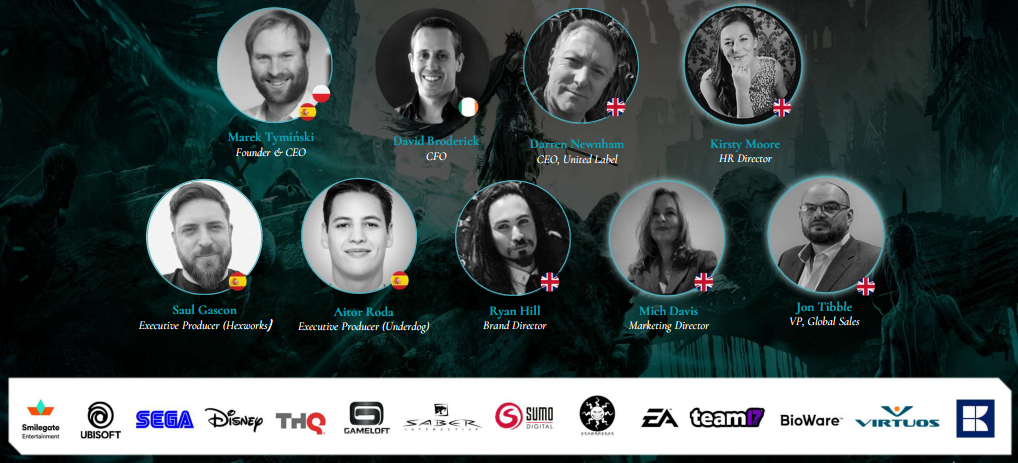
CI Games has a two-board structure. The management team is led by CEO Marek Lech Tymiński, who has extensive experience in the industry, having launched his first enterprise in 1997 and been on the board of several video games companies since. He is supported by CFO David Broderick, who has more than two decades of strategic, technical finance and operational leadership experience, including three years as CFO at Keywords Studios.
The supervisory board includes six members, with key personnel detailed at the end of the report.
|
Exhibit 12: Experienced international management team |
|
|
Source: CI Games |
CI Games has an international development strategy, partnering Polish (Warsaw) with European development expertise (Barcelona and Bucharest), and an international management team (Exhibit 12). This is a continuation of the remote development strategy implemented by necessity during COVID-19 lockdowns, recognising that Polish development capacity remains constrained, leading to high wage inflation. This strategy allows CI Games to attract and retain experienced senior staff and developers, who would otherwise not be prepared to relocate to Poland. As a result, CI Games has built teams in several European countries, notably Spain and Romania (Hexworks), as well as the UK. CI Games also has a US-based distribution business.
Business model
CI Games develops, publishes and distributes video games, both digitally and physically:
■
Development: CI Games has two principal development studios, Underdog in Warsaw (specialising in first-person shooter titles), which has been responsible for the SGW franchise, and Hexworks, launched in 2020. Based out of Barcelona and Bucharest, Hexworks developed the latest version of LotF, and specialises in soulslike fantasy action RPGs.
The company has worked with third-party developers in the past, but we believe future development is likely to be brought inside given management’s emphasis on expanding the scope and quality of its pipeline, as highlighted by the termination of its agreement with Batfields.
■
Publishing: CI Games publishes games based on both its own IP and licences, marketing and distributing titles online as well as through local distributors for physical product. The company publishes games on all key platforms, including the next-generation consoles (PS5 and Xbox Series X/S), as well as PC.
■
Partnerships: physical distribution agreements can drive advanced sales of a game in the short term, expand the geographic reach and lead to margin expansion via the sharing of marketing costs and other cost of goods sold (COGS). In FY23, management signed agreements with previous partners Plaion and U&I Entertainment to support the physical distribution of LotF across Europe and the Americas, respectively.
■
Distribution: CI Games distributes its games (both digitally and physically) directly to retailers. The group’s titles are sold in over 160 countries worldwide, including in the United States, through CI Games USA Inc. CI Games also works with distribution partners (eg Koch Media, part of Embracer Group).
■
Digital versus physical: the group’s strategy favours higher-margin digital sales over physical sales, with digital’s share of FY22 total sales rising 20pp to 89%. Digital sales are higher margin as there is no inventory component or price protection provisions for retailers (see Exhibit 13). However, we expect physical’s share of FY23 sales to increase from FY22 levels following LotF’s launch, before declining faster than digital over time, as is usual for new titles. The planned higher cadence of new releases per the strategic roadmap could result in gross margins below FY22 levels as physical sales increase alongside major releases. However, the overall shift toward digital will persist as a margin driver.
Exhibit 13: Digital sales offer higher margins than physical retail sales
Retail |
Digital |
Comment |
||
RRP |
$59.99 |
$59.99 |
Equivalent sales price |
|
VAT |
20% |
20% |
||
Discount/commission |
25% |
45% |
Scope for higher discounts on digital sales |
|
Gross revenues |
$37.49 |
$27.50 |
||
Price protection |
25% |
0% |
No need to de-risk retailer for digital sales |
|
Net revenues |
$28.12 |
$27.50 |
||
COGS |
$15.00 |
- |
Digital sales have zero COGS |
|
Marketing |
15% |
15% |
Similar levels of marketing |
|
Gross margin |
$8.90 |
$23.37 |
Reduced COGS drives higher margins |
|
Royalties |
5% |
5% |
Royalties relating to UE5 |
|
Net margin |
$8.46 |
$22.20 |
||
Net margin (%) |
23% |
81% |
Digital margins are more attractive than physical |
Source: Edison Investment Research
■
COGS/opex split: CI Games includes certain operating costs like variable marketing and production expenses in its COGS rather than opex. CI Games may also amortise these costs.
Financials
As highlighted in our last note, CI Games’ Q323 results were the last prior to the release of LotF. Performance was driven by boxed pre-sales of LotF invoiced in September, alongside continued strong back catalogue performance, especially SGWC2 (released in 2021) and releases from United Label. Revenue increased 43% y-o-y to PLN59.1m and gross margin contracted 17.7pp to 53.7%, reflecting marketing investment in LotF included in COGS and the longer lifecycle of current releases. Lower revenue, an expanding global employee base and other marketing costs drove an operating loss of PLN1.7m (H122: PLN6.2m profit).
To support expenses, the group drew PLN20m from its credit facility and issued a PLN27.8m convertible bond. Net debt reached PLN62.0m, including leases of PLN2.8m.
We expect sales from LotF to pay down the debt across FY23 and FY24, as highlighted by our updated forecasts below.
Updated forecasts following launch of roadmap
Our forecasts are driven by sales in LotF, accounting for 88% of FY23 revenue and 71% of FY24 revenue. The remaining sales are from CI Games’ back catalogue, namely SGW, as well as from its share in United Label. We note that SGWC2 was a featured title on Steam’s Black Friday sale alongside LotF, providing a boost to back catalogue sales in Q4. In FY24, we expect there may also be a small contribution from a beta version of Survive.
FY23 forecasts still show triple-digit year-on-year growth
We reduce our FY23 revenue forecast to PLN242m following the launch of LotF, primarily driven by the initial negative sentiment relating to performance issues. We believe the quick resolution of these problems as well as robust sales of the higher-priced deluxe and console versions of LotF have largely offset this, with our forecast indicating 328% y-o-y growth. Assuming stable pricing, we believe CI Games delivered broadly half the sales required to reach our updated forecast in LotF’s first eight days post release. However, we expect that remaining sales for FY23 will be driven by higher volumes of discounted units concentrated around major sales events, including Black Friday and Christmas.
Additionally, our FY23 revenue forecast includes some impact from greater provisions for price protection on physical sales set aside for retailers as prices drop to incentivise purchases. At the current spot rate, the 14% depreciation of the US dollar against the zloty since we last updated forecasts has also affected our expectations. It is worth highlighting that we assume games are sold in US dollars, which we then translate into zloty, CI Games’ reporting currency.
Exhibit 14: Updated FY23 forecasts and introduction to FY24 forecasts
PLN000s |
FY23e |
FY24e |
||||
Old |
New |
Change |
y-o-y growth |
New |
y-o-y growth |
|
Revenue |
270,044 |
242,472 |
(10)% |
328% |
140,304 |
(42)% |
Cost of sales |
(94,515) |
(109,112) |
15% |
584% |
(60,331) |
(45)% |
Gross profit |
175,528 |
133,360 |
(24)% |
227% |
79,973 |
(40)% |
Adjusted EBITDA |
206,880 |
104,291 |
(50)% |
549% |
80,105 |
(23)% |
PBT |
131,458 |
46,113 |
(65)% |
305% |
23,327 |
(49)% |
Normalised net income |
105,166 |
36,890 |
(65)% |
305% |
18,662 |
(49)% |
Adjusted EPS diluted (PLN) |
0.57 |
0.20 |
(65)% |
323% |
0.10 |
(49)% |
Revenue growth (%) |
354.0 |
327.7 |
(42.1) |
|||
Gross margin (%) |
65.0 |
55.0 |
57.0 |
|||
Adjusted EBITDA margin (%) |
76.6 |
43.0 |
57.1 |
|||
Normalised operating margin |
47.8 |
20.3 |
17.3 |
|||
Closing net debt/(cash) exc. financial leases |
(84,004) |
23,797 |
N/A |
N/A |
(1,163) |
N/A |
Source: Edison Investment Research
Expanded marketing efforts for LotF post launch and price protection for retailers drives our COGS forecast, lowering our gross margin forecast by 10pp to 55% in FY23. We note most of CI Games’ variable costs relating to units sold are included in COGS. Effective marketing may widen audience reach, attracting new players to try the latest updates, further improving sentiment and generating momentum. Our depreciation and amortisation expectations are driven by the PLN178m production costs for LotF, where we assume that most of these costs will be amortised over three years, consistent with the company’s historical amortisation schedule.
On the balance sheet, we note CI Games recognises revenue from boxed versions of the game when distributed to retailers, receiving a portion of the invoiced cash upfront and the remainder over time dependent on the individual retail partner agreements. Due to timing in 2023, we expect a large increase in debtor days, which should decline in FY24 as the company continues collecting cash from retail partners. This drives our year-end net debt position of PLN23.8m, alongside assumed capitalised development costs of PLN93m for its strategic pipeline based on a Q3 run rate.
Introduction to our FY24 forecasts
Our FY24 revenue forecast of PLN140m is down 42% on our FY23 expectation, given there are no planned releases for the year.
We believe revenue will be primarily generated by LotF, which may continue to see strong sales given its late release timing in the year. As highlighted by our strategic roadmap analysis, management’s focus on producing games to a similar standard as LotF has pushed the full version of Survive and the next iteration of SGW to FY25.
As discussed previously, digital versions of the LotF should increase as a share of total sales over time, underpinning our 2pp increase in gross margin. We forecast opex to remain high given the group’s release pipeline, leading to a 3pp contracting in EBIT margin on lower revenue. Our EBITDA margin forecast indicates a 14.1pp year-on-year expansion to 57.1% because we expect a higher proportion of costs relative to FY24 revenue to be amortised.
We forecast a positive working capital movement as cash is collected from retailers to drive free cash flow of PLN25.9m. This will be key to paying down debt, and management indicated in its Q3 results presentation that it plans to become debt free in FY24. As a result, we expect a swing back to a net cash position of PLN1.2m by year-end.
Employee incentive scheme
At its AGM on 29 June, management proposed an incentive programme for key employees of CI Games, including management, designed to bolster long-term objectives, including the financial success of its strategic pillars. Eligible employees will be awarded warrants at an issue price of PLN3.5 (a 70% premium to the current share price) contingent on certain net profit targets, as illustrated by Exhibit 15.
The implementation of the programme will begin if the company totals net profit of PLN150m across FY23 and FY24. If this target is missed, the threshold becomes PLN250m across FY23 to FY25, which we believe is the more likely scenario using our forecasts. A total of 9m warrants will be issued in either scenario. Employees can then earn an additional 1m warrants for each additional PLN25m of net profit generated, up to a total of 13m warrants, as indicated by Exhibit 15.
Exhibit 15: Breakdown of incentive programme
Net profit (PLNm), FY23–24/FY23–25 |
Number of warrants, that can be allotted |
150/250 |
9,000,000 |
175/275 |
10,000,000 |
200/300 |
11,000,000 |
225/325 |
12,000,000 |
250/350 |
13,000,000 |
Source: CI Games
Valuation
In the short term, maintaining LotF’s momentum into FY24, generating cash and paying down debt are key to the investment case. In the longer term, delivering on the strategic roadmap looks more compelling, enabling smoother revenue generation through more frequent releases and decreasing dependence on its two main franchises. As an early adopter of UE5, the central development platform going forward, CI Games can leverage lessons learned from LotF’s launch to ensure quicker development to the highest industry standard and mitigate potential post-release problems. If management can deliver on its strategic vision, the path is clear for stable year-on-year revenue growth and cash generation to be priced into the stock.
Exhibit 16: Peer table
|
Year end |
Share price |
Market cap |
EV |
Sales |
EBITDA |
EV/sales |
EV/sales |
EV/EBITDA |
EV/EBITDA |
Company |
|
|
|
|
FY1/2e (%) |
FY2e (%) |
FY1e (x) |
FY2e (x) |
FY1e (x) |
FY2e (x) |
CI Games |
Dec-23 |
PLN2.0 |
80 |
90 |
(42.1) |
57.1 |
1.7 |
3.0 |
4.0 |
5.2 |
|
|
|
|
|
|
|
|
|
|
|
CD Projekt SA |
Dec-23 |
PLN111.1 |
2,556 |
2,369 |
(31.9) |
45.8 |
8.9 |
13.1 |
16.9 |
28.5 |
Team17 Group PLC |
Dec-23 |
193.0p |
327 |
273 |
3.3 |
29.5 |
1.6 |
1.6 |
6.9 |
5.3 |
Frontier Developments PLC |
May-24 |
131.4p |
60 |
50 |
(15.7) |
2.1 |
0.4 |
0.5 |
1.7 |
23.6 |
Devolver Digital |
Dec-23 |
19.5p |
100 |
26 |
17.0 |
9.3 |
0.3 |
0.3 |
7.3 |
2.8 |
11 Bit Studios SA |
Dec-23 |
PLN540.0 |
301 |
284 |
378.7 |
74.1 |
17.7 |
3.7 |
151.2 |
5.0 |
Remedy Entertainment Oyj |
Dec-23 |
€25.0 |
337 |
287 |
100.8 |
23.9 |
8.9 |
4.4 |
NM |
18.5 |
Mean |
|
75.4 |
30.8 |
6.3 |
3.9 |
36.8 |
13.9 |
|||
Median |
|
10.1 |
26.7 |
5.2 |
2.6 |
7.3 |
11.9 |
|||
Premium/(discount) to mean |
|
|
|
|
|
|
-74% |
-23% |
-90% |
-66% |
Source: Edison Investment Research, Refinitiv. Note: Prices as at 12 January 2024.
We value CI Games against other mid- to small-sized European games publishers, mainly those focused on AAA game production. On EV/sales, CI trades at 1.7x FY1e and 3.0x FY2e, a 48% average discount to peers. This discount widens to 76% when using EV/EBITDA, where the company trades at just 4.0x and 5.2x in FY1e and FY2e respectively.
We note that the peer multiples have been driven by a few key names, such as the larger CD Projekt, which develops the well-known Witcher and Cyberpunk franchises, and 11 Bit Studios, poised to scale rapidly following the release of highly reviewed titles after a significant hiatus. We believe this highlights the potential for CI to trade at multiples above its current rating if it delivers high-quality titles from its strategic pipeline.
Sensitivities
A summary of the principal risk factors relating to CI Games is set out below.
■
Execution risk: following some delay to its original strategic roadmap, we believe the investment case now requires CI Games’ strategic pillars to be delivered to schedule, to budget and at high quality, while offering attractive unit sales.
■
Portfolio concentration: CI Games holds a relatively narrow portfolio of titles but has a clear strategy to add new titles to broaden the portfolio over the coming years. As the portfolio grows, the group’s exposure to a single title reduces; however, currently any single failure would likely have a material financial impact on the business.
■
Distributed development: having weathered the initial impact of COVID-19 and substantially built its LotF development team during the pandemic, CI Games has developed the systems and processes to effectively manage distributed game development. Management has used the opportunity to continue to offer working from home to attract key international development talent that would not otherwise relocate to Poland and sees this model as a market differentiator. However, remote teams make collaboration harder and inevitably increase development risk.
■
Tax risk: CI Games plans to use Poland’s IP Box tax relief to reduce its effective tax rate to 5% for qualifying development revenue from 2022. In addition, the Polish government’s proposed tax changes for sole traders are likely to raise labour costs in the tight market for Polish games developers. Although CI Games is increasingly building development teams outside Poland, adverse changes to Poland’s tax legislation would likely have a material impact on CI Games’ future financial results.
■
Foreign exchange: with an increasingly European cost base and revenues principally denominated in US dollars, euros and pounds sterling, while results are reported in Polish zloty, CI Games has significant exchange rate exposure. Although the company has currency hedges, it is unlikely to provide a perfect offset.
■
Attraction and retention of key staff: as a people-based business, CI Games is reliant on the quality of staff that it can attract and retain. If key staff were to leave in search of higher wages or new projects, this could influence the quality of games being developed and their market success. As well as continuing its policy of remote working, CI Games has instituted a long-term incentive plan to motivate and retain senior management.
■
Track record: CI Games has learnt from the challenges it faced in 2017 and reconfigured its strategy in order to be able to deliver consistently higher-quality games with internal development teams based outside Poland. Recent launches indicate that management is investing more in quality, with the intention of generating stronger financial returns. This strategy remains at an early stage and there is no assurance of its long-term success.
Exhibit 17: Financial summary
PLN'k |
2019 |
2020 |
2021 |
2022 |
2023e |
2024e |
||
Year end 31 December |
IFRS |
IFRS |
IFRS |
IFRS |
IFRS |
IFRS |
||
INCOME STATEMENT |
||||||||
Revenue |
|
|
47,478 |
46,010 |
105,528 |
56,694 |
242,472 |
140,304 |
COGS |
(29,013) |
(26,683) |
(39,602) |
(15,949) |
(109,112) |
(60,331) |
||
Gross Profit |
18,465 |
19,327 |
65,926 |
40,745 |
133,360 |
79,973 |
||
Adjusted EBITDA |
|
|
20,514 |
27,829 |
62,486 |
16,076 |
104,291 |
80,105 |
Depreciation and amortisation |
|
|
(19,467) |
(19,100) |
(20,179) |
(8,257) |
(55,170) |
(55,763) |
Normalised operating profit |
|
|
1,047 |
8,729 |
42,307 |
7,819 |
49,121 |
24,342 |
Amortisation of acquired intangibles |
0 |
0 |
0 |
0 |
0 |
0 |
||
Exceptionals |
0 |
0 |
(2,040) |
0 |
0 |
0 |
||
Share-based payments |
0 |
0 |
0 |
0 |
0 |
0 |
||
Reported operating profit |
1,047 |
8,729 |
40,267 |
7,819 |
49,121 |
24,342 |
||
Net Interest |
(828) |
(197) |
2,552 |
3,567 |
(3,009) |
(1,015) |
||
Joint ventures & associates (post tax) |
0 |
0 |
0 |
0 |
0 |
0 |
||
Exceptionals |
0 |
0 |
0 |
0 |
0 |
0 |
||
Profit Before Tax (norm) |
|
|
219 |
8,532 |
44,859 |
11,386 |
46,113 |
23,327 |
Profit Before Tax (reported) |
|
|
219 |
8,532 |
42,819 |
11,386 |
46,113 |
23,327 |
Reported tax |
(3,096) |
(1,435) |
(4,476) |
(2,811) |
0 |
(10,055) |
||
Profit After Tax (norm) |
153 |
5,972 |
31,401 |
9,109 |
36,890 |
18,662 |
||
Profit After Tax (reported) |
(2,877) |
7,097 |
38,343 |
8,575 |
46,113 |
13,272 |
||
Minority interests |
0 |
(138) |
(1,535) |
(379) |
0 |
0 |
||
Discontinued operations |
0 |
0 |
0 |
0 |
0 |
0 |
||
Net income (normalised) |
153 |
5,834 |
29,866 |
8,730 |
36,890 |
18,662 |
||
Net income (reported) |
(2,877) |
6,959 |
36,808 |
8,196 |
46,113 |
13,272 |
||
Average number of shares outstanding (m) |
155 |
168 |
183 |
183 |
183 |
183 |
||
EPS - normalised (PLN) |
|
|
0.00 |
0.03 |
0.16 |
0.05 |
0.20 |
0.10 |
EPS - diluted normalised (PLN) |
|
|
0.00 |
0.03 |
0.16 |
0.05 |
0.20 |
0.10 |
EPS - basic reported (PLN) |
|
|
(0.02) |
0.04 |
0.20 |
0.04 |
0.25 |
0.07 |
Dividend (PLN) |
0.00 |
0.00 |
0.00 |
0.00 |
0.00 |
0.00 |
||
Revenue growth (%) |
116.0 |
(3.1) |
129.4 |
(46.3) |
327.7 |
(42.1) |
||
Gross Margin (%) |
38.9 |
42.0 |
62.5 |
71.9 |
55.0 |
57.0 |
||
Adj EBITDA Margin (%) |
43.2 |
60.5 |
59.2 |
28.4 |
43.0 |
57.1 |
||
Normalised Operating Margin (%) |
2.2 |
19.0 |
40.1 |
13.8 |
20.3 |
17.3 |
||
BALANCE SHEET |
||||||||
Fixed Assets |
|
|
62,297 |
69,137 |
90,767 |
158,466 |
199,751 |
241,505 |
Intangible Assets |
54,828 |
58,987 |
80,959 |
152,044 |
194,017 |
235,991 |
||
Tangible Assets |
376 |
437 |
1,774 |
1,528 |
1,319 |
1,100 |
||
Right-of-use assets |
1,133 |
6,484 |
4,391 |
3,397 |
3,397 |
3,397 |
||
Investments & other |
5,960 |
3,229 |
3,643 |
1,497 |
1,017 |
1,017 |
||
Current Assets |
|
|
34,803 |
41,150 |
61,345 |
20,795 |
89,002 |
8,519 |
Stocks |
3,118 |
1,576 |
2,614 |
1,171 |
2,989 |
826 |
||
Debtors |
19,921 |
6,833 |
13,144 |
12,242 |
49,823 |
5,766 |
||
Cash & cash equivalents |
6,659 |
28,207 |
37,843 |
6,618 |
35,426 |
1,163 |
||
Other |
5,105 |
4,534 |
7,744 |
764 |
764 |
764 |
||
Current Liabilities |
|
|
(30,308) |
(5,570) |
(10,164) |
(32,400) |
(95,779) |
(43,779) |
Creditors |
(4,675) |
(4,351) |
(4,972) |
(11,641) |
(34,372) |
(41,595) |
||
Tax and social security |
0 |
0 |
(41) |
(66) |
(66) |
(66) |
||
Short term borrowings |
(24,051) |
(33) |
(13) |
(18,575) |
(59,223) |
0 |
||
Lease liabilities |
(634) |
(324) |
(955) |
(1,219) |
(1,219) |
(1,219) |
||
Other |
(948) |
(862) |
(4,183) |
(899) |
(899) |
(899) |
||
Long Term Liabilities |
|
|
(6,474) |
(8,173) |
(6,839) |
(4,644) |
(4,644) |
(4,644) |
Long term borrowings |
0 |
0 |
0 |
0 |
0 |
0 |
||
Lease liabilities |
(269) |
(5,867) |
(3,925) |
(2,783) |
(2,783) |
(2,783) |
||
Other long-term liabilities |
(6,205) |
(2,306) |
(2,914) |
(1,861) |
(1,861) |
(1,861) |
||
Net Assets |
|
|
60,318 |
96,544 |
135,109 |
142,217 |
188,330 |
201,602 |
Minority interests |
0 |
(169) |
(1,704) |
(1,404) |
(1,404) |
(1,404) |
||
Shareholders’ equity |
|
|
60,318 |
96,375 |
133,405 |
140,813 |
186,926 |
200,198 |
CASH FLOW |
||||||||
Op Cash Flow before WC and tax |
19,686 |
27,632 |
65,038 |
19,643 |
101,283 |
79,090 |
||
Working capital |
(20,665) |
13,991 |
(6,505) |
10,565 |
(16,668) |
53,442 |
||
Exceptionals & other |
(379) |
533 |
350 |
512 |
480 |
0 |
||
Tax |
(136) |
(1,547) |
(4,838) |
1,018 |
0 |
(10,055) |
||
Operating cash flow |
|
|
(1,494) |
40,609 |
54,045 |
31,738 |
85,095 |
122,477 |
Capex |
(2,059) |
(2,597) |
(4,761) |
(4,434) |
(3,090) |
(3,630) |
||
Capitalised development costs |
(18,255) |
(19,864) |
(39,648) |
(75,740) |
(92,973) |
(92,973) |
||
Acquisitions/disposals |
0 |
0 |
0 |
0 |
0 |
0 |
||
Equity financing |
9,279 |
29,124 |
0 |
0 |
0 |
0 |
||
Change in borrowing |
7,703 |
(24,018) |
(20) |
18,562 |
40,648 |
(59,223) |
||
Dividends |
0 |
0 |
0 |
0 |
0 |
0 |
||
Other |
(1,127) |
(1,690) |
33 |
(1,264) |
(872) |
(914) |
||
Net Cash Flow |
(5,953) |
21,564 |
9,649 |
(31,138) |
28,808 |
(34,263) |
||
Opening net debt/(cash) |
|
|
4,127 |
18,295 |
(21,983) |
(32,950) |
15,959 |
27,799 |
FX |
0 |
(16) |
(14) |
(87) |
0 |
0 |
||
Other non-cash movements |
(8,215) |
18,730 |
1,332 |
(17,684) |
(40,648) |
59,223 |
||
Closing net debt/(cash) |
|
|
18,295 |
(21,983) |
(32,950) |
15,959 |
27,799 |
2,839 |
Closing net debt/(cash) ex financial leases |
|
17,392 |
(28,174) |
(37,830) |
11,957 |
23,797 |
(1,163) |
|
Source: Edison Investment Research, company accounts
|
|||||||||||||||||||||||||||||||||||||||||||||
|
|
Research: Consumer
Tertre Rouge Assets (TRA) is a shell company created to purchase physical assets and businesses related to the classic car market. The company is seeking to raise £50m to purchase six rare classic cars for £31.4m and a luxury auto events business for £4.6m. The company has assembled a first-class management team, which it believes provides Tertre with a particular advantage when sourcing car assets at the most attractive price. The classic car market has historically outperformed other traditional and ‘passion’ asset classes such as gold, equities, fine wine and luxury watches, providing greater diversification for investors. Tertre’s proposition enables investors access to an asset class with particularly high barriers to entry and limited liquidity.